Category Archives: 2023 Movies
Aquaman and the Lost Kingdom (2023)
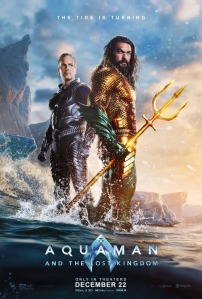 Aquaman and the Lost Kingdom is he last of the Zack Snyder-then-not-Snyder-verse DCU movies, and with that the ten years of mostly middling super hero heroics comes to an end not with a bang but with a whimper. I was a fan of 2018’s original Aquaman thanks to the self-aware craziness and visual decadence from its wily director, James Wan (Malignant). This is still the major appeal of the franchise, a universe that feels pulled from a child’s imagination and recreated in loving splendor on the big screen. The problem with this tone is that it’s a delicate balance between silly fun and silly nonsense. The goofy charm of these movies is still alive and well as they open up an even bigger undersea world of lore (Martin Short as a fish lord!), but this time it feels like a movie that is making it up as it goes, and all that “and this happens next” storytelling begins to feel like a monstrous CGI mess needing to be tamed. This might have something to do with the fact that Wan finished filming the movie over two years ago and it’s endured several re-shoots, including featuring two different Batman actor cameos at different points, to now bring to a close a decade of interconnected movies that are going to be blinked out of larger continuity in 2025 (excluding Margot Robbie’s Harley Quinn, I guess). Lost Kingdom has plenty of enjoyably weird undersea nightmare creatures, a specialty of Wan given his horror roots, but the ultimate villain spends most of his time sitting on a throne in wait and is laughably dismissed so easily in the climax. The whole evil magic trident that corrupts from its evil influence has a very Lord Sauron ring to it. I give the movie points for transforming into a buddy movie between Arthur Curry (Jason Momoa) and his brother Orm (Patrick Wilson) halfway through. The jail break sequence is fun and different, and their bickering dynamic makes for winning comedy. However, the drama feels too overworked, with holdovers from the first film (Black Manta, Amber Heard’s unremarkable love interest) repeating their same beats with robotic dedication. The opening reveal of Arthur being a new dad and it cramping his macho-cool style made he fear we were headed for Shrek 4 territory, where the new dad needs one more adventure to realize the importance of family, etc. Because even when you’re riding a mechanical shark, fighting alongside the crab people, and tunneling through worm prisons, it’s all about recognizing the importance of family, kids (the real undersea treasure after all). I defy anyone not to laugh at the literal concluding speech and its enigmatic “sure, fine, whatever”-energy. As a mere movie, Lost Kingdom is silly escapist entertainment that could enchant a few with lowered expectations, and as the final entry point in a universe of super heroes, it’s a fitting nonsensical end.
Nate’s Grade: C
Share this:

Maestro (2023)
 Watching Bradley Cooper’s years-in-the-making Leonard Bernstein biopic Maestro, I was unfortunately reminded of 2012’s Hitchcock, a would-be glimpse at the fraught drama behind-the-scenes over the making of Psycho but instead was mostly about whether or not Hitchcock’s marriage was going to work out. It was a bizarre creative choice, one where I said that the filmmakers managed to find “the least interesting and essential angle” and squandered the dramatic appeal of its own material. I don’t know what Cooper, who stars as Bernstein but also directs and co-wrote the script, was going for here as the movie does very little to communicate the genius or legacy of this composer. If you knew nothing about Lenny Bernstein, you’d walk away from the two hours of Maestro primarily remembering two things: 1) he was bisexual, and 2) his wife (Carey Mulligan) had a rough time of it. It’s another in the line of curious biopics of queer historical figures that choose to rather emphasize the experiences of the long-suffering-yet-dutiful spouse (The Danish Girl), which is a wealthy dramatic perspective to explore but shouldn’t there be more focus on the queer icons in their own movies? They had a complicated marriage and an arrangement where Lenny could explore his passions in many senses. This tentative understanding definitely leads to tension and blow-out fights in their relationship, but then why doesn’t the movie spend more time reflecting why this is, the strain of Lenny having to repress his sexuality amidst his celebrity? There’s one strong moment of struggle where Lenny has to assure his teenage daughter that, despite the rumors of her summer camp, he is not gay. It’s like watching part of him die in that moment and made me wonder even more why this repressed identity didn’t factor into more of the plot. We have characters falling over one another to congratulate Lenny on his genius and importance but the movie seems to assume you already know enough about this man, weirdly gliding over his life’s accomplishments and their impact. I’m not a fan of biopics that rush through a figure’s accomplishments like an abbreviated Wikipedia article, but at least that maximal approach makes you understand why this person was deserving of their own movie. Maestro strangely strips away the important context of its star, from his works in musical theater to his hand in the resurgence of classical music, to even his own repression of his identity. It makes the movie feel like a series of scenes lacking form, where life can suddenly become a confusing visual fantasy while we’re also jumping through time. Thankfully, the acting is the saving grace of the film. Cooper (A Star is Born) is magnificent and Mulligan (Saltburn) is equally so, and they’re terrific together. The best acted scene for Cooper happens to be his conducting of a musical piece inside a church, and supposedly Cooper spent six years in preparation to authentically conduct this moment. It’s technically impressive but I can’t help but wondering if this obsessive focus was misapplied. Rather than simply relying upon acting out the moment, maybe we could have given more exploration of who these people were rather than learning how better to disguise going through the motions. Maestro is, unfortunately, a miss.
Nate’s Grade: C+
Share this:

Love Again (2023)/ Rye Lane (2023)
 Romantic comedies used to be a powerhouse of Hollywood and now it feels like they’ve all disappeared from your local multiplex. Rom-coms gave us industry stars, careers, and household names, the likes of modern rom-com royalty including Nora Ephron, Cameron Crowe, Nancy Myers, and Richard Curtis, and two of which have screenwriting Oscars. It’s a subgenre that is quite often dismissed, usually by condescending men, let’s be honest, as empty-headed maudlin wish-fulfillment. It’s no coincidence that rom-coms are looked at as more of a female-driven genre aimed at a more female-centric audience, so the contemptuous pile-ons from men can often seem like insights into masculine social allowances for empathy. I’ve long been a fan of romantic comedies, even written a few, because they’re just so damn likable. It’s a foundational principle of the genre, to get you to like the characters, their interactions, their courtships. The movie is romancing its audience at the same time the characters are romancing one another, and who doesn’t like to be swooned? Two 2023 rom-coms, Love Again and Rye Lane, showcase directly how appealing and heartwarming and swoon-worthy that excellent rom-coms can prove, and how middling when its genre is taken for granted.
With Love Again, we follow Mira (Priyanka Chopra Jonas) who is mourning the loss of her deceased boyfriend. She continues to send texts to his old phone number explaining the depth of her grief and confused feelings trying to get her life back on track. It just so happens that her dead boyfriend’s old number has been given to the work phone for Rob (Sam Heughan), a journalist who is getting over his own recent heartbreak. He takes a curiosity to this stranger sending him such heartfelt texts, and after meeting her from afar, decides to try to get to know her better, resulting in the two of them romancing but with the Big Awful Dreadful Secret always waiting to be discovered for the unfortunate Act Two break.
 I don’t understand Love Again, like at all. I understand what happened on screen in a literal sense but the reasoning behind it, the storytelling choices, are so bizarre and foreign to me that it feels like a group of aliens who only learned human behavior through the worst direct-to-streaming rom-coms tried their hand at recreating human interactions and falling in love. The very premise seems almost like an afterthought, so why even go through the trouble of this labored conceit? The fact that Rob has been receiving this sad woman’s grief texts could present a real ethical conundrum, beyond the fact that he knows her private thoughts and feelings and he doesn’t even know who she is. The natural angle would be for him to take it upon herself to do small things to make her feel better, maybe from the outside perspective of a secret admirer, a position he never intends to go beyond. The issue becomes when he starts to transition to romance, because now he has a head start that she didn’t even realize was happening. Also, he could make use of the information that she’s been unknowingly feeding him, about favorite foods or interests, to better sweep her off her feet, but that also places us in an ethically dubious scenario of emotional manipulation, akin to what Bill Murray tries to get away with the loops of Groundhog Day. It’s a borderline stalker situation that can easily go too far. The fact that Love Again doesn’t even cover these most obvious plot scenarios makes the entire premise feel perfunctory; it could have been anything that accidentally drew Rob to Mira because it’s so unimaginative and, simply, bad at its own inept storytelling. It’s so baffling and feels like it was made with contempt for its audience, believing that they would accept anything as long as the genre parts were covered, so Love Again’s story is the barest of pained efforts.
Love Again is bad in ways that are despairing while also being mind-numbing. You get a sense early on how little feel for the material the filmmakers have, at how poorly the scenes are at disguising their creaky plot mechanics from the viewer. It’s the kind of movie where a kindly bartender introduces himself and seconds later is all, “I sure feel bad about your dead boyfriend.” It’s that kind of movie, the kind with supportive friends and work colleagues who are only there to provide words of encouragement or set the scene in the most transparent and lazy way, “You know you haven’t been the same since…” to better tee up the audience as far as what is important. All movies do this but the exposition needs to be masked with character details or comedic exploits, and the better to visualize a person’s life.
 This is also the kind of comedy where the jokes amount to the first idea of every scene, where there is never a subversion or even an escalation or a comedic situation. In this world, Nick Jonas makes a cameo as a bad date who is vainly obsessed with bodybuilding and that is the only joke you’ll get with that appearance to the end. It’s the kind of movie where Mira’s “quirk” is asking dates would you rather scenarios that aren’t even raunchy or extreme or even that telling of her own personality. Her other personality trait is that she likes, get this, putting her French fries on her cheeseburger (what a crazy bohemian!). It’s the kind of movie that has Mira as a children’s book author and doesn’t even bother to provide a scene of her demonstrating her storytelling prowess and insight for creating metaphorical-heavy stories to impart important lessons for children. This technique could have been a greater insight into her emotional state without having to rely upon the character just spouting out her feelings. Even worse, the movie doesn’t use her texts to her beloved as a means of getting to know her better. It’s the very premise of this movie, supposedly. These details meant to give the movie its definition, what separates it from the rom-com pack, but what it produces feels so insufficient and haphazard that you wonder if this was a failed genre MadLibs.
It’s also bad that Chopra Jonas (The Citadel) and Heughan (Outlander) have a remarkable lack of chemistry. They’re both good-looking human beings who have previously shown to be quite capable and appealing actors. I do not blame them for the lack of feeling in this movie. They could only do so much with the poorly written characters and the clunky dialogue. Watching them attempt to flirt with this material is like watching two cats try and recreate the H.M.S. Titanic. It’s just not going to work well.
 Here’s another example of how poor the filmmakers have developed the elements of their tale. Rob is still mending his broken heart from a fiance that left him a week before their wedding. He is a cynic, although like everything else in this movie, if you push too hard it’s only there as a shallow fixture for story. But if you’re going to make him the cynic, make him believe that love is impossible, it’s a chemical condition of the brain, some delusion, and that this drives his contempt for having to interview Celine Dion, a pop star best known for her soaring ballads about love and sunken ships and hearts going on. He thinks her songs are cheesy and silly, and over the course of the movie, of course he becomes a believer (at least this the movie understands the arc to follow). Again, the most obvious route would be to make him a music critic, someone who decries silly love songs and thinks of them as a destructive drug for the masses. This would make more sense why he’s so irritated at having to cover Dion, and why he would be covering Dion, and it would also make more sense then for his reconsideration. The movie, instead, makes Rob a big fan of… basketball. He loves to watch basketball. Why is this man covering Celine Dion then? If he was going to cover basketball, why not bring his passion for it more into focus, at least as something he can learn from and share with Mira? They share a quick game where she basically says, “I like this game too,” and that’s the rest of this completely underdeveloped characteristic that doesn’t tie back in thematically at all. Again, if you’re going to make this much of Dion’s multiple appearances, including devoting your end credits to having your cast and crew enthusiastically lip sync to her songs, then at least tie her better to your plot.
Ms. Dion doesn’t need me to defend her. She’s a grown woman and can make her own decisions, and I’m sure she was handsomely paid for her contributions in Love Again whose soundtrack features five new songs and six of her past tunes (why not go the jukebox musical route at that volume?), but I need to further explain the awfulness of Love Again’s choices. Late into the movie, Dion discusses her own personal loss, mourning her husband of twenty-plus years who died in 2016. The fact that this real woman is mining her own real tragedy to provide the emotional boost to our bad protagonist in a bad rom-com just feels morally queasy to me. It just feels wrong, especially in the name of such an undeserving character in an undeserving movie for her to have to rehash her own personal grief.
 On the other end of the quality spectrum is Rye Lane, a smaller British indie that follows Dom (David Johnsson) and Yas (Vivian Oparah) through a crazy day and night together across the bounds of South London. She discovers him crying in a toilet stall, a meet-cute so intentionally un-cute. They’re both nursing mixed feelings and unchecked anger over being dumped by their respective exes. Dom discovered his girlfriend cheating on him with his best mate and now he’s scheduled to meet with them both to better clear the air. Yas finally stood up to her neglectful and self-centered sculptor boyfriend but she wants to recollect her favorite record in his flat before she can bid goodbye to him forever. Together, they will help each other through their respective relationship detritus and plot their next steps forward.
What an immensely charming movie Rye Lane is and it’s one that reminds you about the innate pleasure of the rom-com genre when paired with characters we want to get to know better. Thank goodness the screenwriters keenly understand how to develop our protagonists but also make them imminently winning. By establishing both Dom and Yas as reeling from recent breakups, and from such awful people, it makes us want to root for them to regain their sense of composure, dignity, and personal joy. We want them to show up these people who have made them feel so low, and it just so happens that one another will serve as the ultimate and unexpected wingman. I loved it when Yas buddied up next to Dom and pretended to be his very doting and very sexual new paramour as well as press Dom’s former flame on her own cheating ways, shifting the power dynamic. It supercharges the growing friendship between the two of them as well as reconfirm their need to find a partner who can and will go out of their way for them. Watching each of them encourage and aid the other during a time of need and insecurity serves as a reliable provider of satisfaction and a clear path for us to also fall in love with these unique people.
 The writing is so quick-witted and charming that simply listening to these revealing and often hilarious conversations is a pleasure. I’m reminded of Richard Linklater’s famously talkative Before trilogy, another all-in-one-day whirlwind romance of two characters exploring a locale while also exploring one another under a limited period of time. It’s a natural structure because it provides a looming urgency but the drama also unfolds more or less in real time with the characters learning about one another at the same pace that the viewer is, and so our emotions feel better attuned as the characters change their perceptions of one another. This is the joy of rom-coms, finding characters you simply want to spend time with because they’re so charming, interesting, and deserving of finding happiness of their own making. Dom and Yas are wonderful characters separately but the right combination together. He’s more nerdy and awkward and she pushes him to be more assertive and confident. She’s less sure of her worth and sets herself up for sabotage in landing a job she might love, and he refuses to let her let herself down. It’s genuinely amusing and heartwarming to watch these two help one another in their time of need.
Rye Lane is also peppered with playful and, at times, chaotic visuals to goose up the talky proceedings. Debut director Raine Allen-Miller will often use quick inserts and playful visual framing to add more pizazz to the presentation, like when Yas and Dom present their recollection of events like narrators to a stage play of their own lives. It’s lively and fun but occasionally the visual inserts and sound design, or perhaps the score itself, felt like added distractions to the appealing core elements of the movie. It was the only annoyance I felt in such an otherwise funny and charming movie boasting such winning performances. It felt a little unnecessary at times and seemed like the filmmakers had doubts that the material and the performances themselves were enough to sell the entertainment of the movie.
 Romantic comedies remind me of the old saying, “it’s not the singer, it’s the song.” They’re like many other sub-genres of movies and storytelling itself, complete with expectations and formulas and rules and recognizable parts and pieces that add up to, hopefully, entertainment. In this regard, movies are like a meal, and two people can follow the same recipe with the same ingredients and concoct two totally different final creations. Fans of rom-coms are like fans of any other genre, looking for good storytellers to value their time and give them an escape. It’s not just that the familiar elements are included, it’s what is done with them, the care and affection from the storytellers, chiefly creating characters that you can fall in love with and root for their own happiness and fortuitous fortunes.
Love Again is based on the 2016 German film Text For You, itself based on a 2009 German novel (I watched the trailer on YouTube, and it’s weird having actors refer to text messages as “SMS-es”). It’s a reminder of how soulless the worst of these lazy rom-coms can feel when producers look to check boxes to fulfill some list of genre requirements that they think will satisfy the lowest expectations of a gullible fan base they can exploit. Rye Lane is the latest example of the real pleasures of a finely developed rom-com that understands the essential appeal of what makes these movies more than “chick flicks.” Skip Love Again and its ilk and instead feel the pitter-patter of your heart renewed with Rye Lane.
Nate’s Grades:
Love Again: D+
Rye Lane: A-
Share this:

Rebel Moon – Part One: A Child of Fire (2023)
 Creating an original sci-fi/fantasy universe is hard work. It involves bringing to life an entire new universe of characters, worlds, back-stories, rules, conflicts, cultures, and classes. There’s a reason major studios look to scoop already established creative universes rather than build their own from scratch. This is what director Zack Snyder had in mind when he pitched a darker, grittier, more mature Star Wars to Disney, who passed. Over the ensuing decade, Snyder and his collaborators, Shay Hatten and Kurt Johnstad, continued working on their concept, transforming it into an original movie series, resulting in Netflix’s big-budget holiday release, Rebel Moon – Part One: A Child of Fire, a clunky title I will not be retyping in full again. Snyder’s original results of the “darker, grittier Star Wars” are rather underwhelming and don’t make me excited for the concluding second movie being released in April. Why go to the trouble of building your own universe if you don’t want to fill in the details about what makes it important or at least even unique? I can see why Snyder would have preferred Rebel Moon as a Star Wars pitch, because they could attach all the established world-building from George Lucas and his creative collaborators as a quick cheat code.
In another galaxy, the imperial Motherworld is the power in the universe. The king and his family have been assassinated, and in the power struggle that follows, several planets have taken up arms to fight for independence. On a distant moon, Kora (Sofia Boutella) is doing her best to live a nondescript life as a farmer, helping to provide for her community and stay out of trouble. Well trouble comes knockin’ anyway with Admiral Atticus Noble (Ed Skrein) and his fleet looking for resources and powerless villagers to abuse. Kora’s history of violence comes back to her as she fights back against the Motherworld soldiers with cool precision. Her only hope is to gather a team of the most formidable warriors to protect her village from reprisals. Kora and company band together while her mysterious past will come back to haunt her reluctant return to prominence.
 For the first thirty to forty minutes of Rebel Moon, I was nodding along and enjoying it well enough, at least enough to start to wonder if the tsunami of negative reviews had been unfairly harsh, and then the rest of the movie went downhill. One of the major problems of this Part One of a story is that it feels like a movie entirely made up of Act Two plotting. Once our hero sets off on her mission, the movie becomes a broken carousel of meeting the next member of the team, seeing them do something impressive as a fighter, getting some info dump about their mediocre tragic backstory, and then we’re off to the next planet to repeat the process. After the fifth time, when a character says, “Anyone else you know?” I thought that the rest of the movie, and the ensuring Part Two, would be nothing but recruiting members until every character in the galaxy had joined these ragtag revolutionaries, like it was all one elaborate practical joke by Snyder. Some part of me may still be watching Rebel Moon, my eyes glazing over while we add the eight hundred and sixty-sixth person who is strong but also shoots guns real good. Then the movie manufactures an ending that isn’t really an ending, merely a pause point, but without any larger revelations or escalations to further our anticipation for Part Two in four months’ time. What good are these handful of warriors going to be defending a village in a sci-fi universe where the bad guys could just nuke the planet from orbit? Find out in April 2024, folks!
The entire 124-minute enterprise feels not just like an incomplete movie but an incomplete idea. This is because the influences are obvious and copious for Snyder. Rebel Moon starts feeling entirely like Star Wars, but then it very much becomes a space opera version of The Magnificent Seven, itself a remake of Akira Kurosawa’s Seven Samurai. With our humble farmer, our high plains drifter trying to turn their back on an old life of violence, and the recruitment of our noble fighters to ward off the evil bandits coming to harass this small outpost, it’s clearly The Magnificent Seven, except Snyder doesn’t provide us the necessary material to invest in this scrappy team. The characters are all different variations of the same stoic badass archetype, like you took one character mold and simply sliced it into ten little shear pieces. The characters don’t even have the most basic difference you could offer in an action movie, variation in skill and weapons. One lady has laser swords (a.k.a. lens flair makers) but pretty much everyone else is just the same heavy gun fighter. One guy doesn’t even bother to put on a shirt. Some of them are slightly bigger or more slender than others but the whole get-the-gang-together plot only really works if we have interesting characters. If we don’t like the prospective team members, it’s like we’re stuck in an endless job interview with only lousy candidates.
 The fact that Rebel Moon is derivative is not in itself damaging. Science fiction is often the sum of its many earlier influences, including Star Wars. Rebel Moon cannot transcend its many film influences because it fails to reform them into something coherent of its own. There is no internal logic or connection within this new universe. The original world building amounts to a slain royal family, an evil fascist regime, and maybe a magic princess connected to a prophecy of balance, and that’s it. All the flashbacks and expository data dumps fail to create a clearer, larger picture of how this sci-fi universe operates. The inner workings are kept so broad and abstract. We have an imperial evil and assorted good-hearted little guys. The movie begins by introducing a robot clan of knights that are dying out, and even a young Motherworld soldier who seems likely to defect, both opportunities to go into greater character detail and open up this world and its complications. So what does Snyder do? He leaves both behind shortly. Even though we visit a half dozen planets, these alien worlds don’t feel connected, as if Snyder just told concept artists to follow whatever whim they had. They don’t even feel that interesting as places. One of them is desert. One of them has a saloon. One of them is a mining planet. It’s like the worlds have been procedurally generated from a computer for all we learn about them. They’re just glorified painted backdrops that don’t compliment the already shaky world building. They’re too interchangeable for all the impact on the plot and characters and any declining sense of wonder.
Given the open parameters of imagination with inventing your own sci-fi/fantasy universe, I am deeply confused by some of the choices that Snyder makes that visually weigh down this movie in anachronistic acts of self-sabotage. Firstly, the villains are clearly meant to be a one-to-one obvious analog for the Empire in Star Wars, itself an analog for the fascists of World War II, but Lucas decided having them as stand-ins was good enough without literally having them dress in the same style of uniforms as the literal fascists from World War II. You have an interconnected galaxy of future alien cultures and the bad guys dress like they stepped out of The Man in the High Castle. It’s too familiar while being too specific, and the fact that it’s also completely transparent with its iconic source references is yet another failure of imagination and subtext. I just accepted that the Space Nazis were going to look like literal Nazis, but what broke my brain was the costuming of Skrein’s big baddie in the second half of the movie. At some point he changes into a white dress shirt with a long thin black tie and all I could think about was that our space opera villain looks like one of those door-to-door Mormon missionaries (“Hello, have you heard the Good Word of [whatever Snyder is calling The Force in this universe]?”). Every scene with this outfit ripped me out of the movie; it was like someone had photo-shopped a character from a different movie. It certainly didn’t make the devious character of Atticus Noble more threatening or even interesting. I view this entire creative decision as a microcosm for Rebel Moon: a confused fusion of the literal, the derivative, and the dissonant.
 Snyder is still a premiere visual stylist so even at its worst Rebel Moon can still be an arresting watch. He’s one of the best at realizing the awe of selecting the right combination of images, a man who creates living comic book splash pages. I realized midway through Rebel Moon why the action just wasn’t as exciting for me. There’s a decided lack of weight. It’s not just that scenes don’t feel well choreographed or developed to make use of geography, mini-goals, and organic complications, the hallmarks of great action, it’s that too little feels concrete. It feels too phony. I’m not condemning the special effects, which are mostly fine. The action amounts to Character A shoots at Bad Guy and Character B shoots at Other Bad Guy, maybe behind some cover. There’s only one sequence that brings in specifics to its action, with the challenge of defeating a rotating turret gun pinning the team down from escape. That sequence established a specific obstacle and stakes. It worked, and it presented one of the only challenges that wasn’t immediately overcome by our heroes.
The Snyder action signature of slow-mo ramps has long ago entered into self-parody territory (I’m convinced a full hour of his four-hour Justice League cut was slow motion), so its use has to be even more self-aware here, especially in quizzical contexts. There are moments where it accentuates the visceral appeal of the vivid imagery, like a man leaping atop the back of a flying griffin, akin to an 80s metal album cover come to life. Then there are other times that just leave you questioning why Snyder decided to slow things down… for this? One such example is where a spaceship enters the atmosphere in the first twenty minutes, and a character drops their seeds in alarm, and those seeds falling are detailed in loving slow motion. Why show a character’s face to impart an emotion when you can instead see things falling onto the ground so dramatically?
 The actors are given little to do other than strike poses and attitudes, and for that they all do a fine job of making themselves available for stills and posters and trailers. Boutella (The Mummy) is good at being a stoic badass. I just wish there was something memorable for her to do or make use of her athleticism. The best actor in the movie is Skrein (Deadpool) who really relishes being a smarmy villain. He’s not an interesting bad guy but Skrein at least makes him worth watching even when he’s in the most ridiculous outfit and awful Hitler youth haircut. There’s also Jena Malone (Sucker Punch) as a widowed spider-woman creature. So there’s that. Cleopatra Coleman (Dopesick), who plays one half of a revolutionary set of siblings along with Ray Fisher, sounds remarkably like Jennifer Garner. Close your eyes when she’s speaking, dear reader, and test for yourself. I was most interested in Anthony Hopkins as the voice of our malfunctioning android (literally named “Jimmy the Robot”) operating on mysterious programming that hints at something larger in place relating to perhaps the princess being alive. Fun fact: Rebel Moon features both actors who played the role of Daario on Game of Thrones (Skrien and Michiel Husiman).
Even with all the money at Netflix’s mighty disposal, Rebel Moon can’t make up for its paltry imagination and thus feels like an empty enterprise. I’m reminded of 2011’s Sucker Punch, the last time Snyder was left completely to his own devices. I wrote back then, “Expect nothing more than top-of-the-line eye candy. Expect nothing to make sense. Expect nothing to really matter. In fact, go in expecting nothing but a two-hour ogling session, because that’s the aim of the film. Look at all those shiny things and pretty ladies, gentlemen.” That assessment seems fitting for Rebel Moon as well, a movie that can’t be bothered to provide compelling characters, drama, or world-building to invest in over two to four hours, once you consider the approaching Part Two. I wish this movie had a more distinct vision and sense of humor, something akin to Luc Besson’s lively Fifth Element, but fun is not allowed in the Zack Snyder universe, so everything must be grim, because grim means mature, and mature means automatically better, right? Rebel Moon is a space opera where you’ll prefer the void.
Nate’s Grade: C-
Share this:

Godzilla Minus One (2023)
 In his seventy years, Godzilla has been many things, a force representing mankind’s hubris, a protector of the Earth, a father, a weird chicken-like creature that Godzilla 1998 director Roland Emmerich asked his concept artists to make “sexy,” but rarely has the famous giant lizard been genuinely scary, and even rarer still has any of the thirty movies been genuinely serious. The surprisingly affecting Godzilla Minus One achieves both with impressive execution. Set shortly after the end of World War II, the far majority of this monster movie is given to somber human drama, with our protagonist a kamikaze pilot too afraid to give his life senselessly for the cause. Once he returns home, he is treated like a pariah, shamed by his neighbors attempting to literally put the pieces of their lives back together amidst the rubble. He’s riddled with post-traumatic stress and two counts of survivor’s guilt eating away at him. For this man, his war is not over. To make matters even worse, there’s a gigantic lizard terrorizing the seas and heading straight for Tokyo. The second half of the movie follows a very satisfying formula taken from Jaws, with a group of men getting on a boat, working together, and trying to catch their big prize. The ingenuity of their plans makes use of the meager means at their civilian disposal, as the military cannot get involved out of fear of stoking U.S.-Russia aggression in the dawn of the Cold War. The way this character’s arc comes together, at a great moment of heroism that also ties in his relationship with other supporting characters you’ve come to enjoy, is great storytelling. Usually in monster movies the human drama is filler and you can’t wait for those pesky people to get squished to make way for the waves of destructive fun. Not so here, as every scene the characters are in peril has you clenching your fists in fear that Godzilla could triumph. This Godzilla is terrifying and I really enjoyed the sense of scale the filmmakers exhibited, making sure we saw him from a human-sized perspective, and the special effects, while not outstanding, are quite remarkable for its small-scale budget. For Godzilla fans, there might not be enough of the Big Guy for them. I was taken with the emotional journey of these hardscrabble characters fighting for dignity and redemption and to protect their found families, and that was never something I thought would be the major selling point of a Godzilla movie — human emotion. Fear not, the 2024 American release looks to bring back the cheesy nonsense.
Nate’s Grade: B+
Share this:

Wonka (2023)
 Was there anyone out there wondering how a young Willy Wonka could have gotten his start as a cutting-edge candy maven? It’s an unnecessary back-story for a kooky character that most will just accept as is. The invented story of Wonka is one of an upstart entrepreneur (Timothee Chalamet) proving a danger to the established corporate oligarchy’s vice-grip on the local confectionery industry. They use the levels of corrupt power to scheme and block Wonka from getting started, but his charms and optimism are just too much, and he wins over the town with his candied delights that provide revelry to the people’s humdrum lives. As a candy-colored musical following an underdog triumphing from the power of friendship and integrity and imagination and good will, it mostly works on a fizzy cloud of its own manufactured whimsy. It’s all highly silly stuff and working very hard to be light-footed and whimsical. There are moments that made me smile and tohers that made me chuckle, like one rich man who gags whenever somebody ever says the word “poor.” The new songs are fairly forgettable except when they’re making you remember the dreamy 1971 numbers. I also think Chalamet (Bones and All) is painfully miscast as our young Wonka. I don’t think his broody-moody acting style works shifting over to manufactured quirk. His performance is just so off from the beginning. Wonka would have been exceedingly better as an original musical without trying to retrofit into the world of Willy Wonka, although that would mean losing Hugh Grant as our first specimen of Oompa Loompa, and he is a droll delight. It’s just weird for a movie to work this hard to tell us how Wonka got his start and to end on uplift when we know in the future he grows up to be a sad middle-aged loner who has to resort to a scam to find a successor, as well as the town becoming an impoverished slum to Wonka’s oppressive factory. My pal Ben Bailey reasoned it would be like a prequel to Death of a Salesman where a younger Willy Loman starts his career as a door-to-door salesman, so chipper and eager to make a name for himself. Wonka is a sugar rush designed as an origin story.
Nate’s Grade: B-
Share this:

The Boy and the Heron (2023)
 It’s been over ten years since renowned animation legend Hiyao Miyazaki graced the silver screen with what was believed to be his last film yet the retirement didn’t kick, for the benefit of all of us. I’ve resisted watching 2013’s The Wind Rises simply because of the melancholy of it supposedly being his final film. The man is in his 80s and still hand draws much of his storyboards, so if indeed this is the last Miyazaki movie we ever get, it ties thematically with many of the concepts and interests of this man’s storied career that it feels like a fitting capper. It’s his most autobiographical, following 12-year-old Mahito as he relocates to the country after surviving the firebombing of Tokyo during World War II. Unfortunately, he lost his mother in the bombing, and now his father is remarrying his mother’s younger sister, who looks near identical to Mahito’s mother. On the grounds of his new home, the boy discovers a strange overgrown tower with a door that leads to another world, and it’s within this world that a creepy scary bird promises Mohito can find his mother again. The Boy and the Heron is an imaginative and transporting fantasy with some major themes around the edges about grief and acceptance and environmental disaster, but it’s the haphazard structure and poor pacing that hold it back for me. Simply, it’s too long to get going and then too short to conclude. We don’t exit to the hidden fantasy world until almost halfway through, and the time in the regular world is stretched out, especially without going into further detail about our protagonist, who is kept very opaque. The discovery of the new world and learning its strange mostly bird creatures and rules and conflicts is where the movie really gets interesting, especially once the menacing heron becomes a squat man serving as our reluctant guide. It feels like there’s going to be some heavy revelations forthcoming, especially with the supposed duplicate nature of Mohito’s mothers, but it all comes down to an aged Man Behind the Curtain with a reveal straight out of Willy Wonka and the Chocolate Factory. We take too long to get to that intriguing fantasy world, and then once we’re there it feels a little too surface-level in design for a world on the cusp of dying. Then it’s a mad scramble to leave, and while the culminating decision feels earned in its wisdom, it also feels like the movie has simply run out of ideas. The Boy and the Heron is beautifully animated; the world feels like it’s undulating before your eyes, and there are numerous moments that allow it to breathe. However, it feels like maybe we could have gotten started sooner and finished a little later. Even mid-level Miyazaki is better than most, so The Boy and the Heron is still a worthwhile animated fantasy even if it doesn’t reach masterpiece status from a master storyteller. At least now I can finally watch The Wind Rises, so there’s that too.
Nate’s Grade: B
Share this:

Joy Ride (2023)
 The “girls can do it too” spirit pervades the raunchy comedy Joy Ride, which follows four twenty-something women of various Chinese-American heritage as they road trip through China to discover one woman’s birth mother. It’s a comedy about smashing representation barriers, giving voice to a specific identity crisis while also promoting sex positive shenanigans. I enjoyed the details of the cultural perspective of being young and Asian, but I felt the characters were too thinly drawn, settling into archetypes without fully embracing their comic differences. I liked each character from the actors and their performances primarily. There is one really ribald comic set piece where the ladies, collectively, hobble a basketball team from their individual sexual appetites, and I heartily laughed at the mounting catastrophes, but the other crass humor feels a bit too listless and surprisingly forced. An impromptu K-Pop performance of “WAP” should have been a lot funnier. Still, Joy Ride, while being less than euphoric, is a mostly fun movie that coasts thanks to the easy camaraderie of our four funny leads and some well-articulated perspectives getting their chance at the ole’ sex comedy formula.
Nate’s Grade: B-
Share this:

May December (2023)
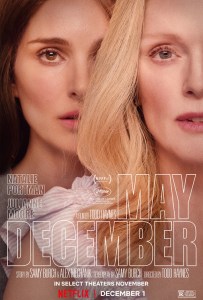
The critical darling May December reminded me of another 2023 Netflix prestige awards contender, David Fincher’s The Killer. That genre movie was about trying to tell a realistic version of the cool super spy assassin and I found that enterprise to be fitfully interesting but mostly dull and unfulfilled. This movie seems to be going for a similar artistic approach under director Todd Haynes (Carol, Far From Heaven), tackling a sensationalized ripped-from-the-tabloids tale of perversity but telling a more realistic version, which also leaves the movie fitfully interesting but mostly dull and unfulfilled. May December is a frustrating viewing experience because you easily recognize so much good, so many exciting or intriguing elements, but I came away wishing I had seen a different combination and execution.
Elizabeth (Natalie Portman) is a famous actress with an exciting new movie role. She’s going to play Gracie (Julianne Moore), a woman who gained national scandal for her sexual relationship with a then-13-year-old Joe. The two of them have been together for several decades and have several children and now are inviting Elizabeth into their home to better understand her character. Each person is on their guard. Elizabeth wants to keep prying to uncover emotional truths that she can gobble up to improve her future performance and career. Gracie is wary of making sure the version of her story that she wants for public media consumption is what Elizabeth receives. And Joe (Charles Melton), now in his mid-thirties and looking more like an older brother than father to his graduating children, is reflecting about the history of his relationship and who was culpable.

There’s so much here in the premise of an actress studying her subject and wreaking domestic havoc in her attempt to discover secret truths that would rather stay hidden. May December uses this premise as an investigative device, allowing the inquisitive actress to serve as the role of the audience, trying to form a cohesive vision of events from each new interview. It allows the first half of the movie to feel like a true-crime mystery, uncovering the different sides of a sordid story and the lasting consequences and legacy for so many. There’s a very lurid Single White Female approach you could go, where the avatar of the person starts to replace the real person, where Elizabeth crosses all sorts of lines and even thinks about crossing some of the same lines that Gracie had; what better way to get in the mind of a predator, right? I was waiting for this interloper to destabilize this carefully put-together illusion of a “normal family,” but by the end you feel like little has been learned and most everything reverts to its prior stasis. I suppose that’s, again, the more realistic version of this kind of story, that even when confronted with uncomfortable revelations most people will fall back on what they know. May December’s underwhelming conclusion is that, by the end, maybe people are actually who we think they are.
Haynes’ cinematic specialty is exploring the artificiality of movies, from having multiple actors portray Bob Dylan in 2007’s I’m Not There, to destabilizing the nostalgia of the 1950s Douglas Sirk-styled romantic drama with 2002’s Far From Heaven. He’s also inherently drawn to stories of emotional and sexual repression. This movie is all about performance as identity; it’s about an actress trying to refine her tools, but it’s also about a middle-aged woman who has adopted performance as her defense system (this also might explain why Gracie’s lisp seems to come and go). Some part of her has to know that she crossed some very serious lines, no matter how many times she explains away their relationship as merely “unconventional.” Even though they’ve kept this union for 25 or so years, it still began when Joe was 13 years old and she was an adult. There are very intriguing dimensions to this dramatic dynamic, with the excuse of a Hollywood version of their “love story” to motivate each participant to reflect with renewed perspective. The problem is that Gracie has worn her mask for so long that I doubt there is another version of her any longer (“I am naive. In a way, it’s a gift”). As a means of survival, she projects herself as a well-intentioned victim of scrutiny rather than as a child predator who has manipulated her husband into codependency for decades. This means that, frustratingly, there isn’t much there to glean once the facts of the case have been collected, which makes watching a bad TV actress try and better emulate a bad person incapable of introspection seem like an empty exercise in artistic masturbation, and maybe that’s the point?

The conversation around May December being some kind of “camp comedy” (it was recently nominated for Best Comedy/Musical by the Golden Globes) has left me genuinely stupefied. I think the term “camp” is used a little too loosely, as some seem to conflate any heightened emotion as equivalent to camp. May December is really more an example of melodrama. It’s near impossible to retell the Mary Kay Letourneau story without the use of melodrama, so its inclusion doesn’t merely qualify the movie as camp. But at the same time Haynes is making deliberate use of certain elements that make the movie even more jarring, like the oppressive and operatic musical stings that hearken to earlier 1950s melodramas. These musical intrusions are so broadly portentous that it’s practically like Haynes is elbowing you and saying, “Eh, eh?” I suppose you can laugh at how arch and over-the-top the musical stings are, but is this a comedic intention? Are we supposed to laugh at how out of place this musical arrangement is in modern filmmaking, or is Haynes trying to draw allusions to old Hollywood melodramas and make a case for this being similar? Whatever the case may be, I guess one could laugh at the stilted performances but then I think that’s approaching the movie from an ironic distance that makes it harder to emotionally engage, which seems like the whole point of the exercise, to go deeper than lazy tabloid summation.
The performances from the female leads circling and studying one another are rather heavy on mannered affectations and arch irony, but it’s Melton (TV’s Riverdale) who emerges as the soul of the movie. He’s so easy going and dutiful, quick to defend his wife and assure everyone that even at 13 years old he knew what he was doing and consented to their affair. Of course this is nonsense, and the real draw of the movie is watching this family man begin to crack, and when he does it’s like every repressed emotion comes spilling out. It makes you wish that he had been the main character of the story and Elizabeth more the supporting character trailing after.

Allow me a tangent, dear reader, because I’m reminded of the 2023 re-release of 1979’s notorious Caligula where a producer tried to re-edit the famously trashy movie, hewing closer to author Gore Vidal’s original screenplay and less the explicit excess of producer and Penthouse publisher Bob Guccione’s editorial influence. It seems like so much effort to reclaim one of cinema’s most over-the-top movies, but can you really make a classy version of a movie about the cruel Roman emperor that has a wall of spinning blades as an execution device and copious floating brothels? The movie is forever known for its trashy and outrageous elements because it is emulating an outrageous tyrant of history given to hedonistic and lascivious excess. Nobody wants the “classy” version of this sensational story because that’s the tamped-down and boring version of this story (granted, there are plenty of prurient Guccione additions that we could also do without). Taking sensational melodrama and trying to subvert the sensationalism under the guise of genre deconstruction can work; however, the key is that the “classy” approach has to be a more compelling alternative to the soapier, melodramatic version. I think I would have enjoyed the more sundry and soapy version of May December because with this version I felt too removed, and the movie itself felt too removed and uninterested in so many of its more potent elements for the sake of drifting ambiguity. It’s a drama that seems to stew in downy contemplation but without enough compelling examination to make the effort fulfilling. I kept waiting for the movie to open up, and then the movie just ran out of time. It’s got some admirable goals, and a strong performance from Melton that makes your heart ache, but May December would have been better served either being far more trashy or far more serious rather than straddling a middle ground that left me distant and impatient and ultimately disappointed.
Nate’s Grade: C+
Share this:

Lady Ballers (2023)

Conservative commentator Ben “Debate me!” Shapiro is not the first name you would think of with comedy, at least not intentional humor. His outlet The Daily Wire has begun producing and releasing its own movies, starring the likes of Gina Carano and and Some White Lady as Snow White in their Snow White movie that exists solely because Disney had the temerity to hire a diverse woman to play a fairy tale character. I reviewed 2022’s Shut In, the Daily Wire’s low-budget-friendly contained thriller, and was surprised that much of it worked as a straightforward drama. It’s not enough to get me to watch their school shooting thriller, Run Hide Fight. Next up is one of the worst movies of 2023, Lady Ballers, a sports comedy built upon the idiotic premise that a washed-up high school basketball coach (writer/director Jeremy Boreing) can gather his former male athletes and compete on a newly accepted stage. They will disguise themselves, wearing dresses and wigs though not bothering to shave their beards, and call themselves trans women and waltz to money and glory.
The central joke of Lady Ballers is a mean-spirited perspective deeming trans rights to be little more than a calculated media sideshow of accruing social woke points. To say this movie is transphobic goes without saying and from people who don’t deserve any misspent assumptions of good faith about “starting a dialogue.” In this world, trans people are a confused liberal scam, something that can be solved by kicking a guy who says he thinks he’s a girl in the balls and telling him to get over it. The movie feels like a proverbial kick to the balls for all genders.

Just think about the nature of comedy being one of subversion, of zigging rather than zagging, and the failings of Lady Ballers become even more magnified and odious. The most obvious joke would be these out-of-shape former athletes thinking they could simply throw on dresses and trounce the competition only to find that these women aren’t just good, they’re far better. This would force the characters to reassess their wrong-headed beliefs and learn lessons about being humble, empathetic, and open-minded. But naturally that’s not the worldview that Lady Ballers and The Daily Wire want to reinforce (it’s sad that “empathy” is not a universal goal) because their audience isn’t coming to this movie with a desire to rethink transphobia or gender-based assumptions and general sexism levied against female athletes. They’re coming to have their “anti-woke” feelings coddled and sexist notions soothingly reconfirmed (“Turns out white male of non-exotic sexuality is the only group not being cast by Hollywood these days” – you sure about that?). Because of this starting point, the attempts at comedy don’t really work because it’s forgoing subversion and surprises of the status quo, and continuously punching down, making fun of even recognizing the humanity of trans people or that they simply even exist.
For the reported defenders of women’s sports, the entire premise of Lady Ballers is deeply sexist. The film posits that any man, no matter how out of shape, could competitively destroy a woman in sports. It’s a laughably misguided assertion, bringing to mind a 2019 survey that found 1-in-8 men thought they could win a point in tennis against Serena Williams. The idea that anyone with little experience could contend or even dominate against a female professional athlete who has devoted her life to improving her physical prowess is built on pure misogyny, the notion that men have to be superior to women no matter the context. “Soon all the best women will be men,” says the conniving and morally bankrupt journalist. The filmmakers, and numerous politicians who have become obsessed with policing the genitals of student athletes, style themselves as the defenders of women when they couldn’t care less about women’s sports, and Lady Ballers even makes this very observation as a bad joke, giving the phony advocacy game away. One character responds to the question of what makes a woman a woman with, “They’re just like men, only better. Just shave your legs, tell each other how brave you are for things that require absolutely no physical courage, and don’t be afraid to cry at work.” There’s a montage of the guys attempting all these other sports and instantly dominating all women. Are you sure you don’t actually really despise women, Lady Ballers? That’s what it looks like here. The film’s entire premise is built upon the dumb concept of male superiority regardless of circumstance. You can’t fashion yourself the protector of women while also thinking they must be inherently inferior.

There are so many scattered conservative straw man send-ups that Lady Ballers becomes an unintentionally fascinating profile of what agitates conservative media at the moment, or at least what agitates their easily agitated audience that they’re catering to, whether or not they genuinely believe in the horrors of what they’re stoking and selling. There are jokes about touchy-feely out-of-touch liberals just wanting to resolve matters with hugs. There are jokes about journalists being wholly untrustworthy and callously taking advantage of multiple abortions. There are jokes about evil school teachers indoctrinating students. There are jokes about black teens being untrustworthy criminals who will steal from you. There are jokes about space lasers followed by jokes about Jewish military. There are jokes about considering the MRNA vaccine as part of one’s regular diet, which doesn’t remotely make sense. There are several conservative cameos like Ted Cruz, Matt Walsh, Candace Owens, and even Shapiro himself that will go over most viewer’s heads, as will references to things like Dylan Mulvaney and Riley Gaines, the woman who tragically finished in fifth place in a swim meet instead of fourth because of a trans athlete. Late in the film, the coach comes to see women as being better caregivers and communicators, and while we’re meant to celebrate his widening perspective, it’s still a window into where the conservative audience easily stoked for this movie thinks that the real important values of women lie, namely putting up with men and making them better people.
And yet, despite myself, I could at least recognize a few passing jokes that kind of work on their own, if you can remove the morally repugnant context of the movie’s aims. Early in the movie, as we’re establishing the teammates as high school athletes, two players are fighting and one responds curtly with, “Your mom’s a catch!” to which the other player adds, “She’s your mom too!” In the same scene, the players plead for the coach to inspire them, and he shrugs and says, “I already threw three chairs on the sidelines, pal, I don’t know what else you want from me.” I think I actually chuckled at that line. The ongoing character definition of two players being twins from sharing fathers who shared the same mother at the same time is at least something outlandishly memorable at the expense of its dumb characters rather than a group of people. One character’s psychotic obsession against badgers based upon his high school mascot has some potential and makes for some weird asides that, at least, don’t make fun of trans people. I even kind of like the simplistic sports chant “winners are just losers who win” as a reflexive joke. When the evil yet sexually voracious journalist lady, who has been engaging in an affair with our coach, slaps him hard, she adds the helpful aside, “These are not sexy slaps.” The concluding game involves inviting little girls to take the place of our scheming men, and it’s played as a heartwarming act of valuing sportsmanship, and then the newscasters reveal the little girls lost by 400 points, not because they’re girls but because it was children versus grown adults. It’s as if someone who at least had a passing understanding of some comedy punched up some of these lines and situations, which makes the rest of Lady Ballers that much more embarrassing.

However, is finding tiny slivers of comedic merit a critical fool’s errand considering the despicable worldview and disingenuous intent of Lady Ballers? I’m reminded of all the film historians and academics that praised the technical merits and storytelling methods of Leni Riefenstahl’s anti-semitic “documentary” Triumph of the Will or D.W. Griffith’s Birth of a Nation. Maybe you can objectively analyze Griffith’s use of zooms and cross-cutting and modern storytelling techniques in his 1915 silent era blockbuster, or you could examine the deplorable racism and the fact that the movie served as a rebirth for the KKK’s membership and a new era in segregationist terrorism. It all depends on the individual viewer and their tolerance for overlooking offense, but it’s hard for me to venerate well-designed or executed pieces of a diseased whole. This is not to say Lady Ballers is on the same filmmaking wavelength as Griffith or Riefenstahl; it’s a dumb sports comedy that wishes it was a second-rate Zucker-Abrahams movie. The bar is considerably low, infinitesimally low for this movie considering its target audience and targets, and yet this movie trips over even the mildest of expectations. Lady Ballers only confirms that a comedy made by people who don’t understand comedy can only ever be limited in its funny, especially when its built upon a premise radiating seething ignorance.
Nate’s Grade: D


 nathanzoebl
You must be logged in to post a comment.