Category Archives: 2020 Movies
The Rental (2020)
 Dave Franco’s directorial debut showed me more promise than I’ve ever seen in big brother James Franco’s many, many directorial outings. The younger Franco also co-wrote The Rental with mumblecore/indie horror mainstay Joe Swanberg (Netflix’s Easy), and the movie is at its best when it feels like a really tense relationship drama with some creepy overtures for good measure. Two couples (Dan Stevens and Alison Brie, Sheila Vand and Jeremy Allen White) are renting a beautiful ocean-side cabin for the weekend. There’s a palpable tension early on as Vand’s character, a woman of Middle Eastern descent, challenges the homeowner why he chose to deny her bid over her white male co-worker. From there you quickly understand that she and Dan Steven’s character have a dangerous sexual attraction to one another and, after a drug-fueled night, circle each other hungrily and inevitably. I felt nervous simply waiting for them to cheat, and when they do, it sets the rest of the movie in motion because the evidence of their infidelity is what provides such an intriguing dimension of personal stakes. They discover a hidden camera in the shower head but it also means they are reluctant to go to the police because what if that proof is subsequently revealed? This delicious turn causes one half of our couples to conspire together and keep secrets from their significant others, and The Rental has a crafty and effective unease to it as the characters get more frantic, paranoid, and confrontational. There’s a solid hour of good material here with the relationship drama taking center stage in a creepy surveillance thriller setting. Franco also shows solid promise as a visual stylist. His ability to create an uncomfortable atmosphere of dread while maintaining pleasing, cleanly composed visuals is impressive. It reminded me at times of an Ari Aster A24 horror movie (Hereditary, Midsommar). Alas, it’s the last fifteen minutes that do The Rental in as it succumbs into being a boring slasher movie with a boring, and vague, killer. It fits with the parameters of the story being told but it’s the most boring and underwritten aspect, falling entirely on the mere iconography of slasher cinema to serve as external escalation. It’s a bit of a disappointment of an ending after such a promising and personal start. I definitely think Dave Franco shows promise as a filmmaker and a genre director who doesn’t sacrifice character for empty atmosphere, which is my most common complaint for much of atmospheric gonzo indie horror (see: Mandy, Neon Demon). At under 90 minutes, the movie doesn’t wear out its welcome and has enough juicy tension and drama to warrant at least one viewing. Hopefully, Dave Franco steps behind the camera again and hopefully he will write a better ending too.
Nate’s Grade: B
Share this:

The Beach House (2020)/ Archive (2020)

Sometimes when watching a movie I will get disappointed because I sense a path not taken that should have been, an intriguing premise that hasn’t fully been developed, and I get sad that the movie I’m watching isn’t really the best version of its potential story. Call it the Black Mirror Syndrome (oh, hot take). I felt this same assessment while watching two small indie films recently released on demand, one horror and one science fiction. Each has its own artistic merits and each I felt wasn’t the best version of itself.
The Beach House follows a twenty-something couple on a beach side retreat. They have problems in their relationship, there’s an older couple who arrive at the same house, and after awhile the film essentially becomes The Color Out of Space, an atmospheric horror movie about humans dealing with a biological unknown. Something from the sea is coming out, via mist or jellyfish or… something, and it’s affecting human psychology and physiology. The Beach House is far too vague for its own good and takes far too long getting its story moving. I started falling asleep at several points, so my attention was not exactly rapt. It ends in an expected downbeat manner but without greater explanation or even theories about what is happening, and there’s just not enough story and drama present to fill that void. The characters come across a subdivision of beach homes mysteriously absent any neighbors. It reminded me of a Stephen King story beginning, an environment where something bad has transpired and the new characters have to figure it out. As far as creepy atmosphere goes, it’s fine, and there are moments of unnerving body horror, like a protracted sequence where our heroine fishes out a jellyfish tentacle inside her wounded foot. Still, the general obtuse nature of the entire enterprise, and the underdeveloped characters we’re stuck with, made this feel like a disappointment for all but the most desperate for atmospheric horror.
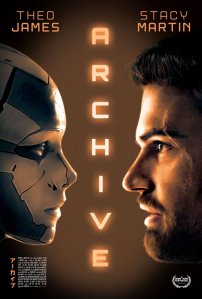
Archive follows one scientist (Theo James) trying to replicate his dead wife Jules (Stacy Martin) into a physical robotic form. She died in a car accident but he was able to save her consciousness onto a server available to consumers, but it will fray over time and only delays her inevitable passing, so he’s toiling away at a remote mountainous lab to create a new host to download her into. He’s gone through two different robots, each more complicated and more representational of Jules’ full brain; the first (J1) is like a box with legs and has the capacity of a child, the second robot (J2) is more like a teenager and reminiscent of the robot from I Am Mother, and the the third one (J3), under construction, looks the most human and will contain the full brain activity and hopefully the full Jules. Archive is fine and goes just about where you would expect, with exception to a last-minute twist that doesn’t make any sense. You can pick apart why it doesn’t work but I guess they wanted something shocking. The problem is that this movie needed to be told from a different lead perspective. Rather than being told from the scientist’s point of view as he doggedly tries to save the woman he loves, Archive should have been told from the second robot’s perspective. J2 looks at what her master is doing with the third, seeing the time and attention he’s putting into her, making her more feminine, and J2 feels pangs of jealousy and loneliness. She pleads for her master to make her better, asks why she isn’t good enough, and wants to be better while he essentially strips her for parts for her replacement. I felt so much for this second robot and her sad plight with a cold, selfish, oblivious creator. If Archive had been told from J2’s perspective, it could have been something special. She is going through a wealth of emotions, desiring to be all the things her creator projects onto his latest project, and she feels like she is failing him. When Archive focuses on its robots it’s at its best, and when it goes back to its human trying to avoid losing his wife one last time, it becomes too ordinary. It does have some commendable production values and special effects for a lower budget indie. I wish the movie could have been rewritten from the start and given us the superior dramatic perspective to serve as our guide.
Nate’s Grades:
The Beach House: C
Archive: C+
Share this:

Killer Raccoons 2: Dark Christmas in the Dark (2020)
 Dear reader, I already know what your first question is regarding the title of this low-budget, schlocky comedy, and yes, there actually was a first Killer Raccoons movie. Back in 2005, writer/director Travis Irvine and his pals made Coons! Night of the Bandits of the Night for only $5,000 and their slasher killer was a team of trash-eating, nocturnal mammals with a bad rap. It got a small DVD release from Troma Studios and would be considered a success by any modest standards of genre filmmaking. For whatever reason, Irvine decided he had more raccoon-related mayhem to indulge and got his friends back together to make a sequel 15 years later. Filmed throughout Ohio in 2018, the end result is Killer Raccoons 2: Dark Christmas in the Dark (it seems in the ensuring decade, somebody wised up about not having “coons” as a title). As with other Ohio-based indies, I do happen to know several people involved in this local production but I will be doing my best to write an objective, bias-free review of… a killer raccoons movie. That might be one of the most absurd sentences I’ve ever written in my years as a film critic.
Ty Smallwood (Yang Miller) has just gotten out of prison after the events of the first film. He’s looking to start a new life, prefers to go by Casey, and has plenty of people unable to recognize him (it’s a different actor from the first film). Casey is meeting Darlene (Evelyn Troutman), the little sister of one of the women killed at that fateful campsite 15 years ago. They’ll better get to know one another over one long train ride home for the holidays. Ranger Rick Danger (Mitch Rose, also a different actor) has other plans. He and the other surviving members of the summer camp have hijacked the train with help from raccoons wielding automatic weapons. Ranger Danger plans on holding the nation’s government hostage (the mayor of their small town is now the Secretary of Defense) with a super phallic death laser satellite operated in space by trained raccoons (why? Who cares?). Casey teams up with a steward, Double A (Ervin Ross), and they go car-to-car trying to rescue passengers, evade armed raccoons, and thwart Danger’s evil catastrophic plans.
 Somebody actually went and made a schlocky beat-for-beat parody of 1995’s Under Siege 2: Dark Territory, and I have yet to process whether this is a commendable act of unusual comedy obsession or simply a folly with no real appeal but to the smallest of fringe audiences. The Under Siege sequel was another Die–Hard-in-a-place setup happening miraculously again (this time on a train!) with Steven Seagal as its leaden lead, so devoting the plot structure to reminding people about the existence of this movie and its many low-points seems, in some sense, like the kind of hyper-specific meta ironic comedy you’d find in an Adult Swim special. In my own comedy writing, I rekindled an old TV series from the 90s that was unceremoniously cancelled after eight episodes (The 100 Lives of Captain Black Jack Savage), leaving its 100-countdown mission unfinished and dangling in my mind until I wrote my own conclusion. Re-examining some forgotten relic of personal pop-culture, especially something built around silly and stupid, is a fine starting point for a comedy riff. However, the expectation is that more will be done than serving as a reminder of that inspiration. If you’re simply re-creating the beats of the source to completion then what exactly is the point? Nobody needs a crummier version of an already crummy movie. That’s where Killer Raccoons 2 goes awry. It’s so committed to recreating Under Siege 2, including exact character roles, names, and many dialogue repetitions, that you could have removed the killer raccoons completely. I even started watching Under Siege 2 again for this review simply to determine if the pixelated spy camera nudity used in the opening to demonstrate the satellite’s telephoto prowess was exactly the same stock footage used in the actual movie (they are separate people; you’re welcome, world). Killer Raccoons 2 is more an inexplicably fixated parody than a goofy killer animal comedy, and that is a major letdown of imagination.
Let me give you an example of the disappointing complacency of too much of the comedy. The hijackers (all sporting an eye-patch, a stylish motif I did enjoy) are trying to find Darlene among the passengers since they now know she has value with her relationship to Casey. Darlene says she’ll adopt a disguise and she literally arranges a strand of hair to lay across her face like a fake mustache. Now this is a silly, obviously transparent disguise but it shouldn’t be the end of the joke. A better extension would be since we expect it to be so flimsy that it somehow works and the hijackers cannot tell the difference. Then the hair strand could drop and the hijacker would express immediate confusion and alarm, only for Darlene to place it back in place, and the hijacker’s worry replaced yet again (“There was another woman just here.”). It’s one idea but it’s an idea, building off subverting expectations and then developing the setup to build into something more. The problem with Killer Raccoons 2 is that there aren’t any real comic set pieces, no really well-structured scenarios that can make you smile from their very inception about what will transpire. The closest is an improvised fight with whatever household kitchen items are available, at one point pitting waffle maker against waffle maker. Much of the humor is so obvious that the obvious nature is itself the joke, like the chintzy special effects, bad wigs, and copious amount of penis jokes (the deadly satellite is named the “PEN-15”). However, there’s a fine line between an obvious joke being funny and the filmmakers pointing it out. There are too many times where characters literally explain jokes or point out the absurdities.
 This is a 96-minute comedy when, in all honesty, it could have even been pared down to 80 minutes. The pacing can feel slack and many confrontations can stretch on, circling the same obvious joke. Even moments that work, like the improvised fight, go on too long and without sustained energy. There are way too many plot beats from Under Siege 2 distilled here (the Seagal movie is only a couple minutes longer). There are too many characters involved in the action too. I’m shocked how much effort Irvine has gone to in order to bring characters and story points from the original into this unexpected sequel. It’s been 15 years so I can’t imagine there was much demand for fidelity to not just Killer Raccoons 1 but also Under Siege 2. The most useless character is a painfully protracted cameo by the likes of aging porn star Ron Jeremy. I understand the appeal from a marketing standpoint of having a celebrity “name,” but the movie would have been better served with Jeremy making his contractual appearance and then hastily departing. The movie’s humor dies a tragic death every strained second he is regrettably onscreen.
As a hit-or-miss comedy, there are moments that had me genuinely laughing, mostly because of the exuberance of its go-for-broke cast. There were repetitions that would occasionally make me giggle, like referring to Darlene’s “dead sister he lost his virginity to,” or the emphasis on “for real dead for real” with characters always surviving insane mishaps through two movies. There are the occasional moments were a sudden escalation in violence against the raccoons got me to laugh. When the film is being silly, it has a charm where the goofiness and cheap budget enhance the entertainment value (“While this spoon appears to be harmless, it’s actually really super-hot”). Take for instance Ranger Danger furiously typing in the air but with no keyboard present. The sight itself is good enough to earn a quick goofy smile, but if the movie were to comment upon it, then the joke would just seem ruined. It’s that character that, by far, brought me the most laughter. The character of Ranger Danger is a twangy hoot chiefly because of the comic timing and impressive gusto of debut actor Mitch Rose. He takes okay jokes and adds such professional polish that got me to laugh out loud (“A gazillion dollars?” “I just… look, I made up a number”). Several of his line deliveries are pure wonders (everything about the golden VHS tape he so reveres), and he’s the kind of capable comic actor that could be the anchor of a bigger vehicle. Somebody get this man more work in the funny industry, pronto. Yang Miller (Huckleberry) is also deserving of praise by playing his self-serious loner hero so serious that he’s oblivious to his own ineptitude.
 I don’t have to over-complicate this. By its overly verbose title alone, you’ll know if you have any interest in Killer Raccoons 2: Dark Christmas in the Dark. It’s a goofy comedy that’s proudly low-budget, lowbrow, and low on ambition. It’s a sequel to a movie nobody likely saw, religiously parodying an action movie that hardly anyone remembers, and it’s filled with little raccoon puppets that could have easily been ditched for what they add to the overall comedy. I’m a little shocked there aren’t more tasteless exploitation elements present, like gratuitous nudity, over-the-top gore, and more envelope-pushing crude humor. Killers Raccoons 2 feels decidedly juvenile but not quite transgressive. It’s not going to be a great experience but the hits might outnumber the misses, especially if your sense of humor is attuned to the likes of schlocky Troma movies, Conan O’Brien, and late-night Adult Swim. It’s that combination of trash and irony that can prove blithely appealing, though I wish Irvine had put more effort into his comedy compositions. It feels weird to lament what could have been with a title like Killer Raccoons 2, but this just could have been funnier. A strange side note is that Irvine ran as the libertarian candidate for governor in Ohio in 2018. There’s a lazy joke to be had about him running the government the way he makes his movies, but I’m not going to stoop to that level. That’s for Killer Raccoons 3.
Nate’s Grade: C
Share this:

Palm Springs (2020)

I am a sucker for a clever time travel tale, or parallel universes, a sci-fi story where the creative ingenuity is front and center, and Palm Springs is a delightful new rom-com bursting with imagination. By this rate, most audiences should be familiar with the time loop formula, from comedy classic Groundhog Day to Source Code to Edge of Tomorrow to Netflix’s audacious series, Russian Doll. It’s a creative conceit that rests on building patterns and subverting expectations, allowing a writer an unparalleled opportunity to retell a story, pulling at the edges and getting to answer an assembly of “But what if?” questions. It builds out its world and makes it feel richer and more intricate, all the little stories and characters that might have been missed had there only been a single avenue. It requires a creative storyteller with a big imagination for details, but when done correctly, the time loop movie can be a wealth of satisfying payoffs and intriguing detours. Palm Springs deserves to be added to that list of hallowed time loop movies.
It’s the day of the wedding for Sarah’s (Cristin Milioti) sister. There’s one wedding guest that seems to stand out. Nyles (Andy Samberg) seems prescient on the dance floor, has a prepared speech that earns tears, and strolls through the reception like he owns it. Sarah becomes smitten with him and, against her better judgment, follows him into a mysterious glowing cave. She wakes up in her bed and relives the wedding day again, learning she too is now trapped in that 24-hour loop with Nyles. He laments that she followed him, having once encouraged another person to join him in the world of no tomorrows (a rueful Roy, played by J.K. Simmons). But with a partner, the many days have a new relevance, and Nyles and Sarah depend on each other, but is there a chance that they can escape or are they doomed to perform the Electric Slide forever?

Right away, you can tell that writer Andy Siara (TV’s Lodge 49) has given his story tremendous thought, and the fun of it is watching our main characters go through the process of discovery while learning more about each. The rules of the universe are straightforward; whether death or sleep, they will wake up back that fateful wedding morning. Nyles has felt trapped for so long and the prospect of another companion going through his same purgatory fills him with guilt, but he cannot help feeling a new purpose when he finds a partner for this weird world. Initially she’s looking for an escape, but then she opens up to the possibility to a life permanently on pause, without consequences, and how freeing this can be. Then the appeal dampens as we come to understand why this day is a personally painful one for Sarah and why she would be desperate to live another day, any other day. When she drops out for a solid stretch in the second half, you miss her just as much as Nyles and better realize what a great team they made. Palm Springs has plenty of fun with the possibilities (Nyles requests a quick death over a long drive to “beat the traffic”) but it doesn’t lose sight over why we should care about these people. It doesn’t really matter how the time loop began or whatever theory will end the loop. It’s the central relationship that will ultimately provide the emotional anchor, and it’s because of that attention that by the conclusion of Palm Springs I felt uplifted, buoyant, and happy (a mid-credits scene thankfully answers the one lose thread, providing an even more welcomed conclusion).
Make no mistake, this is a funny movie and I laughed often. Samberg (TV’s Brooklyn 99) and Milioti (Black Mirror) are terrific together and genuinely seem to enjoy one another. They have a combustible spark to them that reminded me of older screwball comedies. Having a willing partner allows Nyles to cater to different impulses but also pushes him to re-examine his perspective when he has someone new who sees the excitement in their unique position. However, except for Roy and his long drive from Irvine, they are hopelessly alone, unable to move forward, and the question arises can there be anything of significance without consequences? The screenplay has a natural dark streak with its humor, so even when things get heavy with existential quandaries, it doesn’t stop the movie from being smart and enjoyable. There are so many wonderful little payoffs, little running gags, and larger payoffs to be had with the time loop formula. It also hooks an audience by watching a character fail, and fail, and fail, only to succeed. Palm Springs is a romantic comedy that can be funny, romantic, and make me care.

Debut director Max Barbakow keeps the pacing swift and has fun playing with bold primary colors across the desert setting. The tone of the movie is delicate as it can go into silly revelry, like a surprise coordinated dance routine and a wedding outburst involving a bomb, into yearning romance, into heartfelt pathos, and then even the occasional stomach punch. For as rightfully beloved as Groundhog Day is, there’s nothing that comes close to feeling like an emotional gut punch. With Palm Springs, the time loop is given its sci-fi examination, the comedy is given is full exploration, but it’s the characters that matter most, and Barbakow prioritizes the right feelings at the right times. By the end, you feel sweetly fulfilled by these 90 charming minutes.
At first, I wondered why the Roy character was included except as a cautionary tale why Nyles would not want to rope someone else into his purgatory. But then as we visited with the older man, I realized, as he does, that he’s meant to symbolize the change in perspective (mild spoilers to follow). The family that he couldn’t stand before his loop-life has now become his personal oasis. He’s grown in appreciation and love of his family bonds. He is the example for Nyles about how one can personally grow and change when given dedication and enough time to see it through. It’s a nice moment, and while Simmons (Whiplash) is always wildly entertaining when he’s bulldozing over others, giving Roy a poignant sendoff made me feel like he was a much more integral character and his earned wisdom was its own special reward.
Palm Springs is a great detox of movie, with enough sunny comedy and winning romance to make you smile and enough tortured existential drama to provide substance. Everyone involved, from the writer to the director to the cast, is having a blast and it’s fun to join in the good times. When it comes to time loop cinema, Palm Springs is a respite of entertainment and smartly developed and richly realized execution. Find it on Hulu and kick back.
Nate’s Grade: A
Share this:

The Old Guard (2020)
 What do you do with an action movie where the action is actually the least interesting part? The new Netflix film, The Old Guard, is based on a comic book series by Greg Rucka (Whiteout) about a mercenary squad staffed with immortals through the ages. Lead by Charlie Theron, whose character Andy traces back to at least the Medieval period, leads the team and sees promise in their newest recruit, Nile (Kiki Layne, If Beale Street Could Talk), a U.S. soldier who is shocked to discover she can come back to life. It’s through this new recruit that we get an introduction to the hidden world of immortals and their hidden history, and it’s these flashbacks that I found the most entertaining aspect of the entire two-hour movie. Watching Theron swing a Viking battle axe is a lot more fun than watching her stalk corridors with a gun. There’s also some great little moments that show an attention to developing the characters and their psychology. Andy has a centuries-old love that was trapped in a suit of armor and thrown into the sea. Besides the fact that drowning is horrifying, imagine dying, then reviving, and then drowning again and again, every few minutes, for an eternity. Wow that is a new level of horrifying. Each of the characters has an interesting history and some degree of dimension, and it’s these soul-searching conversations that I enjoyed the most as they discuss the costs of living forever. However, it’s not quite forever, because immortal heroes have an obvious problem about holding stakes, so at some point the immortals will lose their healing ability, though they don’t know when. It’s something, but it feels more arbitrary, and the super smarmy pharma CEO villain (Harry Melling) is a non-starter as a threat. The action sequences almost feel like a chore, like the filmmakers are checking boxes instead of using them to advance the plot in meaningful and exciting ways. The action isn’t bad but just mundane, lacking memorable set pieces or engaging complications. Even their use of taking punishment is under-utilized in the design. Simply put, a movie with this kind of premise and with Theron as your lead should be more exciting. I loved Mad Max: Fury Road. I loved watching Theron lay waste to goons and gangsters in 2017’s Atomic Blonde, a movie built around her physical capabilities and smartly constructed action set pieces. However, the action we get with The Old Guard lacks the same transformative ability and fight choreography. It’s just thoroughly fine, at best, and I kept wondering if they were saving themselves for a big finish. Sorry to disappoint, it’s just more office hallways with limited gunplay. The energy level is lacking and the music choice throughout the film affects this as well, with the same kind of downer tracks playing again and again. I would rather have spent these two hours listening to the immortal stories around a campfire.
Nate’s Grade: C
Share this:

Disclosure (2020)
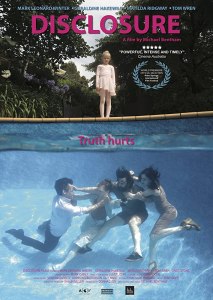 It starts with an accusation from a child during a playdate. Natasha, the four-year-old daughter of Emily (Matilda Ridgway) and Danny (Mark Leonard Winter), has a very serious accusation against the older nine-year-old son of Bek (Geraldine Hakewill) and Joel (Tom Wren). They’re neighbors, friends, and both sides are certain they can work things out like agreeable adults. Danny and Emily feel only right to be upfront about the accusation and ask to send the son to counseling. Joel and Bek are wary of this getting into the news (Joel is a local politician) and want the allegation withdrawn. Natasha says it happened. The boys say it did not. Over the course of one very long day, writer/director Michael Betham will push both couples to the brink.
Disclosure (not to be confused with another 2020 movie by the exact same name) plays out for 80 minutes like a play, locking us in one location with four characters growing increasingly hostile to one another. It’s an uncomfortable movie because it traps you in that squirming discomfort of hard conversations and high-pressure tactics to relent or capitulate on ethics. It’s important that we never really know the full truth of what actually happened between the children. We have what four-year-old Natasha has said happened, we have the denials from the older boys, who are older but still children themselves, and we have two sets of parents trying to make sense of some pretty startling behavior. Bek is convinced her own children could never commit something so heinous, and therefore Natasha must be confused or lying. She argues the children were too young to understand what her account alleges. Emily is convinced because of her daughter’s youth that she must be telling the truth, because why else would she concoct this harmful account? Each gets dug in from their perspective and only becomes more hardline. Bek reveals a startling secret of her own, being a victim of sexual grooming and manipulation in her youth, and this confounds Emily even more, asking why Bek doesn’t then believe the word of the victim here? These discussions begin in a civil manner that begins at surface-level neighborly pleasantries, but once the central conflict emerges and the opposing resolutions are debated, you start to wonder whether you are watching people at their extremes or whether you are watching the characters as they really are at heart.
 This is a patiently paced movie with every scene feeling like its own mini-movie or individual play, often a two-hander, and I was rapt with attention each time to see how the tension escalated. The couples think they can resolve matters, that they can convince the other side to the merits of their perspective and they can be persuaded to come over to their thinking. Naturally, this doesn’t happen. Given the seriousness of the alleged act, it brings out a ferocious defensive side, contemplating how far each member of each couple is willing to go to protect their children. It’s not like they get into a knife fight or anything that breaks the tonal reality of the scenario, but there is a clear moment where we have a divide between heroes and villains. That designation is a little flippant as nobody is portrayed in a strictly villainous manner; however, there are obvious moral missteps late in the movie that rely upon power plays and leverage. Bek and Joel have so much more immediate power between the couples and they’re not afraid to inflict it. They come over unannounced, catching Emily and Danny relaxing naked in their pool, vulnerable, embarrassed, and already discombobulated. Danny is eager to smooth things over and find a middle-ground because he loves his wife, and daughter naturally, but also because he doesn’t want to lose a prime career opportunity of working on a book with Joel. Eventually, the wealthier couple will use their wealth and influence to maximum pressure, even if they lament how much more they have to lose if the details of the allegation became public. For them, they have more at stake and Emily and Danny should be more reasonable and accommodating to their requests.
Eventually, there is a turning point where Disclosure goes from uncomfortably ambiguous to picking a side. A character clearly goes into the wrong, and at first you believe this transgression is to defend their child, but as it continues you begin to wonder whether or not it’s simply to “win” the argument and push aside a larger introspection over what this accusation personally means for this family. It made me loathe the character although it makes them more interesting and complicated. Ultimately, you will never know what happened with the children and the ending is somewhat unsatisfying because we end in a stalemate. I was genuinely hoping the movie would keep going for another 15-20 minutes to advance the plot and tensions further, but I understand the principle of Betham leaving on a point of disagreement and ruin and leaving the characters wanting. There are words and actions that will be highly unlikely to be taken back. They must deal with it all.
 Thankfully, the performances are universally strong to match the intensity of the story. It’s the women that make the biggest impact. Hakewill (The Pretend One) begins with the impression of Bek being an entitled rich wife who is used to getting what she wants, and over the course of those fractious 80 minutes, she proves how much this is merely an act. In fact, her own troubled marriage and past are in conflict with this veneer. Hakewill has several moments of barely-veiled rage that can be chilling but also heartbreaking. Ridgway (Book Week) is the face that many viewers will adopt as their own, meaning her perspective of treating her daughter’s accusation as credible and demanding response. She feels betrayed by her supposed friends, ambushed and wounded, and that she needs to remind her own husband to support their side of the argument. Ridgway is terrific as she tries to process her righteousness and disappointment over how everything spins out of control. The husbands are able in supporting positions, especially Wren (Winners & Losers) who uses a chummy sense of empathy as a shield he’ll drop at a moment’s notice. Winter (Escape from Pretoria) has the least to do simply of the players because his character attempts to be the most active peacemaker in the group.
Disclosure could have serviced as a stage play and the adaption wouldn’t have been too challenging but I’m glad Betham made this for the medium of film. I’m glad I got to see the subtle expressions of great actors trying to keep their cool, trying to stomach their resentment, and trying to force their opposition to retreat. It’s a pugilistic match where each side is convinced that they’re in the right or, in the wake of contrary evidence, that they have enough worth fighting for to be declared the winners. Characters keep saying they just want to think “about the children” and what’s best for them, but nobody seems to be on the same page about what that means. This isn’t an easy film to watch and given the thin line of sexual violence versus sexual exploration, as well as the question of how old a child can recognize their actions, it made me quite uncomfortable throughout, but I was always intrigued with where it would go next. Disclosure is a small Australian film that is available for streaming rentals and while it’s not going to be the most fun 80-some minutes of your day, it will definitely make you think.
Nate’s Grade: B+
Share this:

Hamilton (2020)

Multi-hyphenate sensation Lin-Manuel Miranda’s Hamilton sounds like a bizarre misfire, a hip-hop-infused musical about one of the lesser known Founding Fathers, and yet not only does it succeed so magnificently, so transcendentally, it’s one of those rare artistic pinnacles that lives up to its own momentous hype. This is one of the crowning artistic achievements of the twenty-first century. I’m exceedingly grateful for a filmed version of the vaulted stage experience, with the original cast, that allows me that front-row view my bank account never would afford. This is going to be a film review of what is, essentially, a live theatrical performance, but really this written review is going to be a celebration of Hamilton and what I consider to be so phenomenal.
In 1776, Alexander Hamilton (Miranda) is an immigrant looking to make his name in the American colonies and the looming war with Britain for independence from King George III (Jonathan Groff). He meets and befriends Aaron Burr (Leslie Odom Jr.), an ambitious upstart who seems fatefully linked with Hamilton through the decades. Hamilton falls in love and marries Eliza Schuyler (Phillipa Soo) but also has a close relationship with her older sister, Angelica (Renee Elise Goldsberry), who keeps her real feelings at bay to protect her sister. Eager to get into the action, Hamilton accepts a position as George Washington’s (Chris Jackson) right-hand man as the battle comes to New York and the colonists do the unthinkable and defeat England as we conclude the musical’s first act. “You’ll be back,” King George retorts.

Next comes the tricky part of building a functioning country in the aftermath. Hamilton is appointed to be Secretary of the Treasury by newly elected President Washington, but his federalist principles are fought against by some pretty big names in the cabinet, like James Madison (Okieriete Onaodowan) and Secretary of State, Thomas Jefferson (Daveed Diggs). Both are wary of a centralized government and prefer more power to be held by the states. The Founding Fathers jostle for ideological supremacy and Hamilton gifts his opponents with the burgeoning nation’s first political sex scandal with Maria Reynolds (Jasmine Cephas Jones). Aaron Burr rises in local and national politics but sees Hamilton as a constant thorn in his side. With the presidential election so close in 1800, Hamilton’s endorsement of Jefferson over Burr is the final straw, and Burr demands satisfaction in a duel against Hamilton that will prove tragic.
For fans of musical theater, Hamilton is a two-hour-and-forty-minute joyously exuberant celebration of a bold artistic vision, the electricity of live theater, and broadening American history in a manner that makes it far more accessible, relevant, and humane for a modern audience. The very nature of having minority actors portraying the Founding Fathers and their famous wives is part of Miranda’s appeal that he wanted to tell the story of America with the America of today. Ordinarily, African-Americans would never get an opportunity to play Washington or Jefferson, or a Chinese-American woman playing the role of Eliza Hamilton, and there is definite power in representation, in seeing these different faces playing these historical figures. The deliberate color-blind casting makes America’s history feel more inclusive. It’s such a simple act, opening the ethnicity of historical roles, but it produces a beautiful result and provides even more cross-textual commentary, like slave-owning presidents played by black thespians.

Another miraculous effort by Miranda is his ability to generously humanize many of the characters, including the man who eventually murders Hamilton himself. Very often when we talk about the Founding Fathers and other Great Figures of History from oh so long ago, they take on a mythic quality and seem less human, less flawed, and less relatable. They seem practically superhuman, absent our doubts and desires. Miranda’s portrayal of the men and women of America’s founding does the opposite and makes these people feel relatable, flawed, and human yet again.
This includes Hamilton as well. He’s obsessed with his sense of legacy, has a pretty healthy ego that gets him into trouble, and might have been having an emotional affair with his sister-in-law, never mind an actual affair with Maria Reynolds. He’s so concerned about his “good name” and rumor of impropriety (he was accused of embezzling government money to pay for Ms. Reynolds’ husband’s extortion) that he literally confessed to his marital misdeeds and published it. Hamilton is consumed with writing his ideas (“Why do you write like you’re running out of time?”) and an impending early death, something he amazingly escaped during a hurricane in the Caribbean that destroyed his village as well as his mother’s fatal illness. He was so eager to get into the heat of war that Washington had to sit him down to persuade him that dying as a martyr isn’t as glamorous as living and seeing through your ideals. Hamilton’s death at the hands of Burr is likely the most widely known fact about both duelists, but the musical brings each to glorious and troubled life with unerring compassion without excusing their real failings.
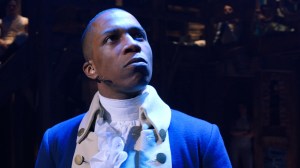
Burr serves as the narrator of our near three hours, setting the stage for Hamilton’s story with his own regrets and jealousies framing his recounting. He’s a complex character worthy of his own biopic, an orphan who finished college in two years, had an affair with the wife or a British officer, lost her at sea, and championed retail politics centuries before it was the norm. His personal philosophy was one of caution, diametrically opposed to Hamilton jumping after whatever he wanted no matter the consequences. Burr longs for being near the real center of power, and his showstopping number “The Room Where It Happens” is an ode to his desire. He begins as a friend and ally of Hamilton, then political rival, and finally as a mortal enemy. He’s too calculated with his personal beliefs, never wanting to be too challenging and at risk, which is an embodiment of his social-climbing ambition as well as his callow decision-making. To Burr, avoiding risk and not accruing enemies is simply smart business. The musical does an excellent job of humanizing Burr (“Now I’m the villain in your history book”) and offering a perspective in opposition to Hamilton but not without its own measurable merits.
The domestic side of Hamilton could be its own movie to itself. The relationship between Alexander, Eliza, and Angelica is complicated to say the least. Angelica was the elder sister and in her stellar song “Satisfied” she details the social pressures of being in that position, being expected to marry into a desirable match that will see the family name and fortune to prosper. Feeling initially unsure about Hamilton’s intentions, she introduces him to her sister Eliza instead, and it’s a choice that she feels conflicted about ever since. Angelica dearly loves her sister (“I love my sister more than anything in this life/ I will choose her happiness over mine every time”) but cannot help but still feel a yearning for her brother-in-law. However, when the Reynolds scandal comes to light, she will defend her sister to her dying breath. That sisterly deference makes Angelica such a fascinating figure, and it certainly makes the Hamilton marriage more intriguing and roiling with pent-up desires. Eliza sings about removing herself from the narrative in “Burn” and how her husband has “forfeited the rights to my heart.” She’s been trying to impress upon her husband to be happy in the moment (“Look around, look around/ How lucky we are to be alive right now”) and enjoy his accomplishments rather than looking ahead. Her eventual forgiveness of Hamilton is one of the most emotional moments of the show that causes me to tear up. And she serves as a final testament to Hamilton’s legacy during the final number, after his death, and fills in the gaps of history by asserting her own agency back into the observed “narrative.”
I’ve gone over 1300 words, dear reader, and I haven’t even talked in depth about the music, so allow me to say that Hamilton as a musical is just about music perfection. Hip-hop is such a densely wordy platform that allows so much information to be imparted at lightning speed, which means that lyrically these songs are jam-packed with clever asides, allusions, and rhyming recitations of history. The songs are instantly quotable and filled with deep consideration from witticisms to also important dramatic themes and perspectives. I was amazed at Miranda’s composition skills in particular how he’s able to weave and build off character leitmotifs. It’s brilliant how something like Hamilton’s declarative early song “Not throwing away my shot” about his ambitions can come back during his duel with Burr where he raises his pistol in the air, away from Burr, and literally throws away his shot. Or how the beat of a song can imitate a failing heartbeat in a fractious moment of tragedy. Or how King George’s self-involved songs are fashioned to be like 1960s British invasion pop ditties. Or how cabinet arguments become riotous battle raps between Jefferson and Hamilton. Or how the same actors who played Hamilton’s wartime buddies in Act 1 are playing his political rivals in Act 2 (“Have you forgotten Lafayette?” he asks of Jefferson, the same man who portrayed Lafayette). There are layers and layers to the compositions here and the music is remarkably assured; almost every song is a certified earworm, and it’s an entirely sung musical. Every person will have their favorites, and for me they include “Satisfied,” “The Room Where It Happens,” “History Has Its Eyes on You,” “Dear Theodosia,” “One Last Time,” and the moving finisher, “Who Lives, Who Dies, Who Tells Your Story.” Even if you don’t like rap music, Miranda’s offerings are so catchy, so accomplished, and so bursting with excitement, that it’s near impossible to resist.

This movie was filmed in 2016 from the original Broadway cast, many of whom earned Tony awards for their sensational work (Diggs, Goldsberry, and Odom Jr.). Everyone is truly excellent but my favorite performer, by far, is Diggs (Blindspotting). He gets to spit lightning-fast rhymes in a French accent as Lafayette, and his portrayal of Jefferson as a dandy in the style of Andre 3000 from Outkast is enormously entertaining. His “What Did I Miss?” introductory number is a perfect impression for Jefferson’s arrival onto the stage. Diggs’ is so charming even when he’s being a scoundrel trying to plot the doom of Hamilton. His battle raps with Miranda are a highlight and Diggs also seems to get the most tricky lyrical arrangements because of his peerless skills at maintaining flow and diction (“I’m in the cabinet, I am complicit in/ Watching him grabbin’ at power and kiss it/ If Washington isn’t gon’ listen/ To disciplined dissidents, this is the difference./ This kid is out!”). There’s a reason Diggs has become the other breakout star of the show.
Soo (The Code) breaks my heart with her Act 2 solo numbers and then mends it back as she reasserts herself on “Who Live, Who Dies, Who Tells Your Story.” Goldsberry (Altered Carbon) has such a fire to her. Groff (Mindhunter) is hilarious as King George, though his singing involves a lot of literal spitting. Miranda (Mary Poppins Returns) is exceptional as the titular character who comes from nothing and through the power of his ideas creates America’s financial institutions that are still standing to this day. But it’s his personal relationships that better define him in the play. The fatherly relationship he has with Washington is affectionate (“One Last Time” has an extra poignancy knowing Washington died shortly after leaving office) and his hopes for his newborn son (“You’ll Blow Us All Away”) speak to a larger truth about parenting that also links up with the foundation of a nation in infancy. There’s also his complicated love divided between Eliza and her sister. Miranda has such a natural charm and swagger and earnestness that seeps into his performance and every performer.

So is there anything about this movie-wise to separate it from a bootleg of the show? Director Thomas Kail (also the director of the musical) does make smart use of when to go tighter on his actors, to zero in on the emotions and expressiveness, and when to go wider for best impact. The stage is designed like a bullseye with a rotating circle, which can play up the dramatic confrontations between foes, especially the duels. I was impressed at points where the movement of the stage would be perfectly timed with camera focus and edits, allowing other characters to loom over the shoulder, or pop into focus, giving the production a greater sense of filmed visuals. However, this is really a filmed version of the stage show, so as a movie, it’s only going to do so much with those trappings. The unreality of theater has to be accepted but the movie version does a great job of maintaining the intimacy of the shared theatrical experience. It’s even nice to hear the applause after the musical numbers or some of the laugh lines hit home.
By this time, you’ve likely heard about the Broadway-smashing Hamilton success story of Miranda and his crew but do yourself a real favor and watch the movie with the OG cast. Yes, there are historical shortcuts taken for dramatic license and not everything you see on stage will be one hundred percent accurate with the long record of history, but it all clicks for the greater storytelling aims. Some might be uncomfortable with the re-visioning of the Founding Fathers, either by the open-ethnicity casting or glossing over their slave-owning faults, but Miranda’s larger goal of making history reflective of the people who currently live today is admirable. In short, unless you have the kind of money to blow on a front-row ticket, enjoy the Hamilton movie experience until Miranda eventually wrangles his artistic milestone into a more movie-movie version.
Movie Grade: A
Show Grade: A+
Share this:

365 Days (2020)

I never thought I would say these words but I am now reconsidering the artistic merits of the 50 Shades of Grey franchise, and that’s because 365 Days is an even more problematic and pathetic imitation of something that was already problematic and pathetic. The Netflix sensation is a Polish movie based on a trilogy of Polish books, and it’s been one of the most watched movies on the streaming service for months, all but guaranteeing that the remaining two novels by author Blanca Lipinski will find their way to the small screen in the near future. 365 Days is a gross distortion of romance and an uncomfortable watch for many reasons of taste and entertainment.
Massimo (Michele Morrone) is the son of a slain mafia boss. Laura (Anna Maria Sieklucka) is an ordinary woman in a bad relationship with a man who expresses little interest in her. One night, in Sicily, she’s kidnapped by Massimo and wakes up as a prisoner in his mansion. He’s been obsessed with her since he first saw her and is convinced that he can make Laura fall in love with him. He promises never to do anything against her will (as he literally gropes her that second) and that she will remain a captive for 365 days. If she doesn’t fall in love by then, he promises to let her go.

If you’re not troubled by that icky starting point for a modern romance, I worry about your concept of what consent means because this ain’t it. This is not the first story to use a brooding, dangerous, misunderstood man as its heartthrob, or a woman who despises a man before falling for him, nor is it even the first pseudo romance utilizing Stockholm syndrome. Laura even cites Beauty and the Beast by name. However, 365 Days seems inordinately confused about the simple concepts of consent and romance. Massimo is meant to seem gentlemanly when he says he’ll allow Laura to come to her own conclusions; he’s just so confidant in his charms. If that was simply the case, he wouldn’t need to kidnap and imprison her. He could try introducing himself and dating her. When her romantic desire is directly linked to her freedom, there is no real possibility for consent here. Laura attempts to run away at one point and inadvertently sees a mafia underling executed, which should motivate her more to flee or motivate Massimo even more to keep her locked up. It does neither. She never attempts escaping again even though she does leave the compound and runs into strangers. I suppose she accepts her captivity, though at one point she almost single-handedly instigates a war with a rival mafia family and that would have been an excellent act of rebellion. That would have been the more intriguing, feminist-friendly version. Instead we get the version where Laura bleaches her hair to appear more like Massimo’s blond ex-girlfriend. Commence heavy sighing.
Massimo isn’t some sad little puppy dog who needs love. He’s the head of a crime family, and the movie doesn’t present any potential softer side or moral code or vague introspection for the man. Sure, he kills a guy who was trafficking in children, but he seems to be nonchalant about trafficking adults. I was completely astonished that no redeeming qualities are ever presented for this dude (unless you count his bank account). He’s a creep. He’s awful. He’s got obvious anger and control issues. At one point, Laura starts wearing revealing lingerie and even stripping in front of him, all to tease him. It’s not so much an act of defiance and agency, and it only makes Massimo more agitated and aggressive. He grabs her forcefully and warns her not to “provoke me.” The implications are that he’s not responsible for his own actions because of her behavior. He tries to make Laura jealous but his actions are gross, like forcing her to watch another woman fellate him. He tries to charm her but his actions are gross, like his repeated use of the come-hither line, “Are you lost baby girl?” which is also the first thing he ever says to her face-to-face before kidnapping her. I shuddered every time he said it. The only selling points for this man are his physical looks (to me he looks like any disposable Euro trash villain in a Taken sequel) and his lavish lifestyle. The fantasy of living a life of privilege I suppose is enough for Laura, and fans of the movie and novels, to excuse the innumerable warning signs.

The bigger attention-grabber for this modestly budgeted foreign romance is the graphic sex. While not crossing over into un-simulated sex scenes, these uncomfortably long scenes cross more than a few lines. The first thing you’ll likely note is how aggressive Massimo comes across The very first sequence is inter-cut between Laura masturbating on her bed, to showcase her untapped passion from her bad boyfriend, and Massimo getting a blowjob from a stewardess who very much does not look to be enjoying herself. He is forcibly grabbing this poor woman’s head and repeatedly shoving it downward, enough to look to generate her tears. Again, I must stress, this is the first impression of sex we get from 365 Days. This behavior reappears when Massimo is trying to make Laura jealous through forced voyeurism. The sex scenes feel so drawn out that 365 Days does begin to feel like a high-gloss version of soft-core porn. The plotting is just as empty and careless as we fill time from one sexual act to another. Just because there’s a lot of thrusting and writhing bodies not make onscreen sex automatically erotic. You have to feel the heat, feel the passion of the characters being unleashed, but also have empathy for those coupling, and empathy is a hindrance for Massimo and Laura. This movie doesn’t even know how to do simple storytelling right. It should present some kink of Laura’s in Act 1, before she meets Massimo, to show she has a secret wild side, and then that’s the avenue that could have been accessed for her to peel away those inhibitions. Even that is sleazy but it’s better storytelling structure.
The ending of 365 Days also made me scream at the screen because of how disastrously incomplete it is. It’s not an ending but a cliffhanger and one that doesn’t even serve as a meaningful cliffhanger knowing there are two whole books left to adapt (366 Days?). I was baffled by the appeal of 365 Days, so I looked up the plot synopses of the other stories ahead and, dear reader, believe me when I say that it only gets worse and more outlandishly soap operish from here on out. We’re talking identical twin brothers, dead dogs shipped in the mail, and even more trashy love affairs.

365 Days is two hours of rearing back in your seat wincing and groaning. While the cinematography is lush and the locations in Italy are idyllic, there is nothing sexy about this movie whatsoever. That’s because it’s built on a reprehensibly flawed premise of romance that doesn’t remotely understand consent. At no point does Laura really have an actual choice here. She is a prisoner who falls in love (or so she says) with her abuser. The fundamental draw of an onscreen romance, the desire to see people together, is absent with this twisted power dynamic. I want to see Laura escape, not twirl around with a shopping bag and dressing up for her man. This should have been a completely foreign-language production because when the foreign actors speak in English, they already sound disjointed, affect-less, like they’re victims of a bad dub. When they speak in their natural languages, it’s remarkably night and day. This is bad. All the way bad. Please don’t even spend one solitary day of your life, even during a pandemic, on 365 Days.
Nate’s Grade: D
Share this:

Irresistible (2020)
 Jon Stewart was a chief part of keeping me sane during his storied 16-year tenure on The Daily Show, and every night he helped deconstruct politics and media bias with reassuring clarity and soothing wit. I was expecting far more bite from his first writing/directing effort since leaving his show in 2015 but Irresistible feels anything but and especially toothless when it comes to political savvy. Steve Carell (Vice) stars as a Democratic strategist still reeling over 2016 and who sees a bright shining star in a local Wisconsin farmer (Chris Cooper) who could help rebrand what a Democrat looks like. Carell agrees to help the man get elected mayor, which leads to a fish-out-of-water comedy where the big city elite tries to fit in with the salt-of-the-earth folk of small-town middle America. Rose Byrne (Like a Boss) plays a shameless Republican strategist who coordinate with the opposing candidate and lives to torture Carell, and she’s easily the best part of the movie. Some of the satirical jabs land (a CNN screen divided among 24 talking heads all talking at once) but many more feel strangely outdated, like a political satire from ten or fifteen years ago and not reflective of a the seismic post-Trump landscape. The satire doesn’t feel hard hitting enough and the comedy doesn’t feel especially well constructed beyond simple quips, so Irresistible lands in a disappointing middle ground of meh. It’s not a bad movie or even one bereft of certain entertainment, but coming from Stewart, it feels too safe and too self-satisfied. There’s a late twist that re-configures the entire context of the movie and I can’t decide whether it’s clever or ridiculous. There is a potential romance being leaned upon with Mackenzie Davis (Terminator: Dark Fate) that has the best and most knowing punchline when it comes to Hollywood’s depictions of romance. That was a joke that hits its mark with force. Too often the film seems content to nibble at the edges of larger political malfeasance. Ultimately, it becomes a lesson about the dangers of big money in the escalating arms race of politics, which is definitely a worthy issue, but in the exhausting era of Donald Trump, it almost feels quaint as the biggest target. Irresistible is a middling political satire for today and one that sadly made me worry whether Jon Stewart might have lost his touch.
Nate’s Grade: C
Share this:

Da 5 Bloods (2020)
 Given the current political climate, there might not be a better filmmaker to seize the moment than Spike Lee. The controversial director has been making controversial, thought-provoking, inflammatory movies for over 30 years, and after the Oscar-winning success of 2018’s excellent BlackkKlansman, he’s on an artistic resurgence not seen since the early 2000s (please watch 2000’s Bamboozled, an underrated media satire that’s only gotten more relevant). In comes Netflix and their deep pockets and wide creative latitude for filmmakers and the result is Da 5 Bloods, a stirring movie that seems like a modern Kelly’s Heroes but becomes so much more.
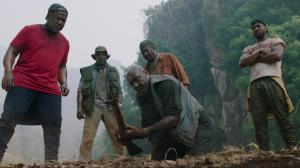
“Da 5 Bloods” is the nickname for a group of Vietnam War vets, all African-American. Paul (Delroy Lindo), Otis (Clarke Peters), Eddie (Norm Lewis), and Melvin (Isiah Whitlock Jr.) venture back to Vietnam to discover a cache of gold bars they had hidden in 1971 as G.I.s. They’re also going to bring back the remains of their fallen leader, Stormin’ Norman (Chadwick Boseman), who died after they struck literal gold. The land has changed in the ensuing decades, with American culture finding its complacent commercial footing (a dance hall has an “Apocalypse Now” party presented by Budweiser), but then the men have also changed. Paul has brought along his adult son, David (Jonathan Majors, The Last Black Man in San Francisco), in an attempt to better understand one another and bridge their divide. When the multi-generational Bloods go for their buried treasure, it becomes a question over how far they will all go to get out of Vietnam rich.
 Lee’s commentary on art, war, and the commoditization of history happens early and with great deliberation. The most notable choice is how the flashbacks back to the group’s Vietnam experiences are portrayed. The aspect ratio squeezes to 4:3, akin to news footage or home movies over these memories, but Lee’s stylistic vision goes further. You’ll notice very early into the flashbacks that they take on a sort of heightened quality, coming across more like a movie version of the Vietnam War than the real experiences. The guys complain about the Rambo movies and then these flashbacks feel like their own Rambo rendition. The editing is quick, the shots are tight, and the boys are bursting with bravado, none more so than Stormin’ Norman, their celebrated friend who they believed was the best of them, and he’s played by a big-time movie star and a real black superhero of popular culture. The flashbacks take on an unreliable quality, exaggerated and fed by the bombastic war depictions of popular culture. This is later proven correct with a late personal reveal. The sequences feel more like preferential memories, and this is exemplified by the choice to have all the older actors play themselves in the flashbacks. It takes a little mental adjustment but I enjoyed the choice. It added to that surreal quality that made the scenes more worthy of analytical unpacking. It also gave our established characters more to do as they are slipping into their literal flashbacks coming back to Vietnam. Gratefully, Lee has also forgone any de-aging CGI spackle over his actors’ faces. Consider this the anti-Irishman, and it didn’t take me out of the movie at any point. I appreciated the choices.
The movie is about war and its representations in movies, as evidenced from those flashbacks, and then Da 5 Bloods becomes its own war movie. When the violence happens for real, it’s played differently than how it appears through the gung-hp flashbacks. It’s grislier, uglier, and hits you in the stomach. It’s not the rah-rah moments to celebrate in jingoistic fashion. As the Bloods get closer to their gold, the movie transforms into its own hybrid of Treasure of the Sierra Madre and pushes the characters to reconcile how far they will go to keep their secret. This pushes some characters to challenge others on a shifting plane of morality, and you never really get a sense of what might just happen next. When a French woman was talking about visiting Vietnam with the purpose of finding and detonating leftover landmines from the war, I knew it was only a matter of time before this scenario resurfaced with a vengeance. When the Bloods are exploring a hillside with a metal detector, I kept wincing, waiting for an eventual click and an explosion. There is a taut rescue sequence that also taps into a relationship showcase for two characters. That’s the greatness of what Lee has done here, because on top of mixing genres and tones and political commentary, he also makes sure that the action, the real action, actually means something.
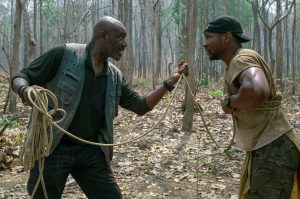 The last act of the movie is a big standoff with genuine stakes, and while it serves as a fun example of our older underdogs more than holding their own, it gets into the major theme of legacy. What will be these men’s legacy? What will the legacy be for a son who has never felt close to his father? What about a daughter who never knew her father? What will last beyond these men? The legacy of Stormin’ Norman informs and haunts the other Bloods; Paul practically breaks into tears confessing that he sees Norman’s ghost on a near daily basis. They all feel guilt over being unable to save Norman but also being unable to bring his remains home until now. Going back is not just about financial windfalls, it’s also about making good on a delayed promise. Talking about what the men will do with their shares of the loot allows each to fantasize about a more perfect life ahead, while at the same time coming to terms with their life’s regrets. This is where Eddie gets his most potent opportunity to stand out. The character too often just feels present rather than integrated in the narrative, but here he opens up about how his life might not be as perfect as his friends tease him about. Inherent in this ongoing discussion is the notion of what does sacrifice mean and for whom. Lee repeatedly threads historical footnotes of African-Americans being shortchanged after serving their country in wartime. Even though only making up ten percent of the U.S. population during Vietnam, black soldiers made up over 30% of the grunts on the ground. Paul says, “We fought in an immoral war that wasn’t ours for rights we didn’t have.” The Bloods view this gold as their long overdue reparations for being black in a racist country. However, it’s Eddie who won’t allow the Bloods to merely deal in grievance. He cites Stormin’ Norman and how they can improve the lives of the next generation even at their own expense. Even as the gunfire picks up and we have a misplaced mustache-twirling villain (Jean Reno), Da 5 Bloods is an action flick that has much more on its mind, looking to the past, present, and a better future.
 This is a compelling ensemble tale but Da 5 Bloods is clearly Lindo’s movie. Lindo has been a hard-working actor for decades, with roles in Get Shorty, The Core, Gone in 60 Seconds, The Good Fight, and a bevy of Lee’s films (er, “joints”) like Crooklyn, Clockers, and Malcolm X. But it’s the role of Paul that will serve as the actor’s finest career performance. There is so much pain and anger coursing under the surface with this character. Paul wears a red MAGA hat in proud defiance and to the jeers of his pals. Paul is a Trump voter who wanted to shake up the system, the same system that had let him down for his life. He’s haunted by his past, and even decades later, he can admit returning to the jungles is still affecting him. The gold represents something elemental, mythical to him, a lifetime-defining event that he needs to accomplish. As this zeal overtakes him, Lindo unleashes spellbinding monologues looking directly into Lee’s camera as he marches along, narrating his stormy inner thoughts, and trying to assess the contradictions of his life. Lindo doesn’t just play Paul as a hardass grumpy old man. He’s still reeling, from service, from fatherhood, from the decades having vanished, and from the setbacks to retrieve the gold. Paul’s odyssey takes on a religious passion play that builds him into a symbol of America’s unmet promises and fallibility. Even in uncertain COVID-19 times, I’d be shocked if Lindo isn’t nominated for an Oscar.
Netflix’s Da 5 Bloods is a great movie and invigorating reaffirmation that when Spike Lee really gives a damn he is one of our most essential filmmakers, even after 30-plus years in the director’s chair. The movie is packed with rich detail and character moments, little things to keep you thinking, and a blending of tones and texts that invites further analytical examination. At its core, it’s a story of friendship and legacy, and the actors are a great pleasure to watch grouse and weep and laugh together. Even at a taxing 154 minutes, I was happy to spend the extra minutes with these men and better understand them and their pain and their relationships. Even though the movie delves in loss and grievance, I found it to be ultimately hopeful and galvanizing. Something as simple as a hand-written letter can turn out to be more restorative than millions in gold bars.
Nate’s Grade: A-


 nathanzoebl
You must be logged in to post a comment.