Category Archives: 2010 Movies
Cats & Dogs 2: The Revenge of Kitty Galore (2010)
 Obviously this movie is bad. A sequel to a lukewarm family film from nine years ago, the chances were slim that Cats and Dogs 2: The Revenge of Kitty Galore would have ever worked. They don’t even have the temerity to have the subtitle read “Pussy Galore” for fear that repeating the most famous Bond girl name might cause parents discomfort. It’s a live-action talking-animal movie that posits that cats and dogs have been fighting an ages-old feud and they all have secret lairs and technology at their service despite lacking opposable thumbs. Really, premise alone you’re already lowering the standards, and with standards firmly and securely lowered, you may even laugh once or twice (that’s probably about it). It depends on how susceptible to puns you are because that is the primary joke vehicle. The film makes an attempt to throw animals into a Bond-styled action thriller with, pardon me, shaggy results. The character animation is poor, the dialogue feels like it was stitched from one groan-worthy pun after another, and yet Cats and Dogs 2 doesn’t offend with its sheer badness. Premise alone, you sort of watch the thing in a vegetative state.
Nate’s Grade: D+
Share this:

Love and Other Drugs (2010)
 Director Edward Zwick has spent the last two decades making mass-friendly action films with designed to teach us all some valuable lesson, like Blood Diamond and Glory. But the idealistic filmmaker began his career with realistic relationship dramas like About Last Night… and the seminal TV show thirtysomething. There wasn’t an explosion to be had, unless you count the emotional ennui of middleclass white people. Love and Other Drugs is adapted from the biography of a Viagra salesman, which seems like a strange jumping off point for a romantic drama. Watch out for those unexpected side effects.
It’s 1996, and Jamie (Jake Gyllenhaal) is a smooth-talking, suave pharmaceutical rep for the medical giant Pfizer. He’s been dispatched to the Ohio River valley area with a mission to push his drug samples on doctors and raise his quotas. While posing as an intern, he meets Maggie Murdock (Anne Hathaway), a coffee shop beauty in stage one of Parkinson’s (don’t attack me, they reveal this spoiler before you even see Hathaway’s face). She spurs his advances but he persists, and the two agree to a strictly sexual relationship. Because of her illness, Maggie is wary of getting attached to people. She sees Jamie as a shallow, well-muscled lunkhead who won’t want anything else but a slew of orgasms from a pretty girl. And Jamie is content, until, of course, he falls in love. Maggie feels she’s sparing her lover the pains that will accompany her Parkinson’s. The two struggle with her illness, the toll it takes on their relationship, and the possible future they will have together… in between lots of sex.
 The true pleasure of Love and Other Drugs is watching Hathaway and Gyllenhaal together onscreen. The Brokeback Mountain buddies have tremendous chemistry that makes their give-and-take exciting and pleasing. Hathaway and Gyllenhaal may be the best onscreen couple I’ve seen since 2005’s Mr. and Mrs. Smith. Chemistry is such an indelible component for romance and yet it is so elusive to capture. So when a cinematic couple really create some serious sparks, it’s a memorable exchange. Hathaway and Gyllenhaal are a terrific team but also the rare screen couple that raises the performance of their partner. You are easily convinced that these two enjoy the company of one another; they’re so confident with each other even as they’re tumbling around naked. Hathaway has grown into an actress of surprising range, making keen use of her animated Disney heroine features. She has a knack for playing defiant, spunky women that have an alluring fragility, and that also describes her Maggie (how does a coffee shop give Hathaway the health insurance she needs for Parkinson’s meds?). Gyllenhaal has always had his boyish charm, but he seems catapulted to new charisma heights with Love and Other Drugs. He’s exploding with energy and comes across bursting with life onscreen. He starts as a suave Lothario drunk on his own charms but, as movie journeys dictate, he morphs into a committed, mature man. The roles are pretty standard (slick selfish salesman, sad girl with illness) but the duo bring extra vitality and heat that makes Love and Other Drugs compulsively watchable in its finer moments.
It’s refreshing to witness a major Hollywood movie that treats human sexuality without the standard artifices of Hollywood. Love and Other Drugs is not coy when it comes to physical lovemaking. This isn’t a blockheaded movie where the woman goes through the entire night of passion while wearing a bra the entire time (the epitome of PG-13 sex). This isn’t a movie where after a healthy bout of sex the couple feels the need to cover up their goods as they lay beside one another. Like after a vigorous sexual experience now the lovers suddenly become bashful at their own state of nakedness (get the fig leaves – stat!). So it’s refreshing to watch a film deal with sexuality without giving undue attention to how “risqué” everything is. The nudity is European-style casual, and while the film manages to be quite sexy, the nudity and sex scenes do not play as shameless titillation. The sex and copious nudity is just another part of the storytelling. Of course it also happens to be a prominent and highly marketable storytelling aspect. It’s not like Hathaway and Gyllenhaal are homely actors. Watching beautiful people writhe together on screen and nonchalantly walk around without a stitch on has always been a sure-fire way to sell tickets. Love and Other Drugs utilizes all that skin to lure boys into a traditional romantic drama. It’s to Zwick’s writing and directing credits, and the natural chemistry of his two high-wattage stars, that the parade of flesh doesn’t feel like naked, prurient exploitation. It’s not exactly an edgy film by any means but it’s assuredly adult in its portrayal of sexuality. Or at least it thinks it is. The sex isn’t really a topic to be explored with nuance and clarity; it’s more something to keep the actors busy.
 Ultimately, the tonal inconsistency is what hampers the momentum of Love and Other Drugs. It’s hard to build narrative momentum when the film just seems to be starting over time and again. Zwick bounces around different tones, sometimes wildly from scene to scene. At heart it’s a weepie romance, the sick girl and her paramour coming to terms with their doomed love. But then the movie also wants to be an energetic, smart-alecky comedy, then there are all sorts of crude gags (hope you like boner jokes), and then the film also wants to be a satire on high-powered pharmaceutical companies and their sleazy influence romancing doctors. And then in between all that is the weepie drama stuff as Maggie has to deal with the (movie) realities of her illness. Here’s an example of the tonal whiplash that did the movie no favors: Jamie stumbles in on his disgusting younger brother (see below) masturbating to a sex tape of Jamie and Maggie, of his own brother and his brother’s girlfriend. The scene is played for broad comic laughs and ends with Jamie beating his brother off screen with that very sex tape. If people needed another reason not to make sex tapes, here it is: Josh Gad might one day view them and pleasure himself. You don’t want that, trust me. But then the very next scene involves Maggie working on her art and unable to control her Parkinson’s symptoms, namely finger tremors. We watch as Maggie diligently and patiently tries to open a bottle of pills, the childproof locked top confounding her stubborn fingers, only to eventually find that the bottle is empty and her symptoms will only increase. The fact that these scenes coexist right next to one another makes their differences all the more jarring. Love and Other Drugs tries to jostle diverse genres but the different tones never coalesce. As a result, you feel violently ripped from one movie to another.
Let me give due attention to just how revolting the character of Jamie’s younger brother is. Josh is a cancer on the movie. He doesn’t make a scene better but rather drags it down to a lower level. He’s slovenly, boorish, coarse, and routinely unfunny. You can practically feel his sweaty fingerprints pawing at the movie for attention. This character is abominable and repulsive. He inserts himself into Jamie’s home and offers no dramatic value. His purpose seems to be solely as a cheap go-to plot device whenever Zwick feels he needs a random profane joke. Gad (The Rocker, 21) is a comic that I have enjoyed in other contexts, but he’s got the wrong energy and feel here, succumbing to the angry desperation of his character. Josh serves no worthwhile purpose and just becomes a pathetic distraction for a movie that already doesn’t seem to have full focus on what matters. He’s supposed to be an annoying presence but this annoying? You probably won’t find a more unnecessary and loathsome fictional character in a movie all year.
 Zwick can’t keep tired clichés from clipping how high the film can fly. The film’s message about family over business feels trite no matter how much nudity tries to obfuscate it. The Parkinson’s angle is too easily transformed into melodrama. The film takes a trip to a Parkinson’s meeting in Chicago with real-life people suffering through different stages of the debilitating disorder. It draws a poor comparison with Maggie’s tremors, which start to seem like a lightweight Hollywood example of illness (like when a character coughs onscreen and it somehow communicates a quickly metastasized cancer). Even after shirking Hollywood conventions the movie manages to end in that tried-and-true fashion where the man has to chase after the woman to give the Big Speech about how he truly feels. The Pfizer storyline that follows the launch of impotence-crushing super drug Viagra feels like the first draft of a different screenplay or the last remnants of a different story that’s been hollowed out. It’s fairly superficial and meant to serve merely as the male lead’s occupation that he has to reconsider when love’s on the line. The side stories and side characters feel like distractions. Oliver Platt is a fine actor to have in your movie, just make sure he has something to do other than drive Gyllenhaal around. Also, the movie follows the lead from the cancelled TV show Cold Case in that every scene from the past has to be accompanied by some generic hit of the day, like a simplistic scrapbook of the times.
Love and Other Drugs feels tragically overextended and if only Zwick had only been more judicious this could have been a really solid film. There are three or four different films at play here. The tone never settles down, bouncing from broad comedy to weepie Lifetime-related drama. Gyllenhaal and Hathaway work wonders together with and without clothes. Their performances make the film stronger, and they make you wish that the movie had more going on for it than spirited rolls in the hay. You even wish there was more to the sex than simply large amounts of it. Zwick will always wear his liberal idealism on his sleeve and slip a message into his films, but this time the message is completely eaten alive. If anybody walks away from Love and Other Drugs with a blinding passion for prescription drug reform, then they must have been watching a different movie. The one I watched was amusing in spurts and had nudity.
Nate’s Grade: B-
Share this:

The Runaways (2010)
 This fizzy 1970s glam rock biopic on the teen girl rock group The Runaways is a fairly shallow tale elevated by a handful of strong performances. All but completely ignoring the other members of the famous girl group, the movie focuses on lead singer Cherie Currie (Dakota Fanning) and guitarist Joan Jett (Kristen Stewart). Both actresses slip under the skin of their real-life figures, imbuing the anger, desperation, and sheer nerve of pubescent rock stars being exploited. Watching Stewart’s attitude-filled strut, or how Fanning transforms from any other California girl into a slinking rock goddess igniting a Tokyo stage, is downright exciting to behold. But the chief reason to watch this film is Michael Shannon (Revolutionary Road) as the group’s flamboyant, lewd manager who put the girls together. Shannon is his typical bug-eyed sensational self, but the profane tirades he unleashes are downright poetic. He gives the movie a desperately needed pulse, and thus when he leaves the screen he also takes most of our interest. The biggest issue The Runaways has is that writer/director Floria Sigismondi doesn’t convince us why any of this matters. We watch the girls get together, play their first gigs, improve musically, and then all of a sudden they’re famous thanks to a magazine headline montage. Then they’re broken up. You neither feel the rise nor the fall, nor do you ever truly get a good feel for any of the characters. The Runaways spends too much time posing and trying to look fierce when it should have spent more attention on a decent script.
Nate’s Grade: C
Share this:

Splice (2010)

Splice is a slice of freaky-deaky sci-fi horror done with enough style and weirdness to keep your eyes glued to the screen. Director Vincenzo Natali (Cube) takes a few notes from David Cronenberg in staging his creature feature. A scientific couple (Adrien Brody, Sarah Polley) are about to have their gene-splicing lab shut down, so they make a radical decision to start an experimental personal project. Utilizing human genes, they combine other DNA to create a new species. The moral ambiguity and scientific danger is thoughtfully addressed, with the couple quickly finding how easy it is to make moral compromises. Soon they become attached to the creature they name “Dren” and view her as a daughter. Things get even crazier when Dren starts exhibiting some Oedipal desires (I believe the reverse is more fitting, an Elektra complex). Slick cinematography and seamless practical and digital effects help ensure that Splice is never dull. The movie seems two steps away from achieving true greatness. In the end, after all the intrigue and surprising amount of emotional subtlety given the premise, Splice devolves into a by-the-numbers slasher film. The final act is all about character poking around in the dark for the big scary monster. It’s not nearly as intellectually stimulating. In this regard, Splice reminds me of 2007’s Sunshine, another sci-fi film that started strong, had some style and brains, and then blew it by devolving into a clichéd horror movie where characters outrun a super-powerful slasher villain. As a fan of intelligent sci-fi, it’s frustrating to get teased with greatness and have to settle with pretty good, but I’ll gladly take the gonzo pleasures of Splice over any rote action thriller.
Nate’s Grade: B
Share this:

The Girl Who Kicked the Hornet’s Nest (2010)
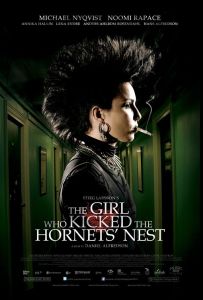 The worldwide publishing phenomenon comes to a close with the third and final film, The Girl Who Kicked the Hornet’s Nest. In the span of nine months, all three Swedish films, based on the late Stieg Larsson’s best-selling books, have been released stateside. Hollywood is already filming the first of three remakes directed by David Fincher (Fight Club), with Fincher’s Social Network star Rooney Mara in Lisbeth’s chunky shoes. Releasing three films in one year, mere months apart, has given the series the feeling of an event. The Girl Who Played with Fire left a lot to tie up, but audiences steeped in the Larsson’s sordid particulars should find something rewarding, albeit unspectacular, in this final chapter.
The third film picks up immediately after events from the previous story. Lisbeth Salander (Noomi Rapace), punky computer hacker and international badass, is being airlifted to a hospital. She is recovering from a brawl with her father that left her with a bullet in her skull and him with an axe lodged in his (surprisingly, both live. Credit Swedish healthcare). Her father, Zalachenko (Georgi Staykov), was a Soviet spy that defected to Sweden in the 1970s. He is a high-value informant, which means that anyone who would compromise or expose Zalachenko needs to be dealt with. And if Zalachenko is going to speak his mind, perhaps he needs to be silenced as well. Mikael Blomkvist (Michael Nyqvist), muckraking journalist and Lisbeth’s staunch ally, is trying to protect his friend and one-time lover by exposing the corrupt and powerful. Lisbeth is trying to be silenced, and if assassins don’t work then the state will try her for attempted murder and lock her away in a mental institution, the same institution that Lisbeth was committed to at 12 when she tried to save her mother by setting her abusive father ablaze. The sinister Dr. Teleborian (Anders Ahlbom) admitted Lisbeth when she was a child and is eager to have her back in his clutches. He and the other crooked government officials will stop at nothing to put her away and stop Mikael from publishing the truth.
 So at the axe-swingin’ conclusion of Girl Who Played with Fire, I felt that some of my conclusion had to be put on hold until I could see the third film, the conclusion to what seemed like one larger film. For Fire I wrote: “As such, it’s hard to fully analyze certain storylines at play. I imagine that the sex trafficking storyline will carry on with the third film because of the tease that high-profile figures in government and police offices were involved. It already establishes a conflict and a set of antagonists ready for the third film. Then again, I may be too hopeful and the storylines of interest in Part Two may be completely dropped or mishandled by Part Three (see: Matrix sequels, Pirates of the Caribbean sequels).” Guess what happened? Dropped storylines abound as well as a lack of follow-through on most everything but the major storylines involving Lisbeth’s tortured personal history.
Now that we can all witness how Lisbeth and Mikael have walked off into that Swedish sunset, I can finally and conclusively say that the second film is incomplete and will never be complete. The loose ends abound and characters are completely forgotten, like Lisbeth’s Asian friend/sometime-lover and her boxing pal who took a beating. Apparently their narrative purpose was to take Lisbeth’s licks (could this be the greatest double entendre in the history of film criticism? Yes). The brute that dished out those bruises is a blonde baddie named Neidermann who looks like he was ripped from a bad James Bond flick. He is a straggling loose end that circles the narrative like a lost child in a supermarket (“Are you my mother?”). The high-reaching sex trafficking ring featured in Fire has a tenuous connection to Hornet’s Nest; in Fire we talk about an Evil Shadowy Government and in Hornet’s Nest we see the faces of that Evil Shadowy Government Agents.
If the first film was a slow-burning and lurid thriller, the second film a preposterous action film, then the third film falls clearly into the genre of legal thriller. The majority of the plot revolves around the People vs. Lisbeth Salander. The sluggish opening gives way to a sluggish series of pre-trial preparations. Mikael assigns his sister to serve as Lisbeth’s attorney, and thus we see the behind-the-scenes arrangements as far as gathering evidence, building a case, plotting arguments and counter-arguments, preparing Lisbeth to confront the men who have caused her such suffering and anguish. And being a courtroom thriller, we also get a heavy dose of new characters, almost all of them elderly and somewhat menacing (a guy with cancer even becomes a hired gun for One Last Job). There are a lot of liver-spotted faces to try and sort through, so it helps when the filmmakers add touches to set them apart (one of them wears a bow tie, another has glasses). Given the lethargic nature of assembling a court case, the pacing can get pretty slack. Then there’s the issue of Lisbeth. She spends almost the entire movie in police custody and the first hour or so confined to a hospital bed. It doesn’t make for pulse-pounding stuff. Lisbeth is a willful, defiant, quick-witted creature so it feels like she’s like a caged bird in this third and final film.
 Rapace is starting to catch serious Hollywood heat and deservedly so because once again she commands the screen. At first when the series began I was unsure of her acting abilities considering her mysterious character is forced to respond through a prism of emotional reserve. She doesn’t speak much but her intense, cold stares speak volumes to the turmoil she has bubbling under the surface. Restrained to a hospital bed or a jail cell, Rapace is given even less to work with. The part is nearly mute for long stretches of plot. Yet Rapace finds new and interesting ways to channel her character’s intensity and allow the audience to view her thought process. It’s a sign of a talented actor when a character’s internal thinking can become transparent without the need for hyperactive expressions. Lisbeth Salander is a complicated character and the audience deserves to have such an intriguing presence fleshed out into three dimensions. I wrote about the disappointing downgrade of Lisbeth’s character in Fire: “We project the interest we felt for her from the first film to the Salander stand-in represented in the second film. She’s still a resourceful, loyal, and cavalier presence, but the plot corners her into being a creature of action. She becomes the fantasy bisexual ass-kicking protagonist that was merely hinted at previously. That sounds like a good thing, but trust me, it does the audience a disservice to box in such a fascinating character.” With Hornet’s Nest, we discover the extent of how men have damaged her, which focuses more attention on the person of Lisbeth rather than the Gothic aesthetics. It’s a return to form even if Lisbeth is still remote.
Luckily, The Girl Who Kicked the Hornet’s Nest does manage to offer a satisfying sense of closure. The series has several bad men doing bad things, so it’s rewarding that after sitting through close to seven hours of material yields some long-awaited justice for Lisbeth Salander. We yearn desperately for this pint-sized gal to get her vengeance and for the powerful to find their comeuppance. Watching the antagonists fall would be more fulfilling if they weren’t only introduced a mere hour ago in this movie. Salander doesn’t get to put on her Gothic war paint until her first court appearance. It feels like a triumphant return, complete with a towering and imposing mohawk. Blomkvist’s storylines will always be the movie’s weak point considering he has to compete with the likes of the audacious Salander. In Hornet’s Nest, his magazine team is threatened but you never really take any of it seriously, because of course the crusading journalist will stick by Lisbeth. The ending is less than desired and tries to recycle some of the same action tropes that lead Girl Who Played with Fire astray. The final scene leaves you with a sense of, “Oh, so that really is it? Better get my coat then.”
 The Girl Who Kicked the Hornet’s Nest works as a mostly fitting capper to a long-standing mystery series. The bad guys are punished, the good guys prevail, there’s an open-ended resolution that leaves you squirming for more, especially now that Lisbeth is a free woman. At a bloated 145 minutes, Hornet’s Nest can often feel like an overextended Swedish episode of Law and Order. There’s a good 45 minutes that probably could have been left on the cutting room floor. At times the movie feels like it’s lurching along, caught up in the mountain of details. But then it generally finds a way to regain momentum and head to a satisfying close. Still, it’s disappointing that for the majority of the two sequels Lisbeth and Blomkvist have rarely been onscreen together. They worked so well as a team in the original Girl with the Dragon Tattoo. I never would have thought that the sequels would take that concept and keep them apart for as long as possible. Too bad author Stieg Larsson isn’t around to write new adventures for his characters, though there are rumors about an unfinished fourth manuscript left on Larsson’s laptop. Until that gets sorted out between Larsson’s widow and his family in Swedish court, I guess the world will have to settle for the forthcoming Hollywood remakes.
Nate’s Grade: B-
Share this:

Harry Potter and the Deathly Hallows Part 1 (2010)
 When author J. K. Rowling dropped off her last 700-page tome in the Harry Potter series, the world went into a state of mourning, right after ravishing every page of The Deathly Hallows. There would be no more literary adventures. You can expect that same sense of longing for the studio suits over at Warner Brothers considering the Harry Potter franchise has grossed over five billion worldwide. The bounty was about to be over, especially with one last book to adapt into an eventual overly long movie. Then the suits came across a genius strategy: split the last book into two separate movies. Filmed simultaneously over a year, Harry Potter and the Deathly Hallows will be released in two parts eight months apart. I understand that it’s hard to say goodbye to the boy wizard that charmed millions, and tow movies almost guarantee that nothing will be left out in the adaptation process. It also ensures that Warner Brothers will have two movies that make giant piles of money instead of one. Deathly Hallows: Part One plays its part setting up the finale, but judging from what we’re given, this series conclusion could have effortlessly been condensed to one overly long film instead of two.
Picking up shortly after the events of Half-Blood Prince, Harry (Daniel Radcliffe) and his best pals, Ron (Rupert Grint) and Hermione (Emma Watson), are on the run. Lord Voldermort (Ralph Fiennes) is determined to be the one to slay the boy wizard. Voldermort and his influence have taken over many facets of the magic world’s infrastructure, and they are all after Harry. Harry learned that his snake-faced nemesis has broken his soul into pieces and hidden them inside magical items known as horcruxes. Unless these horucruxes are destroyed, Voldermort will never be able to truly die. Harry and company has to hunt down those accursed horcruxes while being hounded by evil forces determined to kill them all.
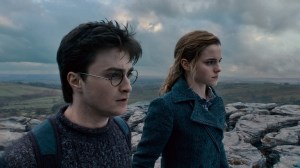 For a solid hour I felt like I was watching the second best Harry Potter film; Alfonso Cuaran’s Prisoner of Azkaban still stands as the artistic highpoint. Watching the characters on the run and constantly in peril spurs your protective feelings. We’ve seen them grow up, vanquish evil and hormones, and now they seem to be in serious danger and you feel real tension. I stopped to realize how much I actually cared for these characters and how concerned I was. There is a somber sense of finality, and I enjoyed characters and events colliding back together for one big finish. It truly feels like everything is coming to a titanic close, and the film manages to be the most emotionally satisfying of the series. That’s likely because it’s building off six films of character growth and goodwill. But it’s also due to the fact that Deathly Hallows spends the most time examining the characters of Harry, Ron, and Hermione. The series has followed a very lockstep plot formula and now it’s been stripped away. The kids are removed from the school setting so we get to spend plenty of time alone with the trio. In fact, it’s a bit too much time. We spend an interminable amount of time with these kids lost in the woods, waiting for something important to happen. While we wait we have the trio address fears, anxieties, and emotional hang-ups, which turns Part One into the most insular, reflective movie in the entire series. While this makes the movie rich with feeling before we come to the finish line, it also makes the film somewhat boring because these kids aren’t that deep.
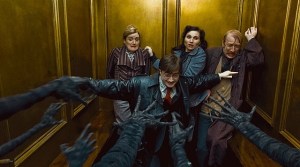
Luckily, Deathly Hallows Part One presents some of the more exciting action sequences and tense mood yet for a franchise mostly built upon investigation and Hardy Boys stuff (with extra magic!). The Harry Potter world has always been more interesting to me the darker it got, and now the series has now firmly converted to the dark side (as far as PG-13 fantasies go). The opening shows each of the three kids being left alone, including Hermione protecting her Muggle parents by wiping away their memory of their daughter. Tough stuff. Then we transition to a floating Hogwarts teacher held prisoner by Voldermort and his legion of Death Eater followers. She’s struck dead and we see a tear roll down her bloodied face right before Voldy’s pet snake eats her. Parents be warned, this is no longer kid’s stuff. Death comes to several supporting characters and there’s plenty of spooky stuff that adds up to a gloomy atmosphere. The infiltration of the Ministry of Magic is a thrilling sequence. Harry and pals disguise themselves as Ministry workers to locate a horcrux from Dolores Umbridge (I cheered at the sight of Imelda Staunton back in pink). The scene is tense and lays out the stakes and important characters to fear. It also produces some potent drama as Ron is disguised as a Ministry member whose innocent wife is being interrogated. The moment culminates in a genuinely exciting chase sequence that got me excited for what was ahead. What I failed to realize is that there was not much more ahead.
 With all that extra attention spent on character, I can also say that Part One has some definite issues with its stagnating narrative. Having never read the books (get over it, Potter nation), I go in blind every time short for the mega-spoilers that I can’t help but learn thanks to all the Potter readers inhabiting my circle of friends and family. I can tell you if something doesn’t make sense because I don’t have the background knowledge of the books to fill me in. There was plenty in Deathly Hallows that made little sense. The adaptation introduces the titular deathly hallows, which ends up being another three super special magic items. There’s a nicely Gothic animated sequence to try and explain the three hallowed items, but it all adds up to a fairy tale that makes little traction. The narrative has already shaped up into a portentous scavenger hunt. Harry and friends are after the remaining horcruxes containing the soul of Mr. Snarly Face. The entire 145 minutes of Part One is spent destroying a single horcrux, leaving 3 or 4 remaining. Now they add three more magic items to find and it all compounds my feelings of fatigue. Did I mention they also have to find a magic sword? How many magical items are these kids going to be responsible to find and how many am I expected to care about?
I left the theater with many questions about what the hell the deathly hallows were, why they mattered, and all sorts of other storylines too. I could not follow all the new characters they threw so late into the game, especially some old wand maker and his connection to wand thievery. And when the hell did everyone gain the ability to teleport at will? Why don’t they teleport all the time then, especially out of danger or when they’re chased through the woods? My friend (an avid Potter reader) had to deal with a litany of stupid questions, likely treating me as a parent would a child asking about where the sun goes when it becomes night.
Also, the film is intended to be a prelude for an epic finale but it mishandles its own sense of climax at several turns. I’ll refrain from heavy spoilers, but one of the most interesting characters, played by an actor I adore, is killed off screen. Off freaking screen! Some other character comes back and says, “Oh yeah, he’s gone,” and then everyone looks glum and goes about their business. It happened so matter-of-factly and anticlimactically that I never made the connection. So later in the film when it’s confirmed that this character is in fact dead, I felt pretty thick. The last chapter of Harry Potter is destined to be a combined 5 hours, and you’re telling me they couldn’t fit in a fight scene that lets this character go out with style? I suppose somebody thought it was more dramatic to just mention a character death offhand. Following this logic, I can’t wait for the grandiose finale where Harry Potter just walks back into a room and says, “Oh, by the way, I just killed Voldermort. So who wants to get a bite to eat?” The emotional climax of the film involves the death of a supporting character I have yet to see onscreen for 8 years. How am I supposed to feel for a character that hasn’t been seen for so long? The ending is sad, sure, but it would have been more effective if: a) I knew what significance the character had in the narrative, and b) it didn’t look like Harry was clutching a rubber doll to his chest. We spend too much time with new characters that end up having minor worth or come across as one-offs. The movie would have benefited from some of the deathly exposition that clogged the first two film’s storylines. As the movie comes to a close it should be clearing things up instead of polluting the narrative with more names and faces.
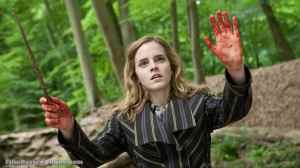 Director David Yates has been captain of the Potter helm since 2007’s Order of the Phoenix, and he seems to have found a unifying visual balance for the series. The film’s tone has gotten heavier and having a singular director take the series to an end looks to be a godsend. Despite a lengthy slog in the middle, Yates keeps the pacing fairly tight and tense. The visuals and special effects are just as luminous as ever. The true treat for me is watching all these splendid British actors assembled: Alan Rickman, Ralph Fiennes, Imelda Staunton, Helena Bonham Carter, Timothy Spall, Jason Isaacs on Team Evil, and Brendan Gleeson, David Thewlis, Rhys Ifans, Julie Waters, Robbie Coltrane, Michael Gambon on Team Good. Then there are new additions like glass-jawed David O’Hara (Wanted) and the great Peter Mullan (Young Adam) making strong yet short appearances. I don’t really care why all these talented thespians are together but I’ll enjoy them all the same.
Harry Potter and the Deathly Hallows: Part One is the beginning of the end, literally a prelude for the finale coming to theaters in summer 2011. The film manages to be exciting and dramatic and equally boring and confusing, especially for someone who has willfully refused to read the books. Spending more time with the teen actors has its pluses and minuses, chief minus being that while they wait for stuff to happen so do we. The manufactured end point for the movie feels far from satisfying, but the film manages to effectively whet the appetite for the follow-up. As the Harry Potter series comes to a close it’s hard not to get nostalgic and apologetic, but I resist this urge. Looking back, many of the Potter films have been fine pieces of entertainment but also too long, misshapen, and too slavish to making a book on tape. Part One of Deathly Hallows still falls victim to some of these faults, but the accumulated goodwill of the series and actors makes a 145-minute prologue easily bearable.
Nate’s Grade: B
Share this:

Jonah Hex (2010)
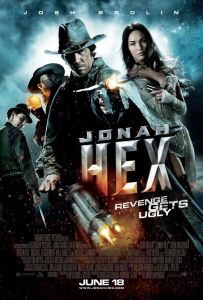 Clocking in at barely 73 fraught minutes, Jonah Hex is a bizarre Western sci-fi hybrid that never really stops to fully explain the rules of this universe. Josh Brolin, who does what he can with the disfigured badass, plays the Hex of title. Hex has a facial deformity along his mouth, which means it’s hard to understand whatever the man is saying as he slurs and mumbles the majority of his tough guy talk. It’s not smart to have your main character unintelligible. Watching Jonah Hex gives you the impression that nobody, cast and crew, knew what was happening. One minute Hex rides a horse with a, I kid you not, double gattling gun, and the next he’s fighting against a crazy John Malkovich who wants to build Eli Whitney’s doomsday machine. Did I also mention that Hex can bring people back to life for short periods of time via his magic touch? The look of the film is overly aggressive, with a rock guitar jackhammer score and plenty of souped-up special effects shots that try and ignite some flailing sense of excitement. It’s hard to get excited about a movie that feels so soulless. Jonah Hex feels like some studio shill thought they could buy a comic property and fill it with sure-fire elements that would please a teenage male base. Megan Fox (Transformers) in a bodice can only distract from the gaping void of a cohesive screenplay for so long. Then you stop and remember how much this movie sucks.
Nate’s Grade: D
Share this:

The Karate Kid (2010)
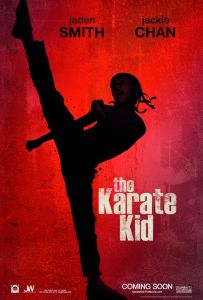 Was this ever a refreshing revelation. This transplanted Karate Kid remake takes the basic elements of the seminal 1980s underdog sports film and makes a rousing, satisfying, and surprisingly emotional experience. It sounds like sacrilege to take on a classic and fill it with an aged Jackie Chan and Will Smith’s progeny, but by God it works. It all works. It’s clear that pint-sized Jaden Smith (The Pursuit of Happyness) is a chip off the old block; he’s got a natural charm and feels like he can turn it on at will. His acting doesn’t come across as forced, and the kid can even tackle the heavier dramatic stuff with shocking ease. The other benefit to Smith is that he LOOKS like a true 12-year-old kid, gangly and scrambling for protection and self-confidence. Ralph Machio was in his early 20s when he was waxing on, waxing off. Smith and Chan have a bristling chemistry, and I ended up eating my words when Chan channeled a succession of teary emotions. The teacher/student dynamic leads to enough satisfying moments to feel like you’ve gotten your money’s worth. The same lessons of discipline get a fresh coat of paint. There’s no real reason that a Karate Kid remake needed to be made (it feels like China funded it as an unashamed tourist commercial) especially since there were three sequels of varying quality. While a little long with an overextended kung-fu tournament, Karate Kid is a family film that won’t melt your brain.
Nate’s Grade: B
Share this:

Birdemic: Shock and Terror (2010)
 Ever since the organic, years-in-the-making cult ascent of The Room, every blogger and journalist has been trying to scour the world of inept cinema to crown the next great worst movie of all time. We all want to be kingmakers of camp. In the summer of 2009, After Last Season mystified audiences and seemed like it could be an excellent camp candidate, until people actually saw the film and discovered that it was more painful awful than pleasurable awful. Then a few months ago a new contender emerged — Birdemic: Shock and Terror. The extremely low-budget ($10,000) film, curiously dubbed a “romantic thriller,” is the THIRD film from writer/director/former software engineer James Nguyen. The Sundance Film Festival rejected his aviary masterpiece in 2009 but that didn’t stop Nguyen. He took a van, decorated it with (fake) dead birds, drove around promoting the film with the aid of screeching eagle cries, enticing people to come inside and watch the movie (sounds like the first reel of a serial killer film to me). The magic mixture of romance and eco terror has captured the interest of major media outlets like The New York Times, Entertainment Weekly, The Guardian, USA Today, BBC News, The Wall Street Journal, CBS News and ABC News, and the collective sugar-high rush to judgment says that Birdemic is “the worst film of all time.” Naturally, I had to see anything that vies for that hallowed honor.
For a movie citing the shock and terror of birds, it may be something of a shock that, short of a poorly rendered CGI dead bird on the beach, the first 40 minutes of this movie are absent the titular winged creatures. The first half of this movie is a mostly boring yet hugely personally eventful week for Rod (Alan Bagh) and Nathalie (Whitney Moore), our witless leads. Rod scores million dollar sales at his software company, which leads to Oracle buying the company for a billion dollars. He also successfully finds a venture capitalist to invest $10 million in his own solar panel startup. Nathalie, Rod’s high school classmate, is an underwear model. She goes from a photo shoot –in a one hour photo store in a strip mall!– to the cover of the Victoria’s Secret catalogue. They meet at a diner and then go on a series of dull dates, culminating in Rod responding to a goodnight kiss on the cheek with the request of going upstairs in her apartment (total misread of the signs). Regardless, Nathalie tells her mother that Rod is a special guy who’s not just interested in one thing, conveniently ignoring the end of the date. He meets mom and then after a night of hilariously, uncoordinated Caucasian dancing at a vacant bar, the two decide to consummate the relationship in the most romantic fashion possible — a seedy motel bedroom. And yes, they both have homes. It was at this point that I checked my watch and yelled, “Where the hell are the birds already?!”
It is after the off-screen lovemaking that the birdemic finally strikes. The next morning, for no discernable reason, birds turn into kamikaze agents and dive-bomb gas stations, cars, homes, and whatever else, causing explosions citywide. Rod and Nathalie team up with another motel pair, Ramsey (Adam Sessa) and Becky (Catherine Batcha), who conveniently have a stash of high-powered automatic weapons in their van. The gang fights their way to the van and then the rest of the movie turns into a series of mini-adventures finding victims and survivors of the birdemic.
 I will give Mr. Nguyen his due. His clueless naiveté is endearing, which makes the movie much easier to appreciate. Plus, unlike the filmmakers behind After Last Season, Nguyen has at least a competent idea of how movies are supposed to work. He doesn’t have any visual talent but he at least knows how camera compositions are supposed to be established, how editing orients the audience, and how to construct a story that people can at minimum follow. This is not intended as backhanded compliments, just another reminder at how monstrously appalling After Last Season was. It’s gotten to the point that basic competency is considered a virtue. Nguyen knows basic cinematic rules and the visual vocabulary that goes with cameras. He doesn’t have the skill to do anything else. The film was shot on DV and yet it constantly has focus issues. Characters will be stationed at distances that render them blurry. If Nguyen had a focus limit, why have the actors routinely wander outside that safe zone and into the blurry reaches of nothingness? Then there will be moments where it is painfully obvious that the background is a green screen, but why was that necessary? Nguyen will have two characters sit down at a restaurant, and then the rest of the table conversation will be green screen. That has to be the weakest excuse for a green screen ever (“We couldn’t afford to shoot people sitting at a table for an extended period of time”).
The editing is frequently choppy, jumping around to disorient the viewer, breaking visual rules of geography, but the editing seems on a timed delay. Every new shot/scene seems to start three seconds later than it should. The worst offense in the whole movie is the sound quality. Clearly using only the built-in microphone from his camera, Nguyen allows great portions of his movie to be un-listenable. A day at the beach turns into listening to the wild howl while it obscures all dialogue.
Birdemic has all the requisite components that make up a delightfully bad movie: bad acting, bad dialogue, plot holes, bizarre directorial and script decisions, and extreme awkwardness. For an outbreak of killer birds, everybody seems so resolutely casual about this aviary apocalypse. There is no sense of urgency or danger; characters will stroll in their walks and frequently make outdoor pit stops. One female character is killed after she wanders needlessly far from the safety of the van to pee. They didn’t decide that an indoor bathroom would be safer? The gang also decides to wander through a crowded forest, a habitat that might, you know, attract birds. Then there’s the careless frolic on the beach, again needlessly far from the refuge of the van. Rod is held up by one motorist for gas (yes, society has broken down that far in hours, and yet you can watch hundreds of cars pass along the other half of the road, foolishly driving toward the birdemic and their doom). But then Rod leaves behind the full gas container and hops back into the van, escaping a not so imminent bird attack. They keep venturing to outdoor areas to escape an enemy that utilizes the sky. They even have a picnic! In short, these people are dumb.
 But, to be fair, maybe they’re reacting with such relaxation because the birds are more laughable than intimidating. Nguyen recycles the same low-rent special effects of birds mysteriously levitating. They flap their wings but don’t ever seem to be moving. These CGI creatures look like early computer effects from the 1990s. These birds seem to explode on impact. I wouldn’t be too alarmed, either. When the gang leaves the motel, the bids hover and squawk, and some characters use coat hangers to swing away their non-moving antagonists. Ramsey doesn’t even try to fight them off after a few seconds. He just stand there while the birds fail to do anything. They keep appearing in swarms, though they seem to purposely be following our band of dumb characters. The second half of this movie mostly follows characters shooting and driving. You start to anticipate that the Duck Hunter dog is going to appear at some point and pick up the fallen carcasses and snicker. Avatar, this ain’t.
To call any of this acting would be a generous use of the term. Moore, as Nathalie, might actually be a plausible actress. She handles the material the best. Her onscreen love interest, on the other hand, is astoundingly bad. Bagh has mastered the aloof, dead-eyed stare, which he uses as his specialty. When Rod first meets Nathalie he gazes in one long unbroken stare, which communicates more “Did I leave the gas on?” then, “Is that the girl I sat behind in an English class and never talked to?” Bagh seems to have learned his lines phonetically because his line delivery is steeped in a singsong rhythm. The dialogue is mostly short exclamations that give no indication of character or plot. It’s hard to gauge the acting ability of clear non-actors in a trashy movie. It’s all a sliding scale.
Nguyen has been working on the story of Birdemic for five years. This labor of love was also Nguyen’s platform to make mankind think about its effect on the environment. Yes, the movie has all sorts of environmental messages squeezed in, where characters debate the ecological motivations of the bird attacks. A Tree Hugger (that’s his literal screen credit) theorizes that the birds are fighting back to protect Mother Nature, that’s why they seem to go after cars and gas stations. A doctor in Canada (we’re informed that the van leaves the country by watching it drive past an arrow pointing to the U.S. border written in sidewalk chalk) theorizes that the birds from Canada were infected with the notorious bird flu, and then it spread south. The doctor also gets the opportunity to declare man the most deadliest threat of them all, thus fulfilling a sci-fi disaster movie requirement. The TV news alerts about the peril of global warming, and even though the film is set in 2008, the characters see An Inconvenient Truth at the theaters (“An important movie!”). The environmental message doesn’t begin to approach cohesive commentary.
 As I was watching, I got the weird impression that Nguyen had been commissioned to film a tourist video for the city of Half Moon Bay, California. Then somewhere along the line the promotional project was scuttled and Nguyen looked at his assembled footage and said, “Well, why not make the most of it?” Ladies and gentlemen, Birdemic: Shock and Terror is “the most of it.” There are numerous scenes that serve no purpose other than highlighting some of the offerings of Half Moon Bay, from the quaint local shops, to the lighthouse, to its beaches and natural beauty, truly Half Moon Bay is where you want to spend your next vacation. There are pointless scenes of extended driving. The first three minutes of this movie is watching Rod drive to the office from the scenic view of his dashboard. The opening sequence mirrors Manos: The Hands of Fate, which began with over 10 minutes of uninterrupted driving shots. The opening is even more mind numbing because Nguyen plays the same 55-second piece of music over and over. So the next time you’re driving through California, think about stopping in Half Moon Bay, home of the world-famous birdemic.
Now comes the inevitable, and somewhat subjective part, where the critic must place Birdemic upon the scale of Absolute Awful ranging worst of the worst (Manos: The Hands of Fate) to the best of the worst (The Room). The people behind Birdemic are trying to streamline the cult phenom process. It premiered in New York City in early 2010 and is already being funneled to many markets. It all feels a little too manufactured for my tastes, like the media is so eager to be ahead of the hipster curve. Birdemic is a perfectly enjoyable laugh-out-loud experience best had with a bunch of your friends and perhaps some adult beverages. It’s a fine piece of derisive entertainment thanks to the sincerity of Nguyen. But in the world of bad, The Room still reigns supreme. Whereas Birdemic has plenty of bad housed in 90 minutes, it’s pretty much the same bad decisions and limitations. I look forward to Nguyen’s next film, Peephole: The Perverted. You just can’t go wrong when a movie has a subtitle, “The Perverted.” He may not be Tommy Wiseau, but this man knows how to make some tasty trash.
Nate’s (Derisive Enjoyment) Grade: B+
Share this:

The Last Song (2010)
 Miley Cyrus is tragically miscast and way out of her depths in this mawkish drivel. I don’t really understand the appeal of Billy Ray Cyrus’ achy-breaky star progeny. The girl’s all teeth. Her acting repertoire from her gigantically popular Disney TV series and movies has lead Cyrus to the motto that bigger is better. She plays every scene much louder and bigger than required, mistaking volume for drama. I don’t think (right now at least) that she has the acting capabilities to carry a drama, let alone a drama weighed down by so much overly serious, heavy-handed material. But then heavy-handed is a Nicholas Sparks trademark, same with someone dying of a terminal disease by film’s end (the streak continues). What’s remarkable about The Last Song‘s ineptitude is that Sparks wrote the screenplay and the novel at the same time, tailoring it specifically for Cyrus. The part was written with her in mind, which makes the failure even larger. Cyrus cannot do teenage angst to save her life. If you wanted a moody, angst-driven, hip-to-be-square, believable young actress, then they should have hired Kat Dennings (Nick and Norah’s Infinite Playlist). Cyrus is a troubled teen who mopes all summer, forced to spend time with her divorced father (Greg Kinnear, fighting to find some dignity in the film) before, well, you can guess where we’re headed. For melodrama, it all comes across as fairly dull and sterile (PG-13: wrestling in mud, PG: throwing mud). What’s even worse is that the titular “last song” Cyrus performs to honor a fallen loved one is powerfully bland. And yet I have the sneaking suspicion this stab at expanding Cyrus into adult roles could have been much worse. As it is, The Last Song is a sudsy dud.
Nate’s Grade: C


 nathanzoebl
You must be logged in to post a comment.