Category Archives: 2009 Movies
Race to Witch Mountain (2009)
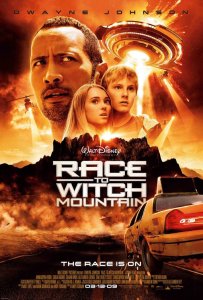 Does anyone ever fondly recall, let alone even recall, the 1975 original children’s film, Escape to Witch Mountain? This remake is Disney-fied in all places. It’s a lackluster kiddie adventure with more special effects, car crashes, and one-liners. Dwayne “The Rock” Johnson cements his tight grip on the family film genre; I really like this guy as an action hero and as a charismatic comedic actor, but being a wisecracking chauffeur to monotone yet strikingly Aryan-looking space aliens isn’t cutting it. The little green pre-teens need to get back to their ship and escape the clutches of government agents and an alien killer. This is one of those movies were everyone leaves their brain at home. This is the kind of movie where everybody is profoundly stupid and easily tricked. You’d think space aliens and intergalactic travel and psychic abilities would be met with more than incredulous jokes. Regardless, Race to Witch Mountain is devoid of fun, wonder, and excitement despite a decent effort by the assorted cast. This is lazy, by-the-numbers stuff masquerading as quality family entertainment. Families and children deserve coherent stories with actual characters and action sequences that feel like they matter. The only thing that really matters in Race to Witch Mountain is the fact that nobody will remember this movie in 35 years time, allowing Disney (or whatever alien/robot/alien robot overlords run the show at the time) to follow through with another thoughtless, mechanical remake.
Nate’s Grade: C
Share this:

Adam (2009)
 It’s a romantic comedy with a quirk. Adam (Hugh Dancy) has Asperger’s syndrome, a higher-functioning level of autism that makes social interactions difficult. Lucky for him he?s handsome enough that his new neighbor (Rose Byrne) falls for him anyway. What follows is mostly standard romantic comedy stuff, with boy and girl feeling each other out, except Adam has trouble with figurative language and implied speech. The movie works on a low-key cuteness as it hits all the conventional plot destinations, but then it charts its own path for an ending. I give credit to writer/director Max Mayer for bucking formula and following his convictions, refusing to tie everything together so easily. With that said, the Asperger’s portrayal seems to go into an extreme, Rain Man-level of social disability. Adam is crippled with fear even to leave his home; he is a slave to routine. Dancy is a sympathetic lead, though he’s overly reliant on his character’s quirks. Adam isn’t a freak or some delicate flower needing to be protected from the rigors of reality, and I think the movie would have benefited from a broader look at Adam’s ongoing lifelong struggle with his brain. Mostly, audiences are served up a sweet if somewhat plain romance with an extra dash of eccentricity, but not enough to rock any rom-com sensibilities. It’s a non-threatening alternative to the genre.
Nate’s Grade: B
Share this:

Humpday (2009)
 There’s a definite squeamishness out there when it comes to the idea of men expressing intimacy. Brokeback Mountain proved even liberal Hollywood wasn’t ready to anoint a movie about two gay dudes secretly getting it on. There will be large portions of people that will refuse to give a movie like Humpday a chance simply because of its premise: two guys plotting to have sex. It’s not a dirty movie by any means, nor does it get graphic with details or conversations. But the movie exactingly explores the uncomfortable relationships men have with expressions of romance. Humpday is also extremely funny in that pained, awkward sensibility, and I challenge the squeamish to give this charming indie a shot at love. If it makes it any easier for people to take (SPOILER ALERT) they don’t actually go through with it.
Ben (Mark Duplass) is living a comfortable existence with his wife, Anna (Alycia Delmore). Then one day his old friend from college, Andrew (Joshua Leonard), unexpectedly visits. Andrew has lived a Kerouac-like existence on the road as an aspiring artist. The two guys catch up on old times and Andrew invites Ben over to a party. He ditches his wife, and her pork chops, for the party, which turns out to be hosted by a group of free-love artists. The alcohol-fueled conversation lands on Humpfest, the annual amateur pornography festival held in Seattle. Ben and Andrew come up with their own entry idea: two straight guys that will have sex. “That’s beyond gay,” somebody says. Both men refuse to back down. Ben books a hotel room. The only thing he has to do now is tell his wife about Andrew’s “art project.”
 Humpday explodes male sexual insecurities better than any film since 1997?s Chasing Amy. Each man refuses to back out of having gay sex because they don’t want to be seen as less masculine. It’s masculinity brinksmanship, willing to go all the way to prove superior heterosexuality through a homosexual act, and it?s nothing short of brilliant. Neither Ben nor Andrew wants to “puss out” on their big moment. But neither of them really wants to go through with it either, which leads toward tremendous amounts of awkward comedy. Writer/director Lynn Shelton has fashioned a scenario that is hilarious but also subtlety heartfelt; many films deal with the bromance of heterosexual love, but Shelton pushes it to the limit. These two guys do care about each other, and you can see their camaraderie as they recount old stories and open up to one another, and in the end they might be willing to go to the extremes for their friendship, whatever the consequences may be.
Both Ben and Andrew have deep-seated insecurities about their personal lives; Andrew wants to live a free-spirited artistic lifestyle but is really too scared to fully commit, and too “square” for abandoning all sexual inhibitions like some of his casual artsy pals; Ben has a house, a job, a wife, and feels defensive about his life choices, particularly the idea that he’s settled down and giving up. Both men are also insecure by sexually adept women, so it may be natural that they seek the company of each other for solace and mutual understanding. The final act, where the two friends meet in a hotel room for their big night, is a slice of awkward comedy heaven. They haven’t worked out any logistics, locations, warm-ups, anything, and watching them verbally hatch a game plan is hilarious and oddly touching in equal doses. They really don’t know what they’re doing and why they’re there.
The actors have a naturalistic feel because, as I’ve found, the dialogue was almost entirely improvised. They shot in chronological order so to build from conversation to conversation, and you can feel the character dynamics strengthen and deepen. Duplass (The Puffy Chair) has a great, wide fake smile that hides a lot of anger and dissatisfaction. He’s sort of a schlubby everyman that we can empathize with even as he moves forward with his participation in the “art film.” Leonard (The Blair Witch Project), and his scraggly beard, effectively conveys a man weary about where his rugged life has led him. He is also hiding behind a guise, the guise of being a nonconformist that chooses to have no earthly ties, but bit-by-bit you see that Andrew is tired of disposable human connections. Leonard and Duplass feel like life-long friends. Then there’s Delmore, who really is the wary, incredulous voice of the audience. She too comes across as realistic under the circumstances, and her reaction when she discovers the true purpose of the “art project” is volatile, yes, but also surprisingly reflective. The three leads never feel like actors; the illusion that these are real people is never broken even given the peculiar circumstances of the premise.
 What I really appreciated about Humpday is that every moment feels genuine and every scene has a point. I was amazed that Shelton and her small unit of actors had made it so that every conversation had purpose; there is so little fat to this screenplay. Each scene reveals something new about a character or pushes the narrative forward toward its uncomfortable climax, and each moment never breaks the reality of the story. Given these characters and the amiable direction they follow, Humpday is believable. I suppose it might be easy to dismiss it as another entry in the fly-on-the-wall “mumblecore” film series gaining traction in independent cinema, but Humpday is really more an observational character study that examines male relationships and the sexual politics of being a “man’s man” in today’s world of sexual liberation. There is a nuanced perspective on human sexuality here that I may be erroneously crediting to Shelton simply because she is a woman. It helps to have a more mature, open-minded perspective about the complexities of human behavior for this story to succeed, and I think a female presence behind the camera affords that luxury. There is commentary below the surface; however, Humpday can be entirely enjoyed as a surface-level comedy of an awkward heterosexual showdown.
I find it interesting that the original theatrical poster only featured the two shirtless guys eyeing each other, and with a pink background no less. The DVD cover has inserted Anna between the two guys and gone with the more boy-friendly blue background cover. I think this tiny detail is another reflection of just how uncomfortable the subject matter is for many people. Humpday is an insightful, perceptive little character study that feels real and honest, while at the same time the movie doesn’t allow sexual politics to become the headline. The movie remembers to be funny, often, and any discomfort is worth it.
Nate’s Grade: A
Share this:

Terminator Salvation (2009)
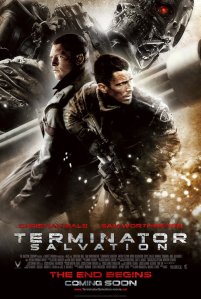 The fourth Terminator movie ultimately comes across as a lifeless enterprise. It’s set during the war between man and machine, which means John Conner (Christian Bale) is leading the human resistance, as was prophesied. He must stop those crafty machines from finding and killing Kyle Reese (Anton Yelchin), who is destined to be sent back in time and become Conner’s father. The storyline focuses a lot more attention on the mysterious man Marcus (Sam Worthington), who isn’t so mysterious because they give away in minutes that he’s a machine. But he’s a thinking machine that reclaims his humanity, or whatever. The point of this movie is to make some cool action sequences and not step on the toes of the previous movies. Director McG (Charlie’s Angels) has a few nifty visual tricks up his sleeve, but this is one soulless machine just going through the Action Blockbuster subroutine. The character development is nil, the story is muddled, the machines are dumb, and Bale forgoes any normal kind of speaking voice in favor of growls and hissing. The throwbacks to the other movies can be fun (a 1984-aged Arnold!) or agonizingly lame (shoehorning in famous quotes like, “I’ll be back”). The movie is competent and has one or two exciting chase sequences, but that is simply not good enough coming from this storied action franchise. Terminator Salvation plays out more like Transformers, where the robots are big and bad and loud and sort of dumb. I guess that sums up the movie pretty well.
Nate’s Grade: C+
Share this:

Up in the Air (2009)
 Up in the Air is the kind of movie that slyly sneaks up on you. This charming comedy is much like George Clooney’s character, a man paid by cowardly bosses to fire their employees. He’s so good at his job that his skills appear effortless, but at the same time he can take heavy subject matter and make you feel better and thankful afterwards. The topical backdrop of corporate downsizing and layoffs could produce plenty of easy pathos, but Up in the Air works expertly on several layers; it’s a brisk, clever comedy with revealing repartee; it’s an adult romance that blissfully lets them behave like mature adults; and it’s a moving character piece about people realizing what they have gained and lost due to their lifestyle choices. When Clooney is fighting back tears from a crushing disappointment over being overlooked to walk his sister down the aisle, it may be the most compactly perfect moment of acting in his career. Throughout director Jason Reitman’s script (he co-wrote the adaptation of Walter Kirn’s 2001 novel), the human element is debated in our technological age. Clooney’s young cohort (Anna Kendrick) wants to simplify by firing people over the Internet. What is the cost of losing our human connection? Reitman doesn’t resort to a stolid happy ending, which is somewhat of a relief. The movie doesn’t present easy answers or pretend that life can be tied up with a bow. Up in the Air is a bristling comedy with an understated emotional current running alongside. It’s racking up tons of awards and deserves many of them, though I won’t get t the point of calling this the best film of 2009. However, Reitman has delivered another deeply entertaining, charismatic, and involving comedy that sprinkles in potent human drama.
Nate’s Grade: A
Share this:

The Box (2009)/ Capitalism: A Love Story (2009)
 Both films on the surface seem so radically different and yet I found lots of common ground between a sci-fi conspiracy and a muckraking documentary about the biggest financial meltdown of the modern era. Both are centered around the concept of greed and whether humanity can forgo selfishness for empathy of their fellow man. Would you kill a stranger for a million bucks? Would you rig a financial system so that the richest one percent can gamble the life of a nation? Both movies also bite off more than they can chew and both movies exist as interesting yet dispirit elements that could use more cohesion and resolution.
You have been given a box with a button. If you press the button tow things happen: somebody you do not know will die and you will receive a million dollars. Do you press it? That’s the hook of writer/director Richard Kelly’s sci-fi morality tale based upon a short story by Richard Matheson. The Box is a messy and outlandish conspiracy sandwiched between two moral tests, the second a consequence of the first and a means to wipe the slate clean. There’s plenty of weird unsettling moments, including the horrendous wallpaper of the 1970s, but not everything really hangs together. Kelly’s intergalactic conspiracy can get readily outlandish with all the variables and needed participants, but like in Donnie Darko, he lays out enough tantalizing info to keep your attention and then keeps the narrative vague enough for personal interpretation. However, unlike Darko, this movie needed to cleanup its loose storylines. It just sort of ends in perplexing rush, and I sat in silence through the end credits waiting for some kind of scene to help tie together dangling storylines that were left to dangle for an eternity. The Box has a nicely tuned foreboding atmosphere, and it certainly keeps you guessing, but it will also keep you scratching your head to try and make sense of everything from button boxes to teleportation pools to Mars probes to sudden nosebleeds to Satre’s No Exit. Kelly, as he has done with his previous movies, packs a lot in two hours. Whether or not it all formulates is up to the viewer’s wearying patience. I’d rather have more movies like The Box than more thoughtless drivel from the Hollywood assembly line.
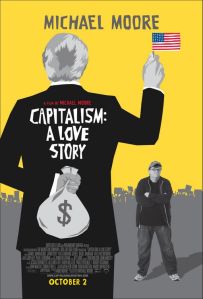 After 20 years, you pretty much know at this point what you’re going to get from a Michael Moore documentary. There’s the anecdotal evidence, emotional interviews of the downtrodden, the one-sided arguments, the nods to the depressive state of Flint, Michigan, and Moore trying to bully his way to see the powers that be that have no interest seeing him. In a way, Capitalism: A Love Story is like a greatest hits collection for Moore that reminds you of his better moments and better films. Despite all the outrage, Moore wants to throw the baby out with the bath water. He cites capitalism as an evil that needs to be eradicated. His thesis isn’t very cohesive and consists of a series of related and unrelated anecdotes, some of them grossly offensive like companies profiting from the death of employees thanks to “Dead Peasant” life insurance policies. But at no point do you walk away thinking, “Let’s start from scratch. What has capitalism gotten us?” Several of his points are easy to agree with. There is a flagrant disregard for the well being of others on Wall Street, who carelessly gambled the nation’s fortunes and then got the taxpayers to cover the loss. The bailout is a crime of pure capitalism and in a true capitalistic society there is no such thing as “too big to fail,” there is only fail. It’s not following an ideology built upon greed that has hurt the U.S., it’s unchecked greed, capitalism run amok without any oversight or regulation that has endangered the nation’s livelihood, and I’m surprised Moore didn’t emphasize the process of deregulation from Reagan to Bush more. The story of our financial meltdown is too large for a confined two-hour narrative window, and it’s too important a lesson for a man like Moore to use it as fire to ignite a people’s revolution.
Both movies: C+
Share this:

Obsessed (2009)
 When it comes to derivative, generic, formula-laden movies, usually you can predict every step of the plot with great accuracy from the trailer. Obsessed may be the first movie I could predict every moment based just from seeing the poster. This poor man’s Fatal Attraction follows a surprise-free trip to the end credits. Idris Elba is a family man who is harassed and stalked by his increasingly psychotic temp/temptress (Ali Larter). The movie doesn’t even have the temerity to have its lead cheat on his wife. There?s an interracial angle that is never really dealt with, meaning that the lone plot detail separating Obsessed from its peers is also swept under the rug. Everything here is borrowed from better movies with more style, substance, and heat. Larter doesn’t work as an antagonist or a figure of lust. She acts like a disinterested and icy when she should be flirty and smoldering. The plot quickly gets ludicrous as Larter’s repeated seduction attempts get brazen and confrontational. It strains credibility that Elba would keep trying to keep things under wraps. This girl needs to be referred to the police. Alas, I suppose these stalker thrillers wouldn’t be as interesting if people reacted realistically to psychotic behavior. Beyonce Knowles is the angry wife who gets to exact vengeance during the movie?s all-out, hair-pulling climactic catfight. But it’s a long slog until that catfight.
Nate’s Grade; C
Share this:

The Taking of Pelham 123 (2009)
 This needless remake is yet another nail in the coffin for the filmmaker that is (was?) Tony Scott. The director seems to have a love affair with irritating and superfluous visual artifice. Scenes will jump into slow-mo, or stutter-stop speed, or the visuals will all of a sudden turn into blurry shadows. Scott proves yet again that he’d rather fiddle around with film stocks and random jarring effects than aid his narrative. The story of Pelham is rather mediocre, as a tattooed gunman (John Travolta) and his crew take a subway car hostage. A train dispatcher (Denzel Washington) becomes the only one allowed to speak to the gunman. Travolta is wholly unconvincing as a profane criminal mastermind. The villains are gruff idiots, some of whom think at the end that maybe, just maybe, they can get the jump on 30 armed policemen surrounding them. They were not the top of their class at Henchmen School. The story is frustrating and the character motivations for Travolta remain vague and unclear. Sure, he gets financial gain, but what else? What about his shady past? Why this specific route to this mundane goal? It’s like Scott and the movie simply just didn’t care anymore because they knew it was time for the film to end in a big chase scene. Also, the movie seems to make a case that NYC cops are the worst drivers in the world. They crash more cars than Billy Joel (joke brought to you by the year 2003). This is one train to miss.
Nate’s Grade: C
Share this:

Julie & Julia (2009)
 Meryl Streep is as she always is, which means to say she’s terrific as famous jubilant chef Julia Child. She’s got the sing-songy voice down cold, and Julia comes across like a spigot of joy, yelping with delight like a child. It’s hard to not find it adorable, and her husband (Stanley Tucci) is a kind, caring man who complements her well. The scenes between the Childs can be heartwarming and delightfully comic. However, for some weird reason, the Julia Child section is only half of this movie. Writer/director Nora Ephron decided to frame the movie with the biography of Julie Powell (Amy Adams) writing a blog in 2002. Huh? Powell wants to prepare all 500 recipes from Child’s best-selling book on French cuisine in one year. As you might expect, this whole section turns into a lot of narration over food preparation and Powell becoming increasingly narcissistic about her blog fame. The only real purpose this modern storyline serves is to add perspective to the Julia Child storyline, giving historical context to what we see Streep and Tucci struggle over. The real resonance is with Streep as the larger-than-life cooking personality and her upward climb to be taken seriously as a chef and as an author. I don’t care about Julie Powell. She keeps interrupting a better storyline. Apparently the real Julia Child didn’t care for Powell either, because late in the movie Powell discovers that the real Child (who died in 2004) thinks the whole blog thing is a gimmick. And isn’t it? Then again, isn’t having Streep as Julia Child a gimmick of casting? Julie and Julia would have been better served if it had completely carved off the Julie section.
Nate’s Grade: B
Share this:

2012 (2009)
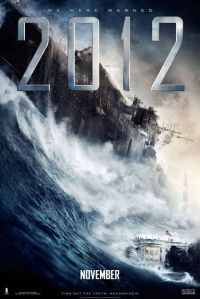 Let’s get this out of the way. The world isn’t going to end in 2012. Well, it might, but it won’t be because the Mayans said so. Because truth be told, the Mayans didn’t say anything about the world ending. The Mayan calendar exists in large circular amounts of time, and the largest period of time is called a bactun. An epoch, 13 bactun, will be coming to an end somewhere around December 21, 2012, but this in no way is a signal for the end of days. It just means that one cycle of time has come full circle and we begin anew. This is entirely a Western invention. If you learn nothing else from this review, know that the world will be fine come 2012. At least in this regard. Who knows about nuclear holocaust, biological warfare, religious fanatics bringing about the end of days, Sarah Palin running for president. The world could still end, but don’t blame the Mayans. They’re already dead anyway. They didn’t see that one coming, either.
2012 is the latest disaster movie from director Roland Emmerich, who fondly destroyed the world in Independence Day and The Day After Tomorrow. In news interviews, Emmerich has insisted that 2012 will be his last disaster movie (yeah right!), so he wanted to pull out all the stops. And he does. 2012 is like the disaster movie to end all disaster movies. It’s great escapist fun but it’s also silly and cheesy and hokey and all things a great memorable disaster movie should be. The movie packs so much that you may likely experience fatigue by the end.
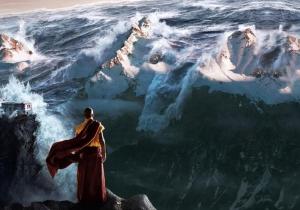 Like previous Emmerich movies, we follow a dispirit group of people from all walks of life who coincidentally come together. Jackson (John Cusack) and his wife Kate (Amanda Peet) are separating. Kate is currently seeing a new guy, Gordon (Thomas McCarthy, the writer/director of The Station Agent), and Jackson’s son thinks highly of new dad (maybe he saw the excellent Station Agent). Jackson is trying to become a better dad and take the kids camping to Yellowstone National Park. It’s there that he runs aground with government officials and a conspiracy radio host (Woody Harrelson) warning about impending doom. He puts enough pieces together to hatch a plan to save his family and escape. The government was alerted by a geologist (Chiwetel Ejiofor) in 2009 and has been preparing for massive seismic shifts. The president’s chief of staff (Oliver Platt) has been planning the “continuity of our species.” The elites have secured a place on massive arks built in the Himalayan mountain range. Jackson and his family must find a way to reach the arks in China for any hope of surviving the next chapter in human existence.
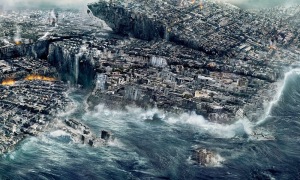
Emmerich packs so much earthly chaos into this movie that it can get flabbergasting. It’s not enough that California is upending by earthquakes and gaping chasms, it has to be thrown into the sea city block by city block. It’s not enough that Yellowstone National Park emits a thunderous volcanic discharge; it has to explode with the might of three mushroom clouds. It’s not enough that a 150-foot tidal wave strikes Washington D.C., it has to drag along a U.S. aircraft carrier that topples the memorable architectural sights of the city. It seems like Emmerich is trying to one-up everything that has come before in disaster cinema, but beyond the cheesy Irwin Allen movies of the 1970s, his only real competition is himself. No one wreaks havoc upon the world like Emmerich. He has the same destructive tastes of a mad scientist of Godzilla. He’s a big kid that likes to see things fall down and go boom. And in that regard, Emmerich has no equals. Not even Michael Bay, who certainly has panache to his record of ruination, can compete with this German master of disaster. No one can do enjoyable cheesy entertainment on such a mass scale like this man.
 The special effects in 2012 are first-rate and the true draw to see this thing on the big screen. Large-scale global devastation has never looked so pretty. This is a full-blown summer movie in the midst of the fall prestige season. The destruction is often awe-inspiring thanks to Emmerich and his team of visual wizards, and the buildup of suspense can be palatable as well. The pacing is better than you would expect for a movie that runs over 150 minutes, but that didn’t stop the contingent of teenagers in my theater from standing up and leaving whenever there wasn’t violent death. At least Mother Nature wasn’t taking out specific monuments with pinpoint precision like She normally likes to do in these things. And just like in disaster movies, the “chosen few” are gifted with the amazing ability to outrun fireballs, earthquakes, falling debris, falling buildings, and just about everything falling at high velocity. Sure the immediate heat from an explosion at Yellowstone would instantly fry the characters, and sure an airplane can?t fly through a pyroclastic cloud, but it’s all part of the territory for the genre. If it was really true to life than we’d all be dead and the movie would be considerably shorter.
So what is the protocol for enjoying mass entertainment that coincides with massive death? Emmerich is usually very good about his disaster sequences to keep his focal point at long distance angles, both so that the audience can get a full vision of the mayhem and also to make sure that we cannot concentrate on the little people fruitlessly scurrying away for their lives. If you stop and think, practically every second of on screen destruction in 2012 involves thousands of nameless, faceless people dying horribly, and these are the big moments when the audience chows down on greasy fistfuls of popcorn. It reminded me somewhat when the news kept repeating the planes crashing into the World Trade Center towers as pieces for their 9/11 segments, and I’d stop and think, “You know, you just paused an image and in that image is the reality that hundreds of people are dying.” It’s a strange thing to contemplate, which is probably why Emmerich overloads your senses with (safe distance) disaster carnage. There is an image that does cross a line, where we witness office building workers tumbling out of the crumbling high rise. That’s one 9/11 image that’s just too distasteful even for a disaster flick.
 Naturally the reason to see these kinds of movies is the big bangs for your bucks, but what happens during the downtime? I was genuinely surprised how involved I became with the collection of characters. I’m not saying that this is deep, penetrating writing, but it’s easy to wring some pathos out of a story when you have one character after another delivering a teary “Goodbye, I always loved you” speech to their soon-to-be-dearly-departed relatives. I cared about these characters enough to wince when they began being picked off one-by-one when the script called for heroic sacrifice upon heroic sacrifice. Burrowed beneath the avalanche of special effects, like really really buried in there, is an interesting philosophical argument about how people would behave during the end of the world. Would they be selfless or selfish? Would they step on their neighbor’s neck for another minute of life or would people sacrifice? Personally, I’m a bit of a pessimist, but the debate is intriguing. I also thought that 2012 had a vital conversation about who exactly gets to survive. In the story, a seat on the super arks are a billions Euros, which gives the insanely rich a huge advantage, but it’s because of the insanely rich private sector that the world’s governments are able to build these massive arks and plan for a future. So there you have it: a future world with the likes of billionaires and politicians. Who will get them all coffee? Who will pick up their dry cleaning? Who will take their calls? Is this even a world worth living in?
2012 is dopey and self-serious and way too long but man is it entertaining. The fabulous special effects are the real star of the movie, though the assorted cast does well. 2012 is deemed Emmerich’s last disaster picture, and if that holds true then he’s making sure there isn’t anything left to destroy. This is disaster pornography on a scale rarely seen in the movies. It deserves to be seen on the big screen for maximum enjoyment of maximum destruction.
Nate’s Grade: B


 nathanzoebl
You must be logged in to post a comment.