Category Archives: 2008 Movies
Vantage Point (2008)
 Vantage Point presents a terrorist strike and a presidential assassination from six different perspectives (though the advertising credits 8 perspectives). The Rashoman-style idea presents enough intrigue to sustain viewer involvement, but then it seems like the movie gets tired of its own gimmick, throws its hands in the air after the fifth trip down memory lane, and says, “Ah, forget this. Here’s what really happened,” and spells it out. The perspectives are too short and there are frankly too many; the idea is good but the execution is flawed. I think having possibly three perspectives play out for around 40 minutes each would have beefed up the plot and allowed for more intriguing criss-crossing. Not all of the perspectives are equally compelling (Forest Whitaker as a tourist with a camera seems like a lame way to bridge plot points) but they do link together and each submits a bevy of new questions and surprises. The swift, 90-minute running time means there’s precious little screen time to be doled out to the many characters, so don’t get used to seeing most after their main appearance. Vantage Point careens toward a finish that ties everything and every perspective together with a fairly nifty car chase. The movie could use some extra time spent on the flaccid characters (I’m at a total loss as for the motivation of several of them), and the film strains credibility, and yet it works as a passable thriller with enough of an edge to pass the time agreeably.
Nate’s Grade: B-
Share this:

Jumper (2008)
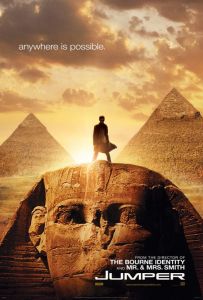 The premise for Jumper seems like adolescent wish fulfillment. Who wouldn’t want the ability to instantly get away? Plus, being able to instantly vanish would unleash an inner Lothario in some men, causing them to love the ladies one night and leave them high and dry the next morning. Having the ability to be anywhere at a moment’s notice is quite a powerful gift but could it lead to tremendous vanity? Director Doug Liman doesn’t seem too interested in all the interesting possibilities afford by teleporting teenagers and instead unleashes what feels like an empty prequel to a hopeful sci-fi franchise.
David (Hayden Christensen) is a shy kid at school when he discovers one day that he has the ability to instantly transport himself to another location simply through the power of his mind. David uses this teleporting ability to, naturally, rob banks and build a cushy lifestyle for himself. He can snack on top of the Sphinx’s head, surf along Australian waves, hang off the clock face of Big Ben, and best of all, he never needs to reach for the TV remote again (seriously, David teleports from one couch cushion to another just to snag the not-too-distant remote). David is a jumper and he discovers he is not alone. Griffin (Jamie Bell, the true star of the movie) has the ability as well and enlightens David on the perils of the jumper lifestyle. Paladins have been hunting and killing jumpers for hundreds of years. The Paladins carry staffs that shoot electrified tethers out, hoping to wrap up the jumpers. The electric bolts stop the jumper from being able to concentrate and escape. Roland (Samuel L. Jackson), a head Paladin, explains that “only God should be able to be all places at all times.”
 Complicating matters is that David has reconnected with his high school crush Millie (Rachel Bilson). He whisks her off to Rome and they break into the Coliseum together like crazy kids do. He’s vague about where he’s been for 8 years and says he can afford such expensive getaways thanks to his “banking” job. But Roland is circling and plans on getting to him by any means, even if poor Millie gets gutted in the process.
Jumper has some flashes of excitement and a halfway decent premise, but this film is completely hollow on the inside. Liman must have been too entranced with his premise to ask for anything substantive from his slew of screenwriters. The movie has a handful of great images and moments that surely make for a crackerjack trailer, however, there is hardly any attention paid to plot or character or even enticing action. There is one good chase scene between two jumpers going through many stops around the globe; one second they’re running on a beach, the next through downtown Tokyo, and another falling off the Empire State building to landing safely inside a community swimming pool. The pace is a little too break-neck for my taste but the sequence is high on imagination and finally plays with the fun possibilities of teleporters otherwise ignored by the film. That’s the highlight of the movie, right there, and yet even it feels mildly derivative of the sequence in Being John Malkovich where Cameron Diaz chases Catherine Keener through the subconscious bowels of John Malkovich’s memory. This is a movie that asks little of its audience because the filmmakers barely scratched the surface with their material. The execution is a wash and the movie feels like a scattered sightseeing tour told by someone high on crystal meth.
The characters are pretty shallow and powerfully bland, and the romance between David and Millie is entirely contrived and unbelievable. In fact, Millie isn’t a character but a plot contrivance. In the beginning she’s established as the caring girl next door for adoration, then flash ahead years later and upon her first reunion with David she has sex with him because, well, I don’t know, because the plot demands some impromptu sex. Then her purpose is to serve as a broken record of morality; a good hour of Millie’s dialogue is reiterations of the lines “What’s wrong?” “Are you okay?” and “What aren’t you telling me?” It gets really annoying and all she does is keep repeating these queries while David drags her by the hand through Rome. It also hurts that Christensen and Bilson have zero chemistry together. But expectantly, Millie’s final purpose is to be the damsel in distress that requires rescuing. Millie’s lax characterization is emblematic of the film as whole. She and the other characters serve a strict, utilitarian purpose to move the plot forward when it’s called for, but the plot isn’t even that good!
The audience is willing to accept the unbelievable as long as it makes some for of logic on its own terms. People have the ability to teleport, got it. But then the movie throws in the Paladins and gives us little explanation. These grey-coated hunters are some religious order or something and have hunted jumpers since the Middle Ages, though their grasp of technology must have improved. I wanted to know more about these hunters, and “religious fundamentalism” seems like a lazy excuse for motivation. Why do these people go to such great ends to kill jumpers? What is their history? Why do they use tazers instead of guns? If a jumper can’t dodge an electric cord then surely they wouldn’t be able to dodge a bullet. How come the jumpers don’t use guns to easily knock off the Paladins? If this is an ongoing war then how come no one else has caught on to the massive collateral damage of the battles? The jumpers leave trace damage to wherever they appear, so how come no one else seems to have caught on? Just like all the other plot elements, the Paladins are established and then ignored by the filmmakers. I kept finding my mind wandering and I created my own intriguing back-story for the Paladins, one where the insurance companies of the world are sick of losing money to the self-serving jumpers, so they subcontract the Paladins to kill these financial fiends. Right there I just spent more time thinking about how to make this movie interesting than the people responsible for making this movie interesting. The corporate avenging angle is more fun than simply making the villains an age-old religious sect like they were plot leftovers from The Da Vinci Code. This movie needed a whole heaping helping of exposition to provide some minute level of clarity to all the flash and noise.
 There are so many plot holes and loose storylines that it seems like the filmmakers had the delusional thought that this movie was the first step in a franchise. Because of this belief, we are treated to every single character being left hanging and there is no resolution or sense of finality. The subplot with David’s mother (Diane Lane) is tacked on with promise of addressing it in the future. Jumper doesn’t so much end as put everyone on hold, including the audience.
Liman delivered on his Hollywood potential with 2002’s Bourne Identity and 2005’s Mr. and Mrs. Smith, so Jumper is a pretty crushing letdown for a man with such a great mind for inventive action sequences. Liman is sunk by such a terrible script, but it almost seems like the plot was dictated by Liman’s handful of visual cues he had in his brain. There are some nifty images and a couple of cool moments, but cool moments do not make a 90-minute movie, and Jumper lurches from plot point to plot point with depressing routine. There’s so little imagination with the brief, lackluster action sequences given the sheer possibilities with teleporting.
The acting seems on autopilot. Christensen is too bland for words. I repeat my earlier prediction that Christensen will likely be nothing more than the human equivalent of a vacant, pretty mannequin for his acting career; though I must suggest that everyone see his one piece of acting greatness in 2003’s Shattered Glass. His character in Jumper is pretty much a cipher for the audience to have some vicarious, globe-trotting fun, but David is pretty hard to like and doesn’t give an audience much insight into his character. His monotone delivery buries the cheesy dialogue. And, as a die-hard Ohio State fan, it made it even harder for me to root for an Ann Arbor kid. Bilson is pretty but relies on looks of anxiety and sensuous lip biting to display the depths of her one-note character. Jackson delivers a performance suitably in the Samuel L. Jackson canon of screaming and scowling, this time with a white buzz cut hairdo.
If I were being charitable, I’d say that the absence of a succinct story and sufficient characters is because Jumper feels like the pilot to a franchise. But I’m not being charitable. I expected much better from Doug Liman than 20 minutes of setup and another hour of shiny, flashy diversions with little context. The premise isn’t capitalized at all and for a film about the thrilling possibilities of having the world at your fingertips, this movie sure lacks any sense of whimsy and fun. Jumper tells the audience that it has the power to go anywhere, but all I wanted to do was transport myself into a different theater.
Nate’s Grade: C
Share this:

In the Name of the King: A Dungeon Siege Tale (2008)
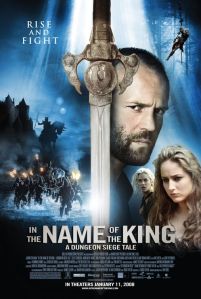 I have no idea how it happened but someone gave infamously reviled director Uwe Boll a bunch of money to adapt a fantasy video game called Dungeon Siege into a star-laden movie. In the Name of the King: A Dungeon Siege Tale seemed to be Boll’s stab at achieving mainstream credibility. He assembled his best cast yet with plenty of recognizable stars. At one point, I remember reading that Boll wanted to divide this film into two, Kill Bill-style, or release a 180-minute version. Until this movie, no Boll film had ever gone over barely an hour and a half. After seeing a slimmed down version that runs a little over two hours, I honestly have no idea what more Boll could have. In the Name of the King struggles to fill two hours worth with crap.
In a far off land, there lives a farmer named, coincidentally enough, Farmer (Jason Statham). His world is turned upside down when his family is killed by a band of creatures known as the Krug. He and his friend (Ron Perlman) must track down Farmer’s captured wife (Claire Forlani) and inflict some peasant vengeance of their own.
Evil wizard Gallian (Ray Liotta) was the cause of the attack. He has built up a whole army of Krug to challenge the King (Burt Reynolds) for the throne. Gallian also has two unwitting allies. The King’s nephew, the Duke (Matthew Lilard), wants to rule and is willing to plot with the evil wizard to achieve this goal. Muriella (Leelee Sobieski) is secretly sleeping with Gallian; he says he is teaching her how to use her blooming magical powers (remove your mind from the gutter) but he is really stealing her powers.
Farmer reluctantly becomes a leader to protect the kingdom. Gallian is stupefied that this simple farmer is somehow beyond the control of his magic. That’s because Farmer should probably change his name to Prince because he is the long-lost son of the King and some stable girl. Merick (John Rhys-Davies) serves as the King’s most trusted advisor but he is also the father of Muriella. He scolds her for being so foolish and being used by Gallian. She suits up like Joan of Arc and wants to fight, but her father won’t allow it.
Eventually this all leads to a large-scale battle between the forces of good and evil where Gallian uses his magic powers to create a cyclone of books to stop Farmer. There you have it.
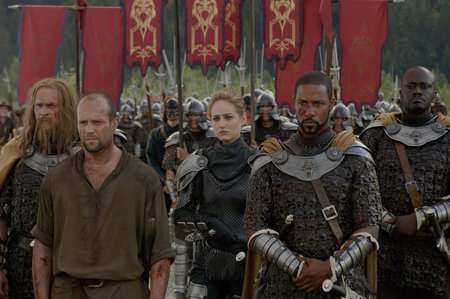 If I were Peter Jackson, I might consider a copyright infringement suit, because In the Name of the King is a sloppy Lord of the Rings rip-off through and through. The long-lost heir to the throne must accept his magisterial destiny … just like in Lord of the Rings. There is a 10-minute fight sequence that happens in a swath of woods … just like in Fellowship of the Ring. The villain relies on an army of stupid supernatural hordes … just like Lord of the Rings. There is a wizard-on-wizard duel … just like Lord of the Rings. A noble woman wishes to fight but her father does not approve, so she sneaks off in armor and does fight … just like in Return of the King. There is a shadowy “other” world that goes beyond our dimension … just like in Lord of the Rings. The eventual trek of our heroes leads to a volcano, but not just that, it’s also the villain’s lair … just like in Lord of the Rings. Bastian (William Sanderson, in his sixth Boll movie) serves no purpose other than to resemble Legolas. John Rhys-Davies you should know better; you freaking starred IN the Lord of the Rings trilogy.
So what does a $60 million budget get Boll? Lots and lots of crane shots. Boll relies on extended aerial photography and zooming, CGI landscapes that serve to remind you how much better Lord of the Rings was and that Vancouver is no New Zealand. There are some segments that lack a firm geographic bearing because Boll wants to jump from expansive crane shot to expansive crane shot. I get that he wants to showcase the depth of the battles, which do feature a fair amount of background action, but the repetition of any camera technique will always grow old if it doesn’t feel congruent to the onscreen drama. I’m happy that Boll wants to open up the scope, but when he relies on a multitude of high-angle crane shots in motion the effect becomes wearisome. The audience can never settle into the action because Boll is too forceful with wanting to demonstrate what he bought with his budget. The cinematography is a notable step up for Boll and longtime director of photography Mathias Neumann. Then again, if I had a $60 million budget I’m sure my movie would look good too, or at least better.
In the Name of the King is the biggest budget Boll has ever had, but it seems like proper costumes must have still been out of his price range. The marauding horde of Orcs, oh I’m sorry, the Krug look like cheesy low-rent Power Rangers villains in goofy rubber outfits. The camera never lets you get a good glimpse of these creatures because even Boll knows how crummy they look. You get another idea of how bad the creatures look when Farmer utilizes the familiar dress-in-other-guy’s-uniform-to-pretend-to-blend-in ploy that was perfected by the aging action stars of the 1980s. So Farmer knocks out a Krug creature, throws on its spongy armor, and is able to walk around the Krug camp.
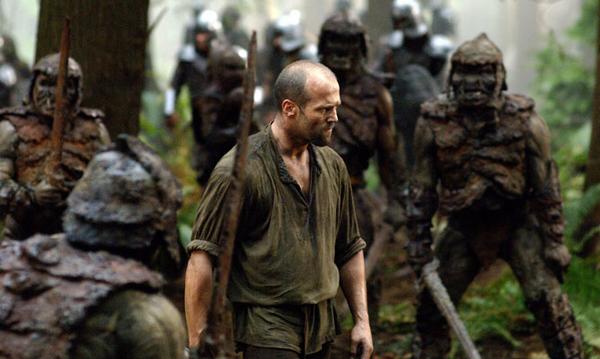 The special effects also seem to run the gamut. The green screen work is painfully ineffective and very transparent, like when Farmer is swinging down a rope across a gorge. When Boll tries to show large fields of soldiers it also exposes how fake the CGI work looks. The many battalions of soldiers look like a dated computer video game. The special effects for Alone in the Dark were better and that film had, reportedly, half the budget of this movie. Realizing all this, it’s no wonder that Boll tries to use as many real sets as he can.
And yet despite all of this, In the Name of the King is high-class camp. Boll achieves a workable level of derisive enjoyment that manages to keep the movie entertaining even while its spins into stupidity. The fight scenes are actually decent and Boll manages to compose a few shots here and there that look quite good, like when the camera scans over a field of dead bodies. During the action centerpiece, the 10-minute battle in the woods between man and Krug, Boll’s camera manages to frame some solid, if unspectacular, action with some good angles. It’s also cut to be mostly coherent. The fight choreography is credited to Siu-tung Ching who also did the choreography for Hero and House of the Flying Daggers. He must have procrastinated until the night before his choreography was due. It will pass but there’s little creativity there; however, Boll must have been flabbergasted. I think the true test for derisive viewer enjoyment will be when the ninjas come out of nowhere at the King’s disposal. All of a sudden in the middle of a medieval style fantasy fight there are flipping black-clad ninjas. I loved it for its sheer anachronistic absurdity. To me, it felt like Boll was trying to cram in everything that he thought was theoretically cool into one massive fight sequence. He just didn’t have the money to also include pirates and robots and hobos and vampires and bears and Batman.
Fantasy is just not Boll’s preferred territory and it mostly shows. He really wants to make his own entry in the style of Lord of the Rings, but you can tell his mind is elsewhere. The plot is a mess but that isn’t indicative of Boll’s lack of interest with the film, it’s just indicative of a typical Boll movie. In the Name of the King feels like Boll is following a checklist of what is expected in a modern fantasy epic, except that Boll cannot provide the epic part. Here’s my proof: the vine-swinging tree nymphs led by Elora (Kristanna Loken). If Boll was really invested in this movie he would have paid more attention to these alluring vixens. These anti-war ladies have sworn off men (take that for what you will) and live their lives like Cirque du Soliel jungle performers. This stuff is right up Boll’s exploitation rich alley, and yet he and the film treat these women of the woods like afterthoughts. They show up and save the day when the film requires an inexplicable savior. I don’t know how helpful tree-dwelling women would be in a fight either unless it was fought in a well-forested area. Boll not capitalizing on these women warriors proves to me that his heart isn’t in this movie.
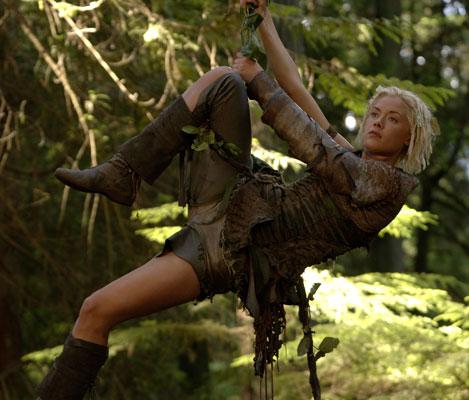 Screenwriter Doug Taylor was clearly cobbling a story together by his fading memory of the Lord of the Rings trilogy, and yet this being a Boll movie, there are still plenty of head-scratching decisions that defy logic even for a would-be fantasy film. For instance, why does Farmer fight with a boomerang? How effective can a weapon be when it gets thrown and then needs to be picked up? The boomerangs that I know can hit people, sure, but usually hitting someone stops its path of movement. Then again, these could be magic boomerangs. How did Gallian raise such a massive monster army to rival that of the King’s without anyone noticing? I’m sure the excuse for that is also magic-related. The Duke takes out two legions of soldiers for his own purposes, and when one man asks where the commanding officers are the Duke, in front of everyone, stabs him. It seems like a lousy way to lead but I’m sure Joseph Stalin would approve. A telekinetic sword fight sounds cool on paper until you realize it is just actors standing passively while CGI swords clang around them. During the climactic battle it’s dark and raining (hey, like in Lord of the Rings) for the King’s army vs. the Krug, but then as Farmer and Elora race to the Volcano Lair it is light out. How many time zones does this kingdom have? Also during this climactic battle, the King’s army has the high ground thanks to a hill and the Krug race up the raised land. The archers atop the hill fire their flaming arrows at an angle pointing up, which would sail over the heads of all their targets. I suppose the King’s archery education program has been suffering some severe budget cutbacks.
The dialogue is pretty corny amidst all the sword-and-sorcery antics and induces its fair share of giggles. When Muriella asks Gallian if he always appears out of nowhere he responds, “No. I appear suddenly. Out of somewhere.” Thanks for clearing that semantic argument up. He also has a very icky conversation with his bedfellow Muriella dripping with double entendres: “I knew you would come,” “I told you I would,” “I felt it before you came,” “You told me I could come and go as I please.” I think my favorite moment is when the King is on his deathbed and addressing Farmer. He advises the man of agricultural means to try using seaweed to enrich his soil. “How do you know this?” asks Farmer. “Because I am king,” he replies.
The actors all feel like they are in separate movies on a collision course with one another. Boll has never had a firm command with actors. The big name actors feel their way around a scene with little guidance from Boll, which means they routinely experiment and play their roles like they were an exercise instead of a final performance. A fine example is a single line spoken at a family table; it’s just perfectly off enough to prick your ears to Boll’s tone-deaf direction. I think Boll either doesn’t care that much about performances or is easily cowed into submission by actors. Staham is recycling his glaring machismo that he’s turned into an action movie franchise, but he seems to me like a modern-day Steven Segal who dispatches foes in a monotone whisper. Luckily for Boll, Statham is adept at picking up fight choreography and so the movie benefits by watching the actor clearly in the middle of the fracas performing his own sword fights.
 Most of the actors also seem to be falling back on past performances as inspiration for what to do under Boll’s laissez faire direction. Perlman plays his standard gruff tough with a deadpan delivery. Sobieski hasn’t acted in a movie for some time. She comes across as her usual inexpressively empty self, which is her thing, along with being a physical clone of Helen Hunt. Loken shows she can swing from a vine but not master a vague British accent. Forlani gets to cower and weep. Burt Reynolds is playing Burt Reynolds, and Rhys-Davies falls back on his trademark gravitas. Only Lillard seems to find enjoyment out of Boll’s vacuum of direction. His accent mirrors his wildly over the top style of acting that sometimes feels like a fish flopping around for air. His physical mannerisms are uncontrolled and he sneers through much of his lines, but I’ll give it to Lilard, he is much more fun to watch than any of the other slumming stars.
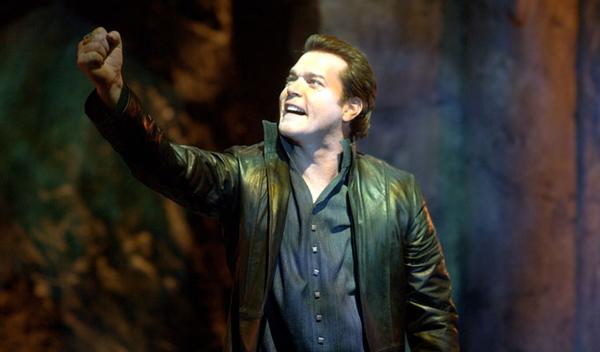
Special attention must be made to Liotta, who is on a different plane of terrible. It’s bad enough that he’s chewing the scenery in his typical manic, bug-eyed crazy yell-speak he refers to as acting, but the movie has to open on the discomfiting image of Liotta trying to suck Leelee Sobieski’s face inside out via kissing. Liotta’s character Gallian feels and looks out of place; he resembles a skuzzy Las Vegas magician with a pompadour and a long leather jacket and a button-down shirt. Where did this man come from? His performance is astonishing in how deeply the awful goes, and when he tells Farmer’s wife, “I feel him inside you,” try your best not to shudder.
After seeing eight of his films and writing 17,000 words on the man (including 2,600 for this review), I feel like I have a special connection to Uwe Boll. I just don’t sense that Boll’s heart was truly in this venture. In the Name of the King seems to be the last time I think we’ll see Boll flirt with mainstream Hollywood genre filmmaking. I think his time luring known actors has come to a merciful end. His next slew of films seem destined to all direct-to-DVD and feature no name casts that are mostly the same actors he has worked with before. In the Name of the King will stand as a ridiculous Lord of the Rings rip-off that has some workable action alongside its many laughably awful moments. It’s a lousy fantasy movie with too many extraneous characters and too familiar a plot outline. Even for a $60 million film, Boll finds new ways to prove that no matter what sized budget the man has he will always try to grasp something beyond his reach.
Nate’s Grade: D+
Share this:

27 Dresses (2008)
 Katherine Hiegl is a likeable enough actress. She got her big break in 1994’s My Father the Hero, which had the exceptionally gross premise of having an adolescent’s father posing as her European lover to score the guy she’s really got her eyes on. The most memorable moment of the movie was a 15-year-old Heigl strutting around in a thong bathing suit. Her resume got better with a steady stream of network TV shows like Roswell and Grey’s Anatomy, and then she broke into another level of stardom thanks to the runaway success of [I]Knocked Up[/I] where she carried Seth Rogen’s baby. Then she told Vanity Fair that she felt Knocked Up was “sexist” and that the women were portrayed as shrews and that the men were fun-loving dudes (I must have seen a somewhat different movie). She’s entitled to her opinion, but what seems very odd is that Heigl’s follow-up to her breakout role is 27 Dresses, a romantic comedy about a woman who is a perennial bridesmaid and yearns for her own perfect wedding when her life will be complete.
Jane (Heigl) busies her time helping others to have heir ideal weddings. She has contributed to so many wedding ceremonies that she has amassed a closet full of 27 bridesmaid dresses that serve as trophies. Jane is in love with weddings. She is also harboring a crush on her boss (Edward Burns, wooden as always) that seems to be going nowhere. Jane’s younger sister Tess (Malin Akerman) comes to visit and immediately hooks up with Jane’s boss/crush. Jane’s wisecracking best friend (Judy Greer) is quick with a quip and declares Tess to be some very negative terms. Poor plain Jane is also taken aback when she meets wedding columnist, Kevin (James Marsden), whose fawning words about weddings are like poetry for Jane. He turns out to be a cynical guy who feels weddings and marriages are “the last legal form of slavery.” When Tess gets engaged to the boss man, wedding responsibilities fall upon Jane and Kevin is right beside her, ready to trade barbs about romance and perhaps start one of his own.
 27 Dresses hews pretty close to the familiar romantic comedy formula trappings. Opposites attract, bickering will lead to romance, and then true love will overcome all misunderstandings, that’s a given. Another given is the fact that we will get a montage of Heigl trying on all 27 titular dresses. 27 Dresses also includes the wisecracking best friend who has no purpose of her own but to comment on the troubles of our heroine with stark bluntness. Once again, this is the type of film where one character has some earlier, negative opinion or statement that resurfaces late to bite them in the ass after they have learned how flawed and shallow that original opinion was (otherwise known as the 11th hour misunderstanding). One party has a personal epiphany and runs to catch the other party leaving by some means of transportation (I’ve seen boats, taxis, motorcycles, barges, but usually they run to catch a plane). And then there’s the sing-a-long; oh what romantic comedy would be worth its salt if it didn’t include a group sing-a-long to some older tune that just united everyone in spontaneous song? 27 Dresses uses Elton John’s “Benny and the Jets” to rock out a beer bar. Really, “Benny and the Jets”? Rocking out a bar? And it’s not even a gay bar? Hmm. 27 Dresses is rather predictable from the first frame onward, but familiarity isn’t necessarily a deal-breaker for a strictly genre movie.
I’ve seen plenty of romantic comedies and I like to judge them fairly, so I use my patented cute-to-cringe count whereby I take stock of the number of times I smile, laugh, or find a moment, line of dialogue, or even choice of song that leaves a favorable impression. I then compare this figure with the number of times I want to roll my eyes, check my watch (if I had one), vomit, or any piece of dialogue or moment that feels so saccharine, so unbelievable even in the rom-com universe that I want to laugh derisively. The final tally for 27 Dresses was somewhere in the middle but I’ll admit it skewed closer to the positive “cute” side of the spectrum.
The acting overall really helps to make the most of the formulaic material. Heigl seems destined to thrive in the rom-com genre; she has an every girl appeal and seems apt making funny faces of seething indignation (take note of the amount of times she uses food in her mouth for comic effect). She seems like the heir apparent to Sandra Bullock movies. Her chemistry with Marsden is ripe and they bring out good thing in one another with their playful give-and-take. Marsden has a terrific smile (seriously, the man might have the best choppers in the industry) and is suitably dreamy but he also has an enjoyably droll delivery. Akerman plays a spoiled brat well, though she isn’t given the opportunities to flash her rather skillful comic skills that she displayed in The Heartbreak Kid remake. Greer is a top-notch scene-stealer and deserves her character deserves her own movie. She has the most fun role to play but Greer sinks her teeth into the character and delivers a juicy performance that feels slightly naughty, uncensored, and carefree.
The movie falters when it trips up in maintaining believability. There’s an extensive scene in a Goth bar/club where the costumed extras are acting like… costumed extras. It’s the least believable Goth club I have ever seen in a movie, not that I was expecting Hollywood fluff to pain an accurate picture. It’s just wall-to-wall stereotypes, but not only that, they’re distracting and lame and dated stereotypes. Then Jane marches outside to scream to the heavens an expletive-filled rant about her bad luck when, ut oh, right next door to the Goth club is an old couple celebrating their 50th wedding anniversary. What? Grandma and grandpa Old People celebrating their marriage vows next door to a Goth club? This incongruous setting takes a long, long while to set up one very blah joke that could have functioned anywhere. Realistically, the joke is that Jane is swearing unbeknownst to others, so why even have it next to the world’s crummiest Goth club? If you’re going that route, why not have grandma and grandpa Old People dressed in tacky Goth apparel as well? This may become my most nit-picky criticism of all of 2008 but it really stuck in my craw.
 A better example is how the film handles Jane’s bratty sister, Tess. For 90 minutes we bare witness to Tess being a thoughtless, self-absorbed, lying, horrible human specimen, and then the movie tries to change strides. In the very end, it wants us to open up and look at Tess’ life and realize that she doesn’t have it so awesome because she was fired and dumped. Oh my, that must be perfectly excusable then for her rampant inexcusable, me-first behavior. If 27 Dresses has an antagonist in its midst than Tess is that bridezilla. The movie plays her bitchiness for comedy but then wants an audience to forget every whine and betrayal because, woe is her life, Tess wants to be happy. Tess remains an unsympathetic twit from beginning to end, no matter how hard the movie and its soft piano score try to change your mind.
The fact that 27 Dresses thought it could throw in some contradictory evidence at the last minute to make an audience forgive Tess is very telling. It showcases that the film has a hard time grasping the realities of characterization; Kevin is cynical about weddings because he was stood up at his; Jane must focus on making others happy because she is afraid of focusing on her self; Ed Burns is a douche. That isn’t necessarily an indictment on the film per se, just my honest opinion. 27 Dresses spells everything out in bold statements that hit like anvils, like when Kevin’s news editor congratulates him on his front-age story ridiculing Jane: “Hey, you got what you wanted, right?” Gag. The movie is too lockstep with the genre’s clichés that it doesn’t push hard enough with its characters, so we get plenty of intermittently cute moments but cute moments that will be easily forgotten and stored away like one of Jane’s hideous bridesmaids gowns.
27 Dresses is more or less par for the course in a genre littered with sappy clichés and cookie-cutter characterizations, and yet the movie possesses enough charm to outdistance its lapses in believability. The acting ensemble help make the movie enjoyable in parts, especially the chemistry between Heigl and Marsden. 27 Dresses passes the time but you wish that Heigl, Marsden, and especially Greer would be teleported to a better movie. One free from bitchy younger sisters, bar sing-a-longs, giddy dress-up montages, and Ed Burns. Did I mention that his character is a douche?
Nate’s Grade: C+
Share this:

Untraceable (2008)
 The Internet can be a scary place, no question. There’s plenty of weird crap in wide-open world of the World Wide Web. There are sites devoted to teaching people how to make bombs in the privacy of their own kitchen. If you can name a fetish, chances are there’s a pay sex site already built for it (I tried “clown porn” and was not disappointed, and by that I mean that I found a site for it and WAS deeply creeped out). According to the ongoing Dateline specials, everyone wants to “talk” to adolescent girls while they’re home alone. In short, the Internet can be a scary place. Untraceable, a barrel-scrapping genre movie, taps into our fears of the unknown in cyber space.
Agent Jennifer Marsh (Diane Lane) is a member of the Portland, Oregon office of the FBI. She specializes in tracking down cyber criminals and bringing them to real-world justice. There’s a new Web site called “Kill With Me.com” that invites anonymous users to serve as executioners. The site creator creates death traps that increase in deadliness the more users click onto the site; so a man bleeds out faster the more people that want to catch a glimpse of it. Lucky for the FBI, the cyber killer is doing all this nasty business in Portland. Marsh and her cyber assistant (Colin Hanks) try finding the location of the IP site but, somehow, it skips around the world and cannot be pinpointed. The victims of the site are specifically chosen, and Marsh is struggling to put it all together. Then the cyber killer begins stalking her and lets others join in on the fun.
 Untraceable is rather hypocritical in nature. It wants to titillate an audience but then shame them for embracing the titillation; the movie is purveying the same crap that it derides. The premise of a digital age serial killer that transforms murder into an online democratic act sounds nifty. Plenty of insightful questions generated by this premise like the nature of exploitation, media, and the culpability on the account of the insatiable viewing public. It’s too bad, then that Untraceable just uses the premise as a jumping off point to create a half-assed Saw. The movie is mostly concerned with reworking the familiar tropes of the serial killer genre, this time with some extra dashes of torture and Saw-style death traps. But the movie doesn’t fully commit to horror so much of the gore is implied. The extra attention to torture seems timidly tacked on to the framework of a thriller, likely grossing out the older folk that came to the movies thinking they were going to watch Diane Lane assert justice on this new fangled Internets thing. The movie has a vague fear of technology and computers and seems programmed to scare people that don’t know any better, namely the people who think computers are bigger toasters.
The script by relative neophytes is where the movie treads water. The villain is revealed fairly early, like a half hour in, and this revelation does nothing to help build tension. The culprit responsible for the laughably implausible death traps is a gangly eighteen-year-old twerp (Running with Scissors‘ Joseph Cross; yes that kid). I understand that in serial killer movies the villain usually takes on some form of supernatural abilities, like the ability to be everywhere and never be seen, or the ability to draw super strength at opportune times. When Untraceable apathetically reveals its villain the movie seems like it’s already giving up and conceding, “Okay, this is the big bad dude and he weighs about 110 pounds soaking wet. We know he could never outmatch anyone that is over five feet tall.” Marsh’s home life is also given obligatory screen time, including Marsh’s mother keeping watch of the home, but it never matters. In this world, birthday parties just get in the way of FBI manhunts.
The film also requires character to act inexplicably stupid at a moment’s notice in order for the plot to hum along. Marsh is such an expert on cyber crime, and yet she doesn’t bat an eyelash when her young daughter downloads a mysterious computer program sent to her by a “friend”? Never mind that this FBI expert logs onto the “Kill With Me” site on her home computer, allowing the killer to hack into her computer and look through all her personal information and cyber dirty laundry. The worst lapse occurs after our tech-savvy killer has effectively hacked into Marsh’s OnStar computer system in her car. The engine shits down and the car slows to a halt. Marsh leaves her car to use a roadside telephone to tell another cop that the killer has hijacked her car. The cop on the phone advises her to be on alert. Right after she hangs up, the car’s engine and lights become operational once again. Marsh trots over to her car, whose door had been open since she left, and simply hops back inside without checking the vehicle at all. She is swiftly tazed and kidnapped by the killer who was routinely hiding in the back seat. It’s not like a trained FBI agent would be able to miss the inescapable sight of somebody hiding in a tiny backseat with little room to crouch. I can excuse smart people making stupid decisions, but when a movie like Untraceable has experts not following through on situations that require their expertise, then it comes across as contrived. Really, a cop wouldn’t even peek in the backseat?
 Lane holds her own, and even that is an accomplishment for something so rote. She’s an actress easing into her forties and finding a new tap of talent. Frankly, she should have won the Best Actress Oscar for 2002 with her fabulous work in Unfaithful. That movie came out five years ago, and yet the Diane Lane in Untraceable looks so much older. I think the filmmakers were trying to make her look more harried by not applying makeup or utilizing soft focus. You can see her wrinkles and her age, and these are all well earned for a great actress, and Untraceable wants to maker her look her age in a time where Hollywood seems to dump out an actress’ business card once she hits 40. I just thought that was interesting, but the most interesting facet of this entire movie is that the actor who plays the head of the FBI team (Peter Lewis) looks remarkably close to 2008 Republican presidential candidate Mike Huckabee. It’s uncanny. If Huckabee ever plans on contributing to a filmed biopic of his life, then Peter Lewis should be on his shortlist.
Untraceable scrapes the serial killer genre for some form of life. The novel premise gives way to predictably lackluster thrills and gaping plot holes. Lane saunters around with a gun for two hours, mixed in with some extended sequences of torture, including one that involves hundreds of heat lamps. Look, I know I’m no cop, but couldn’t someone simply trace the massive electric bill this guy is generating? It’s just sloppy police work all around. Why? Because the movie requires giant lapses in judgment so that it can continue. The world can be a sick place, but has it always been this way? A better movie would dig deeper; this movie just wants to fry a cat and call it a day.
Nate’s Grade: C
Share this:

Cloverfield (2008)
 I can think of no movie that has come out of virtually nowhere to build tremendous hype like Cloverfield. Before the summer of 2007 this movie didn’t appear on anyone’s radar whatsoever, and then came a teaser trailer before Transformers. The tease was nothing but party footage of well-wishers when, all of a sudden, explosions are in the distance, people are fleeing, and the Statue of Liberty’s severed head rolls to a stop in a street. Bam. Release date. Nothing else, not even a title. All of a sudden the world had an insatiable appetite for everything Cloverfield. Mega-producer J.J. Abrams had done it again. In one fell swoop he took control of geek nation. I never expected Cloverfield to live up to the massive hype, but this modern monster movie delivers more bangs than whimpers.
The first twenty minutes of the film introduce us to our cadre of yuppy characters. Rob Hawkins (Michael Stahl-David) is leaving for Japan to take a business promotion. His friends throw him a surprise going away party to celebrate and wish him the best. Rob’s brother Jason (Mike Vogel) and his girlfriend, Lily (Jessica Lucas), start videotaping the party. Jason hands off the taping duties to Hud (T.J. Miller) who, thankfully, has a much steadier hand. Hud walks around the party gathering interviews and he zeroes in on Marlena (Lizzy Caplan), a gal he’s been nursing a crush on. Rob is nervous to see if Beth (Odette Yustman) will come to the party. Beth and Rob are long-standing friends that took the plunge and had sex a couple weeks prior. Now Rob is hoping for something more but Beth isn’t on the same page; she brings a date to the party. Interrupting all this twenty-something relationship drama is a giant monster attacking New York City and dropping little baby monsters to scurry the streets and feed.
 While not entirely unique, Cloverfield is certainly a reinvention of the dormant monster movie. By seeing its gimmick through to the very end, the film gives a perspective rarely seen in movies that involve cataclysmic disasters. Usually films that involve space aliens, monsters, or some form of incredible destruction follow the people in power, the Army generals, the politicians, the President of the United States as he solemnly looks out his office window and says “God help us,” under his presidential breath. Cloverfield, however, eschews all of that. This movie is all about people caught on the peripheral of a disaster and just trying to survive. They have no idea what’s happening, they have no idea when they will be in danger, they have no idea where to go, they have no idea how long they have, and they definitely have no idea what it is that’s obliterating the city. The film dares to place us in the shoes of ordinary civilians as they document the fantastic. The “found footage” concept and the ordinary perspective are interesting though some will quibble that staying inside one point of view is too limiting for the scale of Cloverfield. This film is more than The Blair Witch Project meets Godzilla; this movie is a collective manifestation of the nation’s 9/11 anxieties. Cloverfield is the first 9/11 disaster movie. The shock and confusion of the situation take on even more resonance by triggering some of the same emotions many experienced on that fateful day in 2001. And yet Cloverfield doesn’t feel exploitative or disrespectful as it draws upon our 9/11 memories and fears, which is saying something substantial about the filmmakers’ skill and the remarkable healing power of time. Some images are unmistakable, like a white cloud of dust that blows through the city and also helps to shroud the monster. People scamper around the city yelling for some kind of explanation when some character, offhandedly, says, “Do you think it’s another terrorist attack?”
The film is also got some fabulously frightening moments that are not related to 9/11 anxiety. Cloverfield is a great, old school horror movie on top of a subversive social experiment. Talented writer Drew Goddard has had experience building tension on some of TV’s finest shows, like Buffy, Angel, and Lost. Now with his debut screenplay, Goddard cranks up the suspense and creepiness to maximum effect. Part of the horror is trying to find meaning in the madness but another equally enjoyable part is walking into perfectly executed classic horror moments. You will be on edge about what could possibly be around a corner. Our band of survivors decide to walk through the subway tunnels and discover that Hud’s camcorder has night vision; sure enough, you are waiting with baited breath for the second that night vision is shifted on and something pops out in view. There’s a distinct difference between cheap jump scares and spooks that, as I say, earn their boo. This tunnel scare is catapulted to frightening from the ominous buildup that comes from seeing hundreds of rats running away. When I saw the fleeing rats, I knew something very bad was coming from behind. The structure is clever as Goddard gives us back-story on Beth and Rob via the original footage of them canoodling that cuts in here and there. Goddard earns his stripes with a script swiftly paced, filled with genuine scares, and smart enough to keep an audience laughing with gallows humor at key moments (“Okay, so our options are… die here, die in the tunnels, or die in the streets.”).
 You the viewer are in the middle of the action with this film and there’s no getting out, no distancing yourself from the chaos, no watching men in lab coats and military uniforms dissect the situation over large boards. The gimmick of Cloverfield is flawlessly executed thanks to director Matt Reeves, who spectacularly resurfaces from movie jail after writing duds like The Pallbearer and Under Siege 2: Dark Territory. Reeves explores some dark territory of his own but never breaks the tenuous tone needed for the movie to succeed. The movie is constructed with many long takes and it never exposes its secrets. I watched spellbound by the artistry of maintaining the illusion from beginning to end. Watching the Brooklyn bridge collapse from the inside is exciting and terrifyingly real. Reeves and Goddard smartly decide not to show their monster for as long as possible. Catching glimpses of a shadow or the flash of a tentacle-like appendage are enough to register goose bumps; the human imagination will always be more capable of engineering horror. Eventually the film does give its monster the proverbial close-up and the giant, skyscraper-sized beast looks a little familiar in design (think Vin Diesel sci-fi movie).
Cloverfield is a well-executed genre movie with a clever concept that is fully realized. The constantly bouncing and roving handheld camera might make an audience queasy, but the perspective of the end of New York City as brought to you via YouTube is stimulating and a comment on our self-absorbed culture. The film works as a finely tuned fright film elevated by its stylistic concept and the filmmaking skill to pull it off. Cloverfield being “found footage” and evidence from the Department of Defense doesn’t exactly bode well for the characters onscreen, and the film dispatches them with cool malice. No one is safe and no one can stop what’s coming. If that doesn’t sound like the perfect summation of 9/11 fears, then I don’t know what else is.
Nate’s Grade: B+


 nathanzoebl
You must be logged in to post a comment.