Category Archives: 2005 Movies
Kiss Kiss, Bang Bang (2005)
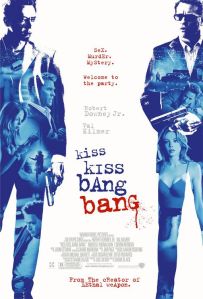 Shane Black was a Hollywood icon by the time he was in his early 20s. In 1987 he sold a script called Lethal Weapon to producer Joel Silver that put a jolt back into action flicks and gave the template for all buddy-cop comedies to come. He earned a then-record $1.7 million for his script, The Last Boy Scout, topped later by the $2 million paycheck he got for The Long Kiss Goodnight. It’s a shame both scripts were marginalized by their film directors. Black went underground for a long time, nursing his wounds over what had happened to his screenplays. Then in 2004, Black began his comeback vehicle, a modern day detective story that also lampooned Hollywood, and this time he’d direct his own material. The final product is called Kiss Kiss, Bang Bang, and Black’s comeback film is nothing short of a cinematic knockout and the most refreshingly entertaining movie of all 2005.
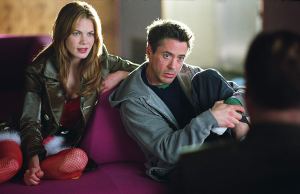
Harry Lockhart (Robert Downey Jr.) is a small-time crook on the run from the cops when he stumbles into an acting audition. They hand him a script, tell him his partner’s dead, and are so impressed with his “acting” that he’s immediately flown to Hollywood. Harry is teamed up with Gay Perry (Val Kilmer), a cop who does advisory work and just happens to be gay. During a house party, Harry reunites with a childhood friend, Harmony Faith Lane (Michelle Monaghan). They reminisce about their childhoods in Indiana and their fascination with the Johnny Gossamer detective novels, but she has much more on her mind: her sister’s gone missing and she needs Harry to find her. Trouble is Harry hasn’t told her he’s not a real detective. He’s gone from crook to pretend actor to pretend detective, and before Christmas is over he’ll be up to his neck in bodies, intrigue, double-crosses and all the stuff that would make for a rip-roaring Johnny Gossamer book.
 First and foremost, Kiss Kiss, Bang Bang is one deliriously fun party. The film moves at breakneck speed through its smart, cheeky gags. Black’s dialogue is hilarious and feels so effortlessly natural coming from Downey Jr. and Kilmer, like he’s got their speech patterns tattooed in his brain. In fact, the dialogue feels so robust and natural, never glib and self-conscious, that it almost comes across as feeling like a heavy improv session between two immensely talented actors. Kiss Kiss, Bang Bang, Black’s opus to the hard-boiled detective genre, has more twists and turns than a seizure patient doing the Hokey Pokey. You never know where this movie will head next or what joke will topple you over with unexpected laughter, and that’s what makes Kiss Kiss, Bang Bang so unabashedly thrilling to watch. Even when the movie does start to veer into more conventional material, Downey Jr. is there as our narrator to point out what we’re all thinking and to make fun of the expected. Kiss Kiss, Bang Bang can get jubilantly perverse at parts (a corpse getting a golden shower), but the macabre touches never deflect from the film’s boundless, inconsumable energy. Everyone is having the time of their lives in Black’s comic caper, and it shows.
Seriously, this movie is the definition of a laugh riot. It’s like a carnival ride through a gag factory (that sounds kind of spooky, actually), and Black has such an assured confidence to his writing, evidenced in his set-ups, reversals, and the insightful tweaking of Hollywood that could only come from one of its own (Harry laments that the nation turned over and shook and all the normal girls hung on while the crazies landed in L.A.). Here’s a conversation between Harmony and Harry about a promiscuous actress:
Harmony: Well, for starters, she’s been f***ed more times than she’s had a hot meal.
Harry: Yeah, I heard about that. It was neck-and-neck and then she skipped lunch.
Just re-reading it makes me laugh. How many comedies make you laugh just thinking about them in retrospect? Kiss Kiss, Bang Bang is one of those oh so rare delights. It even has a talking bear in it!
 The lone detraction for Kiss Kiss, Bang Bang is the movie’s overall lack of substance. It doesn’t reach for anything more than bold entertainment, and to that end it succeeds in spades. Some may argue the movie is spinning so fast to try and distract you from its empty center, but I say enjoy the ride while it lasts. I only wish this movie was longer, like Lord of the Rings-long. I did not want to leave this world and these characters. My claw marks might still be visible on the armrests where they had to throw me out.
Black also proves to be a very slick director with a natural eye for camera placement. His photography is very pleasing, relying on different light placements to add surreal touches that accentuate the narrative. Black keeps his movie at a breathless pace and knows how to handle his actors. His narrative side-steps enliven the film and grab our attention, and Harry’s voice over is never overused to explain the minutia the script cannot. The only drawback for Black might be that his film could be too smart for its own good. I mean, most of the movie going public will be stooped by a joke about adverbs. Black has an obvious love for detective yarns and film noir, that’s evident with the film’s style and the fact that chapter titles are Raymond Chandler novels, but some familiarity with this world will sharpen your experience. Kiss Kiss, Bang Bang never panders to its audience, and that may hurt Black as far as making a movie that will reach out to Middle America (Perry apologizes to the Midwest for using the “f-bomb” as often as they do).
The chemistry between Downey Jr. and Kilmer is incredible, positioning them as one of the finest comic pairings in recent cinema history. Their indelible camaraderie is the true heart of Kiss Kiss, Bang Bang. They bat insults and injuries with comic aplomb. Both characters are unapologetic, Harry as a nattering criminal screw-up way in over his head, and Perry as gay man who’s fine with that and will rip your testicles off just the same if you cross him. He’s not stereotypical swishy or flamboyant, but he’s very enjoyably dry and sarcastic. Both actors have a history of being troublesome to work with, but Downey Jr. and Kilmer have been two of our most amazingly talented actors … when they want to be. Kilmer is the coolest customer in the film, being nonchalantly badass even when he’s about to blow his top (this is NOT a gay joke, by the way). Downey Jr. is his usual charming, amiable, fast-talking self, but even his tiniest details speak comedic volumes, like his reactions and general awkward physicality. I cannot imagine anyone else doing as excellent a job in these roles, especially Harrison Ford who was sought by producers for the Gay Perry part (feel free to shudder at what might have been Hollywood Homicide 2.
 Monaghan is a break-out actress that could have been even more break-out-er by this time. She’s mostly had small unmemorable roles in films like Unfaithful and The Bourne Supremacy, but 2005 was set to be her year. She had roles in Constantine, Mr. and Mrs. Smith, and Syriana. Unfortunately, her scenes were cut from Syriana and Constantine, and her role was drastically pared down in Mr. and Mrs. Smith. The only thing Monaghan has to show for 2005 is Kiss Kiss, Bang Bang, and that’s all she’ll need. She’s bright and pretty, but she also gives Harmony a great sense of being run down, another girl getting off the bus to Hollywood with stars in her eyes only to find out the harsh reality. Her combative relationship with Harry as they reconnect and try and wonder how they went astray is another film high point. She’s a comedic asset and should be on Hollywood’s speed dial if they need a charming, funny, capable actress.
Kiss Kiss, Bang Bang is a wicked good time. It’s complex, twisting, riveting, unique, hilarious, and just about every synonym you can think for the word “awesome.” Black’s comeback may be too smart for its own good, and having a general understanding of film noir will enhance your experience, but this is one comic caper that’s so much fun, so stylish, so damned entertaining, who cares if it lacks substance? Kiss Kiss, Bang Bang is a refreshing blast of fresh air and should please anyone looking for a smart Hollywood film mixed with doses of their familiar sex and violence. But that’s what makes Kiss Kiss, Bang Bang so exhilarating, nothing about it could be classified as familiar. Seeing this flick is like being invited to the party of the year. Just make sure to head to your theater before your invitation gets lost in the mail.
Nate’s Grade: A
Share this:

Elizabethtown (2005)
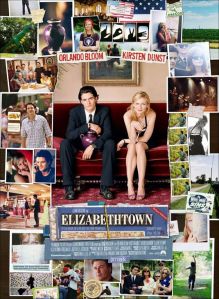 Cameron Crowe is a filmmaker I generally admire. He makes highly enjoyable fables about love conquering all, grand romantic gestures, and finding your voice. His track record speaks for itself: Say Anything, Singles, Jerry Maguire, Almost Famous (I forgive him the slipshod remake of Vanilla Sky, though it did have great artistry and a bitchin’ soundtrack). Crowe is a writer that can zero in on character with the precision of a surgeon. He’s a man that can turn simple formula (boy meets girl) and spin mountains of gold. With these possibly unfair expectations, I saw Elizabethtown while visiting my fiancé in New Haven, Connecticut. We made a mad dash to the theater to be there on time, which involved me ordering tickets over my cell phone. I was eager to see what Crowe had in store but was vastly disappointed with what Elizabethtown had to teach me.
Drew Baylor (Orlando Bloom) opens the film by narrating the difference between a failure and a fiasco. Unfortunately for him, he’s in the corporate cross-hairs for the latter. Drew is responsible for designing a shoe whose recall will cost his company an astounding “billion with a B” dollars (some research of an earlier cut of the film says the shoe whistled while you ran). His boss (Alec Baldwin) takes Drew aside to allow him to comprehend the force of such a loss. Drew returns to his apartment fully prepared to engineer his own suicide machine, which naturally falls apart in a great comedic beat. Interrupting his plans to follow career suicide with personal suicide is a phone call from his sister (Judy Greer). Turns out Drew’s father has died on a trip visiting family in Elizabethtown, Kentucky. Drew is sent on a mission from his mother (Susan Sarandon) to retrieve his father and impart the family’s wishes. On the flight to Kentucky, Drew gets his brain picked by Claire (Kirsten Dunst), a cheery flight attendant. While Drew is surrounded by his extended family and their down homsey charm and eccentricities, he seeks out some form of release and calls Claire. They talk for hours upon hours and form a fast friendship and stand on the cusp of maybe something special.
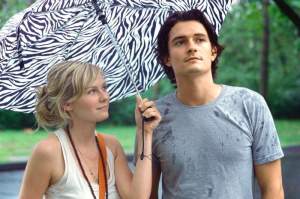 I think the most disappointing aspect of Elizabethtown for me is how it doesn’t have enough depth to it. Crowe definitely wears his heart on his sleeve but has never been clumsy about it. Elizabethtown wants to be folksy and cute and impart great lessons about love, life, and death. You can’t reach that plateau when you have characters walking around stating their inner feelings all the time, like Drew and Claire do. They might as well be wearing T-shirts that explain any intended subtext. Crowe squanders his film’s potential by stuffing too many storylines into one pot, thus leaving very little attachment to any character. Elizabethtown has some entertaining details, chiefly Chuck and Cindy’s drunk-on-love wedding, but the film as a whole feels too loose and disconnected to hit any emotional highs. If you want a better movie about self-reawakening, rent Garden State. If you want a better movie about dealing with loss, rent Moonlight Mile.
This is Bloom’s first test of acting that doesn’t involve a faux British accent and some kind of heavy weaponry. The results are not promising. Bloom is a pin-up come to life like a female version of Weird Science, a living mannequin, possibly an alien with great skin, but he isn’t a real compelling actor. He has about two emotions in his repertoire. His whiny American-ized accent seems to be playing a game of tag. He’s not a bad actor per se; he just gets the job done without leaving any sort of impression. To paraphrase Claire, he’s a “substitute leading man.”
Dunst is chirpy, kooky and cute-as-a-button but is better in small doses. Her accent is much more convincing than Bloom’s. Sarandon deserves pity for being involved in Elizabethtown‘s most improbable, cringe-worthy moment. At her husband’s wake, she turns her time of reflection into a talent show with a stand-up routine and then a horrifying tap dance. Apparently this gesture wins over the extended family who has hated her for decades. Greer (The Village) is utterly wasted in a role that approximates a cameo. Without a doubt, the funniest and most memorable performance is delivered by Baldwin, who perfectly mixes menace and amusement. He takes Drew on a tour of some of the consequences of the loss of a billion dollars, including the inevitable closing of his Wildlife Watchdog group. “We could have saved the planet,” Baldwin says in the most comically dry fashion. Baldwin nails the balance between discomfort and bewilderment.
 Elizabethtown wants to be another of Crowe’s smart, feel-good sentimental field trips, but it falls well short. I was dumbfounded to see how little the story progressed. It lays the groundwork for a menagerie of subplots and then, in a rush to finish, caps everyone off with some emotionally unearned payoff. To put it simply, Elizabethtown wants credit and refuses to show its work. The film is packed with characters and ideas before succumbing into an interminable travelogue of America in its closing act, but what cripples Crowe’s film about opening up to emotional growth is that the movie itself doesn’t showcase growth. We see the rough and tumble beginnings of everyone, we see the hugs-all-around end, but we don’t witness that most critical movement that takes the audience from Point A to Point B. The results are beguiling and quite frustrating. Take the subplot about Drew’s cousin, who can?t connect to his father either and wants to be friends to his own son, a shrill little terror, instead of a father. Like most of Elizabethtown‘s storylines, these subplots die of neglect until a half-hearted nod to wrap everything up. Father sees son perform and all is well. Son does little to discipline child but all is well. Elizabethtown is sadly awash in undeveloped storylines and characters and unjustified emotions, and when they’re unjustified we go from sentiment (warm and fuzzy) to schmaltz (eye-rolling and false). I truly thought Crowe would know better than this.
Crowe has always been the defacto master of marrying music to film. Does anyone ever remember people singing Elton John’s “Tiny Dancer” before its virtuoso appearance in 2000’s Almost Famous? Crowe has a nimble ear but his penchant for emotional catharsis set to song gets the better of him with Elizabethtown. There’s just way too many musical montages (10? 15?) covering the emotional ground caused by the script’s massive shortcomings. By the time a montage is followed by another montage, you may start growing an unhealthy ire for acoustic guitar. Because there are so many unproductive musical numbers and montages, especially when we hit the last formless act, Elizabethtown feels like Crowe is shooting the soundtrack instead of a story.
Elizabethtown is an under-cooked, unfocused travelogue set to music. Crowe intends his personal venture to belt one from the heart, but like most personal ventures the significance can rarely translate to a third party. It’s too personal a film to leave any lasting power, like a friend narrating his vacation slide show. Elizabethtown is gestating with plot lines that it can’t devote time to, even time to merely show the progression of relationships. The overload of musical montages makes the movie feels like the longest most somber music video ever. Bloom’s limited acting isn’t doing anyone any favors either. In the end, it all rings too phony and becomes too meandering to be entertaining. Elizabethtown is a journey the film won’t even let you ride along for. This movie isn’t an outright fiasco but given Crowe’s remarkable track record it can’t help but be anything but a failure.
Nate’s Grade: C
Share this:

The Longest Yard (2005)
 Does anyone else remember an episode of South Park from the 2004 season where Eric Cartman dresses up as a robot named AWESOM-O? The best part of the episode came when Cartman stumbled into a Hollywood meeting and they asked the robot to pitch a movie idea. He came up with idea after idea of Adam Sandler in some wacky yet predictable situation, each a slight variation from the last. The Hollywood execs ate it up and scribbled everything down, chanting, “Goldmine!” I imagine The Longest Yard remake, the latest Sandler comedy vehicle, came about through similar creatively bankrupt circumstances.
Paul Crewe (Sandler) is at a low point in his life. The once star quarterback has been banned from football for throwing a game. His girlfriend (Courtney Cox) thinks they should split, and after being chased by police for drunk driving, he?s been sent to prison. The warden (James Cromwell, your go-to guy if you need someone old) has big plans for Crewe. He wants the young stud to organize an all-inmate football team to play against the cruel guards. Crewe gets help from a fellow inmate Caretaker (Chris Rock) and they set about finding the right men for their team. A former Heisman-winning football player (Burt Reynolds), who happens to be in the same prison, becomes the coach. Slowly but surely the group becomes a team united to get some revenge on their tormentors.
The Longest Yard is an Adam Sandler comedy in the worst way possible. The film is sloppy and sophomoric but generally unfunny. It sets its comedy heights on kicking people in the nuts and making fun of gay people. Mission accomplished. The sex jokes, while in abundance, generally fall flat because the movie is so ineptly transparent when it comes to comedy. It lets all the air out of the supposed punch lines. The humor is typically homophobic but infuriatingly also anti-women. You see, one of the guards is taking steroids in a bottle with a giant label that says, “Steroids?”(so much for keeping a low profile). The boys replace the steroids with -hee hee- estrogen pills. And in three days time, which would of course have no effect in such a short period, the guard is now crying, and overly emotional, and empathetic, and he has hot flashes, though I don’t know how in the world a man comes to that conclusion. Apparently it’s funny because women are weak and care about each other. I would be offended by this whole joke if it wasn’t so incompetently done. The Longest Yard exists in its own inept world where inmates have cells within arms reach of each other and there’s a prison football league. Lest we forget, this prison also keeps a star system to rank its inmates. Little did you know of Roger Ebert’s unorthodox side projects.
 Sandler plays Adam Sandler as he does in most of his Hollywood flicks. He’s likable, he’s a goofball, and it all works out. I wonder if we’ll ever see the true thespian side of Sandler again, like in Paul Thomas Anderson?s deconstructionist Punch-Drunk Love. Rock’s abrasiveness is toned down but he also loses his comedic edge. He’s basically another stereotypical black character in a movie making tired jokes about the difference between black people and white people. Cromwell and Reynolds both appear to be having fun mucking it up with the youngins. The rest of the supporting cast have their moments but aren’t very memorable. The movie fills out the athletes by having real football players and wrestlers.
What’s worse is that The Longest Yard wants to also be taken as a serious movie. This causes some intensely jarring scenes intended for dramatic impact but they just stick out sorely and are misplaced. Every time the movie goes from kicking people in the nuts to dealing with something like racism or death, the movie flounders from the tonal whiplash. The original movie was more of a prison drama than a sports movie, let alone a comedy. The Sandler remake wants to be all three and isn’t good at any of them.
This movie is so formulaic that it could have been written on a string of napkins, likely only totaling three. The Longest Yard feels like 2005’s greatest example of a cut-and-paste studio approved movie. Of course the embattled hero will once again face his demons and his past. Of course the motley crew of idiots and convicts will come together for something greater than themselves. Of course the evil guards will all get their comeuppance in appropriate ways. I expected all this from the start, but where The Longest Yard goes terribly wrong is when even the details can be correctly guessed. I watched the film with a couple friends and we accurately guessed every character move, scene transition, character development, and sadly, every punch line. This is a film that spells everything out, including the jokes. Here’s an example of the film’s shortsighted thought process: the dastardly warden soaks the player’s field and makes it all muddy with the intention of demoralizing the team. What? These are prisoners, and you think mud is going to demoralize them? Don’t even get me started on how insane it is sending Burt Reynolds into the game as a running back. There’s more attention spent on the limp football scenes than the story or the comedy.
 Another example of how weak the comedy is comes during the football game. It’s being telecast on ESPN and Chris Berman is providing the play-by-play. His sidekick in the booth is an inmate who doesn’t say anything. Berman even broaches this fact on air. Now, if The Longest Yard knew the facets of comedy, the natural payoff for this sequence would be for the silent inmate to say something at the very end, something funny or unexpected or even verbose. Instead, the film has the inmate talk two or three times and he adds no comedy. That’s The Longest Yard in a nutshell: all set-up and no return. And seriously, stop with the Rob Schneider cameos already.
The humor is a cocktail of physical slapstick and the occasional one-liner. There just isn’t anything satisfying to the comedy The Longest Yard has to offer. The jokes typically don’t build to anything greater and the humor is simply immediate with no lasting results. There’s nothing that will make you keel over with laughter, nothing that rises above a smirk or a slight giggle. The jokes are way too predictable and there’s nothing funny about the expected. That’s why most people don’t chuckle when the mail arrives. This just isn’t an entertaining comedy, plain and simple.
The Longest Yard is a tirelessly formulaic affair that is so ham-fisted with comedy it can’t even deliver jokes properly. This is a dumb, sanitized, audience-friendly easily digestible piece of puff that will get caught in your throat. This is a Franken-movie, with various parts crammed together for the best possible results by some studio overlord. The Longest Yard‘s comedy is sophomoric and generally insipid, the drama is a complete misstep and tonally out of place, and the football scenes are vapidly jazzed up. This is a sports move that doesn’t work as a comedy and a comedy that doesn’t work as a sports movie. Sandler’s devout army of fans will likely be satiated with this latest effort, feeling the flick to be stupid fun. For me, it was just stupid. Very stupid.
Nate’s Grade: D
Share this:

Flightplan (2005)
 Anyone else tired of seeing that damn trailer for Flightplan? Ever since maybe June, I’ve been seeing Jodie Foster freak out on an airplane. The trailer also had the misfortune of revealing way too much information about the film’s plot, seriously spoiling a key moment. This got me thinking about other movie trailers that spoil the movie. The worst offender I can fathom is 1998’s The Negotiator, where Samuel L. Jackson and Kevin Spacey are pitted against each other as hostage negotiators on opposite sides. The trailer had the nerve to reveal that Spacey and Jackson team up in the end to fight The Man collectively. Why does it seem that movie trailers these days spell out film twists? Are movie audiences demanding more investment before shelling out money? Do studios just not have faith in audiences anymore? With all this in mind, I ventured into Flightplan with my family thinking there might be more to the film than one poorly spoiled twist. I was wrong.
Kyle Pratt (Foster) is a very distraught woman. She’s returning from Berlin to the United States with the casket of her dead husband aboard. To make things worse, at 30,000 feet her daughter Julia goes missing. Kyle looks around the giant aircraft that she helped design, still not finding any trace of her absent little girl. Kyle becomes more frantic the more she looks and finds nothing, troubling an air marshal (Peter Sasrgaard) and the pilot (Sean Bean). No one remembers seeing Julia on board. She believes her daughter is somewhere and someone is definitely responsible. Kyle is dealt a crushing blow when word comes from a Berlin mortician that not only is the plane carrying the body of her dead husband but also her dead daughter. Is Kyle right or is she one crazy mamma? And so the drama unfolds.
 Flightplan is a rather boring trip. Well over half of this movie is spent watching Kyle wig out and search compartments for her missing kid. She’s frantic and possessed and it’s interesting to watch a woman come undone, especially of Foster’s talent, but after several searches and little progression, the film feels like it’s going nowhere. There’s very little story for very long stretches of time. Flightplan relies on its outlandish final twists to provide a story, because without them the film would just have been 60 minutes of a mother freaking out on a plane. You can see that with home movies.
The premise is a direct homage (or rip-off) of Hitchcock’s The Lady Vanishes, but Flightplan could have been something special if it wasn’t so afraid of going against convention. The film sets up our leading lady looking for her missing child, and as the hours tick away she becomes more and more undone, practically terrorizing the other passengers. In a bit of incisive bigotry, Kyle even unfairly blames a pair of Middle Eastern passengers, who then garner everyone’s suspicious eyes. Now, with all this set up, what if Flightplan took a different path and we remained in doubt whether Kyle ever had a living daughter, and then through her grief, confusion, frustration, and misplaced anger she became a terrorist and was the cause of the plane going down. Wouldn’t that be neat? A little thought-provoking about role reversals in a post-9/11 anxiety-riddled world? It’s not like I expected a dour, Twilight Zone-esque ending, but Flightplan presents Kyle as a crazy woman with the entire world against her, and yet the movie virtually winks at you to say, “Don’t worry, this is Hollywood, no matter how outlandish the conspiracy, our heroine will always be right.” At the end, the film even has the distasteful audacity to have a scene where Kyle walks past every airline passenger, shaming them for having ever doubted a crazy loud woman who had terrified them and jeopardizing their safety. Shame on you all, passengers. Don’t you know that she’s Jodie Foster? She has TWO OSCARS! Kyle doesn’t even offer an apology to the Middle Eastern passengers, and they even carry her bags for crying out loud!
 There’s suspension of disbelief and then there’s Flightplan. The missing-daughter scheme is so ridiculous, so convoluted, so rickety, that it makes Scooby-Doo schemes look downright like Hitchcock. For those who have seen the film, or just want to know the laundry list of variables to allow this plan to work, read on (massive spoilers ahead). Apparently, the ones behind everything are the helpful air marshal and one stewardess. They want to squeeze 50 million dollars from the airline. This is the best way they propose to do so: First, they locate an airline engineer living abroad and kill her husband and make it look like suicide. Then they pay off the mortician so they can stash explosives in her husband’s security sealed coffin. Then apparently they know when Kyle will want to fly again and it also happens to be a flight that the marshal and the stewardess will be scheduled aboard. Now, once the plane is in flight, the marshal somehow manages to steal the little girl, awakening no one, takes Kyle?s boarding pass and doesn’t awaken her, and stows the little girl away without being seen. They then let Kyle go nuts looking for her missing tyke so they can, get this, have a credible hijacker that they can accuse of plotting to blow up the plane unless … she gets 50 million wired into an account. Afterwards, the marshal will somehow get the Feds to kill Kyle and he’ll slip the detonator in her cold dead hand. Oh, and the stewardess changes the flight manifest twice too. What. The. Hell? Does this sound like the easiest way to make money? This plan also involves Kyle wiggling her way into the cargo hold and manually opening her hubby’s casket with the security code so that the marshal can get a hold of the hidden explosives. This entire tortuous plan revolves around a primary assumption that NO ONE will remember or interact with Kyle’s daughter the entire time. This assumes not a single person will remember little Julia, even though mother and daughter boarded first onto an empty plane. What would happen if Julia hit the call button for a pillow? Oops. What would happen if anyone next to them just said, “Hi?” Oops. What would happen if people on the plane contacted anyone at the airport? Oops. The entire conspiracy rests on 400 people’s bad memories. Those do not seem like good odds to me, but then again I’m not a movie villain. The entire heft of Flightplan is built around the revealing of this nefarious, fool-proof plot. The movie can’t help but crash and burn with such a laughable, preposterous Big Twist to give plausibility to the proceedings.
It’s a shame because Foster gives a real nail-biting performance. She’s splendidly rattled and lets the audience see the gears of fear turn in her eyes. The acting as a whole is the lone strength of Flightplan. Foster provides entertainment just from her sheer talent to be able to make a turkey like this flick even remotely watchable. The rest of the cast is okay to good and they all deserve pilot wings for keeping straight faces.
Flightplan is a timid, tedious, tiresome, and painfully preposterous thriller. Foster’s excellent performance is wasted in a film that spins its wheels before unleashing a dreaded torrent of illogical plot twists. You may be twisting your head around just to understand how any of this deeply flawed movie could be plausible. Flightplan should appeal to people that liked 2004’s The Forgotten, a very similar child-vanishes thriller. Another thing both movies have in common is that they’re utterly terrible.
Nate’s Grade: C-
Share this:

Waiting… (2005)
 I have always respected restaurant workers; it’s just how I’ve been brought up. Short of elephant in vitro fertilization, being a waiter has got to be one of the hardest, most thankless jobs on the planet. The waiter (or server, the popularized non-gender specific term) is always the last responsible for food and the first to bear the brunt of a customer’s wrath. They’re easy targets. Their livelihood is also dependent on the idea of common decency in mankind. For these tortured, put upon, overlooked lot comes a new comedy aimed to ease the pain. Waiting… is a balls-out (pun very much intended) gross-out comedy that will make you a better, more sympathetic tipper (I generally start at 20 percent).
Welcome to the wonderful, family-friendly world of Shenaniganz. It’s another day of business for the restaurant staff and another day of enduring the slings and arrows of unruly customers. Monty (Ryan Reynolds), the leader of the pack, escorts a newbie (Freaks and Geeks‘ John Francis Daley) through the rules and customs of the Shenaniganz family. The cooks (Dane Cook, Luis Guzman) like to get randy at work, the bus boys (Max Kasch, MTV’s Andy Milonakis) like to hide in freezers and toke up, and the wait staff (Anna Faris, Justin Long) are all dating each other. Meanwhile, Dean (Long) is mulling over whether to take the manager’s job offered to him by his buffoonish boss (David Koechner). He feels his life is going nowhere and he’s stuck in a dead-end job. And there’s a store-wide game where workers try and get other people to inadvertently look at their genitals. God I hope this doesn’t go on when I order my food.
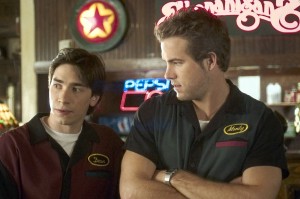 Bishop (Chi McBride) tells two other characters, “You guys are so one-dimensional.” It’s like the movie’s doing my job for me. Waiting… is stocked with underdeveloped characters that don’t even seem used properly. They all have one characteristic of note, from the white wannabe rappers to the bitchy self-loathing server that’s been there longer than anyone else. There’s a lesbian bartender and by the end of the movie that’s still the only thing you know or feel about her. Dean’s girlfriend (Kaitlin Doubleday) has nothing to add to her character, nothing to really say, no personality, she’s just “the girlfriend.” Waiting… has so many lame, poorly developed characters that go nowhere and shed little purpose or personality. It’s a general waste of talent, especially Faris and Guzman.
Reynolds is a charming and gifted comedic actor. He’s got the rat-a-tat-tat delivery down cold and adds a great polish to dialogue that ordinarily wouldn’t seem funny. He can seem at once jerky, knowing, charming, distasteful, and funny. Consider Reynolds a Vince Vaughn Jr. in the making. Long is supposed to play a character dissatisfied with his bearings in life, yet he comes across as disinterested in being in the movie. You almost expect him to shrug his shoulders and just say, “Whatever.” Long too is a very capable comedic actor but he needs far broader roles (Dodgeball) than something where he has to shuffle his feet and mope a lot. As stated earlier, Waiting… really wastes most of its talent by stranding them in thankless roles that don’t give them much to do or add. Koechner is the bright spot as a clueless, leering buffoon of a manager who keeps trying to connect with “the kids” and score with some as well.
 The story feels the same way. For a 90 minute movie so much of this feels unbearably plodding. Waiting… sets up the life of a restaurant well but then can’t find much to do. The story feels formless and the characters can?t provide any direction because of their limitations. The plot seems like a group of anecdotes looking for structure. Even the comedy is rather uninspired and bland. Waiting… attempts gross-out guffaws but just ends up becoming, well, kind of gross. Dropping food and serving it doesn’t exactly register on the Ha-Ha meter no matter how many times the act is repeated. The gross-out apex comes when vengeance is heaped upon a very hostile customer with an assembly line of new “additions” to her order. In this one instance the gross-out is transcended because the audience cares about the situation. Most of the humor is juvenile and not even good at it; the penis-showing-game is inherently homophobic and a running gag with little payoff. The best joke in Waiting… is the film’s production design; Shenaniganz looks nearly identical to those homogenized chain restaurants dotting the landscape. If you stay throughout the entire end credits you’ll discover that all the crap on the walls is actually an elaborate, Rube Goldberg-esque device.
Waiting… is a very knowledgeable film about the food service industry, what with writer/director Rob McKittrick spending years and years in restaurants. I think the only way you could seriously enjoy this comedy, while sober, is if you have experience working in food service. My fiancée has spent years as a server and she identified more with the characters than I ever could. There are scenes in Waiting… that are a server’s fantasy, like when Dean returns his measly one-dollar tip back to his customer. The movie is a safe release for people in the field, much like Office Space. McKittrick even thanks Kevin Smith in the closing credits, but Waiting… doesn’t have an iota of the wit, intelligence, and comedic savvy of Clerks. This is a bargain basement comedy that will largely appeal to fellow restaurant slaves yearning to have their beaten voice heard.
Waiting… is an aimless comedy with no characters to feel for, little personality beyond its knowledge of the restaurant environment, and a cast done in by one-note roles and bland gross-out jokes. Reynolds walks away with his dignity and adds a comedic polish to some otherwise ordinary jokes. Mostly, the film feels like a waste of time, energy, and talent. Waiting… will definitely appeal to people who have felt the wrath of working in food service, but objectively this is one comedy that just doesn’t order up any laughs.
Nate’s Grade: C
Share this:

A Sound of Thunder (2005)
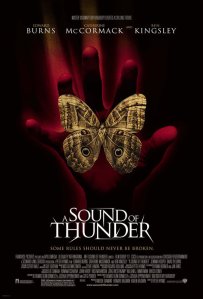 A Sound of Thunder, based on the classic short story by Ray Bradbury, is a movie that no one is going to see by design. It was shot way back in 2002, traded directors when Renny Harlin left to make Mindhunters and Peter Hyams (End of Days, The Relic) stepped in, sat on a shelf for two years, and now is being released without a peep. I have not seen a single TV ad, a single trailer, and until a few days ago I hadn’t even seen a poster for the film. It’s like the studio doesn’t want anyone to know that A Sound of Thunder exists and that they?re responsible. With zero advertising, the only people who are going to pay to see this are those familiar with Bradbury’s story. A Sound of Thunder will be gone in the blink of an eye. It doesn’t help that the movie is awful.
In the year 2055, time travel is here and available to those with deep pockets. Charles Hatton (Ben Kingsley) runs a service that allows rich people to travel back millions of years for the ultimate big game hunt — dinosaurs. The time squad is led by Travis Ryer (Edward Burns), a brilliant scientist biding his time working for the man. The time travel inventor (Catherine McCormack) warns about the dangers with playing around in the past. The tiniest alteration could drastically change the future. Hatton assures everything is safe; they hunt the same dinosaur that is just about to be destroyed and touch nothing else. Of course something does go wrong. On one hunt the clients run off the safe path and accidentally step on a butterfly. This causes “time waves” to sweep the present-day Earth and kick start some evolutionary changes. Travis is left to figure out what went wrong and fix it before humankind is wiped off the planet with the next wave.
 The movie pretends to play with brainy sci-fi principles, but A Sound of Thunder is really an empty vacuum of logic. As a precautionary measure, the team only travels back in time and hunts the same damned dinosaur. This dinosaur is special because it’s minutes away from getting stuck in a tar pit and then being obliterated by an exploding volcano. The team picks this dinosaur because hunting it won’t disrupt the fabric of time. Gotcha, but then why does stepping on a butterfly even matter? Is a butterfly seriously going to survive the oncoming volcanic blast and wall of ash? If the butterfly is just moments away from it too being destroyed, then why does killing it seconds earlier affect all of evolution? And how come these changes in time are always disastrous? Can’t someone just as reasonably step on a butterfly and wipe out cancer?
Let’s talk about A Sound of Thunder‘s alternate evolutionary timeline. In this world, because of our infamous butterfly stomping, apes and dinosaurs have inexplicably become linked. They’ve evolved into some weird hybrid, with a baboon head and the body of a dinosaur. This seems entirely implausible to me that two very different creatures would just blend together. At least A Sound of Thunder could have gone all out and had other animal mash-ups, like a whale/hummingbird or a walrus/cheetah. A Sound of Thunder could be rivaled by The Wuzzles in evolutionary theory (please tell me I’m not the only one who remembers The Wuzzles). I would have been more interested if A Sound of Thunder presented the future dinosaurs as fully evolved after an additional 65 million years. Let’s see dinos with industry, tools, community, language, and maybe even popular culture. It sure would be more interesting and imaginative than big dumb monsters.
A Sound of Thunder isn’t a sci-fi puzzler; it’s really a monster movie in disguise. After the evolutionary wrench, the film descends into a banal series of chase scenes, with our characters being plucked one-by-one by different monsters. The characters still manage to spout sci-fi dribble while on the run. Of course the characters can’t stop themselves from doing stupid things. A guy warns our team to be quiet lest they awaken the hordes of sleeping baboon-dinos hanging overhead. So what do they do? They make sure to shine their flashlights repeatedly in the creatures? faces. A Sound of Thunder is more preoccupied with what can go bump in the night than sci-fi brainteasers.

Not how evolution works.
A Sound of Thunder has some of the worst special effects I have ever seen. I’m talking about effects that would be shown up by some half-baked video game from the mid ’90s. It’s really hard to fully explain how profoundly bad the effects are. The green screen work is ugly and painful, with characters surrounded by halos and walking on invisible treadmills. The future’s boxy cars look like they were assembled by Lego. The look of the dinosaur is curiously retro, all sleek, entirely green or brown, and lacking definition. It looks like what people in the 1950s thought dinosaurs looked like. In the wake of Jurassic Park, a less realistic, more reptilian dinosaur is not the way to go. The film tries to save money by using the same dinosaur and repeating the scene with diminishing returns. Every special effect in A Sound of Thunder comes across as flimsy from the wildlife, to the skyscrapers, to the dinosaurs, to even a subway car and rising water. Every effect is so terribly obvious and obviously terrible.
The film’s acting is expectantly dull. Kingsley hams it up and has great fun as his money-grubbing business tycoon. He adds a zest to his lines. Burns plays every role so dead-panned that I doubt I will ever see an emotion from him that isn’t accompanied by a smirk. The rest of the actors couldn’t find their way with an industrial flashlight to shine in a monkey-dino’s eyes.
A Sound of Thunder is an inept sci-fi flick more concerned with hungry monsters than ideas. The special effects are abysmal, the acting is wooden, the plot holes are glaring, and the atmosphere is laughable. This giant schlockfest is so bad that it achieves a fun campy value, destined to become a drinking game for science fiction nerds. Only Ray Bradbury fans will be at the theater to see A Sound of Thunder, so in turn that means only Ray Bradbury fans will be disappointed with how terrible the film adaptation is. Everyone else will be at home scratching their heads; certain that a film called A Sound of Thunder never existed. Just like the studio wants.
Nate’s Grade: D-
Share this:

The Brothers Grimm (2005)
 Director Terry Gilliam is one of the true artists working today in movies. His manic, off kilter, visually grand imagination has crafted wonderfully vivid fantasias, but it also has given Gilliam a reputation for being the captain of a sinking ship. The Adventures of Baron Munchausen is regarded as one of Hollywood’s bigger failures, unfairly I might add. A fascinating 2003 documentary called Lost in La Mancha detailed the bizarre circumstances and implosions that forced Gilliam to shut down production of his pride and joy, a film about Don Quixote. We’re talking things as out of control and unlucky as acts of God conspiring to doom this project. But then, Gilliam has always been fighting someone or something his whole film career. The studio refused Gilliam’s cut of Brazil so he sneaked out a print, showed it to the Los Angeles film community, and they dubbed it the best film of that year. Gilliam is a man governed by his idiosyncrasies. He’s blessed with a unique voice but cursed with the prospects of not having anywhere to say something (would he not make simply the most divine Harry Potter film yet?). And so Gilliam strikes his hands at something a bit more commercially minded with the action/comic fable, The Brothers Grimm.
Will (Matt Damon) and Jakob (Heath Ledger) Grimm are nineteenth century ghostbusters, so to speak. They travel from town to town ridding the villagers of evil spirits, witches, and all sorts of demonic creatures. Trouble is it’s all a lie. The Grimm brothers and their pals set up the spooks and rob the town blind. Will enjoys the fame, and especially the women, but Jakob feels apprehensive. It?s the Napoleonic wars, and the French have occupied the Germanic lands. A snooty general (Jonathan Pryce) plans to behead the two Grimm brothers unless they solve a strange case in a rural town. A slapsticky, torture-loving commander (Peter Storemare) is sent to watch over the “Grimmies.” At the village, Will and Jakob discover the town has had 10 of its daughters kidnapped with little explanation. With the help of a free-spirited woman (Lena Headey), the brothers encounter giant wolves, moving trees, lickable frogs, and the giant tower of the Mirror Queen (Monica Bellucci). The Queen was given eternal life but not eternal youth. In order to gain eternal youth, the Queen needs to take the lives of 12 hearty girls, and only the bumbling Grimm brothers stand in her way.
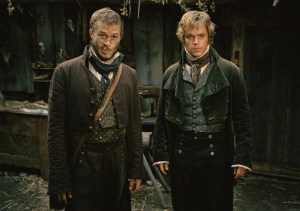 The acting is an example of the film’s messy feel. Ledger talks with marbles in his mouth. He’s putting more detail into the character than it deserves. Damon seems like he’s sleepwalking through the film, and his accent fluctuates wildly. He’s sort of a grinning straight man to Ledger’s tic-heavy daydream believer. Belluci is a ravishing beauty and proof positive for Hollywood that women over 40 don’t need to be put out to pasture. Too bad all she’s expected to do is look pretty and seductive in The Brothers Grimm. Pryce plays his role like a cartoon caricature. Stormare has already given one crazy performance this year (Constantine), and his frenzied, nearly indecipherable performance seems to be the closest to Gilliam’s whacked-out wavelength. Stormare is entertaining in every scene he’s in but can be found guilty of chewing scenery like it was a delicious candy house.
The Brothers Grimm is a gorgeous looking film. The sets are massive and greatly detailed. The location shoots in Prague seem like the perfect environment for Gilliam’s beyond-this-world landscapes. Gilliam experiments with advanced computer graphics for the first time and adds his oddball touches. A child has her eyes taken by a glob of mud, and then the mud reshapes itself into a lumbering gingerbread man. A horse spits out a spiderweb and ensnares a child. And it looks really freaking creepy. The Mirror Queen’s defeat is another standout effect as she breaks apart like shattered glass. The look of The Brothers Grimm is outstanding, but it’s what takes place inside those pretty pictures that dooms the film to mediocrity.
 The Brothers Grimm is an unfocused mess. It has disjointed subplots and several story elements that just don’t fit. The wacky French occupation feels like a leftover from a different movie. It just doesn’t work and grinds the movie to a screeching halt with every resurfacing. The Brothers Grimm will routinely work its way into a narrative corner and then use a “magic” cheat to escape (magic axe, magic mirror, magic kiss). Gilliam has always been a master maestro of chaos and visual oddities, but this time he’s tackled a film with a very weak script by Ehren Kruger (Ring Two). Kruger doesn’t bother laying the groundwork of his magical world or establish the rules. Therefore anything can happen and rarely feels satisfying. The characters are one-note, each given a single character trait to play with (skeptic, believer, idiot, etc.). The pacing is pretty sluggish. The first act takes an eternity to set up the film’s characters, plot, and yet it still feels sloppy. The twists and turns are easily telegraphed and unexpectedly boring. The plot is frustrating, shortsighted in scope, and far too conventional for Gilliam’s tastes. When The Brothers Grimm reaches its happy ending you’ll swear you can hear Gilliam gagging somewhere.
Gilliam adds a worthy macabre tone to the film. There will be touches that you know are pure Gilliam, like a woman skinning a rabbit as she talks, or a cat flying into the blades or a torture device. In fact, The Brothers Grimm has a lot of humor involving the comic demise of animals. This isn’t exactly a film appropriate for young children despite the appeal of a fairy tale background. The film wants to tweak fairy tale legends like the two Shreks, but Gilliam wants to make them disturbing nightmares, not something of irreverence. This puts the film’s tone at odds. One minute you’ll have a scene that?s morbid, darkly funny, and unconventional, and then the next minute you’ll have a scene that’s cliché, dull, and whimsically misplaced.
The Brothers Grimm feels like a Terry Gilliam film under glass. The script is weak and plodding, the characters barely leave a dent, and the tone is uneven. The plot is pulled in too many directions and lacks momentum. There are a handful of fun comic diversions but the movie feels like a loose collection of disjointed story elements. There are flashes of grim humor and visual elegance but more often than not the film is just stupendously boring. The Brothers Grimm feels the same way the Coen brothers’ Intolerable Cruelty felt: a unique vision compromised and downsized by studio conformity. You can see the indie spirit but the heart just isn’t beating. The Brothers Grimm is mediocre at best. How very grim indeed.
Nate’s Grade: C
Share this:

The 40-Year-Old Virgin (2005)
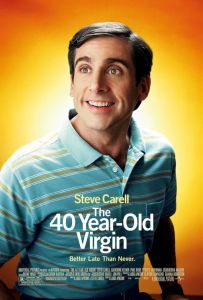 Yes it’s an uproarious sex farce, that’s a given from the ads, but this movie is also surprisingly sweet and genuinely moving. A lot of credit goes to star/co-writer Steve Carell and co-writer/director Judd Apatow, creator of some of the best, most honestly funny TV series unjustly cancelled. Apatow is a master at mining human comedy for pathos, where you get a great sense of character and really feel for those onscreen, and yet nothing feels cheap or unwarranted, all the while deriving comedy from the situations. We need more men like Apatow in the film industry. Carell can do it all whether it’s deflecting his insecurity, which we feel so bad when he comes up with outrageous things he’s overheard to make himself seem like one of the guys. The supporting cast is top-notch. They’re basically the stock roles in a sex comedy and yet they bring so much more to the table, with a true-to-life boys-will-be-boys camaraderie that you can identify with. The character relationships in The 40-Year-Old Virgin really elevate the story and the jokes and make the film something really special. It’s not merely a barrage of gross-out humor; it’s a nice story with some very tender moments. This is a movie that goes well beyond its gimmick premise, never feeling like a skit blown up into a feature film. It mixes in psychology, heartbreak, awkwardness, but also insights into loneliness and human connection. The best character-based comedy in years.
Nate’s Grade: A
Share this:

Red Eye (2005)
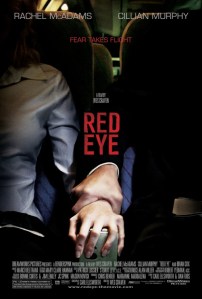 Red Eye is something of a comeback for Wes Craven, the horror master that’s been somewhat grasping at straws for several years (for further proof see Cursed). The concept is ripe for tension and the film has little fat on it, clocking in at a meager 80 minutes. It’s divided like so: 20 minutes set-up, 40 minutes on the plane, and 20 minutes off the plane for the conclusion. Red Eye is so enjoyable when we’re trapped on that flight, catching the icy stares of Cillian Murphy, that I personally would love an additional 20-30 minutes more in the air. There’s a nice chain of cause and effect, as the audience is with Rachel McAdams (fast becoming the Hollywood It girl) as she tries to think her way out of her jam, each time thwarted by the chilling Murphy once more. It’s a great duel of wits. The last act of the film is too conventional and predictable to close out such a great claustrophobic pressure cooker. It’s also a bit insulting that she’s ultimately rescued by a man after we watch 80-minutes of her plucky ingenuity and courage. Red Eye is a solid thriller carried by two great performers on the rise.
Nate’s Grade: B
Share this:

The Aristocrats (2005)
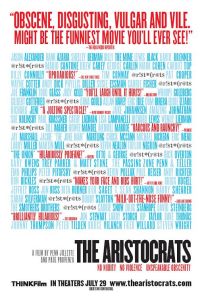 A man walks into a talent agency. He tells the agent he’s got a family act the likes of which no one has ever seen before. The agent tells the man to continue. The man’s wife, children, and pet come into the room and proceed to do the most vile, puerile, horrendously vulgar acts to themselves and each other. The agent is shocked. After a long moment of silence, the agent says, “What do you call this act?” The man replies, “The Aristocrats!” Ba-dum-dum.
It’s really not a good joke, but what makes it special is that the middle is entirely open for the comic to say whatever they want. Comedians will build and build in their obscenity so that the weak punchline is practically an afterthought. It’s a joke that goes all the way back to the days of vaudeville. Comics tell it to each other after shows like a secret handshake. The Aristocrats, an unrated documentary, gathers 100 comedians and lets them put their own crass spin on a classic dirty joke.
 The movie boasts plenty of well-known names getting down and dirty, like Robin Williams, Chris Rock, Whoopi Goldberg, George Carlin, the South Park creators, Jason Alexander, Eric Idle, Richard Lewis, Andy Dick, Fred Willard, Howie Mandel, Eddie Izzard, and Drew Carey (he insists the punchline should be accompanied by finger-snaps). Few comedians give a full rendition of the joke but the clips are just as potent. Judy Gold involves her unborn baby in the act and Carrie Fisher says her mother likes to sing in a very different kind of shower, but the filthiest mind of all belongs to Bob Saget, who can’t make it through without breaking up and saying, “What am I doing?” The Aristocrats also includes comics from different eras, including Larry Storch, the Smothers Brothers (one of which has never heard the joke before), and even Phyllis Diller, who pretty much just cackles at others. Dana Gould manages to pull together a very funny clean rendition involving the Amish version of the joke. The film opens on Carlin, closes on Gilbert Gottfried, and oh what a journey the film takes.
The Aristocrats is very very funny but also a rather incisive look at the nature of comedy. In between dishing the dirt, various comedians rhapsodize about the mechanics of comedy, the freedom in conquering taboos, and the intricacies of delivery (Paul Reiser stresses that any poo-related parts should be saved for the big finish). Penn Jilette says, “It’s the singer, not the song.” The Aristocrats displays comedy like it was jazz, each individual playing the same note a different way.
Things get a tad repetitious after awhile and the vulgarity starts to lose its impact once you’ve listened to countless unspeakable acts, mostly involving family members, the animal kingdom, and the loosening of bowels. As an example, my friend from college, Jason Davis, attended Mardi Gras in New Orleans one year, and as any viewer of late night TV will attest, the girls have gone wild. The ladies, it seems, will freely show you their bosoms in exchange for cheap plastic beads, and some don’t even want anything in return. Jason said the experience was amazing, at first, but after hours of non-stop frontal nudity, it all got a little tiring after awhile. The rampant nudity lost its effect and Jason started paying more attention to the women who actually kept their clothes on. So too is it with The Aristocrats, in a manner of speaking.
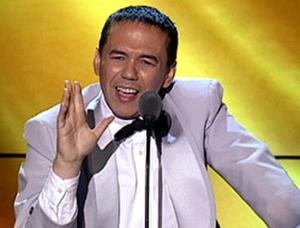 The film’s unabashed vulgarity will spur guffaws and titters, especially in an “Oh-my-God-did-he/she-just-say-that?” way. But after so many tellings, things that were funny because they were taboo don’t seem as funny in repetition. It’s at this point that an audience can really appreciate comics that take unconventional routes toward telling the joke. Eric Meade does a card trick, Kevin Pollack does the joke as Christopher Walken, Mario Cantone performs the joke as Liza Minnelli, Sarah Silverman actually puts herself in the joke’s family (for my money, she gives the best performance), Penn and Teller do a magic trick with a soda bottle, there are jugglers, a ventriloquist, and even a mime. The Aristocrats still has its straightforward dirty pleasures, but it’s much more satisfying when certain comics work outside the box.
It should be obvious at this point but The Aristocrats is not going to be a movie for most people. The incredibly course language and graphic accounts of lewd acts will not sit well with most of the American public. This is a movie strictly for people that have a strong stomach and like hearing a dirty joke. For that group, The Aristocrats will knock you silly with laughter. My three friends whom I saw the film with said they were in pain from laughing so hard. Perhaps that speaks volumes about the company I keep.
The Aristocrats is a bawdy, filthy, hilarious documentary that becomes more than a bunch of funnymen retelling a dirty joke. This is a film for a very select audience, to say the least, and it does lag at parts when the continual vulgarity loses its impact. The Aristocrats also seems to be erratically edited; scenes will rapidly jump from different angles for little reason. Every comedian has their own style and every audience member will find something different to strike their funny bone. At the very end, The Aristocrats invites viewers to submit their own form of the joke for the eventual DVD. I don’t know about you but I’ve already got a goldmine of ideas.
Nate’s Grade: B


 nathanzoebl
You must be logged in to post a comment.