Category Archives: 2004 Movies
National Treasure (2004)
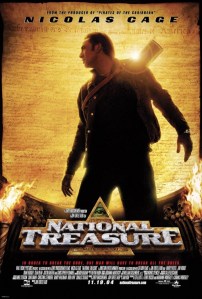 The premise for National Treasure, the newest Jerry Bruckheimer action film, is something of a mess. According to the film, during the Crusades a magnificent treasure was found. The Knights Templar swore to protect it, and the Masonic order carried the vow through the ages. The founding fathers of the Unites States were among this Masonic order, and they went about hiding the fabulous riches and set up a series of elaborate clues to discover its whereabouts. These clues include symbols on the back of our currency and, get this, a secret invisible message on… the back of the Declaration of Independence. Yes, the Declaration of Independence is a treasure map. The silly premise for National Treasure equates the Declaration of Independence with a Denny’s place mat. Can something this outlandish make for a good movie? Well, it depends on your working definition of “good.”
Benjamin Franklin Gates (Nicolas Cage) is somewhat of a laughing stock amongst his peers. His family name is cursed with the crazy belief in some long lost treasure hidden by the founding fathers. His father (Jon Voight) rues the family name being attached to such foolish theories. Of course such foolish theories in Hollywood are always right, no matter how stupid (did I mention the Declaration of Independence is a treasure map?). Ben and his treasure hunting partner Ian Howe (Sean Bean) find a definitive clue, but then Ian double-crosses on Ben and, gasp, wants the treasure for himself. This turns into a race to see who can steal the Declaration of Independence, though Ben wishes to steal it to protect the document and the treasure. Along the way, Ben teams up with a techno-nerd (Justin Bartha) and a hot government official (Diane Kruger) to crisscross historical monuments and sites to unravel the clues before Ian can.
 National Treasure is dumb. Little to absolutely nothing makes sense in this film. This is an obvious, embarrassing attempt to ride the popular coattails of The Da Vinci Code and Americanize the quest. Except that National Treasure really comes across as some half-baked movie version of a kid’s educational game show.
There are so many holes, so where do I begin? First off, why would the founding fathers make it so pointlessly, hopelessly elaborate to find this stockpile of treasure? I’m talking crazy complicated, like having one clue involve finding a ship buried in the Arctic Circle. Yes, the Arctic Circle. Supposedly, the founding fathers decided to hide the treasure because they didn’t want the British to get their grubby, nice-fitting gloves all over it. Something tells me that the founding fathers had more important things going on, like, oh I don’t know, a war! It’s purely absurd to have Washington, Franklin, Jefferson, Adams, and all the rest more interested in hiding some treasure than breaking from England and building an independent nation based on their ideals.
There are some other head-smackers, like the fact that an assembly of clues has been left entirely undisturbed in 200 plus years, like a single special brick. And, for that matter, how does Cage cut through mortar so easily with just a pocket knife? If there’s a gigantic catacomb under D.C., then what’s holding up the city? How come 200 year old oil still burns as well? Wouldn’t that have dried out by now?
 Cage reverts back to his manic show-offy character behavior. In Bruckheimer movies, Cage seems to have theoretic spurts here and there, like he keeps sticking some extremity in an off-screen light socket. He’s generally likeable but his character comes across more like some social studies teacher’s daydream. Bartha and Kruger add less-than-snappy one-liners, but their presence never becomes grating. Bean seems to be playing the stock bad guy role he always is, whether it be GoldenEye, Don’t Say a Word, or Patriot Games.
Sure, even the Indiana Jones films had plot holes (how does closing your eyes guard you from the wrath of God?) but their thrilling adventures overcame any quibbles. National Treasure, on the other hand, is an adventure lacking anything thrilling. This is the first action film to put me to sleep. I can forgive an action/adventure flick being dumb but being boring is a capital offense.
The action sequences in National Treasure are never fully thought out; they usually involve Cage and his cronies outrunning Sean Bean’s group of thugs (repeat). The film’s best moment is the actual theft of the Declaration of Independence. This is the lone sequence in the film that feels like thought was put into drawing out suspense, thinking of natural and interesting complications, and, surprisingly, having the sequence not be overcome by idiocy. After this scene, National Treasure descends into ill-conceived chase scenes strung between crazy elaborate clue hunting. By the time the film reaches its anticlimactic ending, you may have rustled through your change, eyeing the backs of quarters and dimes to ensure there’s no hidden message about a sequel.
National Treasure is a ridiculously stupid, inexcusably boring, ineptly plotted historical adventure for people who get their history solely from movies. Bruckheimer and Cage have an up-and-down partnership, but National Treasure starts with the worst film premise of the year and can?t go much further. Fans of clue-hunting adventure tales may excuse the gaping plot holes, and National Treasure has found a sizeable audience willing to go along for the ride, but the movie doesn’t contain much thrills, entertainment, or anything historically resonant. National Treasure should have stayed buried.
Nate’s Grade: C
Share this:

Alexander (2004)
 I was standing in a theater weeks ago and saw a large banner for Oliver Stone’s epic about Alexander the Great. I listed the names; Colin Farrell, Angelina Jolie, Val Kilmer, Rosario Dawson, Jared Leto. This had to be perhaps the greatest assembly of pretty actors ever in a motion picture. There’s a whole lot of sex appeal there, and Anthony Hopkins, as the film’s reflective narrator, isn’t too shabby looking himself for a man his age. After having seen Alexander, it’s safe to say the actors sure are pretty but the movie is far from it.
Alexander (Farrell) is one of the greatest historical figures. He rose to become a Macedonian king, dominated much of the known world before he was 30, and then died mysteriously at a young age. In flashes to his youth, we see Olympias (Jolie) coaching young Alexander on his future glory. Standing in her way is one-eyed King Phillip (Kilmer), Olympias’ husband though not the father to Alexander. She frets that he will sire a direct heir to the throne, and upon Phillip’s assassination, Alexander reaches new heights. He travels to Babylon with the purpose of avenging his father’s death, rumored to be paid for by Persian gold.
Alexander keeps traveling east conquering new lands but returning kings to their rule and assimilating “barbarians” into his armies. His generals begin to question Alexander’s actions, especially his surprise marriage to an Asian peasant woman (Dawson). He is unable to sire a male heir with her. Hephaistion (Leto), Alexander’s childhood friend and lifelong lover, worries that Alexander has become power hungry and distrustful of those around him. Many of his men only want to see home after seven years of battle. After defeat in India, Alexander decides to turn back but he never sees home again.
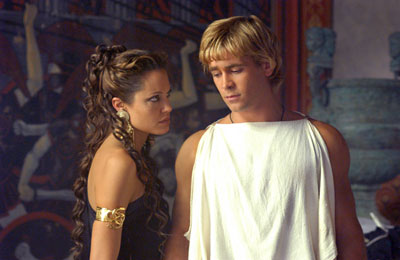 For such a lavish biopic, Alexander seems fairly remote. We don’t really get to know much about the psychology of Alexander. He’s a historical figure with equal parts good and bad ready for debate, but whenever Alexander does hit some of its star’s less-than-stellar moments, it seems to gloss right over them. Hopkins will narrate about some town that resisted, then we’ll see a quick image of it burning, and then we move on. Or we’ll see a slew of dead army officials and Hopkins will say, “He slaughtered all he felt were responsible for mutiny, but I’d expect any general to do the same.” There are several moments where we’ll hear Alexander massacred a town, or sold people into slavery, and then we get the next scene. It’s quite comical, almost as if Hopkins is a tour guide at a museum saying things like, “And then Alexander ate all of the first born babies. Moving on now…”
There are just so many awful laugh-out-loud, loopy moments in Alexander. It’s not enough that Jolie speaks in some bizarre accent; to make sure the audience understands that she’s duplicitous she has a snake wrapped around her in every scene. I’m not kidding; every scene that Jolie is in she has snakes coiled around her.
There’s a moment late in the film that is so hilariously dreadful, it’s hard to believe what you’re seeing. Hephaistion has caught ill and is on his death bed. Alexander is wrought with emotion but then strolls over to a window and begins another huge speech that ends up being all about his glory. What makes the scene go from bad to I-cannot-believe-they’re-doing-this bad is that Hephaistion, in the background, is convulsing and dying. You see his body tense up, twitch, leap into the air, and practically do some kind of triple axle, all while Alexander speechifies blithely unaware. I challenge anyone not to laugh.
Stone needlessly complicates his film with flashbacks, giant leaps forward in chronology skipping Alexander’s rise to respected leader, and skittish hallucinations. Stone is accustomed to breaking up the chronology of his films, but Alexander is too long and too campy to play around with for effect.
The acting of Alexander is set to overkill. Farrell seems miscast and doesn’t have the weight to carry such a historically meaty role. He looks pretty, and he can snarl like a pro, but the only thing worse than his overblown performance is his terrible blonde hair. This just wasn’t the right role for this talented actor. Jolie is so naturally seductive that she could have played her role mute and been effective, maybe more so. Kilmer seems to be working some kind of Irish accent but he comes off the best of the three. Leto gets overshadowed by his bangs.
Alexander also seems to speed over its star’s bisexuality. It wasn’t uncommon for men to bed both sexes, but the movie seems terrified of portraying anything beyond longing glances. Alexander and Hephaistion are reduced to some whispers here and there, but the limit of their physical affection stops at hugs. It actually is kind of funny the amount of times they hug, which I think is over five. You can tell the filmmakers wanted more but then were like, “Eh, let them hug again.” In some weird turn, it seems the film shows more depth with Alexander’s relationship with his horse than with his lifelong lover.
For a three hour movie about a military man who conquered much of the known world, there’s a shocking lack of action. Alexander has two action set-pieces and then that’s it. The first set-piece is a battle between Alexander and the vastly numbered forces of the King of Persia. The battle lasts twenty minutes and is disjointed, bloody, and perfectly indicative of the confusion of war. Stone cuts back and forth between majestic aerial shots showing the progress of battle and hand-to-hand combat amid the sand and dust clouds. Stone also labels certain sections of the armies, which gives a greater understanding of the battle. It shouldn’t be a surprise that this battle is the highlight of Alexander.
The only other action set-piece comes very late in the movie. Alexander’s forces have marched all the way into India. Warriors on the backs of monstrous elephants stampede onward to intercept Alexander’s armies. This battle is also chaotic, and Stone utilizes a lot of quick point-of-view shots like people getting squashed by pachyderms. The action is satisfying if a bit over the top (a warrior gets impaled on a slow-moving elephant’s tusks), that is until Stone goes off the deep end. Alexander gets wounded in battle and suddenly the film switches tints, bathing everything in reddish and bright neon hues. Everything has a tin outline. It’s rather ridiculous and unfortunately reminds me of Ralph Bakshi’s misguided animated Lord of the Rings.
 That’s all you get for action, so I hope you like speeches rich with superfluous historical name-drops, because that’s what Alexander is all about. I’d bet money that nearly an hour of this three-hour opus involves people delivering speeches. Alexander rallies his men, Phillip talks about the Greek tragedies, Olympias strokes Alexander’s greatness and need for kingship, his generals talk about his decisions, and then we get endless moments of Alexander talking about a new world, bringing people together, and respecting other cultures. Alexander seems to go dead as soon as some character pulls out a soapbox. Worst of all, many speeches involve lots of historical references that an audience cannot be expected to keep up with. The overall effect is like listening to an unwanted party guest drone on. Alexander may be trying to talk to death his enemy.
What makes all of this worse is that the dialogue and the drama are so melodramatic. The center of Alexander’s creaky psychology is a domineering mother and a scornful father who scream at each other a lot. Whenever someone has a disagreement in Alexander they resort to over emotive screaming. You may start tuning the actors out after awhile. Much of the dialogue is terrible, but there is the occasional howler line like, “It is said that the only defeat Alexander suffered was Hephaistion’s thighs.” You may concur with Alexander’s men and want to return to your family as soon as possible after watching this.
I was trying to think how something like this, so misguided and off the rails, could chug along without a peep from someone saying, “Hey, maybe this isn’t working.” Then I got it. You see, Alexander is Oliver Stone. Both men are revered for previous victories, both men are generals that take full control of their armies, and both men are fiercely stubborn. If someone questioned Alexander’s decisions, chances are they could be killed. Now I’m fairly certain Stone wouldn’t go that far (there may be many graves dug over the grumblings over U-Turn), but I can see how difficult voicing dissension might have been.
Stone’s long in the waiting Alexander epic is bloody, ponderous, exaggerated, talky, sumptuous and off-the-charts loony. This is a giant mess only a visionary director could amass. Only historical junkies might be entertained by Alexander, and the rest of us will just be glazed over. We never get to really know Alexander, nor do we even get our money’s worth for action, so unless you click your heels to the thought of hours of speeches, skip Alexander. Trust me, it’s far from great.
Nate’s Grade: C-
Share this:

Finding Neverland (2004)
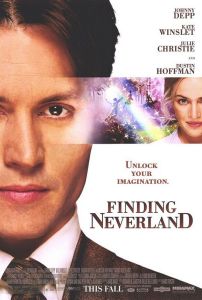 My friend George Bailey and I came to a similar conclusion during a recent conversation. There are a handful of movies, usually released around this time of year, that are packed to the gills with awards hype and general goodwill. Then I see them and feel underwhelmed for whatever reason and I walk out and feel that I should like the movie more than I do (if I do at all). I don’t know what to call it, societal guilt, elitism, but this is exactly what I felt when I left Finding Neverland.
J.M. Barrie (Johnny Depp) is in search of his next play. It?s 1903 London, and the financier (Dustin Hoffman) of his last play has taken a financial bath. Barrie’s also emotionally closed off from his wife (Radha Mitchell). One day in the park, Barrie stumbles across Sylvia (Kate Winslet), a widow managing four boys by her lonesome. Barrie takes a shining to her children and delights in spending long days with Sylvia and her boys. From his encounters with Sylvia and the boys, Barrie works up the inspiration to write a new story, called Peter Pan. Of course the public has its own gossip about a married man gallivanting about with a widow and her boys (think recent Michael Jackson scandals). Then there?s Sylvia?s mother (Julie Christie), who is set to put her house back in order starting with removing Barrie from their lives.
 The message of the movie is about the need for adults to slow down, open their imagination, and become bewitched by the power of believing. Because it’s not like there aren’t any other Hollywood movies out there that teach us to loosen up and enjoy life. Thank you Finding Neverland, I never would have found this out by myself. The message of belief overpowering all is also a bit naive, but then it works into the whole cross-stitching of sap the movie is generating.
Not even Depp can save the film. Long established as one of the most versatile and exciting actors, Depp finds ways to disappear into his oddball characters. In Finding Neverland, Depp sports an impressive Scottish brogue, but, sadly, this is the most impressive aspect about his performance. There had been much talk about Finding Neverland being Depp’s next opportunity at finding Oscar, but it would be a shame if Depp won for such a lackluster, artificial performance especially when he’s been brilliant so consistently in other movies. J.M. Barrie was somewhat eccentric, but in Finding Neverland he comes off as mostly vacant. The film tries to show that Barrie didn’t really fit in, but instead of becoming a showcase for Depp’s acting it becomes a showcase for Depp’s silence. The performance is so subtle that it doesn’t even come off as a performance. If Depp stood in the background of a movie, it would be akin to this performance.
Winslet has also been a very versatile actor. Her role in Finding Neverland never really deepens beyond Disadvantaged Woman. She’s been hit by adversity, she’s beset by four rambunctious kids and an icy mother, but that’s about all the film does for her characterization. Winslet is a tremendously talented actor, as evidenced by her Oscar-worthy performance in this year’s Eternal Sunshine of the Spotless Mind. So why strand her in a role where her character’s greatest acting moment is coughing fits?
Director Marc Forster (Monster’s Ball) has the frustrating habit of having two shot styles he shoots in. He decides between medium shots which usually involve two or three people, or large close-ups. While I was watching Finding Neverland I never once thought to myself that something was filmed in a visually interesting way. Some of Forster’s decisions seem unnecessary, like when he has to visually show us scenes of imagination instead of allowing the audience to, gasp, use their own imagination (hey, isn’t that the message of the movie?).
Finding Neverland tries so hard to be a three-hanky movie (and truth be told I heard a lot of sniffling in my theater during the last half hour), but what stops the film short is how unbelievably transparent everything is. Finding Neverland could have explored the rich complexity of an enigmatic figure like J.M. Barrie, but instead it settles for goopy sentimentality at every opportunity. Barrie becomes sugar-coated into an earnest father figure, and in the process key facts are sugar-coated as well. What do you mean? Well, Sylvia’s husband didn’t die until several years after Barrie wrote Peter Pan. Barrie’s wife didn’t have her affair until long after Peter Pan. Also, the original Peter threw himself in front of a train because of how upset he was about his connection to the famous character. I guess that’s why this is a biographical movie merely “inspired” by true events, much like Hidalgo.
The filmmakers rely on cloying tricks to make an audience care about its characters. The movie paints in very stark black and white tones, mainly “adults = shortsighted” and “children = special.” This is a film that is proud to take the easy road and makes little effort to cover its pride. It plays toward audience expectation and thus loses any long lasting magic.
Finding Neverland takes the easy road for audience-friendly sappiness. Barrie insists that 25 orphans be strategically placed around the theater on opening night of Peter Pan. Sure enough, the theater is full of old white men with monocles, and apparently they just don’t get the spirit of theater. The orphans laugh and squeal from the stage antics, and somehow this triggers all those old curmudgeons to learn to laugh once again. You see, all it takes is strategically placed orphans to make us laugh at life again.

When Sylvia is hanging laundry she starts to gently cough. If you’re smart, you’ll instantly figure out what trajectory is in store for her, but even if you miss this single cough don’t worry, because Sylvia will be doubled over with coughing later to spell it out for everyone. You can all but see the strings being pulled (the audience will cry… now!). All can be overcome in the end, those who didn’t understand will, and we’ll all be happier and live life to the fullest, in theory of course.
Finding Neverland wants to be Shakespeare in Love, another whimsical movie that shows how a writer utilized the people and events around them to pen a masterwork. Except in Shakespeare in Love there was a romance to fall back on, as well as some ripe comedy, but with Finding Neverland there isn’t anything to fall back on. It’s a Hallmark card mass-marketed to the largest possible audience.
Everything about Finding Neverland is disappointingly under whelming. The direction is shabby, the actors are marooned by their weak roles, and nothing is sacred in the film’s pursuit of that tearjerker ending. This is a movie for people that ask little of their movies, and yet I can reasonably see Finding Neverland becoming an audience favorite and riding good word of mouth all the way to awards season. Finding Neverland is a film that never takes flight because it’s too content to stay grounded by going the easy route.
[Nate’s Grade: C
Share this:

The Incredibles (2004)
 You’ve been there before. You know the drill. You’re staring up, mouth agape, at the multiplex’s list of new titles wondering what to see. It happens to the best of us. Who can you trust in these situations? Most people used to think they could trust Tom Hanks, but after his accent experimentation in The Ladykillers and The Terminal, not to mention his giant creepy mustache in The Polar Express (with accents!), that train of trust might have left the station. A lot of people felt they could trust an Oliver Stone movie, and, well, look how that turned out. No, moviegoers, the only trustworthy name that won’t let you down is Pixar. With hits like Toy Story and Finding Nemo you know that those computer wizards are looking out for you. Their newest work, The Incredibles, will keep Pixar alive in the moviegoer circle of trust.
The Incredibles takes place in a world where superheroes walk, run, jump in single bounds, and zip through the sky. They’re beloved and revered, with the super-strong Mr. Incredible (Craig T. Nelson) at the head of the pack. But then a fiend strikes more powerful than any dreaded super villain: litigation. A mountain of lawsuits pile up against superheroes, and the government disbands its programs and relocates all super-abled beings into new identities and homes.
Fifteen years later, Bob Parr, a.k.a. Mr. Incredible, has married Helen (Holly Hunter), a.k.a. Elastigirl, who can stretch her shape, which comes in handy keeping their two children in line. Dash (Spencer Fox) begs his parents to allow him to use his power of super speed, especially at his schools sports. Violet (Sarah Vowell), all long haired Goth angst, uses her power of invisibility to just disappear during school and other functions she feels she doesn’t fit. It seems the only member of the family fully adjusted and happy to a “normal” life is Jack Jack, the Parr’s infant son who may or may not develop super powers of his own. Bob feels crushed by the grind of office work and hiding what makes him and his family special. He escapes at nights with old friend Frozone (Samuel L. Jackson) and the two of them relive the good old days with attempted heroic acts. Helen catches on and they have a huge fight with the kids as witnesses. Helen explains to her family in the best way that she can that their days as superheroes are over. They have to adjust to a different life now.
 Bob’s wanderlust is soon quenched when he receives a mysterious invitation from a beautiful, white-haired woman named Mirage. She offers Bob the chance to become Mr. Incredible once more, to use his gifts and abilities to stop a robot on the loose on some island. Bob leaps at the chance, hiding his ongoing super exploits from his wife, and regains a sense of purpose. He hasn’t been this happy in ages; however, it all comes to a head when he learns that Syndrome (Jason Lee), the one responsible for the run-amok robots, has other plans. Not only this, upon capture Mr. Incredible realizes that he has ties to Syndrome way back during one of his less-than-super moments.
Helen is shocked when she finds out what Bob’s been up to, but also partially relieved it’s not an affair. She visits their old costumer Edna Mode, whose glasses and black wig may be bigger than the rest of her shrimpy body. Edna has redesigned a team of superhero costumes, and with them in hand Helen becomes Elastigirl once more and takes Dash and Violet on a journey to save their father and become a family once more.
The Incredibles is a film bursting with entertainment. This is an explosion of imagination, of wit, of grand storytelling, that the audience should sit and soak up every loving and beautiful second of it.
The voice work is wonderful. I’m sure Disney execs were scratching their heads over Craig T. Nelson, but I cannot imagine anyone else that could deliver as much in the role. Hunter is excellent, as always, as a doting mother and crime fighter. Lee is great with a villainous role that has a lot more depth to it than near any live-action film. His verbal gymnastics are perfectly suited for a slighted super villain.
Writer/Director Brad Bird’s first feature was the 1999 masterpiece, The Iron Giant, which I consider the finest animated film of all time (you heard me, Walt). Bird’s first film was a masterful mixture of little boy fantasy, reality, strong characters, humor, and excuse-me-there’s-something-in-my-eye tenderness. I know many people who, after seeing The Iron Giant, say they were, “crying like they watched a puppy get hit in the face with a shovel.”
 With this being said, my trust in Bird as a master storyteller is still there. The Incredibles is the first Pixar film concerning real people, not just toys, ants, fish, monsters, and, uh, more toys, and the results are astounding. This is a film rich in complexity, human insights, family warmth, and, again, realism. Bird has fully realized The Brady Bunch of superheroes. They feel just as flesh and blood as any characters I’ve seen in any film this year. They have desires, secrets, shame, guilt, anger, burdens, pride, and above all, love. I mean, how many animated films have an actual subplot involving marital suspicion? You won’t find that in The SpongeBob Squarepants Movie. When Elastigirl and the kids go off to save her heroic hubby, she has a sit-down with her children and warns them that, yes, death is very real, and that these people will indeed kill them if discovered (this is the first PG-rated Pixar film, by the way). It’s a great moment that reminds you how much you care for these people.
Bird’s imagination seems incomparable. He has a razor-sharp feel for comedy, like Elastigirl’s scene caught between several sliding doors or the lively, hysterical Edna Mode personality, but he also possesses the ingenuity for crafting some of the most exciting action sequences in a long time. The Incredibles has uncanny action scenes, set to Michael Giacchino (TV’s Lost) blazing jazz score, which should make the James Bond producers die from envy.
Bird has created a stupendous action film, a heartwarming family drama, a hilarious comedy, and a gorgeous film to watch. Movies rarely get this entertaining, but for Pixar, it’s all just part of the norm. I hope someday we don’t take Pixar’s accomplishments and staunch consistency for granted, because they aren’t just reinventing what animation can do, they’re also reinventing what films themselves can do. You can have all the accents you want Tom Hanks; I’ll gladly take The Incredibles and its bounty of offerings.
Nate’s Grade: A
Share this:

Bridget Jones: The Edge of Reason (2004)
 You don’t see too many sequels to romantic comedies, and that?s practically by design. Most romantic comedies consist of keeping the leads apart as long as possible, and then in that final climactic moment they connect, embrace, kiss, usually while a camera pans around them and some up-tempo Top 40 songs swells on the soundtrack. Then we end, our story finished. You see, romantic comedies are essentially modern fairy tales, and they end on the “happily ever after” moment, the most joyous moment. We don?t think about what their lives could be afterwards. I doubt few in the audience are biting their nails to know who does the dishes or if their sex life diminishes.
So for all of these stated reasons, sequels to romantic comedies are rare, unless, of course, they’re based on a book series that’s a cash cow of chick lit. Thus, America, we are given Bridget Jones: The Edge of Reason, the sequel to the smash 2001 film Bridget Jones’s Diary.
 The movie takes place four weeks after Bridget (Renee Zellweger) and Mark Darcy (Colin Firth) cuddling in the falling snow. Their relationship is all lovey-dovey, until Bridget starts reconsidering if she made the right choice of men. Her former boss, Daniel (Hugh Grant) has gone on to fame as a travel correspondent for TV news. He’s a bad boy, for sure, but sparks flew with him. Bridget also suspects Mark of cheating on her with a leggy colleague (whose final plot revelation is quite dumb). Bridget tries her best to fit in with Mark’s upper crust society, but is starting to feel unaccepted. Then she becomes a partner to Daniel on his travel reports, and the two visit exotic locales and sparks begin once more.
Edge of Reason feels like a poor slapdash grab at money. The film lifts entire scenes from the first Bridget Jones movie and tries reworking them for similar effect. Watching Firth and Grant sissy fight each other is amusing … the first time I saw it in 2001. For the most part, it seems like the filmmakers behind Edge of Reason were straining to come up with things after that “happily ever after” moment. What other reason can there be for some of the disastrous plot turns in Edge of Reason? The revolving door of writers (including author Helen Fielding herself) manufacture petty and foolish nitpicks for Bridget that she treats as life or death. It’s hard to feel concern for her. When you strand your main character -in a romantic comedy, no less- in a Thailand prison because she was caught smuggling drugs -in a romantic comedy, remember- then you have some giant plot issues.
The wit and biting commentary from Bridget seem to be stripped away. She only makes two journal entries, which open and close the film, and they were responsible for some of the greatest comedy bits in the original movie. She no longer comes across as a snappy, ordinary girl with a big heart and some big neuroses (did I mention the Thailand prison?). The Bridget of Edge of Reason seems a bit obnoxious at times. The comedy of Edge of Reason doesn’t generally rise above slapstick. Watch Bridget parachute into a dung field (Ha!), watch Bridget ski backwards down a slalom (Hilarious!), watch Bridget get stoned from magic mushrooms (You’re killing me!), and don?t forget to watch her fall down, like, a lot (R.I.P. Nate; cause of death: laughing too hard). The makers of Edge of Reason are just trying too damn hard.
It’s a wonder that Edge of Reason does work at times, and that reason is because of the acting of our romantic trio. Zellweger is still incredibly charming despite some of the things she’s forced to do. She’s never looked better than when she has her Bridget Jones physique; she’s practically glowing. Grant is at his best when he’s a cad, and once again he gets the best lines, especially when he’s undressing Bridget during a work trip. The movie comes alive when he and Zellweger start their flirtatious battle. Firth adds shades of humanity and adoration to his fuddy-duddy role. He’s got a great everyman appeal even when he’s being a twit.
Edge of Reason also seems to flog whatever it feels is funny. If Bridget saying something inappropriate in front of a group of dignitaries and ambassadors is funny, then expect it to happen again five or six times. And it does, sadly. Edge of Reason is almost a wall-to-wall torture chamber of public embarrassment for Bridget, and if the filmmakers thought that would endear her to audiences they were wrong. We were endeared already by her wit and charm, but I guess the people behind Edge of Reason thought we didn’t want more of that. I miss you old Bridget Jones, wherever you are.
 The first Bridget Jones movie was directed by Sharon Maguire, a personal friend of Fielding. Maguire was close enough to know how to adapt the story and retain the elements that made Bridget Jones entertaining. Edge of Reason‘s director Beeban Kidron seems to be assembling a Bridget Jones movie for a focus group. We lose the personality of Bridget and get an accident-prone buffoon. All that’s missing are the banana peels.
Everything about Edge of Reason screams laziness. A great example of this is the film’s choice for music. The songs are so obvious, from “All By Myself” to “I’m Not in Love” to songs that simply have “love” in their title, like “I Believe in a Thing Called Love” to Beyonce’s “Crazy in Love.” Chances are, if your band ever released a song with “love” in the title, the music director of Edge of Reason considered using it.
Bridget Jones: The Edge of Reason will likely entertain its core audience (there were very few men unaccompanied by women in my theater). The cast makes this stilted sequel worth watching. If you really liked Bridget Jones’s Diary, you’ll probably be intermittently amused with Edge of Reason, because it’s the same meal, only reheated with a bit of a chill. Let this be an example of why Hollywood doesn’t make sequels to romantic comedies. We’re happy enough with “happily ever after.”
Nate’s Grade: C+
Share this:

Saw (2004)
 Saw was pieced together by two first-time filmmakers, director James Wan and writer Leigh Whannell. They envisioned that old movie favorite, the imaginative serial killer. Their killer would put people in horrific life-or-death situations, testing our will to live even if it meant rummaging around the intestines of a live human being for our key to freedom. With a budget of a mere million dollars, Wan and Whannell have executed a dark, slick, sometimes thrilling, sometimes laughable fright flick. The only question is if audiences are hungry enough for the splashes of blood Saw can deliver, or if they’d rather watch Sara Michelle Gellar turning Japanese.
Adam (Whannell), a private photographer, and Dr. Gordon (Cary Elwes), a workaholic surgeon, are in a very strange circumstance. They’ve both just awoken and find themselves chained by their feet at opposite ends of a bathroom with a dead body between them. Neither has any idea how they got there. Dr. Gordon theorizes that they’re the culprits of the Jigsaw Killer, a psycho that places his victims in elaborate death traps they must fight to get out of. In the pants pockets of Adam and Dr. Gordon are audio tapes from Jigsaw establishing the rules of this “game.” In eight hours, if Dr. Gordon does not kill Adam, his wife and daughter will be killed. Jigsaw has even left them clues to their escape, most notably a pair of rusty saws not strong enough to cut through their chains, but still plenty strong to slice through their feet if they so choose. Outside this game, Detective Tapp (Danny Glover) is closing in on the identity of the Jigsaw Killer and may be the only hope Adam and Dr. Gordon have.
 Saw is a grisly horror movie that hits the right macabre marks. Horror is such a tricky genre, and you can either build tension in an effective what’s-around-the-corner kind of way (The Ring, 28 Days Later), or, if that fails, and it often does (The Grudge anyone?), you can cut your losses by showing the gory goods (Texas Chainsaw Massacre, any slasher film). This isn’t to say one version is inferior to the other; sometimes we just want to be grossed out. Saw is a horror film committed to horror, sometimes to a rather unpleasant and sadistic point. In a way, the fact that Saw goes for broke in its depiction of the grotesque makes it more enjoyable than recent horror fair that tried to hedge their bets on jump scares and nosy cats.
In some manner, Saw is like a dumber, trashier Seven. They both involve serial killers with agendas and they both give the killer the upper hand. While Seven is a masterpiece of the thriller genre, Saw is a mostly entertaining horror entry. Its premise is razor-sharp and really hooks an audience. We know only as much as the characters do, so their discoveries work two-fold. The pacing is tight, the cinematography is exceptional for its budget, and the end had me jump out of my seat. I will say this; Saw reluctantly seems to think that it needs to reveal the identity of the Jigsaw killer, as well as his motives, to satisfy an audience. I think no answer could ever be satisfying; however, the actual reveal of Saw‘s true killer had me wanting to give the filmmakers a standing ovation. There are fleeting moments of greatness here among the misery. Whannell knows when to show which cards, and it makes the story more enticing.
There are glaring issues with Saw. The acting is one of them. Elwes is usually a stable character actor, but chain him to a wall and say,”Go!” and the man will overact as if his real wife and child depended on it. Whannell, a first time actor and the co-writer, goes deliriously over the top in some battle of scenery chewers. Don’t feel too bad if you feel like laughing during certain moments of “emotional turmoil.”
Saw seems to exist in that magical place known as It Could Only Happen in Movies World. For example, a serial killer designing highly elaborate, and personally clever, death traps could only happen in a movie. I love the fact that the film even shows evidence that the Jigsaw Killer builds dioramas of his future death traps. If he entered them in the Third Grade Sadistic Science Fair, I’m fairly certain he?d at least earn a blue ribbon or a gift certificate.
Yes, only in a movie are we expected to believe one man can kidnap people, lug them around, set up his elaborate Rube Goldberg puzzles, and then kick back and elude police capture. The entire premise of Saw is whole-heartedly ludicrous, and the plot turns are heavily contrived, but, as an audience, you must yield such ordinary eye-rolling to enjoy the pleasures of Saw. If you can swallow plot holes and just go with the film’s skewed logic, there is some enjoyment to be had.
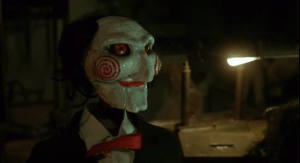 Wan can also be his worst enemy. Too often he punctuates chase scenes with pounding heavy metal, which does little more than numb an audience. Wan’s film loses some of its focus in the middle as the audience endures flashback after flashback. To goose up the viewing, Wan shoves in extraneous flashes of gore. Just like The Exorcist prequel, flashes of something horrific do little more than to cause an audience to yelp. They’re immediate. If you want true gut-churning reactions, you have to build, and in the end Saw remembers what it came to do and sprints to the finish line.
Saw also exists in the grimiest possible world. Whether it be parking garage, office, or even personal apartment, the characters of Saw exist in some netherworld of filth crying out for an army of scrubbing bubbles. I’m sure this was intentional, but can’t any place in horror movies afford a coat of paint nowadays?
Saw is a gruesome, twisted, sometimes sadistic horror movie with a knock-out premise, a moderately good ending twist (not the final end, though), and some lag time in between. Wan and Whannel really stretch their budget to impressive ends and imply more blood and guts than are shown. Fans of hardcore gore horror should be pleased with Saw, though they may find themselves giggling at it from time to time. I was hooked by its premise and found myself getting more intrigued as the revelations began to sift. Many will find Saw too ugly, gory, or stupid, but for fans of the genre, it should satisfy the itch recent PG-13 horror couldn’t efficiently scratch. Saw is violent, contrived, ridiculous, but also, in the end, gruesomely entertaining in parts.
Nate’s Grade: B-
Share this:

Surviving Christmas (2004)
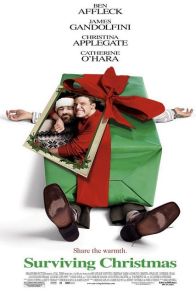 Surviving Christmas was originally supposed to be released, get this, a whole year ago for Christmas 2003. Paramount objected to the original release, saying it was too close to the release of their own Ben Affleck action flick, Paycheck (I doubt anything could have helped that turkey). So Dreamworks held onto it for another year and released it around the holidays. Halloween that is. The nation hasn’t even experienced Halloween or Thanksgiving yet, and we’re already getting a Christmas movie in our stocking. Given Affleck’s recent track record (the man hasn’t had a hit movie since 2002’s Sum of All Fears), audiences might not expect more than a lump of coal when his name’s above the title.
Drew (Affleck) is a cynical ad executive trying to figure out his plans for the approaching Christmas season. He gives his girlfriend tickets to Fiji, but she expected an engagement ring, so she dumps him right there claiming he doesn’t know what family life is. Drew finds his old family home now populated by the Valco family. He offers Papa Valco (James Gandolfini) $250,000 for him and his wife (Catherine O’Hara), son, and daughter (Christina Applegate) to be his family for Christmas. Papa Valco accepts. Drew is a stickler for family tradition, and mandates tree shopping, hat wearing, dinner script reading, and sleeping in his old room. The family’s hostility begins to wear down but things get even stickier when Drew falls for the Valco’s daughter, and then his ex-girlfriend shows up wanting to see his family.
 The central flaw of the film is Affleck’s character. Drew is a jerk. That’s all there is to it. Somehow Affleck has become the go-to actor for arrogant, work obsessed men that desperately need to see that there’s more to life (Bounce, Jersey Girl, Forces of Nature). I think this is also the second or third time he’s played an ad executive. Surviving Christmas seems to exist in some weird dimension where a jerk shows us the true meaning of Christmas and family togetherness. What’s even worse is that Drew doesn’t change as a character, he doesn’t seem to grow, and the ending actually seems to reward him for his selfish, material, obnoxious ways.
I like Affleck, I really do. I like his work in Kevin Smith’s films, and he can make a good action hero if given the right material (Say a Sum of All Fears, and not so much a Paycheck). The man is charming, he’s eloquent, and he’s self-deprecating and constantly funny. He’s the kind of guy you want to buy a beer. Now, having said all this, Surviving Christmas is Affleck’s worst performance of his career. Affleck can do comedy, and not just in a Greek tragedy kind of way with his life in the tabloids. In Surviving Christmas, Affleck mugs like nothing is sacred. His eyes bug out. He exaggerates near any expression, from his smug grin to his childish fits. For a man who has Gigli, Reindeer Games, and Pearl Harbor to his credit, it’s something when it’s said that Surviving Christmas may be his acting low point.
Gandolfini seems to have been cast to play against type. He’s still got that flinty stare and slow simmer of anger, but he’s generally wasted. He’s the comic foil to Affleck’s jerk, and yet he still doesn’t come across that much better. His monstrous woolly beard is also mildly disturbing. Applegate brings more life to her love interest role than the role deserves. Her romance with Drew seems so spontaneous, especially given her natural hostility to him. The only actor that has any real moments to stretch and shine is O’Hara. A veteran of improv, O’Hara has some of the film?s funnier moments, like when she makes mini marshmallows with a butcher’s knife, or her wild photo shoot Drew arrangers for her.
Surviving Christmas is indeed a chore to sit through. The movie, at its gooey heart, doesn’t know what kind of holiday film it wants to be. A good example is the opening montage of holly jolly Christmas sequences. In between standard, saccharine moments of feeling, there?s an old grandmotherly woman who bakes a tray of gingerbread men, with frosted frowns, and then sticks her head in an oven. Huh? Surviving Christmas tries to have it both ways. It wants to lampoon Christmas sentiment with the occasional touch of dark humor, but then it plays into a feel-good holiday formula complete with sled rides, tree lighting, and hot cocoa. The result is a schizophrenic comedy that doesn’t work being dark or cuddly.
 The whole wacky premise of Surviving Christmas screams sitcom, and the conventional proceedings and stock characters that follow guarantee it. The only way this could be more of a sitcom is if they drew a line down the middle of the house, the boss was coming over for dinner unexpectedly, and a pesky cat swallowed someone’s wedding ring. Surviving Christmas‘ relation to a sitcom is the only way I can explain why the film has stale jokes about internet porn (What, there’s porn on the Internet? When did this happen?). There’s even horny old men and wedgie jokes too! This is a movie in desperate need of a laugh track. I kept expecting everyone to turn their heads and go, “Dreeeeeeeeew” and then Affleck shrugs his shoulders, bugs his eyes out, smirks, and the studio audience goes wild.
It probably doesn’t help that Surviving Christmas is credited to over five writers and was directed by the director of Deuce Bigalow: Male Gigolo. The comedy rarely hits its marks because it’s so frustratingly tied up in its identity. The film wants to make incest jokes, but then in the same breath it wants us to listen to some syrupy back story explaining why Drew is the lonely, socially challenged jerk he is. The laughs of Surviving Christmas are mostly limited to broad slapstick and the occasional inappropriate remark. The preview audience I watched the film with seemed to be rolling in the aisles while I mostly rolled my eyes.
There will be a section of the public that enjoys Surviving Christmas. Fans of Christmas cheer and broad PG-13 comedies may find laughs amongst the wreckage. Surviving Christmas doesn’t have the gusto to commit to black comedy like Bad Santa (a new Christmas classic), but it also doesn’t build its characters strongly enough for an audience to care about them. They’re all mainly jerks and twits. This is a Christmas movie that doesn’t know what stripes it is. How else to explain it coming out in late October.
Nate’s Grade: C
Share this:

Team America: World Police (2004)
 The MPAA is mad, plain and simple. It’s an organization intended to rate movies so our wee ones don’t stumble into something not intended for their virgin eyes. They also have a long history of haggling with filmmakers over ratings and the necessary cuts to ensure a commercial rating. And, in their eyes, puppet sex was deemed too indecent. You see, the MPAA initially gave the all-puppet action movie Team America: World Police, the new film from South Park creators Trey Parker and Matt Stone, an NC-17 for an extended scene of two marionettes engaging in enough sexual positions to make a G.I Joe blush. However, we’re talking about puppets, people! Puppets! They’re not even anatomically correct. Does anyone find it crazy that a governing board says watching two dolls bang together in “simulated sex” (is there any other kind with puppets?) is inappropriate for all ages under 17? Surely, if the MPAA is to be eventually reformed, this will be Exhibit A.
 Team America is an elite team that fights terrorists and police the globe in red, white, and blue helicopters, jets, and flying limos (the team logo is a bald eagle with the earth in its beak). The team leader Spottswoode recruits Broadway actor Gary, star of the musical Lease (key song: “Everyone has AIDS”), because they need someone to pretend to be a terrorist and flush out their secret plan. Gary is reluctant at first but agrees to join the team.
Team America flies to Paris and Cairo to battle terrorists. They snuff the terrorists, but world monuments like the Eiffel Tower and Sphinx get lost among the collateral damage. Things look promising for Team America, and Gary expresses feelings for Lisa, a blonde psychologist haunted by the loss of a teammate and a lover.
Terrorists strike the Panama Canal in retaliation, and a group of celebrities led by Alec Baldwin condemn Team America. Michael Moore, with hotdog in each hand, protests outside Team America’s headquarters. In these moments of disarray, we learn the true source of the Weapons of Mass Destruction and brains behind the attacks is North Korean dictator Kim Jon Il, who has a plan for “9/11 times 2,358.”
While not reaching the satiric highs of the South Park movie, Team America is a political movie that lambastes both sides of the coin. This has been a very heavy year for political films, from leftist documentaries like Fahrenheit 9/11, The Hunting of a President and Going Upriver: The Long War of John Kerry, to more subtle jabs at the current administration (the very Cheney-like VP of The Day After Tomorrow), to more obvious indictments (the stuttering, axiom-loving dumbbell candidate in John Sayles’ Silver City). So in a year bursting to the seams with political screeds, it’s quite refreshing to have a movie that lampoons both the Right and the Left.
Team America satirizes the arrogant, shoot first ask later, cavalier foreign policy America has been accused of (“We’re going to bring democracy to you if it kills you.”). The film also criticizes Hollywood celebrities who feel that their uninformed, unsolicited opinions are germane to the political process. In the end, it’s the celebrities who get the worst of the beating (Matt Damon appears to be, um, challenged). Parker and Stone shrewdly satirize pretentiousness and ego, no matter which side it falls upon. They lose their focus as the film enters its final gory act, instead resorting to garish ways of killing puppets.
 Team America has a good one-two combination with its political punch, but where it really shines is the knockout it delivers to bombastic Jerry Bruckheimer action films. This is a delirious send-up of a wide array of action movie clichés, including team members and their secret crushes as well as their hidden traumas. Characters will fight or die in slow-motion for dramatic effect. Characters will all have some special talent that will come into play at an important moment. Kim Jon Il has a typical villain lair, including large shark tanks and trap doors. When a character dies in the opening sequence he mutters the line, “I feel so… cold[.” Hilarious! There’s even an entire training montage set to a song called, “Montage” (sample lyric: “Show a lot of things happening at once, remind everyone of what’s going on!/ And with every shot show just a little improvement – to show it all would take too long!/ That’s called a montage!/ MONTAGE!/ Even Rocky had a montage!/ MONTAGE! “). There’s also a love song all about Pearl Harbor sucking as a movie.
Like all the other films by Parker and Stone, Team America is a robust musical. The songs aren’t as sharp as the ditties from the South Park movie, but they’re still quite amusing. The Team America theme is a rousing anthem called “America, Fuck Yeah!” which is a perfect example of the film’s simultaneous mixture of the profane and the brilliant. Later in the film, when Team America is taking a public backlash, there’s a somber remix of the theme that’s even funnier.
Some things are just funnier because of the limitations of puppets. Watching two marionettes try to fight is hilarious, because they really do nothing but kick their legs and limply slap each other. Before Team America, I never realized how funny it was just to watch marionettes walk. They’re so awkward and jumpy, that just seeing them step from side to side can put a smile on your face. When the music of Kill Bill comes onscreen, and the puppets walk in slow dramatic fashion, it’s even more absurd and funny.
 Parker and Stone also have fun with self-awareness, like when they take Gary on a tour of the sights of Washington D.C. and he stands next to an actual tombstone at Arlington National Cemetery. There’s also a Matrix parody that actually comes off as fresh. There’s a giddiness to watching puppets swear, fight, vomit, stagger drunk, and even do the nasty. It’s a gimmick that doesn’t get old.
This is also one terrific looking movie. The sets are massively intricate and the photography by Bill Pope (who did shoot the Matrix films) bathes the proceedings in beautiful mixtures of light and dark. There may be moments you forget that what you’re watching are miniatures. It is filmed to look like a typical action movie. The music is a spot-on parody of action films, with its heaviness on flutes when the villain is around, to the foreign lady mournfully singing during scenes of tragedy. There’s fantastic craft and detail worked into Team America that I can unequivocally say Team America: World Police is the best looking, R-rated all-marionette musical action movie… ever.
Team America may be the funniest film of the year. There are some moments of drag, and sometimes less profanity would make certain punch lines better (unfunny homophobic jokes like the acronym F.A.G.), but the movie is a comedy that’s pee-your-pants funny. Team America is definitely not for kids (what kind of irresponsible parent assumes “puppets = for kids” and ignores an R-rating?). Because of the equal opportunity satire, this may end up being a movie that conservatives and liberals both claim to be their own. For fans of erudite satire, crude humor, and puppet sex, Team America will be a blast. Make sure to stay throughout the end credits to hear a special closing song not in the film.
Nate’s Grade: B
Share this:

The Forgotten (2004)
 Fair warning: This screed contains huge spoilers about the movie as I rip it apart. The press release for The Forgotten says, “What if you were told that every moment you experienced and every memory you held dear never happened?” And now, upon having seen The Forgotten, I say, “Oh, if only.”
Telly (Julianne Moore) is still grieving the loss of her nine-year-old son who died in a plane crash 14 months ago. She’s seeing a psychiatrist (Gary Sinise) and slowly coming to terms with her loss. One day she discovers all remnants of her son missing. His clothes, baseball glove, even his appearance in pictures has vanished. She accuses her husband (Anthony Edwards) of stealing them, but then is shocked when her hubby and doc both tell her that Telly never had a son. She’s been delusional for years since a miscarriage and has created an imaginary son. Telly refuses to accept the possibility that she’s nuts, and finds initial resistance and then acceptance from another parent (Dominic West) who also remembers a daughter that died in the same plane crash. Together they set off to learn the truth, all the while being hunted down by the NSA for some mysterious reason.
 The Forgotten shares a very dubious honor. Only twice in my life have I been strongly tempted to walk out on a movie, and that was while watching Lost in Space and The Thin Red Line. Six years later, The Forgotten became the third. It got so bad during the second half that I was fashioning my moveable armrest into a crude headboard for me to sleep upon. I was that bored. I can explain the reasons for my boredom very easily: terrible plot structure.
The Forgotten opens with Telly grieving over the loss of her son, and Moore is so good at grief that she can hook an audience as soon as her face crinkles into sadness. Around the 20-minute mark, Telly is told that she never had a son and has been delusional the whole time. Now, stop right there. That’s a great premise. If the makers of The Forgotten had stretched this part of the movie to about 90 minutes, put some thought and skill toward it, then we could have had something fascinating and heartfelt. Instead, you’re given the easily expected and the very boring.
At the 20-minute mark, Telly is told she has no child and she’s crazy. At around the 30-minute mark, none of this matters. The movie doesn’t even allow an opportunity for Telly to even doubt for a sheer second about her wild hunch that everyone in her life, including The New York Times, being apart of some global conspiracy to hide the fact she had a child. And of course, because she?s our heroine and this is Hollywood, her incredibly outlandish theories will be proven right. I understand that, but to reveal her theory’s accuracy only TEN MINUTES later is ridiculous. The Forgotten wastes no time proving Telly’s wild ranting as being correct. It’s as if The Forgotten feels that its audience is cultivated from the dumbest common denominator.
At the 40-minute mark the “A-word” is used, and before the 60-minutes mark, the audience knows everything. The last hour of the film is so obvious; no, it’s beyond obvious. It’s super obvious. It can’t even be obvious because The Forgotten has told you EVERYTHING. You’re not waiting around for predictability to play its way out, because you’ve been told everything. All that’s left is to sit and watch dull chase scenes (a book editor outrun NSA trained agents? Please).
There will be some heavy spoilers in my discussion of the film’s plot. I’m posting fair warning now, but doubt they’ll be too surprising given the ads on TV for The Forgotten (who else would you think was responsible?).
I have no idea what the makers of The Forgotten were thinking. They blow all their secrets in the first half and then mill around for another hour. It’d be like if The Sixth Sense revealed Haley Joel Osment sees ghosts and Bruce Willis is dead in the first hour, and then for another hour they sit uncomfortably and ask about the weather. Anyone think that movie would have worked the same? This is why I was so bored. I could have fallen asleep and accurately predicted everything that would happen in the second hour. There didn’t even need to be a second half to this film. It was all irritatingly explained to us in the first hour. Once the mystery’s gone, the only thing the audience has to keep its faltering attention are the questions of whether Telly can win back her son, and who will be vacuumed out of the universe next. That’s not much to justify another tension-free, revelation-free hour of awful movie.
The ending is also steeped in lunacy. So apparently all-powerful aliens love to play experiments on us and basically control our whole lives. Peachy. Telly is apart of an experiment, and the creepy, slim alien tells her that she’s the anomaly. All the other test subjects have forgotten, but not her, and the little green men want to know why. What’s even more peculiar is that this specimen of a supposedly advanced race is mad at Telly for gunking up the project, and he’s (its?) going to beat her until she forgets and the project is finished. But the alien just said she was the lone anomaly. By definition the project worked if everyone else succeeded. I’m no advanced race and I figured that out. Guess I’m smarter than the screenwriter of The Forgotten.
Once again, humans miraculously triumph over supposedly all-powerful alien species. I realize an audience wants to see our heroes succeed at the end and conquer evil, but is it even plausible when this evil can alter everyone’s existence at a moment’s notice? In the end, Telly gets her son back and her life is fulfilled. The makers of The Forgotten expect you to take this for a happy, victorious ending. Don’t. Sure, Telly has her kid back, but what’s to stop these all-powerful aliens from doing it again. For that matter, since she was the anomaly, wouldn’t they continue to perform experiments on her to see what makes her tick?
 What makes The Forgotten even more irksome is that it’s a blatant rip-off of Alex Proyas’ visionary 1998 sci-fi noir, Dark City. The plot of Dark City is about all-powerful aliens that experiment with human beings. They plant different memories into their heads, allow their human test subjects to live multiple identities, to see what makes us work. A reluctant doctor helps the aliens but is really rooting for the one test subject that seems beyond their power. The aliens are baffled about this anomaly. This is practically the entire plot for The Forgotten; trade Shell Beach for Quest Air, lose all the style, thrills, imagination, and pacing of Dark City, and what you’re left with is The Forgotten.
It’s not enough that The Forgotten is possibly the most ineptly plotted movie ever, or that the trailer and commercials gave away too much (I knew the ending before stepping into the theater), the ails of The Forgotten are exacerbated by the fact that it’s a shallow, homely, incompetent rip-off of Dark City.
I do not fault Moore. She is one of the finest working actresses today and will elevate anything she is in to some degree. She’s stranded by the material. The only performance I even took any note of was the surprise appearance of Lee Tergesen. He’s shown equally impressive comedic chops (USA’s Weird Science) as dramatic chops (He was the closest thing to a hero on HBO’s Oz). It’s always fun to see personally beloved character actors, even if it is in an abomination like The Forgotten.
Director Joseph Ruben (Money Train, The Good Son) finds astonishing ways to make The Forgotten even worse. He overplays his hand early, like having many overhead shots cued with weird, aerial noises. There’s also an ominous and extremely mobile cloud formation that spells out the antagonists. The second half is filled with pointless chase scenes, and Ruben can’t manage to make any part of them exciting. He does have one interesting jump moment while Telly is riding in a car, but I already saw it this year in the superior Bourne Supremacy.
The Forgotten may end up being the worst film of 2004, and with a year dotted by the likes of Hellboy, Van Helsing, Catwoman, and National Lampoon’s Gold Diggers, that may be all I need to say. I suppose someone out there may find something redeemable about The Forgotten (if they haven’t already seen Dark City), but the film’s tepid pacing, mind-numbingly foolish plot structure, and mounting illogical doom the poor audience to two hours of head-smacking boredom. This is a first-class Hollywood train wreck. It doesn’t work as a drama about grief, it doesn’t work as a psychological thriller, and it really doesn’t work as a half-baked X-Files episode. The Forgotten is a really great title, because in a few weeks it’ll be exactly that.
Nate’s Grade: F
Share this:

Sky Captain and the World of Tomorrow (2004)
 Sky Captain and the World of Tomorrow started as a six-minute home movie by Kerry Conran. He used computer software and blue screens to recreate New York City and depict a zeppelin docking at the top of the Empire State building. The six-minute short, which Conran spent several years completing, caught the attention of producer John Avnet (Fried Green Tomatoes). He commissioned Conran to flesh out a feature film, where computers would fill in everything except the actors (he even used the original short in the feature film). The dazzling, imaginative results are Sky Captain and the World of Tomorrow.
Polly (Gwyneth Paltrow) is a reporter in 1930s New York. She?s investigating the mysterious disappearance of World War scientists when the city is invaded by a fleet of robots. The city calls out for the aid of Sky Captain, a.k.a. Joe (Jude Law), a dashing flying ace that happens to also be Polly?s ex. Joe and Polly form an uneasy alliance. He wants to stop Totenkopf (archived footage of Laurence Olivier) from sending robots around the globe and rescue his kidnapped mechanic, Dex (Giovanni Ribisi). She wants to get the story of a lifetime, a madman spanning the world to abduct scientists, parts, and the required elements to start a doomsday device. Along the way, Captain Franky Cook (Angelina Jolie) lends her help with her flying amphibious brigade. Together they might stop Totenkopf on his island of mystery.
 Sky Captain is a visual marvel. It isn’t necessary a landmark, as actors have performed long hours behind green screen before (just look at the Star Wars prequels). Sky Captain is the first film where everything, excluding props the actors handle, is digitally brought to life inside those wonderful computers. The results are breath-taking, like when Polly enters Radio City Music Hall or during an underwater dogfight with Franky’s amphibious squadron. Sky Captain is brimming with visual excitement. The film is such an idiosyncratic vision that there’s no way it could have been made within the studio system.
Sky Captain has definite problems. For one, the characters are little more than stock characters going through the motions. The story also takes a backseat to the visuals. The dialogue is wooden and full of clunkers like, “You won’t need high heels where we’re going.” Generally the dialogue consists of one actor yelling the name of another character (examples include: “Dex!” “Joe!” “Polly!” and “Totenkopf!”). My father remarked that watching Sky Captain was akin to watching What Dreams May Come, because you’re captivated by the painterly visuals enough to stop paying attention to the less-than-there story and characters. The characters running onscreen also appears awkward, like they’re running on treadmills we can’t see, reminiscent of early 1990s video games.
Let’s talk then about those characters then. Paltrow’s character is generally unlikable. She’ll scheme her way toward whatever gains she wishes, but not in a chirpy Lois Lane style, more like a tabloid reporter. She whines, she yells, she complains, she berates, and she doesn’t so much banter as she does argue. Sky Captain is more enigmatic as a character. He seems forever vexed. Jolie’s Captain Franky Cook gives her another opportunity for her to use her faux-British accent. Jolie’s character is the strong-willed, sexy, helpful heroine that should be the center of the film, not Paltrow’s pesky reporter.
It’s also a bit undignified to assemble Laurence Olivier as the villain. It’s very unnecessary, but at least he wasn’t dancing with a vacuum cleaner.
 Now, having acknowledged the flaws of Sky Captain, I must now say this: I do not care at all. This is the first time I’ve totally sidestepped a film’s flaws because of overall enjoyment. I have never felt as giddy as I did while watching Sky Captain and the World of Tomorrow. When the giant robots first showed up I was hopping in my seat. When I saw the mixture of 1930s sci-fi, adventure serials, and Max Fleischer cartoons, I was transported to being a little kid again. No movie has done this so effectively for me since perhaps the first Back to the Future. I loved that we saw map lines when we traveled from country to country. I love the fact that the radio signal hailing Sky Captain is reminiscent of the RKO Pictures opening.This is a whirling, lovelorn homage that will make generations of classic movie geeks will smile from ear to ear. I don’t pretend to brush over the flaws, with which story and characters might be number one, but Sky Captain left me on such a cotton-candy high that my eyes were glazing over.
One could actually make a legitimate argument that the stock characters, stiff dialogue, and anemic story are in themselves a clever homage to the sci-fi serials of old, where the good guys were brave, the women plucky, and the bad guys always bent on world domination. I won?t make this argument, but it could lend credence more toward the general flaws of Sky Captain and the World of Tomorrow.
Sky Captain is an exciting ode to influences of old. It’s periodically breath-taking in its visuals and periodically head scratching with its story, but the film might awaken childhood glee within the viewer. I won’t pretend the film isn’t flawed, and I know the primary audience that will love Sky Captain are Boomers with a love and appreciation for classic cinema. Sky Captain and the World of Tomorrow will be a blast for a select audience, but outside of that group the film’s flaws may be too overwhelming.
Nate’s Grade: B+


 nathanzoebl
You must be logged in to post a comment.