Category Archives: 2002 Movies
My Big Fat Greek Wedding (2002)
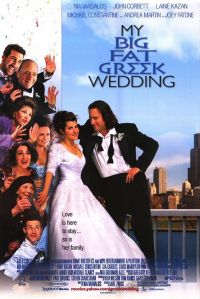 Toula Portokalos (Nia Vardalos) opens by telling us that as a Greek woman she has three responsibilities, “1) Marry a Greek boy. 2) Have lots of Greek children. 3) Make lots of food.” Toula works in her family’s restaurant letting life pass her by, while her father pleads with her to get married even though she is already “old” at 30. It doesn’t seem like that day will ever come for Toula, nor is she looking forward to it, until a handsome stranger (John Corbett, Aidan from Sex and the City) catches her eye in the restaurant. Through more encounters the two seem to have sparks flying off from the heat they generate. He pops the question and Toula happily says yes. There’s only one slight problem – he’s not Greek.
My Big Fat Greek Wedding isn’t anything provocative or innovative but it does have its charming moments and engaging humor. These “ethnic family comedies” are really a double edged sword to work with. You see, they will exaggerate the cultural eccentric-ness of the characters to the point of gross parody but then rely on them to become endearing lovable characters who the audience appreciates for the very same reasons it’s laughing at them. And while Greek Wedding can be found guilty of this notion as well it really does take someone from the inside to come up with this stuff, so there must be some love there to start with.
Vardalos, who also wrote the script, is a perfect casting choice exactly because of her everyday looks. This isn’t someone like Jennifer Aniston trying to pull off being poor and un-pretty; this is a normal looking gal pulling off normal. It works exceptionally and Vardalos certainly knows how to hit a joke. The supporting cast of goofy yet lovable Greeks is played with admirable gusto by the many assembled players. A favorite of mine is the elderly grandmother who continues to try and escape from their home. And yes, an N’SYNC member is in this movie. Why I will never know. Is he even Greek? Is “Fatone” a Greek name?
My Big Fat Greek Wedding is a big helping of family comedy and easy to see why it’s become as crowd pleasing as it is. It’s nothing new or extravagant, but hey, I’d easily go see this again than ever venture close to a theater showing XXX or Blue Crush or Pluto Nash or The Master of Disguise or…
Nate’s Grade: B
Share this:

Changing Lanes (2002)
 Don’t be misled by fancy marketing, Changing Lanes is no more a thriller than In the Bedroom (now that was some fancy misleading marketin’). At its core Lanes is a morality tale hiding under the clothing of thriller ilk. But while the film is surprisingly engaging the majority of it centers on Ben Affleck and Samuel L. Jackson doing a good or bad deed and countering one. And in this dilemma the deck is stacked for audience favorability. Jackson is a down-on-his-luck father fighting an impending divorce and trying to get a loan to purchase some real estate so his wife and kids won’t move away. Affleck is a cocky lawyer in a big firm who had an affair with his secretary (the chipped-tooth looking Toni Collette). Who do you think is the “good” guy? The film seems to bend over backwards to try and make Affleck not so bad, like showing him remorseful and pushed to the edge, under threats from his father-in-law and firm partner (Sydney Pollack), and being urged into a dark unethical territory by his own wife (Amanda Peet).
Jackson underplays his role, despite the snippets of vocal outbursts, and earns the compassion of the audience. Affleck plays Cocky Lawyer Man Who Becomes Humble and does a fine job. The supporting cast really shines in Changing Lanes especially Peet. Her one true scene involving her chilly sit-down with her husband is great in its sharp veer from what is expected.
Changing Lanes was directed by Roger Mitchell (Notting Hill) with a bit of nerves. Some scenes are shot from obtuse angles and the score has an inappropriate electronica taste. In the end though, Changing Lanes is an involving morality tale with some good lead performances.
Nate’s Grade: B
Share this:

Human Nature (2002)
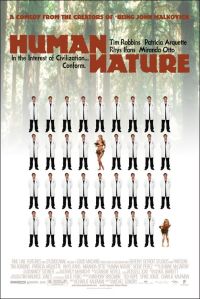 Screenwriter Charlie Kaufman jumped on to Hollywood’s A-list when his feature debut Being John Malkovich was unleashed in 1999. Malkovich was a brilliant original satire on identity, be it celebrity or sexual, and was filled with riotous humor but also blended beautifully with a rich story that bordered on genius that longer it went. Now Kaufman tries his hand expounding at the meaning of civilization versus animal instinct in Human Nature. As one character tells another, “Just remember, don’t do whatever your body is telling you to do and you’ll be fine.”
Lila (Patricia Arquette) is a woman burdened with excessive body hair ever since she was old enough for a training bra (with the younger version played by Disney’s Lizzie McGuire). Lila feels ashamed by her body and morbidly humiliated. She runs away to the forest to enjoy a life free from the critical eyes of other men. Here she can commune with nature and feel that she belongs.
 Nathan (Tim Robbins) is an anal retentive scientist obsessed with etiquette. As a young boy Nathan was sent to his room for picking the wrong fork to eat his meal with. He is now trying his best to teach mice table manners so he can prove that if etiquette can be taught to animals it can be ingrained toward humanity.Lila and Nathan become lovers when she ventures back into the city, eliminating her body hair for now, because of something infinitely in human nature – hormones. The two of them find a form of content, as neither had known the intimate touch of another human being.“Puff” (Rhys Ifans) is a grown man living his life in the woods convinced by his father that he is an ape. One day while walking through the woods Nathan and Lila discover the ape-man and have differing opinions on what should be done with him. Nathan is convinced that he should be brought into civilization and be taught the rules, etiquette and things that make us “human.” It would also be his greatest experiment. Lila feels that he should maintain his freedom and live as he does in nature, how he feels he should.
What follows is a bizarre love triangle over the reeducation of “Puff,” as Nathan’s slinky French assistant Gabrielle (Miranda Otto) names him. Lila is torn over the treatment of Puff and also her own society induced shame of her abundant amount of body hair. Nathan feels like he is saving Puff from his wayward primal urges, as he himself becomes a victim of them when he starts having an affair with Gabrielle. Puff, as he tells a congressional committee, was playing their game so he could find some action and “get a piece of that.”
 Kaufman has written a movie in the same vein as Being John Malkovich but missing the pathos and sadly, the humor. ‘Human Nature’ tries too hard to be funny and isn’t nearly as funny as it thinks it is. Many quirky elements are thrown out but don’t have the same sticking power as Kaufman’s previous film. It’s a fine line between being quirky just for quirky’s sake (like the atrocious Gummo) and turning quirky into something fantastic (like Rushmore or Raising Arizona). Human Nature is too quirky for its own good without having the balance of substance to enhance the weirdness further. There are many interesting parts to this story but as a whole they don’t ever seriously gel.
Debut director Michel Gondry cut his teeth in the realm of MTV making surreal videos for Bjork and others (including the Lego animated one for The White Stripes). He also has done numerous commercials, most infamously the creepy-as-all-hell singing navels Levi ad. Gondry does have a vision, and that vision is “Copy What Spike Jonze Did As Best as Possible.” Gondry’s direction never really registers, except for some attractive time shifts, but feels more like a rehash of Jonze’s work on; yep you guessed it, Being John Malkovich.
Arquette and Robbins do fine jobs in their roles with Arquette given a bit more, dare I say it more, humanity. Her Lila is trapped between knowing what is true to herself and fitting in to a society that tells her that it’s unhealthy and wrong. Ifans has fun with his character and lets it show. The acting in Human Nature is never really the problem.
While Human Nature is certainly an interesting film (hey it has Arquette singing a song in the buff and Rosie Perez as an electrologist) but the sum of its whole is lacking. It’s unfair to keep comparing it to the earlier Malkovich but the film is trying too hard to emulate what made that movie so successful. Human Nature just doesn’t have the gravity that could turn a quirky film into a brilliant one.
Nate’s Grade: C+
Share this:

Panic Room (2002)
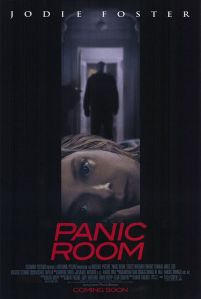 Meg Altman (Jodie Foster) is a newly divorced woman shopping around Manhattan for a new place to sow her wild oats thanks to a healthy marital settlement. The brownstone in question is truly spacious. It comes complete with four floors and a working elevator installed by the invalid former owner. Megs teenage daughter Sarah immediately takes a shine to her new digs and urges mom to sign the dotted line. It seems besides a great location the place also comes complete with a secret room that houses a separate phone line, a wall of monitors all corresponding to cameras, as well as medical supplies and a silver commode. This panic room is surrounded by four feet of concrete and sealed by an airtight steel door. It seems its the ultimate in home protection.
But before Meg and Sarah can barely unpack a trio of burglars enters the home with the hopes of securing the reclusive former owners riches. Meg grabs her daughter and scurries into the panic room just in time to seal the door behind her. She communicates to the men to take what they want and leave. One of them writes on a piece of paper that what they really want is inside the panic room. The burglars aren’t going anywhere, are well equipped and know the panic room better than she does. Meg and her daughter are safe but trapped with little voice to the outside. Thus the pieces are all set and an intricate game of moves and counter-moves takes place to see who has the upper hand, in and out of the panic room.
 Panic Room is that rare treat as a movie alive and well with energy, tenacity and a double-dose worth of entertainment. The movie flies by and youre left catching your breath or checking your pulse at certain junctures. The suspense continues in an arching fashion and keeps giving the audience new situations to be taken with.
It’s been two years since the public has last seen Jodie Foster in a movie and its good to have her back. Her performance is nominal but she’s put through what must be the most physically strenuous film of her career. She has that rare versatility as an actress to wear corsets and frilly-wear one film and then to be holstering a gun and barking at transsexual serial killers the next, all while maintaining complete confidence and integrity at either.
It seems that today we have a staggering lack of female action leads that could kick your ass. Sigourney Weaver once owned this throne but now the only thing we have to offer is pinups. We have Angelina Jolie’s scary glares. We have the pout of Michelle Rodriguez, who has since blown what promise she showed in Girl Fight by starring in two horrible consecutive films about zombies (one of these said zombies being Vin Diesel). And I dont think I even need to go into Milla Jovovich. So it’s refreshing knowing that Foster, even while pregnant for part of filming, can swing with the big boys and surely roll some heads and take some names.
The actors portraying the burglars play basic criminal archetypes, but do passable jobs with them. Forest Whitaker is the soft-spoken security expert who refuses to play rough if the situation calls for it. Jared Leto is the comically impulsive grandson who feels slighted by not being granted a sum of the inheritance. Dwight Yoakam (yes the Dwight Yoakam) is the questionable addition with an itchy trigger finger and a determination to get his mitts on the money.
 Director David Fincher, the auteur that gave us a head in a box with Se7en, returns with his kinetic kick and brooding finesse. Fincher is a vastly talented visual director and adds more richness to the film with lovely cinematography and an astutely mature sense of tension.
However, Fincher’s sensory excesses get the better of him the longer the film goes. Does the audience really need to have the camera travel through the handle of a coffeepot? Does anyone really need the camera to swirl into the bulb of a flashlight so we see how it works? It may come to the point where you’re anticipating the next superfluous camera movement, and praying that it isn’t plunging into Yoakam’s nostrils. Once or twice is fine, but after awhile the nomadic camera movements become far more distracting to the film. The ending is also a bit anti-climactic for my taste.
Panic Room, despite a few missteps, is a great exercise in suspense. You may get so wrapped up youll find yourself, as I surprisingly did, reverting to the annoying habit of talking to the characters on screen and trying to instruct them. Panic Room is the kind of movie you wish Hollywood made more often: something with genuine thrills that leaves you pinned to your seat and bubbling with anticipation, before turning you into a puddle of warm goo.
Nate’s Grade: B
Share this:

Metropolis (2002)
 It has the screenplay penned by Katsuhiro Ôtomo, writer/director of Akira. The director is Tarô Rin, director of numerous anime including X. And it’s based upon a classic manga by the same name. If you understood any of this, especially if you successfully identified anyone, then you are a prime candidate for Metropolis.
Metropolis is a future wonderland of a city, with the coronation of Duke Red’s gigantic Ziggurat building, to which he plans to rule the world. He’s evil. Detective Shunsaku Ban and his nephew Kenichi have been hired from Japan to find an illegal organ trader who they believe has some connection to Duke Red. Sure enough, with his help the duke is building the most powerful robot named Tima who also happens to look pristine like his deceased daughter. His adopted son Rock takes offense, kills the organ trader, and chases Kenichi and Tima through the subterranean bowels of the city. Then there’s some chase scenes. And… um… the disaster montage ending. There’s your story folks.
Time for an anime checklist. Androgynous heroes? Check. Sprite looking females with super duper powers? Check. Bad guys with snozes like Toucan Sam? Check. Robots, robots, robots? Check. A story that bites off more than it can chew? Check. Gratuitous nudity and grotesque gore? Nope. Well this is a PG-13 movie.
Metropolis is without a doubt one of the most beautiful animated films I have ever seen. The dazzling vistas of the city are a wonder to behold. Metropolis is an amazing movie to watch. To say it is candy for the eyes is an understatement; it’s Girl Scout cookies for the eyes. The visuals are astonishing but the story lacks any character development. The script borrows heavily from Blade Runner, Brazil and the original Fritz Lang silent masterpiece Metropolis. There’s also a rather dumbfounding sequence where the montage of destruction, including the annihilation of the Ziggurat, set to Ray Charles’ “I Can’t Stop Loving You.”
For anime fans it all won’t matter. The film is a sight to behold. It’s gorgeous but flaccid in its thinking and plotting.
Nate’s Grade: B-
Share this:

Kissing Jessica Stein (2002)
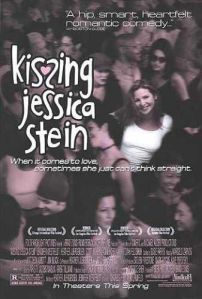 Kissing Jessica Stein stars Jennifer Westfeldt as the perfectionist title heroine searching for true love in the Big Apple. She answers a personal ad sent by Helen (Heather Juergensen), an art gallery manager trying her hand at women for the first time. What begins in comedic awkwardness turns to the fires of passion. Which leads to much more awkwardness as Jessica attempts to keep her secrets and the true identity of her “friend” from her mother.
Juergensen and Westfeldt wrote the script based on characters they have nurtured for several years, and their comfort level with the material shows. Each gives a wry and charismatic performance, with Westfeldt proving herself an acting revelation. It must be nice for her to have something else to her résumé than being one of the “girls” in Two Guys, A Girl and a Pizza Place.
Kissing Jessica Stein tiptoes a fine line with some characters possibly becoming gay or Jewish stereotypes; however, they never do fall into the abyss of Caricature Land. Tovah Feldshuh, playing Jessica’s mother, might make you wince at the thought that she’d be mired as a Mike Myers “Coffee Talk” portrait. But she has scenes where she shows real tenderness that is very affective.
At times the movie feels a bit too wrapped up in its own precocious-ness. There’s even a standard montage of bad dates that becomes annoying much sooner than it ends. Those looking for deep lesbian issues needn’t apply here. Kissing Jessica Stein hits its targets on a surface level, which can be deemed appropriate for an innocuous romantic comedy. The downer closing 10 minutes seems to come from nowhere and betray the feel of the movie.
The film plays by conventional rules for the most part but these don’t diminish the healthy humor in the least. Kissing Jessica Stein is a charming and fun experience and would serve as a good date movie for prospective couples.
Nate’s Grade: B
Share this:

The Time Machine (2002)
 The Time Machine is one of the most famous works of fiction in history. It was writen long long ago by the great H.G. Wells. It presents a fantasy glimpse into our future, but in it Wells also gave readers the opportunity to ponder what would happen if they could go back and change their own lives. People have used the story as a cautionary allegory to our own times, like the 1960 film version of The Time Machine. Now, a bigger budget Hollywood remake attempts to put another spin on the Wells classic.
Alexander Hartdegen (Guy Pearce) is an absent-minded professor interested in cracking down the physics of time. He’s chided by some of his peers for crackpot theories and his fascination with any new gadget. He’s supposed to meet Emma (Sienna Guillory) at Central Park and tonight’s the big night he plans to propose to her. He eventually catches up to Emma and the two go strolling off into the park. Shortly after popping the question the two become victims of a mugging and in the fray Emma is left dead. The death drives Alex to create his fanciful time machine, which only happens to take four years time.
Alex gives his big brass LA-Z-Boy looking machine a try and travels back to that fateful night to avoid Emma’s death. Alex avoids the mugger all right, but while purchasing flowers his fiancé gets plowed over by a runaway carriage instead. It seems that one cannot change the past. Alex decides to give the future a chance and travels to a very Back to the Future 2 looking 2037. Someone astutely asks Alex if his time traveling machine makes a good cappuccino.
 When Alex hops a little further into the future the moon is breaking up because of ill-fated lunar construction. Moon rocks are hurtling toward the surface and disrupting everyone’s day. (It was in this moment that a scene of rocks smashing into the World Trade Center was cut for taste) Alex jumps back into his machine but is konked out by some lunar cheese and falls asleep at the wheel. The next thing you know Alex is in a mysterious future world.
The place where The Time Machine really bogs down is once Alex arrives in 80,000 something or other. The child-like thrills and adventure of Alex zipping between the past and near future are buried underneath the standard post-apocalyptic movie world. The people dress in loin cloths and rags (though some of the female natives wear revealing tops that look like see-through chain mail) but still have perfect teeth. When Alex doesn’t understand the linguistics of 80,000 AD the next words that he hears are English from shapely native Mara (pop star Samantha Mumba). It’s amazing that English survived 81,000 years when Latin didn’t last a mere 2,000 and change.
It turns out these people who live in huts resembling hot air balloons along the faces of cliffs are called Eloi. The Eloi don’t have anyone looking old enough to carry an AARP membership and are apprehensive to speak of why. Perhaps it’s because creatures resembling something that would belong in The Mummy Returns pop up from the sand to capture whatever slow moving prey they can and return to for an underground feast.
The creatures, called Morlocks, are the offshoots of evolution. Seems after the whole moon destruction thing (whoops!) those who took refuge below the surface have evolved into dusty hunchbacked cannibals. Their rowdy ranks are controlled by Uber-Morlock (I’m not making up that name) who resembles an albino bassist for Poison or Skid Row. It’s actually acclaimed actor Jeremy Irons under all that pancake makeup and fleshy spine-showing prosthetic. The less said about Irons the better.
It’s during this part that The Time Machine reverts into a half-baked Stargate. Alex encourages the Eloi race to stand up to their oppressors and fight for their freedom. He becomes part of the Eloi community, rallies the troops into rebellion, and also has to save the damsel in distress.
The Time Machine remake isn’t the political statement the 1960 film was on man’s folly with technology, particularly nuclear weapons. What this suped-up version is all about is special effects and plenty of them. The effects are for the most part dazzling, especially the scene where Alex travels to 2037 and we see the development of New York City with skyscrapers assembling themselves.
 Simon Wells (The Prince of Egypt) directed this remake and is actually the great-grandson of the famous adventure’s author, H. G. Wells. Trivial Pursuit fans everywhere rejoice. Wells had to sit out the last 18 days of shooting due to “exhaustion” and Gore Verbinsky came off the bench to finish the directorial duties. The film clocks in at a scant 90 minutes but there are definite moments of drag.
Pearce (Memento) is a hunky hero and for the most part is admirably gung-ho with the role. Samantha Mumba’s motivation must have been to stand and look pretty the entire film, which is all she really does. To think that Mumba might be the most talented of the recent singers-come-actors (Mandy Moore and Britney Spears) is a distressing thought all its own.
As The Time Machine kept dragging into its Mumba-filled period I began day dreaming of an alternate, darkly comic version. In my head, Pearce’s character keeps traveling back again and again to save his beloved only to lose her a different way each time. I could picture a humorous montage of his girlfriend dying an assortment of colorful deaths and Pearce just getting more frustrated and jaded. I could picture them skating only to have her plunge below the ice. I could picture the couple dining at a fine restaurant only to have her choke and Pearce just throw his napkin onto the table and sigh loudly. I was enjoying my alternate take on The Time Machine so much that I didn’t want to return to the one that was playing.
The Time Machine has its moments of thrills and excitement but they are mostly condensed to the opening third. This remake doesn’t have the political edge or wow-factor the original did. It plays more to the rules of conventional Hollywood than the wide open possibilities Wells wrote about. Pearce tries valiantly and the special effects are really something, but more often than not The Time Machine is not worth your time.
Nate’s Grade: C
Share this:

We Were Soldiers (2002)
 Randall Wallace and Gibson last teamed up on Braveheart and came away with a bushel of gold statuettes. Their latest collaboration is a Vietnam war flick called We Were Soldiers based upon the novel by Lt. Col. Hal Moore and photographer Joe Galloway. It details the chaos of the battle at Ia Drang where 400 US soldiers were surrounded in a valley by 2000 North Vietnamese fighters and held their own for three long days.
The opening chunk of We Were Soldiers concerns the domestic side of the soldiers. Lt. Col. Hal Moore (Mel Gibson) is a man of great honor and battlefield heroics complete with five kids and a determined and loving wife Julie (Madeleine Stowe). Does anyone have any problems identifying the hero yet? Moore has been commanded to assemble an inexperienced band of soldiers and mold them into the 7th Cavalry division. His men include new father Lt. Jack Geoghegan (Chris Klein), helicopter pilot Maj. Bruce Crandall (Greg Kinnear) and grizzled veteran Sgt.-Maj. Basil Plumley (Sam Elliott). They’ve been called in to be apart of one of the first strikes of the Vietnam War in 1965. Gibson rallies the troops and they head toward the East. What followed could be deemed a suicide mission as the 7th Cavalry and other divisions were surrounded by the advancing Vietcong and fought to the teeth for their survival.
Director Randall Wallace (who last directed and adapted for the screen Man in the Iron Mask) is a director that doesn’t know a thing about subtlety in his mess of patriotism. Wallace just doesn’t hammer his points and views; he’ll bludgeon you to death with them. Gibson ensures his men that he will be the first one into battle and the last to leave. Sure enough, as the helicopter is setting down we see a big close-up of Gibson’s boot hitting the earth and a thunderous echo follows. The point has been made. Wallace also manages to squeeze in a bit where he can skewer the media. A horde of reporters show up at the end of the battle, ducking at any noise they hear, and stick their mics in Gibson’s face asking absurd questions like “How do you feel about the loss of your men?” Oh Wallace, you are such a shrewd satirist.
 The violence in the film is incredibly graphic, as with the tradition of most recent war movies like Black Hawk Down. The violence almost reaches a sadistic level where we see slow motion shot after shot of people with a geyser of blood spewing from head wounds. The blood flows freely and often but loses its impact. I would even go as far as saying that much of the violence in ‘We Were Soldiers’ is overkill under Wallace.
The makeup that accompanies some of the battle wounds is surprisingly disappointing (as is a lot in the film). One character, after an accidental blast from napalm, has half his head looking like a burnt marshmallow. The shoddiness of the look inspires more laughs under your breath than gasps.
The battle of Ia Drang shows reactions from both sides of those fighting. Every now and then the film cuts back to the Vietnamese side in their underground lair. The leadership over explains all their strategic movements in large flailing gestures. It’s like a cheap play-by-play for the audience. We Were Soldiers also follows the recent trend of trying to humanize the enemy. But these attempts are easily seen as the hollow politically correct handouts that they are. One scene shows a Vietnamese soldier writing in a book to his honey back home. It’s nice to see clichés transcend ethnicity.
 The film succumbs to the usual war movie clichés and Hollywood formula. The problem with making a supposed “emotional” Vietnam movie is that the definitive Vietnam movies concerning the madness of battle (Apocalypse Now and Platoon) and the crippling after-effects (The Deer Hunter and Born on the Fourth of July) have already been made. We Were Soldiers portrays Vietnam before the politics got in the way and concentrates on the courage of the men who dutifully entered into battle at the heed of their country’s call. I can’t help but feel that the men who bled and died in that battle don’t deserve a better movie.
Gibson as Moore gives a stoic performance and adds a level of humor to the figure, but there’s no questioning the mettle of this soldier. Gibson’s character is almost an exaggerated propaganda action figure. Moore’s courage is unquestionable and that’s the way they want it. Madeleine Stowe is a terrific actress but is generally wasted here. Most of the movie she spends her time hugging people while wearing some horrible Cher wig and looking eerily like Hillary Swank in The Gift. Chris Klein looks entirely out of place, as does his wife played by curly-coifed Felicity actress Keri Russell. Greg Kinnear spends the entire movie sitting in a helicopter chair barely seen. They could have saved some money and hired an extra.
We Were Soldiers is an okay film but it should have been much more. Gibson elevates what could have been worse but Wallace isn’t doing the film any justice. Wallace is too heavy-handed with his direction and flag-waving message and seems to have his film begging to be taken seriously. We Were Soldiers can pass the time all right, but there are better things you could do then watch this force-fed old-fashioned narrative.
Nate’s Grade: C
Share this:

Crossroads (2002)
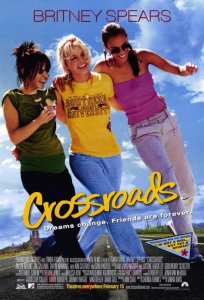 When informed that her feature film debut was receiving shrieks of laughter during advanced screenings for critics, Britney Spears said she was glad because she never likes the same films the critics do. Well Ms. Not That Innocent, the truth hurts; you’re not a girl, not yet an actress. Crossroads is really the filmic adventures of Britney Spears and her ever-present navel. The navel should get second billing, but alas, we do not live in a society of equality for navels.
The film opens up with three 10-year-old best friends burying a box of wishes and dreams and promising to be bestest friends forever and ever. They make a pact to come back and dig up the box on the night of their high school graduation. Flash to the present and the word “bestest” isn’t what it used to be. Lucy (Britney Spears) has become the virginal nerd preparing to give her speech as valedictorian. Kit (Zoe Saldana) has become the haughty popular snob, obsessed over getting married ever since she got her first Bridal Barbie. Mimi (Taryn Manning) is pregnant and become the trailer trash girl that everyone sees fit to remind her of. Despite their growth apart they all do come together to reopen their box of dreams. Mimi informs the others that she plans to head to California to audition for a record deal in an open contest. Kit decides to use this opportunity to check up on her boyfriend at UCLA who has been strangely evasive. Lucy complains that by having her nose in a book her entire high school experience she never got to go to a football game or even “hang out.” Somewhere a small violin is playing. She decides to jump at this chance and possibly see her mother in Arizona, who ran out on Lucy and her father (Dan Akroyd) when she was only three. The wheels of their adventure are provided by guitar-playing mystery Ben (Anson Mount). He pilots them on their travels to the Pacific coast, though the girls think he might have killed someone, but oh well.
 Crossroads is filled to the brim with every imaginable road trip cliché. The girls “open up” after getting drunk, have a scuffle in a bar, reap in the sights of nature, and perhaps create some sparks of romance with their hunky heartthrob of a driver. The car also inevitably breaks down and the girls have to find a way to scrape some quick cash together. They enter in a karaoke contest and Britney proceeds to sing Joan Jett’s “I Love Rock and Roll” with her two gal pals providing backup. But no, this isn’t the last time you’ll hear Ms. Brit sing. In an effort to pad as well as become a showcase for its star, Crossroads gives us many scenes of the girls just singing to the radio. Besides Jett, Shania Twain’s “Man I Feel Like a Woman” and Sheryl Crow’s “If It Makes You Happy” are also on the chopping block. You’ll also be accosted by the movie’s single “Not a Girl, Not Yet a Woman” several times, including one scene where Poet Britney is asked to share her poem and it ends up being the song’s lyrics.
Saldana (Center Stage) is not given much, as the attention is always centered on Britney, so she merely comes off like a token conceited character. Only Taryn Manning (crazy/beautiful) comes away with a little dignity. She gives Mimi a lot more heart than should be there and shows some honest reflections for her character. She also, coincidentally enough, looks like a dead ringer for Joan Jett with her black bangs.
Crossroads is nothing but a star vanity project for Spears, with some not-so-subliminal Pepsi product placement here and there. This was not a script looking for a lead; this was something Britney’s management team suited for her, and Crossroads is perfectly suited for Britney. It allows for many ogling periods of booty shaking. The majority of the film’s drama doesn’t even concern her, and when she does have to act her scenes are cut short to help her when the real drama unfolds. The movie’s true intentions are revealed when Britney is shown in her pink underwear twice in the first 15 minutes.
 Crossroads moves along on gratuitous skin shots of Spears half-naked body every 20 minutes until it reaches its torture chamber of a final act. In this very melodramatic period we get abandonment, date rape, infidelity, and even a miscarriage in one of the film’s most shameless plot devices. Of course none of these horrors matter, especially a psychologically damaging miscarriage, because Britney has to get to her BIG audition in order to perform, yep you guessed it, “I’m Not a Girl, Not Yet a Woman.” She also has to wear what looks like kitchen drapes while she sings.
You’ll walk out of the theater wondering many things. Why does Britney wear pink in EVERY single scene she’s in? There’s even one scene where she changes from a pink top to another pink top and is FOLDING a third pink top into a suitcase. Are we to believe that Akroyd and Spears share some kind of genetics? In what high school would Britney be considered a nerd?
Hopefully Crossroads will be the pop princess’ last foray into film, but I strongly doubt this is the last we’ve seen of Britney Spears. Crossroads is a terrible girl-power trip. Only Spears’ target demographic will enjoy this melodramatic mess. Truly, the two largest groups that will see this film are adolescent girls and creepy older men who fawn after adolescent girls. Crossroads is exactly everything you’d expect.
Nate’s Grade: F
Share this:

Rollerball (2002)
 The year is 2005 and the number one sport, at least in the former Soviet Union for some reason, is a mixture of roller derby, football and some kind of ESPN X-game. The man behind Rollerball is Alexi Petrovich (Jean Reno), who still thirsts for that lucrative cable contract with the U.S. and just might do anything to get it. Play suspicious music here.
Jonathan Cross (Chris Klein) is an NHL draft pick in trouble with the law after a stupid high speed street race. His pal Marcus Ridley (LL Cool J) tells him of a new extreme sport catching on in Central Asia, and Jonathan accepts his offer. The two are enjoying their success in Spandex but start to have reservations when they notice Petrovich including more violence as a ratings booster. Jonathan can’t just look the other way. Because he’s the good guy. So after a botched escape (shot infuriatingly all in what seems like night vision green) he collects his fellow ballers to rebel against Petrovich and whatever. As you can easily see, the story of Rollerball is not exactly its strong point. Not that there is a strong point in Rollerball.
 The original Rollerball came out in 1975 and was full of political themes like corporate dictatorships and Orwellian observations on a dominated, passive society where war and nationalism have been replaced with a roller sport. Though the themes of this James Caan vehicle were a bit heavy-handed at times, the action was rather impressive especially as the corporations try their best to squash Caan in a bloody onslaught of an ending. The 1975 Rollerball had a political message and some nice action. What does the 2002 version have? Try banality and plenty of it.
Klein came to the limelight through movies like American Pie and Election, and if his dimwitted deer-in-headlights look wasn’t doing it for you before then God help you with his performance in Rollerball. Rebecca Romijn-Stamos plays Klein’s teammate and lover on the Rollerball circuit. Reno deserves a trophy for even delivering the majority of his lines with a straight face.
Oh how the mighty have fallen John McTiernan. You once directed such great 80s action movies like Die Hard, The Hunt for the Red October, and Predator but now you spend your days remaking old Norman Jewison films. It began with the lukewarm remake of The Thomas Crown Affair and now a boring re-cooking of Rollerball follows it up. Can a remake of F.I.S.T. or Fiddler on the Roof be the only thing we have to look forward to now?
 The most jarring problem with Rollerball, and there are so many to choose from, is the hack editing choices made. The way the movie plays one wonders if they threw all their footage in a wood chipper and grabbed whatever pieces they could and glued them into a movie. Scenes exist but appear in no discernible pattern or order. All one sees in their chair is a whirl of colors and you might be wondering if you stepped into Kaleidoscope: The Motion Picture.
The story behind this Rollerball was that it was originally slated to come out August of 2001 but after test screenings that left people howling the studio bumped it to the winter and cut it from an R to a more commercial PG-13. Lost in this cost-cutting maneuver are gore (which you would think would be important for a violent future gladiator sport) and a nude scene involving Romijn-Stamos. Which version would you have rather seen?
Rollerball is a laughably noisy and empty film that will leave your head spinning for all the wrong reasons. It’s likely the worst flick you’ll see for 2002 right now, that is, until the following week when Britney’s near-certain train wreck of a film debut opens. But until that time Rollerball is the true champion – of boredom and stupidity.
Nate’s Grade: D


 nathanzoebl
You must be logged in to post a comment.