Monthly Archives: December 2022
Marcel the Shell with Shoes On (2022)
 The feature-length movie based upon the short stop-motion films about a mollusk in sneakers, Marcel the Shell with Shoes On might just be the most precious movie of the year. It’s set like a faux documentary where a lonely filmmaker discovers a magical inhabitant in his Air B&B, a very soft-spoken little guy with a heart much bigger than his actual size. Marcel (voiced by co-creator Jenny Slate) is looking for his lost family who were unknowingly absconded when the original couple who lived in the house broke up and gathered their things quickly before storming off. Dean (Dean Flesicher-Camp, also the movie’s director) records Marcel and his innocent little observations on life and the bigger world and posts the videos online, and Marcel becomes Internet famous, for good and bad. The plot of the movie is less important than its overall gentle nature. There’s not a lot that happens in the movie, but you dont mind because it’s really an 80-minute sit-down with Marcel. The entire movie is just so sweetly innocent that it’s hard to resist. It also has some bigger things to say about our place in the world as well as mortality. Marcel has a loving yet ailing grandmother shell (voiced by Isabella Rossellini) who is beginning to lose her lucidity, and it will hit home for anyone who has watching a loved one suffer from mental decline. Marcel the Shell with Shoes On is a perfect little antidote for our modern cynical lives. It’s overwhelmingly adorable and wholesome and winsome and just plain cute.
Nate’s Grade: B
Share this:

The Fabelmans (2022)
 Steven Spielberg has been the most popular film director of the last fifty years but he’s never turned the focus squarely on himself, and that’s the draw of The Fabelmans, a coming-of-age drama that’s really a coming-of-Spielberg expose. The biographical movie follows the Fabelman family from the 1950s through the late 60s as Sammy (our Steven Spielberg avatar) becomes inspired to be a moviemaker while his parents’ marriage deteriorates. As a lifelong lover of movies and a childhood amateur filmmaker, there’s plenty here for me to connect with. The fascination with recreating images, of chasing after an eager dream, of working together with other creatives for something bigger, it’s all there and it works. I’m a sucker for movies about the assemblage of movie crews, those found families working in tandem. However, the family drama stuff I found less engaging. Apparently Sammy’s mother (Michelle Williams) is more impulsive, spontaneous, and attention-seeking, and may have some un-diagnosed mental illness at that, whereas his father (Paul Dano) is a dry and boring computer engineering genius. I found the family drama stuff to be a distraction from the storylines of Sammy as a budding filmmaker experimenting with his art and Sammy the unpopular new kid at high school harassed for being Jewish. There are some memorable scenes, like a girlfriend’s carnal obsession with Jesus, and a culmination with a bully that is surprising on multiple counts, but ultimately I found the movie to be strangely remote and lacking great personal insight. This is why Spielberg became the greatest filmmaker in the world? I guess. I’ll credit co-writer Tony Kushner (West Side Story, Lincoln) for not making this what too many modern author biopics have become, a barrage of inspirations and connections to their most famous works (“Hey Steven, I want you to meet our neighbor, Ernest Thalberg, or E.T. as we used to call him back at Raiders U.”). The Fabelmans is a perfectly nice movie, with solid acting, and the occasional moment that really grabs hold of you, like a electrifying meeting with a top Hollywood director in the film’s finale. For me, those moments were only too fleeting. It’s a family drama I wanted less family time with and more analysis on its creator.
Nate’s Grade: B
Share this:

Women Talking (2022)
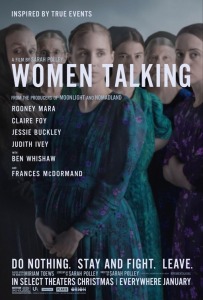 The hard-hitting Oscar-worthy drama Women Talking could have been titled Twelve Angry Women, but with the necessary subtitle: But They’re Very Justified in Their Rage. It is, as the title suggests, a movie almost entirely about women talking in one central location, enough so to feel like a stage play captured for the screen. However, the reason these women are assembled is heartbreaking, infuriating, and eminently engrossing. Women Talking demands to be heard.
The dozen women have gathered to debate the future of their participation in their community, a closed-off Mennonite coalition. They are victims of heinous sex crimes and general repression, debating between staying and fighting and abandoning their way of life. These women are talking about their own agency and what their collective response will be to the great wrongs that have prevailed upon them. It’s not just that the women of this community have been preyed upon by predators in their midst, their trauma has been dismissed as ghosts and devils until literal men were literally caught and apprehended. The next part is even more galling, as the guilty men will be returning back to the community and the women are expected to forgive the predators and go back to life as it has been. Except how exactly has life been for the women of this small community? The assaults have been going on for decades, enough that many of the children are the byproducts of their abusers. One grandmother is brought to tears that she should have done more to protect her adult daughter, herself married to an abusive man. The systematic nature of this abuse is the core of their deliberation. Can they stay and reform a broken society from inside, or is the best hope radically breaking away and starting anew without the men?
 The movie also serves as a debate over the capacity for grace and forgiveness, reminding me in subject as well as the approach of last year’s equally hard-hitting and equally spellbinding indie, Mass. I found it especially insulting that these women are expected, by the male leaders, to simply forgive and forget, to shuffle back to subservience. It’s a larger philosophical discussion over the nature of grace and accountability. It would be showing grace to these men to forgive them when they do not deserve it, and surely the male leaders would underline this point in a comparison with their religious text, akin to Jesus forgiving those who crucified him. However, if forgiveness is not the catalyst for reform and reclamation, then it’s just another empty gesture that maintains the status quo of abuse going unpunished and the abusers being protected. It’s easy to make larger connections to larger societies protecting predators through conditioned silence. The entertainment industry has been rife with bad men, and yes it’s typically men, behaving criminally and being protected by their position, and it might be easy to make connections with Women Talking and She Said, the fact-based take-down of Harvey Weinstein. Are these people worthy of forgiveness or is the patriarchal system of power (women aren’t even allowed to learn to read and write in this community) beyond salvaging? Within minutes of watching, I was already shaking my head and saying they should burn it all to the ground.
Women Talking is powerful and somber without being overly grave to the detriment of the material. It’s never taken anything less than serious, but the subject matter is handled very sensitively and even rated PG-13. Under the careful guidance of writer/director Sarah Polley (Away From Her, Stories We Tell), the film doesn’t soft-pedal the abuse these women have suffered but it doesn’t wallow in it either, getting overloaded with sordid details. The screenplay unfolds key pieces of information over time, allowing the audience to piece together a fuller picture (I didn’t even realize the family connection of the dozen women until an hour in). It would be easy if the only response explored was one of unfathomable rage, best exemplified by a stirring monologue where Claire Foy (The Crown, First Man) rattles off what she will do to protect her young daughter including murder, including vying with the Almighty, and even including spending eternity in hell. It’s easy to be all teeth-gnashing vengeance and fury, and entirely deserved considering these women are already looked upon as second-class citizens. However, Polley aligns her movie as a debate between anguish and hope and the difference between false and real hope. Is it real to hope that these men will change? Is it real to hope that August (Ben Whishaw), a college-educated child of a former outcast, can break the cycle? By the end, the main feeling I had was catharsis, that these women can chart a new, better path.
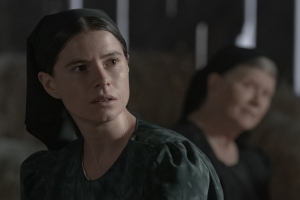 Given the heavy subject matter and the ensemble nature of the production, you would be right to assume that this is an actors’ showcase. The three biggest roles belong to Foy’s Salome, Rooney Mara’s Ona, and Jessie Buckley’s Mariche, each presenting a different perspective. Salome wants to stay but mostly as a means of collecting vengeance for her and her daughter. Mariche wants to forgive the men because, if they do exile themselves, they are told their immortal souls will be denied the kingdom of heaven. It also happens that Mariche’s alcoholic husband is one of the accused men returning. Ona is pregnant with her attacker’s child and questioning which setting would be best for her, staying with what she knows or risking a new life, for better or worse. Foy and Buckely (The Lost Daughter, Men) each have a signature monologue opening up their character perspective and each of them cinches it (call it their “Oscar clip moments”). Mara (Nightmare Alley) has the more contemplative and subdued role, which makes it less showy. Her character is the one who questions the most the value of forgiveness, and of course whether it counts when forgiveness is forced with the threat of eternal damnation. If Salome is the movie’s fury, then Ona is a reflection of begrudging hope, and Mara succeeds with a noble sense of grace.
There are two minor quibbles I have with Women Talking that hold it slightly back for me, and it’s not the locked-in setting making the proceedings feel like a staged play. Polley uses visual inserts and cutaways to devastating effect to highlight the women’s trauma, from awakening to the aftermath of assault to miscarriages, notions to heighten the visual storytelling potential of the medium without digging into exploitation and losing the tasteful tone. The directing even takes a few cues from Sydeny Lumet’s work from 12 Angry Men. One critical aspect that holds back the movie, again only slightly, is that the characters tend to feel a little more like various points of view rather than finely developed characters. Given the nature of the debate, there’s a lot of ground to cover, and it’s a smart storytelling move to coalesce. It just slightly limits some emotional engagement; it’s still there because of the skill of the actors and every drop of empathy they rightly earn, but the characters aren’t as well realized as they could have been. This can also be simply because we’re dealing with a dozen characters to try and supply enough material for. Even in 12 Angry Men, not every juror is going to be given equal importance (nobody cares about you, juror #7, so sit down). I reflect back to Mass, an excellent 2021 movie that you should seek out, and how personable and in-depth those characters came across over their feature-length sit-down. It also helps that it only had four characters to balance. The other minor criticism I have is the overemphasis the movie places on a long-in-the-works romance between Ona and August, who maybe has more screen time than maybe any woman. For a movie dealing with the sexual and emotional trauma of women and them taking account, I’m left uncertain about the amount of time we spend on an unrequited romance. It’s not like Polley is elbowing in wacky rom-com material, as it all likewise carries the same subdued tone. I just don’t know if this movie needs a romance elevated during its otherwise 100 plaintive minutes.
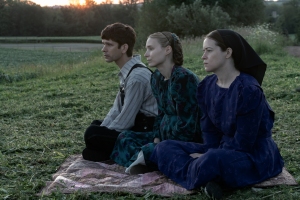 Women Talking is an urgent movie that every person should watch. The central dynamic is radiating with dramatic potential, and the actors are uniformly excellent, even the youngest actors handling some very touchy material. Polley’s direction is stately and subdued without removing any of the surging emotional power inherent in her drama. I’m overjoyed that Polley has returned back to filmmaking as she hasn’t made a movie in ten years. It’s a triumphant return for Polley, one that will likely have her vying on the biggest stages come awards season. Women Talking is timely and, unfortunately, also timeless. By the end, you’ll feel slightly exhausted but better for it, like the euphoria that comes after a good cry and you feel like, having pushed through, you’ll be better for it.
Nate’s Grade: B+
Share this:

Fire of Love (2022)
 Find someone who looks at you the way that Katia and Maurice Krafft look at volcanoes. The French husband-and-wife team were two of the world’s finest volcanologists and would leap into dangerous locales to better study and document erupting volcanoes. The documentary Fire of Love is built upon their extensive archive of stunning nature footage, often mesmerizing and then horrifying to realize how close Katia and particularly Mauriece appear to the explosive action. The movie is narrated by twee filmmaker Miranda July (Kajillionaire) and she sounds so somber that you’re waiting for the story’s inevitable ending, that the two of these passionate volcano nerds got too close to one of their subjects. Katia says, “I follow him, because if he’s going to die I’d rather be with him.” Until then, we explore their relationship as well as their scientific expertise in trying to better warn about erupting volcanoes to prevent future loss of life. It’s a noble effort, one that the Kraffts have to pay for with television specials and global appearances to better fund their research and air travel. I found Fire of Love to be a better nature documentary than an insightful examination of the relationship between these two scientists. The movie’s narration feels given to poetic pontifications that often sound reaching and a tad pretentious. It feels like the movie is a little too desperate to make larger conclusions. Some times, just having access to exclusive and awesome volcano footage can be enough for a 90-minute documentary.
Nate’s Grade: B
Share this:

RRR (2022)

The Indian film sensation that has converted millions across the world has one new convert: me. I’ve been hearing about RRR all year and how outlandish it is, how wild and audacious this three-hour action historical musical can be, and that it’s a celebration of the exuberant possibilities of film, and to every part of that sentence I pump my fist and declare an enthusiastic yes. Think of it as a superhero movie that also happens to be a musical. RRR is set in 1920s India and follows two real-life figures central to India’s independence from Britain. Komaram Bheem (N.T. Rama Rao Jr.) and Alluri Sitarami Raju (Ram Cgaran Teja) never met in real life, but the movie makes them not just enemies but also the best of friends. Both men are set on a collision course, with Bheem searching for his little sister who was kidnapped into the big city by the British governor (Ray Stevenson), and Raju is working his way through the ranks of the British police and searching to arrest Bheem. What might get in the way is the greatest bromance in years, as these guys don’t just like one another, they will swear their undying allegiance and love for the other. Raju helps his BFF talk to a nice British girl he is crushing on, and he even helps Bheem by leading a dance off between hilariously haughty British elites. That “Naacho Naacho” dance is a shot of pure joy and encapsulates the movie: it’s frantic, frenetic, overpowering, and purely genuine. There isn’t a hint of irony in any of the overzealous 186 minutes here. The lead characters act like super powered gods, or burst into song and dance, complete with cover-worthy poses, but at no point does the movie want you to laugh at it; it wants you to get on board and enjoy how perfectly crazy the movie is. It took me about an hour, but I was won over completely by RRR. There is a man getting whipped who moves the crowd into a revolutionary mob through the power of his song. There’s a guy throwing a leopard at another man’s head. A man kicks a running motorcycle into the air and then uses it as a projectile. It’s got spectacular action with more style than a hundred Hollywood movies. The action is so well choreographed and clear to understand that it’s immensely gratifying to watch. The extravagant wire work adds to the grandiose mythic nature of the movie. The arc that Raju has is more compelling and satisfying than many in even American indies. Not only are these gents buff as hell, and effortlessly charming, but they can and will dance circles around the competition. I won’t pretend I have a deep knowledge of Indian cinema but this seems like an excellent entry for many Western fans to explore the stylistic heights of Indian cinema. This is a wild romp with cheer-worthy heroes, a bromance for the ages, and villains you can’t wait to topple. RRR is a bit exhausting by the end but I was never bored during its different tonal shifts. It might not be the best movie of the year but it’s certainly going to be the most movie you’ll get in 2022.
Nate’s Grade: A-
Share this:

Triangle of Sadness (2022)
 The Palme d’Or-winning satire Triangle of Sadness comes from excellent stock. Swedish writer/director Ruben Östlund made audiences squirm with 2014’s Force Majeure and 2017’s The Square, so I anticipated an excellent comedy that made me cringe as often as it made me laugh. The unwieldy two-and-a-half hour experience made me laugh, made me avert my eyes, and ultimately underwhelmed in approach and pacing. Lampooning the entitled, oafish, and essentially useless upper class is an easy enough comedic approach, but I guess I was waiting for something more specific or nuanced. I did enjoy the kindly elderly couple who made their fortunes on grenades and landmines. The movie starts off lackluster, with a handsome young couple (Charbli Dean, Harris Dickinson) arguing over money, and then transitions to its luxury cruise where the rich are pampered and pandered, like when the entire crew has to drop whatever they’re doing to change into a swimsuit and take a dip in the water to please a rich lady who bravely believes she is helping these poor souls “relax” from their troubles. Too often, the movie trades in pretty broad critiques and even humor. There’s a nauseating ten-minute sequence that is nonstop projectile vomiting and exploding toilets overrunning with filth (do you get it? The ship is also called “Society” and it sinks, so do you get that?). The last hour of the movie involves a small group from the cruise trying to survive on a deserted island, and it’s here where the power balance shifts, allowing Abigail (Dolly De Leon), one of the housekeeping staff, to become a de facto leader because she’s the only person with useful skills. The obnoxious rich people begin to get some comeuppance, but Östlund won’t allow easy payback for satisfaction. I missed the simplicity of Force Majeure‘s deconstruction of fragile masculinity. It was a much more coherent thesis that felt richly explored with its supporting characters and central dynamic. I think this movie was a little too scattershot and lackadaisical. It’s supposed to be about capitalism propping up a useless class of people, but there isn’t enough savagery during the island portion to really seal this prickly commentary. At no point, do people literally eat the rich, alas. Triangle of Sadness ends so abruptly that I loudly groaned, as it feels less ambiguous and more like I’m missing out on an actual conclusion of a movie, and after 150 minutes at that. It’s an entertaining and exacting experience but one that could have benefited from judicious trimming and a little more shaping, with its narrative and social criticisms. Also, R.I.P. Dean, who died shortly after the film’s release and was only 32 years old.
Nate’s Grade: B
Share this:

Guillermo del Toro’s Pinocchio (2022)/ Pinocchio (2022)
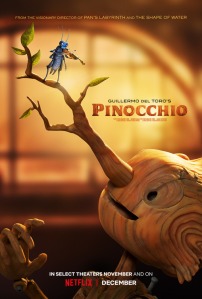 It seems 2022 has unexpectedly become the year of Pinocchio. The 1883 fantasy novel by Carlo Collodui (1826-1890) is best known via the classic Walt Disney animated movie, the second ever for the company, and it was Disney that released a live-action remake earlier in the year on their streaming service. Now widely available on Netflix is Guillermo del Toro’s stop-motion Pinocchio, so I wanted to review both films together but I was also presented with a unique circumstance. Both of these movies were adaptations of the same story, so the comparison is more direct, and I’ve decided to take a few cues from sports writing and break down the movies in a head-to-head competitive battle to see which has the edge in a series of five categories. Which fantastical story about a little puppet yearning to be a real boy will prove superior?
1. VISUAL PRESENTATION
The Netflix Pinocchio is a lovingly realized stop-motion marvel. It’s del Toro’s first animated movie and his style translates easily to this hand-crafted realm. There is something special about stop-motion animation for me; I love the tactile nature of it all, the knowledge that everything I’m watching is pain-stakingly crafted by artisans, and it just increases my appreciation. I fully acknowledge that any animated movie is the work of thousands of hours of labor and love, but there’s something about stop-motion animation that I just experience more viscerally. The level of detail in the Netflix Pinocchio is astounding. There is dirt under Geppetto’s fingernails, red around the eyes after crying, the folds and rolls of fabric, and the textures feel like you can walk up to the screen and run your fingers over their surfaces. I loved the character designs, their clean simplicity but able readability, especially the sister creatures of life and death with peacock feather wings, and the animation underwater made me question how they did what they did. del Toro’s imagination is not limited from animation but expanded, and there are adept camera movements that require even more arduous work to achieve and they do. I loved the life each character has, the fluidity of their movements, that they even animated characters making mistakes or losing their balance or acting so recognizably human and sprightly. There’s a depth of life here plus an added meta-textual layer about puppets telling the story about a puppet who was given life.
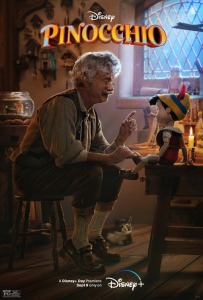 In contrast, the Disney live-action Pinocchio is harsh on the eyes. It’s another CGI smorgasbord from writer/director Robert Zemeckis akin to his mo-cap semi-animated movies from the 2000s. The brightness levels of the outside world are blastingly white, and it eliminates so much of the detail of the landscapes. When watching actors interact, it never overcomes the reality of it being a big empty set. The CGI can also be alarming with the recreation of the many animal sidekicks of the 1940 original. Why did Zemeckis make the pet goldfish look sultry? Why did they make Jiminy Cricket (Joseph Gordon-Levitt) look like a Brussel sprout come to life? It might not be the dead-eyed nightmare fuel of 2004’s The Polar Express, but the visual landscape of the movie is bleached and overdone, making everything feel overly fake or overly muddy and glum. The fact that this movie looks like this with a $150 million budget is disheartening but maybe inevitable. I suppose Zemeckis had no choice but to replicate the Pinocchio character design from 1940, but it looks remarkably out of step and just worse. When we have the 1940 original to compare to, everything in the 2022 remake looks garish or ugly or just wrong. The expressiveness of the hand-drawn animation is replaced with creepy-looking CGI animal-human hybrids.
Edge: Netflix Pinocchio
2. FATHER/SON CHARACTERIZATION
The relationship between Pinocchio (voiced by Gregory Mann) and Geppetto (David Bradley) is the heart of the Netflix Pinocchio, and I don’t mind sharing that it brought me to tears a couple of times. As much as the movie is about a young boy learning about the world, it’s also about the love of a father for a child. The opening ten minutes establish Geppetto’s tragedy with such surefooted efficiency that it reminded me of the early gut punch that was 2009’s Up. This Geppetto is constantly reminded of his loss and, during a drunken fit, he carved a replacement child that happens to come to life. This boy is very different from his last, and there is a great learning curve for both father and son about relating to one another. This is the heart of the movie, one I’ll discuss more in another section. With del Toro’s version, Geppetto is a wounded and hurting man, one where every decision is connected to character. This Pinocchio is a far more entertaining creature, a child of explosive energy, curiosity, and spitefulness. He feels like an excitable newborn exploring the way of the world. He’s so enthusiastic so quickly (“Work? I love work, papa!” “I love it, I love it!… What is it?”) that his wonder can become infectious. This Pinocchio also cannot die, and each time he comes back to life he must wait longer in a netherworld plane. It provides even more for Pinocchio to understand about loss and being human. This is a funny, whimsical, but also deftly emotive Pinocchio. He points to a crucifix and asks why everyone likes that wooden man but not him. He is an outsider learning about human emotions and morals and it’s more meaningful because of the character investment.
 In contrast, the Disney live-action Pinocchio treats its title character as a simpleton. The problem with a story about a child who breaks rules and learns lessons by dealing with the consequences of his actions is if you have a character that makes no mistakes then their suffering feels cruel. This Pinocchio is simply a sweet-natured wannabe performer. He means well but he doesn’t even lie until a sequence requires him to lie to successfully escape his imprisonment. The relationship with Geppetto (Tom Hanks) is strange. This kindly woodcarver is a widower who also has buried a son, but he comes across like a doddering old man who is quick to make dad jokes to nobody (I guess to his CGI cat and goldfish and multitude of Disney-tie-in cuckoo clocks). I don’t know what Hanks is doing with this daffy performance. It feels like Geppetto lost his mind and became stir crazy and this performance is the man pleading for help from the town, from the audience, from Zemeckis. It’s perplexing and it kept me from seeing this man as an actual character. He bounces from catalyst to late damsel in distress needing saving. The relationship between father and son lacks the warmth of the Netflix version. Yet again, the live-action Pinocchio is a pale imitation of its cartoon origins with either main character failing to be fleshed out or made new.
Edge: Netflix Pinocchio
3. THEMES
There are a few key themes that emerge over the near two-hours of the Netflix Pinocchio, which is the longest stop-motion animated film ever. Sebastian J. Cricket (Ewan McGregor) repeats that he “tried his best and that’s the best anyone can do,” and the parallelism makes it sound smarter than it actually is. The actual theme revolves around acceptance and the burdens of love. Geppetto cannot fully accept Pinocchio because he’s constantly comparing him to Carlo. When he can fully accept Pinocchio for who he is, the weird little kid with the big heart and unique perspective, is when he can finally begin to heal over the wound of his grief over Carlo, allowing himself to be vulnerable again and to accept his unexpected new family on their own terms. There’s plenty of available extra applications here to historically marginalized groups, and del Toro is an avowed fan of freaks and outcasts getting their due and thumbing their nose at the hypocritical moral authorities. By setting his story in 1930s Italy under the fascist rule of Benito Mussolini, del Toro underlines his themes of monsters and scapegoats and moral hypocrites even better, and the change of scenery really enlivens the familiar story with extra depth and resonance. All these different people want something out of Pinocchio that he is not. Geppetto wants him to strip away his individuality and be his old son. Count Volpe (Christoph Waltz) wants Pinocchio to be his dancing minion and secure him fame and fortune. Podesta (Ron Perlman) wants Pinocchio as the state’s ultimate soldier, a boy who cannot die and always comes back fighting. When Pinocchio is recruited to train for war with the other young boys to better serve the fatherland’s nationalistic aims, it’s a far more affecting and unsettling experience than Pleasure Island, which is removed from this version. In the end, the movie also becomes a funny and touching exploration of mortality from a magic little child. The Wood Sprite (Tilda Swinton), this version of the Blue Fairy, says she only wanted to grant Geppetto joy. “But you did,” he says. “Terrible, terrible joy.” The fleeting nature of life, as well as its mixture of pain and elation, is an ongoing theme that isn’t revelatory but still feels impressively restated.
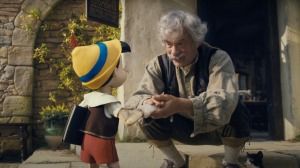 I don’t know what theme the Disney live-action movie has beyond its identity as a product launch. I suppose several years into the Disney live-action assembly line I shouldn’t be surprised that these movies are generally listless, inferior repetitions made to reignite old company IP. For a story about the gift of life, the Disney Pinocchio feels so utterly lifeless. I thought the little wooden boy was meant to learn rights and wrongs but the movie doesn’t allow Pinocchio to err. He’s an innocent simpleton who gets taken advantage of and dragged from encounter to encounter like a lost child. The Pleasure Island sequence has been tamed from the 1940s; children are no longer drinking beer or smoking cigars. They’re gathered to a carnival and then given root beer and told to break items and then punished for this entrapment. The grief Geppetto feels for his deceased loved ones is played out like a barely conceived backstory. He’s just yukking it up like nothing really matters. By the end, when he’s begging for Pinocchio to come back to life, you wonder why he cares. If you were being quite generous, you might be able to uncover themes of acceptance and understanding, but they’re so poorly developed and utilized. That stuff gets in the way of Pinocchio staring at a big pile of horse excrement on the street, which if you needed a summative visual metaphor for the adaptation, there it is.
Edge: Netflix Pinocchio
4. EMOTIONAL STAKES
 One of these movies made me cry. The other one made me sigh in exasperation. The Netflix Pinocchio nails the characterization in a way that is universal and accessible while staying true to its roots, whereas the Disney live-action film feels like a crudely packaged remake on the assembly line of soulless live-action Disney remakes. By securing my investment early with Geppetto’s loss, I found more to relish in the layers of his relationship with Pinocchio. In trying to teach him about the world, Geppetto is relying upon what he started with his past son, and there are intriguing echoes that lead to a spiritual examination. Pinocchio is made from the tree from the pinecone that Carlo chased that lead to his death. Pinocchio hums the tune that Geppetto sang to Carlo. Is there something more here? When he visits Death for the first time, the winged creature remarks, “I feel as though you’ve been here before.” These little questions and ambiguity make the movie much more rewarding, as does del Toro’s ability to supply character arcs for every supporting player. Even the monkey sidekick of the villain gets their own character arc. Another boy desperately desires his stern father’s approval, and he’s presented as a parallel for Pinocchio, another son trying to measure up to his father’s demands. Even this kid gets meaningful character moments and an arc. With this story, nobody gets left behind when it comes to thoughtful and meaningful characterization. It makes the movie much more heartwarming and engaging, and by the end, as we get our poignant coda jumping forward in time and serving as multiple curtain calls for our many characters, I was definitely shedding a flurry of tears. Hearing Geppetto bawl, “I need you… my boy,” to the lifeless body of Pinocchio still breaks me. Under del Toro’s compassionate lens, everyone is deserving of kindness.
As should be expected by now, the Disney live-action movie is lackluster at best when it comes to any kind of emotional investment. The characters stay as archetypes but they haven’t been personalized, so they merely remain as grubby facsimiles to what we recall from the 1940 version. Jiminy Cricket is meant as Pinocchio’s conscience but he vacillates from being a nag to being a smart aleck who even breaks the fourth wall to argue with his own narration. I hated every time he called the main character “Pee-noke” and he did it quite often. He’s far more annoying than endearing. There’s also a wise-cracking seagull that is just awful. The Honest John (Keegan Michael-Key) character is obnoxious, and in a world with a talking fox who dresses in human clothing, why would a “living puppet” be such a draw? He even has a joke about Pinocchio being an “influencer.” The only addition I liked was a coworker in Stromboli’s traveling circus, a former ballerina who injured herself and now gets to live out her dancing dreams by operating a marionette puppet. However, the movie treats the puppet like it’s a living peer to Pinocchio and talks directly to the puppet rather than the human operating the puppet, and the camera treats her like she’s the brains too. Safe to say, by the end when Pinocchio magically revives for whatever reason, just as he magically reverted from being a donkey boy, I was left coldly indifferent and more so just relieved that the movie was finally over.
Edge: Netflix Pinocchio
5. MUSIC
 This was one area where I would have assumed the Disney live-action film had an advantage. Its signature banger, “When You Wish Upon a Star,” became the de facto Disney theme song and plays over the opening title card for the company. It’s still a sweet song, and Cynthia Erivo (Harriet) is the best part of the movie as the Blue Fairy. It’s a shame she only appears once, which is kind of negligent considering she sets everything in motion. The Netflix Pinocchio is also a musical and the songs by Alexandre Desplat (The Shape of Water) are slight and low-key, easy to dismiss upon first listen. However, the second time I watched the movie, the simplicity as a leitmotif really stood out, and I noticed the melody was the foundation for most other songs, which created an intriguing interconnected comparison. While nothing in the Netflix Pinocchio comes close to being the instantly humable classic of “When You Wish Upon a Star,” the songs are more thoughtful and emotionally felt and not just repeating the hits of yore, so in the closest of categories, I’m going to say that Netflix’s Pinocchio wins by a nose (pun intended).
Edge: Netflix Pinocchio
CONCLUSIONS
One of these Pinocchio movies is a visual marvel, heartfelt and moving, wondrous, and one of the best films of 2022. The other is a hollow vessel for corporate profit that copies the imprint of the 1940 animated film but only more frantic, scatalogical, and confused. In the year of our lord Pinocchio Two Thousand and Twenty-Two, there is only one movie you should see, and at this point ever see as it concerns this old tale. Guillermo del Toro has harnessed magic, and we are all the better for his bayonet imagination and enormous heart for his fellow outsiders.
Nate’s Grades:
Guillermo del Toro’s Pinocchio: A
2022 Pinocchio: C-
Share this:

Amsterdam (2022)

It’s been seven long years since writer/director David O. Russell made a movie. He was prolific from 2010-2015, making four movies, which were nominated for a slew of Oscars, especially in multiple acting categories. Three were also nominated for Best Picture and Russell was nominated for Best Director three times as well. It was quite a vaunted run of mainstream and critical success, with devoted actors like Christian Bale and Jennifer Lawrence eager to sign up for Russell’s quirky ensembles (it helps when both won Oscars playing Russell roles).
It’s natural to want to take some time off after such a busy creative period, but as the years stretched on, and after the Me Too accountability movement, Russell’s on and off-set behavior gathered more scrutiny and rebuke. His volatility had been known, like his screaming fit he had on the 2004 I Heart Huckabees set with Lily Tomlin. Even George Clooney recounts stepping up to Russell’s bully behavior on the set of 1999’s Three Kings (rumor has it Clooney was the one who released the Huckabees footage). On 2013’s American Hustle, Amy Adams said she cried repeatedly from Russell’s bullying and felt intimidated and isolated. Then there were the renewed revelations from Russell’s own niece who had been transitioning and accused Russell of inappropriate touching when it came to her changing body. Russell even admits to this, though he defends his actions by saying he was given tacit permission, or so he says. With all of this controversy and harassment swirling around Russell, it’s a wonder who would want to continue working with this kind of person. I guess as long as he was producing at his peak level, studio execs would excuse his bad behavior and keep funding his ballooning budgets. Well Amsterdam might just be the end of Russell’s star-studded big studio ride.
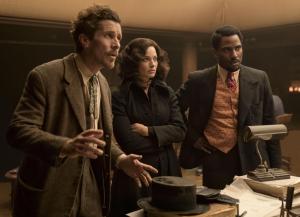
In 1933 New York, Burt Berendsen (Bale) is a WW1 veteran making ends meet as a doctor who specializes in veteran care. He and his best friend Harold Woodman (John David Washington) are framed for a murder and on the run, and the only way to clear their good names is to uncover a conspiracy that leads to a possible government coup. Helping the fellas out is Valerie Voze (Margot Robbie), a nurse who makes art from the shrapnel she recovers from inside war vets, and a wealthy socialite who also happens to be in love with Harold. Together, the three friends bumble their way through danger and mystery and crazy mishaps.
This is a mess of a movie, a waste of its top talent, and an excess of Russell’s excesses. The director has established a certain style since 2012’s Silver Linings Playbook, a movie I still to this day genuinely love (it was my top movie for that year). It’s a style that communicates mania, a nervous energy, and it made sense for Silver Linings Playbook as the movie was following a bipolar protagonist given to uncompromising bouts of mania. It makes less sense with each additional movie, but this improv-heavy, experimental, loose sensibility has become the default style for the director, and it feels misapplied. It leads to Russell bombarding his actors with questions or different requests in the moment, keeping them guessing, and actors have gone forward saying they never knew what they were shooting on the day and the shooting never stopped. This indulgence leads to stories that feel like a lot of elements are sloppily thrown together with the undying hope that somehow it will all come together in the end. With Amsterdam, it doesn’t.

It’s not a great sign when I can say that the entire first hour could be jettisoned. There’s little sense of urgency for far too long, and what is presented feels almost comically unrelated, like even Russell can’t believe his silly characters are in real danger. The uneven pacing creates many dead spaces that feel like an awkward improv detour that you wish could have been avoided. We’re introduced to Bert as a drug addict, and then as a World War One veteran helping other veterans with facial scars and wounds, Bert’s relationship with his pal Harold, then their history in France during the war, then their introduction to Valerie and their kinship, then we have a mysterious death that also leads to a secondary love interest, which requires more setting up of the first love interest and her disapproving family, and then we get police investigating and warning about the first death and then a second murder, this time blamed on our characters, and they’re off to clear their names by… reuniting with Valerie and then bumbling through more characters before, finally the movie presents what it’s actually about well after a full hour-to-80 minutes of movie. It is exhausting and feels like a meandering alternative story that was clumsily grafted onto the Business Plot of 1933. The first half of the movie feels like a slipshod screwball comedy, and then once the particulars of a fascist conspiracy to overthrow the president are introduced, it’s like watching Looney Tunes characters try and foil Adolf Hitler. It just does not tonally work.
The Business Plot is a lesser known event in history, glossed over by the fact that the chief perpetrators more or less got away with their insurrectionist planning. They never did succeed in overthrowing FDR and installing their puppet, but they also did not get prosecuted in the end and most of the media dismissed the scheme as hogwash. It’s undetermined how advanced this plot eventually got but a coup was discussed by a consortium of business leaders. It feels like Russell is applying what he learned from 2013’s American Hustle, which introduced a crazy group of fictional criminals and then, in its last hour, explored the real Abscam criminal sting of the 1980s. I can see themes that Russell thinks are still prescient today, like a dark element desiring to overthrow the U.S. government because it didn’t get its way, as well as the collusion of big business in political king-making, seeking shells that will do what their benefactors demand. The problem is the themes behind this scheme are too serious for Russell’s trifling antics. Think about retelling the insurrection on January 6th but for the first hour it’s two bumbling bank robbers who keep finding themselves in the worst possible situations, ending at the U.S. Capitol. If you’re going to treat the rise of fascism, assisted by corporate overlords, as a serious threat, and something relevant for today, then maybe don’t have most of the movie be wacky nonsense.
Russell’s past films have often glided on energy and in-character authenticity, but this one feels so grasping and desperate. When the master plan to reveal the conspiracy and its shadowy participants is throwing together a big veteran’s show, I was reminded of the movies of young Mickey Rooney and Judy Garland where the solution to any dilemma was to put on a show. Then at one point the literal Nazis are singing loudly in German and are being confronted by our characters and the good patriotic Americans counter by singing “America (My Country ‘Tis of Thee)” and I had to stop the movie and just let out a deep sigh. I think Russell was going for the famous reference in Casablanca, also against Nazis, but it just flounders into unintentional comedy, accentuated by the antsy energy that treats it like camp. There are a couple of spots that I laughed out loud, though I doubt that was the intended response, like watching Taylor Swift abruptly run over by a car. The attempts at actual humor are winding and often lead to little, and the characters feel like more of a collection of quirks than firmly established personalities and perspectives to anchor a movie. What does Bert having a false eye add besides something for Bale to fidget with? What does Chris Rock have to do here? What does Anya Taylor-Joy have to do here? Most egregiously, what does John David Washington have to do here? It feels like Russell just wanted a character for Bert to talk to. The screenplay is overstuffed and polluted with all these minor and underwritten characters that could have been better consolidated.

I suppose you can still have fun with Amsterdam and engage with it on a light-hearted level, smiling as you watch the many big stars having a good time messing around with accents, props, and wacky character traits and tics, like a bunch of kids with a dresser of costumes (maybe it is a throwback to those corny Rooney/Garland kids pictures after all). With other Russell movies, I’ve felt invigorated by the energy and artistry, encouraged to sit a little closer and be more attentive of the character turns, and dig into the actors making three-course meals of their roles. With Amsterdam, I felt the desperation to recreate the success of old patterns but the creeping realization that it wasn’t going to materialize. It’s just a big mess of a movie, not without interesting ideas or moments or good acting, but too much feels resoundingly and frustratingly frivolous. You could ditch entire characters, entire subplots, even entire hours of this movie. Amsterdam cost Disney/Fox $80 million dollars, the biggest of Russell’s career, and only earned a pittance, so I think there is a retraction in due order. Begin with not watching Amsterdam yourself.
Nate’s Grade: C
Share this:

Emancipation (2022)
 There is a question with every new movie depicting the Holocaust or slavery or some other horror of the past, why do we need this still? It’s a suitable question but one that rests upon the fleeting assumption of history being settled upon. “We all agree slavery was bad,” some opponent might say, “So why do we need another movie to convince us what we already know?” One need only look at the last couple years and the diverging controversies over teachers covering the ills of America’s past with clarity, and it’s clear that the idea of settled-upon history is an illusion. There will be people arguing slavery wasn’t as bad as history has perpetuated, that even the Irish experienced something similar as indentured servants (but they were still legally viewed as people). Some will erroneously argue that slaves were there by choice, or that their masters weren’t all cruel, and that even by having a roof over their head and the bare minimum for sustenance that they were “looked after.” There are battles happening all over the country, with one side trying to present the evils of slavery in an unvarnished manner and the other trying to obfuscate, mitigate, or distract from the facts because accepting a reality that your country has made mistakes somehow means being unpatriotic or loving your country considerably less. So to answer the question, as long as we have others denying history for political expediency, then yes, we need more media to remind us that the horrors of the past were indeed horrific. With that in mind, Emancipation is meant to be a rousing spectacle about one man’s incredible fight for freedom, but what it really comes across is a fumbling awards movie as awkward action movie.
Peter (Will Smith), or known as Gordon, is separated from his family and forced to work on the Confederate railroad in 1863 Louisiana. He hears about President Lincoln’s Emancipation Proclamation freeing the slaves and believes if he can just get to a Union camp, then he can return to his family. Peter fights back and escapes into the swamps and heads for Baton Rouge, a five-day journey. On his trail is the dangerous slave catcher Jim Fassell (Ben Foster), who will stop at nothing to secure Perter and prove his racial superiority to his fugitive.
 There are two competing impulses running through Emancipation that never seem to coalesce, always pulling the movie in opposite directions or at least undercutting its value in entertainment or substance. On the surface, Emancipation looks like an awards-ready spotlight. It’s got Will Smith playing a real-life historical figure who suffered greatly but triumphed in the end, a man whose image lives on in our history books (well, depending upon your state) and contributed to the abolitionist movement. He was a real person who made a real difference during a tumultuous time. I get a strong sense that Smith was following the 2015 template of Leonardo DiCaprio’s The Revenant for this project, and especially the Academy-friendly model of physical torment equaling Oscar gold as it did for Leo. It’s hard not to feel like the movie was formulated as an awards gamble, that sizing up all the elements, Smith saw a fast track back to the Oscars (this was in production before Smith did win his first acting Oscar for 2021’s King Richard). Naturally, Smith isn’t the first person to select Oscar-friendly roles for the purpose of earning some serious acting trophies. Nor should he be inordinately penalized for that ambition. All that matters is the end result, and it’s there where Emancipation struggles with its own identity crisis and where its transparency becomes a hindrance.
This movie wants to be a substantive drama that can enlighten us about the perseverance of the human spirit, and for the first thirty minutes Emancipation feels honed from the likes of 12 Years a Slave. Then at the Act One break, Peter and several other slaves break free, and from there the story becomes a tense chase movie for an hour, only to conclude its final half hour as a war movie akin to Glory. It’s a tonal balancing act that doesn’t quite work. I was interested in the first 30 minutes, which establishes the brutality of slavery in a way that feels empathetic but tasteful. It’s a question whether or not historical horrors should be watered down, made palpable to a wider audience, and if in doing so dilutes the power of history, but that’s another debate. When the movie becomes an elongated chase sequence is where my patience began to wane. This is where director Antoine Fuqua really seems to settle in, playing into his background of action movies (Training Day, The Equalizer, Olympus Has Fallen, The Magnificent Seven). Fuqua’s instincts are for action movies, and that’s what Emancipation becomes, but it so clearly wants to also be Something More and doesn’t quite accumulate into that. The Revenant stretch is reliant upon episodic survival and the final half hour is about a war charge. I suppose one can be generous and say that Peter’s canny survival skills are overt characterization, or that the environmental threats are representative of a larger hostile world, but the action movie parts were pretty to look at but also emotionally inert for me.
 I considered the lead character in 12 Years a Slave to be the least interesting person in his own story, but the movie found plenty of space for more immediately compelling figures. Not so with Emancipation, as once Peter goes on the run, it feels like overall characterization is put on hold. Smith is perfectly reasonable as a determined and dehumanized individual pushing back against the monstrosity of slavery, restricting much of his performance to the physical realm. The sheer intensity of his eyes can convey plenty that the script characterization lacks. Smith lowers his voice modulation, adopts an inconsistent Haitian accent, and gives a rather subdued performance given the sensational material. I think it’s because the film is geared more as an action movie rather than as an in-depth character study, so when we’re left with the characters, their limitations emerge.
This paucity also extends to the supporting characters. At first I thought that Charmaine Bingwa (The Good Fight) was going to be relegated as the suffering wife for our protagonist to get home, but then the movie keeps cutting back to her like she’s having prophetic dreams. What is happening here? The check-ins with Peter’s wife all deliver the same obvious information, namely his family misses him. This woman doesn’t even get a storyline of her own in the meantime, a conflict to overcome to keep her family out of further harm in the absence of Peter. The biggest supporting character is the villain, and even he is boring. Foster made a name for himself playing psychopaths in late 2000s cinema and has matured with more nuanced roles in The Messenger, Hell or High Water, and Leave No Trace. He’s one of our best actors, and yet he’s given so little here. His slave catcher gets a monologue that’s meant to provide insight into his admiration for the intelligence of black people. I kept waiting for something more with this guy to define him beyond a stock racist. I guess maybe the movie is saying he’s not as racist because he begrudgingly concedes that slaves aren’t stupid, but he’s still massacring them, so it feels like a minimal distinction of character. He also gets defeated in such an anticlimactic manner. If he’s only a stock villain, at least give us the thrill of defeating him.
 The cinematography by Robert Richardson (Once Upon a Time… in Hollywood) is at once gorgeous and also confounding. The emphasis is on deep focus, so you can see lots of rich details in elegantly framed compositions. There are sweeping camera movements, especially during the war-torn finale worthy of Matthew Brady, that are breath-taking, again calling attention to its handsomely mounted pedigree. However, the color palette has taken notes from Zack Snyder and drained away all color to the degree of looking monochromatic. Repeatedly throughout the movie, I would comment to myself about how beautifully filmed a scene was… and then complain about how the dour color grading sucked the life out of it.
Emancipation is a genre movie that envisions itself as a high-minded Oscar contender, and when it attempts to be something more than a crisp-looking chase movie, that’s where it exposes itself as lacking the substance it so desires. The life of Peter, or Gordon, is meaningful, the person behind the famous photo of the scarred back that made the cruelty of slavery a vivid picture. The experiences of every person who endured the hell of slavery is an indictment worthy of being told, but the personal story becomes grounded down into familiar B-movie pap. If the production was content to be a thrilling B-movie, that would be one thing, but it’s clearly engineered to be Something More, which is usually adjacent to Something Important. I think following The Revenant as a model was a mistake, and I think giving the reins to Fuqua was a mistake, and I definitely think the limited characterization and color palette was a mistake. Emancipation is a strange movie to watch. It’s about the horrors of slavery, and it’s also at the same time about a man wrestling a gator in the swamp. Emancipation is a movie that wants to pretend to be something it’s not but also won’t fully trust its deeper instincts and impulses.
Nate’s Grade: C+
Share this:

Bones and All (2022)
 What do you get when you team up Oscar-nominated director Luca Guadagnino, twee handsome man Timothee Chalamet, and the ravenous consumption of human flesh? You get the new indie drama Bones and All, a literal love story between cannibals. It’s boy-meets-girl-meets-dinner.
It’s 1980s Reagan America, and Maren (Taylor Sheridan) is in high school and not allowed out to parties for a good reason. Her father (Andre Holland) nails her bedroom window shut, and we soon realize why when, at a slumber party, Maren eats one of her friend’s fingers. It’s back on the run except Maren’s father has finally had enough. He leaves her behind one morning with a tape recorder to explain. Maren travels to the Midwest and discovers other Eaters, those afflicted with her same impulses. One of them is the young man Lee (Chalamet), who Maren decides to follow. They can look out for one another, but what’s to be done when the hunger strikes, and how far will they go to feed?
 Bones and All is a doomed Romeo and Juliet romance with its own provocative subversion. I was hooked for the first half of the movie, as the script slowly revealed that these cannibals are born this way and their compulsion may also give them super powers, like the ability to smell their own kind as well as key characteristics, like a last feeding or even when a person may be close to death. The movie plays along the fringes of a monster or superhero formula, where we have people with extraordinary abilities, or a curse they must keep hidden depending upon your perspective, and how this challenges their vulnerability and sense of self. It’s reminiscent of vampirism, the need to feed, so we’ve seen aspects of this kind of story dozens and dozens of times, but the world and rules can still be engrossing to learn. Maren and Lee trade stories of their “first time,” though in this context it’s the first time they fed on human flesh, and it so happens both are with a traumatized babysitter. It’s a morbid bonding experience but such is partnering with a person who shares your unorthodox appetites. I was getting shades of Bonnie and Clyde, with our cross-country duo keeping on the run, and also Let the Right One In, where a man is reluctantly killing in order to feed and protect his ward. There’s also the 2017 French film Raw with a young woman discovering her family trait of cannibalism. The source material of Bones and All is a 2016 YA novel by Camille DeAngelis and the script feels very much like the total of its many pop-cultural and literary influences.
There’s still something compelling here about two oddballs finding a person who understand their unique situation. The addiction analogy is apt and provides an interesting discovery, as both Maren and Lee inherited their eating habits from a parent similarly affected. Maren’s search for her biological mother is a solid direction as it also promises a search for answers. Russell (Netflix’s Lost in Space, Escape Room) is an understated but captivating lead. Her character has never been out on her own and doesn’t know much about a larger world of Eaters, so every encounter is her stretching her boundaries and discovering what she is capable of. She also needs to learn how to better live with her impulses, or whether she even can, and being paired with a more experienced companion allows her to explore those feelings with better understanding. Chalamet (Dune) is part scraggly drifter, part twink prostitute, part deceitful vampire, and part sensitive boyfriend. In other words, he fits right in as a brooding Byronic love interest that Maren questions how close she can allow herself to be in his presence. The us-against-the-world sensibility of young and/or forbidden love is amplified with the extra genre trappings. In many ways, Bones and All feels like a strange amalgamation of Guadagnino’s last two movies, the 2018 gory remake of Suspiria and the 2017 tender gay romance, Call Me By Your Name.
 Where the movie starts to lag is its second half, which is built upon two conflicts that feel inadequately developed. The first, and biggest, is the relationship between Maren and Lee. It’s natural for Maren to be wary of Lee early on, especially with how much is at stake if either one of them. There’s also the danger of being alone with a cannibal, much like befriending a wild animal and always having to keep one eye open. It becomes a guessing game of trust and compulsion, can either control their urges? However, the romantic coupling between Maren and Lee felt very distant, as if the movie intended for them to be these star-crossed lovers and instead both of them looked at each other and shrugged and settled on being friends. It’s not that there isn’t really any heat or chemistry there. I can ignore that when both members are struggling to control how much of themselves they offer to the other. It’s a relationship built upon mutual survival and the occasional make out, but the difference between the two of them is at once emphatically stated and then casually ignored. The big hiccup for a Maren/Lee relationship seems to be that Lee will kill people in order to feed and Maren disagrees with this. You would think over the course of their time together the movie would follow one of two directions: 1) Lee’s willingness to kill for food becomes more extreme and Maren is pushed away, or 2) Maren begins to share in Lee’s willingness to kill and changes her moral outlook. Neither of these really happen, so when Maren considers leaving Lee’s company, I was left wondering what changed. He’s presented as dangerous, but he doesn’t become more unhinged, and there isn’t a point of no return for their relationship. I didn’t feel much when this union was arbitrarily was put on pause.
The other conflict is an external one and a nag. I thought there would be more attention about Lee and Maren having to hide from encroaching law enforcement. Instead, it’s another Eater who becomes a stalker, and this character would have been best served as a one-sequence passing weirdo. The reappearances feel contrived and poorly integrated once the fledgling Lee/Maren relationship takes center stage. There isn’t enough to the character to deliver with multiple appearances. The fact that this character plays such a big role in the second half is a letdown. If Lee and Maren were worried about people coming after them, why not the police tracking them for the murders they leave behind? Why not even a gang of Eaters that have decided there is even more security in number and have no compunctions over eating their own kind? That topic isn’t even explored, whether eating an Eater would be even more compelling. You could even have someone deem themselves a Super Eater who seeks out other Eaters to consume, either because he or she feels they are an even more exquisite taste/addiction, or because they have a self-righteous sense of purpose and feel eliminating other Eaters will protect the innocent they feed upon. It’s not even expressed whether they have to eat living people or if old corpses could suffice. There are different external threats that could have been better developed and integrated, so it’s a shame that the one we have is given so much more attention than deserved.
 With every movie, it’s important to judge what you’re presented rather than what could have been; it would be unfair judging a hamburger at a restaurant for not being a pizza. Still, I felt like the more compelling perspective to tell this cannibal love story was a parent protecting a child rather than as disaffected teenagers. I thought following Maren’s father from raising her and realizing she had a problem but ignoring it until he couldn’t, and then his challenges to reign in her impulses, would be the more compelling and dramatically charged point of view. It doubles down on the theme of what a parent would do for their child, as well as the personal fear of every parent whether they are capably raising the child to be a moral and self-sufficient adult. Then you mix in the possibility of the genetic lineage for cannibalism, and you can have the parent trying to pass down their knowledge to their progeny or the parent feeling immense guilt for bringing this would-be innocent into a situation that may spell their doom. Every time the narrative went back to Maren listening to her father’s audio narration, I felt like I was getting a bigger picture of the weight of the years of raising Maren. I suppose that also might lean a little heavily into a similar Let the Right One In dynamic. I understand that Bones and All is an adaptation of a YA novel and young outsider lovers is par for the course with the genre, so I wouldn’t expect such a radical adaptation even if it feels like a superior story perspective for drama.
Even as things didn’t fully come together for me, I was always interested in Bones and All for its two-hour duration. It’s not every day that genuine artists are putting their all into a love story that also involves chewing the nipple off a dying man. It didn’t really work as a romance for me because I didn’t really feel invested in the coupling of our main characters. There is so much more intriguing dramatic potential here with these story particulars that I can’t help but feel slightly disappointed by the end results hewing very closely to YA staples. More could have been explored in the romance, especially what nourished the attraction and what would compel Maren to rethink her feelings. As a gauzy, young lovers-against-the-world drama, it has its melancholic pleasures and diversions, one of which is that it was filmed primarily in southern Ohio. It was also filmed in Columbus, so I got to point to the screen and say, “Hey, I recognize that Greyhound bus station” (that was the extent of the Columbus filming, one five-second external cutaway). Bones and All can surprise plenty of viewers, and I’m positive many will be swooning from its mixture of romance and depravity, but the bigger surprise for me was that it left me ultimately hungry for more of everything.
Nate’s Grade: B-


 nathanzoebl
You must be logged in to post a comment.