Daily Archives: May 15, 2016
Money Monster (2016)
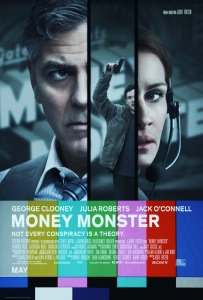 Jodie Foster hasn’t acted in a movie since 2013’s Elysium, and if you saw that movie you might have some sense why she’s taking time away. As a director, she has few film credits to her name, which makes each new Foster directing effort raise the question, “Why this one?” I would assume her last effort, 2011’s The Beaver, was her desire to work again with her Maverick co-star Mel Gibson and perhaps give him a career boost. Money Monster is a would-be hostage thriller with a socially conscience message about the greed and recklessness of Wall Street; however, the Bernie Sanders faithful, let alone anyone mildly educated on the excesses of Wall Street, will find this movie surely lacking, as will anyone looking for a competent and engaging thriller.
Lee Gates (George Clooney) is the host of Money Monster, a financial entertainment show where he provides stock tips to his loyal viewers. One day and angry man, Kyle Budwell (Jack O’Connell), wanders onto the set brandishing a gun. He demands Lee strap on a bomb vest. Kyle lost his life savings on a bad stock tip and he demands justice. Lee agrees to hear the guy out and get to the bottom of why this stock dramatically fell of a cliff, which leads him to suspect internal manipulation from the CEO (Dominic West). Lee’s director Patty (Julia Roberts) stays put through the duress and remains the voice in his ear, coaching him to safety and running research to discover the truth.
 While I was watching Money Monster I had to remind myself that this wannabe message movie existed in our reality, because the brunt of its ire against Wall Street criminal shenanigans is targeted specifically against one bad trader instead of the system. It’s like this movie exists before the 2008 financial meltdown, before the Oscar-winning movies Inside Job and The Big Short, but it doesn’t. It’s borderline insulting that the screenplay myopically focuses all of its attention on one bad actor and lets the rest of the Wall Street elite escape blameless for criminal misdeeds. The bulk of the movie after Kyle begins his hostage standoff is tracking down this bad trader and digging through archives to pin the blame for a stock fall on this guy, all the while keeping him away from the news so he doesn’t get suspicious. It’s a ludicrous turn of events that manages to take a big picture story with relevancy and find the smallest, most insignificant way to tell its tiny story. The condemnation should be for the system and not one guy, and not one character breaks from this preposterous thinking. It feels like they exist in a different time and place. If you didn’t know anything about Wall Street before this movie you would still be left clueless. Is there supposed to be a happy ending when they bring this guy to justice? The movie sets up an ending that doesn’t exactly feel like anyone learned a lesson or even that the villain was properly punished (oh no, he suffers the scorn of Internet memes!). The final line is so glib and self-satisfied that I groaned. By the end of Money Monster I was wondering what any character had learned from the experience except, maybe, to have better locks on the studio doors.
The other debilitating problem is that Money Monster is a movie that cannot find a character for you to care about. The setup should be so obvious and elicit audience sympathy and a natural underdog to root for against a corrupt system. Instead Kyle is a moron. First off he invests all of his money into one single stock based upon one tip from Lee’s TV show. That’s a pretty big risk. Next he takes hostages and makes demands, and yet none of those demands are for the return of his money but rather a simple apology. There’s also the fact that he’s more a ranting and raving angry lunatic than somebody who has targeted ire against the body of Wall Street, making for a pretty uninteresting hostage scenario. You also have to factor in that there will be no good outcome for Kyle, and so he’ll be leaving his girlfriend and unborn child left to fend for themselves after he blew away all their money on a bad gamble. This is not a sympathetic character nor is he rendered in a fashion to make him that interesting. He’s an angry and impulsive man whose actions are almost always about himself and his sense of being wronged. The other two primary characters, Lee and Patty, are completely absent personalities beyond staying cool under pressure. If you put a gun to my head I would not be able to tell you anything about either of those characters as people. Lee doesn’t seem to go through any sort of introspection over his own culpability with his TV show, and Patty is so laser focused on the problem at hand that we know nothing about her other than her capability. Spending 90 minutes with this trio of lackluster characters is a waste of 90 minutes.
 Despite the brisk pacing, I was bored mercilessly with Money Monster. I just didn’t care and Foster and company gave me no reason to care. The pacing made it hard to develop these characters; they felt like chess pieces being randomly assembled across a board, moved when the plot required it, and inert without these manipulations. When the movie goes outside is another example of nothing feelings believable. The will-he-be-shot suspense sequences are hackneyed and dumb. There are a couple of moments of solid comic relief at the expense of character egos, with Emily Meade (That Awkward Moment) serving as the highlight of an otherwise monstrously mediocre movie. Here is a list of other actors that are wasted in do-nothing parts: Caitriona Balfe (TV’s Outlander), Giancarlo Esposito (TV’s Breaking Bad), Christopher Denham (Argo), Lenny Venito (TV’s The Sopranos), and Chris Bauer (TV’s True Blood).
Money Monster is a disappointment in just about every stripe, from its perfunctory performances from it’s a-level movie stars, to the development of its characters, from its suspense sequences, and especially from its frustrating and laughably short-sighted vilification of Wall Street misdeeds on one culprit. It’s like this movie was pulled from a time capsule from the 1990s. Foster’s direction is perfectly acceptable though indistinct from any other journeyman. I cannot say what attracted her to this project as a director except for the opportunity to work with Clooney and Roberts. Otherwise, Money Monster is a thriller that keeps butting heads against reality, reminding the audience at every turn of its airless artificiality and stark superficiality.
Nate’s Grade: C


 nathanzoebl
You must be logged in to post a comment.