Daily Archives: April 29, 2011
Super (2011)
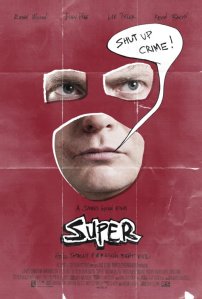 Super is a different kind of superhero movie. Writer/director James Gunn (Slither) has crafted a story that attempts to deconstruct the superhero fantasy. In his story, the people that put on the costumes to fight crime are just as dangerous as the criminals.
Frank (Rainn Wilson) has two memories he can hold onto as his life’s highlights: marrying Sarah (Liv Tyler), a former drug addict, and assisting the police in finding a crook. He works as a short order cook and dreams of being something more. Then local crime lord Jacques (Kevin Bacon) comes into Frank’s home, eats his eggs, compliments him on his cooking of said eggs, and then walks off with Sarah. He’s been gotten her hooked back on drugs. Frank tries to rescue her but Jacques and his goons (Michael Rooker, Sean Gunn) won’t let him get anywhere close to his wife. Then Frank becomes inspired. He feels that God has spoken to him and instructed him to become a crime-fighting super hero, the Crimson Bolt. With a wrench, Frank patrols his streets looking for crime to vanquish and a way to thwart Jacques. Along the way he gets help from Libby (Ellen Page), a 22-year-old girl who works in a comic book store. She jumps at the chance to live out her super hero fantasies and elects herself to be Frank’s sidekick, Boltie. Together they plot to clean up their city and maybe enjoy some of the perks of superhero-dom.
 Super mines familiar territory scene in other movies, the what-if scenario of what might transpire if people put on some tights and attempted to fight crime. Unlike last year’s similarly themed Kick-Ass, this is a movie that refrains from overt style. It does not portray Frank as a hero in any traditional sense. Gunn takes great pains to showcase the frayed mental state of his main character. Frank is troubled, seriously troubled. His attempts to escape his reality are borderline dangerous and his violent attacks are without warrant. I watched this movie shortly after seeing the suitable violent Hobo with a Shotgun (good pairing, folks), and the tone of the violence between the two films was starkly different. Hobo‘s violence is meant to make you laugh; Super is meant to make you wince, then laugh in a “Oh my God” kind of alarm. In Super, the extreme bouts of violence, which are not as prevalent as in Hobo, are meant to make you think how stunningly dangerous Frank and Libby are. When somebody cuts in line at a movie theater, the rest of the people react in disgruntled anger. But Frank goes into his car, changes his clothes, comes back as the Crimson Bolt and declares, “You don’t cut in line,” and strikes the guilty party across the face with his trusted wrench. The crowd is freaked out, naturally. These revenge fantasies are taken to the limits, and Frank has decided that everyone deserves the same punishment for breaking the rules of society whether they be a drug dealer or a line jumper (“You don’t butt in line! You don’t steal! You don’t molest little children! You don’t deal drugs! The rules haven’t changed!”). Frank follows in the same vein of disturbed social justice as Travis Bickle.
The characters are played straight, which only highlights their demented oddball qualities even more. Wilson is a strong comedic actor as he showcases week after week on TVs The Office. He’s always had something of a unique “off” quality to him, be it presence or looks or demeanor. It allows him to slip into cracked characters so easily. Frank is a troubled individual, but there’s something sympathetic about his plight to finally assert himself in the world and stand up to forces that he feels have victimized him. He’s a sad guy, lonely, deeply insecure, feels impotent to the world, and yet he can put on a costume and work out his varied psychological issues. Wilson can be terrifying, deadpanned hilarious, and even potentially touching as he desperately seeks a life filled with moments he can be proud of.
 But it’s the little firecracker that is Page (Juno, Inception) that makes Super come alive with risk. Page’s performance is bristling with uncontrollable energy; she practically shakes with excitement over becoming a superhero sidekick and leaving her boring reality. Then, when they actually do kill bad guys, she jumps around, taunting at the top of her voice, chuckling at a level of violence that should be disquieting to most normal human beings. That’s because Page, in particular, has tapped into her character’s manic wish-fulfillment role-playing persona. What would faze people makes me laugh and hop around in impish joy, because she is laying out her idea of justice. And Page is joyous to watch. She’s so excited onscreen that her words practically trip over themselves. And then there’s the superhero sexual angle. This is the first movie, by far, where I ever viewed the elfin actress in a sexual manner. And with Gunn’s film being what it is, prepare for some strange discomfort. Libby tries to seduce her superhero partner into being a partner of a different sort, and she leaves the sidekick suit on.
The tone is meant to make you squirm and laugh under your breath through gritted teeth. Seeing Frank legitimately hurt people can be funny in a bleak sense, and the delusions of the main characters and their inept execution as superheroes certainly adds plenty of chuckles. When Frank tells his newest sidekick that they’re going to fight crime, she’s bouncing off the walls in happiness. That is until she discovers “fighting crime” means sitting in an alley and just waiting for crime to materialize. “This is so boring,” she groans. Frank’s oft-repeated catch phrase of empowerment, while swinging his wrench of justice, is: “Shut up, crime!” But then he later starts to reconsider his place in the order of society, reflecting upon his brute force actions and whether he too has become a criminal in the pursuit of battling evil (“How can I tell crime to shut up if I have to shut up?”). The side stories involving the evangelical TV superhero The Holy Avenger (Nathan Fillion) are a hoot. They’re even funnier when you consider that Frank uses these outlandish bits of corny Christian message-delivery as confirmation from God. For those looking for some Kick-Ass kicks, they will be sorely disappointed until the violent confrontation between good (Frank and Libby?) vs. evil (Jacques and his minions).
 Super isn’t so much of a superhero parody as a morally queasy, crazy, discomforting comedy of the darkest sort. Gunn’s film shows that people with unchecked superhero fantasies can be just as dangerous as the criminals they seek to penalize. Gunn de-romanticizes the concept of vigilantism. Wilson and Page make a fun pair of superheroes with a few screws loose themselves. This is a different kind of superhero movie, the type that shows how dangerous and ridiculous and insane the fantasy can be in a real world where the bad guys have guns and a short fuse. Gunn’s Troma-fied super story has plenty of dark laughs, uncomfortable moments, and nutball characters. I don’t even fully know what to think about the film. Do I really like this? Am I supposed to? Is this all entertaining or just uncomfortable? Is it an entertaining form of discomfort? Does the ending, which aims for emotion, work, or has the film burned too many bridges and fried too many nerves to attempt something tonally different? Super probably won’t win any new converts to the genre, and I imagine its bleak laughs will push many away, but the film also has a car-crash watchability. I do not mean that in a backhanded way. Super keeps you watching but you don’t know if you want to.
Nate’s Grade: B


 nathanzoebl
You must be logged in to post a comment.