Daily Archives: November 18, 2010
The Girl Who Kicked the Hornet’s Nest (2010)
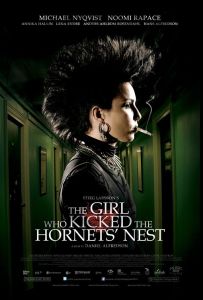 The worldwide publishing phenomenon comes to a close with the third and final film, The Girl Who Kicked the Hornet’s Nest. In the span of nine months, all three Swedish films, based on the late Stieg Larsson’s best-selling books, have been released stateside. Hollywood is already filming the first of three remakes directed by David Fincher (Fight Club), with Fincher’s Social Network star Rooney Mara in Lisbeth’s chunky shoes. Releasing three films in one year, mere months apart, has given the series the feeling of an event. The Girl Who Played with Fire left a lot to tie up, but audiences steeped in the Larsson’s sordid particulars should find something rewarding, albeit unspectacular, in this final chapter.
The third film picks up immediately after events from the previous story. Lisbeth Salander (Noomi Rapace), punky computer hacker and international badass, is being airlifted to a hospital. She is recovering from a brawl with her father that left her with a bullet in her skull and him with an axe lodged in his (surprisingly, both live. Credit Swedish healthcare). Her father, Zalachenko (Georgi Staykov), was a Soviet spy that defected to Sweden in the 1970s. He is a high-value informant, which means that anyone who would compromise or expose Zalachenko needs to be dealt with. And if Zalachenko is going to speak his mind, perhaps he needs to be silenced as well. Mikael Blomkvist (Michael Nyqvist), muckraking journalist and Lisbeth’s staunch ally, is trying to protect his friend and one-time lover by exposing the corrupt and powerful. Lisbeth is trying to be silenced, and if assassins don’t work then the state will try her for attempted murder and lock her away in a mental institution, the same institution that Lisbeth was committed to at 12 when she tried to save her mother by setting her abusive father ablaze. The sinister Dr. Teleborian (Anders Ahlbom) admitted Lisbeth when she was a child and is eager to have her back in his clutches. He and the other crooked government officials will stop at nothing to put her away and stop Mikael from publishing the truth.
 So at the axe-swingin’ conclusion of Girl Who Played with Fire, I felt that some of my conclusion had to be put on hold until I could see the third film, the conclusion to what seemed like one larger film. For Fire I wrote: “As such, it’s hard to fully analyze certain storylines at play. I imagine that the sex trafficking storyline will carry on with the third film because of the tease that high-profile figures in government and police offices were involved. It already establishes a conflict and a set of antagonists ready for the third film. Then again, I may be too hopeful and the storylines of interest in Part Two may be completely dropped or mishandled by Part Three (see: Matrix sequels, Pirates of the Caribbean sequels).” Guess what happened? Dropped storylines abound as well as a lack of follow-through on most everything but the major storylines involving Lisbeth’s tortured personal history.
Now that we can all witness how Lisbeth and Mikael have walked off into that Swedish sunset, I can finally and conclusively say that the second film is incomplete and will never be complete. The loose ends abound and characters are completely forgotten, like Lisbeth’s Asian friend/sometime-lover and her boxing pal who took a beating. Apparently their narrative purpose was to take Lisbeth’s licks (could this be the greatest double entendre in the history of film criticism? Yes). The brute that dished out those bruises is a blonde baddie named Neidermann who looks like he was ripped from a bad James Bond flick. He is a straggling loose end that circles the narrative like a lost child in a supermarket (“Are you my mother?”). The high-reaching sex trafficking ring featured in Fire has a tenuous connection to Hornet’s Nest; in Fire we talk about an Evil Shadowy Government and in Hornet’s Nest we see the faces of that Evil Shadowy Government Agents.
If the first film was a slow-burning and lurid thriller, the second film a preposterous action film, then the third film falls clearly into the genre of legal thriller. The majority of the plot revolves around the People vs. Lisbeth Salander. The sluggish opening gives way to a sluggish series of pre-trial preparations. Mikael assigns his sister to serve as Lisbeth’s attorney, and thus we see the behind-the-scenes arrangements as far as gathering evidence, building a case, plotting arguments and counter-arguments, preparing Lisbeth to confront the men who have caused her such suffering and anguish. And being a courtroom thriller, we also get a heavy dose of new characters, almost all of them elderly and somewhat menacing (a guy with cancer even becomes a hired gun for One Last Job). There are a lot of liver-spotted faces to try and sort through, so it helps when the filmmakers add touches to set them apart (one of them wears a bow tie, another has glasses). Given the lethargic nature of assembling a court case, the pacing can get pretty slack. Then there’s the issue of Lisbeth. She spends almost the entire movie in police custody and the first hour or so confined to a hospital bed. It doesn’t make for pulse-pounding stuff. Lisbeth is a willful, defiant, quick-witted creature so it feels like she’s like a caged bird in this third and final film.
 Rapace is starting to catch serious Hollywood heat and deservedly so because once again she commands the screen. At first when the series began I was unsure of her acting abilities considering her mysterious character is forced to respond through a prism of emotional reserve. She doesn’t speak much but her intense, cold stares speak volumes to the turmoil she has bubbling under the surface. Restrained to a hospital bed or a jail cell, Rapace is given even less to work with. The part is nearly mute for long stretches of plot. Yet Rapace finds new and interesting ways to channel her character’s intensity and allow the audience to view her thought process. It’s a sign of a talented actor when a character’s internal thinking can become transparent without the need for hyperactive expressions. Lisbeth Salander is a complicated character and the audience deserves to have such an intriguing presence fleshed out into three dimensions. I wrote about the disappointing downgrade of Lisbeth’s character in Fire: “We project the interest we felt for her from the first film to the Salander stand-in represented in the second film. She’s still a resourceful, loyal, and cavalier presence, but the plot corners her into being a creature of action. She becomes the fantasy bisexual ass-kicking protagonist that was merely hinted at previously. That sounds like a good thing, but trust me, it does the audience a disservice to box in such a fascinating character.” With Hornet’s Nest, we discover the extent of how men have damaged her, which focuses more attention on the person of Lisbeth rather than the Gothic aesthetics. It’s a return to form even if Lisbeth is still remote.
Luckily, The Girl Who Kicked the Hornet’s Nest does manage to offer a satisfying sense of closure. The series has several bad men doing bad things, so it’s rewarding that after sitting through close to seven hours of material yields some long-awaited justice for Lisbeth Salander. We yearn desperately for this pint-sized gal to get her vengeance and for the powerful to find their comeuppance. Watching the antagonists fall would be more fulfilling if they weren’t only introduced a mere hour ago in this movie. Salander doesn’t get to put on her Gothic war paint until her first court appearance. It feels like a triumphant return, complete with a towering and imposing mohawk. Blomkvist’s storylines will always be the movie’s weak point considering he has to compete with the likes of the audacious Salander. In Hornet’s Nest, his magazine team is threatened but you never really take any of it seriously, because of course the crusading journalist will stick by Lisbeth. The ending is less than desired and tries to recycle some of the same action tropes that lead Girl Who Played with Fire astray. The final scene leaves you with a sense of, “Oh, so that really is it? Better get my coat then.”
 The Girl Who Kicked the Hornet’s Nest works as a mostly fitting capper to a long-standing mystery series. The bad guys are punished, the good guys prevail, there’s an open-ended resolution that leaves you squirming for more, especially now that Lisbeth is a free woman. At a bloated 145 minutes, Hornet’s Nest can often feel like an overextended Swedish episode of Law and Order. There’s a good 45 minutes that probably could have been left on the cutting room floor. At times the movie feels like it’s lurching along, caught up in the mountain of details. But then it generally finds a way to regain momentum and head to a satisfying close. Still, it’s disappointing that for the majority of the two sequels Lisbeth and Blomkvist have rarely been onscreen together. They worked so well as a team in the original Girl with the Dragon Tattoo. I never would have thought that the sequels would take that concept and keep them apart for as long as possible. Too bad author Stieg Larsson isn’t around to write new adventures for his characters, though there are rumors about an unfinished fourth manuscript left on Larsson’s laptop. Until that gets sorted out between Larsson’s widow and his family in Swedish court, I guess the world will have to settle for the forthcoming Hollywood remakes.
Nate’s Grade: B-
Share this:

Harry Potter and the Deathly Hallows Part 1 (2010)
 When author J. K. Rowling dropped off her last 700-page tome in the Harry Potter series, the world went into a state of mourning, right after ravishing every page of The Deathly Hallows. There would be no more literary adventures. You can expect that same sense of longing for the studio suits over at Warner Brothers considering the Harry Potter franchise has grossed over five billion worldwide. The bounty was about to be over, especially with one last book to adapt into an eventual overly long movie. Then the suits came across a genius strategy: split the last book into two separate movies. Filmed simultaneously over a year, Harry Potter and the Deathly Hallows will be released in two parts eight months apart. I understand that it’s hard to say goodbye to the boy wizard that charmed millions, and tow movies almost guarantee that nothing will be left out in the adaptation process. It also ensures that Warner Brothers will have two movies that make giant piles of money instead of one. Deathly Hallows: Part One plays its part setting up the finale, but judging from what we’re given, this series conclusion could have effortlessly been condensed to one overly long film instead of two.
Picking up shortly after the events of Half-Blood Prince, Harry (Daniel Radcliffe) and his best pals, Ron (Rupert Grint) and Hermione (Emma Watson), are on the run. Lord Voldermort (Ralph Fiennes) is determined to be the one to slay the boy wizard. Voldermort and his influence have taken over many facets of the magic world’s infrastructure, and they are all after Harry. Harry learned that his snake-faced nemesis has broken his soul into pieces and hidden them inside magical items known as horcruxes. Unless these horucruxes are destroyed, Voldermort will never be able to truly die. Harry and company has to hunt down those accursed horcruxes while being hounded by evil forces determined to kill them all.
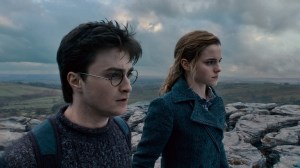 For a solid hour I felt like I was watching the second best Harry Potter film; Alfonso Cuaran’s Prisoner of Azkaban still stands as the artistic highpoint. Watching the characters on the run and constantly in peril spurs your protective feelings. We’ve seen them grow up, vanquish evil and hormones, and now they seem to be in serious danger and you feel real tension. I stopped to realize how much I actually cared for these characters and how concerned I was. There is a somber sense of finality, and I enjoyed characters and events colliding back together for one big finish. It truly feels like everything is coming to a titanic close, and the film manages to be the most emotionally satisfying of the series. That’s likely because it’s building off six films of character growth and goodwill. But it’s also due to the fact that Deathly Hallows spends the most time examining the characters of Harry, Ron, and Hermione. The series has followed a very lockstep plot formula and now it’s been stripped away. The kids are removed from the school setting so we get to spend plenty of time alone with the trio. In fact, it’s a bit too much time. We spend an interminable amount of time with these kids lost in the woods, waiting for something important to happen. While we wait we have the trio address fears, anxieties, and emotional hang-ups, which turns Part One into the most insular, reflective movie in the entire series. While this makes the movie rich with feeling before we come to the finish line, it also makes the film somewhat boring because these kids aren’t that deep.
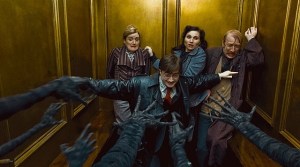
Luckily, Deathly Hallows Part One presents some of the more exciting action sequences and tense mood yet for a franchise mostly built upon investigation and Hardy Boys stuff (with extra magic!). The Harry Potter world has always been more interesting to me the darker it got, and now the series has now firmly converted to the dark side (as far as PG-13 fantasies go). The opening shows each of the three kids being left alone, including Hermione protecting her Muggle parents by wiping away their memory of their daughter. Tough stuff. Then we transition to a floating Hogwarts teacher held prisoner by Voldermort and his legion of Death Eater followers. She’s struck dead and we see a tear roll down her bloodied face right before Voldy’s pet snake eats her. Parents be warned, this is no longer kid’s stuff. Death comes to several supporting characters and there’s plenty of spooky stuff that adds up to a gloomy atmosphere. The infiltration of the Ministry of Magic is a thrilling sequence. Harry and pals disguise themselves as Ministry workers to locate a horcrux from Dolores Umbridge (I cheered at the sight of Imelda Staunton back in pink). The scene is tense and lays out the stakes and important characters to fear. It also produces some potent drama as Ron is disguised as a Ministry member whose innocent wife is being interrogated. The moment culminates in a genuinely exciting chase sequence that got me excited for what was ahead. What I failed to realize is that there was not much more ahead.
 With all that extra attention spent on character, I can also say that Part One has some definite issues with its stagnating narrative. Having never read the books (get over it, Potter nation), I go in blind every time short for the mega-spoilers that I can’t help but learn thanks to all the Potter readers inhabiting my circle of friends and family. I can tell you if something doesn’t make sense because I don’t have the background knowledge of the books to fill me in. There was plenty in Deathly Hallows that made little sense. The adaptation introduces the titular deathly hallows, which ends up being another three super special magic items. There’s a nicely Gothic animated sequence to try and explain the three hallowed items, but it all adds up to a fairy tale that makes little traction. The narrative has already shaped up into a portentous scavenger hunt. Harry and friends are after the remaining horcruxes containing the soul of Mr. Snarly Face. The entire 145 minutes of Part One is spent destroying a single horcrux, leaving 3 or 4 remaining. Now they add three more magic items to find and it all compounds my feelings of fatigue. Did I mention they also have to find a magic sword? How many magical items are these kids going to be responsible to find and how many am I expected to care about?
I left the theater with many questions about what the hell the deathly hallows were, why they mattered, and all sorts of other storylines too. I could not follow all the new characters they threw so late into the game, especially some old wand maker and his connection to wand thievery. And when the hell did everyone gain the ability to teleport at will? Why don’t they teleport all the time then, especially out of danger or when they’re chased through the woods? My friend (an avid Potter reader) had to deal with a litany of stupid questions, likely treating me as a parent would a child asking about where the sun goes when it becomes night.
Also, the film is intended to be a prelude for an epic finale but it mishandles its own sense of climax at several turns. I’ll refrain from heavy spoilers, but one of the most interesting characters, played by an actor I adore, is killed off screen. Off freaking screen! Some other character comes back and says, “Oh yeah, he’s gone,” and then everyone looks glum and goes about their business. It happened so matter-of-factly and anticlimactically that I never made the connection. So later in the film when it’s confirmed that this character is in fact dead, I felt pretty thick. The last chapter of Harry Potter is destined to be a combined 5 hours, and you’re telling me they couldn’t fit in a fight scene that lets this character go out with style? I suppose somebody thought it was more dramatic to just mention a character death offhand. Following this logic, I can’t wait for the grandiose finale where Harry Potter just walks back into a room and says, “Oh, by the way, I just killed Voldermort. So who wants to get a bite to eat?” The emotional climax of the film involves the death of a supporting character I have yet to see onscreen for 8 years. How am I supposed to feel for a character that hasn’t been seen for so long? The ending is sad, sure, but it would have been more effective if: a) I knew what significance the character had in the narrative, and b) it didn’t look like Harry was clutching a rubber doll to his chest. We spend too much time with new characters that end up having minor worth or come across as one-offs. The movie would have benefited from some of the deathly exposition that clogged the first two film’s storylines. As the movie comes to a close it should be clearing things up instead of polluting the narrative with more names and faces.
 Director David Yates has been captain of the Potter helm since 2007’s Order of the Phoenix, and he seems to have found a unifying visual balance for the series. The film’s tone has gotten heavier and having a singular director take the series to an end looks to be a godsend. Despite a lengthy slog in the middle, Yates keeps the pacing fairly tight and tense. The visuals and special effects are just as luminous as ever. The true treat for me is watching all these splendid British actors assembled: Alan Rickman, Ralph Fiennes, Imelda Staunton, Helena Bonham Carter, Timothy Spall, Jason Isaacs on Team Evil, and Brendan Gleeson, David Thewlis, Rhys Ifans, Julie Waters, Robbie Coltrane, Michael Gambon on Team Good. Then there are new additions like glass-jawed David O’Hara (Wanted) and the great Peter Mullan (Young Adam) making strong yet short appearances. I don’t really care why all these talented thespians are together but I’ll enjoy them all the same.
Harry Potter and the Deathly Hallows: Part One is the beginning of the end, literally a prelude for the finale coming to theaters in summer 2011. The film manages to be exciting and dramatic and equally boring and confusing, especially for someone who has willfully refused to read the books. Spending more time with the teen actors has its pluses and minuses, chief minus being that while they wait for stuff to happen so do we. The manufactured end point for the movie feels far from satisfying, but the film manages to effectively whet the appetite for the follow-up. As the Harry Potter series comes to a close it’s hard not to get nostalgic and apologetic, but I resist this urge. Looking back, many of the Potter films have been fine pieces of entertainment but also too long, misshapen, and too slavish to making a book on tape. Part One of Deathly Hallows still falls victim to some of these faults, but the accumulated goodwill of the series and actors makes a 145-minute prologue easily bearable.
Nate’s Grade: B


 nathanzoebl
You must be logged in to post a comment.