Daily Archives: December 22, 2009
Avatar (2009)
 Avatar cannot possibly meet expectations. Can it? The long-in-development pet project of director James Cameron has been dubbed as nothing short of a tectonic shift in moviemaking; it will “change movies forever.” Cameron had the idea for the movie 15 years ago but held on, waiting for the technology to catch up. After you’ve directed Titanic, the highest grossing movie in history, I suppose you have the luxury of waiting. The budget has been rumored to be wildly anywhere from $250 million to $500 million. Avatar was always planned as a 3-D experience and nothing short of the savior of modern movie and the theatrical experience. It would make going to the movies an event once again, something that could not be duplicated at home on puny TV screens. Given the reams of hype and anticipation, Avatar couldn’t possibly succeed, could it?
In the year 2154, mankind has posted a colonial base on the distant moon of Pandora. The planet orbits a gas giant and the atmosphere is deadly to humans after a few minutes exposure. The planet is inhabited by all walks of deadly, incredibly large life, including the indigenous Na’vi tribes, skinny, nine-feet tall blue aliens. The Na’vi also have connective tissues coming from their ponytails that allow them to connect with all nature by “jacking in,” so to speak. They are a relatively peaceful clan that makes sure to respectfully use every part of the space buffalo. It just so happens that they are also sitting on top of a huge enrichment of the mineral Unobtanium, which sells for a crapload of money back on Earth. A corporate exec (Giovani Ribisi) has hired a private army of mercenaries to forcefully move the natives. In the meantime, they are trying to reach a diplomatic solution. Dr. Grace Augustine (Sigourney Weaver) is the head of the Avatar program, where they biologically grow Na?vi bodies with some human DNA mixed in. People can then link their brains to the giant Na?vi bodies and walk and talk among the natives.
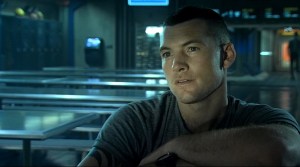
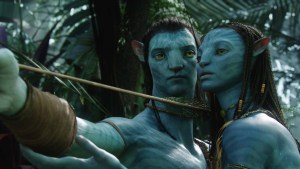 Jake Sully (Sam Worthington) is an ex-Marine who is living the rest of his life in a wheelchair. His twin brother was apart of the Avatar program but was murdered, and he?s signed on to take his brother’s place (the avatars, naturally, are hugely expensive). Jake will plug into his avatar body and be able to feel like he can walk again. Colonel Miles Quaritch (Stephen Lang, superb) likes the idea of having a former Marine on the inside. He makes a deal with Sully: provide useful Intel on the Na’vi, and he’ll get his “real” legs back. Jake and his fellow avatars ingratiate themselves with the Na’vi, and Jake is taught the ways of the tribe by Neytiri (Zoë Saldana). Their teacher-student relationship transforms into a love affair, and Jake begins having second thoughts about his mission.
To the heart of the matter, the special effects are transcendent. This is one of those pinnacle moments in the advancement of special effects technology. Avatar is now the new standard. The environments are so incredibly realistic that if I were told that Cameron and his crew filmed on location in some South American jungle, I would believe it without a moment’s hesitation. But everything in this movie was filmed on a giant sound stage. The visual detail is lushly intricate and altogether astounding. The planet of Pandora feels like a living, breathing world, with a complex environmental system. Every blades of grass, every speck of dust, every living creature feels real. Cameron and his technical team have crafted an intensely immersive, photo-realistic alien world. The level of depth is unparalleled. I found myself trying to soak up the artistry in every shot, admiring a tree canopy four dimensions back. The planet has an extensive night period, which has allowed the planet to evolve with an emphasis on bio-luminescence. Everything from moss that glows from being stepped on, to dragonflies that look like spinning flames, to glow-in-the-dark freckles on the Na’vi allows the movie, and Pandora, to feel like it has a rich evolutionary history. The ecosystem makes sense given the particulars of this world. Cameron isn’t just giving an extra leg or another eye to make the wildlife alien. The special effects are so good that you can easily take them for granted, like Jake’s atrophied legs. Those were special effects as well and yet they looked so real that I never stopped to consider them.
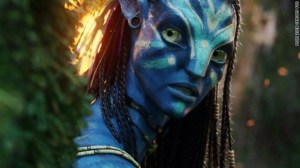
The Na’vi don’t necessarily have the same level of photo realism, however, this is by far the greatest motion capture accomplishment of all time. The creatures don?t appear rubbery or waxy, and there is honest to God life in those eyes, the same life that is absent in Robert Zemeckis’ motion capture movies. The CGI characters have believable facial expressions, capturing subtle movements and realistically capturing emotion. I’m still not a fan of motion capture, but at least Cameron makes effective use of the technique by recording actors movements and mannerisms and transforming them into nine-foot tall blue cat people. That seems like a better use of the technology than having Tom Hanks play a mystical hobo.
 The 3-D is impressive as well but not the “game-changer” it was heralded to be. This is because Cameron doesn’t want to distract the audience and make them conscious of the 3-D gimmicks. There aren’t any moments where someone just hurls something at the screen randomly. There aren’t any clumsy swordsmen jutting forward. Because the 3-D glasses naturally dim the screen and make things darker, Cameron has smartly compensated by cranking up the natural light and vivid colors on screen. Nothing ever comes across as murky or hard to distinguish. Cameron has designed a 3-D environment that spaces out the different elements of the foreground and the background. There will be floating bits like ash or water that will seem right in front of your face. Short of that, you may find yourself forgetting about the 3-D because it’s not always utilized for a 160-minute action movie. It’s more just pushing the visual planes back with your depth of field. After all the praise about Avatar being the triumphant 3-D experience, I’m surprised that the best 3-D I’ve ever seen is still Zemeckis’ Beowulf. At least you still have that laurel, Zemeckis. For now.
From a narrative standpoint, Avatar has a lot of borrowed elements. It follows the exact same plot paces as Dances with Wolves. In fact, this story is exactly Dances with Wolves in space. Like Kevin Costner’s film, we follow an injured military man find acceptance and community with a native (Pandorian?) population. He falls in love, changes his world perspective, and realizes that these dignified people of the land deserve more than to be pushed aside for the greed of the Encroaching White Man. So he bands together and leads the natives against the superior military power of the White Man (It’s also the same plot formula for 2003’s The Last Samurai too). There?s even a young native that distrusts our hero at the start but eventually comes to call him “brother.” Add a few touches from Ferngully and The Matrix and there you have it. It’s the modern tale of colonialism where we, the people in power, are the enemy, though the villains of Avatar are corporations and private military contractors. That might not sit well with certain parts of the country; the same people that blithely think America can do no wrong simply because of its name. Cameron’s politics are pretty easy to identify on screen, and it’s probably too easy to dismiss the flick as “tree-hugging” eco-worshipping prattle. However, this is the same man that wrote and directed True Lies, which is nothing but the cool allure of the military industrial complex AND the villains were Arab terrorists.
Now, the characters aren’t too deep and the love story between Jake and his blue lady seems to be missing a couple reels worth of romantic development, but the movie follows its familiar beats with ease and the last act is terrific. It’s once again one of those all-out endings that gives way to a relentless series of explosions, but Cameron brings together all the creatures and characters he has established prior, which makes for a hugely satisfying and kick-ass payoff. Cameron is one of the greatest masters when it comes to constructing an invigorating action sequence, and he pulls out some great ones in Avatar. Geography is so key to staging a compelling action sequence, utilizing the particulars of the location and having an audience familiarized with the location. By he end, Cameron has fleshed out his world so well that we recall specific locations and remember their strategic value. The assault between the giant mechanical robot suits and the noble natives is great, with different points of action on the ground and in the air. Some have complained that the action sequences of Avatar are like a video game cut scene, and so what? My one complaint about the action is that we lose perspective by being with the Na’vi for so long. The audience becomes accustomed to seeing the world from the Na’vi proportional perspective, forgetting that these creatures are nine feet tall and even they look tiny on their flying dragon creature things, so how big must those things be?
 The movie is not without some level of flaws, primarily in the storytelling department. The first 90 minutes of the movie feels really solid but then the next hour kind of simplifies everything in a rush to the climactic booms. The human villains become dastardly, the Na’vi become extra noble, and the romance with Jake and his blue lady gets consummated in a sequence begging for biological questioning (Do they “jack in” to each other? Is this somehow considered bestiality?). Jake could have benefited with some more back-story as well. The earnest “I see you” Na’vi greeting can get silly after a while. The whole avatar aspect doesn’t feel fully committed and could use more explanation. The Ribisi character is a shallow glimmer of the corporate weasel that Paul Reiser played so perfectly in Aliens. Cameron never says why the Unobtanium element is so valuable in the movie; apparently, Earth is out of energy resources. There are elements that border on the ridiculous, like the giant mech robot suit having a giant Bowie knife. The end leaves the distinct impression that the defeated human beings will just come back with bigger hardware and stronger nukes. If this Unobtanium element is so valuable to the energy resources of Earth, I doubt that one butt whipping is going to stop the exploitation of Na’vi resources. The sappy end credit love song by James Horner and Leona Lewis also might elicit more than a few guffaws.
The only real groundbreaking part of Avatar is the visuals but a familiar story doesn’t stop Cameron’s technical achievement. The plot is entirely predictable, and wholly borrowed, with a crazy different environment and a fresh coat of CGI. But can a highly derivative story kill a project built upon visual wonders? Not for me. Star Wars itself was derivative of many other stories, from samurai tales like Akira Kirosawa’s The Hidden Fortress, to Buck Rogers and Flash Gordon, to Westerns like The Searchers, and war movies like The Guns of Navarone and The Dam Busters. Has that hindered the lasting impact of George Lucas’s quintessential space opera? I’d doubt you?d find too many folk with nagging complaints about Star Wars being too derivative. That’s because the characters were interesting and we cared about them, the story was satisfying, and the visual techniques pushed the medium forward. I could repeat that exact same sentence, word-for-word, about Avatar. It might not change movies forever as we know it, but Avatar is a singular artistic achievement that demands to be seen at least a few times, if, for nothing else, to stare at lifelike trees some more.
Nate’s Grade: B+
Share this:

The Lovely Bones (2009)
 The Lovely Bones, based upon Alice Sebold’s 2002 best-selling blockbuster, is about some heavy stuff. It’s told entirely from the point of view of a dead teenage girl. She was raped and murdered by a skeevy neighbor, and now she gets to watch her family get torn apart through grief. For most filmmakers, this material would not be considered a “breather,” but then most filmmakers are not Peter Jackson (to my knowledge, only one is). The man known for epic fantasy adventures and lavish special effects applies his skills to bringing Sebold?s beyond-the-grave drama to life. The Lovely Bones has enough skill and craft to its merit, but Jackson’s rep as a filmmaker cannot save this poor adaptation. Who would have thought that the lord behind those Rings pictures could be felled by a teenage girl?
“I was fourteen years old when I was murdered,” Susie Salmon (Saoirse Ronan) informs the audience. In 1973, young Susie Salmon (like the fish, we will be told many times) is walking home from school one night. Mr. Harvey (Stanley Tucci) approaches her and asks her to be the first kid in the neighborhood to see his underground clubhouse he built. She follows inside and will never make it back out alive. The police discover Susie’s knit hat and massive amounts of blood in the earth but no body. Susie’s family is a wreck. Jack Salmon (Mark Wahlberg) consumes himself with the mission of finding his daughter’s killer, alienating his wife, Abigail (Rachel Weisz). Mr. Harvey watches the stalled police investigation with growing pleasure, knowing he has gotten away with yet another child murder. As the years pass, he sets his sights on Susie’s younger sister, Lindsey (Rose McIver). But Susie is not completely absent during this period of time. She awakens in a magical, CGI-attuned spiritual realm known as the “in-between.” It is here that she spies on her family and her murderer and tries to pass time.
 Since most of this story is told after her death, and because Susie died when she was a blossoming teenager, apparently she’s doomed to live the rest of her quasi-afterlife in that awkward visage. Imagine being a 14-year-old for eternity, and the only clothes you have to wear are ugly mustard-colored corduroy pants? That sounds more like hell than heaven. So Susie gets to interact in an afterlife built upon the mind of a teenager, which means that the afterlife involves pretending to be on magazine covers and dancing to disco music (again, heaven or hell?). I know that Jackson was asking for trouble by even attempting to interpret the ethereal, but his candy-colored version of Susie’s afterlife comes across like a bright, shiny doctor’s waiting room (“God will be with you in just a few minutes. Please enjoy our magazine selection in the meantime.”). It’s like you have to find peace before going through them pearly gates. Heaven doesn’t want your negativity so you are forced to chill in a screensaver.
There’s going to be some natural disconnect in trying to showcase a realm beyond human comprehension. I accept that, but why does Susie even bother staying in this “in-between” world? She spies on her family in grief through the years but she has no power to change things; that is, until she does for some inexplicable reason. And what does she do with that inter-dimensional power? She inhabits some girl’s body so she can snag her first kiss that her murder denied her. She passed up heaven and chose not to tell people about her body being disposed of. That doesn’t sound like she really reached any sense of enlightenment. But I digress. Why would Susie stay in this “in-between” when it only makes her sad? She’s fairly powerless and, honestly, does anybody really want to delay entering into heaven? Why does Susie get to pal around with all the other Mr. Harvey murder victims like some celestial support group? None of this can be explained because we’re dealing with a topic that defies rationale explanations. However, this “in-between” spiritual land feels like a visual leftover from the 1998 film, What Dreams May Come. That was another movie where I could never explain why anything happened.
 Actually, the entire movie lacks any cause-effect continuity. The Lovely Bones feels bereft of any connective tissue. Characters will make huge decisions or be granted epiphanies because the plot demands it. I have no idea why Jack suddenly figures out that Mr. Harvey responsible for his daughter’s death. He thinks back to a memory and then all of a sudden everything makes sense, but only for his character. For me, none of it made sense. The entire investigation of Mr. Harvey doesn’t really hold up upon reflection. Jack personally looks into every shifty person in town but somehow overlooks the creepy loner across the street that builds meticulous dollhouses for fun? Mr. Harvey also likes to sketch out his murder pits, but just stop and think about Susie’s deathly hobbit hole. The man digs an entire underground lair in a cornfield. Wouldn’t it take hours if not days to refill the whole thing to cover his tracks? For a prolific serial killer, Mr. Harvey seems to be somewhat careless about leaving behind evidence (a safe filled with your victim’s remains?). I guess this is why Susie has to tell us at the onset that people were ignorant to all this unpleasantness in 1973 (I guess that means common sense was acquired in 1974). Why does Abigail all of a sudden desert her family? She can’t take the grief, so she ditches her two other younger children to live the life of a migrant worker. And why does she come back? How can two brown-eyed, brown-haired parents have three blue-eyed, blonde-haired kids? The entire movie lacks vital coherency and context.
From a tonal standpoint, The Lovely Bones never quite settles down and figures out what film it?s going to be. It veers from sentimental melodrama, to thriller, to headache-inducing camp (Sarandon’s boozy grandmother is terrible at housework — hilarious!). Jackson and crew jettison large amounts of Sebold’s text, leaving behind a New Age-y heaven and a fairly lame murder mystery where we already know the guilty party. The drama then pretty much boils down to whether or not Mr. Harvey will get caught.
You can tell that the serial killer segments grabbed Jackson’s interest the most because every sequence with Mr. Harvey feels more predicated and textured, like Jackson is applying more skill to showcase the twisted mind of a sick man. Jackson exerts far more energy into exploring the dark reaches of Mr. Harvey than he does the mourning of the Salmon family. We are denied the complexity of grief and remembrance. As presented, the Salmon family gets to weep and shout but nobody really tackles the issues or moving forward and acceptance of loss. Instead, we watch Mr. Harvey twitch and squirm and plot his next move. Tucci is appropriately scary, aided by an ominous comb-over. The segment when a ghostly Susie stumbles into Mr. Harvey’s bathroom is the best moment of dread. The bright white room is splattered in trails of dirt and streaks of hardened, dark blood, while Mr. Harvey rests in his bath with a washcloth covering his face. It seems like Jackson decided that what fans really wanted from a Lovely Bones movie was more serial killer screen time. If the family drama was going to be this boring, then I say devote the whole movie to the creep.
 The acting is another curious detraction. Ronan (Atonement) fits the part but Jackson forces her to speak in this annoying, pseudo-spiritual whisper, like once you?ve attained the knowledge of the afterlife you become very soft-spoken. She shows a decent range of emotions but even she can?t quite figure out her character. Wahlberg seems miscast in his role and pretty limited in his depiction of obsessive grief. Weisz gets to cry her eyes out the most but then her character sits out the second half of the flick. Sarandon is only playing the role she was given, so I’ll be fair in my criticism, but her brassy, alcohol-swilling grandmother is like an unwelcome party crasher. She’s broad and loud and mostly cartoonish. I understand Sarandon was serving as comic relief amidst all the heavy drama, but it doesn’t count as relief when you wince at her presence. Tucci gives the mot layered, nuanced performance. He tries to relive each kill but soon enough the memory fades, and he feels the unstoppable impulse to feed his demons. Tucci is deeply scary, though he kind of talks like the roof of his mouth is stuffed with peanut butter.
Heavenly Creatures showed the world that Jackson could do so much more than campy, splattery gore and crude humor. It beautifully dealt with the scary, bewildering world of fantasy and budding feminine sexuality. Now after four grandiose movies, The Lovely Bones was supposed to be a trip back to that smaller, character-driven territory that Jackson first charted in Heavenly Creatures. Now I wonder if Jackson has the ability to return to smaller scope pictures. He and his screenwriting brain trust, Philipa Boyens and Fran Walsh, have softened the harder elements from the novel, completely eliminating any sexual emphasis. This PG-13 take is heavy on ponderous acid trip visuals and light on coherence, and when you can?t understand why things are happening after a while you stop caring why. After a while, I just stopped caring about Susie Salmon (like the fish).
Nate’s Grade: C


 nathanzoebl
You must be logged in to post a comment.