Daily Archives: October 11, 2002
Sex and Lucia (2002)
 “Put lots of sex in it. Thats always good,” says a character in Sex and Lucia, the steamy Spanish import now playing. And Sex and Lucia is true to its very title. There are many scenes with Lucia, our heroine, and there’s also oodles of sex. This is the type of movie where if people can walk around without a stitch on, they will. This is the type of movie where a babysitter will masturbate to her mother’s porno. This is the type of movie where shower heads are not used for their intended purpose. No wonder this movie went unrated.
Sex and Lucia is a genuinely erotic movie. And when it comes to eroticism in cinema, the Europeans make us look like sickly amateurs. After exploring whatever late-night stimuli is offered on Showtime or Cinemax youll get an idea of how poor American eroticism is. Usually they involve an adventurous couple, or a sex therapist, or a Jacuzzi/swimming pool, or a lonely stewardess/waitress/secretary and usually Shannon Tweed stars. What disarray the state of our erotic union is in. But for all its shocking and stimulating moments, Sex and Lucia is an intriguing tale of loss, love and sexuality, of course, even if it’s told rather obtusely.
Lucia (Paz Vega) is a waitress in Madrid. She enters into a fiery relationship with a writer named Lorenzo (Tristian Ulloa). Their passion seems to burn as fast as the many cigarettes in the film. Their relationship is full of joyous sex, impromptu strip teases, and blindfolded foreplay. But Lorenzo has a secret he hides from Lucia. Six years ago he fathered a daughter he has never seen when he had a tryst on the beach of a Mediterranean isle. The mother has sent their daughter, Luna (named after the full moon on her conception), into the care of a former porn star and Belen, her randy teenage daughter, in Madrid. Its here that Lorenzo first meets his daughter and then Belen starts coming onto him.
 After learning some disconcerting news about her boyfriend, Lucia leaves to take some refuge on the same sunny Mediterranean island where Luna’s mother lives. Lucia actually takes refuge with her and looks back upon her stormy relationship with Lorenzo. The island has many deceiving holes that fall into caverns all along its beach, directly echoing the rabbit hole for Alice.
This, believe it or not, is the most easily understandable part of the movie. I’ve told you what took place but after seeing it even I dont know what happened. The story has several moments, even entire subplots, that could be the truth, fantasy, sections of Lorenzo’s story, an exaggerated dream, or maybe all of them combined. Your guess is as good as mine, reader.
Writer/director Julio Medem utilizes about every narrative trick in the book to create an alluring puzzle. He washes out the colors of the film (also seen in Three Kings) and seems to correspond to the surreal quality of many story lines. The cinematography is a gorgeous delight. Vega has a smolder and can act circles around her Spanish competition. She gives a brave performance, partially for being as nude as often as she is, and also for displaying the fragile emotions of Lucia so well.
Sex and Lucia is indeed quite sexy but it’s more than just art house porn. The film’s story is an intimate tangle that just might stimulate the largest organ: the brain.
Nate’s Grade: B
Share this:

The Rules of Attraction (2002)
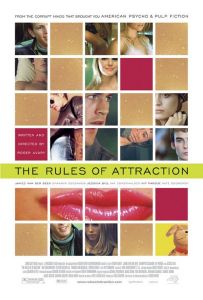 The Rules of Attraction is based on Bret Easton Ellis’ hedonistic 80s novel about boozing coked-out, aloof teenagers and their rampant debauchery. Roger Avary was Quentin Tarantino’s writing partner for years, with an Oscar sitting at home for co-writing Pulp Fiction. As a director Avary lays the visual gloss on thick utilizing camera tricks like split-screens and having entire sequences run backwards. While Ellis’ source material is rather empty, echoing the collegiate friendships bonded over substances or social lubricants, Avary does his best to represent the dazed world of college.
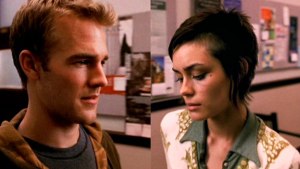 We open with Lauren (Shannyn Sossamon) getting raped by some drunk “townie” while the film buff she had her eyes on videotapes it. She’s just broken up with the bisexual and apathetic Paul (Ian Somerhalder), and both are interested in the sociopath Sean Bateman (James Van Der Beek), a self-described emotional vampire. Lauren keeps a picture book of venereal diseases to ward her from her wayward sexual urges. Her roommate Lara (Jessica Biel) needs no such book. Our introduction of Lara has her dancing down a hall, liquor bottle in each fist, bedding an entire sports team. Some attractions connect, many don’t, but the fun is watching the characters interact in their own seedy yet often hilarious ways.
The best thing that The Rules of Attraction has going for it is its about-face, against-type casting. The film is populated with the WB’s lineup of clear-skinned goody-two-shoes getting a chance to cut loose. Van Der Beek broods like a predatory hawk and bursts with spontaneous rage. Biel sexes it up as a cocaine-addicted harlot who asks if she’s “anorexic skinny” or “bulimic skinny.” Even Fred-Wonder-Years-Savage shows up briefly to shoot up between his toes! The adults of this world are no better than the kids. Eric Stoltz has an extended cameo of a duplicitous professor offering a higher GPA if any coeds are willing to go down on their morals. Swoosie Kurtz and Faye Dunaway show us that pill-popping ditherheads may likely breed drug-addled teenagers.
 Attraction may have the most disturbing suicide I’ve ever witnessed in film. After having her advances rejected a woman slips into the bathtub, razor in hand. The scene is as unsettling as it is because the camera hangs on the poor woman’s face every second and we gradually see the life spill out of her as the music becomes distorted, not letting us escape the discomfort.
Some of Avary’s surface artifice works perfectly, like Victor’s whirlwind account of an entire semester in Europe. Some of the visual fireworks are distractions to the three-person narrative but the film is always alive with energy, even when it’s depressing you. What The Rules of Attraction does get right is the irrational nature of attraction. Each character is trying to fill an inaccessible void with what they think is love but will often settle for sex, drugs, or both. The Rules of Attraction is made up of unlikable, miserable characters that effectively do nothing but find new ways to be miserable. It constantly straddles the line of exploitation and excess but maintains its footing. The movie is entirely vapid but it is indeed an indulgently fun yet depraved ride. If you’re looking for degeneracy instead of life-affirmation, then The Rules of Attraction is your ticket.
Nate’s Grade: B
Share this:

Bowling for Columbine (2002)
 Documentary filmmaker, political activist and corporate pot-stirrer Michael Moore prefaces his latest film Bowling for Columbine by admitting his lifetime membership in the National Rifle Association (NRA). He even received a marksmanship award as a teenager in his hometown of Flint, Michigan. Bowling for Columbine is Moore’s sprawling and hilarious search for answers among America’s zealous gun culture and alarmingly high number of homicides. It’s the tangents Moore just can’t help but take along the ride that add some of the more fun moments.
He opens a checking account at a Michigan bank that’s offering a gun for new customer accounts. Moore astutely asks an employee, “Do you think it’s a good idea handing out guns in a bank?” Moore travels to Canada to find out what reasons exist that make our cultures so different when it comes to crime. After hearing from citizens about how they don’t lock their doors, Moore decides to go door-to-door and see for himself. Sure enough, he walks into half-a-dozen homes.
Moore is better at pointing the finger than fathoming real answers. He touches media sensationalism, our nation’s bloody history, corporate greed, past military involvement, and an environment of fear being developed by those who profit from such actions. The sobering truth is that there are no easy answers to be debunked. The film’s climax involves an impromptu sit-down with NRA president Charlton Heston. Moore questions the sensitivity of the NRA after it held support rallies days after the school shootings in Littleton and Flint. Heston becomes weary and walks out of the interview after five minutes.
The film demands to be seen. It’s complex, challenging, and thought-provoking. Not only is Bowling for Columbine the most important film of 2002, it’s also one of the best.
Nate’s Grade: A


 nathanzoebl
You must be logged in to post a comment.