Blog Archives
A Million Ways to Die in the West (2014)
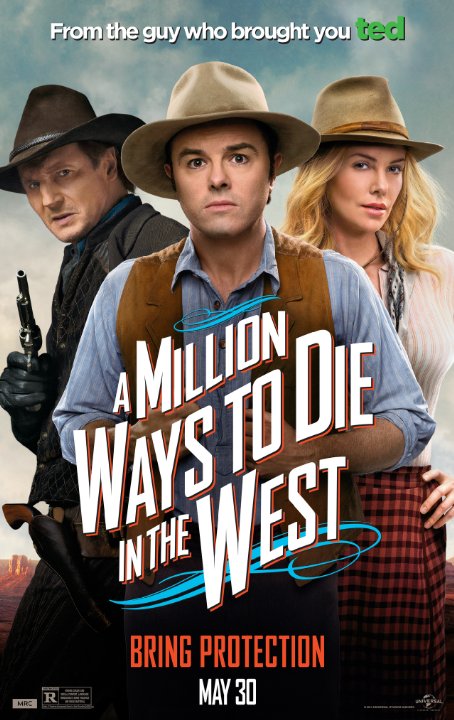 I was no fan of Seth MacFarlane’s first big-screen effort Ted, but I had my hopes up for his Western comedy after some genuinely funny trailers and the reported promise of a lack of anachronistic jokes. A Million Ways to Die in the West lands about half of its jokes, which is a definite improvement though still has enough dead spots that left me shifting around in my seat. The main conceit, a self-aware individual explaining all the myriad ways the Wild West is horrible and will kill you, is a fun operating principal that is also weirdly educational. And MacFarlane actually makes a pretty good comedic leading man, enough so that he could get gigs in other people’s movies. He plays a coward roped into fighting an outlaw (Liam Neeson) after unknowingly falling for the outlaw’s wife (Charlize Theron). The meta jokes critiquing the romanticized living conditions of the West have the highest percentage of laughs, and there are some great sequences like a trip at the local fair which turns deadly so easily. Theron and MacFaralane make a good pair and the supporting cast, with Giovanni Ribisi and Sarah Silverman, are funny and don’t overstay their welcome. Neil Patrick Harris is also amusing as ever and even gets a song-and-dance number about the virtues of mustaches that, honestly, should have been better. But every so often MacFarlane can’t help himself. There are some gross-out jokes that go a little too far. Then there’s the fact that the movie forgets to be a comedy for long stretches, morphing into an action thriller or budding romance. The scenery is nice but I would have liked more jokes. The movie is also far longer than it needs to be, dragging out the climax. I’m also somewhat disappointed that MacFaralne and his writers missed out on an obvious payoff, namely the myriad ways the West can kill you. It only seems natural for Neeson and his gang to be foiled by the West itself, which would present a fun guessing game for the audience to anticipate what deadly condition would strike next. Alas, a missed opportunity. A Million Ways to Die in the West is a hit-or-miss affair with just enough hits to warrant a casual viewing.
Nate’s Grade: B-
Share this:

The Lone Ranger (2013)
 With the director, star, and writers from Disney’s original Pirates of the Caribbean trilogy, you’d likely expect The Lone Ranger simply to be Pirates in the West, and it pretty much is, for better and worse. The pieces don’t nearly come together as well, and the characters aren’t anywhere close either, but I was mostly pleased with the finished results after coming to terms with the flaws of the execution. This is a semi-supernatural reinvention of the Lone Ranger and Tonto, prankish and proudly peculiar.
In 1869 Texas, John Reid (Armie Hammer) is the new district attorney for a small outpost along the railway run by tycoon, Mr. Cole (Tom Wilkinson). John’s brother (James Badge Dale) is the sheriff and the more accepted hero. This all goes awry when the nefarious criminal Butch Cavendish (William Fichtner) kills the sheriff, his posse, and leaves John for dead. He’s brought back thanks to Tonto (Johnny Depp), a Native American with his own quirks. Together, the duo struggle with the idea of justice versus vengeance and taking responsibility.
Thanks to screenwriters Justin Haythe, Ted Elliot, and Terry Rossio, it still follows the summer movie blockbuster blueprint while maintaining its own sense of self. I enjoyed the 1933 framing device and the sense of commentary it added to the legend of Wild West tall tales. Many of these story elements will be painfully familiar, from the unrequited love interest that needs saving, her plucky son, to even the villainous railroad baron, but the film finds ways to keep all these formula figures at least integrated and satisfying, doling out payoffs to several storylines. More so, the film just has a wild sense of fun to it, enlivened by Verbinski’s exuberant feel for action. When he gets things going, the man has a touch for inventive action orchestration akin to Steven Spielberg. He is a director who knows how to add scale and scope to action and make it felt. The movie feels constantly alive and full of surprises, stepping outside itself for some non-linear asides, adding bizarre examples of nature undone (In the words of Nicolas Cage: do not touch the bunny), and a heavy dose of magic realism. It’s just too funky and weird not to be interesting even when it threatens to be boring. Disney put crazy money into something this crazy, folks, reportedly $200 million.
 There are serious problems here much as there were in the Pirates sequels, notably a lingering sense of bloat. At 149 minutes, there could have been a lot of cuts. The saggy middle seems to almost derail all momentum, as Reid and Tonto stumble about the desert, filling in a majority of Tonto’s tragic back-story. Most of the supporting characters are chiefly underwritten. I pity the great Ruth Wilson, so nerve-fryingly awesome on the BBC’s Luther as an enthralling sociopath, and here she’s basically Love Interest/Single Mom for Reid. At least she does a decent job with her Texas twang. There’s plenty of overindulgence all around, and I won’t even entertain the argument that its handling of Native American displacement, while not as clumsily racist as feared, was anything other than schlocky. There are also three villains of different stripes that need to be juggled. There are a lot of storylines and characters to keep active and the movie just cannot keep up. The tone can be somewhat jarring as it dances around dark comedy, earnest sentimentality, tragic drama, and cavalier heroism. It feels like the movie never settles down, which can keep an audience from being fully engaged, fully invested. It hurts even more when the characters are nowhere near as charismatic as Captain Jack Sparrow.
Perhaps I’m being overly generous after coming from Man of Steel, and perhaps, nefariously, Man of Steel is still going on, locking me forever in some sort of parallel mobius strip where I’ll never be able to leave, but I greatly enjoyed the action sequences in Lone Ranger. Verbinski is one of the most talented visual filmmakers working today but, more importantly, he knows how to orchestrate large-scale action sequences in a way that they matter. Yes, like most things in The Lone Ranger, they can go on a bit too long, but here the situations develop naturally with organic complications, the sequences move the plot forward, and they escalate in excitement. The concluding twenty minutes involves a sumptuous dual train chase that keeps shifting and changing, going from atop to parallel trains, to cars being dislodged, people jumping from one to the other, all racing toward a bridge triggered with explosives. It’s a thing of beauty, this final action sequence, and Verbinski’s shot compositions allow things to play out so artfully while the audience still maintains its sense of orientation. It’s a finale that feels exhilarating, and the playful whimsy and sense of danger that the movie had been flirting with before comes together, enough for you to wish the whole movie had tonally coalesced with the skill shown toward the end. As an action fan, I was lapping it up, and the playful non-linear jumps, as well as the satisfying ends to some satisfying villains (Fichtner is terrific), left me grinning and hopping with excitement. A strong finish went a long way toward improving my opinion on the film and minimizing my misgivings.
Who is this dark, weird, somewhat clunky movie really appealing to? The Lone Ranger had its cultural peak back in the 1950s and thus the people actually excited for a Lone Ranger movie must be slim. And those people are probably going to be turned off by something as jokey and unfaithful to the source material as this movie. It does utilize the Ranger’s theme song, the William Tell Overture, but saves it for the end. What about kids? The movie is released under the Disney imprimatur and has the stamp of “from the creators of Pirates of the Caribbean.” Everybody loved the first movie and the sequels were also huge global hits, but this movie is even darker and somewhat grisly. There’s a moment when Cavendish literally cuts open a dude’s chest and eats his heart (mostly off-screen and implied mine you, but still). I can already hear the parental uproar. And while it’s somewhat implied that Cavendish and his men are cannibals, this storyline is never really touched upon again. Did we need the heart-eating scene to fully communicate how nasty our villain is? The true audience for the big-screen Lone Ranger may very well only be the mega fans of 2011’s Rango, Vernibski’s Oscar-winning foray into animation. If you like a somewhat weird, somewhat anarchic, tonally uneven movie with personality and eye candy, then perhaps Lone Ranger is for you. Problem is that this potential audience is going to be meager, but it does include me.
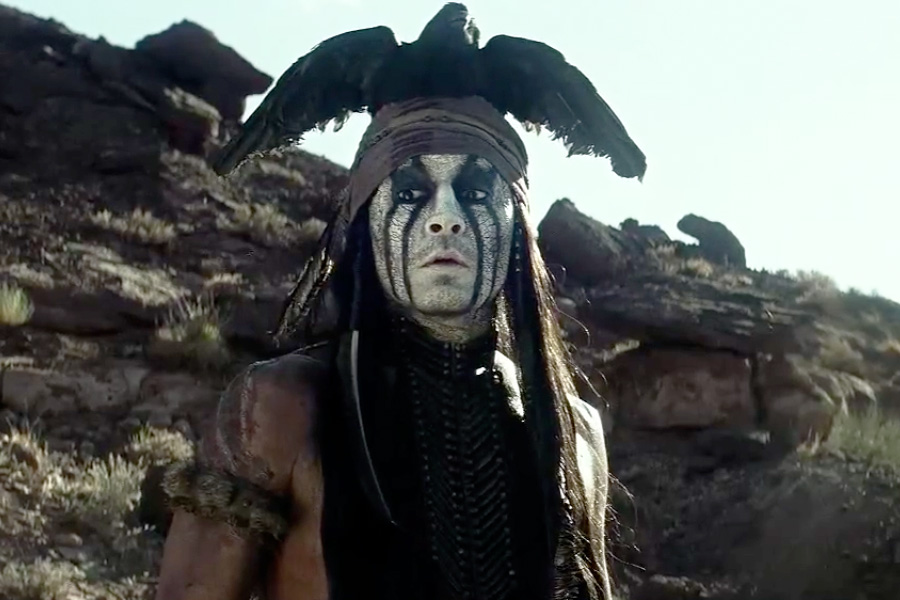 I know there are many people out there experiencing stage four Depp fatigue, and I can’t blame them. His penchant for peculiar character construction can get somewhat tiresome if the movie doesn’t have more going on. In something like Alice in Wonderland, a movie I didn’t even like, at least his weirdness fit with the weird world unlike, say, Dark Shadows, a movie best forgotten by everyone involved. Here his Tonto is as head scratching as he is humorous. And is there an inherent awkwardness having a white actor, in this day and age, playing a Native American? According to the Internet, Depp has said he “probably” has some Cherokee ancestors because he’s from Kentucky. The funny (awful?) thing is that Tonto is often in white face with his special face painting (red face in white face?). I just don’t think he can apply the same bug-eyed, swishy, eccentric sensibility to every character and call it a day. Just when you think he’s gotten away from starring in every movie with Helena Bonham Carter, surprise, here she is. And it’s not even a Tim Burton movie, people! Tonto is seen less as side kick and more of a co-lead if not the real star, and part of that is the bankability of Depp as a box-office draw, part of that is Depp as an executive producer on the project, and part of that is just because the kooky Tonto is just far more interesting than the straight-laced Reid. Hammer (Mirror, Mirror) has the jaw line, the look, and an engaging yet square appeal to him, and if anyone saw The Social Network you know the handsome lad can act. Too often he ends up being a minor foil to Tonto; it takes him far too much hemming and hawing before he accepts his masked outlaw status. As a result, he’s something of a bland fuss bucket.
Disney’s big-budget reworking of The Lone Ranger will probably be held up as the prime example, in a non-Michael Bay summer, of everything wrong with studio filmmaking, the punching bag for blockbusters. Some may even invoke a comparison to another costly Disney endeavor, last year’s flop, John Carter. There are plenty of faults the movie exhibits, namely an extended sense of bloat and an uneven tone, but I’d be lying if I said I was obsessed with the faults by its spectacular end. The movie does enough right, and enough semi-right with enough style and verve, that I left my screening feeling giddy and satisfied. It might be too dark, too glib, too weird, or too self-indulgent, but those are all reasons that made me like this movie even more. There’s a character with a wooden leg that doubles as a rifle, and not only that but one of our villains, a cavalryman, has a clear fetish for prosthetic legs. And this is a Disney film! I can’t help but love the spirit at large. Thanks to a fine supporting cast, Verbinski’s high wire visual stylings, and some strange sensibilities, not to mention a grand finish, The Lone Ranger is as entertaining in what it does right as with what it does wrong.
Nate’s Grade: B
Share this:

Django Unchained (2012)
 It’s an understatement that no one makes films like Quentin Tarantino, though after Pulp Fiction it seemed like everyone was trying. The famous writer/director is an audacious filmic DJ, taking samples from all genres and mixing and matching them into a new and elevated form of art; he takes low-grade B-movie concepts and genres and turns them into highly literate A-class films. My only quibble is that, while I heartily enjoy the man’s unique efforts, I don’t know if we’re ever going to see a different Tarantino anymore. Since 1997’s Jackie Brown, he seems intent on re-imagining exploitation films and B-movies and putting his articulate spin on them. I have yet to dislike a Tarantino film (I rate Jackie Brown the lowest but that’s still an A-) and I’ll be first in line for anything the man attaches himself to as writer/director. Django Unchained is Tarantino’s ode to spaghetti Westerns, and it’s every bit as violent and tense and entertaining as you’d hope it to be.
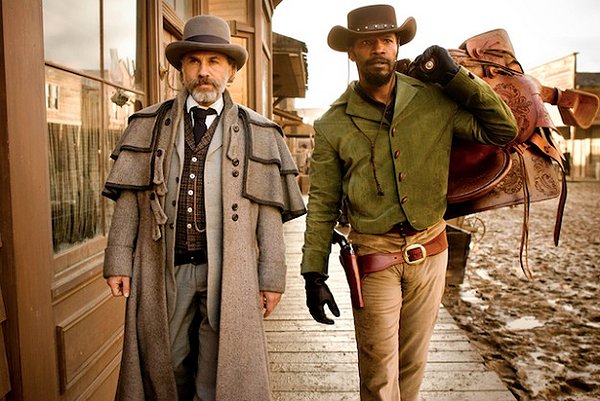
In 1858 Texas, an abolitionist bounty hunter, Dr. King Shultz (Christoph Waltz) frees a slave named Django (Jamie Foxx) and enlists his help in tracking down a team of outlaws. They strike up a mentorship, gunning down outlaws for money. “Kill white folk and they pay you for it? What’s not to like?” Django reasons. After a successful season nabbing bad guys and training Django in the ways of shooting, the men come to a crossroads. Django is looking for his wife Broomhilda (Kerry Washington). She was torn away from him and sold off to wealthy Mississippi plantation owner Calvin Candie (Leonardo DiCaprio). Schultz and Django cook up a scheme to rescue Broomhilda. Schultz will pose as a rich power player wanting to enter the “mandingo fighting” game (think savage gladiatorial combat). Django will play a black slaver, and expert when it comes to picking out prized fighters. With a generous offer, the two get invited to Candie’s family plantation, dubbed Candieland. Standing in the way of their plan is Stephen (Samuel L. Jackson), Candie’s head of the house. Stephen is deeply suspicious of their guests and ready to expose them for who they truly are.
 I’ve been dragging my feet writing a review of Django Unchained and I’m trying to determine why that is. Just after typing that sentence I spent 30 minutes checking my e-mail. I’m an avid Tarantino fan, so I’m left wondering what my hesitation is about. I certainly enjoyed the film, thoroughly, but perhaps my question is whether I should have enjoyed the film as much as I did given the historical reality of slavery. No movie will ever approach the true horrors of slavery; even the very act of owning another human is a detestable and crushing reality. Of course I’m coming at this movie from the perspective of a white male, so I feel like aspects of my commentary can only be minor. Is the backdrop of slavery too horrific for Tarantino to stage his spin on a revenge-filled Western? Spike Lee seems to think so via his critical public remarks. Tarantino has great glee in reveling in over-the-top movie violence, the kind that audiences (at least mine) cheer for. I guess the questionable angle is marrying the two realities and tones. You don’t want to take away from the brutality of slavery and at the same time you want to tell a compelling revenge-soaked thriller that satisfies with its buckets of blood. I’d say Django Unchained mostly finds the right balance to hit you in the gut one minute and the next have you clapping along.
It seems like the media is pressing every black celebrity for his or her personal thoughts on Django and especially Tarantino’s copious use of the N-word. Tarantino has gotten into hot water before with his penchant for the N-word, notably his own sequence in Pulp Fiction, but the N-word is entirely period appropriate for Django. Let’s face it, a majority of Americans, let alone Southerners, had really one word for slaves, and it wasn’t kind. This is the word that would have been uttered. However, after seeing the film a second time, I can see the complaints about the overwhelming use of the N-word. If you were to turn this into an awful and disrespectful drinking game, you’d probably pass out before DiCaprio even steps onscreen.
Like Inglourious Basterds, this movie is really a series of sit-downs that simmer with tension. The man has gotten so good with establishing the particulars of a scene, what the characters desire, and to push it to its breaking point when it comes to tension. While I don’t think anything approaches the highpoints of Basterds, this is still a movie that luxuriates in beautifully played tension and the danger lurking underneath Tarantino’s finely crafted words. And let’s talk about those wonderful words of Tarantino talk, the kind that seem so effortless to build sensationally interesting characters. The man sure enjoys writing his umpteenth variances on badasses engaging in verbal pissing contests (the literal kind are far less entertaining, at least for me). When you have character this sharply developed with such counter objectives, I could watch them duke it out all day. There are some pacing concerns with the movie, particularly once we get to Candieland, but when I’m engaged this much in a movie, I’d rather it go overboard than scrimp. Tarantino’s signature cool/funny/funny cool dialogue is alive and well. Every scene advances the plot, pushes it toward its bloody conclusion where bodies explode with sprays of red mist. It’s completely over-the-top in the Kill Bill vein, enough to draw snickers and laughter from a crowd, but Tarantino knows how to serve up a satisfying ending even with a body count to rival Hamlet.
 I don’t want to give the wrong impression that Django Unchained is deadly serious given the subject matter and historical context. I don’t think it disrespectfully sanitizes the horrors of slavery, but Tarantino’s brand of humor finds opportune moments to poke through. There’s a sequence with an early version of the KKK, a group of Southerners on horses arguing over whether they need to wear the ill-fitting bags on their head they prepared (plus Jonah Hill cameo). I was laughing so hard I thought people around me were going to shush me. It may well be the funniest thing Tarantino has ever written. There’s also natural humor to be had in the awkward handling of race relations, something that hasn’t exactly been perfectly ironed out to this day. A wealthy plantation owner (Don Johnson) struggles to explain how his slaves should treat Django, presented as a freeman by Schultz. “You want me to treat him like white people?” someone asks. This is followed promptly with a curt, “No.” There’s also plenty of gallows humor to be had with the over-the-top violence that pervades in the finale. It’s all key moments to blow off steam, so to speak, and make the film more bearable.
Django Unchained follows a traditional Western plot; in fact I’d say what we watch is essentially Tarantino’s whacked out spin on The Count of Monte Cristo (Alexander Dumas is even referenced in the film by name). Our lead character, Django, is in the Clint Eastwood mode of the strong and silent type. Schultz is the one who does all the talking while Django learns and glowers. They make a terrific buddy team and you almost wish that Tarantino had just diverged his story and allowed them to keep doing their bounty business. But Django’s wife needs some saving and that’s where the movie slows down. I wish Broomhilda had been given more character development. She’s pretty much the princess that needs saving, much like the German folk tale we learn is where Broomhilda gets her uncommon name. My sister described Django Unchained as a love story and I think that’s being a little generous (Tarantino did cut much of her torture, physical and sexual, from his script). We certainly feel Django’s desire to rescue her, and we worry about all the plot machinations and masks the characters must wear to accomplish this feat. With that said, the movie still has plenty of sucker punch surprises, much like Basterds, where violence erupts and despicable characters are given arias to illuminate the depths of their depraved worldviews.
I do wish that Tarantino had been a bit more judicious with his editing (the first without longtime editor Sally Menke who died in 2010) and curtailed all his self-indulgent meta film homage nods. We get stuff like Amber Tamblyn (The Sisterhood of the Traveling Pants) in one shot. Why you ask? See her father also stars in the movie in a small role, and he once played a character titled “Son of a Gunfighter.” So in his own credits, Tarantino lists him as “Son of a Gunfighter” and his daughter as, what else, “Daughter of a Son of a Gunfighter.” When all of that contorting is for an end credits gag and one shot in the whole movie, you feel like it was strictly masturbatory. Then there’s the original Django, Franco Nero, asking Foxx how to spell his name. Old Django asking new Django how to spell his name. I guess it’s supposed to be like a cinematic passing of the torch but it’s another moment that feels superfluous in a 165-minute movie. The movie can get a tad exhausting. The final 15 minutes, while still smartly written and boasting some terrific bloody comeuppance, feels like an add-on that wasn’t needed. It does manage to tie some elements back together but at this point the audience is ready for Django to ride off into the sunset, not have another obstacle to overcome in improbable yet badass fashion. At my first viewing, the kid behind me kept complaining to his parents that the movie had failed to end (“This is still going? It’s already been two hours!”). I also understand the fruitless and ironic nature of asking Tarantino to reign in his self-indulgences; that is, after all, what makes him who he is.
As expected from Westerns, the movie is a boy’s show. Foxx (Ray) has a steely screen presence that works very effectively for the character. The man’s quiet confidence and growing insolence play well, as he burrows into a role that boosts his confidence and assertiveness. Foxx’s journey from beleaguered and shell-shocked slave to mighty walking vengeance is definitely a full performance and one that Foxx delivers without any winks to the camera. Waltz (Carnage) will be dinged for playing a character similar to his Oscar-winning role in Basterds, but he’s still joyously entertaining, with that strange speech pattern of his that he plays like a musical instrument. He has a lot to say with plenty of theatrical flourishes, but that’s what makes him so entrancing. Simply put, Waltz and Tarantino are a match made in heaven.
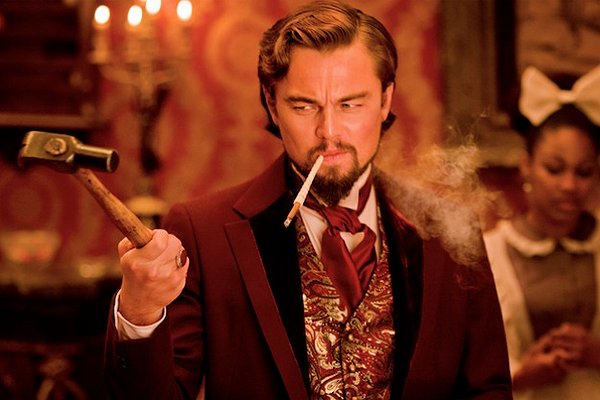
 DiCaprio (Inception) doesn’t appear until over an hour into the film but he’s worth the wait. At my first screening, I thought DiCaprio was good but was unimpressed. Upon a second viewing, I must say my appreciation grew for the man’s performance. Calvin Candie is certainly a vile man and DiCaprio is able to give him such an intriguing brio; he’s not the magnetic source of evil that Waltz was in Basterds, a man able to stay two steps ahead of his prey. Candie is easily taken for a fool. He’s not the smartest guy in the room but he can work up a pretty sizable fury; DiCaprio actually cuts open his hand during a confrontation and remains in character, undeterred. But the best actor in the movie is Jackson (The Avengers). There are far more layers to his head house slave than meets the eyes. It sure seems like he’s really the fist behind the glove. He may put on an act for company, but the man is far more calculating and sinister than anyone else in the film. You know he’s a good villain when the audience cheers the loudest at his demise (don’t act surprised, spoiler-phobes). I wouldn’t be surprised if Waltz, DiCaprio, or even Jackson get nominated for supporting Oscars.
It seems like Tarantino has also stumbled into a hidden lucrative subgenre at the box-office, namely the historical revenge film. Who doesn’t want to see a group historically shafted get some sweet revenge, the bad guys punished, and all with sparkling dialogue? In 2009, Tarantino went on a Nazi scalping spree and got to shoot Hitler in the face. With Django, a brutalized slave becomes the hero of his own story and kills some vile slave owners and traders. It’s essentially a Nat Turner-style rebellion from history, albeit with some harebrained scams and colorful characters. Following this lucrative model, Tarantino could take other maligned minorities and give them cinematic justice. Sadly, there are too many examples to count where Tarantino can take inspiration.
Django Unchained is a bloody, rollicking, talky, messy, exciting, surprising, uncomfortable yet satisfying movie and probably one of the oddest crowd-pleasers in recent memory. I saw it on Christmas day and my theater was a sell out. They loved it, soaking up every minute, laughing at the funny parts and wincing at the gruesome violence. I couldn’t think of a better way to celebrate the birth of baby Jesus. It doesn’t whitewash the evils and viciousness of slavery, but at the same time Tarantino knows how to serve an audience and their demands for big characters, big set pieces, and big vengeance. Django is a sturdy Western/blaxploitation film, and whatever other genres Tarantino feels like tossing into his cinematic blender. Whatever you classify it as, Django Unchained is another Tarantino original specialty and his tremendous talent comes through loud and clear, even with a few false endings and self-indulgences at play. It looks great, has a great soundtrack, and presents great acting talent reciting Tarantino’s great words like they were prized possessions. It’s a bit long and a bit overdone, but when you’re enjoying yourself, who wants to leave the party early?
Nate’s Grade: A
Share this:

Cowboys & Aliens (2011)
 Never as good as a film should be given the talent involved, nor as bad as its detractors might have you believe, Cowboys & Aliens is an entertaining genre mash-up that’s about 60 percent Western, 30 percent alien thriller, and 10 percent naked Olivia Wilde, which is too small a percentage in my opinion. For a solid hour, the movie follows the rhythms of classic Westerns and Daniel Craig has a face vividly made for the Western canvas. The sci-fi elements feel well integrated in small doses, however, when the movie goes all-out intergalactic gun slinging is when the narrative gets swallowed whole by the crude blockbuster nature of this beast. The plot is pretty standard Man with a Dark Past stuff, and can we put a moratorium on people suffering amnesia and choosing to be better people? The characters never really feel real but they feel believably stock for their genre. For a PG-13 movie, the violence can get pretty gruesome, especially in its gooey disembodiment of the alien invaders. You almost feel sorry for these nefarious gold-hoarding (yes, you read that right, the aliens are after our gold – Glen Beck was right!) creatures. The action sequences are a notch above average, the emphasis on practical effects is appreciated, and the movie takes some darkly comic turns, which kept me amused even when the movie’s IQ was dropping at a precipitous rate for the last act. Cowboys & Aliens never pretends to be anything more, or smarter, than its blunt title.
Nate’s Grade: B-
Share this:

Meek’s Cutoff (2011)
 The early frontiersmen lead difficult, backbreaking struggles as they migrated west to start anew. The pioneers had a perilous journey, and judging from Meek’s Cutoff, they had a hard time asking for directions. We follow a wagon train hopelessly lost in Eastern Oregon, blindly hoping they are getting ever closer to water. This awful movie feels about as adrift as the characters. Director Kelly Reichardt (Wendy and Lucy) recreates pioneer life in obsequious detail, which means that for most of the interminably long 104 minutes we’re watching characters walk. And walk. And walk. Hey, now they’re doing something, nope back to walking. Michelle Williams (Blue Valentine) has the most personality of this taciturn bunch, but I couldn’t have cared less about her lot. The movie is practically indignant about the narrative demands an audience has for its movies. This is not some arty examination on the treacherous nature of the human spirit, or some conceited claptrap like such. And in a growing trend of 2011 Sundance films, Meek’s Cutoff ends absurdly abrupt, just as the characters appeared at a crossroads and on the verge of mercifully doing something interesting. Instead, Reichardt ritualistically kills the movie on this spot, robbing the audience of any payoff after 104 minutes of fruitless and tiresome artistic masturbation. If I wanted to watch a recreation of frontier life without any regard to character or story, I’d watch the History Channel. This is an exasperating, maddening, crushingly boring movie that makes you feel trapped on that misbegotten wagon train.
Nate’s Grade: D
Share this:

True Grit (2010)
 It may sound like sacrilege to some to remake True Grit. What can the Coen brothers add? Can Jeff Bridges fill in the boots of John Wayne? Those familiar with the 1969 original will recognize many of the same elements and a solid 70% of the dialogue is the same owing to the fact that both films come from the same source, Charles Portis’ novel. Where the Coens step out is placing the story’s focus on Mattie Ross (Hailee Steinfeld), the 14-year-old seeking vengeance for her dead father. Marshall Rooster Cogburn is a rascally often drunken cynic, so it’s easy to get swept up in the amusing character, initially played by the Duke and now played with great gruffness by Bridges. But the Coens know this is Mattie’s story, and apologies to Kim Darby, but Steinfeld looks like a 14-year-old. Every second onscreen reminds you how truly vulnerable she is, that is, until she opens her mouth. Steinfeld is remarkable and so self-assured. She holds her own with the stars. This is a young actress that has a bright future in Hollywood.
The Coens have put together such richly drawn characters, so it’s a tremendous pleasure just to watch the people interact, luxuriating in that old West speaking style that actors chew over like gumbo. It takes a while for the film to assemble its pieces, but once the gang is underway you just want to spend. As anyone who has ever seen a Coen brothers’ picture, the movie is technically flawless. Whether it be the sumptuous old west cinematography by the best man in the industry, Roger Deakens, the stirring score by Carter Burwell, impeccable sound design, or the overall languid yet authentic pacing of the whole film. There are moments of offbeat humor, moments of quiet tension, explosions of brutish violence, but I had to ask what it all added up to. It’s a good time spent with some nice characters, but it’s hard to shake the idea that the movie falls short of greatness. The Coens can’t be expected to make a masterpiece every time they step behind a camera. But the films that fall short of the M-word generally can be slotted in the “mostly very good” category (O Brother, Burn After Reading). You’re left with a somewhat sour resolution and it starts you thinking whether or not the film had anything substantial to say about vengeance, friendship, community, or a legion of topics. It turns out, True Grit is a solid two hours of great actors working through an entertaining story. For any other filmmaker, that would be all you could ask for. For the Coens, it means the film only can be classified as “very good.”
Nate’s Grade: B+
Share this:

Jonah Hex (2010)
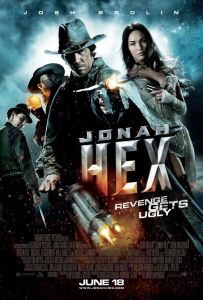 Clocking in at barely 73 fraught minutes, Jonah Hex is a bizarre Western sci-fi hybrid that never really stops to fully explain the rules of this universe. Josh Brolin, who does what he can with the disfigured badass, plays the Hex of title. Hex has a facial deformity along his mouth, which means it’s hard to understand whatever the man is saying as he slurs and mumbles the majority of his tough guy talk. It’s not smart to have your main character unintelligible. Watching Jonah Hex gives you the impression that nobody, cast and crew, knew what was happening. One minute Hex rides a horse with a, I kid you not, double gattling gun, and the next he’s fighting against a crazy John Malkovich who wants to build Eli Whitney’s doomsday machine. Did I also mention that Hex can bring people back to life for short periods of time via his magic touch? The look of the film is overly aggressive, with a rock guitar jackhammer score and plenty of souped-up special effects shots that try and ignite some flailing sense of excitement. It’s hard to get excited about a movie that feels so soulless. Jonah Hex feels like some studio shill thought they could buy a comic property and fill it with sure-fire elements that would please a teenage male base. Megan Fox (Transformers) in a bodice can only distract from the gaping void of a cohesive screenplay for so long. Then you stop and remember how much this movie sucks.
Nate’s Grade: D
Share this:

The Book of Eli (2010)
 Where did the Hughes brothers go? Albert and Allen Hughes have four movies to their names, one of them a documentary about pimps, and their last flick was 2001’s From Hell. I know that Jack the Ripper thriller underperformed at the box office, starring a pre-Pirates Johnny Depp, but was it enough to throw these guys in movie jail for nine years? The Hughes brothers are talented filmmakers, first evidenced by their debut feature Menace II Society, which they wrote and directed when they were only twenty years old. I actually really liked From Hell. I get that it isn’t anywhere as complex as the source material from famous comics scribe Alan Moore, but the movie was slick, stylish, twisty and twisted and satisfying (although, Heather Graham has the worst accent in the history of movies). Where have these brothers been all this time? Nine years later, the Hughes brothers take a whack at the popular genre of the moment –Apocalyptic Cinema. The Book of Eli kind of comes across like a Hollywood version of The Road. It’s all about duplicating the look, without getting too bleak, and failing to replicate the sense of humanity in desperation. Why worry about that when you can have explosions?
It’s been 30 years since the sun scorched the Earth. Food is scarce. Gangs roam the highways. The law is a forgotten concept. Eli (Denzel Washington) is a loner heading westerly and trying to make out a meager existence. He takes the boots off a dead man, hunts emaciated cats for food, and looks for a safe shelter from the blistering sun. He struts into a dusty town looking for clean water. The town is under the rule of Carnegie (Gary Oldman), a man in search of a very specific book for his own purposes. It just so happens that Eli is in possession of this book. Eli refuses to hand over his property, speaking about his mission to transport the book to where it belongs. Carnegie sends his thugs out to kill Eli and retrieve the book. Helping Eli is Solara (Mila Kunis), a teenage prostitute who feels Eli has answers that nobody else has.
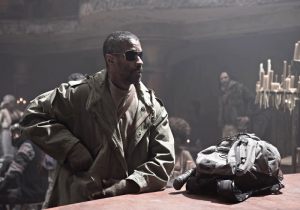 What we have here is a post-apocalyptic Western. Denzel is the lone drifter that comes into a town besieged by lawlessness or a corrupt agency of power. He even has a fight in a saloon that doubles as a whorehouse. He takes on an unlikely younger apprentice and enforces his own moral code through a series of shootouts. It just so happens that in Eli, he also has a giant machete and knows kung-fu. This is pretty strict genre stuff, mixing in apocalyptic elements for some extra flavor. The Hughes brothers give everything an ashy grimy gloss, making the most of desolate locations they shot in New Mexico (“When you need some place that looks like the end of the world, film New Mexico!”). The sparse locations and desaturated cinematography do well in establishing an unforgiving reality of the landscape.
The Hughes brothers certainly have a sense of style when it comes to the camera lens, yet they don’t approach being too self-conscious with their visuals. There’s an extended fight sequence that plays entirely in silhouette. There isn’t an overabundance of special effects in the film to clutter up the bangs and booms. There is one shootout outside a home (with Michael Gambon no less) that mimics some of the unblinking camerawork of Children of Men, swinging from side to side throughout the escalating firefight. It’s a fun visual motif that thrusts the viewer in the middle of the action. Otherwise, the action is all fairly standard stuff. It?s entertaining to watch Denzel take out a bushel of bad guys time and again, but what does that add up to with such a worn out story and half-hearted characterization? The script by Gary Whitta is heavy on apocalyptic mood and light on details. Cue more ass kicking.
Washington is stoic, almost Eastwood-like in his grit. He’s an easy antihero to root for, the reluctant avenger that manages to slice and dice his way through trouble. I won?t say this movie forces Washington to stretch his reserve of acting muscles, but it is undeniably pleasing to watch him perform his own fighting stunts. Oldman hasn’t gotten an opportunity to play a scenery-chewing villain in quite a while. Let’s face it; Evil Oldman will always overrule Good Oldman. This man was created to play sociopaths that have no ability to control the volume of their voice. This man needs a chance to bellow once every movie. Kunis proved she was a capable actress in Forgetting Sarah Marshall, but her role is fairly limited here to sidekick. She stares with her dark eyes and gets to hold a gun. That’s about it. The Hughes brothers have populated their post-apocalyptic world with familiar faces. Tom Waits is a merchant, Ray Stevenson (HBO’s Rome) as the Number One Henchman, Jennifer Beals as the blind mother to Solaris, and Gambon as a well-armed homeowner with an appetite for human flesh. That?s a good stable of actors to fill out a bunch of stock roles. It certainly makes The Book of Eli more entertaining.
The religious element doesn’t dominate the film but it does serve as food for thought. You see the book of Eli’s in high demand is actually he King James Bible. But you see, this isn’t any bible wrapped in leather with a metallic locked binding (all this for a Bible?); this is the LAST BIBLE ON EARTH. That is why Carnegie craves it. In the 30 years since the vague apocalyptic event, apparently mankind rounded up all the Bibles and burnt them, perhaps to express their displeasure with God. Eli operates on the premise that Denzel has the only Bible in the known world, which just seems downright silly. Did people search through every habitable dwelling, every library, and every hotel drawer? There have to be hidden Bibles out there. Even in this extreme setting, it seems to strain credibility to think that mankind is left with one copy of the most widely published book in the history of the world.
 Ignoring this fact, the religious element remains nebulous even though the film chronicles the journey of the Christian text. God is referred briefly but mostly the talk steers around the ideas of “faith” and “fate” and “the right path.” Eli feels he has been chosen for a special mission, and so he trudges west with his eyes on the prize. Carnegie wants to use the Bible as a “weapon” to pervert people’s faith into giving him more power. He wants to abuse religion as a motivational force to expand the reach of his control. Here’s the thing though, Carnegie has control over a town already and rules by fear. This seems to be working fine for him. So he wants to rule by love instead, using the Bible to spread the Gospel of discipleship? It’s somewhat unclear what exactly Carnegie plans to use the text for especially considering that most of the remaining population is illiterate anyway. He could just as easily hold up any book (The Da Vinci Code is shown, why not that one? It even has “code” in the title) and proclaim it the Word of God. It’s not like these people, struggling just to eat and find water, are going to question the power structure.
Not content with being a competent genre film, The Book of Eli ends on one of those ghastly twist endings that forces you to rethink everything that came before it. It doesn’t ruin the movie, but this twist certainly leads a charge toward building a counterargument toward disproving it. I won?t get into particulars but it seems unlikely that Denzel would be as good a shot as he was if the twist holds up.
The Book of Eli has its share of thrills and some interesting visual style, but there isn’t anything here you haven?t seen in hundreds of other post-apocalyptic movies. The dusty landscapes, the biker gangs, the aviator goggles, the cryptic threats, the necessity for leather as a fashion statement. This isn’t a bad movie by any means; it’s just another entry in a cluttered genre that, with our renewed fascination of the end times, is only getting more cluttered. Washington and the assortment of actors put in fine work but it’s ultimately the story that lets them down. This is a by-the-books genre flick with a touch more style courtesy of the Hughes brothers and a touch more gravitas courtesy of Mr. Washington. My advice to the human race: stock up on Bibles. Apparently, in the post-apocalyptic future, they will be more valuable than gold. Invest now while you still can. I got 15 of them and will entertain all offers.
Nate’s Grade: C+
Share this:

Australia (2008)
 Baz Luhrmann is a filmmaker that doesn’t know the meaning of the word “small.” He paints in giant strokes with lavish creative flourishes that separate him from the pack of visionary auteurs. I’ve enjoyed every one of his films thus far and I fee that Moulin Rouge is a romantic touchstone that I can go back again and again to be dazzled and moved. I anticipated that Australia would be suitably grandiose in scope and style. While it suitably grandiose it definitely could have used some fine-tuning when it came to scope and style.
Australia follows the adventures of Lady Sarah Ashley (Nicole Kidman) entering the land Down Under in 1939. Her husband owns a cattle ranch in the north called Faraway Downs. She suspects that her husband travels to Australia to get a bit more business down under, if you know what I mean. He’s been killed and the only witness is a half-white, half-aboriginal boy named Nullah (newcomer Brandon Walters). It was customary for the Australian government to abduct mixed race children and ship them off to a church mission, where the tykes got to learn how to be servants for rich white people (this government policy only officially ended in the 1970s). Little Nullah hides on the Faraway downs ranch with his aboriginal mother. Lady Ashley must decide what to do with her strip of land. The local meat baron, King Carney (Bryan Brown), owns all the land surrounding Faraway downs and is close to maintaining a monopoly. Carney’s right hand man, Fletcher (David Wenham), has been keeping watch over Faraway Downs. Lady Ashley decides to hold onto the ranch and to drive the 1,000 head of cattle to sell at the town of Darwin. Carney orders Fletcher to stop the competition in its tracks. With little resources, Lady Ashley needs a rugged man to lead the cattle drive. The Drover (High Jackman) is a man of adventure and promises to deliver the cattle to their destination in Darwin. Through the course of 165 minutes Lady Ashley and the Drover will fall in love, Nullah’s freedom will be in jeopardy, and the Japanese will bomb Darwin in 1941.
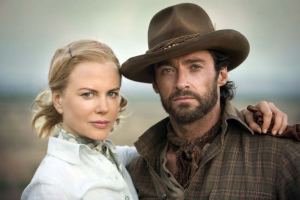 The flick is ambitious, I’ll give it that. Just the title itself sets off an aim to summarize an entire country’s history, culture, and people in a declarative and definitive narrative. Somehow I doubt many will leave the theater and say, “Well, now that’s Australia.” Indeed, I find the film’s narrative to be a limp representation for a country. I suppose most big nationalistic history films start with the birth of nations, but when your country began as a repository for English criminals then I suppose you may want to find a different tale to tell. Australia is really three movies in one colossal package: a Western dust-up, a World War II disaster, and a dark history lesson over the country’s treatment of the aborigines. There is too much movie there, especially at a mammoth running time of 2 hours and 45 minutes. I almost think that Luhrmann believes that if he throws out enough storylines and emotions that somehow it will form a cohesive whole, but the pieces never truly mesh satisfactory. The kitchen sink method rarely works without a grander scheme. The war elements could have been dropped entirely considering that the Japanese bombing sneaks in at the very end of the film and serves little other purpose then decimating the town of Darwin. The movie just all of a sudden transitions into Australia at wartime, and various characters have new positions, like Lady Ashley serving as a phone operator. Where did any of this come from? It just sort of happens without any solid setup or transition despite a near three-hour length. You don’t need to nudge in World War II disasters just to introduce sustainable conflict. Australia is filled with moments where the plot or the characters make big leaps without justifying the transition. Lady Ashley goes from a lily-white upper-class fop to a tanned Outback rootin’-tootin’ adventurer over the course of mere minutes.
Director Luhrmann’s over-the-top visual style is absent and the movie feels strangely square, like Luhrmann is keeping his more manic abilities in check so he can tell an old school epic. But [i]Australia[/i] is not an epic despite a running time that would argue otherwise. It has gorgeous cinematography, gorgeous natural exteriors, and a pair of fairly good-looking leads (Jackman was named People Magazine’s sexiest man alive for 2008), but these are all components and not a finished product. I kept wanting Luhrmann to break free from his creative straitjacket and add some pizzazz and inspired sidesteps. It never happened. Lurhmann has been instrumental in the birth of Australia from beginning to end (he is credited with the screen story), but having such an idiosyncratic and surreal talent make a movie that is so backwards in approach and appeal is lunacy. This is not the best use of Lurhmann’s many talents. Australia has some gauzy and gaudy visuals but it feels altogether devoid of style, though it attempts to make up for that loss in sweep.
 The true history of what happened to mixed race aboriginal children is appalling and certainly worth examination. So why then is Australia another case where the story of a minority’s oppression and tragedy must be told through the eyes of valiant white characters? Nullah’s story is far more interesting then Lady Ashley learning to be a country gal or the Drover learning to settle down. There is much more inherent drama in following a child who feels displaced and forever hunted because of his own genetics. That’s far more powerful than watching the tyke play “Somewhere Over the Rainbow” for the 80th time on his harmonica. Whenever Australia dips into serious statements on the plight of the unfortunate aboriginals, the movie feels very awkward. This is because “serious” is not what the movie does best at all. Australia is a large-scale attempt to revitalize that old-fashioned, sweepingly romantic Hollywood filmmaking of the 1950s. You could just as easily imagine John Wayne and Maureen O’Hara in the starring roles, though the movie’s sensuality and outward comments on racial equality would have been tampered down. My point is that Australia is engineered to be this romantic spectacle that nearly overdoses on sentiment, so whenever it cuts to the aboriginals plight (something serious not in a silly movie sense) then it just seems tonally disjointed.
Let’s also talk about the depiction of the aboriginal people in Australia. Clearly Luhrmann has sympathy for these people and their persecution, and rightfully so. However, the movie turns the aborigines into magical otherworldly spiritual creatures. The depiction is similar to how Native Americans are seen in movies that take place in North America. The Native American is always seen as a being more in tune with nature and spirituality; they’re a “magic Indian” and always seem to possess supernatural powers and great wisdom. These portrayals are intended to be flattering but they really come across as hollow and condescending, transforming disadvantaged people into mystical and mysterious figures. Australia is packed with aborigines walking around, singing their songs to the wind, and having a near-psychic connection to the Earth and its inhabitants. There are several moments where King George, an old aboriginal man, will hum to himself and appear out of nowhere across thousands of miles to pose in a flamingo-like stance. It’s this sort of silly attempt at mystical reverence that stops the movie full-force when it touches upon the terrible realities of how the government treated the aborigines.
 The actors do as best they can with such underwritten characters. Kidman found a perfect collaborator with Luhrmann on Moulin Rouge, a performance that deserved the Best Actress Oscar of that year. She has complete trust in Luhrmann. Her character is the typical role where someone from the outside adapts and finds a new home, which means Kidman is mostly comic and overacts in the beginning. She overdoes the comedy, expressing lines with a bit too much energy that almost seems against her will, like someone is pulling an invisible string to stretch her face into extreme expressions. I’ve always believed that Kidman could be a fine actress but honestly I don’t think I’ve loved a Kidman performance since 2001 with, yep, Moulin Rouge (she was quite fine in Dogville and The Interpreter). I’m starting to dread the thought that I may never see another Kidman performance that sets me afire. Jackman’s background in theater comes in handy when it comes to selling such melodrama and cheesy sentiment. He’s a handsome man and the movie takes great pains to showcase him shirtless. His character is another in a long line of solitary men who have to learn to reach out and love again despite the danger of being hurt. It’ all pretty standard for a Drover, naturally. Walters’ performance can at times be too cloying that it becomes grating. Eventually you do build a tolerance and he becomes more endearing than annoying. I had more fun with the supporting cast who can be relied on to offer glimpses of humor and menace.
I will say that I was rarely bored with the movie, though there are occasions that sag in the overly extended middle. Lurhmann still knows how to make an entertaining movie even if it’s one that generally plays by the book. The first third of the film, the cattle driving section, is the most successful and the most compelling, which is somewhat a backhanded compliment when the movie also deals with racial injustice. The stampede sequence is quite exciting and adds some needed action into the proceedings. From a technical standpoint, everything is staged well and looks refined, and my goodness does Walters have big dark soulful eyes that look pristine on the big screen. Kidman and Jackman’s big screen coupling will likely sate fans of romances between proper ladies and men with musk. Theirs is a romance thinly sketched but told with vigor. Australia is far too accomplished to be dismissed as a bad movie or a grandiose failure, but it never really settles into anything alluring or momentous.
 You know what I’ll take away most from Australia? The term “drover.” Jackman’s character never has a real name, he is simply referred to as “Drover” or occasionally, “Mr. Drover,” as manners require after you sleep with a drover. He is not a “driver” of cattle but a “drover,” which sounds like a present use of a past tense. At one point little Nullah says in voice over, “The Drover drove them cheeky bulls.” Can you “druv”? When you are completed is called “droven”? I wonder if Australian school children ever had to diagram this sentence: “The Drover drove the cows until he had droven them far enough to druv.” This grammatical curiosity lodged in my brain and I amused myself elaborating on the “drover” vocabulary.
Now, Australia itself, as many locals will tell you, isn’t bad. It packs a lot of movie in 165 minutes but I just wish it had been a stronger movie. While the visuals are pleasing and the story is mildly engaging, Australia never justifies itself as the epic it so eagerly wants to become. The story is too disjointed and silly to be taken seriously and too square and stifled to be fun and energetic. Lurhmann is a filmmaker who has such limitless potential; he didn’t just resurrect the movie musical in 2001 but gave it a new language. Watching his talents get henpecked and hampered to tell a nostalgic old-fashioned romance that doesn’t resonate is like watching Gene Kelly paint. Sure it might work but the man just wasn’t meant for it. Which then makes it even more bizarre that Australia has been a passion project that Luhrmann has been working on for years. I don’t feel his passion or even his pride for his native land, though cattle drive tours might increase as a result. This is a movie that could have used more of Luhrmann’s brash and buzzy style. The only thing declarative about Australia is that Luhrmann should have been attached to a different movie.
Nate’s Grade: C+
Share this:

The Assassination of Jesse James by the Coward Robert Ford (2007)
 This is a harrowing, haunting, beautiful, mesmerizing movie that is easily one of the best films of 2007. Casey Affleck is an acting revelation as Robert Ford, the man who worshipped Jesse James and obsessed over him before eventually turning sour and killing his hero. This languid Western, paced at 2 hours and 40 minutes, establishes a mood of gnawing paranoia as the law closes in and Jesse suspects his gang members will betray him. The day-to-day worry and dread of a life of crime really translates, and Jesse James proves an intelligent, unstable leader to mix the pot. The movie builds slowly but the tension grows unbearable and puts knots in your stomach. The acting is outstanding all around, and Brad Pitt proves a great choice for a 19th century American icon weary of his legendary status. The movie presents a fascinating peek into Jesse James’s gang and presents a wealth of historical information, none more intriguing than when the public turned on Robert Ford for terminating one of American’s folk legends. The narration provides sharp, illuminating details in brief expository scenes, and thanks to Roger Deakins’ stunning cinematography, Jesse James is an authentic period picture that is a marvel to view. I was awed by this artistic achievement that still resonates with me long after I finished watching. This film simply envelops you.
Nate’s Grade: A


 nathanzoebl
You must be logged in to post a comment.