Blog Archives
Jack Reacher (2012)
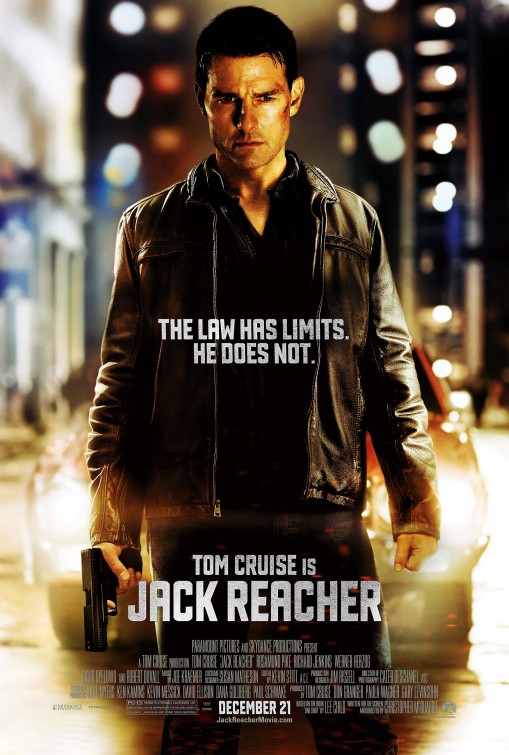 The Jack Reacher of the best-selling novels is a hulking, blonde haired, blue-eyed, 6’4” man of flinty justice. The Jack Reacher of the film of the same name is played by Tom Cruise, an actor who fits none of those descriptions. He is a movie star, however, and those are in short supply. The character is a former MP who operates like a drifter, leaving little trace, and inserting himself as needed to dispense his own sense of justice. The plot of the movie involves Reacher looking for a sniper responsible for a massacre, and hey is that German filmmaker Werner Herzog as the arch villain? Why yes it is. It’s a pretty standard mystery/investigation, complete with crooked cops and inept crooks. What elevates the movie is Cruise’s lone wolf intensity and writer/director Christopher McQuarie’s (The Way of the Gun) ingenuity with clichés. You’ve probably seen this sort of movie before, but McQuarie finds creative and clever ways to stand out, delivering a nifty car chase and a nifty escape as well. It’s just fun watching Cruise outfox his adversaries, via his wits or his fists. Where the movie becomes annoying is how it consistently has to remind you just how badass Jack Reacher is. At every turn, someone will say what kind of exceptional man he is, how he follows his own rules, etc. Reacher even gets the requisite “I’m not a hero so be afraid” speech. After a while, it just feels like the movie is overcompensating, trying to quell the irate fans of Lee Child’s novels who probably envisioned The Rock in Reacher’s shoes. Unlike Reacher the character, Jack Reacher the movie is not the best at what it does, but with a charismatic Cruise in control, it’s at least good enough to see once.
Nate’s Grade: B-
Share this:

Cave of Forgotten Dreams (2011)
 Only Werner Herzog (Rescue Dawn, Grizzly Man) would make a feature-length documentary about doodles on a cave wall. But hold on, those aren’t just any doodles. In the recently discovered Chauvet caves in southern France, explorers discovered cave paintings from humankind’s prehistoric ancestors. The pristine paintings are 30,000 years old, shockingly twice as old as the next oldest cave painting. That means these remarkable displays are the oldest artwork in human history and a great insight into mankind’s beginning; Herzog dubs the cave “the place where the human soul was born.” Herzog was given special permission to film inside the cramped cave, and to share the experience he shot with 3-D cameras. The theatrical experience comes alive with the 3-D, watching the rippling contours of the cave walls, finding that our prehistoric artists actually used the topography of the cave intentionally (abstract thought from long ago). The movie itself is a bit dry and Herzog is prone to ramble on melodramatic pontification, but the real star is the art. It reopens our ideas of life 30,000 years prior. The artwork is also far more sophisticated than you may be assuming. Due to the limitations of shooting, Herzog relies on several talking heads to fill us in on historical/archeological contexts, but it’s never enough. You hunger for more information that the movie ultimately never dishes. But Herzog has given the world a cultural treat, an artifact to remind us about our shared history and the significance of art to humanity.
Nate’s Grade: B
Share this:

Bad Lieutenant: Port of Call New Orleans (2009)
 This is a crazy movie. It is not weird, it is not bizarre; it is not silly. Werner Herzog’s whacked-out movie is a remake of a 1992 movie that wasn’t that good to begin with. This certifiably crazy movie mostly involves Nicolas Cage as a corrupt cop playing all sides and snorting everything that isn’t bolted down in the Big Easy up his nose. For a stretch during the middle, he starts to sound like Jimmy Stewart with lockjaw. The central murder investigation plot is pretty much an afterthought in an environment like this. You want the crazy, and with Cage and Herzog, it is in no short supply. There’s Cage threatening an elderly woman at gunpoint, crawling reptile POV shots, a man’s “soul” break-dancing after the man lies dead, and neon iguanas that may exist only in Cage’s drugged-out mind. The film has been described as a trippy parody of standard cops-and-robbers fare, or as a seriously demented anti-drug message, but I think the best description is just “crazy-ass movie.” It has moments that make you do nothing but shake your head and laugh, like when Cage is about to hit rock bottom and EVERY case/storyline gets solved in a matter of seconds to his bemused disbelief. The comedy is straight-faced but it is definitely there. Cage harnesses his eccentricities and delivers an insanely entertaining performance that reconfirms that there is indeed an actor underneath his Hollywood veneer. He is compulsively enjoyable and the movie is compulsively watchable, every crazy freaking second of it. Iguanas!
Nate’s Grade: B
Share this:

Grizzly Man (2005)
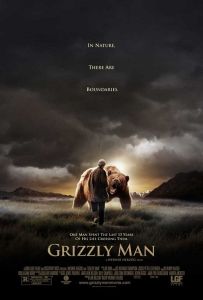 Werner Herzog goes through hundreds of hours of the late Timothy Treadwell’s own footage of himself living amongst Alaskan grizzly bears. He lived every summer with the bears, his “friends,” for 13 years, until one bear killed him and his girlfriend (the deadly altercation’s audio was captured, though Herzog never plays it in the film). Treadwell was retreating from a human society and putting animals on equal pillars as human being, even predators he treated as “men in bear suits.” Treadwell never references his girlfriend, who can only be seen barely once or twice in his hours of footage. That would destroy his fantasy that he’s out there alone, living it up with these creatures. Grizzly Man is an absorbing character study into the working of a very troubled man. It’s interesting how he uses the camera an audience and means of catharsis. He bounces from point to point, brought to tears a bumblebee died mid-flight on a flower. He does different takes of his own nature footage. Herzog presents an altogether different point of view about nature, more cold and survival of the fittest and less cuddly. He brings a critical analysis to Treadwell’s idealized platitudes. The bears Treadwell was spending time with were on protected land, so there really wasn’t much need for his activism. He definitely had a martyr complex going. This critical perspective gives Grizzly Man depth, dueling views of nature playing it out in the documentary form. Weirdly, it seems like a lot of the interviewees in Grizzly Man treated their moments like they were auditioning for Hollywood. This would be a really interesting double feature with March of the Penguins. Treadwell wished for death because his cause would be even greater. Now there’s a movie that will reach millions. Be careful what you wish for.
Nate’s Grade: A-


 nathanzoebl
You must be logged in to post a comment.