Blog Archives
The Number 23 (2007)
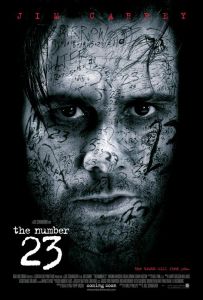 “Nobody likes you when you’re 23.”
-“What’s My Age Again?” by Blink 182
I know math scores have been systematically dropping with America’s youth, but have we gotten to the point where numbers themselves are scary? The Number 23 is a thriller built around the spookiness of a digit greater than 22 but a little less than 24. Does anyone have nightmares about walking down an empty hall only to have the number 23 pounce from the shadows and scream, “Boo?”
Walter Sparrow (Jim Carrey) is a dogcatcher that gets bit on the job. This event causes him to be late for a scheduled birthday rendezvous with his wife Agatha (Virginia Madsen). She wanders into a local bookshop and picks up a worn, self-published book called The Number 23 as a present for her hubby. The book seems to be littered with private details from Walter’s life and he’s left dumbfounded. The main character is haunted by the number 23, which seems to be everywhere and nowhere. Walter starts to see the number dominate his life and fears that he too will fall victim to its control. Walter is also worried that his life will start mimicking that of the book, including the part where he goes psycho and kills his loved ones.
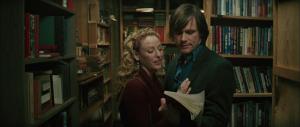 The film spends the majority of its time on two obsessions: the book and the number 23. Now, the number conspiracy is just ludicrous and silly, and it contorts and strains to prove its message. In the flick, someone will scream about some important date in, say, 1940, and then go theorize that it has eerie significance because 19+4+0 equals, tada, 23. But why not 1+9+4+0, or 19+40, or even 1+940? Because then it doesn’t work. Sometimes you take the date, sometimes you add up the numbers in the month, sometimes you need to add up the numbers in the month and the year, sometimes you add and then multiply and then divide numbers (like the contrived manner of making the word “pink” part of this theory); the point is that it’s all arbitrary and worthless. You could go through the same convoluted dance with any number. The same effect happens with cold readings where a “psychic” will spout some vague declaration (“I feel like someone with an ‘R’ in their name died in the last five years”) and rely on the sucker, in this case the audience, to imbue it with some personal meaning (“Oh my God, there was a guy on my street named Rick that died four years ago!”). And all of this relies on the assumption of accurate record keeping for time.
Being haunted by a reappearing number is just dumb, but reading a mysterious book that depicts your own life and predicts you will become a murderer, now that’s interesting. I wish The Number 23 had spent more time with this idea instead of the numerical nonsense. I wanted more questions and contemplation about a book that knows all instead of a number that people bend over backwards to locate in their daily lives. And yet, even this storyline needed a metaphysical jolt. The conclusion follows the most boring, tame, and predictable route that can be best explained. The second half of The Number 23 needed to be more Stephen King and less James Patterson. The psychological aspects of this conundrum are barely explored before the movie seems to lose interest even with its own brand of hokum. Debut screenwriter Fernley Phillips takes the path of least resistance to the finish line.
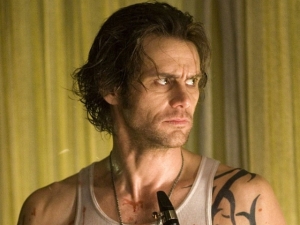 There are some leaps in logic and character motivation throughout. The Number 23 has a strange moral reminder, namely that of a dog that saw something bad and has convinced its doggy self to do something about it, which means spontaneously appearing all over town like a nagging ghost. It is just another plot point that goes too far and breaks credibility, especially since The Number 23 wants to be remotely plausible. Another example is a murder victim who berates her would-be killer while he holds a knife to her throat. She says, among other things, that he’s a freak, she never loved him, and then the final dagger is aimed straight at some long-suffering daddy issues. I doubt anyone picks “knife to throat” as the time to unload their personal grievances. The dialogue also suffers from being so serious to the point of hilarity: “Is 23 a blessing or a curse?” What? Huh?
Director Joel Schumacher (Phonebooth) seems to be having a fun time getting his hands dirty with the material. He can get carried away, and sometimes he uses a sledgehammer when he should have used a slight tap to establish mood. Still, this is one film that you cannot blame the oft-reviled director for ruining. He attempts to goose up this psychological thriller with some persuasive visuals, but all the tricks can’t hide the fact that The Number 23 needs a lot more bite to come across as edgy. It’s too plodding to be disturbing; it’s mostly dank.
Carrey seems an ill choice for this material. Dark brooding doesn’t come natural for America’s foremost manic funnyman; he has some dramatic skills, Eternal Sunshine of the Spotless Mind and a spot-on Andy Kaufman are proof of that, but this isn’t drama, it’s serviceable, gussied-up trash and Carrey doesn’t have the reservoir to show us the dark depths of the human soul. It is somewhat comforting to see Madsen getting more roles since her 2004 Oscar nomination, but she seems to be parlaying that nom into a permanent slot as “wife to lead.” She at least gets to vamp it up in the story within a story as a raven-haired femme fatale.
Even with the preposterous killer number thing, this is a movie with remarkable guilty pleasure potential upside. It’s equal parts interesting and frustrating, and builds a good head of steam before totally unraveling in the last act. The Number 23 is a psychological thriller that just needed better focus with its own obsessions.
Nate’s Grade: C
Share this:

Firewall (2006)
 I’ve seen commercials for Firewall, a new techno-thriller, attached to various TV programs. What’s peculiar is that the commercials are all centered on what Harrison Ford’s character drives in the film. The announcer even says, “See the new Chrysler in … Firewall.” The weird part is that I’ve seen more commercials pimping the movie’s car than the movie itself, like the film is an afterthought to the product placement. With such an inconsistent, stupid, cookie-cutter Hollywood thriller that Firewall is, I’d expect nothing less.
Jack Stanfield (Ford) is a bank security expert living in Seattle. He’s got a loving wife Beth (Virginia Madsen), a teenage daughter and young son, and his bank is about to merge with a larger conglomerate. Before it does, though, Jack takes a meeting with Bill Cox (Paul Bettany) who has a very important business proposition. Jack will waltz into the bank he’s been working at for 20 years and wire $100 million dollars to Cox’s offshore bank account. If Jack fails, the men currently holding his family hostage in Jack’s home will kill them. To secure their safety, Jack must work different sides, infiltrating his own bank and breaking his own system, all the while trying not to get caught and trying to save his family.
The film is so cookie-cutter and filled with obvious and/or useless plot details. In the opening minutes we’re introduced to a remote controlled car that disrupts video frequencies. Of course we know this will come into play later. The opening minutes of Firewall set up all the film’s subplots that will be tidily tied up but only after being ignored. So little of this film feels fleshed out. Firewall seems to think that just having its villain be British is enough. Beth is an architect and designed the family home they’re now held hostage in. Surely this plot point will have greater significance than a toy car. Nope, nothing ever happens as a result of this extraneous detail.
 Ford looks so bored and he does little to hide it. Once again he’s that reticent hero called into action in the name of his family. He really isn’t given much to do and his action sequences are short bursts that involve a lot of him falling down, even when he’s besting a bad guy. A perfect example of how bad the writing is, and how lame they’ve made Ford’s character, is an exchange between Jack and Henry (Robert Patrick) shortly after Ford has liquidated his company of millions. Henry confronts him and says, “You’re not going anywhere. You’re staying here!” And Jack says, like a whiny kid told to eat his vegetables, “No I’mmmm NOT!” Firewall, this is your hero.
The antagonists are another example of how poorly written Firewall is. The villains are incredibly inept on all levels. Their entire plan is kaput from minute one because they didn’t bother to check that the bank was merging and changing its security access panels. Bill basically points to Jack and says, “You come up with a plan now.” The villains need the hero to come up with their scheme, how rich. The bad guys come across like they just took night classes in How to Take Hostages and Extort Money 101. Somewhere Bill must have skipped a few classes because he makes some boneheaded decisions. He kills one of his own men for getting tricked by Jack during surveillance. I suppose he?s trying to make an example but why, if you’re holding people hostage, would you decrease your numbers from five to four? Now you have one less person to get things in line. Bill also must have missed a psychological review to screen out that old Hollywood favorite, the one reluctant kidnapper who’s nice. Did Bill put this thing together through an ad in a newspaper?
Then there’s the dog. Why on earth did the bad guys take the dog with them when they moved the family? It just so happens that the dog has a GPS tracking device on its collar. It’s a plot contrivance so Jack can find his family, but it makes no sense. These big bad men will kill one of their own but take the dog along too? Bill and the gang didn’t have to kill the dog but taking him doesn’t add up. It’s like a serial killer alphabetizing your CD collection.
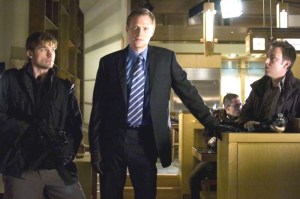 The whole hostage situation is laughable. Bill’s thugs turn a hostage situation into a bed and breakfast, implausibly letting the family roam around the house, watch TV, do whatever really. Bill even makes pancakes for Jack’s kids, that bastard. The most threatening Bill ever gets is when he offers a peanut butter cookie to Jack’s peanut-allergy kid. Dastardly and, oh yeah, the kid didn’t have to choose to eat what the bad guy gave him! This is the worst hostage siege ever. It is insultingly ridiculous. Madsen is annoying as she tries shaming her captors, proclaiming motherly advice. Firewall‘s chances of thrills are spoiled by inept bad guys and the family being in laughably staged peril.
The heist itself is given such lip-service that it almost becomes incidental. It plays for a total of maybe five minutes onscreen and lacks any thrills. Why should there be thrills if Jack came up with it? There no reversals, no setbacks, no complications, no nothing. Firewall needed to be run through a typewriter a few more times, work out a punchier screenplay that actually turns the heist into something tense.
Firewall should have played more like a cat and mouse game, with Jack and Bill battling for supremacy. Instead, Firewall feels emblematic of every other stupidly plotted thriller Hollywood feels it can feed to a mass audience because it slaps a star in it. This is shamefully mediocre, stupid, and, above all else, rather boring. Firewall is your typical disposable Hollywood thriller-of-the-week, just with more tech jargon that Ford looks pained to even speak. If you replaced Ford and Bettany with, say Mark-Paul Gosselaar and Corbin Bernsen, you’d have a movie fit to air late night on TV when the only people awake would be insomniacs. Finally, then, Firewall would have found its rightful audience.
Nate’s Grade: C-


 nathanzoebl
You must be logged in to post a comment.