Blog Archives
The Old Guard 2 (2025)
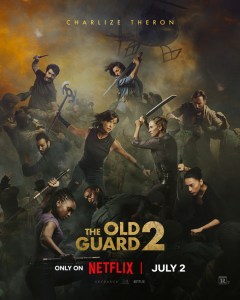
I wasn’t a big fan of the 2020 immortal action movie The Old Guard, but apparently it became one of Netflix’s most viewed movies, so here we are five years later with a sequel about the ancient conspiracy of warring immortals co-starring Chiwetel Ejiofor (not to be confused with Infinite, which is about an ancient conspiracy of warring immortals who are reincarnated into new bodies co-starring Chiwetel Ejiofor). I found the action and the general world-building to be underwhelming, but Old Guard 2 makes The Old Guard look like Michael Bay in comparison. There are two key developments in this sequel. Uma Thurman plays the first immortal and she wants to destroy the world or whatever. The second is that anyone injured by our newest immortal, Nile (Kiki Layne), loses their immortality. The rules of this universe get awfully hazy. I’m taking this directly from the film’s Wikipedia summary: “Additionally, anyone who has lost their immortality can regain their power by another wounded immortal who can transfer their power to the host they choose.” Still following? So we have one person who can make immortals mortal, but any mortal immortal can also choose to have their absent immortality bequeathed to a mortal immortal of their choice, reasserting their immortality. Okay. The confusing rules would be mitigated if we found any of the characters compelling. The sequel does bring back Andy’s (Charlize Theron) ex-beloved Quynh (Veronica Ngô) who was locked into an iron maiden coffin and dumped overseas. The established rules had immortals reawaken from death, so this poor woman would keep waking back up again only to drown instantly and repeat the horrifying process again. Let’s do the math here. On average it takes about two minutes to drown (FYI, I typed into Google “how long does it take to drown,” and now my computer is worried about my mental health). Let’s cut that in half from the extra water pressure filling her lungs. So let’s say she dies every minute. That means she dies 1440 times a day. Over the course of 500 years she has died 262,800,000 times. Rescuing this woman should be a recognition not just of her relentless suffering but the fact that her mind should be shot. Having to endure that horror would break anyone, and Andy coming to terms with her inability to heal someone who cannot die but is also unable to continue life any longer woukd be interesting. That’s my preferred sequel. Instead with The Old Guard 2 we get a bunch of lackluster fights and convoluted lore, and it doesn’t even offer a conclusion, more an implied hand-off to a third movie where the characters may indeed be able to finish what they’ve started. It’s time to let these mortal immortals just die in peace.
Nate’s Grade: C-
Share this:

Kill Bill vol. 1 (2003) [Review Re-View]

Originally released October 10, 2003:
Breathtaking and stylistically amazing. That’s all there is to it. Can’t wait for part two.
Nate’s Grade: A
——————————————————
WRITER REFLECTIONS 20 YEARS LATER
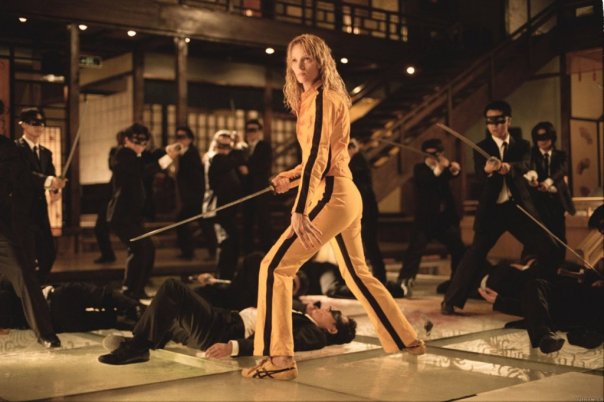
Kill Bill was a turning point in the career of one of the biggest cinematic artists of the past 30 years, and as exciting and stylish as Volume 1 proved, this is the point where Quentin Tarantino vanished within himself and became the ultimate B-movie revivalist. It only took two films for Tarantino to not just become an indie brand name but his own adjective, as Hollywood was flooded with “Tarantino-esque” imitators chasing after the man’s unique voice of snappy pop-culture soliloquies, hard-boiled dialogue, and meta-textual irony. Of course the imitators could never truly capture the full appeal of Tarantino’s movies, overvaluing the surface-level aspects (quirky characters, non-linear plots, unexpected bursts of violence) and missing the greater character depth and thematic intricacies that allow the style to accentuate the entertainment rather than solely serve as that value. 2003 was the crossroads where Tarantino switched from smaller dramas and crime thrillers about semi-recognizable and relatable people (the middle-aged romance in Jackie Brown is the most tender and sincere writing of his career) to remaking and re-packaging his favorite grindhouse exploitation movies. It was like Tarantino himself was following the path of the would-be Tarantino-esque imitators.

Kill Bill began as an idea between actress Uma Thurman and Tarantino on the set of Pulp Fiction; it even feels like a big-screen realization of the failed Fox Force Five pilot that Mia Wallace (Thurman) filmed. Thurman had the idea of the opening, a bloody and beaten woman in a wedding dress being executed only to survive her execution. The idea germinated for years and became two movies worth of material. It’s hard for me to envision Kill Bill as one whole entity because the two volumes feel so thematically distinct. The first is an homage to 1970s kung-fu movies and Eastern cultural influences whereas the second volume serves as an homage to spaghetti Westerns and Western cultural influences. I’m shocked that through the annals of numerous physical media releases at no point has someone released Kill Bill as one whole four-hour movie. It’s only ever been physically screened as such once by Tarantino, and I think the implicit admission is that, while conceived as one sprawling and gargantuan epic, the movies work better as halves that reflect and enrich one another due to that separation. As I wrote in my 2004 review of Volume 2, the first part is the “show” and the second is the “tell,” but what a show Tarantino pulls off.
There was a time where the idea of Tarantino helming an action movie felt antithetical, but he tapped every corner of his encyclopedic knowledge of genre cinema to give us one of the best action movies of all time. The centerpiece sequence pitting The Bride against the Crazy 88s, as well as the ball-and-chain-wielding schoolgirl Gogo, feels like the culmination of a lifetime of cinema geek passion. It’s viscerally exciting without getting boring over the course of twenty-something minutes because Tarantino keeps things shifting, never falling upon redundancies, as if he’s so eager to squeeze in each and every loving homage and reference point. The climax, which again feels so natural an escalation and end point for a “part one,” took eight weeks to film, and the MPAA insisted it be toned down to secure an R-rating (he turned it black and white to obscure the color of the blood, itself another indirect homage to martial arts movies of old when they played on American television). Reportedly over 450 gallons of fake blood was used during the production of both volumes, but this first edition is definitely the more gleefully over-the-top.

The revenge structure is shaped around The Bride (née Beatrix Kiddo) killing the five members of her former gang, the Deadly Viper Squad. Volume 1 only covers two members meeting their just desserts, one of which is the opening scene. That means after the first ten minutes fighting Vernita Green (Vivica A. Fox), we’re working the rest of the movie to the next boss fight. That’s where we get the character dynamics, the obstacles that The Bride must overcome (step one: wiggle your big toe), and the history of O-Ren Ishii (Lucy Lui) and her ascension to Japanese crime lord. With less careful filmmakers, this middle stretch might feel sluggish, but with Tarantino, it’s invigorating as the new world and its many faces connect together to create such an intriguing and engrossing larger picture. Volume 1 provides the structural bones of the story, as well as buckets of sticky viscera, whereas Volume 2 adds the meat and complexity and larger nuance. That doesn’t mean Volume 1 is lacking creativity, it’s just that it’s the half that has to perform more foundational lifting so that those character details and choices will have the larger impact they do. Volume 1 is a long straight line back to O-Ren Ishii, and the accelerating carnage is wonderful to behold.
Thurman has never been better than with her Quentin collabs. After her sudden rise in Pulp Fiction, it felt like her career stalled playing many “hot girl” roles in misfires like The Truth About Cats & Dogs, The Avengers, and of course Batman & Robin. After her Kill Bill revival, her star rose again only to once again falter from more reductive “hot girl” roles in misfires like Paycheck, My Super Ex-Girlfriend, and the movie musical of The Producers. She recently came into the casting orbit of Lars von Trier, a filmmaker who never met a beautiful woman he didn’t want to punish excessively onscreen for society’s ills. Her role in 2014’s Nymphomaniac volume 1 was a memorable high point as a contemptuous woman confronting her husband’s younger lover, the titular nymphomaniac. Perhaps it was the meta-textual comment of Thurman’s cinematic type-casting, the older “hot girl” replaced by the younger, newer beauty. I’m probably just grasping for greater meaning here. Thurman and Tarantino didn’t speak for years after the conclusion of the Kill Bill series, but it wasn’t until 2018 that we found out why. That’s when the public found out about the existence of a video where Thurman was driving a car and crashed. The problem was it should have been a stunt driver but Tarantino insisted and pressured Thurman into doing the stunt, she crashed, was injured, and still suffers to this day. She says she has since forgiven Tarantino even though he and Harvey Weinstein withheld footage of the incident for years.
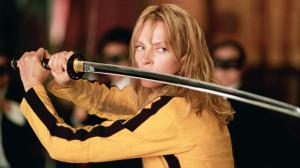
The music has taken on a life of its own. Much was repurposed from old movies and given new context, much like Tarantino’s overall creative mantra. The siren-blaring announcement of two foes facing each other has become its own pop-culture meme. The slow-motion walk to “Battle Without Honor or Humility” has also become pop-culture shorthand. “Twisted Nerve” is a great ringtone, and “Woo Hoo” by the Japanese surf rock girl group The 5,6,7,8s became so inescapably hummable that it eventually became the catchy theme of a wireless company.
This movie also holds a special place for me because the image that immediately comes to mind is watching my father uproariously laughing throughout the movie and rocking in his theater seat. A severed head leading to a geyser of endless blood had my father cackling like a child. By the end of the movie, I recall him turning to me, smiling ear-to-ear, and exclaiming, “Now that was a great movie!” Conversely, I also remember my college roommate falling asleep next to me as The House of Blue Leaves was bathed in (>450) gallons of (black and white) blood.
In the ensuing two decades, Tarantino has directed five other movies, published two books, been nominated for Best Director twice, won his second screenwriting Oscar, and essentially brought the tastes of the Academy to his own. He’s written three Best Supporting Actor winners (Christoph Waltz in 2009 and 2012, Brad Pitt in 2019) and become one of the most commercially reliable names, a director whose very name itself is a selling point for mainstream audiences. Even while some may bemoan that the indie provocateur might be “slumming” with his own highly polished version of B-movies, he’s dragged those same tastes to wide commercial appeal and industry acclaim. Kill Bill Volume 1 is the beginning of Tarantino tattooing ironic air quotes to his output, but when you’re this talented and passionate about movies of all kinds, even a kung-fu homage can become a cultural force and one of the best superhero origins ever (The Bride is pretty much a superhero and compared to Superman in Volume 2). Kill Bill Volume 1 is still a masterfully entertaining and bloody fun experience twenty years later.
Re-View Grade: A
Share this:

The House That Jack Built (2018)

I believe I’m ready to cast Lars von Trier in the same dustbin I’ve consigned Terrence Malick and Michael Heneke. I think I’m done with him and his films. The man has obvious talent but is often his own worst enemy, given to self-destructive impulses and excessive cruelty meant to be daring and challenging but is mostly perfunctory. The House That Jack Built is distasteful by design but also heavy-handed, obvious, and vacuous to a fault.
Jack (Matt Dillon) narrates his life as an American serial killer in the 1970s and 80s. He’s traveling through the afterlife with the help of Verge (Bruno Ganz), a supernatural guide and easy listener. Jack divides his murderous exploits into a series of five key incidents: Lady 1 (Uma Thurman) being picked up looking for car help; Lady 2 (Siobhan Fallen Hogan) as a suspicious neighbor answering the door; Lady 3 (Sofie Grabol) as a mother with kids who is taken hunting and then literally hunted; Simple (Riley Keough), the one who tried to get away; and finally the last scenario where Jack tried to kill multiple men with a single “full metal jacket” bullet. Along the way, Jack talks about the frustrations of his boyhood and adulthood, living with OCD, and the implications of his life’s legacy.

It’s not that a serial killer film, whether it be a psychological examination or gnarly genre thrill ride, can be without artistic merit, but von Trier settles for empty provocations. He’s using the nature of the movie serial killer to essentially terrorize the audience and make them question what entertainment value they ever saw in these kinds of figures and stories, or von Trier’s films at that. I was expecting an unsettling experience given the nature of the subject and the reputation of the filmmaker, but what made the situation all the more oppressive and disquieting is how obvious and heavy-handed everything comes across. The central metaphor could not be any more transparent for any person familiar with von Trier’s back catalogue of punishing feature films. Jack views himself as an artist, specifically an architect, and his art is via terrorizing women for personal satisfaction. In case you needed it further spelled out, Jack is von Trier, a filmmaker who makes movie after movie featuring a central heroine being abused and exploited with no cosmic justice. A von Trier film experience is all about unchecked suffering and systemic abuse from the patriarchy. Sometimes this can be a condemnation that elicits strong emotional responses like a Dancer in the Dark, and other times it feels like von Trier wallowing in flip nihilism, like the conclusion of his two-part Nymphomaniac opus that undid the preceding four hours. Jack kills women for his art; von Trier tortures women for his art. There you go. With that central metaphor established, you’d expect the movie to become an introspective and excoriating probe into von Trier as a notorious filmmaker who often shocks and appalls. Oh how wrong you would be. The House That Jack Built is the same stale slog only with a slight meta twist.
For no better example of how heavy-handed the movie is, simply observe its unnecessary framing device where Verge/Virgil is literally leading Jack in the dark toward the subterranean bowels of Hell and the two are digressing the long walk. My friend and filmmaker Jason Tostevin said he was watching The House That Jack Built with a “scrunched-up face” for its majority until the last thirty minutes when he accepted it as a morose comedy, and then it started playing better for him. That might just make sense, considering von Trier’s overwrought pitch-black sense of humor and overall belief that life is a joke. I did laugh out loud once Jack and Verge are floating in bubbles. It also provides some, not much, context to scenes like Thurman’s, where she keeps needling Jack about what a bad serial killer he would be based on his decisions. It’s almost like von Trier is trying to say that Jack took the psycho killer plunge because a bossy woman kept annoying him and pushed him into it. The early sequence of Jack stumbling into being invited into a woman’s home has a clumsiness that almost invites a degree of wicked comedy, especially after Jack tries to treat the woman who seems incapable of dying. There’s also the absurd conclusion of the “house” Jack actually finally constructs. However, even as a supposed “comedy,” The House That Jack Built is an obnoxious experience that will make you feel worse by the end of its painfully lugubrious 150-minutes.

There was one kernel of an idea that could have worked, the nature of a serial killer with OCD. Those competing impulses would provide a level of new interest. During the second incident, Jack is compelled to go back to the crime scene again and again, risking being caught by a pesky neighbor or police officer, but he can’t help it. He’s obsessed that he didn’t check every last square inch and there’s an unseen blood droplet that will doom him. The concept isn’t new as Ray Bradbury had a short story “The Fruit at the Bottom of the Bowl” about a killer obsessed with eradicating every trace of his fingerprints. It puts the killer in a position of vulnerability that makes every killing more fraught. It’s almost like von Trier can suspect his audience enjoying this aspect of his story and so he must snuff it out. For whatever reason, Jack says he eventually just stopped caring. He just got over his crippling OCD tendencies through the power of criminal apathy. Jack is never in any danger of being caught because, and even Verge interjects on this, the people of this world are preposterously stupid. Nobody believes Jack is a potential murderer, and so this level of ignorance (and white male privilege) enables him to kill with impunity. By removing the possibility of any external threat, Jack becomes that much more boring. The only possible points of interest now become his disturbing murder tableaus. An extended sequence with Keough (Logan Lucky) made me feel queasy, especially when her character’s breasts end up getting severed and slapped onto an ignorant officer’s windshield. That moment felt like von Trier rubbing it in that a good-looking white man can get away with anything.
Even with its five-incident structure, plus celestial-spanning epilogue, the movie is all over the place. von Trier never met a Wikipedia article he didn’t like and want to awkwardly shoehorn into a longer narrative. Get ready for more seemingly unrelated academic asides meant to come across as philosophical pontification on the nature of art, evil, culpability, and whatever else sounded smart at the time. Jack compares his murder sprees to… medieval architecture. He then digresses about pianist Glen Gould, dessert wines and their decomposition process, the screaming WWII German airplane the Stuka, the theory of Ruin Value, the balance of light and shadow from two streetlamps, and you bet there are concentration camp anecdotes. At one point Jack and Verge are debating how one can best enjoy art and von Trier uses clips from his own movies as examples of “challenging art” in case you wondered whether or not he was going to be too hard on himself and his past. These quizzical asides often feel tacked on like academic footnotes, yet the film is stuffed full of them. It lurches from incident to incident and footnote to footnote, mostly because Jack is a rather boring lead character with a boring worldview and past. Then there’s the final epilogue that literally takes place in Hell. If you can make it past that, dear reader, you’ll be treated to a smash cut to the end credits set to, I kid you not, “Hit the Road Jack.” It’s a baffling, tonally discordant decision that only furthers the theory of Jack as a comedy.

I feel like I’ve endured enough von Trier films in my life at this point that I can walk away, content with the decision. It’s getting harder and harder for von Trier to tell a new story and his old tricks have grown tired, placing him into unintentional (or intentional?) self-parody. There isn’t enough introspection or insight or narrative complexities to justify this bloated and bedeviled look at one man’s many misdeeds. The characterization is slack and there are no significant supporting figures, only victims and stooges, and sometimes both at once in von Trier’s mocking reflection of our universe. I felt varying degrees of sympathy for every actor in this movie. They deserve better. Matt Dillon can play to the dark side well but he deserves more than to be a smiling cardboard cutout. Uma Thurman was one of the best actors in Nymphomaniac Part One. Doesn’t she deserve better than to get repeatedly smacked in the face with a broken car jack (get it, a “broken jack,” because the main guy’s name is… oh, you do get it?)? Riley Keough definitely deserves better than to have her breasts fondled for a solid minute onscreen and then used as a coin purse later. And the audience likewise deserves better than to spend 150 minutes watching misguided torment and misogyny disguised as introspection and social commentary. The House That Jack Built is rotten to its very foundations and another excuse in cheap sadism for the cheap seats.
Nate’s Grade: C-
Share this:

Nymphomaniac volumes I & II (2014)
 When Danish film director Lars von Trier said he wanted his next movie to be “porn” he wasn’t kidding. The controversial filmmaker wanted to explore the world of a woman addicted to sex, following her history of varied experiences over the course of two movies/volumes. Actors lined up for the notoriously demanding filmmaker. During the sex scenes, computer effects magic married the actors’ faces and upper bodies with the lower parts of porn stars. Upper half, Charlotte Gainsbourg, lower half, some pornographic double, all spliced together into one onscreen human being. Think about that little special effects ground-breaker, putting Hollywood faces into hardcore sex scenes. Knowing von Trier’s pessimistic tendencies, and his penchant for heaping abuse upon his female leads to the point of uncomfortable exploitation, you may rightly cringe about the prospect of a von Trier “erotic” movie. That’s the funny thing about Nymphomaniac; it’s all about sex, sometimes graphically so, but it’s never erotic. It’s an intriguing, sometimes maddening look at human sexuality and our inhibitions and frailties, until a horrible ending spoils it. In the end, von Trier just couldn’t help himself.
The story boils down to this: Joe (Gainsbourg as an adult, Stacy Martin as the younger version) is found beaten and unconscious in an alley. The kindly, monk-like Seligman (Stellan Skarsgard) finds her, brings her back to his home, and tends to her wounds. Joe says she brought all of her pain upon herself. Seligman finds this hard to believe. She uncorks a lengthy series of tales about her sexual awakening and desires.
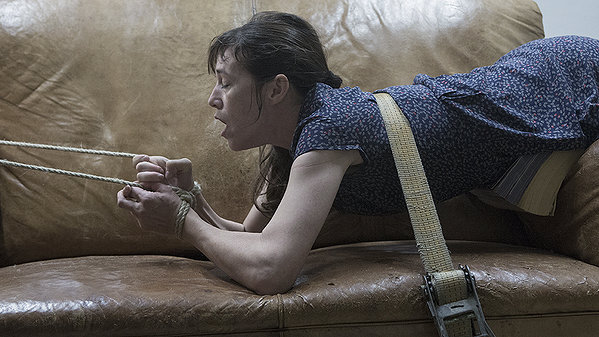 In many ways, Lars von Trier is the best and worst candidate to present a four-hour opus on the life and times of an avowed nymphomaniac. The man approaches the idea of sex addiction in practically the most clinical way possible while still being cinematic. You can practically envision Seligman as a stand-in for von Trier, countering Joe’s sense of shame with a broader, scientific perspective. Really, this is the tale of a woman spilling her guts about all her dirty little secrets and a man nodding along, asking questions, and dismissing her self-loathing with his reason and empathy. It’s sort of like being inside a therapist’s office. I can’t say whether or not I find all the analogous asides to be interesting or simply insufferable pretension. While Joe is detailing her behavior, Seligman will stop her and provide further context, often bringing in such subjects as fly fishing, the mating habits of fish, the Fibonacci sequence, Eastern Orthodoxy, and classical music. It’s almost absurd how encouraging Seligman is, dismissing every action of Joe’s sordid past through an example. After a while, it almost becomes a humorous game all its own, as we know Seligman will use every story as a stepping off point to some weird outside connection. Every item in Seligman’s bare bedroom inspires a story from Joe, which leads to a suspicion that she is something of a salacious Keyser Soze, piecing together her story on the spot; some of the coincidences with Jerome (Shia LaBeouf) seems just a bit too much. Seligman’s enlightened and intellectual asides force the audience to consider deeper meaning with Joe’s actions. Is she irredeemable, does she have control over what she’s doing, is she doing anything even bad? Over the four hours of psychological examination, the doctor is out. Nymphomaniac, especially in Volume Two, is the best film yet on sex addiction. It doesn’t demonize the behavior, it doesn’t treat it as sensationalistic, and it doesn’t overtly judge its lead characters and the choices they make, nor does it spare them the devastating consequences.
The graphic nature of the film is getting all the headlines but Nymphomaniac treats its heroine as an addict trying to get a hold of herself. We begin with young Joe innocently discovering her sexuality, especially discovering the pull she can have over an almost endless parade of weak-willed men who will follow her every whim. If that was the only plot, then there would be little separating von Trier’s film from any late-night cable erotic series (“Oh, let me tell you the time I met this man and we did this…” –Repeat). Over the two movies, we get a stronger sense of how utterly trapped she is by her urges, by her addiction. When she’s dealing with the undignified death of her father, Joe finds whatever solace she can with a willing bedmate. She places herself in precarious situations chasing after that orgiastic high, which disappears at the conclusion of Volume One. The cliffhanger separating the two volumes is that Joe loses her ability to feel sexual pleasure, which is rather problematic for a nymphomaniac. And so in Volume Two, Joe desperately searches for a means to get her groove back, at one point abandoning her own child so that she can pursue her kink. Joe goes to counseling, joins a sex addict group (she bristles at the term and prefers “nymphomaniac”), and tries to detox, at one point removing everything vaguely sexual from her apartment, including anything knob-shaped.
 The film is structured as a series of vignettes and anecdotes, broken up with von Trier’s tried-and-true onscreen chapter system. As expected for a film based around anecdotes, some stories are more interesting or revealing or simply entertaining than others. The stories are a little more whimsical in Volume One but by the time we get to Volume Two, they become more punishing and sad. It’s one thing to bet your promiscuous gal pal who will have sex with the most people on one train ride home, or on a prank to stick a restaurants dining utensil up your vagina, but it’s another when an adult woman, night after night, leaves her toddler at home so she MAY have the opportunity to have her behind whipped. The young Joe stories are easier to shake off as youthful experimentation and thrill seeking, which Seligman rationalizes as well. However, they set up just exactly the path that the adult Joe was destined for. The tales in Volume Two have to ratchet up the stakes, given Joe’s absent mojo, so what was once titillating can become downright disturbing. von Trier’s four hours offer plenty of feel-bad feel-good opportunities along the human sexuality sphere. Adult Joe thinks introducing a language barrier could be enticing, so she asks an African immigrant if he’ll have sex with her. He agrees, but brings his brother along. The two men bicker in a different language, while Joe sits there, head slumped against her hand, comically waiting for these two naked men, their penises wagging in the foreground of the camera, to get to business. It’s quite a funny and ludicrous turn of events.
One story in Volume One stands out for its raw emotional power. Joe has a whole schedule of lovers visiting her door. Well one such older man wanted to have Joe all to himself but her price was high: he had to leave his wife, “Mrs. H.” Surprise, he does, and Joe is already uncertain if this new arrangement is what she wanted; her offer was better in the theoretical sense that he would never cross that line. Well the misses (played with chomping disgust by Uma Thurman) comes for a visit and she brings her kids along. She wants her children to see what their daddy traded them away for. At first, the wife acts civil with some stinging passive-aggression, but the uncomfortable incident is dragged out, and the emotions reach a fever pitch, with crying all around. It’s so uncomfortable, so potent, and so memorable, forcing Joe, and the audience, to think of the ripples of consequences from simple sexual dalliances. While Joe is having her fun, unbeknownst to her, there are far-ranging consequences that she, and by extension the audience, choose to ignore because all those pesky details would get in the way of our fun.
The most troublesome storyline is also one of the longest, with Joe having her backside swatted by a no-nonsense sadist played by Jamie Bell (Man on a Ledge). This guy insists there will be no penetration and his rules are to be followed strictly. It starts out intriguing to get a sense of who this guy is and what his practices will be. Joe has to sit with other women between the hours of 2-4 AM, and maybe she’ll get picked. Night after night, she goes through this setup, so desperate to feel the spark of desire again. This situation feels like it goes on forever. There is no easy climax. Rather it sets up the darker turn for Joe’s character, as she gives up being a mother and a wife. To make ends meet she becomes a debt collector, using her knowledge of men, particularly heir weaknesses, to coax them back into paying. There’s one disarming moment when she takes great pity on a pedophile that will surprise you, and it’s the only incident that causes Seligman to disapprove. Her boss (Willem Dafoe) advises her to think of an eventual replacement she can groom, and his method is singling out a young girl with no support, becoming her world, and slowly manipulating her to do your every wish. In a von Trier film, that is what a retirement 401k package looks like. This whole storyline, including her young mark (Mia Goth) romantically falling for her would-be maternal figure, just feels misplaced, like von Trier doesn’t know how to bring his four-hour opus to a close.
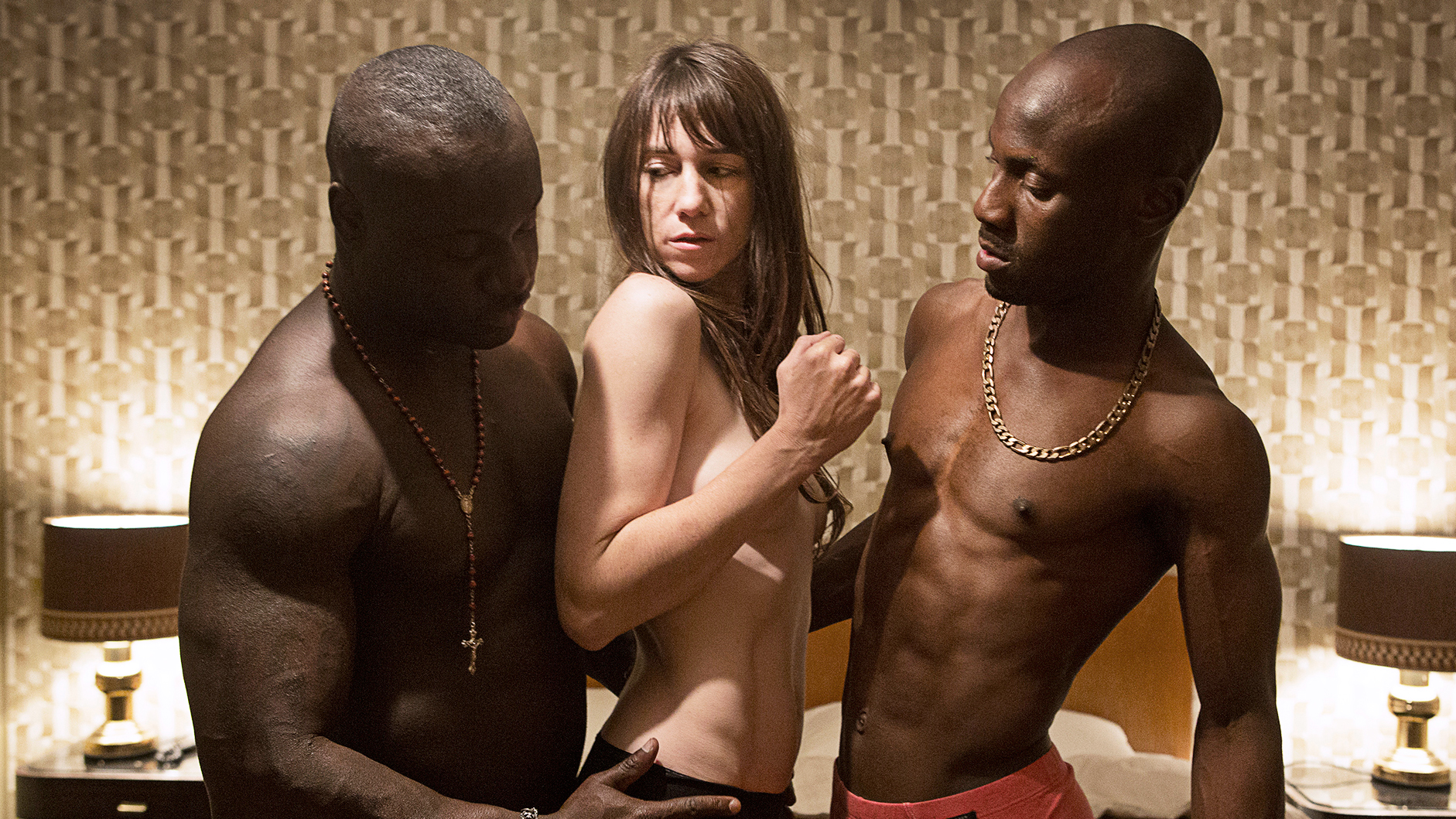 That’s because he doesn’t! This paragraph is going to delve into the conclusion of Nymphomaniac, so be warned that there will be major spoilers being discussed. If you wish to remain pure, skip to the next paragraph. During Volume One, I had the unmistakable feeling that all of this had to be leading somewhere. It wasn’t just going to be one woman distilling her life stories over the course of one night. I also figured there had to be a reason for why Seligman would rationalize every one of Joe’s actions, shifting blame away from herself. And there’s truth to what he says, namely that the world judges Joe far more harshly for her actions because she happens to be a woman committing them. If a man was performing the same stunts, or left his family, he would not be seen as damningly. Then early on in Volume Two, Seligman reveals himself as asexual, a man born without any sexual desire. He argues he’s the perfect person to hear out Joe’s tales of woe, as he can objectively analyze them free from lust and desire and titillation. Then, by the end of volume Two, Joe as decided to change her ways. She wants to be someone different, someone better. She’s turned the corner. What, a glimmer of well earned hope emerging at the end of a von Trier film? That’s impossible. This natural ending is destroyed thanks to von Trier’s nihilistic perspective; he just can’t help himself. And so, though it makes no narrative sense and seems completely out of character, Seligman comes back to Joe, tries to rape her, and is then shot dead. That’s the end. Every man is a deviant. It just completely undoes Seligman’s entire perspective, as von Trier abandons whatever gains he’s made over four hours for what amounts to a groan-worthy joke. It is without question one of the worst, most misguided endings I’ve seen in a film. It makes the previous four hours feel like a lousy setup for a lousier joke.
It’s a shame because Gainsbourg gives a terrific performance as the older Joe. The actress is no stranger to von Trier and his sadomasochist ways, having also starred in Antichrist and Melancholia. You get a sense of her character’s desperation, the thrills of her youth now gone. She’s also grappling with her own fallibility, the anger that comes from that, her antipathy with others, and the regrets and jealousy that penetrate her hard exterior (no pun intended). She’s trying to act above society, an operator who plays by a different set of rules, but it’s fascinating when the emotions reveal themselves from the sensations. And Gainsbourg puts all of herself into this role, submitting to her character’s many mental and physical tortures. Even if she has a body double pasted in, it’s still representational of her and Joe. Gainsbourg manages to draw us in, not wanting our sympathy but eventually earning it. Martin, as young Joe, gets just as much screen time as Gainsbourg, but there’s a vacancy there to her acting, a certain passivity that makes young Joe feel more like a spectator than a participant in her life. Skarsgard (Thor: the Dark World) is an appealing foil for Joe, almost comical in how accepting he is and how excited he can get with his digressive connections. The only other actor of note in the large ensemble is LaBeouf (Transformers) who affects a strange accent but sticks with it. We’ll see if his self-imposed exile from Hollywood and acting sticks as well.
 I’ve spent this entire review talking about everything else rather than detailing the nature of the graphic sex, the point that earned Nymphomaniac much of its curiosity with the general public. That’s because the explicit nature of the sex is inconsequential. I understand that that may sound odd for a movie literally called Nymphomaniac, but that’s because von Trier’s movie is less interested in the salacious and tawdry acts and more about deconstructing a life lived and the increasingly fraught rationale for her choices. Much like Blue is the Warmest Color, the graphic sex is the headliner, and it is occasionally graphic and unsimulated, with more than a few vaginal close-ups. The sex is incidental, a symptom of the human condition, and von Trier’s less-than-sensational look at such a sensational topic grounds the movie intellectually. With Nymphomaniac, von Trier is posing questions, pushing his audience to question our own views on sexuality and concepts of normalcy and what is and isn’t in good taste. We’re prurient creatures lapping up all the dirty details and copious amounts of nudity, but the introspection is what sticks, and it’s an incisive character study that opens up in many beguiling, illuminating, and surprisingly relatable ways…. Until the end. There’s no way to account for Nymphomaniac and just forget the ending. Four hours and for what? I cannot fathom what von Trier was going for rather than a return to his M.O. of humanity resorting to casual cruelty. If you can bear it, Nymphomaniac is a fitfully entertaining film, provocative to the end, and then it all slips away thanks to cinema’s worst practical joker.
Volume 1: B-
Volume 2: C+
The Ending: F
Nate’s Grade Overall: B
Share this:

Percy Jackson & the Olympians: The Lightning Thief (2010)
 If you’re looking for a pristine example of mediocrity, then let Percy Jackson serve as the new definition. From the acting to the special effects to the story, this movie barely registers anything other than a disinterested shrug. Based on a series of young adult books, clearly the producers were eyeing a potential lucrative franchise, which may explain why they hire Chris Columbus as director. The modern-day scions of ancient Greek gods is an intriguing starting point, until you realize that the film is just going to become one big, dumb retread through Greek mythology without a hint of wit. It’s Greek mythology turned into a kid’s book report who never read deeply into the source material. The film’s best asset is its collection of adult actors (Pierce Brosnan, Uma Thurman, Steve Coogan, Catherine Keener, Rosario Dawson), which take your mind off the fairly bland teen actors in the lead. Percy Jackson would be a more forgivable drag if it presented any moments of wonder that didn’t feel trite. The plot has the maddening habit of making characters stupid for plot reasons (hey Lightning Thief who wants to start a God-on-God war, when you have Zeus’s lightning bolt, thus sealing an impending war, don’t stop and monologue!). Yet the film has enough going on that you can follow it with ease and a minimal commitment. Consider putting on Percy Jackson when you need to do some household chores; it deserves that kind of attention.
Nate’s Grade: C
Share this:

Kill Bill Vol. 2 (2004)
 When last we left The Bride (Uma Thurman), she had reawakened from years of coma, traveled to Japan to acquire the finest sword ever created, and crossed off two names from her list of those marked for death in the name of bittersweet vengeance. O-Ren Ishii (Lucy Lui) and Vernita Green (Vivica A. Fox) fell under the hand of The Bride in Kill Bill, Vol. 1. Now, the only members left of the Deadly Viper Assassination Squad (DiVAS), the group our heroine was once a part of, are the one-eyed Elle Driver (Daryl Hannah), Budd (Michael Madsen), and the titular ringleader, Bill (David Carradine).
Kill Bill, Vol. 2 takes a very sharp tonal shift from the previous film. Kill Bill, Vol. 1 was a head-spinning orgy of blood and stylized carnage, and it could be argued that its actual plot was wafer-thin. But it seems with Kill Bill, Vol. 2 that Tarantino had answered every critical concern about the first film before they were even brought to his attention as the two films were shot and cut in one grand effort. This film has a much more genial sense of pacing and numerous moments of drawn-out monologues, a far cry from the breakneck pace and terse dialogue of its forerunner. Fans of the relentless hack-and-slash of Kill Bill, Vol. 1 may be disappointed that this film lacks the chopped limbs, geysers of blood, and senseless, yet immeasurably thrilling, slaughter. In fact, whereas the body count for a lone sequence of Kill Bill, Vol. 1 may be in the fifties, Kill Bill, Vol. 2 has three total murders. It is the quieter, more adult half of this revenge opus. Kill Bill, Vol. 1 was an homage to chop-socky grindhouse Japanese films. Kill Bill, Vol. 2 is Tarantinos homage to spaghetti Westerns and their languid pacing and showdowns.
 The acting is superior to what you would expect from a revenge movie.
Thurman has always been as good as her director, and under the hands of a master like Tarantino she excels. In Kill Bill, Vol. 1 she was a hurricane of rage and an unstoppable warrior. Here we see the human being inside the warrior’s armor, and she performs with amazing assurance and a ragged, raw delivery. When she’s crying on the floor, face and body red and strained, aching, you believe everything this woman does and is capable of doing.
Carradine, with his gaunt features and face like leather, gives the standout performance of the film. Whereas Bill was an unseen menace in Kill Bill, Vol. 1, with the final installment he becomes fully realized as both a figure of terror but also one of great tenderness. He has a lengthy speech about Superman, masks, and the mythology of comic books that is spellbinding. Madsen gives a fine performance steeped with surprising pathos. He’s the only former DiVAS member who feels remorse for his actions at the Two Pines Wedding Chapel that triggered The Bride’s rampage. A large subplot displays Budd’s current life slumming it as a bouncer at a sleazy strip club and getting verbally berated by people he could easily kill. You come away with the idea that its Budds version of penance.Madsen mixes his remorse with sadistic grit, like when he gives The Bride a choice between a flashlight or a can of mace, and this is before he buries her alive.
Hannah seems to relish every moment as the one-eyed right hand to Bill. There’s a scene where a character is suffering from venomous snakebites thanks to her and she sits down and reads a list of Discovery Channel-esque information she looked up on the Internet about the snake and painstakingly copied onto a notepad. She performs with such gleeful insincerity that it is hard not to start to like her for being so good at being so bad.
 Perhaps the person that steals the movie though is Gordon Lui, who plays the cruel master Pai Mei that teaches Thurman all her moves. He has eyebrows like cotton balls and a long, whispery beard he loves to flick around. Its a shame that this hilarious character is not in the film longer. Kill Bill, Vol. 2 also boasts one of the greatest child performances I have ever seen. The actress that plays the daughter of Bill and The Bride has such a natural quality to her acting that it is amazing she isn’t coming up with her lines, reactions, and movements on the spot.
So does a longer, slower, talkier concluding half mean that Kill Bill, Vol. 2 plays it too safe or loses any of its steam? Hell no. Tarantino fills in all the rough spots and unanswered questions from the first film, and the result is drawing the audience further into the story.
We open the film with another perspective of the events that took place at the Two Pines Wedding Chapel that left a wedding party dead, and a bloodied, pregnant Bride shot in the head. We also discover how The Bride became the deadly warrior she is, why she chose to leave the business of hired killing, why Bill reacted in the extreme manner he did, and we even learn to our delight how Elle Driver lost her eye. The result of knowing the full story are characters, which in Kill Bill, Vol. 1 were more archetypal than living and breathing, that have become fully fleshed out, rounded, and incredibly complex figures full of remorse and vulnerability. The Bride and Bill transcend their descriptions as adversaries, and their relationship becomes more intensely complicated when mommy returns home to find her daughter still alive.
Despite all this fancy talk about character building, Kill Bill, Vol. 2 does not disappoint in action and thrills. A fight between The Bride and Elle inside a cramped trailer may be the most brutal, bone-crushing fight sequence I have ever seen between two women. Every strike that connects breaks something, be it furniture or bones. The final showdown between Bill and The Bride is a fitting and satisfying end for both warriors.
Tarantino’s concluding half of this story long in gestation is a highly entertaining, stylish, thrilling, engrossing, eye-plucking good time. There is so much to talk about. This is the first film since, perhaps, Gladiator that I have seen at the full-price theaters three times. In total, I have seen the Kill Bill saga five times in theaters, and I find something new and rewarding every time. Tarantino has given the masses a masterpiece and everyone should take the opportunity to see it.
Nate’s Grade: A
Share this:

Kill Bill Vol. 1 (2003)
Breathtaking and stylistically amazing. That’s all there is to it. Can’t wait for part two.
Nate’s Grade: A


 nathanzoebl
You must be logged in to post a comment.