Blog Archives
Breaking Dawn: Part One (2011)
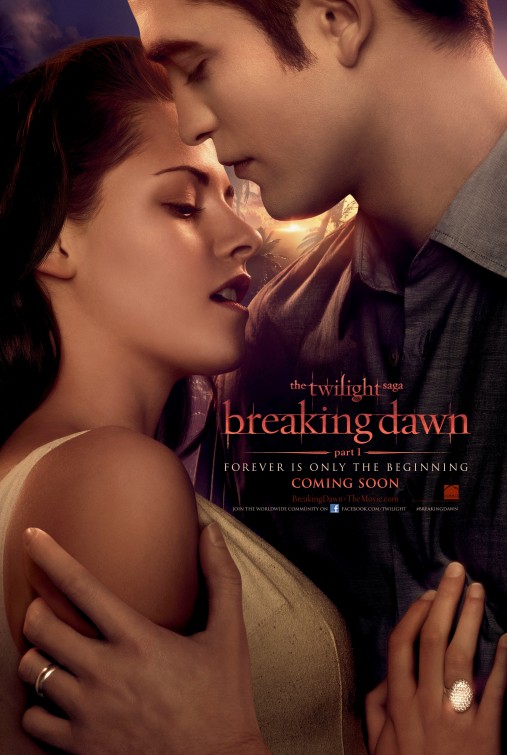 Taking a cue from the blockbuster film franchise of our age, the Harry Potter series, the producers and studio heads decided to split the final Twilight film into two separate movies. Yes, for you cheerless, unfortunate males dragged along to author Stefenie Meyer’s estrogen-drenched soap opera, hoping to be done with Bella Swan and her sparkly vampire boyfriend, well your pain soldiers onward another year. If Breaking Dawn: Part One is any indication, we’re all in for a world of hurt come November 2012.
Wedding bells are ringing for Bella Swan (Kristen Stewart) and her undead boyfriend, noble vampire/undead heartthrob, Edward Cullen (Robert Pattinson). Bella’s persistent demand to be turned into a vampire is finely about to come true. She wants to stay human a bit longer, to savor her last days on Earth before sipping blood through a bendy straw. Her always-in-second best bud, Jacob (Taylor Lautner), is worried for Bella’s well being. The wedding is like a fairy tale and Edward sweeps his new bride away to a tiny island off of Rio de Janeiro, where the housekeepers illogically speak Spanish. The couple makes the most of their time alone, and by this I mean they have sex (I refuse to believe this couple would play chess in their newlywed downtime). Edward withholds any second rounds of sex, fearing he’ll seriously harm his bride (he destroyed the bed in mid-copulation). No matter because Bella gets pregnant right out of the gate. We’re told this is impossible, yet her half-human/half-vampire fetus is rapidly growing inside momma’s belly. The baby is also destroying its host, eating away Bella’s body. Edward demands to kill the baby but Bella will have none of it. She’s going to deliver this baby even if it kills her. If it does kill her, then the truce between the werewolves and vampires will be broken, and Jacob’s feistier tribe mates will be knocking down the Cullen doors looking for some tasty vampires to chomp.
 Director Bill Condon, he of Dreamgirls fame and an Oscar-winner for 1998’s Gods and Monsters, goes hog-wild with the emotions, fittingly reminiscent of the life-and-death swings of emotional polarity that orient a teenager’s life. Condon plays all of the ridiculous melodrama straight. It successfully channels the feelings of teenage angst and obsession, much like the first Twilight film. This Teutonic exhibit of buzzy hormones is like catnip to the Twilight faithful. Finally, they get what they’ve been waiting for, and Condon and screenwriter Melissa Rosenberg delay that gratification even longer. This is the longest wedding I’ve seen on screen since The Godfather. It takes up about 45 minutes of the movie. The protracted walk down the aisle literally takes longer than the rest of the ceremony combined. I can already envision thousands of young girls asking for the “Bella dress” when their time down the aisle comes. At no point does the movie address the fact that the “groom’s side” probably are all absent a heartbeat (“Hmm, extreme paleness? Are you with the bride or the groom? I’m at a loss.”). That’s a missed comedic opportunity. What’s with the wedding guests played by name actors like Maggie Grace (TV’s Lost, Taken)? Did they hire recognizable actors for one-line bit parts? They better have larger roles in the second feature. Under Condon’s direction, the film looks marvelous, and even the long-awaited love scene has some discernible heat to it that will give teen girls “funny” dreams for the next few months. Condon’s also helming the next and final film, so I can at least say it’ll look swell.
This last film was broken into two parts due to the mountains of money the studio would make. It surely wasn’t for some sort of artistic necessity. The plot of BD: Part One is stretched mighty thin. It’s no joke that the wedding and honeymoon takes up half the running time. The baby drama is handled so amateurishly, and the plot ramps up the incubation time so that everything happens too fast for the audience to adjust to how stupid everything truly is. The first half of the movie is free of meaningful conflict. It’s just concerned with payoffs. From everything I’ve read online, and from female friends who have partaken of the series, BD: Part One pretty much covers most of the plot of the 400-page book. What’s left? I would totally give the series a pass if the second movie started with Bella, hair a knotted mess, holding a shrieking baby. Edward sits at the table, drinking. “When are you gonna get a job?” she yells. “When are you gonna stop being a bitch?” he retorts, then gulps down a swig of booze. This domestic downer of an ending would almost make the whole series worth sitting through. Truthfully, as the teaser during the end credits advertises, if Michael Sheen (Frost/Nixon) has a larger part in BD: Part Two, it automatically becomes, sight unseen, the best movie of the series. Thus is the awe-inspiring power of Michael Sheen.
This has long been a silly franchise filled with poorly veiled messages that seem less empowering to teenage girls than reassuring to their parents. Long a heavy-handed message about abstinence, the characters finally get to have sex, after they’re properly married of course (does God really object more to vampire-human relations or when it occurs?). And you better believe the moment Edward and Bella eventually do the deed is a moment that teen girls, and their mothers, around the nation have been anticipating for three long, hard years. The buildup to the carnal climax is a rapturous release for the audience of Twi-hards; my theater felt like it exploded in pubescent hormones and giggling as soon as the proverbial train entered the station. Speaking of euphemisms, I find it telling that not a single character ever refers to sex as, well, “sex.” They keep dancing around the term, referring to it as indistinct pronouns like “this” or “that” or the slightly more specific “honeymoon activities.” It’s like the characters can’t talk about a mature topic without a case of the giggles. There’s even a scene where Jacob talks about Bella’s forthcoming tangle between the sheets, openly, and with alarm: “You’ll kill her,” he tells Edward. He doesn’t kill her but he does leave bruises all over her body. Bella assures her new husband that he’s not to blame, arguing, “You just couldn’t control yourself.” What kind of irresponsible message is that sending to teenage girls? But after enduring three movies of “save it until marriage,” the message is made even clearer when Bella, after one bout of sex, gets pregnant. Boom. Bella breaks the news by saying, “The wedding was 14 days ago, and my period’s late.” Edward stares dumbfounded and replies, “What does that mean?” Apparently, after graduating from high school 200 times just for kicks, Edward must have been absent every damn time for sexual education (“Condoms go OVER? Oh! This whole time I thought they went UNDER, you know, to hold everything in.”).
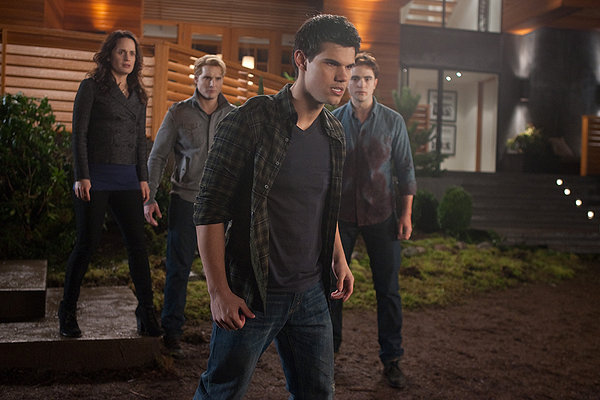 It’s here where the movie awkwardly shifts into a relentlessly pro-life message on legs. I’m not against movies presenting messages, but when a movie is as narratively empty and transparently padded as BD: Part 1, then the movie just gets swallowed up by the clumsy message. It doesn’t matter that Bella’s unborn hell spawn is literally killing her, sucking her dry from the inside out, she’s going to have this baby no matter what, even if she dies in the process. Okay, Meyer, we get it. Here’s a question for the world: can anyone really tell that much difference between emaciated Kristen Stewart and her normal self? She always appears a little sickly and hollow-eyed, but maybe that’s just me. The baby is basically the only conflict the movie presents and it happens so late in the film. Thanks to a fast gestation period, the demon fetus is determined not to wait until Part Two to make its grand entrance. Now that Bella is preggers, she’s become instant buddies with Rosalie (Nikki Reed, a long way from Thirteen), and the two of them begin a war against non-gender pronouns (its vs. he/her). The baby conflict would be more interesting if it was a tad more ambiguous, but the fact that it literally is killing Bella, not to mention its monstrous possibilities, and yet she persists to give birth is less characterization and more stubbornness. If Bella’s worried she’ll never have another chance to have a flesh-and-blood daughter, then explore this. Otherwise it makes Bella look blithely cavalier with her own life.
It’s here where Meyer and the Twilight franchise, already deliriously high on teen angst, goes off the charts into weirdo territory (some spoilers will follow). Never mind where the werewolf boys (and a girl) manage to find new clothes after they destroy them after each beastly transformation, we’ve got far weirder moments to process. There’s a vampire C-section via biting. There are giant wolves communicating via growling telepathy and bad CGI. There are Bella’s completely batshit names for her child; if it’s a boy she wants to combine Edward and Jacob’s names because that’s not awkward (“See, son, you’re named after the other guy I could have slept with but decided to just string along instead.”). And if it’s a girl she wants to combine her mother’s name and Edward’s mother’s name forming the atrocious “Reneesmee.” Excuse me? That makes “Apple” seem as traditional as apple pie. No one tells Bella these names are horrific because she’s pregnant, naturally. I imagine all the characters broke out into laughter as soon as Bella left the room to go puke into a bucket. Easily the weirdest and dumbest thing in the history of the Twilight franchise occurs as a contrived deus ex machina and a tidy solution to Jacob’s eternal, annoying pining. Jacob is determined to slay the monster he believes responsible for killing his unrequited love, Bella, but then he looks into those cute little baby eyes and… swears devotion to this newborn babe. He “imprints” on her, which means that they are meant to be together, and thus the werewolf/vampire truce holds. “Of course,” Edward intones, “Imprinting is their number one law. They cannot break it.” Of course! This reminded me of the scene at the end of the second Harry Potter movie where a phoenix comes from nowhere and cries into a wound (“Of course, phoenix tears can heal anything,” Harry informs while I was physically smacking myself in the head). Doesn’t anyone else find this whole plot development creepy? Jacob can’t have the mother, so he’s going to have the baby? And he’s got to wait 18 years if he wants their coupling to be legal on top of that. I think a messed up name is the least of this kid’s worries.

- Does she look like a healthy person? This is pre-baby succubus.
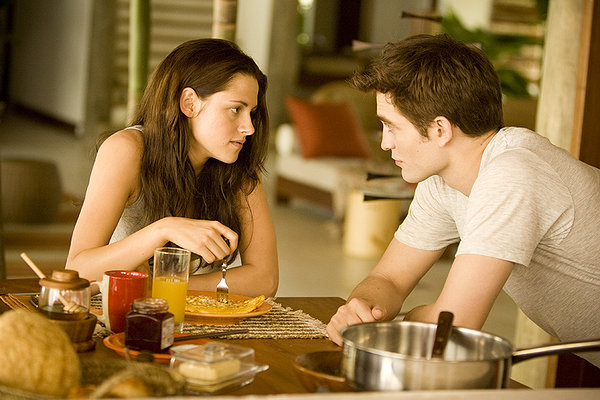
It all comes down to the heroine of the franchise, Miss Bella Swan (sorry, Bella Cullen now). I just don’t get what all the fuss is about. To me, Bella isn’t worth the effort. She’s never really been anything close to a fully formed character. Bella Swan has always defined herself by having a boyfriend, and when he was gone it was about pushing her friends away and moping until she finally found a new guy. She has zero self-identity, no center, she is an empty shell, there is no there there. She’s a cipher, meant for the teenage readership to plug themselves into her place. I won’t restate my theory that the Twilight series is glossed-up pre-teen wish fulfillment, but there you have it. Yet there are sneaking moments where Bella seems almost shockingly… human. Her anxious montage of preparation before her first night of sex is relatable and sympathetic (what outfit to wear? Shave the legs? What kinds of makeup?). Too bad this relatable side of her character vanishes all too quickly. Before Bella defined herself by her boyfriend and now she defines herself by her baby. She’s still the same whiny, selfish, morose, and cruelly manipulative Bella, though. She can’t let Jacob alone; she has to continue stringing him along, bringing him into inappropriate personal matters. Jacob’s always been a bit of a control freak who seems to spout quasi-rapist dialogue (the classic “You love me, you just don’t know it yet.”), but the guy’s always gotten a raw deal as far as I’m concerned. Betrothed to a baby is not a worthwhile parting gift. I worry that young, impressionable girls are going to look at Bella as an influential figure. If these same gals want a literary heroine they could truly look up to, they should feast their eyes on Katniss Everdeen, proactive and laudable star of the Hunger Games and forthcoming movie of the same name.
The three actors have been playing the same character notes for so long that they could all just go on autopilot and collect their paychecks. Stewart (Adventureland) is less annoying than she has been in previous films. I’m trying not to take out my disdain of her character on the actress, who I’ve genuinely liked in pre-Twilight projects (even her Joan Jett performance was pretty decent). Pattinson (Water for Elephants) seems to shrink into the background for this movie. There are a lot of long, ponderous, somehow meaningful stares between the two, with the soundtrack trying to communicate emotions that the screenplay has failed to do (a little more variety on the soundtrack next time, fellas? I think I tuned out after the twelfth melancholy piano ballad). Luckily, Pattinson does have something of a screen presence to go with those abs. Unfortunately, the same could not be said for Lauthner (Abduction). The young buck, formerly of Shardkboy fame, just cannot act. He has a nostril-heavy manner of expressing emotion that makes you wonder if he’s about to blow your house down. It’s telling that within mere seconds of the film beginning, the guy rips off his shirt, the peak of his acting abilities. I suspect it will not be long before Lautner and his six-pack and sitting at home, unemployed, and indulging in a different six-pack.
 Breaking Dawn: Part One is certainly not intended for critics of the book and film series or really any audience member lacking ovaries. But I think that even the most ardent Twi-hards will walk away giggling at the silliness of the overripe melodrama. I try not to be out rightly dismissive of the whole series, but the bad characters, bad plotting, and questionable messages make it hard to continue bending over backwards to find slivers of quality to support. I get the appeal of the series, the fact that Bella Swan is a cipher to exercise frothing teenage wish fulfillment, but that doesn’t excuse the movies from being so bad. This isn’t the painful abomination that was 2009’s New Moon, but it’s come the closest. Only the promise of more Michael Sheen makes me hopeful that BD: Part Two will be better than its predecessors. When you’re talking about an obscenely popular moneymaker, quality becomes secondary to delivering a product that is recognizable to the demands of the screaming fans. BD: Part One is less a payoff than a warning. There is more to come, and if you thought Bella was intolerable before just wait until her vampire growing pains.
Nate’s Grade: C-
Share this:

Eclipse (2010)
 This may be an obvious statement but I will never be a teenage girl. Shocking news to anybody who never knew of the existence of my Y chromosome. Regardless, it’s hard for me to empathize with the madness that surrounds the cultural juggernaut that is the Twilight series. I cannot work myself into a frenzy. I cannot get madly passionate about the merits of Team Jacob vs. Team Edward (though full disclosure: I lean more toward Jacob). I cannot even understand the appeal of the main character and why she’s worth every human, vampire, and werewolf fighting over her. I just can’t walk in the same shoes of the Twilight faithful and their devotion to author Stephenie Meyer’s series. I get the appeal because its adolescent wish fulfillment with the flashes of danger muted by the overall security of traditional values (the vampire wants to wait until marriage before they have sex). I fully acknowledge my divorce from this conjured reality of the Twilight series. But that doesn’t mean I can’t judge the films on their merits. The first film worked for what it was, the second one was resoundingly bad, and now the third film, Eclipse, manages to reheat the same love triangle squabbles and call it something fresh.
Bella Swan (Kristen Stewart) is about to graduate high school and, presumably, graduate from the human race. Her vampire boyfriend, Edward Cullen (Robert Pattinson), has pledged to grant her wish and make her a vampire so they can truly be together forever. Bella’s friend/werewolf/ab model Jacob (Taylor Lautner) is vehemently against this plan. He wants Bella to be with him instead. He’s the safer choice and she doesn’t have to become dead for a happily ever after. Bella is torn between her two romantic options, again. However, Victoria (Bryce Dallas Howard) is out their plotting vengeance against Bella and the Cullen clan of “vegetarian” vampires. She’s creating an army of newborn vampires in Seattle. The army is so powerful that the Cullens reach out to the werewolves for an alliance. Mortal enemies comes together, including feuding paramours Edward and Jacob, to protect Bella and vanquish Victoria once and for all.
 For starters, stuff actually happens in the third Twilight movie. I know that’s a fairly damning comment in itself that one must wait until the third movie for action. But here’s the thing: the plot fails to advance more than an inch. At the end of New Moon, Bella pretty much made her choice when she decided to whisk to the other side of the earth at the very utterance of Edward’s name, leaving poor Jacob high and dry. In Eclipse, she solidifies her choice. In New Moon, Bella implores Edward to turn her into a vampire, which he agrees to do after she graduates from high school (what a bizarre academic motivation strategy). In Eclipse, Bella further implores Edward to turn her into a vampire, which he is reluctant to do, but eventually he agrees. In New Moon, the werewolves and vampires don’t like each other. In Eclipse, that’s about the same, but they form an uneasy alliance to protect Bella, the most important girl in the whole wide world. The third film feels like a student’s paper revision; characters now add supporting evidence to explain their decision-making. Bella now gets to expound in further detail why she should be turned into a vampire (hint: she doesn’t feel like she fits in), Jacob adds to a budding Master’s thesis on why he is the better romantic option for Bella, and Edward gets plenty of opportunity to be the wet blanket, whether he’s turning down a horny Bella (no action there) or warning her about the dire lifestyle of today’s modern vampiric American. Much of Eclipse is people sitting around and chatting about their decision-making, verbalizing stuff that Meyer has no ability to place as subtext. By the end of the movie, at least you feel satisfied that everybody has weighed their options, even if they keep making the same dumb mistakes.
Speaking of action, Eclipse greatly benefits from having an external threat throughout the movie. The first two films felt prosaic and self-involved partially due to the fact that an antagonist was never introduced until the final act of each movie. The first two movies were two hours of brooding and making cow-eyes at each other, followed by a requisite climactic fight that felt anything but climactic.
 With Eclipse, we have Victoria building her army of newborn vampires, and we see that army form, wreck havoc on the streets of Seattle, and for once the Twilight series feels like it has a real threat. That’s because Victoria has never ever felt like a threat. I don’t know how she’s represented in Meyer’s books, but in three movies, this curly-haired vampire has always come across as woefully unintimidating. She feels like a Kate Hudson romantic comedy character with fangs. It just doesn’t work no matter how fast the filmmakers show she can run through forests. The Cullen clan will occasionally chase after her, that is, when they’re not lining up like they’re making superhero posse poses. Victoria has never cut it as a villain, so it’s a good move for her to amass an army of super vampires that will do her bidding. The audience is repeatedly told, rather than shown, how serious the newborn vampires are because, you see, newborns still have some human blood in them. Never mind that the Twilight movies have never made mention of this power before. What’s puzzling is that Victoria has been building up her base of bloodsuckers for over a year, so why aren’t there like a ton more? The army of newborns consists of like twelve vampires. I understand the logistics of having to feed and house multiple vampires, but if I was planning for a brutal assault I’d want as many of these super vampires as I could sire.
Let me rephrase some of what I just said. New Moon did have an antagonist and her name was Bella Swan. She was sullen, whiny, self-involved, casually hurtful, and she led around Jacob on a leash. The dude is obviously in love with her, and even tells her face-to-face in Eclipse. Bella toyed around with her self-described “best friend” for whatever she needed and then she screwed him over for her sparkly vampire. In Eclipse, she starts to repeat this same pattern of behavior. Every movie makes it emphatically clear that Bella and Edward are destined to be together, and yet every movie has Bella engage in this annoying, wishy-washy “Maybe I’ll be with you, maybe I won’t” dance to make the boys fight over her one more time and thus validate her existence. I’ve seen this type of behavior before; it’s loathsome. She’s less unlikable and callous in Eclipse. Bella is absent any defining characteristic so that the millions of Twilight readers can insert themselves into the story as the girl everybody wants to fight over. Edward practically hounds her at every turn to marry him, which also seems like another case of wish fulfillment. Bella seems defined by whatever man she has at the current time. I’m surprised more of Meyer’s readers don’t find this fact insulting. Well, in Eclipse Bella doesn’t magically sprout a personality so you’re stuck yet again with the Bella bores.
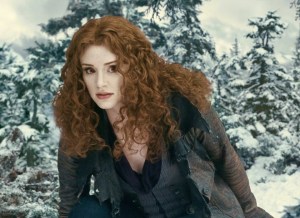 Director David Slade (Hard Candy, 30 Days of Night) was an interesting choice to handle all this teenage melodrama. The visual aesthetic is much more refined and accomplished, and the pacing is infinitely better. New Moon was 130 minutes but felt eight times that long because of all the repetitious plotting and brooding, not to mention the gratuitous beefcake shots. Eclipse is only six minutes shorter than its predecessor and yet it moves along at a steady jaunt thanks to the immediate external threat. It still has to fit in all those beefcake shots to make the soccer moms swoon, but at least the movie maintains that pulpy teenage synergy from the first Twilight movie. The special effects have greatly improved as well, which makes the wolves vs. vampire fight scenes more entertaining to witness for the right reasons.
The screenplay for Eclipse includes all sorts of extras to round out the Twilight universe, though they are tangential to the plot at best. Jasper (Jackson Rathbone) and Rosalie (Nikki Reed) get their back-stories revealed, which means flashbacks with costumes! While each is momentarily diverting, why am I getting time taken out from the movie to flesh out the lives of what are, essentially, background characters? At least Slade doesn’t just let the actors jaw away with exposition; he shows the audience their pre-vampire lives. Screenwriter Melissa Rosenberg has adapted every movie so far and she seems well aware of what her audience expects. Eclipse has the exasperating habit of not leaving anything implied. When Rosalie warns Bella about choosing to become a vampire, Bella promises she’ll never want anything more than Edward. “There’s one thing more you’ll want,” Rosalie says. And then, because the audience is perhaps too thick to pick up that subtlety, she adds, “Blood.”
Our threesome of young actors all seem to have their parts well memorized at this point. One part pouting, one part glowering, and two parts yearning. This is the meatiest film yet for the actors as they all get to assemble heir cases. Jacob argues that he’s best for Bella and tries to convince Edward that if he truly loves her, he won’t let her become a vampire. Edward knows the heartache that comes with transforming into a monster and watching as everybody you love dies while you seem to be standing still. Oh, and there’s that whole insatiable desire to drink blood thing, which is just gross. Bella realizes she’s in love with two guys at the same time. She also realizes that in order for her relationship with Edward to last, she will inevitable have to be turned into a vampire. It’s the fork in the road every “girl who dates vampire” story must ultimately lead.
 Stewart and Pattinson give serviceable performances, though Stewart seems like she’s doing you the favor of acting, like she’d rather be elsewhere. Once again, Lautner, who seems to have the most fun with his role, upstages them. There’s a sequence where the threesome share a tent in the mountains, and Bella is freezing and the ice-cold Edward cannot warm her. A plan is hatched: Jacob will crawl into the sleeping bag with Bella and warm her with his body heat. The ridiculousness of the scene is pierced by Lautner deadpanning, “Well, I am hotter than you” (which left my packed theater screaming in approval). Even though he’s saddled with quasi-stalker dialogue like “You love me, you just don’t know it yet,” Lautner makes the most of his wolf-boy licking his wounds.
Here’s another revelation thanks to Eclipse: vampires are apparently made of porcelain. When a vampire is destroyed in the Twilight world, they literally can have limbs snapped off like it’s nothing. They look like dolls getting ripped apart. Occasionally someone will have their head beaten and the vampire cranium will just shatter into thick pieces, much like a porcelain doll. Weirdest of all, whenever a vampire gets hit they are accompanied by this rattling sound effect, like inside the vampires are filled with rolls of nickels and dimes. It’s bizarre and distracting. I don’t ever remember this happening to vampires in the previous two installments. Why not go the Buffy route and just have dead vampires turn into ash? It doesn’t have to be as violent and nauseating as vampires getting staked on HBO’s superior True Blood, but I expect more than vampires just breaking. These are the creatures of the night. They should not be fragile little porcelain dolls. I know Slade and the producers went this route so that they could ramp up their bloodless action and get away with more onscreen.
The fact that something other than two-hours of lovey-dovey romantic declarations and intense, self-indulgent brooding happens means this is by far the most action-packed film in the Twilight series yet. It’s still not that good but it is a vast improvement over the dour suckfest that was New Moon. In fact, since Eclipse repeats many of the same plot points there really is no reason to ever watch New Moon. Skip it altogether. Once again, little of consequence happens in the film but at least Bella isn’t insufferable and we get some nice supernatural fight scenes out of it. The appeal of the series has failed to be translated on the big screen. It’s all about the swoon, and Eclipse will keep the Twi-hards swooning as they take in their male sex objects brought to visual life. Once again, I will state that the Twilight series comes across like a tedious teenage soap opera scrubbed clean of teenage hormones. Eclipse is probably the most guy-friendly of all the films so far, but even that isn’t enough to keep old material interesting the third time it’s reheated.
Nate’s Grade: C+
Share this:

New Moon (2009)
 Admittedly, I am not a fan of the Twilight series. I have never read one of the books but I didn’t hate the first Twilight movie. I thought it kind of worked on its own merits even if it wasn’t for me. However, New Moon is a crushing bore and a mess.
Bella Swan (Kristen Stewart) is celebrating her eighteenth birthday with her vampire boyfriend, the 119-year-old Edward Cullen (Robert Pattinson). She accidentally cuts her finger and the sight of blood sends one of the Cullen vampires crazy with instinct. Edward concludes that his love would be safer without him. He bids her goodbye and promises, “This is the last time you will ever see me,” forgetting that there are two more books to go. Bella is heartbroken and spends months in a stupor. She finds solace with Jacob (Taylor Lautner), her friend of many years. Jacob’s people are indigenous Native Americans to the area, and he holds a secret as well. Turns out that Jacob is a werewolf. Now Bella has to decide between a vampire or a werewolf (does a Frankenstein monster enter the romantic fray later?). Edward mistakenly believes that Bella has died, so he too wants to die and will seek execution at the hands of the illustrious Vultari, the ruling vampire clan in Italy. Bella must decide between her two loves.
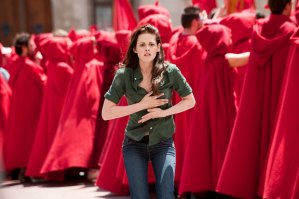 I can precisely indicate where everything goes wrong for the abysmal New Moon — the character of Bella Swan. For the majority of this sequel, I didn’t just detest and dislike her I downright hated her. I hated her. I understand her appeal to the millions of Meyer’s literary acolytes, but man does she come across as a self-centered, casually cruel, messed up girl who spends most of her time being whiny, mopey, and sulky. It’s not just that she has a guy interested in her, it’s the absurd notion that every man cannot get enough of this sullen gal. As presented in New Moon, Bella is such a dour and lifeless personality. I cannot see whatsoever why she is worth such effort. This criticism may be tracked all the way to Meyer’s source material, making Bella absent in defining character dynamics expressly so pre-teen readers can insert themselves as the character and swoon over being the object of universal desire. It is insultingly thin wish fulfillment that this girl has every man, vampire, and werewolf fighting over her in the Pacific Northwest. After Edward leaves, she shuts herself out and rejects all her friends. We see in one camera pan that she spends literal months in a stupor. I understand that teenagers think everything is the end of the world, but she and Edward were together for, what, a few months? Then again, heartache is something that knows no exact time frame for healing, so consider this but a quibble. Bella seems to push others away except when she needs a set of ears to whine.
It is post-Edward where Bella becomes insular, self-centered in her pursuit of danger placing herself in stupidly reckless scenarios, and hurtful. Where Bella really infuriated me is her treatment of her lifelong friend, Jacob. Obviously the big guy has a thing for his her and she knows this, which allows Bella to string Jacob along for almost a whole movie. She leads this little doggie along, teasing him with a “Maybe I will be with you, maybe I won’t” dance that becomes irritating and rather loathsome. Jacob is a swell guy who has looked out for Bella from day one, accepted her coupling with a vampire, sworn enemy of werewolves, and he’s been the best listener to all her self-involved drama. Plus this guy is ripped and has hip flexors that could cut glass. And he is there for her and didn’t abandon her like Edward. So Bella toys with her self-described “best friend” until she can hear the word “Edward” and then she can think about nothing else, even after months of complete separation. I understand that Edward has the sexy, brooding, bad boy appeal, where women think they will magically be the key ingredient to change the troubled man for the better. But on the flipside, Jacob thinks he?’ the key ingredient to finally get Bella to commit to a healthy relationship, and he gets screwed. Seriously, what’s the worse thing about dating a werewolf? You may have to take him for more walks. I suppose this makes me sound like I’m on Team Jacob, as the fans call themselves. I’m really on Team Bella Deserves to be Alone.
 I don’t want to sound unduly harsh. I don’t necessarily have an inherent dislike for characters that make bad decisions or who are, at their core, unlikable. I could forgive the sins of Bella Swan if she had even a hint of subtext. Bella Swan is a void of personality. I cannot recall if this was the same with Twilight, which I haven’t seen since I watched it on opening day in the theater a year ago.
What also sinks New Moon is how it repeats the same plot from Twilight. Once again Bella feels alone, she finds comfort in a boy that says they can’t be together, this intrigues her and pushes her into action, she’s warned of danger, and then finally she settles in with a pseudo relationship with a supernatural stud who makes blanket promises like “I’ll always protect you,” and, “I’ll never let anything happen to you.” It’s not complex folks; Meyer is just feeding pre-teen girls their fantasy of a male romantic interest. Because of this repetitious plot structure, very little of substance happens during the overlong 130 minutes of New Moon. Bella kinda sorta almost gets involved with a werewolf, there’s some lousy Romeo and Juliet allusions, and thanks to a delightfully hammy Michael Sheen (Frost/Nixon, The Queen), we learn a little bit about what makes Bella special to the world of vampires (it’s telling that her “specialty” is her lack of reaction). Beyond that, this is two hours of posturing and some gratuitous beefcake shots of shirtless men. My theater was sold out and packed with the Twilight faithful who swooned when they saw Edward strutting in slow-mo and openly hollering in approval when Jacob first whipped off his shirt. For supernatural creatures, they do more brooding than anything.
Director Chris Weitz (The Golden Compass, About a Boy) replaces Catherine Hardwicke to steer the second movie. I actually think Hardwicke had the right sensibilities for this franchise and she brought a youthful, rambunctious spirit that gave the first film a teenage synergy that made the romance feel pulpy. Weitz does away with this and makes the movie feel more ornate and chaste and dull. The execs spent major money to film in Italy for the vampire Volturi clan, but as near as I can tell some sets would have done the trick. Note to filmmakers: if you spend money to film in an exotic location, show it. As far as I can tell, Weitz was hired because of the bump up in special effects for this picture. Gone are goofy vampire baseball sequences and now we have cheesy wolf battle sequences, which come across like a less refined version of the polar bear brawl from Golden Compass. The special effects have improved but that doesn’t mean they?re good.
 This isn’t exactly the kind of movie that asks for much from its actors, and screenwriter Melissa Rosenberg distills Meyer’s text to the point that the actors pout and yearn. Stewart is an actress I have liked for years since Panic Room, so imagine how I would feel about the Bella character with a less capable actress. Pattinson is absent for almost the entire movie and it’s hard to say that his presence was missed. The best actor of this weird love triangle is Lautner who at least seems to have some fun with his role. He has an amiable spirit that penetrates all the gloom. He’s come a long way from being Shark Boy in 2005?s The Adventures of Shark Boy and Lava Girl.
The plot is a shadow of the first film, and the main character is annoying and hard to sympathize with, there?s so little of consequence that happens, it?s way too long, and, oh yeah, did I mention how much I disliked Bella Swan? At this point, the Twilight franchise is a juggernaut that cannot be contained (as I write this it’s poised to make over $70 million on opening day) and the Twi-hards will find the movie to be catnip, swooning at the visualized male sex objects. For anyone outside the cult of Twilight, the movie version of New Moon will fail to communicate the appeal of the series. The movie feels bloodless. Twilight is like a tedious soap opera scrubbed clean of teenage hormones. I think I’ll stick with HBO’s True Blood, a more nuanced, adult, sexy, and just plain fun series following vampire-human love. Bella could learn plenty from Sookie Stackhouse.
Nate’s Grade: D+
Share this:

Twilight (2008)
 It’s only been three years since the first book in the Twilight series was published, but man has it already become a phenomenon among young girls. Author Stephenie Meyer was a Mormon housewife who professed to never having seen an R-rated movie, so of course she seems like a natural fit for vampire literature. Meyer has taken the torch from Anne Rice and created an insanely popular series of books that chronicle the lives of humans and vampires in the rainy Northwest United States. I had never heard about the books until the spring of 2008, months before the hotly anticipated release of the fourth and final book in the series. Then again, I’m not a preteen girl, so excuse my ignorance. I decided to bear the hormonal, high-pitched squeals and sit with a packed house to experience the movie with the Twilight faithful. Judging from my screening, I think it might be mandatory for all girls between the ages of 7-14 to go see the Twilight film.
Bella Swan (Kristen Stewart, Into the Wild) is the new kid in school. She’s moved back to live with her father (Billy Burke), the sheriff of a tiny Washington town with a population of 3,000 people. Bella has her sights set on the Cullen family, a group of weird kids that are pale and keep to themselves. Edward Cullen (Robert Pattinson) goes out of his way to avoid Bella, and of course this just makes him more mysterious. He tells her that they shouldn’t be friends. Then one day at school he saves her life by stopping a van from crushing her. Bella suspects that this Cullen kid might not be a usual teenager. He’s not. He’s a vampire who hasn’t aged since 1918. Bella is smitten with her otherworldly protector. It’s your typical high school relationship. Bella doodles Edward’s name on her notebook and falls in love with an unattainable boy. Edward must resist the constant temptation to drink Bella’s blood (he and his vamp family are “vegetarians,” meaning they only drink animal blood).
 Let’s examine the distinctions of the Twilight vampire incarnation. Now, the vampire myth is not written in stone, so it allows for creative interpretation. Some vampires cast a reflection, others don’t. Some vampires are thwarted by garlic and crosses and others are not. Some vampires sleep in coffins and others just prefer a comfy mattress. It seems that the two characteristics that follow every vampire tale involve the insatiable thirst for blood to drink and the fact that sunlight is a vampire’s enemy. Meyer’s vampires don’t even adhere to this. They walk around in the daylight with no concern; in fact, we learn they never sleep at all, which means they must have all the late night infomercials memorized by this point. Removing the danger of daylight from the vampire myth proves to be somewhat troublesome decision. This is because, when you think about it, there are little to no drawbacks or limitations to being a vampire in Meyer’s world. Yeah you’ll live forever and crave an unorthodox beverage, but as a vamp you get super abilities, super strength, super speed, and a laughable diamond-like glow when the sun hits your exposed skin (think of those people that encase cell phones in tacky “bling” jewelry). If this is what it means to be a vampire in Meyer’s world then I wouldn’t be surprised if every freaking teenager in the world was signing up to join the army of the undead. The vampire myth brings with it plenty of baggage but it also helps to patch up holes in a narrative; just introducing the concept of a vampire allows an author some free pass with the details. However, vampire tales bring with them a certain set of expectations due to audience familiarity with the popular concept. I could care less if Meyer’s vampires have fangs or chow down on garlic bread, heavy on the garlic, but she loses me when she has vampires roam around during the day with little to no drawbacks. They just don’t feel like vampires. What they feel like are superheroes with skin conditions and a unique appetite. Which is fine, but don’t call it a traditional “vampire” flick.
I completely understand the enormous appeal of the Twilight series because it’s totally pre-teen wish fulfillment. I’m positive that the majority of the pre-teen readership projects themselves as Bella, the typical Every Girl. She encounters a sexy boy who ignores all the flashy and trashy girls and recognizes that special something in the Every Girl. In fact, he respects her and doesn’t want to be physical with her because he’s afraid of giving in to his urges (a rather obvious abstinence metaphor). He wants to love her forever and protect her. He has a dangerous bad boy angle but yet he’s still safe. In short, Edward Cullen is the idealized male for a nation of pre-teen girls who are just stepping into the world of boys (Bella also becomes an object of affection for no less than three boys at school). The Twilight tale even pulls a gender flip: the girl is pressuring the boy to give in to his carnal urges. And yet I can also understand why the books appeal to an older, mostly female, readership as well. If you remove the vampire angle from the story, it’s that old classic literary tale about a gal falling in love with the rebel, the boy who’s misunderstood. Hollywood has been making those sorts of love stories for decades, and so Meyer is able to tap into this classical romantic appeal.
 Twilight never delves too deeply into the dramatic dynamics of a 17-year-old girl dating a 90-year-old vampire. There are a lot of dramatic consequences drawn from dating somebody who cannot age. The Buffy the Vampire Slayer TV show explored the ins and outs of human-vampire relationships with wit and sincerity. Edward is forever seventeen but does that mean he still digs the high school girls? If you’re trapped in the body of a teenager does that mean you are still attracted to teenagers? If I were almost a century old I think I might seek out the comfort and conversation of a more mature woman, which is precisely the notion I’m sure the older female readership also fantasizes about (for all those guilty soccer moms, it doesn’t qualify as fantasizing an underage when he’s undead). Talking to teenagers for the rest of your life seems like a strange form of penance, as does repeatedly completing high school. Are the vampires just bored and attend school to pass the time? Don’t they know that TV was invented?
Twilight doesn’t have much of a plot to fill out a two-hour running time; the bulk of the movie consists of two characters feeling each other out. When the film does introduce an exterior threat (Cam Gigadet as a vamp obsessed with the hunt) it never feels that dangerous or fitting. The outside threat is saved for the very end and is easily dispatched, so the movie would have been better off without forcing a last-minute life-or-death dilemma into its love story. The love story itself doesn’t feel as properly nourished as it needed to be. The whole film experience feels like one long introduction and set-up, not so much an open-and-shut story.
Now, with all of that established, the Twilight film itself isn’t too bad. The movie is well made and certainly has a pulpy romantic vibe. The movie never feels overly burdened by excessive emotion or fake drama. It also follows a leisurely pace but never becomes dull. The actors are a big help. The leads don’t seem like they stepped out of a magazine photo spread; Stewart and Pattinson (Harry Potter and the Goblet of Fire) have a palpable chemistry that simmers throughout. Stewart is a terrific actress that embodies a typical teen, and Pattinson has the heartthrob glower down cold. I think there is rarely a scene where Edward isn’t glowering. Director Catherine Hardwicke (Thriteen) might as well provide onscreen instruction telling the audience when to swoon. Hardwicke is a filmmaker that doesn’t wallow in pretension, so she knows what kind of flick she has at her disposal. On the other hand, she is able to tamp down the inherent cheesiness that can go with a gooey supernatural love story. Twilight is able to work because it strikes the right balance between romance and silliness.
 Fans of Twilight should be delighted by the big screen adaptation of their favorite characters and heartthrobs. Sure the plot is a tad lightweight, the vampires might not be vampires as we traditionally understand them, the characters make giant leaps in their proclamations of love, and the outside conflict is a bit too poorly manufactured, but the movie has some bite. The movie isn’t moody, it isn’t too heavy, and it can come across as entertaining, though I’m at a loss to explain its extraordinary popularity. Now that Hardwicke and company have established the Twilight inhabitants, I hope the inevitable future installments will be better at providing resonating story and characters. If you doubt the certainty of sequels, need I remind you yet again that it is mandatory for girls age 7-14 to see this movie. The Twilight phenom has yet to reach its peak. Get used to it. It’s only a matter of time before Hollywood starts cranking out the Twilight knock-offs. Then, perhaps, I will join the armada of pre-teen girls and shriek wildly.
Nate’s Grade: B-


 nathanzoebl
You must be logged in to post a comment.