Blog Archives
Mr. Peabody & Sherman (2014)
 Surprisingly adroit, Mr. Peabody & Sherman might just be more fun for adults, especially fans of the original 1960s cartoon, than for little kids. It’s under the “family film” banner, a dubious one historically, but I was laughing consistently and good, snorting laughs, long chuckles; the whole gamut. With The LEGO Movie, the wide release of The Wind Rises, and now this, 2014 is shaping up to be a stellar year for animation aficionados. The movie between a genius dog and his adopted son is given the right amount of reverence before all the cheeky irreverence through history. The hops through time, notably the French Revolution, ancient Egypt, and the Trojan War, are fast-paced and clever without stooping to provide much context for the jokes; you either get them or you don’t. Even the necessary character building components between father and son are treated smartly, coming together for an ending that approaches poignancy. The plot can get a little complicated toward the end, what with opening a space-time paradox, but I respect the movie for being complex and tricky and scientific and trusting its audience to play along. The animation looks a little scruffy compared to other big screen efforts, but the script just flat-out works. The comedy, the drama, the relationships, but especially the comedy. If you’re on the fence, please, do yourself a favor, and go see Mr. Peabody & Sherman, especially if you appreciate history and those who love it. I saw it with my father and we both laughed ourselves silly. Needless to say, this blows 2000’s Adventures of Rocky and Bullwinkle out of the water.
Nate’s Grade: A-
Share this:

Veronica Mars (2014)
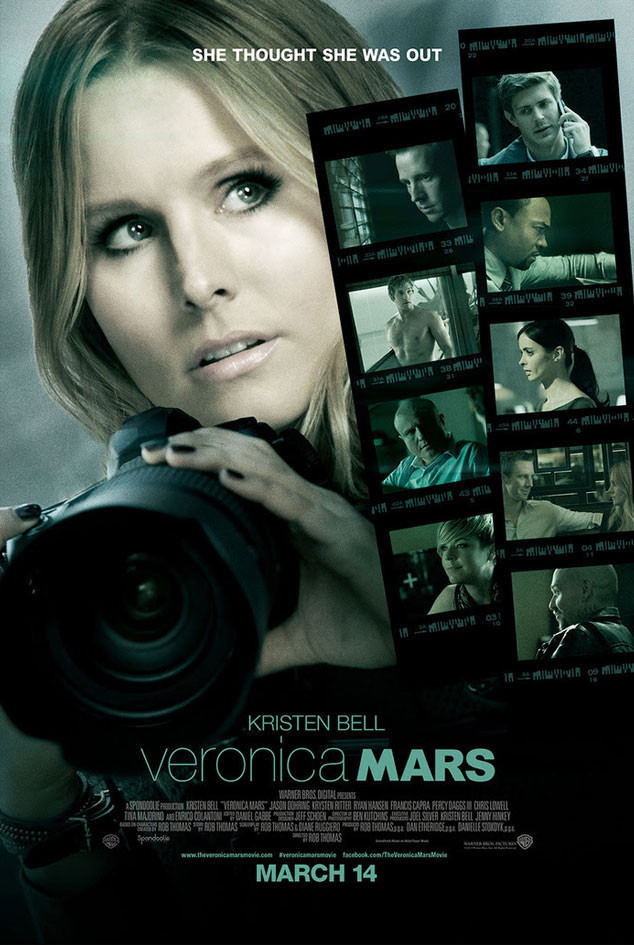 More people know the name Veronica Mars now than probably combined from its short-run on TV from 2004-2007, and that’s squarely because of its record-breaking haul brought in through the fundraising site, Kickstarter. Within hours, the project had already raised two million dollars, on its way to over five and a half million, enough for a long-awaited movie that fans have been teased with ever since the series cancellation. Creator Rob Thomas and his actors were beside themselves in gratitude to their fans (dubbed “marshmallows”). Fueled by the eager hopes of its fans, the movie went into production and is now available for digital download to many of its donors and in a handful of theaters.
Veronica Mars (Kristen Bell) has left behind her hometown of Neptune, California. She’s on the verge of signing with a major New York law firm, and an old friend comes calling. Veronica’s former flame, Logan (Jason Dohring), has recently lost his pop star girlfriend, also a Neptune graduate. He’s suspected of being the killer but he swears his innocence. With the promise of her assistance only lasting a few days, she flies back home and reunited with her old friends (Mac, Wallace, Weevil, Dick) and her father, private investigator Keith Mars (Enrico Colantoni). Veronica should go back to New York with her boyfriend Stosh “Piz” Piznarski (Chris Lowell), she should accept the job offer from the firm, but she can’t help herself fall back into old patterns. She misses the danger, the intrigue, and maybe enough, Logan himself.
 The curious case of Veronica Mars: The Movie is that it was truly made for the fans, those 90,000 people who contributed to their Kickstarter goal. It’s not made for the casual moviegoer who has no foundation with the television series. That’s not to say that Thomas doesn’t try and make the film more inclusive. The neophyte could reasonably follow along, and there is a fast-paced prologue to catch the audience up on the major developments of the series, though almost all from season one. A non-fan could watch this movie but I have no idea what they would get out of it because they would be missing all the connections and context that provide the depth. In a way, this situation reminds me of David Lynch’s Twin Peaks: Fire Walk with Me. Unless you were a fan of Lynch’s iconic thought short-lived TV series, there was no way you were going to follow along or be interesting in following along. It was a movie made for its fan base, and there’s nothing wrong with that though it always helps to provide enough entertainment to prove to the newbies why they should be fans in the first place. I don’t think the Veronica Mars film is able to achieve this. Sure, I enjoyed myself but that was because of my pre-existing fan club and my years-in-the-making desire to finally see proper closure to the characters I came to care about. I feel like someone without that devotion would watch the 105 minutes of Veronica Mars and question what all the fuss was about.
That’s because at feature-length, Veronica Mars is really more of an extended episode of the TV show, and not one of the top tier episodes. As a debut film director, Thomas does a serviceable job of recreating the series noir visuals. The mystery is sufficient if a little dull, lacking a strong sense of urgency throughout most since Logan is already walking around free of charges. The real anchor of the story is bringing Veronica back to Neptune and bringing her back into the family business. The class injustice was a hallmark of the TV series but it’s merely one more slightly malnourished storyline cluttering up the narrative. There are no real reasons to check in on so many characters beyond the fact that it provides resolution for fans. A ten-year high school reunion seems engineered just for this purpose, allowing the new old faces to all reappear again and catch us up. There are characters that appear in near-cameo form (though the surprise celebrity cameo is quite amusing). Even the romance feels mostly grafted onto the story because the core audience demands Veronica and Logan reunite, in all senses. It just becomes a matter of time waiting for the inevitable, as it is with all romantic comedies, except the romance is sidelined here until it isn’t. As a film, it doesn’t feel organically handled that Veronica would leap back into Logan’s arms, and so soon, unless, of course, you are one of those fans (I know MANY) who have been waiting seven years for that moment. Fan service is one thing but it shouldn’t detract from the internal logic of the featured story.
 What does still work are all the hallmarks of the TV show, even if they are less effectively showcased for first-timers. The plucky, sarcastic nature of Veronica still turns her into a heroine worth rooting for, a force of will that has her flaws as well. Bell (Frozen, TV’s House of Lies) can just about do it all, from goofy to heartfelt to ferocious. It’s clear how much she adores this character she helped bring to life ten years ago. The father/daughter relationship is warmly affectionate without dipping into sappy territory. The dialogue is still snappy, though having late twenty-somethings saying it rather than high schoolers has dulled some of the edge. There’s also the sleazy addition of older men hitting on Veronica now that she’s officially out of high school, so hooray. The season-long mysteries of the series, while satisfying and twisty, were secondary to the characters, and watching the overall jovial camaraderie of the cast, is a reminder at how much fans adore these people.
I can objectively critique the faults in the film, as I’ve tried to do for a couple paragraphs, but this is a movie where I set aside my critic hat and merge with the fans. I too contributed to the Kickstarter because I’ve been dying for a sense of closure for one of the best TV shows in the mid-aughts. The finale of season three left much of the show in doubt; Thomas was not counting on cancellation. While fan fiction can run rampant in these circumstances in order to cater to fan demands, it doesn’t compare to the creator being given a reprieve to tie up as many loose ends as possible. That’s the greatest accomplishment of the Veronica Mars movie is that it feels like a genuinely satisfying sense of closure for the fans. While not every storyline is wrapped up, like for instance Weevil’s path, it ends on a point where you can reasonably guess where the characters would continue from here onward if we were never to check in with them again. This is a good resting place. But given the runaway success of the Kickstarter campaign, maybe Warner Brothers could be convinced there are more stories to be told here. I’m cautiously optimistic but really Thomas has already given the fans just about everything they could want, unless they were the Veronica/”Piz” minority of shippers.
Whatever you think of the final product, Veronica Mars: The Movie has changed the way movies can get financed. Smaller boutique films with a passionate fanbase can now get the ball rolling, putting their money into a down payment on seeing their dream movie becomes a reality, convincing studio heads to roll the dice with less risk. I invite all newcomers to watch the series, since that is where it was best. As a film, it’s enjoyable enough and satisfying for the fervent fans, supplying needed closure. However, for people that don’t already have connections to these characters and this world, I don’t think there’s enough going on in the movie to attract a larger discipleship.
Nate’s Grade: B
Share this:

The Lone Ranger (2013)
 With the director, star, and writers from Disney’s original Pirates of the Caribbean trilogy, you’d likely expect The Lone Ranger simply to be Pirates in the West, and it pretty much is, for better and worse. The pieces don’t nearly come together as well, and the characters aren’t anywhere close either, but I was mostly pleased with the finished results after coming to terms with the flaws of the execution. This is a semi-supernatural reinvention of the Lone Ranger and Tonto, prankish and proudly peculiar.
In 1869 Texas, John Reid (Armie Hammer) is the new district attorney for a small outpost along the railway run by tycoon, Mr. Cole (Tom Wilkinson). John’s brother (James Badge Dale) is the sheriff and the more accepted hero. This all goes awry when the nefarious criminal Butch Cavendish (William Fichtner) kills the sheriff, his posse, and leaves John for dead. He’s brought back thanks to Tonto (Johnny Depp), a Native American with his own quirks. Together, the duo struggle with the idea of justice versus vengeance and taking responsibility.
Thanks to screenwriters Justin Haythe, Ted Elliot, and Terry Rossio, it still follows the summer movie blockbuster blueprint while maintaining its own sense of self. I enjoyed the 1933 framing device and the sense of commentary it added to the legend of Wild West tall tales. Many of these story elements will be painfully familiar, from the unrequited love interest that needs saving, her plucky son, to even the villainous railroad baron, but the film finds ways to keep all these formula figures at least integrated and satisfying, doling out payoffs to several storylines. More so, the film just has a wild sense of fun to it, enlivened by Verbinski’s exuberant feel for action. When he gets things going, the man has a touch for inventive action orchestration akin to Steven Spielberg. He is a director who knows how to add scale and scope to action and make it felt. The movie feels constantly alive and full of surprises, stepping outside itself for some non-linear asides, adding bizarre examples of nature undone (In the words of Nicolas Cage: do not touch the bunny), and a heavy dose of magic realism. It’s just too funky and weird not to be interesting even when it threatens to be boring. Disney put crazy money into something this crazy, folks, reportedly $200 million.
 There are serious problems here much as there were in the Pirates sequels, notably a lingering sense of bloat. At 149 minutes, there could have been a lot of cuts. The saggy middle seems to almost derail all momentum, as Reid and Tonto stumble about the desert, filling in a majority of Tonto’s tragic back-story. Most of the supporting characters are chiefly underwritten. I pity the great Ruth Wilson, so nerve-fryingly awesome on the BBC’s Luther as an enthralling sociopath, and here she’s basically Love Interest/Single Mom for Reid. At least she does a decent job with her Texas twang. There’s plenty of overindulgence all around, and I won’t even entertain the argument that its handling of Native American displacement, while not as clumsily racist as feared, was anything other than schlocky. There are also three villains of different stripes that need to be juggled. There are a lot of storylines and characters to keep active and the movie just cannot keep up. The tone can be somewhat jarring as it dances around dark comedy, earnest sentimentality, tragic drama, and cavalier heroism. It feels like the movie never settles down, which can keep an audience from being fully engaged, fully invested. It hurts even more when the characters are nowhere near as charismatic as Captain Jack Sparrow.
Perhaps I’m being overly generous after coming from Man of Steel, and perhaps, nefariously, Man of Steel is still going on, locking me forever in some sort of parallel mobius strip where I’ll never be able to leave, but I greatly enjoyed the action sequences in Lone Ranger. Verbinski is one of the most talented visual filmmakers working today but, more importantly, he knows how to orchestrate large-scale action sequences in a way that they matter. Yes, like most things in The Lone Ranger, they can go on a bit too long, but here the situations develop naturally with organic complications, the sequences move the plot forward, and they escalate in excitement. The concluding twenty minutes involves a sumptuous dual train chase that keeps shifting and changing, going from atop to parallel trains, to cars being dislodged, people jumping from one to the other, all racing toward a bridge triggered with explosives. It’s a thing of beauty, this final action sequence, and Verbinski’s shot compositions allow things to play out so artfully while the audience still maintains its sense of orientation. It’s a finale that feels exhilarating, and the playful whimsy and sense of danger that the movie had been flirting with before comes together, enough for you to wish the whole movie had tonally coalesced with the skill shown toward the end. As an action fan, I was lapping it up, and the playful non-linear jumps, as well as the satisfying ends to some satisfying villains (Fichtner is terrific), left me grinning and hopping with excitement. A strong finish went a long way toward improving my opinion on the film and minimizing my misgivings.
Who is this dark, weird, somewhat clunky movie really appealing to? The Lone Ranger had its cultural peak back in the 1950s and thus the people actually excited for a Lone Ranger movie must be slim. And those people are probably going to be turned off by something as jokey and unfaithful to the source material as this movie. It does utilize the Ranger’s theme song, the William Tell Overture, but saves it for the end. What about kids? The movie is released under the Disney imprimatur and has the stamp of “from the creators of Pirates of the Caribbean.” Everybody loved the first movie and the sequels were also huge global hits, but this movie is even darker and somewhat grisly. There’s a moment when Cavendish literally cuts open a dude’s chest and eats his heart (mostly off-screen and implied mine you, but still). I can already hear the parental uproar. And while it’s somewhat implied that Cavendish and his men are cannibals, this storyline is never really touched upon again. Did we need the heart-eating scene to fully communicate how nasty our villain is? The true audience for the big-screen Lone Ranger may very well only be the mega fans of 2011’s Rango, Vernibski’s Oscar-winning foray into animation. If you like a somewhat weird, somewhat anarchic, tonally uneven movie with personality and eye candy, then perhaps Lone Ranger is for you. Problem is that this potential audience is going to be meager, but it does include me.
 I know there are many people out there experiencing stage four Depp fatigue, and I can’t blame them. His penchant for peculiar character construction can get somewhat tiresome if the movie doesn’t have more going on. In something like Alice in Wonderland, a movie I didn’t even like, at least his weirdness fit with the weird world unlike, say, Dark Shadows, a movie best forgotten by everyone involved. Here his Tonto is as head scratching as he is humorous. And is there an inherent awkwardness having a white actor, in this day and age, playing a Native American? According to the Internet, Depp has said he “probably” has some Cherokee ancestors because he’s from Kentucky. The funny (awful?) thing is that Tonto is often in white face with his special face painting (red face in white face?). I just don’t think he can apply the same bug-eyed, swishy, eccentric sensibility to every character and call it a day. Just when you think he’s gotten away from starring in every movie with Helena Bonham Carter, surprise, here she is. And it’s not even a Tim Burton movie, people! Tonto is seen less as side kick and more of a co-lead if not the real star, and part of that is the bankability of Depp as a box-office draw, part of that is Depp as an executive producer on the project, and part of that is just because the kooky Tonto is just far more interesting than the straight-laced Reid. Hammer (Mirror, Mirror) has the jaw line, the look, and an engaging yet square appeal to him, and if anyone saw The Social Network you know the handsome lad can act. Too often he ends up being a minor foil to Tonto; it takes him far too much hemming and hawing before he accepts his masked outlaw status. As a result, he’s something of a bland fuss bucket.
Disney’s big-budget reworking of The Lone Ranger will probably be held up as the prime example, in a non-Michael Bay summer, of everything wrong with studio filmmaking, the punching bag for blockbusters. Some may even invoke a comparison to another costly Disney endeavor, last year’s flop, John Carter. There are plenty of faults the movie exhibits, namely an extended sense of bloat and an uneven tone, but I’d be lying if I said I was obsessed with the faults by its spectacular end. The movie does enough right, and enough semi-right with enough style and verve, that I left my screening feeling giddy and satisfied. It might be too dark, too glib, too weird, or too self-indulgent, but those are all reasons that made me like this movie even more. There’s a character with a wooden leg that doubles as a rifle, and not only that but one of our villains, a cavalryman, has a clear fetish for prosthetic legs. And this is a Disney film! I can’t help but love the spirit at large. Thanks to a fine supporting cast, Verbinski’s high wire visual stylings, and some strange sensibilities, not to mention a grand finish, The Lone Ranger is as entertaining in what it does right as with what it does wrong.
Nate’s Grade: B
Share this:

Dark Shadows (2012)
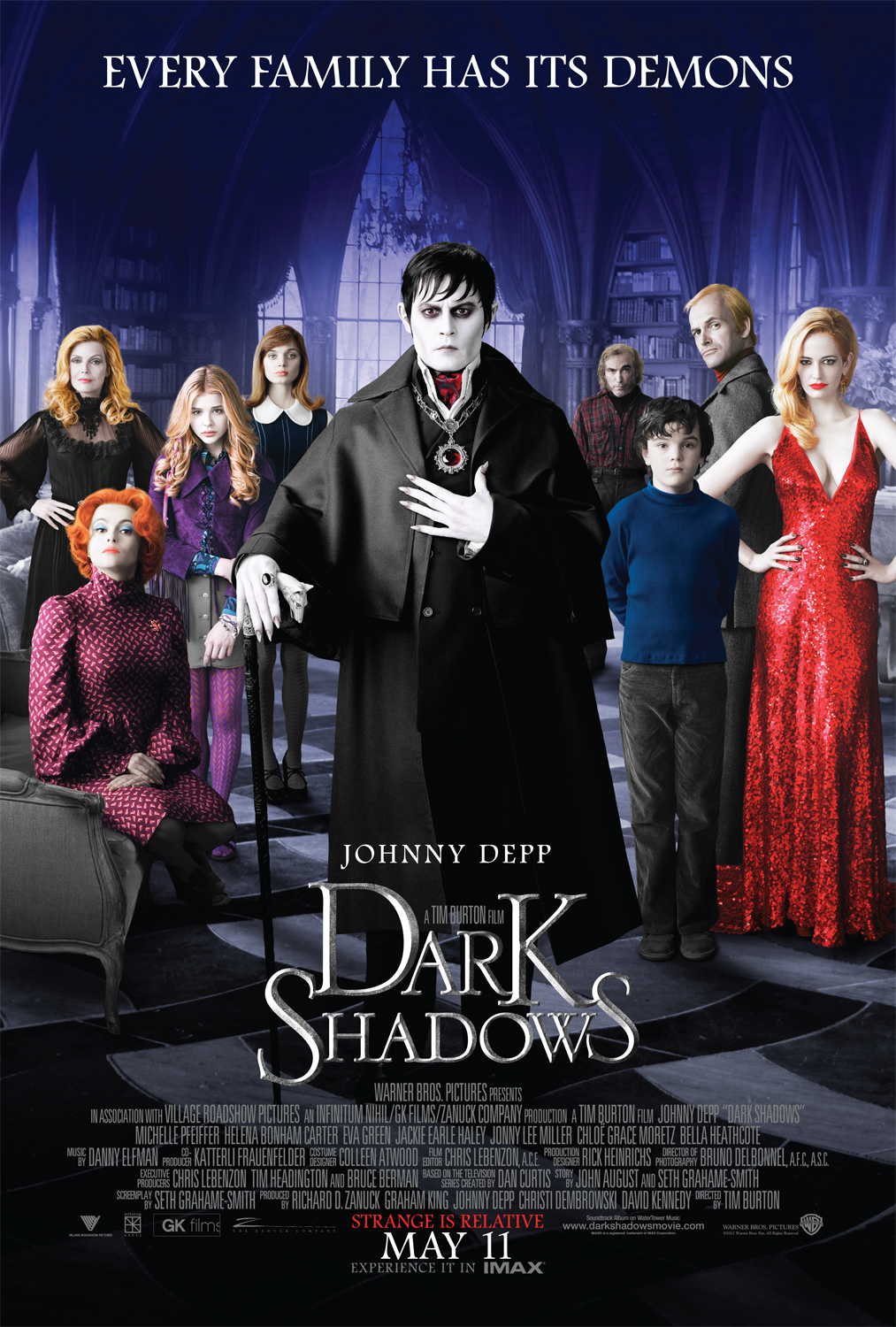 Dark Shadows was a daytime soap that aired for only a brief period of time as far as soaps are concerned, 1966-1971, but it was enough to make a lasting impression. The supernatural soap featured vampires, werewolves, and other creatures of the night, entangled in high-stakes drama and romantic excursions – it was the Twilight of its day. Director Tim Burton and his attached-at-the-hip collaborator, actor Johnny Depp, were fans as children and have kicked around a big-budget big screen version for years. Now that Dark Shadows hits theaters, you’ll be left wondering whether they really ever liked the original show or secretly despised it.
In the 1770s, Barnabus Collins (Depp) is the son of fishing and canning magnate in colonial Maine. He has a fling with Angelique (Eva Green), one of his family’s servant girls, and unfortunately for him, the gal is also a witch in her spare time. She curses the Collins family, killing Barnabus’ mother, father, and the woman he loves. She then turns him into a vampire, riles the villagers into mob mode, and Barnabus gets trapped in a coffin and buried for good.
Two hundred years later, a construction crew unearths an old coffin and out pops Barnabus from his prison. The world is a very different place. Elizabeth Collins Stoddard (Michelle Pfeiffer) is running the Collins family manor and canning company, which has fallen on hard times. A rival canning company is snapping up fisherman contracts, and this company is led by none other than the same ageless Angelique. Elizabeth tries to conceal her distant relative’s unique “condition” from the rest of her family, her brother Roger (Johnny Lee Miller), and his son David (Gulliver McGrath), grieving the loss of his mother, moody 15-year-old daughter Carolyn (Chloe Grace Moretz), and caretaker, Willie Loomis (Jackie Earle Haley). The Collins family also has a new hire, Victoria Winters (Bella Heathcote), who looks strikingly like Barnabus’ lost love from 200 years ago. He becomes smitten with the new lass, who may be the reincarnation of his lost love. That’s enough to rev up Angelique’s wild sense of jealousy, as she tries to get her long-desired man and destroy anyone that stands in her way.
 Is this ever one ghoulish mess of a movie. It never settles on a tone; is it supposed to be a larky tongue-in-cheek send-up, a Gothic melodrama, a dysfunctional oddball family comedy? What is this supposed to be, because whatever it is, it isn’t entertaining. Oh sure, it’s entertaining in a, “Where the hell is this going?” kind of way, but so is being kidnapped by a drifter. The movie feels like it has a box filled with ideas, and every so often it just shakes up that box, reaches inside, grabs one and says, “Let’s give this a try.” The screenplay, credited to author Seth Grahame-Smith (Abe Lincoln: Vampire Hunter), is awash with half-baked ideas and poorly developed characters. The live-in doctor, played by the second stalwart of the Burton Repertory Players, Helena Bonham Carter, is a hoot. Carter (The King’s Speech) has got an edge to her and an interesting dynamic with Barnabus, but sadly her storyline is tied up far too quickly. The character of Victoria is a rather interesting one, a girl who could communicate with her ghostly former relatives, who happen to look just like her. The gal was sent to a mental asylum by her parents and escaped, compelled to come to the Collins mansion. Why in the world wasn’t she the movie’s protagonist? That is a far more compelling perspective than a goofy vampire who speaks all old timey. Seriously, the Barnabus stuff is your basic fish-out-of-water comedy, lazily commenting on the times. There is no joke that is too obvious for this movie (Barnabus inquires why Carolyn has no husband; Barnabus is fascinated by a lava lamp; Barnabus thinks Alice Cooper is an ugly woman – sigh). A lot of the shapeless narrative would be forgivable if the movie was just funnier. Barnabus is just not that fun of a character. His anachronistic verbiage gets dull when you discover that seems to be the movie’s one joke. You may start tuning him out like I did.
The movie feels like a collection of subplots and no main storyline to gather traction. We’re told that the youngest Collins, little David, is enamored with Barnabus, though considering we’ve only seen the two together in like one previous scene, this seems like quite a leap. Unless David has gotten particularly skilled at hiding behind rocks, we haven’t seen any of this. The entire character of David and his sleazy father could be eliminated and they would only minimally affect the story. And then there’s the late revelation that one of our characters has a hidden secret identity, a revelation that fostered no setup. When the character looks into the camera to explain and ends with a curt, “Deal with it,” it’s like Grahame-Smith himself is speaking directly to the audience, mocking it for hoping that the movie would actually do a good job of setting up and paying off character development and relationships. Stupid audience. Why can’t you just be happy with all that neat Tim Burton set design?
 The final melee between the Collins family and Angelique keeps reminding you of the dashed promise of the flick. Angelique, in her witchy withiness, summons dark forces to make statues come alive. Well, sort of. They flail their arms a tad. And then she makes the walls bleed. Well, sort of. The dripping blood stops after just a few inches from where it began. If you’re going to make the house bleed, I want Shining-level torrents of the red stuff. The tonal inconsistency, matched with the muddled plot and scant character work, makes for a pretty frustrating bore of a movie.
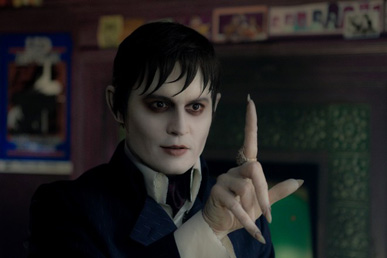
You could usually count on Depp (Alice in Wonderland) for at least committing himself to another bravura weird performance, but the material fails him. He’s caked with alabaster makeup, given claw-like hands thanks to additional knuckles (why…?), and he’s trying his best to transform a list of peculiarities into a character, but like most things concerning the movie, it does not coalesce properly. I actually think the most entertaining actor in the movie is Green (Casino Royale). There’s not much to her role but at least she has fun with it, bringing an admirable level of energy while her peers remain laconic, content to submerge into the 70s scenery. She shows a nice flair for comedy heretofore unseen. Strangely, Green adopts a slightly raspy voice that sounded like an imitation of, none other than, Helena Bonham Carter. If Burton’s note to his film’s young, frisky, sexy antagonist was, “Sound more like my wife doing an American accent,” then I think we’ve butted into something personal best left between husband and wife.
Ultimately, I have no idea who this movie is going to appeal to. The fans of the original soap will surely not be pleased with the jokey, tongue-in-cheek manner that Dark Shadows treats its source material. Fans of Burton’s stylized, dreamy, Gothic fairy tale visuals will find the film tedious and a poor waste of the man’s talents. Even the casual Depp fan will probably find the movie mostly unfunny, weird, and boring. The tonal whiplash never settles down, and the plot is replete with half-developed characters, ideas, and plot points. It just seems to throw everything at the wall to see what sticks, but that’s not the best way to tell a story. Not even Burton’s visuals or Depp’s performance can save this movie. Dark Shadows is unquestionably amongst Burton’s worst films (2001’s Planet of the Apes debacle takes the crown), made all the more inexplicable by the fact that Burton and Depp are self-described fans of the TV show. Maybe we all have different definitions of “fan” that I am not privy to. This movie deserves a quick death.
Nate’s Grade: C
Share this:

21 Jump Street (2012)
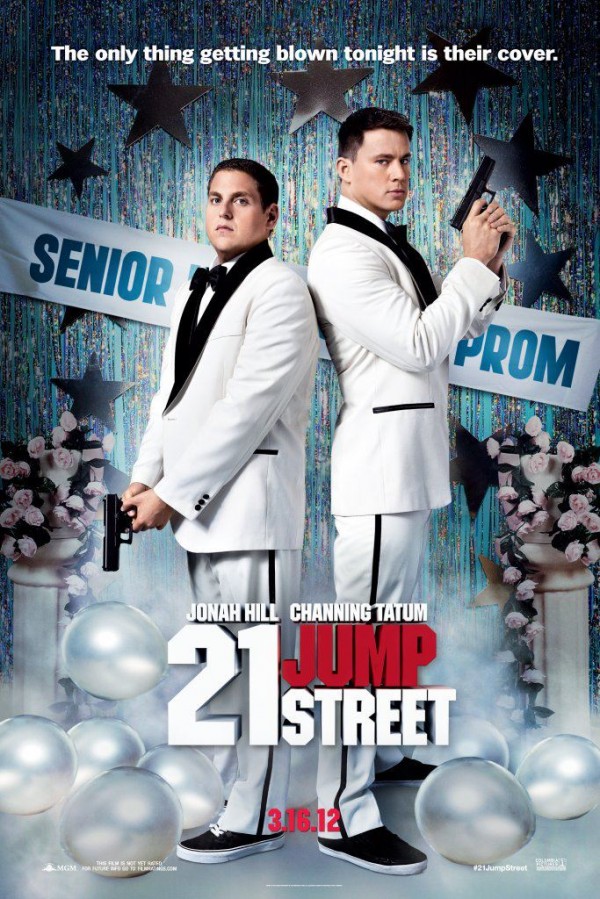 21 Jump Street ran on TV from 1987-1991 and is mainly known as serving as a launching pad for eventual mega movie star Johnny Depp… and Richard Greico too. Youthful looking police officers infiltrated high schools and tackled topical issues of the day (what snap bracelet goes best with my high-waisted jeans?). Why would anyone want to make this movie, let alone comic actor Jonah Hill? Surprising in just about every way, especially when it comes to overall quality, the 21 Jump Street movie is not just a great comedy but also a great movie. How the hell did this happen, Movie Gods?
Officer Schmidt (Hill) is smart but shrimpy (which is saying something considering how dangerous Hill’s weight has been before). Officer Jenko (Channing Tatum) is a stud but pretty dimwitted when it comes to tests. The two form a partnership and get assigned as bicycle cops, not exactly the position of command and authority they were expecting. After a few screw-ups, including failing to read a suspect his Miranda rights (“You… have the right… to be an attorney”), the duo gets bounced to an old undercover program at, you guessed it, 21 Jump Street. The pair is supposed to pose as high school students and find out who’s supplying teenagers a dangerous new club drug. Much has changed since Schmidt and Jenko were in high school together, and both of their profiles were accidentally swapped, meaning Jenko is given AP chemistry and the higher level classes, and Schmidt is given gym and acting courses, where he’s supposed to work his way into the popular circles. Molly (Brie Larson) is a gal in that popular inner circle and Schmidt struggles to accept that a pretty, smart, popular girl might actually “like like” him.
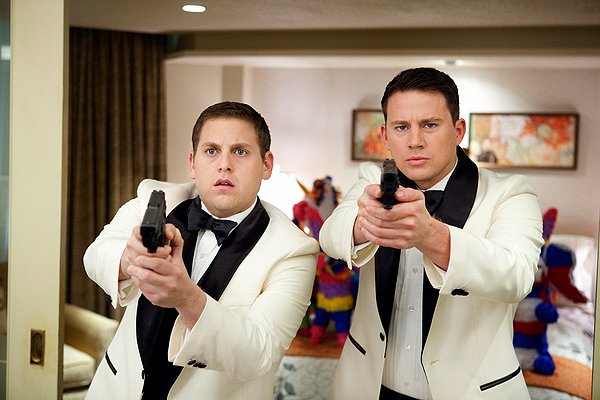 I knew I was in for something special when the movie itself lambastes the very idea of a 21 Jump Street movie, with the police chief (Parks and Recreation’s Nick Offerman) ridiculing the idea of unoriginal nitwits recycling something old that has name recognition and hoping the public will be too dumb to care. The movie beats the audience to the punch every time, mocking the absurdity of its own premise and plot points (many characters note how old Jenko appears). I should have expected more from screenwriter Michael Bacall (co-writer of the Scott Pilgrim movie adaptation) and especially from directors Phil Lord and Chris Hill, the same pair whose rambunctious comedic verve radiated from every frame of Cloudy with a Chance of Meatballs and their brilliant short-lived animated MTV show, Clone High. This movie had me laughing a lot and had me laughing hard, doubling over, with-tears-in-my-eyes laughter at points. Dickson spouts, “Some kid overdoses on drugs. And because he’s white, people actually give a shit,” showing that a movie with a mind-blowing number of male genitalia jokes can provide a few shrewd jabs of social commentary. There’s a great bit where on their first day back in school, Jenko points out the various school cliques. Then he gets to a group of students in skinny jeans, thrift store clothes, and floppy hats, and he looks puzzled. “I don’t know what those kids are?” Ha, because hipsters didn’t exist back in his (my) day.
21 Jump Street is cheeky, rowdy, quick-witted and playful in the best sense of an action comedy. It’s got fish-out-of-water moments as the duo struggle to fit in with a different high school setting. The one-liners and riffs can be gut-busters, but the film does an even better job layering oddball gags (Korean Jesus), loony slapstick, fun but telling character moments (Schmidt not knowing how to end a prayer: “The end, right? ‘The end’?”), strong setups that have stronger payoffs (using the reading of Miranda rights as a genuine emotional climax), and an overall raucous, anarchic spirit.
Here’s one sequence in particular that shows off the film’s clever comedic chops. The film finds a way to satirize the tropes of action movies, particularly buddy cop movies, with such nimble precision. Schmidt and Jenko are on the run but their car chase keeps butting heads with the fabricated reality of Hollywood movie chases. For one, they keep finding themselves getting stuck in traffic on the highway. This forces them to have to keep abandoning cars and finding a new set of wheels ahead of the gridlock. Then, as the bad guys chase them down on motorcycles, the chase causes all sorts of chaotic collateral damage, including oil trucks riddled with bullet holes and dripping the flammable substance all over the road. Then one of the motorcycles skids into the flammable muck, and our heroes wince in preparation of the expected explosion, and then nothing happens. “Huh. I really thought that was going to explode,” one of them remarks casually. And this setup is repeated again, denying us the explosive equation that action movies have pummeled into our brains (car + any tap of force = humungous fireball), and there is a payoff to this comedic tweak on the cliché, and it is silly and terrifically funny. Plus, I haven’t even mentioned that both Schmidt and Jenko are dressed in silly outfits and begin their car chase in a driver’s ed car. This sequence is just one example of the anarchic, robust, and self-aware comedic attitude that the movie flaunts.
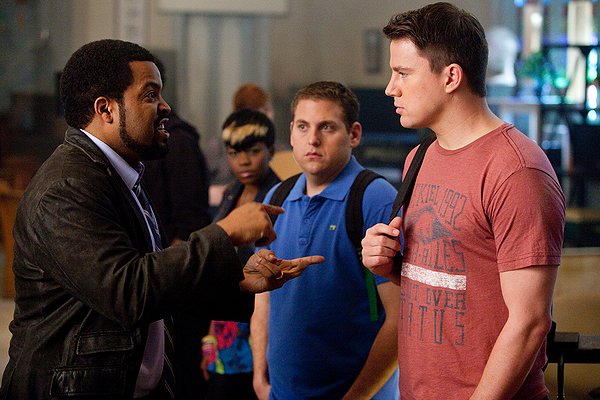 But more than being a hysterical action picture, 21 Jump Street works even better because at its core is a level of sweetness, a satisfying mixture of lewd and heart like the best Judd Apatow ventures. It’s a bromance of epic proportions even by buddy cop standards, the old school bromance vehicle of its day. The guys go back to high school and the movie’s bright switcheroo puts the characters in opposite social spheres, with Schmidt with the cool kids and Jenko struggling with the social misfits and bottom-dwellers, a.k.a. nerds. Of course the whole class assignment also shows the façade of being cool in high school. The movie could have mined this well-worn stereotypical class conflict with ease, but instead it decides to use its contrived scenario as a jumpstart for the guy’s emotional growth. The lessons may be simplistic (perils of ego, believe in yourself, teamwork, personal responsibility) but that doesn’t make them bad lessons, and the fact that the flick seriously uses covalent bonds as a metaphor, and does so in an almost poignant fashion, is worth applauding. The relationship between Schmidt and Jenko engages the audience, and we root for them even when they’re behaving like jerks. They’re misfits who are doubted and reprimanded, which make us hope for their eventual success even more. Refreshingly, the movie doesn’t put them in opposing camps in high school. Schmidt was a dweeb and Jenko was a dumb jock, but that doesn’t mean they needed to be adversarial. When they regroup in the police academy, they form a genuine partnership, realizing they can assist one another. They form an actual friendship and they’re both better cops, and better characters, together.
Hill and Tatum have preposterously good chemistry together as a comic duo. Hill, a co-writer himself, reportedly had to remain steadfast to convince Tatum to join forces, and thank god he stuck it out. Hill’s (Moneyball) already a comic pro at this point, though this role tones down his comical rancor and ups the spaz awkwardness. Tatum (The Vow) is the true revelation. Man does this guy have really great comedic skills; a sharp, instinctive sense of timing, a pliable physicality, and a genial charisma that doesn’t demand solo attention. He’s good at playing dumb without going overboard. He’s not just good, he’s flat-out terrific. Larson (Scott Pilgrim vs. the World) is an adorable and plucky love interest, sure of herself, down to earth, and accessibly quirky. The supporting cast shines in their small roles, notable Ice Cube (Lottery Ticket) as the typical brash and loud police captain, Ellie Kemper (Bridesmaids), in her randiest roll yet, as a chemistry teacher awkwardly flirting with the hunky Jenko, Dave Franco (Fright Night) as an eco-friendly drug dealer, Rob Riggle (The Other Guys) as an aggressive gym teacher, and a special cameo that’s worth leaving unspoiled.
21 Jump Street has some weaker points, namely when the action ramps up it’s pretty mundane when it’s not being funny, but the faults are minor. This is a silly, shrewd, salacious, and outright thrill of giddy entertainment, a comic blast. Hill and Tatum have a wonderful comedic dynamic and the clever screenplay gives them plenty to do with their talents. I didn’t think it was possible to adapt the cheesy TV show into a worthwhile studio comedy, but Hill and company have exceeded every expectation. 21 Jump Street isn’t the most nuanced or subtle comedy, though I will argue spiritedly that it has plenty of smarts in all the right places, but it’s an affectionate, witty, and rambunctious night out at the movies that will be hard to beat this spring.
Nate’s Grade: A-
Share this:

The Smurfs (2011)
 What a smurfin’ terrible movie. This big screen debut for the little blue commune dwellers is a painful experience, magically transporting the little creatures to New York City. They find themselves in the care of Patrick (Neill Patrick Harris), an ad man who’s pretty much a jerk, especially to his doting, pregnant wife. At one point, in his ad man frenzy, he yells, “ I never wanted any little people running around here!” Oh no, what a bizarre outburst that somehow cuts directly to his fears of being a father. The movie spends so much time with the human characters, who are shrill, exasperating, and dull form the get-go. The comedy is a mixture of slapstick and insufferable kiddie wordplay, replacing “Smurf” for just about any word in a sentence for a miserable attempt at humor. It’s like the screenplay was a Mad Libs page (Am I being too generous crediting a whole page to the script?). The Smurfs is clearly designed for a 3D audience, hence there is crap flying at the screen at every turn. Yeah, another stupid thing thrown at the screen. Hank Azaria plays the thankless role of Gargemel, the man who created Smurfette (voiced, not too badly actually, by pop singer Katy Perry) but schemes to capture Smurfs for their… smurfness. I don’t know. If this guy could create his own Smurf, why doesn’t he just keep doing this? Instead, Azaria runs around New York speaking in an arch manner, falling down a lot. I suppose the real question is whether this piece of blue excrement could entertain children, its target audience. Perhaps the youngest of tykes will be tickled by the Smurf adventures, but I think most kids will be puzzled and bored and weirded out by the movie, wondering what they had done wrong to deserve watching this dreck.
Nate’s Grade: D
Share this:

Mission: Impossible – Ghost Protocol (2011)
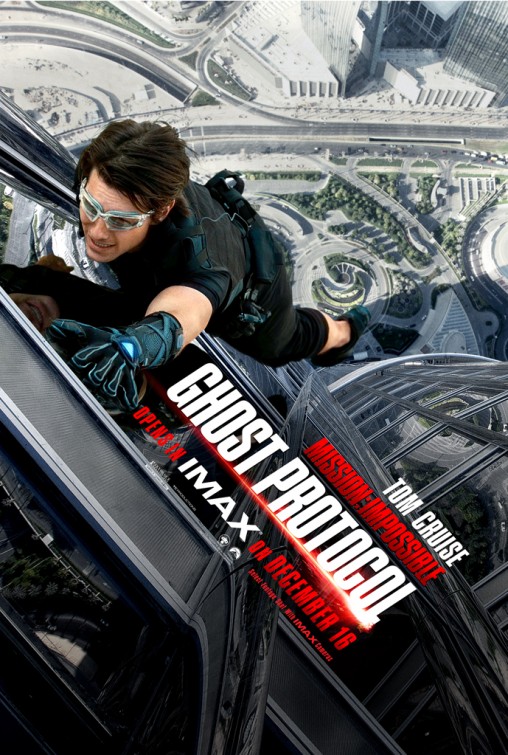 In the span of three months, two Pixar vets will be making their live-action filmmaking debuts. Andrew Stanton (WALL-E, Finding Nemo) is directing Disney’s big-budget John Carter of Mars adaptation, which will be released this March. But first is the awkwardly punctuated, colon-hoarding Mission: Impossible: Ghost Protocol (henceforth referred to as M:I 4), directed by Brad Bird. Any fan of The Incredibles (and who isn’t) knows that Bird is a terrific visual stylist who can compose remarkably exciting action without overlooking characterization. If anyone was ready for the leap into live-action, surely it was this man. Bird is the real star of the movie, and he aces his debut. I think he’s finally living up to the potential he showed with TV’s Family Dog (please note the tongue firmly planted in cheek here).
Ethan Hunt (Tom Cruise) and his IMF squad are on the run. They’ve been framed for an explosion that took out the Kremlin. The president has invoked “ghost protocol” meaning that the IMF no longer exists, and every member is cut loose. That means Ethan and his newest team, techno wizard Benji (Simon Pegg), feisty Jane (Paula Patton), and the mysterious Brandt (Jeremy Renner), have no backup. They are considered rogue agents and Russian’s own special police force is hunting them down as well. Hunt and his team must track down and stop an international terrorist, Hendricks (Micheal Nyqvist, the Swedish Girl with Dragon Tattoo series), who sees the global benefit of nuclear catastrophe (I suppose surviving would be the catch). Hendricks has gotten hold of Russian nuclear launch codes and now is looking to put the final pieces together to initiate a war between the United States and Russia, plunging the world into disaster. Hunt’s team travels around the globe to stop this bad man and his bad plan.
 Bird delivers in a major way in his live-action film debut. The man behind two of the best animated films of all time and Ratatouille, has shown that his keen skills of directing animation have easily translated to real people and real-ish explosions. Bird is a mad genius when it comes to staging elaborate action sequences; he teases out his action with organic consequences and his camera makes adept use of space and geography, and best of all you can easily follow what’s going on in the frame. So when we have an action sequence that takes place in the tallest skyscraper in the world, you know Bird is going to make fine use of this fact to accentuate his action. And the man does so in spades. The Dubai sequence is probably the how-did-they-do-that? standout that people will be most talking about. Hunt has to climb the outside of the aforementioned tallest building in the world using nothing but some special sticky gloves that don’t always work right. He has to climb several stories up, and then there’s the matter of going back down without them. But M:I 4 doesn’t rest on its laurels, because immediately after this sequence we have a feast of thrills. We segue right into a meeting between two parties where Hunt’s team has to pose as each member of this sit-down, orchestrating two separate simultaneous false meetings with the real bad guys. The two meetings dovetail one another as far their needs, making for a blissful parallel of escalating suspense. And then even after this, we get a foot chase into a sandstorm, which then becomes a dangerous car chase into a sand storm. And there are even more great stunts and spectacular action to come, notably a fight in a futuristic car park where the cars tumble from level to level.
Bird has such a firm command of his action, exercising his inspired imagination and all the tools in the special effects paint box. The screenwriters deserve recognition as well, Josh Applebaum and Andre Nemec, both of whom honed their writing chops on J.J. Abram’s sublime spy show, Alias. Their opening sequence, an escape from a Russian prison, sets the stage with Bird’s smart execution; setting up a problem and then letting the situation play out in surprising yet logical and clever ways. It may not have the epic scope of a Michael Bay flick, but Bird’s action is cool without having to be exhausting or noxious. The frenetic pacing rarely lets room for breathing. One of the film’s quiet moments ended in such a jarring fashion that it startled me and I kicked the patron sitting in front of me. I must also credit Applebaum and Nemec for producing the only Mission: Impossible movie that did not involve a turncoat. I was starting to think that IMF’s Human Resources department was in needing of a good housecleaning. Bird, and the screenwriters, has delivered a Mission: Impossible movie so good, with such kinetic and rewarding action sequences, logically utilized gadgets, sexy cars, sexy gals, and exotic locales. They’ve basically made the best Bond movie not to bear 007’s likeness.
Like the previous Mission: Impossible flick, this one emphasizes the team aspect, which makes a more fulfilling and interesting set of missions. M:I 2 became the “Ethan Hunt kicks people in the face for two hours movie,” which Chuck Norris might approve but otherwise was lacking. When J.J. Abrams got on board in 2006, the brand finally got back to its roots. And a team working together with individual strengths makes for a much more satisfying mission that also allows for multiple points of action. Simply out, if you have three people that need to do stuff in synchronicity, it plays out much better than watching Cruise kick people in the face. Choreography is always better when you have more dancing partners. Anyway, with M:I 4 we get some terrific teamwork that can be just as thrilling as the action sequences. Besides the breathless Dubai sequence, there’s a great sequence where the team has to infiltrate a sleazy Indian businessman’s (Anil Kapoor, the TV host from Slumdog Millionaire) cocktail party to get some special satellite codes. Jane is tasked with seducing the sleazy guy, Benji is left to operate a mechanical rover with a powerful magnet that will levitate Brandt, in a metal suit, across the system’s super hot inner mainframe, and Hunt is trying to lose his Russian pursuers. It’s a great sequence where all the pieces come together for maximum effect.
 Cruise has done plenty in the last five years to destroy audience good will, so it’ll be interesting to see if audiences warm back up to the man with the million-dollar smile. Cruise has always been an actor of ebullient energy and charisma, and this has always aided him in action settings and M:I 4 is no different. He’s still a credible action hero and a born movie star, whatever audiences think about his increasingly polarizing personal activities. Lessening Cruise’s load is a smart move, and Pegg (Paul) can provide needed comic relief while Patton (Precious) supplies the sizzle. My goodness can this woman fill out a dress in marvelous ways. Not to be completely sexist, she does a fair amount of ass-kicking too. Her fight with the French femme fatale agent (Lea Seydoux) was all kinds of awesome. Renner (The Town) seems groomed as a potential heir apparent for the franchise. His character is given a small amount of depth to work with, the guilt of a mission gone wrong that has a very personal connection to Hunt. At this point, Renner can do no wrong as an actor in my book. Although there’s only a nine year age difference between Cruise and Renner, so I don’t know how much more mileage that gives you as a franchise. Regardless, Renner is an actor of great conviction and intensity even when he’s silent.
In terms of the franchise, I’d say this fourth installment is just as good as Abrams’ M:I 3, though Abrams had a much better villain and the added emotional urgency of hunt’s wife in distress. Seriously, this is one really boring and completely interchangeable villain. For a movie about the world being on the brink of thermonuclear Armageddon, why do the stakes feel so low? It’s probably because the movie has deliciously orchestrated and eye-popping set pieces but very little urgency. World War III has never felt so ho-hum. Still, it’s hard to fault an action movie when it delivers such high amounts of adrenaline, perfectly packaged in well-developed action beats. This is a high-flying popcorn spectacle of the top order, a grandiose piece of Hollywood escapism. Mission: Impossible 4 is pretty much everything you’d want in a summer blockbuster, only shuttled to winter. I think Bird’s future is limitless, in animation and live-action, and I think the Broccoli family would do us all a favor by tapping Bird to direct a Bond movie. M:I 4 is a pretty good resume for the gig. That would be one mission to die for.
Nate’s Grade: A-
Share this:

Conan O’Brien Can’t Stop (2011)
 You’d think that a behind-the-scenes documentary in the immediate aftermath of Conan O’Brien being paid $30 million to walk away from his dream job hosting The Tonight Show would have plenty of drama and revelations. It doesn’t. This thin documentary mostly just tags along on O’Brien’s multi-city comedy tour during the time he was contractually obligated to not appear on TV. O’Brien doesn’t go into much detail about the Tonight Show brouhaha, making only vague references to his ouster in conversations about confronting his anger. Fans of the gawky comedian will be put off by O’Brien’s often hurtful, prickly behavior toward his subordinates and co-workers. He has a biting wit but often that wit has a discernible edge, making everyone feel uncomfortable, and now you too at home. His bitterness always seems to be bubbling. He’s a conflicted man, bemoaning meeting and greeting fans, citing the exhaustive nature of always being “on,” but then in the next moment he’ll charge into a crowd to feel alive again. Conan O’Brien Can’t Stop is a lackluster documentary that has a few laughs since it does chronicle a road show about funny people, but it’s not too long before even O’Brien fans might wish that he’d just stop.
Nate’s Grade: C
Share this:

The Last Airbender (2010)
 Let The Last Airbender be a shining example of how NOT to adapt a children’s fantasy series into a standalone 90-minute movie. M. Night Shyamalan was hired to write and direct the popular Nickelodeon cartoon into a major movie with a major budget. It’s astounding how poorly made on every front this movie is. Seriously, people should be taking notes because Shyamalan has given a blueprint of blunders to avoid. The first blunder, and perhaps the source of all the others: hiring Shyamalan to begin with.
The film takes place in a fantasy realm where human beings are divided into four different nations based on the natural elements: earth, fire, wind, and water. Each nation has a special select group of people that can control that element. These people are known as benders. The one figure who can control all four elements is referred to as the Avatar, and this figure is reincarnated into a different nation each generation. In the absence of the last Avatar, the fie nation has invaded the other nations. Prince Zuko (Dev Patel) has dishonored his father, leader of the fire nation, and been banished. He seeks redemption by attacking the water nation, where siblings Katara (Nicola Peltz) and Sokka (Jackson Rathbone) live. They discover hidden among the ice a small bald child named Aang (Noah Ringer). This kid is the last of the airbenders and is believed to be the last reincarnation of the Avatar. For obvious reasons, Prince Zuko is after the Avatar to regain his father’s acceptance.
 At one point christened with the moniker of “the next Spielberg,” the writer/director has been slipping and sliding down into the pits of his self-deluded grandeur and stubbornness. After Lady in the Water and The Happening, who in their right minds would give this guy $150 million to direct a special effects-driven summer action movie AND let him adapt the show too? Even if you somehow managed to convince yourself that Shyamalan sitting in the director’s chair was a feasible solution, why on Earth would you let this man near the screenplay? I must repeat: did people see Lady in the Water and The Happening (this is a rhetorical question, because nobody wants to remember seeing them)? The Airbender series is a very well regarded television show that has appealed to audiences of all ages, including those old enough to buy their own beer, thank you very much. What purpose does it serve to ditch the show’s creators and longtime show runners in place of giving the responsibilities for coming up with plot, characterization, and God help us, dialogue, to the man that last gave the world The Happening? The Happening, people! What did you think was going to happen? Even with the lowest of expectations, The Last Airbender will still confound with its dead-on-arrival acting, zero character development, and overly serious spiritual mumbo jumbo. Who at the studio read Shyamaln’s adaptation and thought it was ready to move forward?
The Last Airbender begins with an opening scrawl informing the audience of the four different nations and the significance of the Avatar. Then it sprints forward without ever establishing context. Spending time to explain the rule and makeup of a new world is essential to the fantasy genre; we need to be able to know the rules of this universe and the dramatic stakes. Shyamalan establishes his villains via a lame text crawl. How hard would it have been to open the movie by showcasing the Fire Nation being big and bad? Most films open by establishing the bad guys in true villainous form. This movie would have started out so much better by establishing the villains, their mission, why they’re so bad, and introducing the general audience to the family of bad guys. That way our first introduction to them isn’t so perfunctory. In the film as it is, Shyamalan just sort of slides his characters into the plot in the most bumbling, awkward fashion. We don’t even learn about Prince Zuko’s banishment firsthand. In grand Shyamalan style, characters explain to the audience at every opportunity. Because why would you rather watch Zuko try to impress his father, fail and become scared, and have his father banish him from his nationality, promising to return and win back his father’s approval… when you could just listen to a character recite what took place? Isn’t that way better than watching something in a visual medium? There are a terrible amount of moments that feel clumsily strung together, like several important scenes were taken out at the last minute.
 This is emblematic of the entire movie because unless you’re well versed in the Airbender story, you will be as clueless as I was. I had no idea what was going on for most of the movie. Suddenly characters appear. Suddenly they can do some magical ability. Suddenly they can’t. Suddenly they’re gone. Suddenly we’re somewhere new. Suddenly this character’s dead/ Suddenly the Earthbenders are all kept together in a prison that lies atop plenty of bendable earth. Where’s the correctional planning on that one? I couldn’t explain why anything was all of a sudden happening, or what the exact rules were that helped or hindered characters, and I was left grasping for any sort of workable motivation among all the ridiculous and reflexive New Age spiritualism. Shyamalan and the film’s producers do not set up a damn thing. The film operates on a false assumption that the audience is already familiar with the source material, so it never stoops to setup plot or explain characters and events. That would be a waste of time when they have more substandard water effects to show. Because why would you want to spend $150 million on a movie that appeals to people outside a narrow margin of fans? And when you try and try and cannot understand what’s happening on screen, it’s only natural to lose interest. When the film is as dopey as The Last Airbender it only speeds up the process. I was deeply apathetic all the way through this ungainly mess.
I don’t think there’s anything that irritates me more in a fantasy film than when characters treat everything with such general indifference: “Ho hum, we just found a bald kid and his flying buffalo in a block of ice. Ho hum, he can master all the elements. Whatever. What’s on TV?” If the characters can’t be bothered to care then why should I?
I don’t know what this movie spent on special effects but whatever it was it clearly wasn’t enough. Last Airbender has some of the worst special effects I’ve ever seen in a major Hollywood summer release. Did the ILM gurus pass along their effects work to their interns? The green screen work, featured early with Katara and Sokka in some Icelandic realm, is ridiculously shoddy. People look like they have halos as they stand out against the all-too fake backdrops. The special effects in general are missing a polish and resonance that helps to disguise the illusion. I have to admit that it gets pretty boring watching one character hurl blue water orbs while another hurls red fire orbs. You would hope that a movie where people can control natural elements for combat they could do something more imaginative than fling different colored blobby orbs at each other. You have the power to control fire, the power to command the oceans or the wind, why must you low-ball it? I saw infinitely better choreographed elemental fighting on old episodes of Captain Planet and the Planeteers.
 Once again Shyamalan completely betrays the trust of his actors (don’t think Zooey Deschanel can give an awful performance? See The Happening). He gets lost in the whirlwind of special effects and fantasy worlds, so his actors get short shrift when it comes to direction. Ringer look the part and can perform the tricky martial arts moves with ease, but is that the best reason to hire an actor? Can’t makeup take care of perfecting a look? Can’t a stunt double fill in for the more challenging physical stunts? I’d rather have somebody who can act rather than just look like the human form of an animated character. Ringer is an annoying messianic figure to have at the center of your franchise. His counterparts don’t fare much better. Peltz (Deck the Halls) is impassive and routinely hits the wrong note for a scene, and Rathbone (Eclipse, New Moon) is fairly wooden and plays too many scenes like he was given one note (“bigger eyes”). Patel (Slumdog Millionaire) gets to glower and his voice kicks up in volume at weird intervals. It’s another example of unmoored actors struggling for direction. But the worst offender in the film is Aasif Mandvi, though through no real fault of his own. He is dreadfully miscast as the movie’s chief villain, and wickedness is not in Mandvi’s repertoire. He’s a cutup on TV’s The Daily Show but here Mandvi couldn’t seriously menace anyone. His tone, demeanor, and even very look lack intimidation. He has a glint of mischief that you can’t take seriously. I’m usually not one to point and shout “racism,” but the fact that Shyamlan and the producers have whitewashed the film’s casting is troublesome. Caucasian actors have filled in for the series’ predominantly Asian characters, and all the villains happen to be transformed into dark-skinned figures played by Indian actors.
I can’t explain most of M. Night Shyamalan’s thinking when it comes to the finished product. The Last Airbender seems intended solely for fans given how forgetful it is when it comes to plot setup and explanations and back-stories. Why should an audience be able to follow along? Comprehension is overrated (David Lynch being a lone exception). At the same time, Shyamalan gives nothing back to those fans who have looked forward to a big-budget realization of the popular TV fantasy series. Shyamalan even seems downright disdainful, again falling victim to his own ever-swelling hubris. Why shouldn’t he write the script? Why would the creators have any clue about how to condense their mythological dense show into a satisfying two-hour taste? If you’ve never watched the TV show, you’ll leave the theater wondering why the hell anybody would give a crap about all this junk. The movie presumptuously sets itself up for a series of sequels that I doubt we’ll ever see, certainly not with Shyamalan’s involvement at the least. Shyamlan once again defies his critics and lives on to make yet another artistic disaster. If three straight duds couldn’t detract somebody from throwing $150 million and artistic license his way, then I don’t know if this man and his ego will ever be humbled or tamed.
Nate’s Grade: D
Share this:

The A-Team (2010)
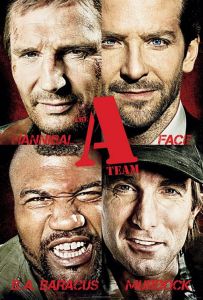 “Overkill is underrated,” quips Col. Hannibal Smith (Liam Neeson) in this big-screen adaptation of the 1980s hit TV show of the same name. And appropriately enough, like its source material, The A-Team is the very definition of mindless action. It’s completely shallow, goofy, yet over plotted and occasionally too serious for its own good, but like the A-team, the movie delivers when it counts. There is an undeniable pleasure in watching professionals work together, hatch a plan, and then watch that plan come to fruition. The A-Team is like an ADD-child because it can rarely sit still; five minutes won’t pass before something blows up. Writer/director Joe Carnahan (Smokin’ Aces) makes sure to keep things flying on screen so that the audience won’t stop and think about the multitude of plot holes and absurdities. The signature sequence that sums up the movie best is when the A-Team boys have escaped a downed aircraft by hiding inside a tank with parachutes attached. As they tumble back to earth they must try to “fly that tank” to land properly. It’s ridiculous on its face but rather entertaining. But the movie has its tongue firmly planted in cheek, even when it comes time to incorporate the show’s signature catch phrases (you could make an effective drinking game for the amount of utterances of “fool,” and, “I love it when a plan comes together”). The A-Team is overblown, silly, high-octane B-movie that obliterates your senses and thinking abilities, which means it successfully captures the spirit of the TV show.
Nate’s Grade: B-


 nathanzoebl
You must be logged in to post a comment.