Blog Archives
Act of Valor (2012)
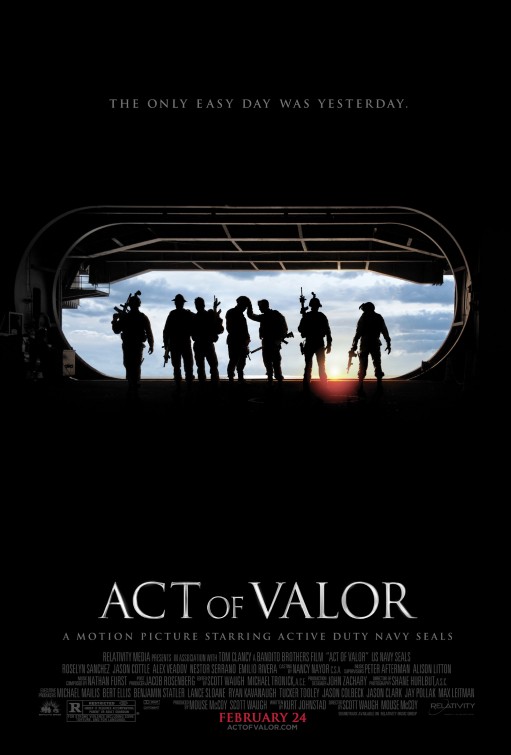 Hollywood often gets ridiculed for its tenuous connection to reality. I doubt any real U.S. Navy Seals look at 1990’s Navy Seals as a paragon of military validity. The makers of Act of Valor thought they could do one better than Hollywood. They hired real-life active-duty U.S. Navy Seals as their stars and made a movie based upon Seal combat experiences. Act of Valor was billed as the real deal. I just wish the filmmakers had spent less time on trivial yet realistic details and more time on plot, characters, and enticing action.
Who cares that the movie stars actual Navy Seals? Apparently enough people did judging by its healthy box-office returns in the spring, but really, why should a movie be any better because it has real Navy Seals pretending to be actors rather than actors pretending to be Navy Seals? Is this movie brought to a greater level of excellence because the characters know intuitively how to hold a gun properly? Was the slight difference in posture the difference maker? I suppose there is some curiosity seeing real Navy Seals go through all their training, but you know who else could be trained? Actors! Which these fellas are not. The line delivery is so flat, like the Seals were just happy to spit out all their dialogue and move along. There’s little emotion to just about any line that isn’t communicated via a bark. I can’t fault these servicemen because they never signed up to be actors; they have bigger things on their minds. Is there anything in this movie that could not have been done with actors? I doubt it. I understand the gimmick but I just can’t comprehend the appeal. Can an actor not be taught how to hold a gun, how to clear a room, how to squeeze the shoulder of his colleague to communicate move forward? I salute the Seals for trying (as well as defending our country, naturally) but I’m reminded of the old adage: it’s easier to teach an actor how to sing than a singer how to act.
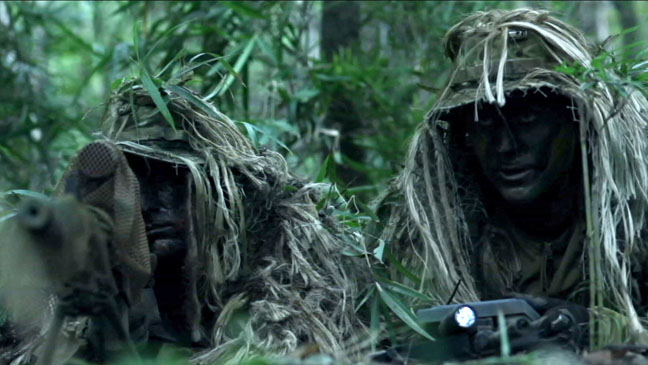 The movie seems more preoccupied with trivial details of authenticity than more important endeavors like story or character development. Here’s the most trivial detail of them all: live ammunition was used during the action sequences. WHY?! Do the guns not work with blanks? Why in the world would you dramatically escalate the danger on set and risk every shoot with live ammunition, actual gunplay? Action sequences are already a risk, so why would you exponentially increase the danger for … a slight uptick in realism? Again, it all feels like a movie in service of a gimmick. The plot is a rather cliché-filled jaunt across the world taking down terrorists, rescuing hostages, and mostly just knocking down doors, sweeping rooms, and shooting people in the head. Sure there’s a bad guy, a Chechen Islamic terrorist (double bonus: Russian and Arab!) and some other bad foreign guys with beards, but none of it ever seems to matter. I also question why a Chechen extremist would plot to attack the U.S., especially since we don’t exactly have the warmest international relationship with Russia. Surely a Chechen attack would strengthen that relationship, and the two countries might work in tandem targeting Chechnya. I’m saying this villainous plan is dumb. The good guys aren’t any deeper. Beyond their bravery, skill in combat, and impending fatherhood, we don’t know anything about these guys. A series of voiceovers try and list the various characters, but once the action starts good luck remembering any of them. In fact, good luck even keeping the two leads apart. I kept mixing them up myself.
And if that wasn’t bad enough, the action is a fairly big let down as well. Directors Mike McCoy and Scott Waugh must have studied under Tony Scott or Michael Bay, because every shot has the sleek beauty to it, the dawning sunsets, the cool gun mettle colors, the rah-rah jingoist spirit. Seriously, most of the action is just people shooting one another. That may sound like a no-brainer to anyone who bought a ticket, but the action needs to be properly thought out as well as the plot. The first mission, rescuing the tortured CIA Agent, is the best sequence because it has different points of action, organic consequences, and makes good use of geography. I’m going to hammer this point time and again until people take notice: geography is essential to well-developed action. You need to make use of your surroundings in interesting ways, otherwise what was the point of even setting the action there? The later action sequences fail to make use of any of these integral ingredients, so it becomes a rote series of people entering rooms, shooting other people, and moving to more rooms. Rather, rinse, repeat. The action has a muscular feel but it gets redundant rather quickly. That’s when your mind starts to notice how transparently the movie is working as a recruitment film for the U.S. Navy. There are sequences in this film that have no bearing on the plot (submarine visit?) other than to showcase the cool things that you, too, can do when enlisted in the Navy. There are plenty of sustained POV shots that give the illusion of a video game, war as a game. This is also why the complexities of war and geo-politics are sanded down to a series of clear-cut missions. I feel like the real servicemen deserve a more complex movie that treats their heroics as something more than clearing a video game level.
 When you get down to it, the audience that made Act of Valor a hit this past spring reminds me a lot of the audience that went to see the nearly four-hour Civil War movie, Gods and Generals. These are audiences obsessed with the details of realism. They’ll pore over the details of costumes and tactics. Whether the movie is actually any good or not, the characters engaging, the plot entertaining, is all immaterial. It’s the details they came to see. Hence the real-life Navy Seals, the missions inspired by real Seals, and the live ammunition on set. That’s what makes a movie to them. For me, I need more than realistic details; I need people and a story, and if it’s an action movie, then there better be well-developed action. It’s not like Act of Valor is a documentary people. It’s all pretend. I’ll be interested in how audiences respond to director Kathryn Bigelow’s movie about the hunt and execution of Osama bin Laden, Zero Dark Thirty. That movie uses actors and has an Oscar-winning director and screenwriter. Let’s see if anyone can tell the difference.
Nate’s Grade: C-
Share this:

The Intouchables (2012)
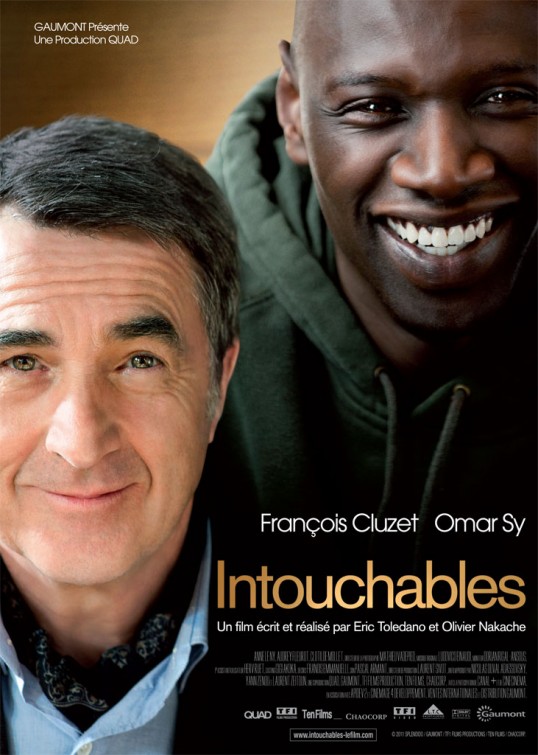 You’d never know it, but the highest-grossing film in Europe last year had nothing to do with super heroes, or sequels, or Hollywood itself. A small French film with the strange title of The Intouchablesmanages to break down just about every European box-office record last fall, sweeping across the continent and winning over hearts of numerous nationalities. The Weinstein Company bought the English-language adaptation rights, but before that gets underway they’re also releasing the original French movie to American audiences. Will subtitle-averse American audiences warm up to the little movie that has proven so hard to resist worldwide?
Philippe (Francois Cluzet) is rich quadriplegic and looking for a new caregiver to his many needs. In walks Driss (Omar Sy), a brash and headstrong man from a very different world: lower class, urban, and black. Philippe responds to the man’s irreverence and gumption and hires Driss on a trial basis. The upper-class lifestyle is like a fantasy to Driss, but the many responsibilities of caring for a man with no feeling below the neck are harder than anticipated. He objects at the very idea of having to manually evacuate the man’s… insides. The two opposites attract and the men become close friends and open one another up to new experiences.
 At its core, The Intouchables is the story of two men and their unlikely friendship. It’s told with enough weight, conviction, and character development that it’s easy to get wrapped up in the movie’s sweeping emotional tide. It’s a familiar tale, essentially that of the coming together of two people from distinctly different walks of life. You’ve seen this type of story before, where the upper class learns to cut loose and embrace life more fully, where the lower-class individual finds a path of dignity and responsibility. It’s been done before but rarely has it been done with such aplomb. Any storyline that involves a quadriplegic man and an inner city youth coming together sounds rife for after-school moralizing and sappy life-lessons. Thankfully, The Intouchables finds an angle that hits the emotional highpoints without tipping over into overt maudlin territory. Phillippe doesn’t want anyone’s pity. What is meant as good intentions can become another handicap; public perception of the individual’s limitations. Like The Diving Bell and the Butterfly, the 2007 inspirational French film about a significantly paralyzed man who could only move his left eye (what is it about French films and paralysis?), The Intouchables brings you into a world few glimpse and shows us what the perseverance of the human spirit can reap. Even a conversation that steers to sexuality can be illuminating and, for concerned male viewers, comforting that even if you can’t feel anything below the neck, the human body can adapt. In this regard, the film is a fascinating look into the life and care of a quadriplegic man (albeit an insanely wealthy one), and the fact that it’s also a moving and winning buddy comedy is yet another virtue. It’s like France’s version of a bromance.
It’s easy to see why The Intouchables has had runaway success in Europe, totaling over $300 million before ever opening in the States. This thing is a born crowd-pleaser. The characters are given room to roam, flesh out, and the interaction between two different men and their growing affection is a natural emotional foundation. We care about these characters, we smile and laugh with their interactions, the way that both men realize they need the other. It’s touching without being cloying and rich with emotional rewards by film’s end. Then there’s the fact that it’s also consistently funny without overplaying the class conflicts. There is an amusing subplot about the nebulous nature of modern art and what qualifies as “art”: the work or the knowledge that it’s from an “artist.” There’s a nice payoff with that one, but most of the humor is character-based, with the jovial Driss bouncing off the staid sarcasm of Philippe. There’s one comic subplot that seems to be hitting the same note time and again — Driss’ dogged romantic pursuit of Philippe’s assistant (Audrey Fleurot). It’s almost forgivable given the immense charms of Sy, but her character gets reduced to little more than a potential love match for Driss’ energetic libido. The humor, buoyant but also sensible, gives the film a defter touch when it comes to the more dramatic moments of loss and isolation and mourning. It’s easy to see why audiences have been falling in love with The Intouchables around the globe; they’re programmed to cry and laugh in equal measure.
And it’s that vague sense of programming that lingers. This is a film that knows exactly what chords to strike and how often. It can be accused of pandering and you’ll be able to guess every point of the plot. You think Driss will get Philippe to finally meet the woman he’s corresponding to for months? You think the upper crust will break from their immaculate stuffy prisons and learn to cut loose, spurned from Driss’ involvement? Do you think Philippe’s bratty teen daughter will learnt to shape up and fly right? Will Driss take a stand and stop his younger sibling from falling under the sway of criminal influences? Will the two men realize they truly need one another’s companionship? The answers are obvious; as are the plot turns and the happy ending, but The Intouchables goes about its business with such mass-appeal precision that you don’t really mind being manipulated. When someone can pull strings this skillfully, and quite transparently, almost daring the audience to resist, I almost admire the manipulation. Unlike Extremely Loud & Incredibly Close, another blatantly manipulative teary adult drama, at least this movie succeeds because we care about the characters rather than just bad things happening to people onscreen. The Intouchables isn’t subtle about its aims, but it is hard to resist a film this beguiling and tender and involving.
 Sy (Micmacs) is the breakout star of the movie. His gregarious, jubilant charisma instantly engenders the character of Driss to the audience. He’s constantly smiling, laughing, and cracking wise, and pushing others to be better. Sy brings such life to the movie that you instantly miss him when he’s gone. Cluzet (Tell No One), a dead ringer for Dustin Hoffman, has the more restrained role, no pun intended. His performance has to be very controlled yet believable, and Cluzet does an admirable job of building a character from the neck up. He’s a wounded man still recovering from the loss of his wife as well as his own crippling fears of loneliness. When these two are together onscreen, that’s when all the movie’s potential problems become a distant memory. The conviction in their big-hearted performances makes all the sentiment easy to swallow.
Several critics have accused the film of being borderline racist. I think the charge of racism is overdone. Just because Driss’ family lives in low-income housing doesn’t mean it’s making some blanket statement about the black experience in France. I suppose some chafe at the energetic, outspoken, and general virility of Driss. But I think critics looking for racist depictions of black males are overlooking the point that Driss had to be outspoken and energetic because Philippe is immobile and reticent. It’s in service of character contrast, not just recapitulating the figure of Loud Outspoken Black Male (a.k.a. the modern-equivalent of the age-old Noble Savage treatment). The significant part of Driss is that he has a sketchy past and comes from a low-income family struggling to get by. His race certainly plays up the contrast between the world of white privilege in France, but it’s not the central difference between these two men. Critics have also brought up the fact that the facts of the true-life story are different than what we see onscreen. Philippe’s caregiver, Abdell Sellou, was a Muslim man from Algeria, not a black man from Senegal. Does this truly bother anybody? Does the man’s heritage and ethnic background drastically alter the relationships formed or the earnest connections made? The movie doesn’t seem to think so and closes with the real-life figures onscreen, showing to each audience member the adaptation differences. Unlike something as racially questionable as The Blind Side, Driss is not rescued by saintly white people; he is an active member in his own self-actualization and not a passive receptor of the benefits of rich white people. With that said, there are still a few moments of ethnic depictions that might make you cringe, like Driss’ reaction to a night out at the hoity-toity opera.
During my viewing, I was reminded most of Scent of a Woman, another down-the-middle buddy comedy about a disabled man and his caregiver learning from one another and pushing beyond their comfort levels. It’s emotional without being too squishy and funny without going overboard, but make no mistake: The Intouchables is just as formulaic as a Hollywood production. The story and conflicts are familiar, the afflictions and backgrounds only differ. It’s feel-good, mass appeal comfort food, and when done this skillfully it’s hard to resist its call (I had a similar reaction to last year’s The Help). Its story of friendship, personal triumph, and all those happy things, but it’s also emotionally manipulative, littered with undeveloped subplots and a few uncomfortable moments of ethnic depictions. Fortunately the shining, vibrant performances from Sy and Cluzet, and their chemistry together, elevate the film’s softer and quasi-pandering sensibilities. It’s the story of two men, and by the end we greatly care for these two men, and their deep friendship and appreciation of one another. The Intouchables is a sly crowd-pleaser that dares you to defy its mass charms. And with actors this good, resistance is futile.
Nate’s Grade: B
Share this:

Bernie (2012)
 The last person the residents of small town Carthage, Texas would expect to be tried with murder would be Bernie Tiede (Jack Black). He was an assistant funeral director, a “born natural” we’re told at comforting others, but he was really the everyman glue of the town. He lead the choir at church functions, loaned his time and money to those in need, directed the town’s fledgling drama productions, coached the Little League team, and went out of his way to spend time with the town’s lonely little old ladies. It was a shock then, in 1996, to find out that Bernie had shot one of those little old ladies, Marjorie (Shirley MacLaine), the meanest one of them all, and stuffed her body in a freezer and kept it all a secret for nine months. During that time, Bernie used Marjorie’s considerable fortunes to help every community project he could. Despite the macabre nature of the crime (she had to thaw out for two days before an autopsy could be performed), the residents of Carthage rallied around their boy, Bernie. District attorney Danny Buck (Matthew McConaughey) had to move the trial to a different venue, not because the accused couldn’t get a fair trial, but because everyone in town wanted Bernie free.
Bernie is Richard Linklater (School of Rock, Dazed and Confused) returning back to his local color roots. The man is excellent at taking the natural peculiarities of regionalism and credibly establishing a slightly skewed yet authentic portrayal of small town Middle America that feels like it was lifted straight from the pages of Mark Twain. Aiding Linklater is the fact that the movie is composed like a true crime special replete with on camera interviews from many of the real townsfolk of Carthage who knew the real Bernie and Marjorie (what a strange experience it must have been acting with the fictional counterparts). They are all amusing, unassuming characters in their own right, many natural scene-stealers, and they’re still fiercely protective of Bernie 15 years after the events of the movie. The town’s unswayable loyalty and adulation for Bernie pretty much becomes the film’s own point of view. Despite confessing to murder, we find ourselves liking the guy. It’s hard not to love the guy when we see him lift the spirits of the bereaved, volunteer around town, and bring so much pride and joy to the citizens of Carthage. When forces are circling around him, we want him to escape. We want him to keep the illusion of Marjorie being alive just a little bit longer, especially when, in death, she is helping so many more people. Even when we reconcile the facts our gut still wants him to get slapped on the wrist for what is, after all, a capital crime. It’s a fascinating emotional journey for the audience in that regard, to ignore the reality of the offense because of how genuinely nice Bernie is, except for that time he killed an old lady and stuffed her in the freezer.
 Black (Tropic Thunder) does something completely different from his usually manic routine. By God, the man inhabits this character. The part plays to his strengths as a performer, his energy and natural likeability, but allows him to mellow out and try a very different tact. For the first time in perhaps his acting career, he’s not playing some variation of Jack Black. He’s playing a real-life person, though that doesn’t necessarily mean the actor is indebted to completely mimicking the living inspiration. Told from the perspective of fawning townsfolk, and one completely mystified prosecutor, Bernie remains something of a mystery as a character. He’s deeply repressed, probably closeted as well, and it’s that distance that keeps us from better understanding him. For all intents and purposes, the people of Carthage loved Bernie, but did any of them really know him? He was a genial presence, charitable and kind, but could anyone really say they truly knew him? Who is the real Bernie, the guy who would break his back helping his neighbors out of the good of his heart, or the guy who shot a little old lady four times in the back? Black doesn’t overplay the fey mannerisms or go to camp levels; he hides behind his friendly veneer and hints at more at work. Bernie’s canny salesmanship with funerals, as well as his lavish spending when he got in control of Marjorie’s finances, give a glimpse at a darker side of Bernie. It’s subtle work for a role that tempts him to go larger. I have no reservations when I say that Black’s controlled yet charismatic performance is worthy of Oscar attention. He’s that good, folks.
Supporting Black are two other great performances from established stars. MacLaine (Valentine’s Day) hasn’t had a role this good since the underrated In Her Shoes. She has great fun as the old sourpuss in town, but she too shows us glimpses of the real Marjorie, the one behind the wall of negativity. There’s a scene where she’s watching Bernie’s musical practice and she can’t help herself but smile. The very act has to break through the scowl that she has so permanently etched into her face, but break through it does triumphantly. MacLaine could have easily been portrayed as a caricature of the grouchy rich old lady, but she’s better than that. You don’t exactly sympathize with her but you do feel Marjorie’s budding comfort, even if it’s slathered in her usual contempt, and you feel her desperation at clinging to the one person who has shown her any personal interest. Likewise, McConaughey (The Lincoln Lawyer) could have been the one-note daffy lawman, and he’s certainly presented as such early on with his attention-seeking theatrics. We don’t really like Danny Buck, but from an objective standpoint he is the voice of reason. He counters the easily forgiving townsfolk, “If he killed you and stuffed you in a freezer, would you not want him to go to jail?” We know he’s right. And yet, strangely, we don’t seem to mind that much. It’s nice to see McConaughey flourish in a role that shows you he can be a real fine actor instead of just a real fine shirtless torso.
 Linklater balances a lot of different tones here but manages to find a satisfying middle ground. Bernie is a chuckler, a movie that will continuously make you laugh but leave your sides safe from splitting. I chuckled and guffawed my way through from beginning to end with great amusement. The comedy is dark but not unrepentantly (hence the PG-13 rating) or mean-spirited. Linklater doesn’t make light that a real woman was murdered, but his film raises a cracked mirror at the absurdities of our culture and the power of charisma/celebrity. There’s a mordant amusement to the entire movie, and you know you shouldn’t be laughing but you cannot help the urge. The constant interviews with the actual Carthage townsfolk add a nice color commentary to the proceedings, filling in the edges of the blanks left over by the screenplay. Some may feel that the constant commentary undercuts the movie, interrupts its flow and turns the movie into one of those grisly TV true-crime specials gussied up for the big screen. The movie does follow a similar trajectory but Linklater balances the small-town satire, tragedy, courtroom drama, and general morbid curiosity into one persuasive, cohesive whole.
Bernie is one of those stories that are so bizarre that it could only come from real life. Buoyed by strong comedic performances, a mordantly compelling story, and some rich supporting turns from real-life witnesses, Bernie is an amusing breath of fresh air amidst the summer movie-going extravaganza. It’s gentler than I would have anticipated, and funnier, and Black’s wonderful performance is worthy of serious awards attention, though I know it will be long forgotten come the fall. I don’t think Linklater was trying to make some kind of larger statement about the powerful allure of charisma, or our malleable sense of what constitutes right and wrong, but Bernie the movie is all about the fronts people put out there and the human willingness to be deceived. Or it’s just a really fun, country-fried slice-of-life comedy. Why not both? Bernie is worth discovering.
Nate’s Grade: B+
Share this:

My Week with Marilyn (2011)
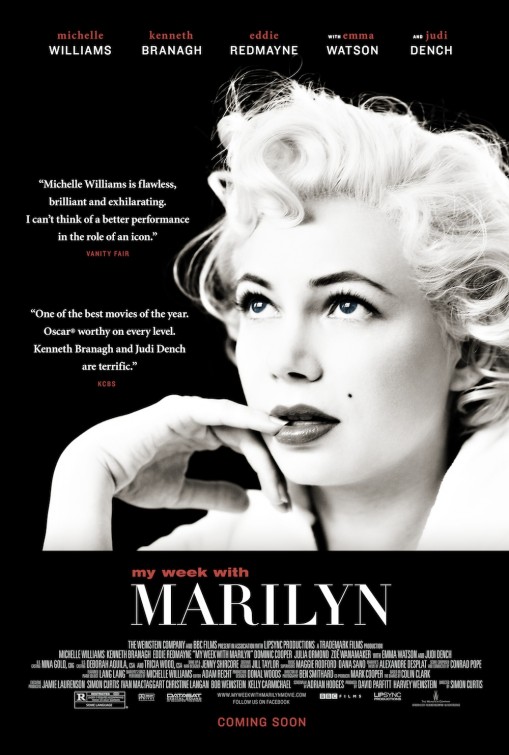 In 1957, Marilyn Monroe (Michelle Williams) was the biggest star in the world but she wanted to be taken seriously as an actress. Laurence Olivier (Kenneth Branagh) was an award-winning thespian considered to be acting royalty, but he was looking to siphon some of Monroe’s fame and vigor. Monroe flew over to England to shoot the light comedy The Prince and the Showgirl, directed by and starring Olivier, and it was here that she changed the life of Colin Clark (Eddie Redmayne). Clark was an ambitious young chap who served as the third assistant director and Oliver’s personal assistant as well. He was mainly a glorified go-fer but the position allowed him to glimpse the world of Marilyn Monroe and her various handlers, Paula Strasberg (Zoe Wanamaker) and Milton Greene (Dominic Cooper). Monroe’s flighty behavior and struggles with acting drive the more professional Oliver stark raving mad. Monroe’s rocky marriage to playwright Arthur Miller (Dougray Scott) is causing her fits of depression. Who better to cheer her up than young Colin Clark? Over the course of nine days, the two become inseparable and Clark falls head over heels for the world’s most glamorous woman.
The character of Colin Clark seems to be stripped of all defining personality traits. He’s this bland kid caught in continual awe. He just seems to be smiling and twinkling those big, compassionate eyes of his, typifying the earnestness of young love. I think he’s been rendered into a cipher for the audience to put themselves in his shoes, becoming star struck with Monroe’s attention. The screenplay takes far too much time on showing Clark coming to the repetitive rescue. His romance with a costume girl (Emma Watson) is a nonstarter and the movie doesn’t even try and hide the fact. She’s the backup romantic option, so the fact that he goes back to her after being spurned by Monroe and we’re supposed to feel that this is growth seems disingenuous and a bit caddish. Perhaps she didn’t take it too hard; if you’re going to be dumped for anyone else, there’s no shame if it’s Marilyn Monroe. Judging by the movie’s depiction, Clark is a rather boring young man, and I didn’t buy for a second that Monroe would cling to him as her hero.
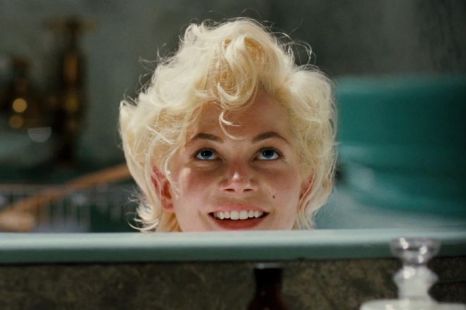 My Week with Marilyn is really focused on the titular star. Clark is just out path to the real star. I doubt there’s anything particularly revelatory about Monroe here. She was plagued with insecurities, a need to be loved, and the fatigue of “playing” herself all the time, all hips swivels and winks. At one point Clark and Monroe are taking a walk and met with a group of fans. “Shall I be her?” she coyly asks Clark and then turns into the vampy goddess the public loved, striking poses and smiling wide. By the very constricted nature of the timeline, we’re not going to learn too much about the famous beauty. She flubbed her lines, she and Olivier didn’t get along, and a mini-entourage of sycophants who were meant to be a surrogate family for the troubled gal surrounded her. Was she a lonely gal crushed by the weight of stardom or a manipulative lady who knew how to get what she wanted? The movie doesn’t take a side, instead serving up all sides of Marilyn Monroe, including a few in the buff. The film has some enjoyable juicy bits, particularly the friction between Monroe and Olivier, but the movie ultimately becomes another fawning admirer of its star. There are a couple musical numbers with Monroe that feel clumsily reproduced and the tone seems too light too often for the dramatic moments to have any real bearing. It becomes another fan that celebrating her image and sponging off her fame and legacy.
While the film may not be revelatory, Williams (Blue Valentine) herself is the revelation. She’s not exactly a dead ringer for the curvaceous, buxom blonde beauty, but she inhabits the spirit of the woman rather than sticking to a breathy imitation. She doesn’t capture the baby-doll voice but the demeanor she has down pat; when she turns it on you can feel the screen light up with the luminescence of star power. There’s quite a difference between the sad, depressed, codependent Marilyn and the sexy pinup fantasy. It’s an incredible performance in an otherwise so-so movie, though I wish the screenplay had given her more complexity to work with. Branagh (Valkyrie) is great fun as the stuffy, overbearing Olivier who gets plenty of snappy lines to vent his frustration over Monroe’s antics (“Teaching Marilyn how to act is as useful as teaching Urdu to a badger!”). Both actors are so good, and so good together, that I wish we could just remove the “my week with” from the title and focus on the relationship between Monroe and Olivier.
Allow me to question the voracity of Clark’s account. He waited until 1995 to publish his film set diaries, and then after his first memoir of his time with Monroe sold well he published another one in 2000, this one filling in a nine-day gap he says was that fateful week with the sex icon of the twentieth century (eat it, Clara Bow!). The second memoir was written fifty years after the fact and from the nostalgic perspective of an old man looking back to his youth. I feel that the particulars have been smoothed over and romanticized. The fact that surviving actors from The Prince and the Showgirl cannot verify any sort of relationship, and that several sources say that Monroe and her new husband Miller were inseparable at the time, cause me to doubt the validity of this personal account. In his first memoir, Clark even criticizes Monroe’s physical appearance (“Nasty complexion, a lot of facial hair, shapeless figure and, when the glasses came off, a very vague look in her eye. No wonder she is so insecure.“). Yet in the second book he becomes her defender. So which is it? Who wouldn’t, with sixty years of hindsight and a best-selling first memoir, embellish their one-time dalliance with a star like Monroe? The most desired woman in the world and he, a 23-year-old nobody, was the one to become her confidant? Aren’t we full of ourselves? And he crawled into her bedroom and was asked to stay the night and didn’t consummate that relationship? In the book she offers and he declines. Talk about the biggest mistake of your life.
 If you’re going to embellish, then you might as well get some action out of it. Then again, maybe in the books Clark says that Monroe gave him a pity handjob and the filmmakers deleted this (I can hear him screaming from beyond the grave, “You fools! The handjob was a metaphor. The whole tale falls apart without it!”). If I ever had even a fighting chance of getting lucky with Marilyn Monroe, you’d best believe I would be telling that story so often that my grandkids would roll their eyes in disgust (“Geez, we get it grandpa. Marilyn gave you a handy once.”). The post-script tells us that after The Prince and the Showgirl, Monroe went on to Some Like it Hot and Olivier went back to the theater for some of his best-reviewed runs of his career. So clearly, these two stars owe all their good success to the heroics of Colin Clark, who nudged them from greatness to legendary. We have only Clark’s take since Monroe cannot dispute Clark’s claims so I feel like the memoir, and the film adaptation, is an exercise in serving Clark’s ego.
My Week with Marilyn is a light, weightless movie that retells the shooting of a light, weightless movie. Well done, everyone. The emphasis on this bland kid and his fairly unbelievable whirlwind romance of the twentieth century’s most iconic sex symbol makes the movie feel self-serving. Does anyone honestly believe the events of this story? Whatever the validity of the events, a movie should be entertaining on its own rights. My Week with Marilyn has its bouncier moments and is saved by stellar acting from Branagh and the radiant Williams. But even the best acting in the world can’t save a movie that feels like it’s completely some old man’s exaggerated, embellished, and somewhat boring fantasy. If this is the relaxed standard for getting a movie made, then I look forward to the eventual film adaptation of my soon-to-be-released novel titled, My 28 Hours of Incredible Sex with Angelina Jolie.
Nate’s Grade: B-
Share this:

Red Tails (2012)
 You’d think a big name like George Lucas would not have a problem getting a movie made. Lucas has been trying to get a movie about the Tuskegee Airmen made since the 1980s, but he says no studio would bite, concerned that American audiences would not be interested in a movie with an all-black cast. So Lucas just paid for the movie himself, forking over $50 million of his own money a.k.a. July’s paycheck from Star Wars toys, a.k.a. what Lucas just had in his pockets at the time. Even though only credited as an executive producer, it’s hard not to feel the Lucas imprint all over Red Tails. The emphasis is on the high-flying aerial combat, ladled heavily with CGI special effects work, rather than on a credible story and characters that we care about. Simply out, the Tuskegee Airmen deserve a better movie than this.
In 1944, the Tuskegee Airmen have been kept on the ground for most of the war. However, the bomber pilots need more protection. It seems that white pilots meant to provide protection of the bombers will easily get distracted, chasing after German fighter planes for a taste of glory. Colonel Bullard (Terrence Howard) and Major Stance (Cuba Gooding Jr.) have been notified that their unit of black pilots will finally get their shot. Marty “Easy” Julian (Nate Parker) leads the squad, followed by Joe “Lightening” Little (David Oyelowo) and Ray “Junior” Gannon (Tristan Wilds). They are to escort the bombers and stick to the bombers; the mission is paramount. The unit paints the tails of their planes a bright crimson to stand out from the pack. The Tuskegee Airmen keep to their creed, ensuring the bombers carry out their missions, and proving themselves every bit as courageous as capable as white servicemen.
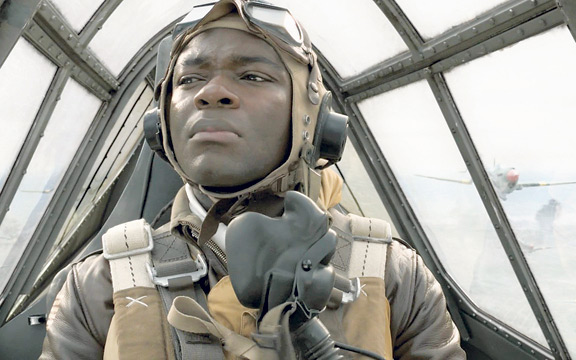 It’s like somebody transplanted a 1950s war film to present day but left every single hoary cliché imaginable. Just because African-American actors get to play the clichés doesn’t mean we’ve made progress. The Tuskegee Airmen are a historical account with enough real-life intrigue; Lucas and company didn’t need to create a fictional tale to illustrate their heroic deeds. The characters are all resoundingly one-note; the troubled leader with a drinking problem, the hotshot who doesn’t follow orders, the wisecracking pilot with a firm religious belief in “black Jesus,” the young guy trying to prove himself, and the guy who gets married and just wants to get back to his girl (guess what happens to him?). Let’s stop and analyze that plot point. Lightening first discovers his Italian beauty (NCIS: LA’s Daniela Ruah) waving while he’s zooming by in an airplane. Naturally he can find her home. After a series of strolls, Lightening asks her to be his wife, and eventually she accepts after some deliberation. Neither of them seems to find this interracial marriage concept a big deal, but in the 1940s, when the Army was still segregated and miscegenation was still illegal in certain states until 1967, you better believe it would be a big deal. Italy was no prejudice-free haven of tolerance, especially under Mussolini’s rule. And by the way, the portrayal of Italy in this movie looks like the war hasn’t even touched the land, physically and mentally. All those happy Italians just walking around smiling. And then there’s the white officers club where one of the black pilots visits and punches a guy after he calls him the N-word. In reality, this guy would have been beaten to an inch of his life. It’s even more bizarre then that, just after a month of flying missions, this say officer’s club greets the black pilots with open arms, fighting to by the guys rounds of drinks. Red Tails, at times, seems to exist in a different universe.
This has got to be the most boring part of a story you could tell about the Tuskegee Airmen. We watch the pilots escort the bombers and stick with the mission. While an interesting historical footnote, that’s about it. The story before the missions and after the missions is infinitely more interesting. I’d much rather see these brave heroes have to go back to a bitterly racist country, be declared honored men of valor by the government and then told they don’t deserve equal rights in the same breath. There’s so much more inherent drama in the conflict of going home to a segregationist country. Likewise, the Army was only integrated late into the war, meaning that African-American soldiers could not enter combat until 1944. Surely the journey these men took to enter the armed services is more compelling, and their experiences must have been even harder, battling the prejudices of their fellow brothers in arms. The early scenes in the film where Col. Bullard is fighting for respect and to get his men an actual mission, butting heads with brass who feel African-American soldiers are inferior, is far more gripping than anything that goes on in the air. The actual war part of this story is the least interesting part. If Lucas and company were so hell-bent on framing their story this way, they should have taken a cue from 1990’s Memphis Belle and stuck to a single mission being the majority of the plot. That would have kept the realism of the situation, ratcheted up suspense, and been a more natural way to get to know our characters.
While only thoroughly mediocre, Red Tails can have some pretty awful moments. The white bomber pilots provide, for lack of a better phrase, color commentary on the plot. Their dialogue is so on-the-nose and transparent, meant to lead an audience into some stilted realization that African-Americans are, gosh, not that different. The dialogue starts off with stuff like, “What? A colored man?! We’re done for,” then goes to, “Hey, these boys might actually be okay. I hope them Red Tails fly with us next time,” and then the movie might as well end on, “Wow, my altogether uninformed prejudices have been completely upended. I’m sorry I ever relied on such outdated notions of race that were completely ignorant. My paradigm has shifted and I’m going to look at people not as black or white anymore, but as people.” It’s so annoying and artificial. The dialogue is mostly cornball but the line that takes the cornball cake is after Lightening attacks a German munitions train, he shouts, “How you like that, Mr. Hitler?!” Really? “Mr. Hitler?” You’d think two African-American screenwriters (John Ridley and Boondocks creator Aaron McGruder) would have eschewed any phrases that could be racially loaded. Speaking of Germans, the movie has one German ace that keep reappearing again and again. Just so we understand that all those cockpit shots of ONE GERMAN are the same guy, the movie gives him a hideous scar along the side of his face. Being a scary scarred German fighter isn’t enough to convince us this man is a villain, so the movie also has him spout some pretty ludicrous racist dialogue, even for someone who may have believed wholeheartedly in the principles of an Aryan race. “Die you foolish, African,” he shouts at one point. Maybe he’s still steamed over that whole Jesse Owens thing.
 But the dumbest moment in a movie that will tax a minimal amount of brain cells is what happens to Junior after his plane goes down. He’s caught behind enemy lines and is thrown into a prisoner of war camp. But what luck, because it just so happens that these prisoners are planning an escape that very night (“At least they won’t see you at night,” one of the guys tells Junior). They’ve dug a tunnel beneath their barracks and Junior agrees to go first to be the lookout. He climbs out of the exit hole right in front of a forest clearing. When the next one in line pops out, however, a German guard has spotted them and turned his weapon on the American. Junior hops from behind a tree, waves his arms wildly to distract, and then runs off into the woods. Inexplicably, this is where the storyline concludes. You’re telling me that a German soldier with a gun isn’t going to give chase into the woods? These guys have the upper hand, plenty of armed men and dogs to track escaped prisoners. The rest of the American prisoners make it out to alive miraculously and one of the guys gives Junior’s dog tags to his unit. How did these prisoners, all escaping after the jig was up, get past everyone? And yet Junior does indeed live too and shows up just in time, in literally the last thirty seconds of the movie, to cut short everyone feeling sad about fallen soldiers. It’s like an angel just dropped him out of the sky. Junior’s escape and perilous journey back to American forces seems like a pretty good story worth telling. It has to be fraught with danger and thrills, but to just hastily end his storyline and magically zap him back to base isn’t just criminally lazy, it’s insulting.
The saving grace of Red Tails is its coterie of talented actors, doing the best they can with the wobbly material. This is a movie designed for the most mainstream of audiences, not for anybody who knows a whiff of history. The characters are one-note, the story is driven by every cliché imaginable, and the reality of the time period feels oddly glossed over at too many points, settling for safe rah-rah movie heroics. The aerial combat sequences can be exciting but they come across as weightless, with all the emotional investment of watching a video game. Credit Lucas giving this movie a decent-sized budget to pull off the special effects and involved combat sequences, but that money would have been better spent on a good script, not one just dusted off from the World War II era and the race of the characters altered. I find this kind of pandering mush to be insulting, especially the fact that the audience is supposed to feel grateful that black soldiers are finally getting the spotlight no matter the quality of film. The choice of “pandering mush” or nothing is a false choice. If giving black characters the chance to run through all the tired, hoary war clichés that went out of style decades ago is progress, then I shed a tear for this country.
Nate’s Grade: C
Share this:

J. Edgar (2011)
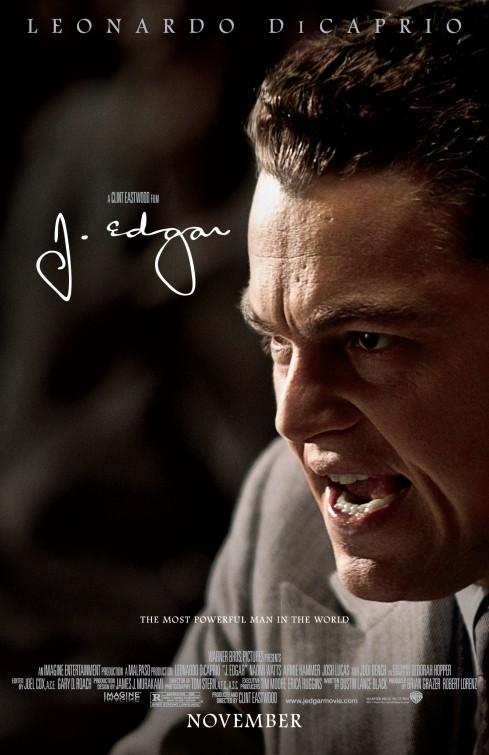 J. Edgar has all the qualities you’d want in a high profile, awards-friendly movie. It charts the life of legendary FBI head J. Edgar Hoover, it stars Leonardo DiCaprio in its title role, and it has Oscar-winner attached as screenwriter (Dustin Lance Black) and director (Clint Eastwood). The only way this movie could be bigger awards bait was if Hoover personally challenged Adolf Hitler to a duel. At a running time of 137 minutes, J. Edgar misses out on explaining why this complex man was who he was, a difficult prospect but I would have at least appreciated some effort.
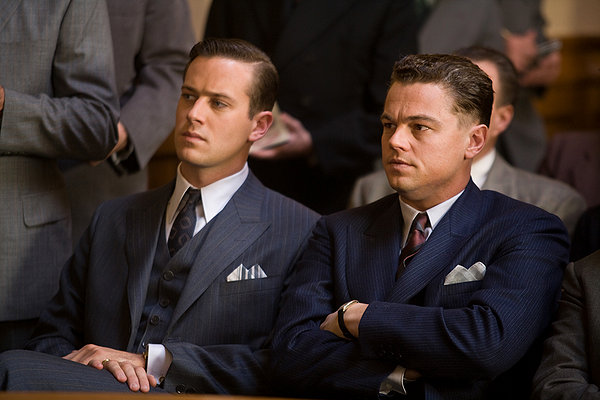
J. Edgar Hoover (DiCaprio) was, at his height, said to be the second most powerful man in the United States. The first director of the Federal Bureau of Investigations served under eight presidents and for over 50 years. The man rose to power fighting against radicals and Bolshevik terrorists in 1919. Hoover successfully arranged for America to deport foreigners with “suspected radical leanings.” He was appointed to head the, then, Bureau of Investigations, where Hoover remade the agency in the image he desired. His agents were going to be clean-cut, college-educated, physically fit, and God help you if you had facial hair. Hoover also fought to bring modern forensic science into investigations and trials, proposing a centralized catalogue of fingerprints, which at the time was dismissed by many as a “speculative science.” Hoover also amassed an extensive system of confidential files on thousands of American citizens he felt were potential threats or if he just didn’t like them. Hoover wasn’t afraid to bully presidents with this secret catalogue. On a personal level, Hoover was admittedly without any friends or interests outside the agency he felt responsible for. His life was defined by three close personal relationships: his mother (Judi Dench), whom Hoover lived with until the day she died; Helen Gandy (Naomi Watts), his loyal secretary and confidant of 40 years; and Clyde Tolson (The Social Network’s Armie Hammer), an FBI agent that Hoover shared a decades-long unrequited romance with. Upon Hoover’s death in 1972, Tolson was given Hoover’s burial flag, and Tolson’s own grave is a mere couple plots away from J. Edgar’s.
 The movie feels trapped in a closet alongside Hoover. The guy was rather enigmatic and hard to nail down, but I would have appreciated Eastwood and Black at least trying to figure the guy out. They treat the subject with such fragility, such sympathetic stateliness about his more salient personality points. It feels like Eastwood doesn’t want to get his hands too dirty, so the provocative material, like the gay stuff, is kept to very period appropriate acts of discretion. A handholding in the backseat of a car is practically scandalous given the treatment on the gay material. The oft rumored cross-dressing aspect is hinted at but explained, in context of the scene, as Hoover’s way of mourning the loss of his mother. With Hoover, there was only his public persona of a moral crusader, a face that he never removed even in his private moments. The guy could never embrace happiness, only duty. It feels like Eastwood couldn’t decide on what stance to take, and thus the film settles on a bloodless examination that won’t upset any of the, presumably, delicate sensibilities of the older audience members. A towering figure of moral certainty, extreme paranoia, righteous conviction, a vindictive streak against his mounting collection of enemies, and a shaky hold on the truth, all in the name of protection against America’s many real and imagined enemies – I feel like the blueprint has been established for the eventual Dick Cheney biopic. It’ll just be slightly less gay.
Let’s talk more about the gay factor. It feels like this area is where Eastwood definitely could have pushed much further, but the old school director seems to be of the opinion that a biopic need not pry nor speculate. Excuse me, but you’re telling me about a man’s life, the least you could do is dig deeper. A domineering mother, who said she’d rather have a dead son than one of those “daffodils,” and the moral restraints of the time, are easy enough to identify why Hoover was a repressed homosexual. That doesn’t separate him from probably a far majority of homosexual men in the first half of the twenty-first century. What makes Hoover, a repressed homosexual, tick? This is no Brokeback Mountain style whirlwind of untamable emotion. Eastwood keeps things chaste, choosing to view Hoover as a celibate man. Hoover and Clyde becomes inseparable “companions,” eating every dinner together, going away on trips, and enjoying the pleasure of one another’s company – the life of the lifelong “bachelor.” But that’s as far as the movie is willing to go (remember the scandalous handholding?). There are hints about how socially awkward Hoover can be, a guy who seems downright asexual at times. He proposed to Helen on a first date where his attempts to charm included showing off his card catalogue system at the Library of Congress (“I bet you show this to all the girls…”). You get the impression he’s not comfortable with this necessary area of human biology. That’s fine room to start, but J. Edgar doesn’t do anything but start its characterization ideas. It gives you ideas to toy with and then moves along. The relationship with Clyde hits a breaking point when Hoover discusses, during one of their weekend getaways, the prospect of finally choosing a “Mrs. Hoover.” Naturally Clyde does not react well to this development, and the two engage in a brawl that ends in a shared bloody kiss. This is about as passionate as Eastwood’s movie ever dares to get.
 I expected more from the Oscar-winning writer of Milk. Black’s lumpy script can often be confusing, lacking a direct narrative through line. Some leaps in time can just be confusing, like when J. Edgar is asking his junior agent typist what figure was most important in the 20th century thus far. The agent answers, “Joe McCarthy,” and then we have a new agent sitting there, and Hoover asks again. Finally we have another agent who responds with Hoover’s desired answer, “Charles Lindbergh.” I suppose we’re left to assume that Hoover fired his typists until he found one who mirrored his own thoughts. There is also far too much time spent over the Lindbergh baby case. I understand it’s the so-called Crime of the Century and, as Black sets up, a situation for Hoover to prove his bureau’s value when it comes to modern criminal science. It just goes on for so long and rarely offers insight into Hoover. Sans Clyde, the majority of the supporting characters offer little insight as well. Hoover’s mother never goes beyond the domineering matrimonial figure. Helen seems like a cipher, rarely giving any explanation for her decades of loyalty despite clear objections to certain choices. She’s too often just a “secretary” there to move the plot along by introducing more characters of minimal impact. With Hoover being such an enigmatic and closeted figure, the supporting characters could have been the areas we found the most insight into the man. Nope.
The entire plot structure feels like a mistake. Hoover is dictating his memoirs so we primarily flash from the 1930s, when Hoover was making a name for himself, to the 1960s, when Hoover is fighting a secret war against, of all things, the Civil Rights movement and Martin Luther King Jr. (he was convinced King was tied to communists). The back-and-forth nature of the story can lead to some confusion over facts and timelines, but the concept of Hoover dictating his memoirs means that the movie becomes a greatest hits compilation, a showcase of Hoover’s finest hours in an attempt to win public support back. He can explain his obsessions and justify his overreaches. That’s why Hoover’s entire catalogue of secret files on thousands of American citizens, including presidents, is given such short shrift. Why would he want to discuss his own subversive tactics hunting subversive elements? The only time the screenplay discusses this secret catalogue is when Hoover and Clyde want to have a good laugh over Eleanor Roosevelt’s lesbian paramour (irony?). Richard Nixon covets these files, so Helen swears that upon the death of her boss that she will shred every page before Tricky Dick can get his hands on them (J. Edgar is rated R for “brief strong language,” and they are all provided by potty-mouthed Nixon). Black attempts something of an Atonement-styled ending with an unreliable narrator, but the effects are slight and only superficial and too late.
 At this point it’s probably going to be rare for DiCaprio (Inception, Revolutionary Road) to give a dud performance. The actor isn’t the first name you’d think of for a Hoover biography. Regardless, the guy does a great job especially with the emotional handicaps given to him by Black’s script and Eastwood’s direction. Given all the emotional reserve, it’s amazing that DiCaprio is able to make his character resonate as much as he can, finding small nuances to work with. Hoover’s clipped speaking style, likely the most readily recognizable feature of the man, is here but DiCaprio does not stoop to impression. He’s coated in what looks like 800 pounds of makeup to portray Hoover in the 1960s. The old age makeup looks good on DiCaprio, though the same cannot be said for his inner circle. Older Clyde looks like he is suffocating behind a gummy Halloween mask; the man looks like he is mummified in his own liver-spotted skin. Older Helen just looks like they powdered her face and added some gray to her hair.
The movie seems to take its emotional cues from its subject; far too much of J. Edgar is reserved, hands-off, and afraid to assert judgment on what was a highly judgmental man of history. What makes Hoover compelling is his array of contradictions. He’s defined by three personal relationships (mother, Clyde, Helen), all of whom he could never have. That’s got to mean something. Instead of exploring these contradictions in any meaningful psychological depth, Eastwood seems to take his hand off the wheel and the film just casually drifts along, steered by the self-aggrandizing of Hoover himself, given so much room to explain detestable behavior in the name of protecting America. J. Edgar is a handsomely mounted biopic with some strong acting, but from Eastwood’s impassive direction (his piano-trinkle score isn’t too good either) and Black’s lumpy script, the finished work feels too closed off and arid for such a controversial subject worthy of closer inspection.
Nate’s Grade: B-
Share this:

50/50 (2011)
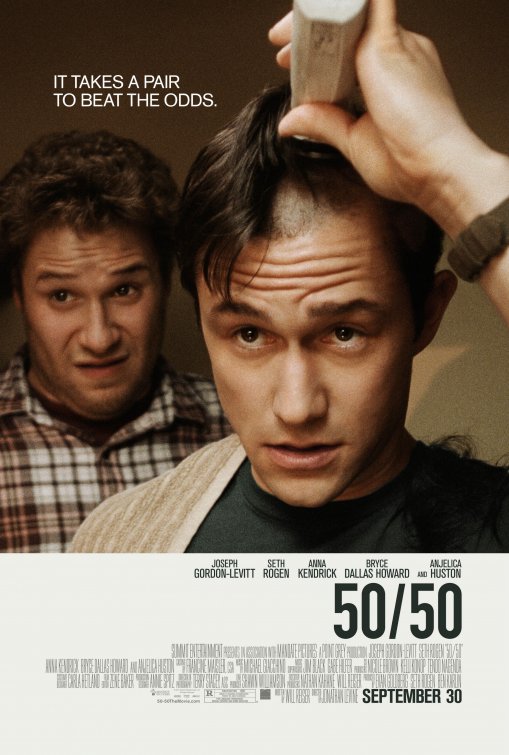 50/50 is based upon the experience of screenwriter Will Reiser, a writer for HBO’s Da Ali G Show who contracted cancer before his 30th birthday. Reiser’s real-life travails with his buddy Seth Rogen (who serves as executive producer) through the good times and bad. I guess when you get cancer it helps to have an established movie star as your good friend. It also helps when you write a terrific script, which Reiser has accomplished. Originally titled I’m With Cancer, I guess the studio felt that a movie with “cancer” in the title was a hard sell to mass audiences (On a related note, Showtime’s comedy-drama The Big C, about Laura Linney finding the humor through cancer treatment, was previously titled The C Word. I don’t know about you, but when I heard “the c word” the first thing that comes to mind is not “cancer.”). Even with a more oblique title, 50/50 manages to walk between comedy and drama with flair. It’s probably the funniest movie you’ll ever see about cancer. Definitely funnier than My Sister’s Keeper.
Adam (Joseph Gordon-Levitt) is a relatively healthy 27-year-old. He likes his job writing for a Seattle National Public Radio station. He likes his girlfriend, Rachel (Bryce Dallas Howard), an aspiring painter. He likes his best friend, Kyle (Rogen), a dude prone to speaking whatever is on his mind. Then one doctor’s visit changes everything. Adam has a very serious form of spinal cancer. He begins chemotherapy to try and stop the tumor’s growth. Rachel drives him to his hospital treatments, helps him during his long nights of nausea, but ultimately it proves too much to bear. She leaves him. Luckily, Adam has a young therapist, Katherine (Anna Kendrick), helping him put his life in order. Adam’s chances of surviving this rare cancer are exactly as the title proclaims, 50/50. As he comes to grips with the measures needed to survive, Adam finds himself growing closer to his therapist in a completely unprofessional degree.
50/50 may be the least sentimental movie I can recall about the realities of living with cancer, and that is its greatest attribute. That doesn’t mean that the movie doesn’t cover serious issues in a flippant manner. Instead of hitting cheap sentiment and milking cancer for easy tears, the movie, thanks to Reiser’s sharp script, forgoes false feelings and finds something more rare and true. There’s no real playbook for something as unexpected as a person in their 20s being diagnosed with terminal cancer. It seems like a cruel irony to be stricken with an illness so young. Adam doesn’t drink, doesn’t smoke, and doesn’t even drive due to the danger. He’s pretty mild-mannered and a bit of a pushover. Adam tries to not let cancer get to him, to shrug off the heavy implications, and to just make it seem like any other personal setback. If he doesn’t treat it like a big deal, maybe it won’t be and his friends and family can follow his lead. This kind of self-manufactured blasé attitude, even in the face of cancer, seems like an apt approach for a younger relaxed generation. Naturally, this denial-heavy approach doesn’t exactly work. It’s too easy to confuse numbness with acceptance. Fortunately, Reiser does not let his story slip into easy maudlin theatrics. We don’t need anybody reminding us, or Adam, how serious his situation is. On the other hand, we also don’t need anybody moralizing about any self-help slogans. Not everyone sees adversity as a blessing into Discovering Who You Truly Are. Reiser refrains from his characters making anything approximating Big Life Statements. Cancer does not lead to automatic personal epiphanies. If it did, we’d have a lot more people inhaling carcinogens and volunteering to work in the Chernobyl ruins.
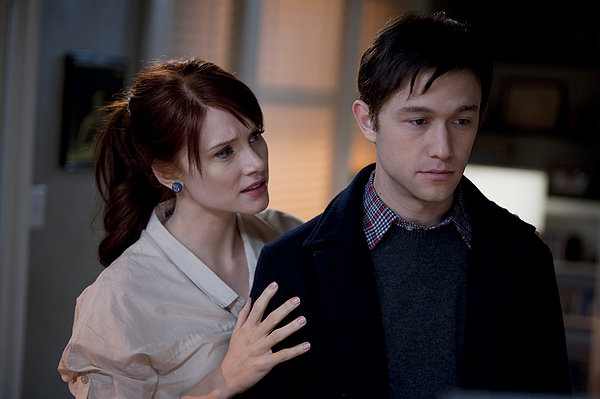 50/50 doesn’t ignore the sometimes odd and dark humor that arises from life’s predicaments. That means this is the only cancer movie where the guys try and use the disease as a way to convince girls to sleep with them. At no point do I remember this occurring with Terms of Endearment or Beaches. And this opportunistic babe hunting doesn’t make the boys come across as sleazy. Adam can’t even enjoy the one-night-stand as his back pain robs him of the pleasure of his nubile well-wisher. The tone is very controlled. The raunchy comedy is not a distraction; at no point does any situation feel like a comedic setup. The comedy comes from the characters being genuine to who they even through the trying circumstances. If your friends are funny, chances are they’ll still be funny talking about cancer. The humor doesn’t make light of things nor does it just play everything for laughs. Humor is how we humanize, how we make the insurmountable digestible.
50/50 also treats its characters with a bittersweet sense of reality; these people are flawed and relatable. They are not instantly made into self-actualized saints thanks to cancer. Adam’s girlfriend actually breaks down because she cannot handle the extra responsibilities and emotional wear and tear. Their relationship fizzles. This seems far more realistic considering many people will feel like they did not sign-up for sleepless nights, 24-hour care, and watching their loved one waste away. It’s a strong individual that can endure that kind of collateral pain, but the movies make it seem like every romantic partner is unnaturally selfless. They become ideal partners, but really most of us would just bail. Reiser easily could have easily written his ex-girlfriend as an insensitive shrew. While she does cheat on the guy, thus making her easy to dispel, Howard makes her vulnerability relatable. She even comes back trying to make amends, forcing kisses upon him to weaken Adam’s resolve. Kyle relishes the opportunity to finally be able to tell off Rachael, a girl he admits to disliking from the start. I don’t get the instant hate, but maybe it’s my complete adoration for Howard even when she’s playing a bad girl that blinds me to her offenses. To dismiss her as a “bitch” seems unfair. How would you react if your boyfriend/girlfriend were suddenly diagnosed with cancer? Could you last?
I found all of the characters to be empathetic and relatable (though a lead who waxes about the glory days of radio and works for NPR seems a bit hipsterish), especially in their personal struggles surrounding Adam’s illness. Adam’s mother, Diane (Anjelica Huston), can be overbearing and would have easily been kept as a caricature in other movies. In 50/50, the film examines her own struggle – a husband with Alzheimer’s who can’t talk to her and a son with cancer who chooses not to talk to her. The isolation she feels, the loneliness, always putting other people’s needs ahead of her own, this is culmination of the caregiver, a role as I’ve stated that too often gets canonized. In 50/50, the reality of living with illness is dealt with in a meaningful manner. The people surrounding you are also affected by your illness. You cannot shut them out to spare them from pain. Adam realizes this too as the film progresses to its moving conclusion.
 The heart of 50/50 concerns two sets of relationships. The one that will catch the most attention is Adam’s budding romantic relationship with his therapist. Their romance feels like it emerges naturally, albeit in a slightly hurried up pace for our small timetable. It’s a romance built upon the chemistry of the two actors, the strength of their individual performances, and the fact that Reiser forgoes anything obviously romantic. He cleans out her car. She gives him a ride home. It’s little things that seem like they matter on a personal level, not the outsized theatrics of romantic gestures. The movements are small but they add up, and we can feel it too. So when Adam, at his lowest point, calls her and says, filter down and radiating in emotion, “I bet you’d be a good girlfriend,” it’s a moment that feels earned. I also greatly appreciated Katherine’s own insecurity about being a therapist. Too often movies depict therapists as omniscient beings that have a fortune cookie answer for all of life’s mysteries. Kendrick hides behind evaporating smiles as her character’s defense mechanism. In 50/50, we get to see a character that is honest about her insecurities about a job that advises others. It’s refreshing. The other main relationship is between Adam and his best friend, Kyle. His best buddy is his spark, the guy who gets him out, who shakes him from moping around. He cares but goes through unorthodox methods to show that care, including trash talking and ball busting. He remains likable to his shaggy core because he has Adam’s best interests in mind, even if that means scoring with girls.
Director Jonathon Levine (The Wackness) gives the movie an improbably beautiful look. This is one cancer comedy that is simply pleasing to watch for the cinematography alone. He doesn’t overpower the narrative with self-aware visual touches, though there is one that stands out. When Adam receives the news from his doctor, the audio becomes distorted after the shocking word “cancer” is uttered. The picture becomes blurred. The world seems to have been swept away. I imagine this sonic body blow is pretty much how Reiser recalls receiving the news, and if not it still feels authentic. The score by Michael Giacchino (Up, Super 8) is subtle and doesn’t intrude too often, ably assisting the drama instead of smothering it.
50/50 is an unsentimental film that manages to be moving and genuinely entertaining on its own terms. It can be rude but that doesn’t mean it lacks sincerity. The characters and their dilemmas feel all too relatable, even the ones we hope don’t become us. The 50/50 production has followed a subdued edict, forgoing sappy melodrama and easy pathos. These emotions are earned the old fashioned way, through characters we care about and drama that feels truthful. The mixture of the course and sweet gives the film a decidedly Judd Apatow (Knocked Up) flavor even though his name is nowhere to be seen. Gordon-Levitt, who at this point can do no wrong in my eyes, gives one of the best performances of his already accomplished career. The comedy, lead by Rogen’s obnoxious best friend, keeps the movie from being bogged down in melodrama. It’s the only way to stay sane, and 50/50 recognizes this and delivers a film that earns its tears and laughs.
Nate’s Grade: A-
Share this:

Tabloid (2011)
 Legendary documentary filmmaker Errol Morris (The Thin Blue Line, The Fog of War) has always had a knack for telling quirky stories involving quirky real-life interview subjects. From people who taxidermy their dead pets to a capital punishment engineer/Holocaust denier, Morris has a gift for making his subjects comfortably candid, and then the man gets out of the way of a good story. And if nothing else, Tabloid is a juicy story that seems too good to be true. As one journalist says, “It had everything.” In 1977, Joyce McKinney, former Miss Wyoming beauty queen, was charged with kidnapping a Mormon man, who she claimed was her boyfriend and had been brainwashed by church leaders. This kidnapping included handcuffing the man to a bed and “three days of food, fun, and sex.” Taking place in Britain, the sensational “Case of the Manicaled Mormon” fascinated the U.K. and turned McKinney into a prized media figure. When she escaped back to the U.S. posing as a deaf mute with a suitcase full of wigs and disguises, it made her even more famous. British tabloids were in a McKinney arms race, trying to out-scoop the other, unearthing secret lusty bondage pictures. Amazingly, McKinney agreed to appear on camera and tell her story, and boy does this woman speak her mind. Morris does not present McKinney up for easy ridicule. She presents a perky version of events, and it’s easy to feel the pull of this woman who is a natural storyteller. Whether her version of the “truth” is real is another matter. I wish Tabloid had dug a little deeper and had more ambition to it. The nature of tabloid journalism, sensationalism, and the ambiguous nature of truth gets ultimately swept aside by the bizarre twists and turns of the story and the outsized personality of McKinney. Tabloid certainly isn’t close to the best documentaries Morris has fashioned, but it’s a fascinating story that sells itself.
Nate’s Grade: B
Share this:

127 Hours (2010)
 So would you give your right arm for a good movie? 127 Hours is the true-life tale of a man trapped between a rock and a hard place. Hiking in dusty canyons, James Franco gets his arm pinned under a rock. And that’s about it from the plot standpoint. That’s because everything is leading up to the grisly inevitability that he will be forced to cut his own arm off for survival. And director Danny Boyle (Slumdog Millionaire) does not let you off the hook. You will see every gruesome second of a man hacking away his own arm, slicing nerve-by-nerve, crushing bones, etc. It’s not the uplifting experience that Boyle and the producers mistakenly believe. The film’s true success is that it still manages to be entertaining and exciting, despite having a central character unable to move more than inches. It’s fascinating to watch Franco use the tools at his disposal to survive for five days before, well, you know. Boyle does a terrific job of making an intimate almost claustrophobic plot feel much more open. Nobody probably could have done this movie better than Boyle, taking his kinetic trademark style and allowing us to enter the mind of Franco’s fallen hiker. 127 Hours isn’t so much an inspirational tale as it is a morbid curiosity that entertains in spurts. But all the visual tricks in the world can’t get people to want to pay to see a man cut off his own arm.
Nate’s Grade: B
Share this:

The King’s Speech (2010)
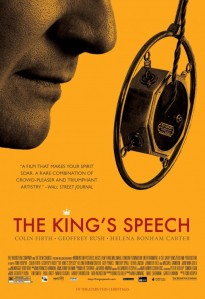 Public speaking is a nerve-racking position. Nobody wants to seem like a fool but it can be hard to do anything else when all eyes fall upon you with expectation. There was a poll a few years ago that asked Americans what their top fears were, and death came in second to public speaking. The Grim Reaper should feel relieved. Now imagine that you’re the leader of a country during a time of duress and you have a speech impediment. That’s the grueling circumstances for King George VI (affectionately known as “Bertie” to family), leader of Britain on the eve of World War II. The King’s Speech tells the inspirational true story of one of the most powerful men in the world finding his own voice.
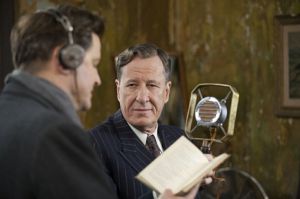
Before becoming king of his country, Bertie (Colin Firth) was the Duke of York and a man suffering from a debilitating stutter. When stressed, it was difficult for Bertie to even read a statement. This speech impediment is made all the more troublesome now that the world has entered into the radio age; kings and presidents are now expected to speak to their peoples, no longer content to just be a striking figurehead. Elizabeth (Helena Bonham Carter), future Queen Mother, seeks out different speech therapists but the traditional methods are getting her husband nowhere. Then she comes across Lionel Logue (Geoffrey Rush), a self-taught speech therapist who worked with shell-shocked WWI soldiers in his native Australia. His methods are unorthodox but he’s the first to begin to get results with Bertie. The demands of his position get even greater when Bertie’s father, George V (Michael Gambon), dies in 1936 and Bertie’s older brother, Edward VIII (Guy Pearce) abdicates the throne. Now Bertie is expected to lead his nation, that is, if he can string two sentences together in public.
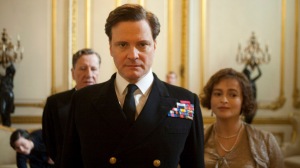 The King’s Speech is really the heartwarming story of the unlikely friendship between a king and a quirky Australian commoner. Their warm, humane friendship allows for several scenes of great humor and great drama. Watching the irreverent Lionel bounce off the proper and isolated Bertie supplies plenty of comedy. It’s essentially an odd couple comedy mixed with a true-life historical drama. There’s great pleasure in watching the chilly relationship between classes thaw, the men grow closer together, and Lionel’s unconventional tactics make progress. Each time Bertie discovers a new practice that removes his stutter, whether it is speaking while listening to music or speaking in the cadence of a song. This is a film that follows the English tradition of understatement even given the dramatic setting, principle characters, and a speech impediment. The characters don’t go around blurting their feelings, leaving the actors room to explore oodles of subtext. There’s a signature scene where Lionel coaxes Bertie into opening up by promising to allow him to paint a child’s model airplane (a treat for a man of title never allowed such toys). As he paints away, Bertie reveals a damaging truth about a neglectful childhood nanny. The truth is so painful that Bertie is forced to reveal it through the cadence of song, which somehow makes the revelation more sad and tragic. Their ongoing relationship is deeply satisfying and emotionally rewarding.
You won’t see a better-acted movie all year, thanks to Firth and Rush. More than following a checklist of gimmicks, Firth inhabits his character from the inside out. He feels like a living, breathing, somewhat broken person instead of a collection of ailments. Firth doesn’t overdo his stutter and treats the character, and the ailment, with a deep sense of compassion. Firth gives what is likely the greatest acting performance by any male in 2010. He is magnificent, commanding, and empathetic in every scene. Likewise, Rush doesn’t overpower as a personality foil. His character manages to be irreverent but without being flippant; he finds a reverent irreverence, if you will. Lionel is treating the future King of England, and the gravity of this stately relationship is not lost on him. Both men hide an inner melancholy, perhaps one of the things that ultimately bonds them together. Rush is flush with vigor and merriment, truly delightful to watch. This is his finest onscreen performance since he won his Oscar in 1996 for Shine.
The enormity of the king’s duties is given due care. You feel the weight of the crown that awaits Bertie and empathize with his quaking hesitation. Ever since childhood, his family looked down on Bertie. His father felt a stern tone would best aid the young stammerer, and his older brother would often belittle Bertie with cruel taunts. You see flashes of this unhealthy dynamic when Edward cuts down his little brother after their father passes.
 Bertie was seen as unimportant. Edward was the one set up for the throne. And yet Edward is the one who shirks his responsibilities in the name of love (a twice-divorced American woman). Edward refuses to become the leader of his people if the ancient rules forbid him from marrying a divorced woman. Bertie cannot buckle under the tremendous pressure and expectations that wait. Even when the rather passive Bertie lashes out, you feel like his anger is a moment of achievement. King George VI also had to deal with the fact that his brother is still alive and well and an alternative to the throne if Bertie is deemed incapable. Firth makes it easy to feel the remarkable pressure of being a leader not born or elected, merely expected. And even if an audience is clueless about British monarchy history and the rules of royal succession, The King’s Speech is easy to follow and comprehend for a daft American like myself.
Truth be told, The King’s Speech is a little stagy, a little square, and a little too fastidious for its own good. Hooper and crew are too content with making a pleasant moviegoing experience that the film lacks any slight form of edge. It’s all just a little too safe, a little too staid. While rated R, this movie could easily be a PG-13 family film, maybe even a PG one, sans the two sequences where Bertie unleashes a torrent of profanities in frustration (he discovers that he does not stutter while swearing). I feel like a curmudgeon for dinging a movie for being, essentially, too nice and gentle, but it clips the ambition of the movie when crowd-pleaser is the zenith of accomplishment. The fateful speech to the nation, on the eve of war with Germany, is even given an extra oomph thanks to the background music of Beethoven. A larger story of triumph seems reduced to the Oscar favorite storyline of Man Overcoming Physical Adversity. The direction by Hooper has some curious tics to it, like sequences of two people talking where they will never share the frame despite sitting side by side. I assume Hooper is trying to communicate some form of emotional distance or wariness, or perhaps it’s just a nod that different actors had unworkable schedules and could not be filmed together. Hooper is a talented director, as anyone who saw the massive undertaking of the masterful HBO miniseries John Adams can attest. However, like John Adams, Hooper is prone to TV-movie staging. His direction limits the cinematic power of the film. It looks like any ordinary episode of Masterpiece Theater.
The King’s Speech is pretty much everything you’d wish for in a movie groomed for awards consideration. This is prime Oscar bait. You may tear up at points, you’ll probably smile in many places, and your spirit will definitely rise. Plus it features some of the finest acting you’ll witness all year. And yet it’s that conscious need to please, to uplift, that can occasionally distract you from the many charms that The King’s Speech offers. The fact that the story is predictable is not a detriment, but the fact that the film doesn’t push harder, dig deeper, or expect more from its audience is a missed opportunity. The material is so rich, but a terrifically acted, smartly written film isn’t a bad consolation. Especially when that film happens to be one of the most rousing and rewarding theatrical experiences of the year.
Nate’s Grade: A-


 nathanzoebl
You must be logged in to post a comment.