Blog Archives
Saturday Night (2024)/ September 5 (2024)
Recently two ensemble dramas were thought to have awards potential that never materialized, and I think I might know at least one reason why: they are both undone by decisions of scope to focus on either a single day or a 90-minute period to encapsulate their drama.
 With Saturday Night, we follow show creator Loren Michaels (Gabriel LaBelle) the night before the premiere episode of the iconic sketch TV series, Saturday Night Live. The story is told in relative real time covering the last 90 minutes before its initial 11:30 PM EST debut in 1975. We watch Michaels try and deal with squabbling cast members, striking union members, failing technology, his ex-wife (Rachel Sennot) who also happens to be a primary producer of the show, muppets, and studio bosses that are doubtful whether this project will ever make it to air. I understand in essence why the real-time setting is here to provide more pressure and urgency as Michaels is literally running out of time. The problem is that we know the show will be a success, so inventing doubtful older TV execs to add extra antagonists feels like maybe the framing by itself was lacking. Think about Air but you added a fictional exec whose only purpose was to say, “I don’t think this Michael Jordan guy will ever succeed.” There are interesting conflicts and subplots, especially with the different groups that Michaels has to manage, but when it’s all stuffed in such a tight time frame, rather than making the movie feel more chaotic and anxious, it makes those problems and subplots feel underdeveloped or arbitrary. I would relish a behind-the-scenes movie about SNL history but the best version of that would be season 11, the “lost season,” when Michaels came back to save the show and there were legitimate discussions over whether to cancel the show. Admittedly, we would already know the show survives, but does the public know what happened to people like Terry Sweeney and Danitra Vance? Does the public know what kind of sacrifices Michaels had to make? That’s the SNL movie we deserve. Alas, Saturday Night is an amiable movie with fun actors playing famous faces, but even the cast conflicts have to be consolidated to the confined time frame. This is a clear-cut example where the setting sabotages much of what this SNL movie could have offered for its fans.
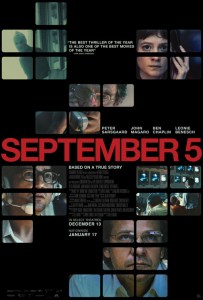 With September 5, we remain almost entirely in the control room of ABC Sports as they cover the fateful 1972 Munich Olympics after the Israeli athletes are taken hostage by terrorists. It’s a subject covered in plenty of other movies, including Steven Spielberg’s Munich and the 1999 Oscar-winning documentary One Day in September, but now we’re watching it from the perspective of the journalists thrust into the spotlight to try and cover an important and tragic incident as it plays out by the hour. It’s an interesting perspective and gives voice to several thorny ethical issues, like when the news team is live broadcasting an oncoming police assault, which the terrorists can watch and prepare for as well. The movie is filmed in a suitable docu-drama style and the pacing is as swift as the editing, and that’s ultimately what holds me back from celebrating the movie more. It’s an interesting anecdote about media history, but September 5 fails to feel like a truly insightful addition to the history and understanding of this tragedy. It’s so focused on the people in the studio and restrained to this one day that it doesn’t allow for us to really dwell or develop in the consequences of this day as well as the consequences of their choices on this fateful day. The movie feels like a dramatization of a select batch of interviews from a larger, more informative documentary on the same subject. It’s well-acted and generally well-written, though I challenge people to recall any significant detail of characters besides things like “German translator” and “Jewish guy.” It’s a worthy story but one that made me wish I could get a fuller picture of its impact and meaning. Instead, we get a procedural about a ragtag group of sports journalists thrust into a global political spotlight. There’s just larger things at stake, including the inherent drama of the lives at risk, than if they’ll get the shot.
Nate’s Grades:
Saturday Night: C+
September 5: B
Share this:

Woman of the Hour (2024)
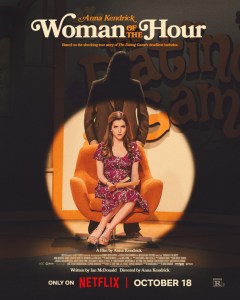 I never knew there was an actual serial killer that appeared on a 1978 episode of The Dating Game, and that he actually won. That’s a killer hook. The problem with Woman of the Hour, Anna Kendrick’s debut as a director, is that there isn’t really a movie here as presented. Because the game show segment can only last so long, we get the creepy first date, that never happened in real life, and watch Kendrick playing our lucky lady with mounting dread. A moment where the killer requests that she re-read the phone number she hastily gave him by memory, because she should know her number, is terrifically tense, as is the scene of him following her to her car. The problem is that this first date can only last so long, just as the cheesy TV game show segment can only last so long, so the movie has to provide extra back-story to fill the time. We get several past encounters with the killer’s unfortunate victims, all played quite unnervingly and seriously. The woman of the hour is less Kendrick getting her fleeting spotlight on TV, and an anecdote to impress people at parties for the rest of her life, than the survivor who eventually leads to the killer’s arrest. Amazingly, at the time of his TV appearance, he was on the FBI’s Most Wanted List but there wasn’t a searchable database, so he clumsily got to keep committing murders, including while out on bail. It’s a harrowing story, but is it one best told through the gimmick structure of the game show appearance? If you were going this route, perhaps best to treat the material like a slow-burn stage play, starting with the first date, and watch in real time as it gets awkward and our heroine begins to have her suspicions that this man does not mean her well. Instead, the game show segments are goofy and broad and the least important moments in the stretched-thin film. There might be a movie with this subject, but I’m not sure that Woman of the Hour is it.
Nate’s Grade: C+
Share this:

Back to Black (2024)
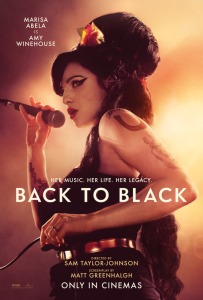 What do you remember about Amy Winehouse? The tragic singer with the booming voice that was mercilessly picked apart by a rabid tabloid media, as well as rampant online speculation, over every step of her addiction to drugs and alcohol? If that’s the extent of your memory, as well as some of her more notable songs like “Rehab” or “Back to Black,” then this musical biopic directed by Sam Taylor-Johnson (Fifty Shades of Grey, Nowhere Boy) is going to feel like a shallow exercise in piling on a troubled and talented performer gone far too soon.
Back to Black, the film, literally has Amy Winehouse (Marisa Abela) vocalize what she wants to be remembered for, not the drugs and alcohol, and the movie then erases Amy as a vibrant, complicated human being into a blurred statistic on the dangers of unchecked addiction. You can’t tell her story without documenting her demons, and yet the movie also seems exceptionally forgiving to the men who contributed to her downfall, her doting father Mitch (Eddie Marsan) who enabled her and her bad boy boyfriend Blake (Jack O’Connell) who introduced her to hard drug abuse. We spend so much emphasis on the bad times and her downfall and yet the movie is strangely reticent to cast much judgment on her bad influences, which makes it seem like the movie is further blaming Amy. At the same time, her downfall is focused on being rejected by a man, which is really insulting and limiting for her as an artist as well as a person capable of independent thought. It’s an even stranger decision given that these two influences, her father and ex, were given withering condemnation in the 2015 Oscar-nominated documentary on Winehouse. Apparently, Mitch Winehouse was furious with the documentary’s portrayal of him and Amy. His secondary complaint was that the documentary focused too much on the negative aspects of her life story, which is comical considering the skewed balance that Back to Black dwells upon. We speed through the good times to wallow in the bad, and without a stronger and more complex portrayal of Amy as a character, it all feels trashy and degrading. It’s harder to feel the heartbreak when the movie is only defining her by our foreknowledge of her death.
 Amy never feels like her own person in this movie, which is a shame since she was a dominant presence. We never get into her creative process or her inspirations. We never get to see the person behind the omnipresent tabloid headlines. The formulaic rise-and-fall structure is so rushed and uninterested in fleshing out Amy as a person, so we get simplistic impressions like she sure loved her “nan” (Leslie Manville) and never recovered from her death. The movie sets a midpoint montage where her grandma’s funeral pushes her to get a signature tattoo and beehive hairdo, and it plays like a superhero finally donning their cape and cowl (At last, she has become… Batman, I mean… the Amy We Remember). It’s played so dramatically that it might even unleash a titter or two. There is such scant insight into this woman and her demons that I doubt anyone will come away with a better understanding of Amy and her place in music history, as well as who she was as a person. The movie omits other struggles that might take the focus off its specific topic of drugs and alcohol. Her bulimia gets nary a mention except for maybe one scene where her inconsiderate roommate asks Amy to please vomit into the toilet a little less loudly. While skipping judgment over her enablers, the movie also avoids being too judgemental on the social impulses and rubbernecking that fed upon the harassment and mockery of Winehouse and her struggles. Again, by omission this is placing further blame onto Amy herself.
For each viewer, Back to Black is going to sink or swim depending upon your reaction to Abela’s (Industry) performance. She does her own singing and learned to imitate Winehouse’s signature soaring vocals, so that’s generally impressive. However, I felt her greatest moments of acting were the scenes where she wasn’t in song. Her over-extended enunciation and head bobs made me consistently cringe, like watching an overzealous Vegas impersonator. In the few instances where the movie slows down, that is where Abela is best, being distraught over the loss of her nan, infuriated by her ex, incredulous at music producers that want to market Amy like the Spice Girls, and charmingly innocent confiding to a young fan in a checkout line. If the movie had cut all of her vocal performances and given me more time with this Amy Winehouse, I would have gotten more insight and entertainment. Abela isn’t given the material to really bring Amy to life.
 Back to Black isn’t so much Amy’s movie as it is her father Mitch’s response to earlier portrayals. He’s portrayed here as a doting and loving father who only wanted what was best for her. You see, his initial refusal to the demands to send his daughter to rehab was because he wanted her to kick this whole addiction thing on her own. She didn’t want it so he wasn’t going to push her. If anything, he’s the hero of this movie, the proud papa who was let down by his daughter’s duplicitous boyfriend-turned-husband, the man who took his little girl away and turned her to the dark side of drugs. When you analyze the approach, it all comes across as a little insidious, a little icky, and unworthy of recreating this woman’s life experiences to better glorify her father. Abela gives it her all, it’s just too little to be had with Back to Black, a shallow biopic treading upon distaste. I’d recommend skipping this movie entirely, unless you’re irreversibly curious, and watch the 2015 documentary Amy instead. You’ll get a much better sense of Amy Winehouse the singer, the star, the addict, and most importantly, the complicated person.
Nate’s Grade: C
Share this:

Scoop (2024)
 It’s like a British Bombshell, a behind-the-scenes account of the media attempting to hold key political and public figures to account for gross sexual imposition. With the Netflix drama Scoop, it just so happens to be Prince Andrew (Rufus Sewell), interviewed by BBC TV journalist Emily Maitlis (Gillian Anderson) in 2019 and scrutinized heavily for his close ties to former friend Jeffrey Epstein. The first half of the movie is about the wheeling and dealing behind the scenes to garner the high-profile interview, to convince Andrew he can clear his name after his connections to Epstein resurfaced. The second half of the movie is pretty much just the interview, which is indeed interesting to watch for the inherent drama, but after a while, I wondered what this movie was adding that I otherwise couldn’t gain from simply watching the actual 2019 BBC interview? There aren’t really scintillating details or clever scheming to guarantee the interview or outfox its news rivals, and the newsroom personalities, lead by Billie Piper (Doctor Who), are hard-working and tireless stock types that don’t leave much of a distinct impression even after the time together. It’s really a plainly presented dramatized version of the infamous interview, the one where Andrew was professing his innocence against his Epstein accuser with his bizarre argument that he has a condition where his body doesn’t sweat. Anderson is great, and Sewell is terrific as he melds into this figure of complacent arrogance and self-delusion (the makeup is also quite impressive). Still, if you’re really interested in gaining further insight, you might be better off looking elsewhere, or just watching the original interview. Consider this a bonus epilogue to Netflix’s The Crown for any die-hard royal aficionados.
Nate’s Grade: B-
Share this:

Killers of the Flower Moon (2023)
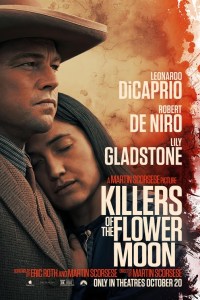
Killers of the Flower Moon has the banner of an Important Movie, telling a story many history books have overlooked for too long, an American tragedy built upon one of America’s original sins with the indigenous peoples, and tying a direct line to not only how we live now as well as how we choose to remember the past. The true story behind the murder of the Osage Nation natives in the 1920s is an urgent story that gets to the heart of greed and the human capacity for evil, and Martin Scorsese’s three-and-a-half-hour movie is somber and mournful and appropriately devastating. But I’m also wondering why I wasn’t as enchanted with it as a movie-going experience. Should I feel movie critic guilt for finding the movie merely good but not transcendentally great?
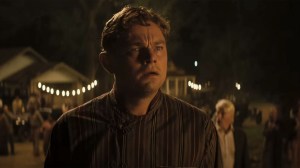
The whole of Killers of the Flower Moon is bleak, which is naturally much of the point. It’s difficult to retell the history of Native Americans in this country, or before there was a “this country,” without making use of lots of synonyms for the word “bleak.” The first hour presents the Native Americans as being legally incapable of greater agency; the murders are consistent, sloppy, and obvious, but the fact that no investigation was triggered for years in an acknowledgement that, simply put, the government just didn’t care about dead Indians. Oh, I hear you saying, but weren’t these Osage different? They had so much money from their oil rights that the local economy exploded with vultures offering common services for egregiously inflated prices to take advantage of people unaccustomed to having money and options. Even with a surge of riches, the Osage didn’t have an elevation in status. They were still looked upon as interlopers in the way of powerful white men getting that money, and there’s nothing these greedy people won’t do to get that money, especially with a system of justice of little accountability for dead minorities. One of the more galling scenes is when the town coroners are questioned over their unusual protocols, like chopping a corpse into tiny pieces so it could not be re-examined by other professionals. The whole town is in on this vile scheme, every doting neighbor can be guilty through complicity or complacency. Death after death, they all know what’s really going on; it’s plain as day, but nobody outside of the Osage feels the burning outrage, and that’s the point of the first half of the movie, to give the audience the same sense of anger and futility.
The majority of the lengthy movie follows our villains plotting their very obvious conspiracy, with Leonardo DiCaprio badly clenching his jaw in every scene as Ernest Burkhart, a WWI-veteran who comes home, becomes a cabbie, and marries Mollie (Lily Gladstone), one of the rich local Osage women. The question for the rest of the movie is whether or not his love for her is genuine or perhaps she is just a means to an end. He’s the lead of the movie and a total dope, a man who unironically proclaims repeatedly, “I love me some money!” Seems hard to read this guy, right? He’s an idiot, and again this might be the point, that this sort of small-thinking man could be the hinge on this entire conspiracy, which results in a lot of Mollie’s family members dying under increasingly mysterious circumstances to consolidate their inheritance. It’s a frustrating and spiritually exhausting experience to watch all these poor characters get murdered, again, so casually and transparently. One of them is staged as a would-be suicide except he’s shot through the back of the head and the gun wasn’t left at the scene. Eventually, the FBI does finally (finally!) arrive in town at the two-hour mark, but by then, I’ve been watching two hours of people dying without a legal stir.

This perspective is best embodied through Mollie, beautifully played by Gladstone (Certain Women, First Cow). When we first meet her, she’s a forward woman who can assert herself and what she wants. Then it all goes downhill after marrying Ernest. She loses damn near every family member she has and is forced to rely upon her husband for support, the same idiot bungling his way through arranging the deaths of her family members. She’s a personal stand-in for the Osage Nation as a whole, as we watch what they have whittled down and bled dry, watching the weight of all this suffering deteriorate their spirits and dignity. This is Mollie, our avatar for tragedy. She’s literally bedridden for a solid hour, and I dearly missed Gladstone’s presence. Since we’ve been aware of the bad deeds of the bad men from the start, much of Killers of the Flower Moon becomes a waiting game of when Mollie is hopefully going to wise up or at least suspect what is happening to her and her family. When will she see Ernest as a more nefarious force in her life, the kind of person you don’t want to solely trust with the responsibility of delivering your life-saving intravenous medicine. It adds to the overall frustrations of watching. Gladstone’s performance rises above whatever limitations her character is stricken with. First off, it’s a powerful performance of immense sorrow; having to watch her pained reaction to overhearing her sister’s skull sawed open for a disrespectful public autopsy is just sickening. The movie lives off this woman’s response to unfathomable trauma on repeat. When she is bedridden and lost in a medical fog, she still manages to communicate her wariness and suspicion through these extra layers of obfuscation.
Robert DeNiro, appearing in his eleventh Scorsese movie, is terrifying as a kindly cattle baron who fashions himself as the best friend of the Osage, preferring to refer to them by their indigenous names and warmly speaking their language. He’s also a monster, a stand-in for American big business and the blood-stained hands of capitalism without morals and oversight. The dramatic core of the movie, besides how far will this go before consequences will at long last germinate, is how can such self-styled men of God commit such heinous acts? How can people justify and equivocate over their own cruel crimes? This question is epitomized in Ernest and his direct connection to Mollie, but it’s also epitomized through DeNiro’s character, William Hale. We have two characters fulfilling the same thematic purpose, which might be the point, but it makes for a redundant narrative experience. DeNiro’s character is so much more interesting than Ernest too, with the full cognitive dissonance of being an avowed man of the people and true ally to the Osage while he’s plotting their demise. DeNiro holds to this homespun, Foghorn Leghorn accent throughout, and I can’t recall him ever raising his voice. It’s a performance where the lasting terror comes through its friendly disconnect. It’s a more impressive performance than watching DiCaprio grimace and mumble through three and a half hours.

Some chastise Killers of the Flower Moon for choosing to tell its story from the perspective of its white perpetrators. I understand from a narrative standpoint and an overall larger thematic point why this was done. Scorsese clearly thinks of his own limits of being the one to tell this story, appearing as a cameo in the coda to provide commentary on how the American morbid desire for true crime and historical atrocities will lead to yesterday’s outrages becoming today’s distilled and de-contextualized “content.” The problem is the movie already feels frustrating as is while we wait for there to finally be some accounting for the ongoing injustices, and centering the entire perspective on only the Osage would magnify this frustration with even less elucidation on the depths of what was happening. Scorsese strips away a lot of the stylistic flourishes and even the electric pacing and editing that we come to expect from his filmography. This is a slow, ponderous movie. It’s meant to provoke outrage. It’s also designed to frustrate, and I suppose I can admire that while also impatiently shifting in my seat and wondering how many of these 206 minutes could have been lost. I feel like a philistine for looking at a $200-million Scorsese movie, while this man is in the late stages of his career and clearly thinking of this reality, and asking, “Hey, can you give me maybe less movie?”
If you haven’t noticed, dear reader, I am a critic in conflict. Killers of the Flower Moon has fantastic production values, strong acting, and the importance of staging history as it was rather than how it may be remembered, especially over events long ignored by history. I even admire the choices that are deliberate that make the movie feel less like easily consumed entertainment. It’s a movie that I feel compelled to see a second time before I settle on my eventual rating (a seven-hour commitment). It’s a sad movie, a bleak movie, a challenging movie, a meaningful movie, and an Important Movie about Important Things. It’s also long, frustrating in structure and execution, and occasionally redundant with its characterization and plotting, giving the impression that things have been stretched beyond breaking. Again, maybe that’s the larger thematic point, but then again I might just be stuck in a rabbit hole of excuses to find some justification for my less-than-ecstatic reaction to Killers of the Flower Moon, a movie of strident artistic vision that can also feel like you’re eating your vegetables for three nonplussed hours.
Nate’s Grade: B
Share this:

Pain Hustlers (2023)
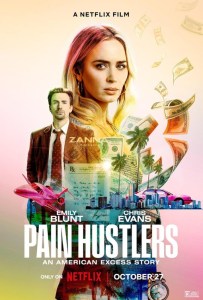
Pain Hustlers is the next attempt to dramatize the numerous stories behind the opioid crisis, a storytelling edict that is becoming its own tragic true-crime sub-genre (Dopesick, Pain Killer, Four Good Days, Recovery Boys, All the Beauty and the Bloodshed). The Netflix original has a starry cast and a topical and serious subject but it’s an un-serious movie caught up in the superficial quirks and appeal of being and making a goofy crime story of greedy sleazeballs.
Liza (Emily Blunt) is a struggling single mother trying to claw her way out of debt and, with her unfinished education and criminal record, few options are widely available. Then enters Pete Brenner (Chris Evans), a loud, gouache pharmaceutical rep for a powerful pain killer. He promises a lifestyle of luxury and power, as long as Liza is willing to ignore or bend a few ethics along the way. Together, they build a sales force of attractive women who wine and dine smaller doctors in order to get them to prescribe their special drug to anyone in need. It’s just that a drug intended for end-of-life pain wasn’t meant for common headaches. As sales boom, Liza begins to worry that her glitzy lifestyle is built upon a mountain of American corpses.
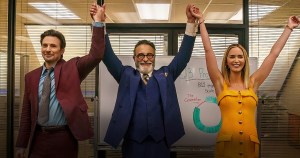
The biggest drawback of Pain Hustlers is that it fully focuses on the glitz and gives lip service to the cost of chasing that avarice. Plenty of movies illuminating bad people doing bad things are accused of glamorizing the misdeeds, from gangster movies to dark romances, though this narrow viewing often seems to conflate depiction with condoning the behavior (see: The Wolf of Wall Street). Watching stories about people stumbling their way into glamorous positions should provide some allure so as to better understand the seductive draw for the characters. The world of vice and power will be a compelling conflict, but for Pain Hustlers, it falters by just focusing on the high-powered lifestyle yet it still lacks specificity to make this story feel interesting on its own. You’ve seen variations of this kind of story before (we’ll call it Scorsese-esque) about the people struggling with less who get a ticket into a new world of access and freedom and then begin to worry At What Cost. Pain Hustlers goes through its plot beats with the most mechanical of movements. The personal details from this supposedly true story feel so generic, reminiscent of similar tales like, Love & Other Drugs and Hustlers. It feels less like an insider account of how these shady people exploited so many and more like the screenplay was cobbled together by what the filmmakers assumed this story must have pertained without reading much of the source novel by Evan Hughes. It’s absent the useful details that allow more of these accounts to prosper as we investigate moral relativism.
The other nagging shortcoming of Pain Hustlers is the consequences for all these bad people. I’m not saying that we need to see comeuppance and justice levied in order for the movie to work thematically; very often these white collar criminal types receive the faintest glance of judicial punishment. What this movie lacks is the emphasis on the consequences, and considering our main characters are pushing sleazy doctors to push highly addictive opioids, that’s a big miss. The movie is all about the climb for its heroine, the comparison of having the fancy life versus a life without. It shortchanges the extremely human cost of its bad actors in a way that does a disservice to the movie and its message. Because of its lack of specificity, this story could have been propelled by any prescription drug, from Viagra to Lipitor. The fact that we’re talking fentanyl, a drug responsible for 200 deaths every day last year according to the CDC, seems immaterial, and that is bizarre.
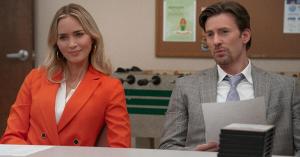
The effects of the opioid crisis begun by Purdue Pharma and the Sackler family, and then trickled down through the complicated tributaries of the American medical infrastructure, will be felt for generations. This is a major story. It would be like, say, telling the story of a struggling single mom who decides to take a career advancement in the Nazi Party in 1940s Germany. You’re not just doing a disservice to the people who really suffered, you’re doing a disservice to the audience to ignore the gravity of their moral culpability and excuse-making, of the drama of the character having to confront their part. For a movie about people profiting from opioid over-prescriptions, there is a grand total of one scene where Liza has to deal with the harsh real-world consequences of her actions (minor spoilers ahead, but I’d advise you to continue, dear reader). Early in the movie, when Liza was forced out of her home, she spent a few days living in a motel. The neighbor lady at the motel has a husband who dies from the opioid crisis, and this one man is meant to symbolize what she has wrought as a whole. It doesn’t work, and the fact that the movie presents Liza in tears trying to make amends to this widow, a character we haven’t had any thought over since Liza leaving her Act One beginnings, is a pitiful excuse for a reckoning.
Evans (The Grey Man) and Blunt (Oppenheimer) feel on autopilot here, namely because of the broad and bland characterization. Blunt resumes her Southern accent I recall from the Quiet Place movies, but her energy level feels too low, too disengaged, like she’s already at her quiet rectitude character phase when she should be at the gee-whiz giddiness of her moral slide. Evans is meant to be playing a cad prone to vulgar boasts and condescension for those he willfully steps over to reach his goals, but his “sleazeball” acting tics feel too forced, too played up, in all the ways that Blunt feels dialed down. There’s no baseline for the two of them, so the scenes they share together feel over and under-cooked, and with a generically developed rise-and-fall screenplay to boot. Andy Garcia (Father of the Bride) is the most interesting character as the head of the company, a doctor who began trying to ensure those in desperate need could have the dignity of mitigating their pain, and transforms into a megalomaniacal huckster who only wants to keep meeting the next sales projections. His rise-and-fall seems much more steep and intriguing than trying to give us Liza, a gutsy single mom (with a wacky mother of her own played by Catherine O’Hara) who we’re supposed to identify with and forgive for playing her part in a deadly chain that has wrecked untold lives across the country and world. She did it for her own kid’s medical treatment. So it’s all okay, right?

This is director David Yates’ first movie away from the familiar confines of the Harry Potter universe since the ill-fated 2016 Tarzan reboot, and only his second non-Potter movie since 2005. Given that history, I’m curious whenever this man jumps onto a non-Potter project because you would assume it has to be special in some manner. I’ll credit Yates with changing his visual preferences from the very drabby and gray palette of his Potter filmography.Pain Hustlers adopts a lot of the stylistic tics we expect in glitzy crime thrillers, from handheld camerawork to sun-bleached colors. There are other techniques to bring a documentary-like authenticity, but the constant cutting back to black-and-white interviews with the characters after the fact only serves as a narration crutch to keep things moving. The character narration lacks further insight from the distance or remorse of the onscreen events. The whole movie feels like a copy of a Scorsese imitator, something akin to 2009’s forgettable The Middle Men, a crime movie about a plunge into the underworld from a naif that doesn’t try too hard beyond empty reconfiguration of the superior style of its influences that I doubt anyone really remembers (you might as well add directorial narration, “Ever since I was young I always wanted to make a gangster movie…”). As immediate evidence to the case, there is a slow-motion house party in Pain Hustlers set to “Turn Down For What.”
Should you spend two hours watching Pain Hustlers? Not really, though if you have a fascination with the many schemers who contributed to making the opioid crisis as trenchant and terrible as it currently is, and likely will be for the near future, then maybe there’s some mild value to be had here. But even those people would be better served watching another Netflix series tackling the same subject matter, the 2023 limited series Pain Killer. For me, the Pain Hustlers story was too broad, and where it could have broken out with specificity is where it decided to wimp out and defer to genre cliches. It’s hard for me to argue that you should spend two hours watching this movie on the subject when you would be far better served, from an informative and entertainment standpoint, watching the two-part, four-hour 2021 documentary Crime of the Century by masterful filmmaker Alex Gibney. That film is damning and compelling and authentic in ways Pain Hustlers can only hope to imitate.
Nate’s Grade: C
Share this:

Reality (2023)
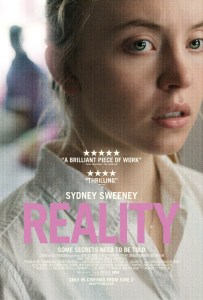 Reality is a film experience where the devotion to verisimilitude is at the sacrifice of drama. The dialogue is reportedly taken one hundred percent from the FBI recordings of their questioning of the preposterously named Reality Winner, played by Sydney Sweeney (Euphoria). She works for a branch of U.S. national security and smuggled a classified document and submitted it to journalists to expose Russia’s intent to hack U.S. voting systems in the 2016 presidential election. The movie takes place more or less in real time as two FBI agents (Josh Hamilton, Marchant Davis) come to Reality’s small home in Augusta, Georgia, begin a search, and question her duties, behavior, and security clearances at her work. We’re inundated early with mundane details of asking about dogs and yoga class coverage while FBI agents are raiding Reality’s home, and the movie doesn’t allude to what everything is about until halfway through. Again, strictly sticking to the script of the government encounter limits creatively where and what the actors can do, so the overall inert feeling is, I suppose, part of the appeal for writer/director Tina Setter’s movie, based on her stage play. I think some people will read the protracted build-up as unsettling in its stubborn ordinariness, or that withholding the juicy drama only makes the collateral mystery and suspicions stronger. Reality is an interesting story told in a frustrating and gimmicky fashion that lessens its dramatic impact. If I just wanted to watch actors re-enact the transcripts, I’d seek out a documentary. I’m thinking of something like 2012’s Compliance, based on a true story and told over the course of one day, but it was harrowing and made me have to watch with my fingers covering my eyes because of the grueling drama that would not look away. There are a few interesting visual quirks here, like actors blinking out of a scene when they say words redacted from the transcript, but mostly it feels too stage bound. Sweeney comes unglued in pretty convincing manner as her different defenses and obfuscations crumble through the interrogation. Reality is a well-meaning movie meant to better frame one young woman’s extraordinary actions through an ordinary lens, but I kept getting antsy for the movie to drop its gimmick and accept that there was more inherent drama in this story than what was going unsaid while we discussed yoga and dogs.
Nate’s Grade: C+
Share this:

Air (2023)
 Who exactly could get that excited about a movie about selling a shoe? Apparently, plenty of critics and audiences judging by the success of Air, the dramatization of the eventual formation and presentation for the first Air Jordan sneaker. It’s Amazon’s first original movie that they’ve given a theatrical release since 2019’s Late Night, and it proved a moderate success for a mid-range adult drama before debuting on its streaming service. I was intrigued by the creative pedigree, as I’ve been an ardent fan of Ben Affleck as a director, and the uniformly strong critical reviews, but I kept thinking, “It’s just a shoe.” It was hard for me to imagine getting that drawn into a drama about a bunch of guys trying to get Michael Jordan’s endorsement. I just couldn’t see the movie in this scenario. Now that I’ve actually watched Air, I can credit it as a well-written and well-acted movie about passionate people putting forward a presentation. That’s the movie, and while entertaining, it’s still hard for me to understand all the fuss.
It’s 1984 and Nike isn’t the market-leading trend-setting company that we think of today. They dominated the running world but few if any saw them as hip. They were struggling behind Adidas and Converse in popularity and cultural cache, and CEO Phil Knight (Affleck) had tasked his basketball head of operations Sonny Vaccaro (Matt Damon) with snagging endorsements from the new NBA rookies. Sonny wants to go all-in on just one athlete, a special case that Sonny thinks can revolutionize the game, and one that could propel Nike to the next level. But first he’ll have to convince Jordan’s mother, Deloris (Viola Davis), that this smaller company with its smaller reach is going to be the best fit for her son’s potential future earnings.
 This is still a movie about a shoe, but it’s really a movie about people who are good at their jobs and trying to change a paradigm of thinking and the Way Things Are Done. I’ve seen it said that Air is “Moneyball for sneakerheads,” and that’s an apt comparison. It’s about a bunch of smart guys fighting for clout, a group of underdogs going up against the entrenched winners, but it’s really about passionate people trying to get others to recognize their passion. So it’s scene after scene of Sonny trying to break through and get others to understand why his way of thinking is going to be the best. It’s also structured entirely around the big presentation with the Jordans, with each stop at a competing shoe company as its own act break. It makes the movie feel very streamlined and focused. It allows moments for minor characters to get their own moment, to make it seem like there’s a larger world behind every scene. It makes the team feel more filled out, and as each person and artist comes together, it’s reminiscent of movies in general, about various talents coming together to put on a big show. With our hindsight already locked in before the opening credits, it’s got to be the journey that matters here, because we know the eventual coupling, so Air has to justify why the before time could be captivating. It’s engaging because it’s a story built upon underdogs and smart people getting to flex their smarts.
Of course, it’s also not too difficult to make someone look smart with the power of hindsight. This was one of the more maddening features of Aaron Sorkin’s frustrating HBO series, The Newsroom. The focus was on a TV show on a cable news network but it existed in our universe, covering the big stories from the recent past. Rather than providing insight into the struggles of journalists trying to break big stories and follow their leads, Sorkin’s show was his turn to rewrite the news, showing how the foolish journalists should have covered these major events. It was his condescending attempt to tell professionals how they should have done their jobs. However, he had the extreme benefit of 18 months or so of hindsight and seeing what was important and what was less so, which just made his critiques all the more condescending (“Why don’t you know all the things that I know from the future, stupid present people?”). I could do this myself, writing a story about a guy in the 1930s talking down to these people hoarding their gold and how they should, instead, invest in a burgeoning computer industry. It’s not hard to look smart when you have history already in your pocket. This is also the case with Sonny in Air, who says over and over how special Michael Jordan is, and we know this too with our personal hindsight, so it makes him look transcendent. However, there could be any number of guys in history that had a similar hunch about Sam Bowie, the player picked one spot ahead of Jordan in the 1984 NBA Draft and whose career was cut short by rampant leg injuries. That could have happened to Jordan too. Sometimes the greatest athletes are the recipients of just horrible luck (look at Bo Jackson, a modern-day Greek God who could have been an all-timer in two sports).
 Where Air glides is with its snappy dialogue and attention to its supporting cast, thanks to debut screenwriter Alex Convery. Despite my reservations on the subject matter, this is proof that a good writer can make any story compelling as long as they channel into the right universal elements. A movie about selling a shoe to a future billionaire becomes an underdog story and one about a group of middle-aged guys trying to live out their dreams by picking the right player to become their vicarious capitalistic dream. The side characters played by Chris Messina as a foul-mouthed agent, and Jason Batemen as an exec who mostly just wants to spend more time with his kids following a divorce, and Matthew Maher (Our Flag Means Death) as a lonely shoe designer, are welcomed and I enjoyed spending time with them all before the big decision. It’s pleasurable just to sit and listen to the conversational banter. If you can find a way to make characters debating the particulars of their industry and make it interesting regardless of industry, then that’s the sign of a good writer. There’s plenty of conflict thrumming throughout, like Sonny pushing to spend his entire department’s budget on one player rather than spreading the risk around, and the climax involves whether or not a billion-dollar company is willing to split some of its earnings with the athlete they’re making mega-million from. It was a first-of-its-kind deal that changed the industry, giving athletes more leverage and direct money for the use of their likenesses, and considering how integral Jordan was to the explosion of the NBA’s popularity, it was money well spent.
There’s no distinct directing flair from Affleck, as I think he recognizes the strengths of this script and how best to utilize them, which is to support his actors and give them space. The most noticeable directing feature is the repeated use of period-appropriate songs and archival footage, which might explain the movie’s staggering reported $90 million budget (for a shoe movie?). Affleck keeps things moving at a light-hearted tone but knows when to slow things down too.
 Air is an amusing drama with good performances and good writing and direction that understands how best to hone both of those selling points. It’s very streamlined while still feeling developed, and it manages to make a decades-old shoe deal feel interesting in 2023. I enjoyed it but I would have enjoyed this cast in just about anything, and I feel like the screenwriter and Affleck as a director have better stories on their docket waiting. It’s an enjoyable and intelligent drama with crackling good dialogue. It’s a solid movie but I guess I won’t ever understand the adoration it received, and that’s fine. Air proves you can indeed tell a compelling movie about a shoe deal. There you have it. Now back to that chicken/egg dilemma.
Nate’s Grade: B
Share this:

Argentina 1985 (2022)
 How does one adjudicate a country’s own nightmare and find justice? That was the situation Argentina found itself in after returning to a democratic state following seven years under a military junta that kidnapped, tortured, interrogated, and killed thousands of its own citizens in the guise of “stopping radical communists.” Argentina 1985 gives you its setting in the title but it’s really about the chief prosecutor (Ricardo Darin) trying to hold the top generals accountable for their crimes against humanity. There is a lot riding on this case and plenty going against him, including near-constant death threats for he and his supportive family. There are some very harrowing personal accounts in the movie, but it’s set up almost like an underdog courtroom drama conceived by Aaron Sorkin, and much is made about putting together the young hotshot team and seizing the day. The movie is swiftly paced for being over two hours and has notable comic relief to keep things from getting too overwhelmingly gloomy given the subject matter. However, Argentina 1985 never loses its focus on making the powerful account for their sins. It’s a rousing courtroom drama with piercing details, engrossing human stories, and the temerity of history. In the light of rising authoritarian movements around the world and even in the U.S., this movie has even more urgent political relevancy about making sure the crimes of government officials are accounted for and that justice is served. It’s a testament to the heroism of everyday citizens and it makes for an invigorating drama that doesn’t lose sight of the big picture amidst the plethora of procedural details.
Nate’s Grade: B+
Share this:

Thirteen Lives (2022)
 The true tale of rescuing the trapped 13 Thai boys in the summer of 2018 is turned into an engrossing and often thrilling if overly long 2022 movie experience thanks to director Ron Howard and a dedicated crew bringing to vivid life the harrowing drama. I was vaguely aware of this story as it played out originally, though missed the critically acclaimed documentary The Rescue from last year that covered the same material, but watching the movie I realize I knew very little of the actual horror. The movie centers around a pair of English divers (Colin Farrell, Viggo Mortensen), both with over 30 years of specific cave diving experience, helping the Thai Navy Seals and government officials to find and save the missing children and their coach. The submerged path is one that lasts about seven hours, and it’s narrow, dark, and treacherous, easy to lose your way. when you only have a tank of air, navigation is the difference between life and death. It’s also a race against time as the monsoon waters are flooding the cave further. The cave traversal sequences are nerve-wracking and deeply immersive, enough so that even I, while watching, started sitting on the edge of my couch in the safety of my own home. The story isn’t entirely centered on our two heroic white guys, as the screenplay by William Nicholson (Gladiator) widens the focus onto many who contributed to the boys eventual rescue, from an engineer who realized they needed to dam water drainage at the top of a mountain, to the locals who agreed to have their crops flooded for the possibility of saving the kids, to the bravery of the Thai Seals, to the hope and burdens of the parents. I never knew the boys had to literally be anesthetized to be removed, and the ensuring climax as the rescue team keeps tabs on how their precious cargo is responding during the multi-hour journey underwater. Howard keeps things pretty straightforward and helpfully provides onscreen graphics to better provide a sense of distance within the cave, which just makes the heroics even more dizzying. Thirteen Lives is an inspiring story about the world coming together for common cause (except Elon Musk, who baselessly accused one of the divers as being a “pedo”) and it’s also genuinely exciting even when you know they all make it out alive, which is its own credit. It might have used some tightening up for pacing, but it’s a well-made dramatization that pays real homage to the many heroes without overplaying its drama.
Nate’s Grade: B+


 nathanzoebl
You must be logged in to post a comment.