Blog Archives
Emilia Perez (2024)

Movie musicals can be sweeping, invigorating, and at their very best transporting, They mingle the high-flying fantasies and visual potential of the cinema, and we’ve gone through many waves of kinds of musicals. Today, we’re in an outlandish world of the outlandish musical, an experience in ironic air 210quotes, where stories that you never would have thought could be musicals would then dare to be different and attempt to be musicals. The much-anticipated Joker sequel, Folie a Deux, dares to be a challenging jukebox musical of old favorites. The French movie Emilia Perez tells the story of a cartel leader that undergoes a sex change and tries to do good with her second life. Both movies are deeply interesting messes as well as experiences I don’t think work as musicals.
In contrast, Netflix’s Emilia Perez is like an entire season of a telenovela streamlined into a two-hour-plus movie that manages to also, for better or worse, be a musical. It is filled with many outlandish and provocative elements you would never expect to be associated with singing and dancing, like a sex change surgery center. This movie mixes so many genres and tones that at one point it feels like you’re watching a crime thriller about Mexican cartels and their manipulation of those in power, and then the next moment it feels like you’re watching an absurd rendition of Mrs. Doubtfire, where a spouse has adopted a new identity and uses this to spend time with their kids they otherwise would not be able to do so. It’s a wild film-going experience; I can’t recall too many musicals that use street stabbings in syncopation with percussion. Because of its go-for-broke ambitions and veering tones, Emilia Perez is destined to be a cult movie, some that fall in love with its bizarre mishmash of elements, but most will probably be stupefied by the entire experience and questioning why, exactly, this was made into a musical.

In Mexico City, Rita Castro (Zoe Saldana) is a savvy defense lawyer tired of living in the shadows of her buffoonish bosses that rely upon her writing prowess to win cases. Someone sees great potential with her, and it happens to be Manitas del Monte (Karla Sofia Gascon), the head of a dangerous cartel. He wants Rita to find the international means to finish the process of Manitas surgically becoming a woman. Under the gun, metaphorically and literally, Rita finds the doctors who will transform the dangerous him into a new her. Manitas then fakes their death, leaving his old life behind to start anew, including their children and wife, Jessi (Selena Gomez). Manitas becomes the titular Emila Perez, but rather retire in luxury, she wants to do good, and Emilia begins a non-profit organization that exhumes bodies, victims from the cartels, to provide closure for their widows and grieving families. Emilia then invites Jessi and their kids to come live in her estate, explaining she is a formerly unknown “aunt” to Manitas. Now Rita is trying to run Emilia’s organization, keeps Emilia from going too far in revealing her identity, and looking out for her own sake considering she’s one of the few that knows about a life before Emila Perez.
I know there will be hand-wringing and cultural tut-tut-ing about the movie’s implicit and explicit themes dealing with trans issues, exploring one woman’s exploration of self and securing the identity she’s always wanted through the lens of a lurid soap opera trading in stereotypes. It’s a lot of movie to digest, and while it feels entirely sincere in every one of its strange creative decisions, it’s also the kind of movie whose tone can invite snickers or derision, like the sex change clinic where a heavily bandaged chorus repeats words like, “vagioplastia” and “penoplastia.” It’s a movie with extreme feelings to go along with its extreme plot turns, but the whole movie feels like it’s trying to settle on a better calibrated wavelength of melodrama.

I think this could have been significantly improved by director/co-writer Jacques Audiard (Rust and Bone, A Prophet) had he embraced more of the movie’s outlandish reality breaking through. Too few of the musical numbers actually do something more than witness someone singing. The opening number, one of the best, involves Rita trying to compose a defense through the streets of Mexico City, while a crowd sweeps around her, often stopping to chime in as an impromptu chorus, sometimes setting up props for her use. It’s a great kickoff, the energy crackling, and I was looking forward to what the rest of the movie could offer. There’s only one other musical number that recreates this significant energy and engagement, a fundraising dinner for Emilia’s organization amongst the powerful members of society. While Emilia speaks at a podium, Rita struts around the floor, sashaying between the tables, and informing the audience about all the dirty deeds and skeletons of the assembled muckety-mucks. She’s literally manhandling the frozen participants, dancing atop their tables in defiance, and it’s a magnificent moment because of how it breaks from our reality to lean into the storytelling potential of musicals. These sequences work so well that it’s flabbergasting that Audiard has, essentially, settled for far less creatively for too much of his movie’s staging. The big Selena Gomez song is just her listlessly singing to the camera while shifting her weight while standing, like the laziest music video of her career. Why tease the audience with the crazy heights as a musical if you’re unwilling?
And now let’s tackle the music, which to my ears was too often rather underwhelming.It sounds like temp music that was intended to be replaced and never was. It’s lacking distinct personality, catchy or memorable melodies, anthems and themes, the things that make musicals enjoyable. The best songs also happen to be the best staged sequences, both involving Rita. These songs have a different vivacious energy by incorporating a hip-hop style of syncopation. “El Mar,” the song during the fundraising dinner, offers an infectious chorus adding extra percussive elements like people slamming fists down onto tables, listening to plates and glasses rattle. These are the moments that enliven a musical and convey its style and panache. Alas, too many of the songs lack that vitality, and can best be described as blandly competent and too readily forgettable.

It’s a shame because Saldana is giving her finest screen performance to date (to be fair, I never watched her Nina Simone biopic). The actress best known for being the strong warrior in sci-fi franchises like Avatar, Guardians of the Galaxy, and Star Trek plays an intriguing character with a rising fire of purpose and paranoia. Early on. Rita is ambitious but unhappy, practically dowdy in appearance, and she begins to come alive under her new role for Emilia. Saldana is electric as she sings and dances and slips effortlessly between Spanish and English, possibly to her first Oscar nomination. She’s the standout, which is slightly strange considering the role of Emilia Perez should be the breakout. Gascon, a trans actress, is quite good in such an outsized role, and gets to play her pre-transitioned identity as well under gobs of masculine makeup and tattoos. The fault isn’t with Gascon’s performance, the issue is that her character has such amazing potential but feels criminally underdeveloped. There is a world of issues of self-identity, culture, repression, shame, anger, jealousy, desire, to name but a few, that could be richly explored from the perspective of the leader of a deadly gang wanting to become a woman. The character is left too inscrutable for my tastes, leaving behind so much unobserved drama. As a result, even though the movie is literally named after her, Emilia Perez feels like a projection more than a character, and if that was indeed the point, then we needed more conflict about that friction.
Emilia Perez is a lot of things all at once; campy, ridiculous, sincere, crazy. It’s messy but it’s an admirably ambitious mess, one that even the faults can be the unexpected charms for someone else. I didn’t fall in love with this genre-bending experiment, although I found portions to be fascinating and others to be confounding. I don’t even think the musical aspects were finely integrated and explored, and so they feel like more of a gimmick, a splashy attempt to marry the high-art of musical theater with the perceived lower-art of grisly crime thrillers and melodrama. It earns marks for daring but the execution is haphazard and scattershot at best. There are moments that elevate the material, where the musical elements feel confidently integrated and supported with the dramatic sequence of events, providing an unexpected and rousing response. However, those moments are few and far between, and the absence only further cements what could have been. Emilia Perez might be your worst movie of the year, a grave miscalculation in tone and storytelling, or it might be a transporting and wild experience, one that can lock up multiple Academy Award combinations for its artistic bravura, a middle-aged Frenchman telling the story of trans empowerment through the guise of a Spanish-speaking musical framework. It sounds like so much and yet paradoxically I was left disappointed that it wasn’t more.
Nate’s Grade: C+
Share this:

I Saw the TV Glow (2024)/ The Watchers (2024)
 I Saw the TV Glow is a strange experience by design, a hallucinatory ode to early 1990s television, coming of age sagas, feeling out of place in one’s own body and mind, and on a Lynchian dream logic wavelength that few filmmakers occupy. From a plot standpoint, Owen (Justice Smith) is a shy kid who looks up to an older girl at school, Maddy (Bridget Lundy-Paine), and they share a love for the TV show The Pink Opaque, a tween-aimed horror series in the vein of Goosebumps or Are You Afraid of the Dark?, which ultimately might be real after all. This movie exists more on a slippery emotional plane than on its story sense. Writer/director Jane Schoenbrun (We’re All Going to the World’s Fair) has created an allegory for self-actualization and self-acceptance through a love of 90s nostalgia and that transitional time of being young and just seeing the cusp of what adulthood promises for the good, the bad, and the mundane. The recreation of the SNICK-era television is perfect, and I loved the little glimpses of these horror monsters taking on new nightmarish incarnations. I wanted the movie to explore its premise more, that this old TV show might be real and posing a danger that only they would uncover. It’s really more a pathway for the characters to explore their selves, what animates them, what confuses them, what provides a sense of community. It’s a movie about the perils of loneliness and finding an outlet, a life raft, whatever that may be, and for Owen it’s this TV show. He connects more with this world than the real one, and when he revisits it later as an adult, it doesn’t live up to his memory. It’s a weird movie but it’s designed for weird kids, or weird adults who used to be weird kids, who found kinship through weird media. It’s a slow and provocative experience that asks you to give yourself over to its vision, but Schoenbrun also makes that engagement quite accessible. While existing as a clear trans allegory, I Saw the TV Glow is open to any outsider who felt unsure of themself and their body and their place in the universe. It’s about obsession and the price of holding onto said childhood obsessions, even if they prove disappointing in your adulthood. It doesn’t offer any general answers or catharsis and is kept on the slowest of slow burns. I began daydreaming of the less arty version of its spooky premise, but that’s simply not going to be this movie. I Saw the TV Glow is impressively personal and surreal and obtuse, but by the end I was hoping for a little more of a foundation to hold onto and its ideas to be fully realized.
Nate’s Grade: B
 The expansion of the M. Night Shyamalan creative dynasty has begun. While based on a 2022 novel by A.M. Shine, The Watchers is brought to us primarily by Ishana Shyamalan, who makes her feature directing debut and adapted the screenplay. It has a buzzy premise that feels at home in a Shyamalan movie, namely a young woman (Dakota Fanning) who stumbles into a strange location with captive people telling her she cannot leave or her life will be in danger from monsters. The group of survivors have to “perform” for their unseen watchers, staring into a two-way mirror inside a closed room. There are certain rules that are hazy and unevenly applied: don’t go out after dark, never turn your back to the mirror, don’t go into the creatures’ subterranean dwelling. This poses an intriguing mystery for a while as the movie unpacks and reveals more about this world and the creatures. However, The Watchers ultimately cannot help feeling like an over-extended episode of a sci-fi anthology TV series like Black Mirror or maybe even Shyamalan’s own Apple Plus series Servant (Ishana wrote and directed several episodes). There just isn’t enough here. The revelations do not sustain our emotional and intellectual investment. Once it’s revealed what the monsters are, I kept waiting for extra levels of twists and turns, and there really aren’t any. Once we settle into Act Three, the movie becomes more or less about housekeeping and gaining acceptance. The whole reason the protagonist is on her journey is to deliver a bird in a cage, and every time this thing keeps appearing even so late into the movie, while she’s running for her life but cannot forget about the caged bird, I felt like laughing. It’s a case of inelegantly finding a way for the visual metaphor (the bird is her!) to continue being tied to the plot after it long stopped making sense. Likewise, there are cutaways to the captives watching a Love Island/Big Brother-stye reality TV show, but little is made as far as commentary on communal voyeurism, so they just come across as little odd comic asides. The movie loses some serious momentum once we get to the convenient info dump sequence (a Shyamalan family favorite: scientist vlogs) and you realize there are no more tricks to deliver. It’s disappointing that a movie with such potent folklore atmosphere becomes a lackluster variation on The Village.
Nate’s Grade: C
Share this:

Lady Ballers (2023)

Conservative commentator Ben “Debate me!” Shapiro is not the first name you would think of with comedy, at least not intentional humor. His outlet The Daily Wire has begun producing and releasing its own movies, starring the likes of Gina Carano and and Some White Lady as Snow White in their Snow White movie that exists solely because Disney had the temerity to hire a diverse woman to play a fairy tale character. I reviewed 2022’s Shut In, the Daily Wire’s low-budget-friendly contained thriller, and was surprised that much of it worked as a straightforward drama. It’s not enough to get me to watch their school shooting thriller, Run Hide Fight. Next up is one of the worst movies of 2023, Lady Ballers, a sports comedy built upon the idiotic premise that a washed-up high school basketball coach (writer/director Jeremy Boreing) can gather his former male athletes and compete on a newly accepted stage. They will disguise themselves, wearing dresses and wigs though not bothering to shave their beards, and call themselves trans women and waltz to money and glory.
The central joke of Lady Ballers is a mean-spirited perspective deeming trans rights to be little more than a calculated media sideshow of accruing social woke points. To say this movie is transphobic goes without saying and from people who don’t deserve any misspent assumptions of good faith about “starting a dialogue.” In this world, trans people are a confused liberal scam, something that can be solved by kicking a guy who says he thinks he’s a girl in the balls and telling him to get over it. The movie feels like a proverbial kick to the balls for all genders.
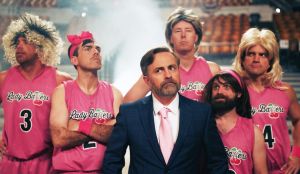
Just think about the nature of comedy being one of subversion, of zigging rather than zagging, and the failings of Lady Ballers become even more magnified and odious. The most obvious joke would be these out-of-shape former athletes thinking they could simply throw on dresses and trounce the competition only to find that these women aren’t just good, they’re far better. This would force the characters to reassess their wrong-headed beliefs and learn lessons about being humble, empathetic, and open-minded. But naturally that’s not the worldview that Lady Ballers and The Daily Wire want to reinforce (it’s sad that “empathy” is not a universal goal) because their audience isn’t coming to this movie with a desire to rethink transphobia or gender-based assumptions and general sexism levied against female athletes. They’re coming to have their “anti-woke” feelings coddled and sexist notions soothingly reconfirmed (“Turns out white male of non-exotic sexuality is the only group not being cast by Hollywood these days” – you sure about that?). Because of this starting point, the attempts at comedy don’t really work because it’s forgoing subversion and surprises of the status quo, and continuously punching down, making fun of even recognizing the humanity of trans people or that they simply even exist.
For the reported defenders of women’s sports, the entire premise of Lady Ballers is deeply sexist. The film posits that any man, no matter how out of shape, could competitively destroy a woman in sports. It’s a laughably misguided assertion, bringing to mind a 2019 survey that found 1-in-8 men thought they could win a point in tennis against Serena Williams. The idea that anyone with little experience could contend or even dominate against a female professional athlete who has devoted her life to improving her physical prowess is built on pure misogyny, the notion that men have to be superior to women no matter the context. “Soon all the best women will be men,” says the conniving and morally bankrupt journalist. The filmmakers, and numerous politicians who have become obsessed with policing the genitals of student athletes, style themselves as the defenders of women when they couldn’t care less about women’s sports, and Lady Ballers even makes this very observation as a bad joke, giving the phony advocacy game away. One character responds to the question of what makes a woman a woman with, “They’re just like men, only better. Just shave your legs, tell each other how brave you are for things that require absolutely no physical courage, and don’t be afraid to cry at work.” There’s a montage of the guys attempting all these other sports and instantly dominating all women. Are you sure you don’t actually really despise women, Lady Ballers? That’s what it looks like here. The film’s entire premise is built upon the dumb concept of male superiority regardless of circumstance. You can’t fashion yourself the protector of women while also thinking they must be inherently inferior.

There are so many scattered conservative straw man send-ups that Lady Ballers becomes an unintentionally fascinating profile of what agitates conservative media at the moment, or at least what agitates their easily agitated audience that they’re catering to, whether or not they genuinely believe in the horrors of what they’re stoking and selling. There are jokes about touchy-feely out-of-touch liberals just wanting to resolve matters with hugs. There are jokes about journalists being wholly untrustworthy and callously taking advantage of multiple abortions. There are jokes about evil school teachers indoctrinating students. There are jokes about black teens being untrustworthy criminals who will steal from you. There are jokes about space lasers followed by jokes about Jewish military. There are jokes about considering the MRNA vaccine as part of one’s regular diet, which doesn’t remotely make sense. There are several conservative cameos like Ted Cruz, Matt Walsh, Candace Owens, and even Shapiro himself that will go over most viewer’s heads, as will references to things like Dylan Mulvaney and Riley Gaines, the woman who tragically finished in fifth place in a swim meet instead of fourth because of a trans athlete. Late in the film, the coach comes to see women as being better caregivers and communicators, and while we’re meant to celebrate his widening perspective, it’s still a window into where the conservative audience easily stoked for this movie thinks that the real important values of women lie, namely putting up with men and making them better people.
And yet, despite myself, I could at least recognize a few passing jokes that kind of work on their own, if you can remove the morally repugnant context of the movie’s aims. Early in the movie, as we’re establishing the teammates as high school athletes, two players are fighting and one responds curtly with, “Your mom’s a catch!” to which the other player adds, “She’s your mom too!” In the same scene, the players plead for the coach to inspire them, and he shrugs and says, “I already threw three chairs on the sidelines, pal, I don’t know what else you want from me.” I think I actually chuckled at that line. The ongoing character definition of two players being twins from sharing fathers who shared the same mother at the same time is at least something outlandishly memorable at the expense of its dumb characters rather than a group of people. One character’s psychotic obsession against badgers based upon his high school mascot has some potential and makes for some weird asides that, at least, don’t make fun of trans people. I even kind of like the simplistic sports chant “winners are just losers who win” as a reflexive joke. When the evil yet sexually voracious journalist lady, who has been engaging in an affair with our coach, slaps him hard, she adds the helpful aside, “These are not sexy slaps.” The concluding game involves inviting little girls to take the place of our scheming men, and it’s played as a heartwarming act of valuing sportsmanship, and then the newscasters reveal the little girls lost by 400 points, not because they’re girls but because it was children versus grown adults. It’s as if someone who at least had a passing understanding of some comedy punched up some of these lines and situations, which makes the rest of Lady Ballers that much more embarrassing.

However, is finding tiny slivers of comedic merit a critical fool’s errand considering the despicable worldview and disingenuous intent of Lady Ballers? I’m reminded of all the film historians and academics that praised the technical merits and storytelling methods of Leni Riefenstahl’s anti-semitic “documentary” Triumph of the Will or D.W. Griffith’s Birth of a Nation. Maybe you can objectively analyze Griffith’s use of zooms and cross-cutting and modern storytelling techniques in his 1915 silent era blockbuster, or you could examine the deplorable racism and the fact that the movie served as a rebirth for the KKK’s membership and a new era in segregationist terrorism. It all depends on the individual viewer and their tolerance for overlooking offense, but it’s hard for me to venerate well-designed or executed pieces of a diseased whole. This is not to say Lady Ballers is on the same filmmaking wavelength as Griffith or Riefenstahl; it’s a dumb sports comedy that wishes it was a second-rate Zucker-Abrahams movie. The bar is considerably low, infinitesimally low for this movie considering its target audience and targets, and yet this movie trips over even the mildest of expectations. Lady Ballers only confirms that a comedy made by people who don’t understand comedy can only ever be limited in its funny, especially when its built upon a premise radiating seething ignorance.
Nate’s Grade: D
Share this:

Alternate Opinion: Lady Ballers Guest Essay
My friend and writing partner Ben Bailey asked me to host an extensive essay he was compelled to write after watching Ben Shapiro’s deeply disingenuous and presumably laugh-free sports comedy, Lady Ballers, a movie built upon not just transphobia but also misogyny. I plan on watching this movie as well because of course it will be one of the worst movies of the year and thus I’ll need to analyze these things for you to spare you, dear reader. In the mean time, enjoy Ben’s monumental take-down on the movie, its terms and goals, and the disingenuous nature of the toxic conservative media ecosystem.
______________________________________________
“Trigger Warning: A Woke Soy Cuck is About to Talk About Lady Ballers“
By Ben Bailey

So, Lady Ballers is a thing. If you haven’t heard of it, or of Ben Shapiro’s right wing Daily Wire production company, I envy your life and your ability to avoid psychic pain. For the rest of you, maybe you’ve seen the trailer or some reaction videos on YouTube, and then you likely did what most rational people would do and casually dismissed it as something you will never have any reason to watch. At least I assume most people will never watch Lady Ballers because most people don’t have a subscription to Daily Wire+ or the wherewithal to actively seek it out through other quasi-legal means, but I watched it, and if only to justify the effort of doing so, I decided to commandeer my good friend’s blog for a bit to talk about it. You should know that I insisted he watch it, because even though I cited him as a friend just now, I secretly hate him and only want bad things for him.
Lady Ballers is the story of the whitest basketball team you’ve ever seen in your life deciding to take advantage of our modern “woke obsession” with regarding trans people as human beings with basic dignity by pretending to identify as women so that they can compete in women’s sports, where they will obviously dominate due to their manly testosterone being the natural kryptonite to weak lady estrogen. If you are as exhausted reading that synopsis as I became writing it, rest assured that the rest of this isn’t actually going to be much of a traditional review of the film on its cinematic merits, because that would be completely pointless. If you’ve seen the trailer and know anything about the people who made it, you already know it’s bad. It’s not funny, its amateurish and just generally poorly made, because it was made by unfunny amateurs who don’t know how to make anything good. I will touch on quality issues here and there, but mostly I want to focus on what the film represents in the larger cultural and political context in which it is being presented. What is the point of Lady Ballers, and what does its form and function say about the bigots behind it and the zeitgeist they so desperately wish to influence?
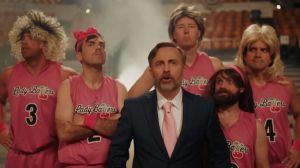 I also want to stress at the outset that the level of critical analysis I am about to apply to Lady Ballers should not be seen as any attempt to elevate it to the level of art worth engaging with or expanding any intellectual strain to deconstruct. Just by talking about this movie, or even calling this loose assortment of tired hate-filled nonsense a movie, might leave the erroneous impression that Lady Ballers is, in any way, inherently interesting. It is not. It is in fact, beyond the novelty of its miserably cynical polemic, a very boring thing that I would defy most people not already tuned into its disgusting message to even sit through (and frankly I bet most of its target audience would find it difficult as well).
Let’s start with Ben Shapiro, the public face of the Daily Wire brand, who appears briefly in a cameo as a referee at one of the games to deliver a line that unintentionally reveals more about him and this movie than anything else in it, flatly stating that he’s just getting paid to be here and doesn’t actually care about anything going on. Ben Shapiro is a grifter, and almost certainly a bad person who probably believes a lot of terrible things about people, but I say probably because you can never be sure with someone like Ben if he actually believes anything he says or is just saying what he needs to say to appeal to an audience of people as bad as he is presenting himself to be. The science is not yet in on whether he is biologically a piece of shit, but he clearly identifies as one, and just as he seems to regard trans identification according to his film, he’s only doing it for the clout and the money. Whether or not Shapiro actually believes any of his own hate-filled rhetoric is immaterial to his main goal, which is raking in money from the suckers in his audience who very much do believe it, and the reason we know this for sure, is because he just made a movie called Lady Ballers.
You see, in a recent interview about the movie on his website, Shapiro revealed that the original intention for Lady Ballers was not creating a kind of dumb, raunchy, shocking for its own sake comedy that he would almost certainly hate if he hadn’t made it himself, but rather, a hard-hitting documentary focusing on his favorite fake culture war controversy. The plan was to have cis-gendered men actually pretend to identify as women in order to infiltrate women’s sports for real and prove that all the so-called trans-women currently doing it were just liars like them trying to get a hairy leg up on the competition. The problem apparently became immediately obvious when they found that the standards for applying to women’s sports as trans-women were much higher than any of their stooges were willing to meet, as they weren’t ready to undergo the hormone treatments, surgeries, and other little details required to prove that they weren’t just a bunch of assholes trying to co-opt something they don’t care about in order to score political points with MAGA douchebags. You get it, right? It’s the one legitimately fascinating thing about Lady Ballers, that its very existence in its current form invalidates its entire thematic premise. They had to make a fictional “comedy” version of the story they wanted to tell because it was impossible to present the thing they claim to believe is actually true in any way that could qualify as a documentary even by their incredibly low standards. As Shapiro is fond of saying, facts don’t care about feelings, and in this case, that appears to be true.
 But of course, that didn’t stop them, so they went ahead and made Lady Ballers, and I could go on for quite a while listing off all the transphobia and misogyny and racism awash in it, as well as all the stuff that wasn’t deliberately objectionable but still offensively unfunny, but again, what would be the point? More interesting to me is what this movie says about the people who made it and the audience it is targeting and what the perceived existence and marketability of that audience says about us as a country and a species. I always felt that the rise of Donald Trump was less about him than it was about us, that whether he won or lost, or wins again or loses again in 2024, it would be a test of our own moral character for us to pass or fail. Do we accept that this is who we are, or do we actually try to live up to what we all want to believe are our better selves? The vitriol intrinsic to Lady Ballers and the Daily Wire and this whole movement of stoking anti-trans hatred to rile up bigots, ultimately in the hope of pushing them to the polls to support a fascist overthrow of our democracy, just seems to me to be another facet of that test, and how close we are to passing or failing it is the only question worth thinking about.
For a movie supposedly about the topic of trans-people in sports, it is a bit surprising that this movie doesn’t actually feature any depictions of real trans-people in it. Obviously, I wasn’t expecting any portrayal to be positive, but I at least expected there to be a trans-character, if only to take the role of a villain or antagonist representing the thing the movie is railing against. We have the aforementioned cis-men pretending to be trans but otherwise no one who genuinely considers themselves to be trans. Even if you dismiss the authenticity of trans identification and say they just wrongly believe something about their gender, you’d think they would show someone like that in their own movie, right? There’s a brief bit at the end where a character suggests they might be, but only as a quick throwaway ball-kicking joke. If trans people are the bad guys in real life, why are they not the bad guys in this movie that wants you to come away thinking that they are so bad?
More to the point, why are there no trans conservatives in the movie? I know there aren’t that many, but off the top of my head I can think of at least two public examples. Maybe Caitlin Jenner was too big a get for this and just saying that the vaunted star of Can’t Stop The Music, Jack and Jill, and literally no other movies is too good for this is saying something, but what about Blair White? Pretty sure she’s been on the Daily Wire a couple of times, but apparently, they couldn’t get her to show up to provide any kind of cover for the transphobic message. That’s literally what she does for a living, being the trans person willing to sell out her own people for conservative clout, and either they didn’t want her in this for some reason, or even she turned them down. Blair White agreed to appear in a Tom MacDonald music video but turned down Lady Ballers?
 That can’t be it. It’s not possible that they even asked them, or ever considered including any trans-people, even as imaginary straw-women to make fun of them, because that would require acknowledging that they are actual people who exist. As the film’s mid-credit stinger suggests, depicting one of the main characters attending Jordan Peterson’s reparative therapy to cure their trans-delusions, for this movie and the ideology behind it to make any sense, trans-people can’t exist, and anyone claiming to be trans is either mentally ill or pulling the same scam as the film’s protagonists. If Jenner had shown up, sure she may have parroted the talking points about keeping sports segregated by the gender binary, but she would have presumably done so with the confidence of a person who clearly believes that they have the right to exist as they are without being accused of being crazy or a liar, which would go against the movie’s larger message that trans-people aren’t just illegitimate as players in sport but illegitimate as people in general. The people behind Lady Ballers are grifters who don’t believe anything, so naturally they assume that everyone else is too, and that includes trans-people, who don’t actually believe what they say about themselves, and are merely grifting a gullible public, just like the Daily Wire is doing.
Designed to work in tandem with freak-outs about Drag Queen Story Hours grooming your kids and doctors prescribing hormone blockers to babies without their consent, the faux controversy about trans-people in sports has always been a thinly-veiled cover for the larger goal of trans erasure, a way to launder openly genocidal rhetoric designed to inspire the very kind of deadly violence against trans-people we’ve seen increase in the last few years as if it were just some completely legitimate concern for the integrity of women’s sports. But Lady Ballers is so blunt and bad at its own messaging that it fails to hide what it needs to hide, giving away the game, no pun intended. Obviously, these people don’t genuinely care about women’s sports; a major running gag in the movie is about how literally no one cares about women’s sports, and the central premise of the movie assumes that any man, regardless of skill, is inherently physically superior to every woman and could beat any women at any sport at any time purely by virtue of being a man.
And I know that sounds like a joke, to the point where you might question my criticizing it in the context of a movie at least intended to be a comedy, but that’s not a joke in this movie. You as the audience are not meant to take the idea that any man is better than all women at all sports as an exaggerated, farcical concept. That is the actual thing you are meant to unironically accept so that the other jokes in the movie work, the underlying rational assumption upon which the other jokes are made relatable. You aren’t meant to laugh at the idea that these men are trouncing these women at the sports the women trained for and the men didn’t, you are meant to laugh at the absurdity that any woman would ever think they could try to go up against any man. A few years ago, there was a poll that found that 1-in-8 men genuinely believed that they could beat Serena Williams in tennis, and this movie was written for them.

If you know who this person is in the picture, I’m sorry.
The virulent misogyny dripping from every corner of Lady Ballers would seem to preclude any genuine regard for the integrity of women’s sports or women in general. The most prominent female character in the film is a conniving reporter colluding with the team’s head coach to cynically milk the “stunning and brave” human interest story for viewers, who casually references her regular abortions as the annoying minor consequence of aggressive promiscuity, you know, the way all women who get abortions do? At one point, one of our “heroes” stares off into the middle distance while spitting out a creepy incel screed sarcastically defining women as just like men but better because they shave their legs, brag about bravery for things that aren’t brave, and aren’t afraid to cry at work, and the next shot is the reporter shrugging and nodding in agreement, as if it was the truest thing ever said and, despite her prior demonstration of assertive hostile feminism, she has absolutely no way to refute it.
Again, you might be saying, these are just jokes. Bad taste jokes, maybe even jokes based on faulty premises that could only be enjoyed by the terrible people who accept those premises, sure, but still, only jokes. But that’s the weird thing about a movie like Lady Ballers that is more preoccupied with its political and cultural message than its service as a functional comedy. The message is not in the service of the comedy, the comedy, such as it is, is in the service of the message. Comedy is about subverting expectations, while cultural polemics are about reaffirming expectations. For instance, if you start your movie with a bunch of characters assuming that simply being men would allow them to dominate women’s sports, one would think the next scene would be them realizing that this was not the case, in a montage of them getting taken down a peg for their sexist hubris. Or you might have an actual trans character presented as a contrast for the absurdity of their fake trans grift. But this movie can’t do any of those things, because to subvert the expectations of its audience of bigoted right-wing morons would defeat the whole point, which is to validate their bigotry and to keep the cash flow coming. The needs of a comedy and the needs of whatever this movie is are diametrically opposed to one another.
Fairly early on in Lady Ballers, before the film’s gender-bending twist, the head coach delivers one of his famously rousing motivational speeches to his team, getting them to chant a motto that will return in the third act: “Winners are just losers who win.” Credit where its due, unlike most of what passes for comedy in the movie, this line at least structurally conforms to be a recognizable joke. It’s not particularly funny or clever, just a superficial rhetorical absurdity, but it also serves as another one of those accidental confessions on the part of the producers. Because if you think about it, losers who win basically describes the Rightwing Influencer Pipeline to which the Daily Wire crew belong.

Also, Ted Cruz cameo.
To the extent that they have won anything, or rather succeeded financially as a grift or culturally as propaganda for a noxious worldview, it has always been with the distinct stench of loser-dom. C.H.U.D.s like Matt Walsh or Michael Knowles speak with all the confidence of people with an actual point, but there’s always this underlying sense that beyond the choir to which they are preaching, the cringe and bluster are obvious to anyone else. When Ben Shapiro tries to own Cardi B and Megan The Stallion’s W.A.P. by questioning whether the titular wetness is a disturbing medical condition, unintentionally revealing to the world that he’s apparently never made his own wife sexually aroused, the self-own, while hilarious, is not even a little surprising. In short, contrary to the utter gob-smacking dearth of actual jokes in their movie, these guys are themselves complete jokes.
And the more important point is that the joke isn’t landing anymore, if it ever did. One need only look to the spectacular failure of Moms For Liberty, a group that tried to ride the wave of transphobia to take local school board elections by storm, only to lose almost every seat they ran for in 2023. If there is any saving grace to Lady Ballers, it is that it decidedly does not feel like the work of people who are or even think they are winning anything. This doesn’t feel like a triumphant victory lap of the Anti-Trans Right, but rather the sad last desperate gasp of a dying movement that was never even a real movement to begin with, the fizzled fart of stale air escaping a punctured basketball, or if you prefer, a balloon used to approximate a fake boob by someone who’s never done drag and didn’t bother to research anything about how to do it right. And that’s good. Not the lack of research but the larger failure of the mission that this movie represents. You still shouldn’t watch it because it sucks.
The thing I’ve always found interesting about Shapiro is that in spite of his horrible takes on everything, he strikes me as someone at least smart and self-aware enough to feel some measure of secret disdain for how his career is dependent upon debasing himself to the kinds of people who boycott M&Ms because the green one isn’t sexy enough anymore. If you didn’t know, he got into the right-wing commentary business after a failed attempt at making it as a screenwriter, and it would seem that the Daily Wire getting into its own film production is at least on some level a way for him to live out the dreams that were robbed of him by his crippling lack of creative talent. I like to think that knowing Lady Ballers is the closest he’s come to the achievement of his lifelong aspirations, and that the actual career he did build for himself is an active impediment to those aspirations trapping him in a cage of his own bullshit from which he can never escape to a land where he is regarded as a legitimate creative person, is the funniest joke of all.
(Addendum: I didn’t have any other place for this, but I did feel I would be disingenuous if I did not mention the one actual good idea in the movie. At one point, the head coach goes to a Hooter’s-esque sports bar but one staffed entirely by men in drag. Of course, in the context of the film this is yet another joke about how men dressed as women are silly and should be dehumanized and presumably executed by the state in the next Trump administration, but out of that context, it’s just a solid concept for a restaurant and I would patronize the hell out of a place like that. Not sure if anyone has ever tried something like it in real life, but if not, they should.)
[Editor’s Note: At the film’s premier, one of the actors was arrested by the FBI and charged with four crimes relating to the January 6 insurrection because of course.]

Share this:

Women Talking (2022)
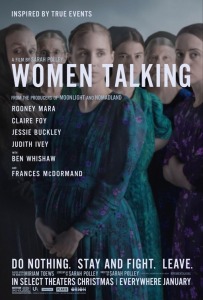 The hard-hitting Oscar-worthy drama Women Talking could have been titled Twelve Angry Women, but with the necessary subtitle: But They’re Very Justified in Their Rage. It is, as the title suggests, a movie almost entirely about women talking in one central location, enough so to feel like a stage play captured for the screen. However, the reason these women are assembled is heartbreaking, infuriating, and eminently engrossing. Women Talking demands to be heard.
The dozen women have gathered to debate the future of their participation in their community, a closed-off Mennonite coalition. They are victims of heinous sex crimes and general repression, debating between staying and fighting and abandoning their way of life. These women are talking about their own agency and what their collective response will be to the great wrongs that have prevailed upon them. It’s not just that the women of this community have been preyed upon by predators in their midst, their trauma has been dismissed as ghosts and devils until literal men were literally caught and apprehended. The next part is even more galling, as the guilty men will be returning back to the community and the women are expected to forgive the predators and go back to life as it has been. Except how exactly has life been for the women of this small community? The assaults have been going on for decades, enough that many of the children are the byproducts of their abusers. One grandmother is brought to tears that she should have done more to protect her adult daughter, herself married to an abusive man. The systematic nature of this abuse is the core of their deliberation. Can they stay and reform a broken society from inside, or is the best hope radically breaking away and starting anew without the men?
 The movie also serves as a debate over the capacity for grace and forgiveness, reminding me in subject as well as the approach of last year’s equally hard-hitting and equally spellbinding indie, Mass. I found it especially insulting that these women are expected, by the male leaders, to simply forgive and forget, to shuffle back to subservience. It’s a larger philosophical discussion over the nature of grace and accountability. It would be showing grace to these men to forgive them when they do not deserve it, and surely the male leaders would underline this point in a comparison with their religious text, akin to Jesus forgiving those who crucified him. However, if forgiveness is not the catalyst for reform and reclamation, then it’s just another empty gesture that maintains the status quo of abuse going unpunished and the abusers being protected. It’s easy to make larger connections to larger societies protecting predators through conditioned silence. The entertainment industry has been rife with bad men, and yes it’s typically men, behaving criminally and being protected by their position, and it might be easy to make connections with Women Talking and She Said, the fact-based take-down of Harvey Weinstein. Are these people worthy of forgiveness or is the patriarchal system of power (women aren’t even allowed to learn to read and write in this community) beyond salvaging? Within minutes of watching, I was already shaking my head and saying they should burn it all to the ground.
Women Talking is powerful and somber without being overly grave to the detriment of the material. It’s never taken anything less than serious, but the subject matter is handled very sensitively and even rated PG-13. Under the careful guidance of writer/director Sarah Polley (Away From Her, Stories We Tell), the film doesn’t soft-pedal the abuse these women have suffered but it doesn’t wallow in it either, getting overloaded with sordid details. The screenplay unfolds key pieces of information over time, allowing the audience to piece together a fuller picture (I didn’t even realize the family connection of the dozen women until an hour in). It would be easy if the only response explored was one of unfathomable rage, best exemplified by a stirring monologue where Claire Foy (The Crown, First Man) rattles off what she will do to protect her young daughter including murder, including vying with the Almighty, and even including spending eternity in hell. It’s easy to be all teeth-gnashing vengeance and fury, and entirely deserved considering these women are already looked upon as second-class citizens. However, Polley aligns her movie as a debate between anguish and hope and the difference between false and real hope. Is it real to hope that these men will change? Is it real to hope that August (Ben Whishaw), a college-educated child of a former outcast, can break the cycle? By the end, the main feeling I had was catharsis, that these women can chart a new, better path.
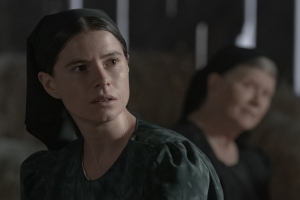 Given the heavy subject matter and the ensemble nature of the production, you would be right to assume that this is an actors’ showcase. The three biggest roles belong to Foy’s Salome, Rooney Mara’s Ona, and Jessie Buckley’s Mariche, each presenting a different perspective. Salome wants to stay but mostly as a means of collecting vengeance for her and her daughter. Mariche wants to forgive the men because, if they do exile themselves, they are told their immortal souls will be denied the kingdom of heaven. It also happens that Mariche’s alcoholic husband is one of the accused men returning. Ona is pregnant with her attacker’s child and questioning which setting would be best for her, staying with what she knows or risking a new life, for better or worse. Foy and Buckely (The Lost Daughter, Men) each have a signature monologue opening up their character perspective and each of them cinches it (call it their “Oscar clip moments”). Mara (Nightmare Alley) has the more contemplative and subdued role, which makes it less showy. Her character is the one who questions the most the value of forgiveness, and of course whether it counts when forgiveness is forced with the threat of eternal damnation. If Salome is the movie’s fury, then Ona is a reflection of begrudging hope, and Mara succeeds with a noble sense of grace.
There are two minor quibbles I have with Women Talking that hold it slightly back for me, and it’s not the locked-in setting making the proceedings feel like a staged play. Polley uses visual inserts and cutaways to devastating effect to highlight the women’s trauma, from awakening to the aftermath of assault to miscarriages, notions to heighten the visual storytelling potential of the medium without digging into exploitation and losing the tasteful tone. The directing even takes a few cues from Sydeny Lumet’s work from 12 Angry Men. One critical aspect that holds back the movie, again only slightly, is that the characters tend to feel a little more like various points of view rather than finely developed characters. Given the nature of the debate, there’s a lot of ground to cover, and it’s a smart storytelling move to coalesce. It just slightly limits some emotional engagement; it’s still there because of the skill of the actors and every drop of empathy they rightly earn, but the characters aren’t as well realized as they could have been. This can also be simply because we’re dealing with a dozen characters to try and supply enough material for. Even in 12 Angry Men, not every juror is going to be given equal importance (nobody cares about you, juror #7, so sit down). I reflect back to Mass, an excellent 2021 movie that you should seek out, and how personable and in-depth those characters came across over their feature-length sit-down. It also helps that it only had four characters to balance. The other minor criticism I have is the overemphasis the movie places on a long-in-the-works romance between Ona and August, who maybe has more screen time than maybe any woman. For a movie dealing with the sexual and emotional trauma of women and them taking account, I’m left uncertain about the amount of time we spend on an unrequited romance. It’s not like Polley is elbowing in wacky rom-com material, as it all likewise carries the same subdued tone. I just don’t know if this movie needs a romance elevated during its otherwise 100 plaintive minutes.
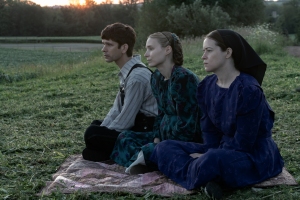 Women Talking is an urgent movie that every person should watch. The central dynamic is radiating with dramatic potential, and the actors are uniformly excellent, even the youngest actors handling some very touchy material. Polley’s direction is stately and subdued without removing any of the surging emotional power inherent in her drama. I’m overjoyed that Polley has returned back to filmmaking as she hasn’t made a movie in ten years. It’s a triumphant return for Polley, one that will likely have her vying on the biggest stages come awards season. Women Talking is timely and, unfortunately, also timeless. By the end, you’ll feel slightly exhausted but better for it, like the euphoria that comes after a good cry and you feel like, having pushed through, you’ll be better for it.
Nate’s Grade: B+
Share this:

West Side Story (2021)
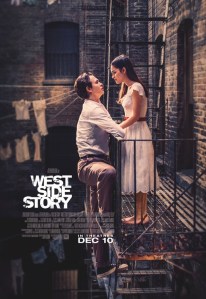 Steven Spielberg, now approaching seventy-five years of age, has experienced such rarefied success as a film director that the man can do whatever he wants. It just so happens he wanted to tackle his first big screen musical, something he’s a little late on considering peers like Martin Scorsese (1977’s New York, New York) and Francis Ford Coppola (1982’s One from the Heart) beat him to the musical punch early. The question isn’t why direct a musical at this stage of his glorious career, it’s why direct a remake of 1961’s Best Picture-winning West Side Story? We already have a perfectly good and revered movie version, and there are other musicals that haven’t even gotten their first big shining moment on the silver screen, so why go back to this particular show a second time?
Once again, we’re following the two New York City street gangs, the Jets, who are made up of Italian and Irish white kids, and the Sharks, made up of Puerto Ricans. Tony (Ansel Elgort) is trying to reform his ways after spending a year in prison for gang violence. The Jets are pleading with him to get back involved, to push back against the Sharks encroaching on their territory. He meets Maria (Rachel Ziegler) at a dance and the two fall instantly in love. The problem is that Maria is Puerto Rican, her brother is the leader of the Sharks, and this relationship would be forbidden and dangerous. Tony and Maria plan to run away together and escape the conflicts of this tragic turf war.
 I’ll risk musical theater heresy and admit outright that Spielberg’s West Side Story actually improves on the much-hallowed 1961 original in several ways. The most immediate and obvious is that we have Hispanic actors playing Hispanic characters. No regrettable brown face including the actual Hispanic actors this time (it’s just humiliating to watch Rita Moreno, in her Oscar-winning role, have to be darkened up to be “more Puerto Rican”). That’s a pretty good improvement already, though it’s not unexpected; 1961 was also the year Breakfast at Tiffany’s was released with its notorious Mickey Rooney performance in jaw-dropping yellow face. Granted, jaw-dropping today, not so back then. 1961 was still only a few years removed from John Wayne taping his eyelids back to portray Genghis Khan. This was the unfortunate norm.
Another immediate improvement is the visual dynamism of 60 years of technical filmmaking advancement. I recently re-watched the 1961 original, a film I haven’t watched since probably the 1990s as a teenager, and it’s a relatively good movie but it’s also a good movie of its time, and by that I mean there are limitations to the presentation. One of the most appealing aspects of movie musicals is how they expand upon our humdrum reality, the splashes of color and synchronicity and bold imagination. I’m not saying the movie musicals of the 1960s were particularly lacking, as there are many classics and favorites, but because of filmmaking practicalities and predilections, movies could only go so far at the time. With 60 years of technological advancements, today’s movie musicals, when under the right guidance, can expand the world of song-and-dance fantasy like few of the past. You need only compare the showstopper “America” in both films, the dancing high-point of either film. The original is on a rooftop for its entire duration. The new version is all over the city block, finally culminating on a crossroads and bringing the denizens of the town out in girl power empowerment. It’s such a high-energy and celebratory sequence and the scale and variance really make it feel so much more joyous and exciting. The choreography is also an improvement. Again, not a slight against the 1961 original, but in the ensuing 60 years we’ve also advanced in the technical precision and creativity of dancers. The 2021 West Side Story is impressive top to bottom with the dancing of all the performers, and with Spielberg as director, he wants you to best appreciate their talents while also making the movie as visually dynamic as he can.
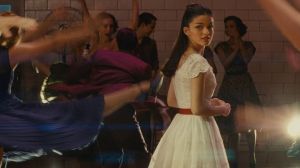
 Spielberg proves an absolute natural at helming a big movie musical. Nothing against Robert Wise, the 1961 director who helmed plenty of influential Hollywood titles like The Sound of Music, The Day the Earth Stood Still, I Want to Live, and Star Trek: The Motion Picture. He was also the editor on Citizen Kane. The man clearly knew how to tell a big screen story across multiple genres. It’s not a shame to say his visual prowess doesn’t quite stack up to a Steven Spielberg, who just happens to be one of the most popular and versatile filmmakers of all time. Spielberg’s camera is much more active than the original movie, and he’s consistently bringing us into the scene, having characters duck in and out of frame, and circling around, always interacting with the world. It makes the movie much more visually immersive and exciting, enlivening an already lively number like the dance hall rivalry between the Jets and the Sharks where each side crowds the edges. The movie operates on a high level of visual pleasure because Spielberg knows exactly how to play to the strengths of the musical genre. Spielberg incorporates the location in each setting and has fun visual flourishes, clearly having given great thought how to visualize every line in each song. The opening of “America” involves women placing clothes on a line, and as the clothes move, it reveals our newest chorus member giving voice to the continuing song. The way the camera moves through the neighborhood to note the encroachment of gentrification. The way he frames the faces of our young lovers. The way he uses shadows as menace. The way he makes every space feel like it’s perfectly utilized for the best shots and edits. Now that Spielberg has proven so adept at handling musicals, somebody please give this man another for our collective benefit.
The top actors are not the leads but two very mesmerizing supporting players. Ariana DeBose, previously seen as one of the ensemble members in 2020’s Hamilton, is pure dynamite as Anita. She explodes with verve and personality and attitude and vibrant life, and the camera loves every second she’s on screen. She gets the bigger emotional arc than Maria. She gets the jubilant song, the aforementioned “America,” and gets her crushing moments of heartache as well. DeBose is phenomenal, and likewise so is Mike Faist (Panic) as the leader of the Jets. Like Anita, this character is brimming with anger and attitude and the movie does a much better job than the 1961 film of presenting him with a point of view that can develop some empathy. Faist is lanky yet so smooth in his movements, and he gets more dancing than just about anyone. He’s balletic in his dancing while still upholding his spiky attitude. Both of these actors are so self-assured in their roles, so vulnerable behind the surface, and so accomplished with their dancing and singing that one wishes the movie would devote more time to both of them.
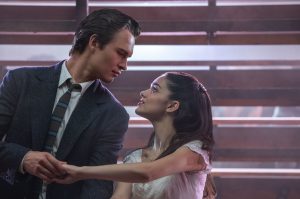 As for our leads, Ziegler and Elgort (Baby Driver) are good but unexceptional as our naifs in love. Ziegler can sing beautifully and definitely has a natural innocence to her appearance. Her eyes are so large and glassy that she reminded me of an animated character at points. Elgort is solid in his singing but I can’t help but feel that he’s been lapped by his co-stars. There is a comic relief musical number, “Gee Officer Krupke,” where the various Jets have fun imitating the nay-saying adults who hastily cast judgement upon these juvenile delinquents. It’s a silly number about guys goofing around and could easily be the first on the chopping block to be cut for time. However, over the course of this fun diversion, I realized that person-to-person in the Jets crew, the same guys that just appeared as background players to fill out a scene previously, how good every person is, and how much more time I wish they had gotten than Elgort. Part of this is that the romance aspect of West Side Story has always been the weakest part of the show. It’s based upon Romeo and Juliet and tied to those tragic plot events, but when both Maria and Tony are ready to run away and marry one another after a single night, and especially after the fateful rumble where Maria is so astonishingly quick to forgiveness (and horniess), the romance plays so incredulously. As a result, the two lovers are essential to the story but also the most boring characters too.
I think the adaptation by Spielberg screenwriting stalwart Tony Kushner (Munich, Lincoln) has smartly updated plenty of political elements, amplifying racial tensions but looking at it over a broader scope. Giving Tony a mentor figure in an older woman who runs her drug store shop, played by Moreno, is a great choice, especially as she represents a medium between the two sides as she is Puerto Rican but her deceased husband was white. It’s smart to have someone from the community and so wise to try and impart lessons to Tony, especially as he wants to change for the better. One update from Kushner didn’t quite jibe for me and felt like token-ism. The youngest member of the Jets, a prepubescent pipsqueak, has been replaced with a trans man fighting for membership. I understand the basic character arc is the same, the outsider trying to be accepted by the group, but the consideration of trans acceptance in the 1960s wasn’t exactly enlightening. The other Jets tease and question the gender identity of the trans man, but this perspective never feels well integrated into the play’s prejudicial world. I suppose more could have been done like having the Sharks harass this character, belittling them over their identity, and then the Jets feeling like one of their own had been attacked and in that they would finally be accepted. Except this inclusion would be around the degradation and potential assault of a trans person, which itself is not the best reason to include a trans character if you’re just setting them up for trauma. I don’t know. This character could have easily been removed if this was all there was.
 One other aspect I found cumbersome was the creative decision to not include English subtitles during the Spanish-speaking portions of the movie. I cannot understand the artistic rationale for this at all. Sure, Spanish-speaking viewers will be fine, and I could piece enough together with context clues and my rudimentary understanding of like 75 Spanish words, but what are we accomplishing here? It just feels alienating, and it inadvertently likens the viewing experience to what the Jets are going through, feeling like they cannot fully understand their new neighbors. I doubt that Spielberg and company wanted to reinforce the perspective of xenophobia, but purposely removing a key portion of your movie from the majority audience in the U.S. seems so strange to me. If it was just scant conversations or moments, I’d excuse it, but the untitled Spanish accounts for like ten percent of the whole movie. Imagine watching any foreign movie without the subtitles on screen. How much meaning are you able to devise on your own?
West Side Story 2021 is a good time for fans of musical theater and a testament that just because something is old and beloved doesn’t mean it can’t even be improved upon with the right people and goals. Both movies are about the same length, 150 minutes, which seems the de facto standard for movies this holiday season, and you’d have a good time with either. I think the updated version adds more visual creativity, impressive choreography, and remodeled racial and political considerations to make it land better for modern audiences. It might not have been needed but I’m glad all the same we now have two West Side Story movie musicals to cheerfully tap along to.
Nate’s Grade: B+
Share this:

DeRosa: Life & Art in Transition (2021)
 Angelo Thomas is an impressive young filmmaker. At his college, the Columbus College of Art and Design in Ohio, the man was able to make a $50,000 feature film, 2020’s The Incredible Jake Parker, the first undergraduate film in over 30 years. Now he’s right back with another feature, the documentary project DeRosa: Life, Love & Art in Transition, illuminating the story of artist Felicia DeRosa, a CCAD grad and professor who lived most of her life as a man before accepting herself and coming out as trans at the age of 43. The 65-minute documentary is nicely polished and deeply empathetic and worth an hour of your time to learn more about DeRosa’s harrowing and inspirational life.
The biggest question any documentary must ask itself is whether there is a story here that can support a deeper dive. I suppose this same question should be given to fictional narratives, can it support a film, but documentaries are limited by the experiences of their subjects. Fortunately, with DeRosa, there is plenty to talk about and the hour running time feels more than enough time to sincerely cover one woman’s journey of self-discovery and an evolving love story where two people recognized they were better together no matter the changes. DeRosa is a natural gabber and quite capable of compellingly retelling her story with bittersweet personal insights and wisdom. She’s an easy person to sit in front of a camera and just say, “Go.” It also helps that the production has access to what must have been hours upon hours of DeRosa’s home recordings. She was prolific in documenting her feelings and anxieties at different points. It’s a wealth of resources for the documentary to be able to immediately supply DeRosa at different points of her life’s journey articulating her struggles and anxieties in the moment. It reminded me a bit of the documentary Val, extensively using Val Kilmer’s home movies enough so that it credited him with cinematography. DeRosa is all over the movie and to our benefit.
 As expected, much of the movie examines individual and societal views on gender identity, a subject that is simultaneously becoming more normalized and scandalized. As more and more trans people discuss their personal journeys of discovery and acceptance, our media and arts are helping to build compassion and understanding. At the same time, as gay rights have become more acceptable across the political spectrum, the new focal point for conservative hysteria and political opportunism has shifted to trans rights. No longer is the thought of two gay people getting married the boogeyman for fundamentalist outrage; now it’s the entire idea of trans people using restrooms and playing sports and more or less existing in a public manner. DeRosa’s own experiences may be similar to many who grow up closeted in households and have to pretend to be someone they are not. There is a social good to hearing more stories of those marginalized from our society and finding their strength and advocacy to inspire others to keep pushing forward.
I expected DeRosa’s mother to be disapproving. Upon discovering her young son playing dress up in feminine clothing, DeRosa’s mother went into a frenzy and kept beating her child. As tragic as this setback is, it’s not uncommon. However, DeRosa’s experiences with her mother become even more gut-wrenching when she reveals how, at the age of 13, her mother raped her while remarking how similar they looked like their father. I had to walk out of the room after this awful revelation and pause the movie. It’s heavy and head-spinning and would send anyone into a depressive spiral. I completely understand the reluctance to dig further without seeming to exploit DeRosa’s sexual trauma for inflated drama. That’s the challenge for any documentary filmmaker. How far do you push your subjects and when do you cross a moral line? DeRosa shares therapeutic letters she has written directed to her mother, and years later it’s still a tangle of complicated emotions to process. DeRosa’s mother is left behind as a topic, fittingly, as DeRosa ventures into independence. She gets news that her mother is on death’s door, and DeRosa is the one who must decide whether to pull the plug and end her mother’s life. That’s all kinds of messed up.
 Another aspect of the documentary that stands out is how much compassion and empathy it builds from the complicated relationship with DeRosa’s wife. Gwen comes from a conservative Christian upbringing and her early relationship with her husband is supportive; they’re clearly each other’s person as they’ve only been apart for twenty minutes in the past eighteen years. Hearing from Gwen’s side is more than simply checking in on how the dutiful wife is dealing with her husband’s identity. I recall 2015’s The Danish Girl that seemed to elevate the grieving perspective of the “poor yet supportive wife” over the turmoil of the one actually going through the gender reassignment surgery for the first time in modern history (and lead to Oscar victory for Alicia Vikander). It was intended to be a considerate and compassionate ploy, but the counterbalance also made it so this perspective was the dominant one, a cis gendered heterosexual spouse who couldn’t quite understand but stood by her man as he chose to outwardly transition to a woman. With this documentary, the inclusion of Gwen enlarges the story and she’s by far the best secondary voice to provide insight for DeRosa. She also knows her story is supplemental but also important. She’s supportive of her wife and acknowledges her own questions and processing, but through this journey it’s allowed her to personally reflect upon her own queer identity. Felicia and Gwen, while not filmed together in interviews, are eminently loving of one another, and to watch them speak about one another is a reflection of grace.
As far as documentaries go, this one is professionally packaged for only having a meager budget of $8,000. It’s sharply edited and with a multi-camera setup for its interviews that allows more dynamic visuals and coverage opportunities. The music is sparse but appropriate, and the editing is smooth as it incorporates personal photos and extensive home video recordings to better give voice to the idea or feeling in that moment. This is assembled like a professional documentary and the interview subjects, while only limited to two people, have plenty to say and are engagingly laid back. I wish the movie was a little longer, but as a documentary, an hour’s length of content seems more fitting in our age of endless streaming docus-series. I’m impressed with Thomas’ finesse at going from fictional narrative filmmaking to documentary filmmaking. He proves a natural for the material. DeRosa: Life, Love & Art in Transition is a confirmation that Thomas can adapt his talents to his subjects and aims with skill and compassion. DeRosa is an agreeable hour of your time and proves another sign than Thomas is artistically thriving.
Nate’s Grade: B
Share this:

Huckleberry (2019)
 As I’ve been more involved in my local film scene, I’ve gotten to know and befriend many good people and creatives that are following their dreams. My long-standing belief is that any movie is a miracle given the enormous undertaking and collaboration it requires, especially if it’s through the often arcane and contradictory gatekeepers of the studio system in Hollywood. Fortunately, writers and directors just gather what resources they can and make their movies on their own terms rather than waiting. I’ve found that these projects could benefit from sincere and respectful film reviews, and that’s something I can actually contribute to. As with other Ohio film projects, I do happen to know a few people involved in key areas with the movie Huckleberry (currently available for free on Amazon Prime, folks), but I promise to be as objective as possible with any constructive criticism and discussion. It’s an intriguing 77-minute feature with an admirable presentation, good acting, and some plotting missteps that hold it back from hitting its full potential.
In Ohio 1999, Huckleberry “Huck” (Daniel Fisher-Goldman) is trans and living as a man, with the occasional hormone shot via the Internet. He’s living with a foster brother (Yang Miller), aggravating various neighbors and authority figures with his attitude, and not-so-secretly crushing hard on his friend Jolene (Sarah Ulstrup). The problem is she already has a boyfriend, an abusive drug-addict named Clint (Justin Rose) who Huck cannot stand. One night it’s too much for Huck to bear, and he takes it upon himself to provide a reckoning for Clint. However, this confrontation doesn’t quite go as planned and an “unknown attacker” gets back at Huck.
 The story of a hero pulled into the spiderweb of a wronged woman in need of protecting is the setup of many an indie thriller and classic Hollywood noir. It’s the scenario of the character getting in over their head and learning that their preconceived notions of the world were naïve. Huckleberry borrows elements from that familiar setup. The direction of the story is very much tied to the lengths Huck will go to protect and/or win over his crush, Jolene. You think this will ultimately create a series of spiraling events that get worse and worse, but that’s also not quite what happens.
Huck is our plucky protagonist unafraid of much, including kissing his crush as his school video project (under different circumstances this act, and his insistence on sharing it to the class knowing Jolene’s potential discomfort, might come across more as creepy). The story does a fine job of establishing a one-sided relationship between Huck and Jolene. She does care for her friend but she’s clearly hesitant about anything beyond platonic, but she doesn’t use Huck’s obvious feelings for overt scheming. It would be easy to have her slide into femme fatale territory and manipulate Huck to take out Clint, but that doesn’t happen. Huck, seeing himself the champion, takes it upon himself to target Clint, and this unrequested intervention actually upsets Jolene and harms Huck’s relationship with her. That was a nice development. By choosing to have Huck incapacitated for a decent portion of the film, Jolene steps into the spotlight. The change in her character is a tad rushed, having to get to a place where she welcomes Huck’s white knight compulsions, but I feel writer/director Roger Hill (Flying Paper) has put together sufficient reasons why she would make her final decision.
This is a low-budget movie that doesn’t feel like a low-budget movie thanks to the admirable professionalism of its presentation and the occasionally stirring cinematography. There were a few moments that made me go, “Wow,” which is exceptionally rare for low-budget films. The photography by Jon Coy (The Turn Out) is gorgeous and makes a painterly use of light. The sets are impeccably chosen as well, making fantastic use of the decaying parts of small-town Ohio to provide a sense of ambience and time and place. There are some judicious shot selections as well, often tethering the camera to a moving object like a car. There’s one shot I thought was really well done where the camera is attached to a shopping cart and we watch Huck place different items inside, each contributing to a bigger, sinister purchasing picture of what lies ahead.
 Another sterling facet of Huckleberry is the acting overall. Ulstrup (The Dance of Amal) is a future star waiting to happen. There are several moments that live or die depending upon her line delivery, and she always succeeds, elevating the scene. A tearful confessional late in the movie had me spellbound. She comes across as so natural from scene-to-scene, whether it’s her awkward uncertainty of what to do with her friend’s feelings for her or the hurt and self-loathing she swallows in her abusive relationship. Ulstrup is excellent at hiding the affectations of acting and digging into her character. Fisher-Golden (The Emma Agenda) has an interesting presence and can definitely play to his character’s strengths of know-it-all condescension and coiled anger. The actor’s best moments are when he’s trying to contain the emotions that will spill out. Rose (Super Dark Times) does a fine job conveying a grungy, desperate lowlife who probably knows he’s never going to be cut for a better life than the one he’s eking out. Rose could have gone on autopilot as the “creepy abusive boyfriend” role, but he establishes a, for lack of better word, integrity to the character that reminded me of the better character actors. I could see Scoot McNary (Argo) in this part, and that’s a fine comparison. I want to single out one performer for making the most of it. Consider the No Small Parts Award to Dennis Lee Delaney (Departure), who plays the school principal who clearly has contempt for Huckleberry, referring to him by his feminine birth name. Again, it’s the kind of role that could be a caricature, but Delaney underplays the scene, bringing a greater sense of realism and disdain. At the end of his one scene, I found myself congratulating the actor and hoping casting directors would see this.
Where the movie miscalculates is once Huck is attacked by an unknown assailant. The aftermath takes up maybe a half hour and far too long, which puts the main character in the penalty box and relies upon the established supporting characters to carry the film. This can’t quite work because the supporting cast, with the exception of Jolene, have just existed to serve the protagonist. They don’t feel like they have a real inner life of their own. This makes it even more challenging when the narrative transforms into a “who dunnit?” mystery. The obvious first suspect is Clint, but the movie telegraphs he is not the perpetrator and makes you suspect everyone else, so we’ll get scenes of people acting mysteriously vague and peculiar to keep up the air of mystery. When a character responds to the news of Huck awakening with a look of worry, is that person the culprit? When another character ominously alerts someone that Huck has awoken, it plays like a warning, but ultimately most of these are misdirects. The narrative cannot sustain this extended guessing game because we haven’t gotten to know the supporting characters to the point that we may suspect them. When the eventual culprit is revealed, I literally said seconds before, “Wait, who is this character?” The reveal lacks the impact needed for a mystery because the eventual culprit was so incidental as to be forgotten. Once revealed, I felt like Huckleberry found some renewed life, because now this person had a secret to keep and would they be caught? How far would they go to keep it? If the film were going that route, I would reveal the perpetrator with no mystery early to better luxuriate in that tension of the consequences of this violent act. However, the emphasized mystery doesn’t allow for that, so it places the film in an awkward holding area with characters unable to carry the narrative burden.
 There are a few problems with setting the movie in 1999 and one of them is the treatment of being a trans high school student, an important dramatic aspect that doesn’t feel fully explored. Early on, when the movie establishes that our lead character is a trans man, it got my attention a little more, as this is not a perspective often showcased in movies during this time period. I thought it would be a way to make a neo-noir thriller or coming-of-age indie fresh. The problem is that nobody in this Ohio rust belt high school views Huckleberry being trans as any big deal. The only push-back comes from his principal during their hostile meeting. That perspective might work in 2019, after greater trans representation and general cultural understanding, but it feels inauthentic to a Midwestern world of twenty years ago. As somebody who was in high school in the 90s, in Ohio, I can say that any trans student living openly as they felt comfortable would have met some degree of resistance, name-calling, and bullying. The fact that everyone in this high school is so accommodating and understanding is remarkable and remarkably unrealistic.
This also opens up the question over why the filmmakers elected to have Huck be a trans man at all. It doesn’t affect the story in any significant way, beyond maybe one neighbor’s added fury when catching his teen daughter intimate with “another girl.” I suppose you could make the argument that Huck is trying to stake his claim on his identity, on this town, and doesn’t care what people think, but does the character need to be trans to convey this? You could also argue just having the lead character be trans is a positive for diversity and simply having better representation, and that’s true. Part of my disappointment stems from the fact that the story had this really interesting perspective and as executed it feels too peripheral. Huck could just have easily been a cis lesbian and achieved the same effect, or even just been a straight cis male. If you’re going to make your protagonist a figure from a marginalized minority group, often the target of bullying and worse, it feels like a narrative disservice to not make that perspective known. This is a very general analogy, but imagine telling the story of an African-American WWII soldier integrated in the armed services and having every person be oblivious to their race and the potential conflict.
 Huckleberry clipped along nicely and had many attributes that I admired, from the crisp photography, professional use of visuals and locations to enhance the story and mood, and the overall good acting. The story is only lesser because there are certain choices that don’t feel as best capitalized, from the main character being trans to the inclusion and overlong attention on a mystery that feels like a diversion at best. Also at no point does any character explain why Huckleberry wants to be called Huckleberry, which seems like a moment tailor-made for 90s-centric indie cinema. The story elements were there for an even more engaging, compelling, and unnerving story but it can’t quite maximize that potential. As a result, Huckleberry is an enjoyable and sincere little movie that was knocking on the door of being great. It’s worth your 77 minutes and I think it points toward bigger and even better things for Hill and Ulstrup in particular.
Nate’s Grade: B-
Share this:

Assassination Nation (2018)
 Assassination Nation is an explicitly potent and timely Movie of the Moment; it’s a modern “Monsters Are Due on Maple Street” for the Age of Trump, exposing the fissures in our society, primarily the elements that prey upon, police, and punish women. The film is brimming with female rage that you may leave shaking. It’s a movie that wants to grab you and scream its message in your face, and that will be off-putting to several, but the overall experience was so stimulating, so ambitious, so affecting, and so emotionally cathartic, that I wanted to howl back, now championing this audacious movie to whomever might listen. This is one of 2018’s best movies and most vital statements.
In Salem, four teenagers have become the most hated people in town. An anonymous hacker has been stealing people’s private information, correspondence, and intimate pictures and uploading it for the public to digest. The town has gone mad with this feeding frenzy of new info and open secrets, leading to suicides, retribution, and murder. Lily (Odessa Young, a strong debut that reminded me of Olivia Cooke) and her BFF posse, Bex (Hari Nef), Sarah (Suki Waterhouse), and Em (Abra), become the main suspects and the town turns on them, looking for some good old fashioned vigilante justice.
The film is messy and chaotic but these are not the usual detriments; it is exploding with things it wants to say about the hypocrisy and nastiness of our modern era. Early on Lily remarks to the audience, “I read this quote from a writer once who said 10 percent of the population are cruel, and 10 percent are merciful, and the other 80 percent can be swayed in either direction. I’m sure that writer has never seen 4chan or Twitter.” At the end of the day, Assassination Nation will not allow its audience to take comfort even as it transforms into a female revenge thriller. Here is a movie that grabs you forcefully and says, “This is who we are now so what are you gonna do about it, huh?”
 When Twilight Zone creator Rod Serling wrote “Monsters Are Due on Maple Street” he was critiquing the veneer of civilization we clung onto through our “good manners,” yet with the right pressure points we could just as easily turn on our fellow man with suspicion. The divisions in our current political climate often feel unable to be bridged; how does one reconcile a middle ground between one side that views gay people, trans people, women, people of color, and immigrants as human beings deserving of rights and protections and another side that laments the Way It Used to Be? There was one tense moment at gunpoint where a character that had previously led a literal lynch mob says, through convenient tears, that he’s sorry. Oh, he’s sorry he almost murdered an innocent classmate? Are there some decisions, some votes that you just can’t erase with a “sorry”? When people are willing to drop all pretenses of humanity for tribal allegiance, then perhaps those people don’t get away with an apology for their grievous harm. As the hacking begins, it’s initially pinpointed coming from a Russian IP address, and I wondered if maybe writer/director Sam Levinson (son of Barry) was making an additional comment about how easily these divisions can be exploited by an outside actor, as they were with the Russian propaganda missions of 2016 (and beyond). There’s another culprit responsible for the dissemination and the eventual explanation for a motive is a pitch-perfect end note demonstrating the destructive nature of casual cruelty.
The breakdowns in the Salem society stem from a deluge of secrets being unleashed and consumed without abandon. Everyone feels exposed, naked, some of them quite literally considering the treasure trove of hacked pictures, again drawing comparisons to celebrities like Jennifer Lawrence getting their intimate personal pictures broadcast. The expectations of privacy are malleable in a digital age of consumption, where the wider public is insatiable to know and see everything no matter the violation. The ravenous consumption of intimate secrets then foments into a mindless mob in need of blood. It’s the social media horde that has to find a new victim to point the outrage machine at. This is best demonstrated by the school’s principal (Colman Domingo), an early victim of the hacker. Included on his cell phone’s gallery are nine pictures of his young daughter in the bathtub. Ready to take down another target, the community demands that the educator resign despite his pleas that they are innocent pictures but the crowd argues that all nudity is the same and therefore sexualized, especially when it depicts females. He’s dubbed a pedophile and a child molester and every horrific term. He’s pressured by the school board to resign and he faces down his hostile, accusatory crowd. I was so taken with this storyline and the personal anguish this man was going through that I wish we had gotten more time and appearances with him as a significant supporting character (this refrain will be referenced again). It’s these early moments that made me think of the Salem of Arthur Miller’s play, a bluntly obvious comparison point for a painfully blunt movie.
 The world of Assassination Nation is deadly to women. It’s the kind of movie where male entitlement can turn a street harasser into a would-be murderer, which dredges up memories of Mollie Tibbetts, killed by a man who refused to accept that she didn’t have to talk with him or acknowledge him while she was out jogging. The teen girls are pressured to be sexual beings by those who want to commoditize their bodies, and then they are puritanically demonized when these actions become public knowledge. I kept finding relevant correlations with so many moments and themes throughout the film, and I imagine many others will do the same. That is one of the charms of a movie bursting with so many things to say; each person may be challenged or affected by something different. The satire is unsparing and darkly comic but when it needs to be serious and disturbing, Assassination Nation can switch tones with ease. You’ll be laughing at some violence, cringing at other examples, and possibly cheering by the end as just deserts are served. Having a multitude of tones and messages doesn’t detract from the overall impact; it just means there are more storytelling avenues to chase and different emotions to elicit.
Take for instance a scene that occurs after the end of the movie. We watch an African-American marching band lead by a lead female performer with a baton. They stomp in unison through the smoldering remains of a suburban neighborhood and play a brassy rendition of pop scion Miley Cyrus’ “We Can’t Stop.” It’s a song about youthful revelry but also a declaration of independence from the oppressive expectations of others (“It’s our party, we can say what we want/ It’s our party, we can kiss who we want”). Can this moment relate to the idea that a younger generation must keep marching onward in the face of tragedy after tragedy, that the racism and misogyny and mass shootings won’t stop, that we’re a constant shuffling funeral march in the unmovable face of broken politics? Is there reference to the expectation of African-Americans to perform through horrifying adversity for the entertainment of a white audience? Is this a celebration or elegy? It’s a strangely beautiful coda that left me thinking even more, and if something that happens even after the end credits can stay with me, you know you have a worthy work of art.
 This is a movie that affected me deeply as a drama and, as it changes gears, a suspense thriller. There are some extended assault and torture sequences that will test the comfort level of every viewer. There is a healthy exploitation streak that runs through the film, but I found it far more meaningful than say the recent gonzo art flick earning overzealous critical raves, Mandy. Levinson’s camera will adopt the male gaze that imprisons these teen girls with close-ups of gyrating movement and pouty stares. Some will characterize these moments as Levinson muddying his message by indulging in the same objectification he has been criticizing. I can understand that analysis but I think it goes deeper. I think the camera is adopting the objectification of the world and Levinson is asking us how we feel now that we’ve gotten to know many of these women. Are they so easily disposable once you widen the lens and see them as vulnerable, sympathetic, and relatable human beings?
The final act delves into full-on exploitation vengeance thriller and becomes a feminist rallying cry against the wider array of misogyny poisoning society. I imagine future generations will memorize Lily’s final speech to the American public with the same degree of awed reverence as college-aged males do for Tyler Durden (a movie where its target audience missed the satire). It would be glib to simply dismiss Assassination Nation as an opportunistic RiotGrrrl response to the Me Too movement. This is a primal cry against the Age of Trump and feels like the first great film in response to our 45th president and all that his ascension has wrought.
When the film does go into thriller mode, Levinson proves surprisingly adept. There is an extended tracking shot that swoops from window to window, floor to floor as we slowly watch a home invasion in progress, and it’s exceptionally taut. The camerawork by cinematographer Marcel Rev (White God) is remarkably fluid, floating around its subjects in glides like the camera is serving as the eye of god. There’s a mesmerizing quality to the visuals that transcends the array of genres the film effortlessly hops between. One minute you’re caught up with the arresting, upside down camerawork leading to an explosion of violence, and the next you’re taken with a surreal depiction of suburbia. The music selection is also on fire with choice tracks by K. Flay, Bishop Briggs, Joywave, Bams Courtney, Gracie Mitchell, Billie Ellish, and others. It alternates between guttural and polished, angry and contemplative, but it screams as loud as the film itself. I’ll be surprised if I come across a better contemporary soundtrack to a 2018 movie.
If there is a niggling detraction for the movie it’s that we could have used more time spent rounding out the supporting characters. Besides Lily and Bex, the other girls are more defined by their relationships and proximity to our protagonist. I wanted them to open up more as characters. I also wanted even more catharsis by the end of the movie. After almost two hours of rampant misogyny and subjugation, I could have used even more lingering vengeance as the girls defended themselves from their attackers. Still, my biggest regret with Assassination Nation is that I didn’t spend more time with the supporting characters and their individual personalities and trials. I just wanted more.
 Bristling with anger and feminine agency, Assassination Nation is a warning shot, a rallying cry, and a daring artistic statement about the role of women in response to the rise of Trump and his cronies. It’s not subtle but that doesn’t mean it isn’t effective. It’s blunt and extreme because our times are blunt and extreme, it’s messy because our news cycles are messy, desperate to cover a cascade of catastrophes and scandals, it’s using the language and imagery of exploitation cinema because that is too often the lens with which women are viewed in modern society, as achievements to unlock, as trophies to be won, and as a product for mass consumption. Levinson has put together a movie that has a possibility of being a seminal film, of being a touchstone of the resistance to the Trump Era and all that it stands for, but at its core it opens up with excoriating detail the pressure and punishment women must persevere through on a daily basis as targets of patriarchal entitlement and the dangerously fragile egos of dangerous men. In the recent weeks we’ve watched a possible Supreme Court nominee who might have committed multiple acts of sexual assault, and the response has been to “plow ahead” and appoint the man for a lifetime position ruling on the legality of women’s rights without further inquiry or investigation. The film feels even more charged, relevant, and prophetic with each new allegation of wrongdoing being hand-waved away as mistaken identity, boys-will-be-boys moral relativism (more like rapists-will-be-rapists), and the same kind of nonsense that women have been subjected to since the original Salem and well beyond that. For every woman fed up with the status quo, Assassination Nation is your movie, and for every man whom needs a feminist lesson with an extra dose of Purge-style bloodletting and vengeance, here is a brazen and affecting statement. Assassination Nation is the movie of the moment and it’s a knockout.
Nate’s Grade: A
Share this:

The Danish Girl (2015)
 While you watch The Danish Girl, you can feel the full weight of everybody’s good intentions. The filmmakers and cast all seem to realize that they are telling a story that will humanize and help others better understand trans issues. It’s the first sexual reassignment surgery and a community that is still fighting for wider acceptance. Nobody wants to screw up this story and do a disservice to representing the stories of the trans community. You feel the earnest good intentions with every frame, and yet I would argue those same good intentions end up paralyzing the movie and its impact.
Lili Erbe (Eddie Redmayne) is living her life as Einar Wegener, a Danish landscape painter of some renown in the 1920s. His wife, Gerda (Alicia Vikander), is a portrait artist trying to be more than the wife of a famous painter. One day, Gerda’s model is absent and she asks Einar to step in. He puts on stockings, holds a gown to his body, and it’s a revelation. Soon after Einar is wearing women’s garments under his clothes and Gerda dresses him up with makeup and a wig. It’s a fun diversion and something of a turn-on for Gerda, and then her husband informs her that Lili isn’t the costume, Einar is. Lili tries to find a sense of explanation with disdainful psychiatrists and doctors but is deemed aberrant. Lili is struggling with this crisis of identity and self-acceptance, and then a new beginning emerges with a helpful doctor who can physically transform Lili from a man into a woman. The surgery is not without risk but Lili is willing to do whatever it takes to feel whole (note: since Lili is the chosen gender identity for the film’s subject, I shall be referring to her as Lili and using feminine pronouns).
 Redmayne (The Theory of Everything) gives a suitably affecting performance that is full of empathy and a halting sense of fragility. He seems like he’s about to crumble at any moment, his nervous smile and pleading and confused eyes communicating Lili’s trepidation and flights of exciting discovery. Redmayne’s delicate androgynous features and long-limbed dancer’s body play to his strengths, as he adjusts his physicality to reflect his mind’s experimentation of what it would be like to be a woman. There’s a rather lovely visual where Lili visits a peep show in Paris. After a few minutes of bashful eye contact, she begins to mimic the peep show model’s physical poses, and the camera’s focus melts between the two. It feels like a dance between the two and in this simple visual much is communicated. Unfortunately, the majority of the movie lacks the impact of this poignant visual. Redmayne too often retreats into his stable of nervous gesticulations and halted speech. It’s a performance that feels too detached and too opaque to make you feel the full turmoil of Lili. There’s an interesting moment when, dressed as Lili, a smitten man kisses her without permission. Lili is upset at the lack of consideration, to which the man replies, “I couldn’t chance you saying no.” That little moment highlights the challenges of women in a society that doesn’t respect their agency. It’s too bad the movie doesn’t present more scenes that explore this new dynamic that Lili will have to adjust to. Instead the move repeatedly falls back on her as Brave and Strong. As presented, Lili is more catalyst than a fleshed-out character, which is remarkable considering the movie is reportedly about her struggles. Rather, the real focus of the story seems to be Gerda, who, incidentally, is the only person on screen referred to as “the Danish girl.”
Gerda is given equal attention in the screen adaptation by Lucinda Coxon (The Crimson Petal and the White), which is generous and will likely leave several viewers confused. First, Gerda is given the most complete character arc and a surprising amount of consideration for her perspective. I suppose she could be the audience’s entry point into this story, the relatable position for many audience members trying to better understand a loved one saying they were born in the wrong body. The movie presents greater empathy for Gerda’s plight than it does Lili, which is definitely unexpected and perhaps misplaced. Surely finding the courage to embrace a controversial identity that precious few will even acknowledge, let alone the bastions of contemporary medical science declaring such thinking to be signs of a degenerative brain, is a bit more of a risk than being a supportive spouse. I don’t want to mitigate Gerda’s own personal struggles dealing with the outward transformation of Einar into Lili. It’s a position that deserves deep empathy and the movie has it in spades, as we watch Gerda try to be supportive while the person she fell in love with erases himself. Vikander (Ex Machina) also kills it. Her performance is full of the breadth of emotions that I found wanting in her screen partner. Vikander’s face registers all the complicated emotions; she’s in a sense saying goodbye to her husband and a specific life they shared, and while for her it can feel like mourning, for Lili it is a rebirth. Viankder’s compassionate and nuanced performance as Gerda is the exclamation on one hell of a year for the Swedish actress.
Director Tom Hooper (Les Miserables, The King’s Speech) gives everything the proper stately appearance with his signature visual indulgences (the man loves his asymmetrical one-shots and generous head room in the camera frame). There are several landscapes or venues that look gorgeous or given a dream-like sense just from Hooper’s framing. His handling of his actors is first-rate, and there’s a comfortable sensuality to scenes between Einar and Gerda, further communicating just how enraptured each is with the other. The musical score by Alexandre Desplat (The Grand Budapest Hotel) is a bit over excited to explain all the many emotions you should be feeling, but other than that the technical aspects of The Danish Girl are pleasing to the senses and enhance the story. I just wish the screenplay gave us so much more to think about when it comes to Lili.
 As a strange aside, I’d like to question what the MPAA is referring to with its disclaimer that The Danish Girl is R-rated for such content as “full nudity.” I understand the concept of partial nudity since you’re only seeing a fraction of the form, but what exactly makes one’s nudity full? Do they mean “complete” as in you see everything, front to back? If so, I thought that content was already covered in the oft-used term of “graphic nudity.” For you ratings aficionados out there, or people who are intrigued with arcane movie trivia like myself, I’ve discovered that “graphic” often means two things: the sight of a penis or pubic hair. If its breasts, bottoms, or female genitals absent the appearance of hair, it’s commonly categorized plainly as “nudity.” There’s likely a larger essay on why male genitals are thought of as “graphic,” and especially why seeing pubic hair on women is somehow a sight in need of more forewarning than simply “nudity,” but I’ll set that bit of cultural soul-searching aside for a later day. If you must know, there’s a brief shot of Redmayne tucking his genitals behind his legs and creating the image of a woman. I double-checked and the MPAA hasn’t revised the rating rationale for 1991’s Silence of the Lambs (also a prominent film tuck display), but I’ll let you know, dear reader, if any more information comes across my news desk on this very weird subject.
Tasteful to a fault, The Danish Girl is a reserved biopic that goes about its story with a sincere and earnest sense of responsibility. It wants to tell its story correctly instead of telling its story in the best-developed and executed fashion, and there is a difference. The performances are strong, though Viankder is the standout as the film’s surprising focus. Redmayne feels too timid and fragile to make Lili’s story resonate beyond common human compassion. The screenplay doesn’t place us insider her mind. Instead, we’re treated more to how Lili’s choices are impacting her supportive but anguished wife. In 1930, a mere four months after the fourth and final surgery, Lili died from complications related to the operation, lending a greater sense of tragedy (this fact is left out of the concluding text). It’s a movie that feels too distant even from itself. Everything is so reserved, so tasteful, so artfully opaque, so afraid of making the wrong step that The Danish Girl ends up being an Oscar-bait biopic that feels too hesitant and bloodless.
Nate’s Grade: B-


 nathanzoebl
You must be logged in to post a comment.