Blog Archives
Grindhouse (2007)
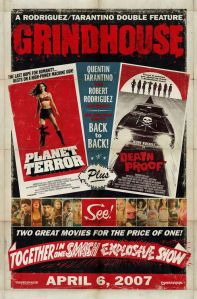 The movie going experience isn’t what it used to be, and Quentin Tarantino and Robert Rodriguez want to do something about it. There?s no denying that the joy of seeing a movie has been watered down a bit; there’s soaring ticket prices, floundering product, and let’s not forget the influx of teenagers with cell phones. Rodriguez and Tarantino grew up gorging upon the exploitation films at their neighborhood grindhouse, where they could see kung-fu, blaxploitation, gory Italian zombie movies, and nearly anything that promised to be titillating and shocking. These movies dealt in copious amounts of sex and violence on a shoestring budget and teenagers lapped it up. Grindhouse was designed to be a double feature with Rodriguez and Tarantino each writing and directing an 80-minute movie. This three-hour plus movie is stuffed to the gills with 70s reverence, right down to cheesy retro clips telling us the film rating via an animated cat. If Rodriguez and Tarantino could, they probably would make the floors stickier just to round out the experience. But that’s the marvelous thing about Grindhouse — it turns the filmgoing experience into an event once again.
First on the bill is Rodriguez’s Planet Terror. An outbreak is about to sweep across a small Texas town. A toxic green gas is causing people to break out in festering wounds that are spreading rapidly. Cherry Darling (Rose McGowan) is a go go dancer who runs into an old flame, Wray (Freddy Rodriguez), a badass drifter with a dark past. They get attacked by a group of “sickos” who take Cherry’s leg as a chew toy. At the hospital we’re introduced in rapid succession to Dr. Block (Mary Shelton) and her creepy husband (Josh Brolin) she plans on leaving for the lovingly massive cleavage of Fergie from the Black Eyed Peas (she gets eaten and can, one assumes, be described as being Fergilicious). The sheriff (Michael Biehn) has an unsettled score with Wray and refuses to trust him, even though the town is slowly being overrun by what appear to be zombies. The survivors take refuge at a Bar-B-Q joint, run by the sheriff’s brother J.T. (Jeff Fahey), located only two miles away from the military outpost that released the gas.
 Planet Terror is a great blast of fun, a perfect ode to schlocky B-movies. Rodriguez creates action movies closer to cartoons, and the more over-the-top and crazy things get the more joyous his films generally turn out. This is a gonzo world cranked up to a wonderfully weird wavelength, where Cherry can have a machine gun leg without any nagging question on how she even gets it to fire let alone why it would be more accurate. It doesn’t matter because this movie is all about 80-minutes of awesome, twisted, gloriously gory fun. Planet Terror isn’t the first zombie comedy, and its inspirations are quite plain, but the film establishes a wide-range of colorful characters effectively and then ramps up the chaos. Rodriguez amuses with even small touches, like a woman trying to operate a car with a anesthetized hands, a pair of skimpy babysitters who clobber a car with baseball bats, and a bio-chemical scientist (Naveen Andrews) that has a penchant for collecting and bottling the testicles of the men who fail him (hey, we all need hobbies). Even amongst an exaggerated canvas there’s still plenty of humor and adoration for the grindhouse experience, like when the beginning of a sex scene is interrupted with a “reel missing” sign. Rodriguez also intentionally downgrades the look of his film, adding hairs and scratches and pops in the film to look like it had been dragged across the floor. Planet Terror even has a dreadfully dated synth score to compliment the full-tilt celebration of splattery schlock.
Tarantino’s Death Proof is going to sharply divide audiences. The action in Planet Terror is relentlessly paced, which makes the adjustment to Tarantino?s half all the more hard. Rodriguez is all about genre relevance and making a film that would excel in the grindhouse era; Tarantino, on the other hand, is all about taking the genre and catapulting it into something ambitious and different and greater.
 Death Proof is Tarantino’s take on the slasher horror genre, with the unique twist being that Tarantino?s roving killer takes out his prey with his car. Stuntman Mike (Kurt Russell) is a stuntman of the old guard. The youth of the day have no idea of the TV shows he worked on or the celebrities he rubbed elbows with. The only lasting visages he has from those removed days are a long scar decorating the side of his face and his stunt car. The vehicle has been outfitted to be death proof, meaning that Stuntman Mike can get into any wreck and come out alive. A group of women are visiting Tennessee for a film shoot. Abernathy (Rosario Dawson) is a makeup artist, Lee (Mary Elizabeth Winstead) is an actress, and Zoe Bell (herself) and Kim (Tracie Thoms) are professional stunt women. The stunt ladies are interested in test-driving a Dodge Charger, the same iconic car used in Vanishing Point. Zoe wants to play a dangerous game known as “Ship’s Mast,” which entails strapping herself to the hood of the car as it speeds along. This is when Stuntman Mike comes roaring with his death proof material and plays an extreme game of chicken.
The narrative structure of Death Proof is deliberately slow. The focus is on a group of Texas girls (including Sydney Poitier’s daughter named, rather unoriginally, Sydney Poitier). They dance to jukebox jams and drink. And they talk, and talk, and talk, and talk. The dialogue is clever but you worry Tarantino has been hypnotized by his own pithy writing. The movie drags a bit but mostly because it follows a film that had the pace of a runaway train. The slow buildup is an intentional correlation to slasher films, which would spend their first half hour setting up characters for the eventual slaughter. I liked how Stuntman Mike was seen playing with his prey and interacting with them. The wait is worth it, though, but then Tarantino turns around and repeats this same setup with a new batch of girls. Many will grow impatient going through the same process all over again and become irritated that they have to endure another round of talky pop culture diatribes in order to get to some more vehicular manslaughter. And at this point, the only character the audience has any affinity for is Stuntman Mike, so it’s a little tough to wait so long for his reappearance. When he does appear, the movie takes some unexpected turns and transforms into a female revenge thriller that left my audience cheering by its conclusion. My wife loved it. I married the right woman.
The makeup work is outstanding. Most of the effect work gets its spotlight during Rodriguez’s half, and Greg Nicotero and KNB have created the most gut churning, sickeningly inventive makeup work since John Carpenter’s The Thing. Rodriguez’s Planet Terror is dripping in blood, and the gore is heightened to such an unrealistic, comical degree that it becomes more tolerable and, in the end, another element in the overall outrageous vibe of the film. Some memorable gore work includes makeup pioneer Tom Savini being ripped apart like a child’s jigsaw puzzle, soldiers whose faces undulate and bubble until they look like close relatives of the Elephant Man, and a truck smashing against bodies like they were made of paper and filled to the brim with Kool-Aid. This is the kind of movie where entire hoses of blood explode from single gun shot wounds. It is a gory, gruesome, sticky icky movie but that?s part of the fun.
 Whereas the makeup work shines in Planet Terror, the stunt work in Death Proof is stupendous. Bell was Uma Thurman’s stunt double in the Kill Bill tandem, so by writing a part specifically for her Tarantino knew he could get up close and personal during the scary moments. Seeing Bell struggling to stay atop the hood of a car zooming at 80 miles per hour is nerve-racking and exhilarating, and you know there isn’t any computer trickery given how Tarantino’s own characters bemoan how computers have blunted action cinema output. That really is Bell and even though it’s all a movie a part of you does think, “Oh my God, this woman is going to die for real.” This killer bumper-car sequence in Death Proof will have you holding your breath. It takes much longer for Tarantino to rev up his action, but when he does he puts the pedal to the mettle.
But don’t get up for pee breaks once Planet Terror is over, because you may miss some of the best parts of Grindhouse. In between the feature films are three fake trailers directed by friends of Tarantino and Rodriguez, who made a fake trailer himself for Machete, about a Federale (Danny Trejo) out for revenge. The Machete trailer gave me the everlasting gift of a line, “They f***ed with the wrong Mexican.”
The best trailer, hands down, is Shaun of the Dead director Edgar Wright?s trailer for Don’t, a Dario Argento style horror film where a narrator instructs the audience lots of items not to do (“If you are thinking about turning this door… DON’T! If you think about going into the basement… DON’T!”). What makes Don’t so wonderful is that the trailer builds a thick head of steam, to the point where all wee see are bizarre rapid-fire images and the announcing repeating the message, “DON’T!” The momentum builds to a great comic high that left me giggling.
Eli Roth, who gave us Hostel and Cabin Fever, one of my all-time favorite filmgoing experiences, runs a close second with his slasher trailer for Thanksgiving. The concept is rather straightforward, a person dressed as a Pilgrim picks off residents around Turkey Day, and a great showcase for Roth’s sense of tongue-in-cheek homage and his warped sense of humor. This trailer has some gasp-inducing moments, chiefly among them a topless cheerleader who performs the splits right onto a knife blade. Wow. Then there’s a guy humping a stuffed turkey with a human head attached. I’ve said it before and I’ll say it again, Roth is one sick bastard but he’s my kind of bastard.
 Rob Zombie’s trailer for Werewolf Women of the S.S. sounds better on paper than how it turns out. There’s a subgenre of Naziploitation films (did you know you could add “-sploitation” to damn near any word?), most famously popularized by Ilsa, She-Wolf of the S.S. Zombie’s trailer has got hairy wolf boobs, Nazis, shiny fetish outfits and S&M, but it feels too new and doesn’t work on the same vibe of Grindhouse. It feels too polished and too happy with itself; it spends more time telling you who’s in this fake movie than delivering anything juicy. The trailer is saved by a brilliant cameo by an actor whom I will not spoil, but suffice to say that I was left in stitches.
Honestly, I cannot say another movie released this year that provides more bang for your buck than Grindhouse. Tarantino and Rodriguez’s double bill will leave you giddy. This is the fastest 3 hours and 10 minutes of your life, folks. Unfortunately, the film hasn’t been doing as well at the box-office and this has caused the Weinsteins to contemplate splitting the films into two to make the most of their investment. I suppose Grindhouse was never going to have a 300-sized audience, since the idea of making a sloppy three-hour love letter to trashy cinema seems destined for a limited appeal. This is a high-art tribute to high camp, and you really do feel you get more than your money’s worth even if you pay, like I do, 10 bucks a pop for a show. I can’t imagine having a better time at the movies this year than the one I had during Grindhouse.
Nate’s Grade: A
Share this:

Rent (2005)
 Rent is one of Broadway’s biggest sensations in the last decade and has become a cultural cornerstone for many. Jonathan Larson updated Puchini’s famous opera La Boheme, transplanting the setting to East Village New York, swapping TB for AIDS, and turning his characters into struggling bohemians fighting for their voices to be heard and love to be kindled. The musical also has an added sense of tragedy. Larson suddenly died on an aneurysm during the final dress rehearsal, sadly never getting to see his finished creation. Rent went on to win Tonys (including Best Musical), a Pulitzer Prize, and damn near the heart of every girl I went to college with. To say it’s been a smash is an understatement. And where ever there’s money and an insatiable audience, there will be Hollywood’s eyes. Now comes time for the Hollywood gloss with director Chris Columbus (Home Alone, Stepmom) and when Rent ditches the intimate confines of theater and hits the big screen, it’s much harder to hide its flaws.
The story takes place within the span of one year (or 525,600 minutes as you’ll be told repeatedly in song), covering Christmases from 1989 to 1990. Mark (Anthony Rapp, Dazed and Confused) and Roger (Adam Pascal) are roommates trying to keep warm during the winter in their giant New York loft. They’re flat broke and their former friend and current landlord Benny (Taye Diggs) expects a full year’s rent to be paid pronto. Roger is racking his brain trying to write that one perfect song; he’s also HIV positive, the unfortunate side effect of a relationship with a junkie. Mark is an aspiring filmmaker and has also recently been dumped by the impetuous performance artist Maureen (Idina Menzel) for … another woman, Joanne (Tracie Thoms), a lawyer. It must be noted that all three of these characters do not have HIV/AIDS; they’re in the minority. Tom Collins (Jesse L. Martin, Law and Order), a gay school teacher, is visiting Mark and Roger when he gets mugged in an alleyway. Angel (Wilson Jermaine Heredia), a drag queen with a heart of gold comes to his rescue. Both men have HIV but won’t let their shortened time stop them from falling in love with one another. Mimi (Rosario Dawson) lives below Roger and Mark and works as an exotic dancer down the street. She too has HIV from a nasty smack habit. She also has her heart set on Roger but he needs a little motivation. For a year these characters will interact and live, love, die, and sing a whole lot.
 The villain of the piece seems to be Benny by default (unless you count AIDS, poverty, and ignorance). Our unemployed band of heroes is upset because dear Benny expects them to, gasp, pay their rent. The scoundrel! Here’s what I don’t get; clearly Benny has a dream for a business and the other artists denounce this artistic dream because it involves money exchanging hands. Benny’s passionate about his dream and actually does something productive like make friends and influences with the business establishment, people with capital to bankroll an entrepreneur’s dream. It’s like everyone’s mad at Benny because he put a suit and tie on and got a job.
Besides, there is something inherently pretentious about Rent’s anthems of sticking it to the man and brash commercialism. Guess what, after 9 years Rent is a franchise. You can get Rent T-shirts, coffee cups, soundtracks, and practically anything that can be merchandised and marketed to the disenfranchised youth with disposable incomes. A musical about the soullessness of commercialism is itself a cash cow, so it rings a little hollow when the deadbeats thumb their noses at the evils of capitalism. Seriously, Mark just about gets hives at the thought of being a cameraman for a TV news show (he calls it “selling out”). In the end he quits his job so he can make his masterpiece … cobbling together home movie footage.
The film version of Rent is populated with 6/8 of the original Broadway cast (Dawson and Thoms are the only fresh faces). This is a well-intention move by Columbus but it backfires. It’s one thing to listen to 20-something bohemians fight for their artistic integrity and worry about food, shelter, rent. It’s quite another thing when the majority of your cast is in their late 30s. You’ve gone from a bohemian to a potential bum. I’m not condemning the pursuit of your artistic ideals and making your name in the world, but not at the price of food and shelter. I’m reminded of a line from The Big Lewbowski: “Your revolution is over! The bums lost. The bums will always lose!”
 It’s hard to feel for some of these characters, who come across as whiny, pretentious, or just plain misguided. Maureen is irritated that her life partner is upset that she was flirting during their engagement party. I mean, really, what’s to get upset about? It’s pretty bad when Rent kills off one of its main characters in a musical montage. A MONTAGE! Afterwards all the characters eulogize what made this person so great. Hey, all that character stuff would have been handier before the death, and then I would have felt something.
Some of these same problems exist with the original stage version, but Rent the movie, and especially Columbus as director, make some bad additions. The original stage version of Rent took place in modern day when it opened. Here, Columbus has dialed back the timeframe and set his story from 1989-1990 (someone forgot that a song references Thelma and Louise, which came out in 1991, but oh well). What makes this time jump shaky is that the film also adds a scene of the happy families championing each other over their racially mixed lesbian daughters’ engagement. They moved time backwards but people’s tolerance was moved forward. That’s not all. It’s bad enough that Roger has a Bon Jovi haircut for the entire film, but then Columbus adds scenes of his escape to New Mexico and we, the audience, are treated to Roger belting his heart out to nature on top of a desert gorge … just like in Bon Jovi’s “Blaze of Glory” music video. Maybe this finally explains why they transported the film to the 1980s.
Where the musical does strain credibility is its fear of fulfilling the dark end of Puccini’s opera. Moulin Rouge! is also based on Puccini’s tragedy and it had the guts and the ambition to end on a tragic note. I‘ve cried at the end of Moulin Rouge!, but I didn’t feel like misting up during Rent. (Spoilers) It’s rather terrible that Mimi can be brought back from the dead by the power of a cheesy rock ballad, and if this holds true, then Bon Jovi is wanted to the E.R., stat! The cheap fake-out ending for Rent is just the nail in the coffin. Everyone has AIDS and thus on borrowed time and yet we can’t have an adult ending dealing with tragedy.
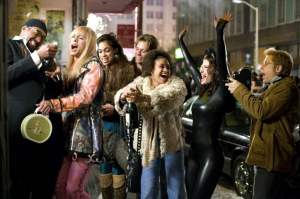 With all this in mind, some things in Rent really do work. The songs are catchy, somewhat fun, and the splashy lyrics follow suit. The cast collectively are entertaining and sing well, though Dawson can get a bit monotone at times. Some of the dance numbers are exciting and amusing, like the “Maureen: Tango” between Joanne and Mark chatting about the spotty behavior of their former and current lover. At one point we flash to them in full classic dress buffeted by a chorus line of fellow tango-ers. “La vie Boheme” is the sassiest and most electric song, finally piecing Larson’s sardonic, witty pop culture lyrics with a lively image. This is a musical that’s got clever lyrics, good singing, and catchy pop rock songs.
For many, especially the Rent heads, a movie version of their favorite musical will be bulletproof. They’ll be thrilled to enjoy an afternoon with their best friends on the silver screen singing their favorite harmonies. I’m sure fans of Rent and fans of broad musical theater will be pleased. For me, the movie falls apart when you pay attention to the story, the characters, the drama, and then the choices in adapting it to film. I just didn’t care for most of the characters and found the story dated, pretentious, and overly romantic, even if the majority of the characters do have HIV and/or AIDS. Columbus’ poor decision making turn Larson’s rock-opera into a movie that wants points for being different when everything about it has practically become marketable and cliché. I’d recommend buying the soundtrack instead of seeing the movie, because at least then you can turn it off when you reach your breaking point.


 nathanzoebl
You must be logged in to post a comment.