Blog Archives
Play Dirty (2025)
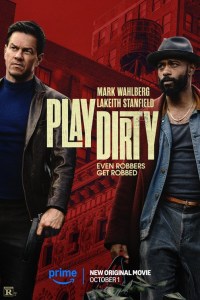 Shane Black is one of the best known writers in Hollywood across three-plus decades. His brand of witty, self-referential genre writing became its own appealing sub-genre of action cinema from the 1980s into the 90s. He resurrected Robert Downey Jr.’s career with Black’s directorial debut, the rollicking and immensely entertaining Kiss Kiss Bang Bang. Downey returned the favor by getting Black the gig writing and directing Iron Man 3. It’s been eight years since Black’s last directing effort, 2018’s messy and ultimately disappointing Predator reboot (Black actually had a small acting role in the original film). Shane Black movies are never ever boring even when they’re not completely working. Play Dirty is based on the Parker book series, a character portrayed by six other actors including Mel Gibson, Jason Statham, and Jim Brown. There are 26 of these Parker books, but after watching Play Dirty, by far Black’s worst movie, I don’t even understand what the appeal would be. This character just plain sucks.
Parker (Mark Wahlberg) is a slick professional criminal trying to score big and get his revenge. In the opening sequence, one of his heist crew, Zen (Rosa Salazar), betrays the group, steals the money, and kills everybody except Parker. He tracks her down and she’s in the middle of an even bigger scheme, one involving billions of dollars from uncovering literal sunken treasure on the ocean floor. He doesn’t like her or trust her but he sure could use his cut of a billion dollars. He taps old colleagues from other old jobs, the colleagues who haven’t been killed, and they must all work together to get their next big score.
 I was blown away by how powerfully unlikable the main character comes across. I don’t need characters to all be beholden to my opinion of likeability, but deficits in this matter are typically offset by writing the character with some degree of personality, menace, or intrigue, something that makes you want to keep watching them onscreen even if you don’t agree with everything they’re doing. However, this Parker guy, as portrayed by Wahlberg, is a big dumb guy who doesn’t recognize he’s a big dumb guy. As a result, he’s beholden to impulsive decisions that come across as cruel to the point of being sociopathic. Again, we’re used to criminal characters being flippant or prone to violence in other stories, but the introductory presentation of this character simply befuddles me and rubbed me the wrong way throughout.
Take for instance the literal opening minutes of Play Dirty. It’s in the middle of a heist but the story doesn’t start us off with the perspective of our thieves collecting their loot. It starts instead with a security guard stumbling onto their heist. He’s with his wife and child in the car and decides, rather than intervening, he’s going to use this opportunity to steal himself some of their ill-gotten loot. Right there, we’re starting with a character making a consequential choice, and our perspectives are not aligned with the robbers but with the robber of the robbers. I wanted him to get away, and frankly, following his story could have proven compelling as well, as someone who gets in over their head and tracked down by professional criminals who want what was taken. Parker gives chase through a race track and eventually shoots this man dead in front of his wife and child. Lest you think Parker is an irredeemable, unfeeling cretin, he takes stock of this woman’s grief and trauma and offers her ten thousand dollars of their loot, to bribe her silence and make amends for the murder of her spouse (that’s not even a good life insurance payout). I don’t know why Black wanted us to begin empathizing from the perspective of some guy who was only intended to be unceremoniously killed, in front of his wife and child. This move made me immediately dislike Parker, and then his little gift for the wife’s trauma felt completely insulting.
 This incident isn’t the only example of Parker being a shoot-first-ask-questions-never brute of limited intelligence. When he reunites with Zen, she’s talking with some guy who planned her new big scheme. Parker doesn’t know anything about this guy other than his physical proximity to Zen. He shoots him dead. For what reason? I don’t know what he was trying to accomplish except an expression of his impatience and hatred for life. I wonder if an elderly nun had been standing next to Zen at this moment and would Parker have committed the same rash act of violence. What about if it was his own mother? To make matters even worse, Parker accompanies Zen to break the news to the dead man’s boyfriend, and it’s in this moment of shock and grief that Parker harasses this bereaved man that Parker berates for crying. He seems to take amusement in how bluntly he informs the other man that his love is never coming back, though leaving out the key part where he carelessly murdered the man. He also shoots Mark Cuban in the leg while he dines in a restaurant for no reason other than being near the guy that he wanted. Again, much of this could be workable if the character of Parker was… anything. He’s not funny, he’s not charming, he’s not really clever or good with plans; he’s just a big dumb guy prone to violence, scowling, and deep sighs. Wahlberg looks bored throughout the whole movie and it makes the character even harder to entertain. If this guy doesn’t want to be here, can we select someone else to be our requisite protagonist?
We might have a leaden dud of a lead, but what about the rest of our enterprising team of thieves and conmen? Do we have any winners here to compensate? Sadly, the team is just as listless. Take Grofield (Lakieth Stanfield) who fraternizes as a theater owner, one who is constantly losing money. That setup has some interest, a criminal who possibly longs to be more of a professional actor, perhaps that eagerness even pushes him into suggesting different covers and roles he could play in their heists. Perhaps he might even see himself above the others since he feels like he is trying to promote the arts. There’s all kinds of ways this introduction could better shape his personality, interests, and contrasts with the other crew. For the rest of the movie, Grofield is just another guy on screen, just another guy driving a car or shooting a gun. There is one brief moment that takes advantage of his interest in acting as he poses as a drunk on a rooftop threatening to jump. After a security guard arrives on the scene, he and Parker subdue the guard, coat him in the same outfit Grofield was wearing, and then toss him off the roof to his death (ho ho). There’s a husband and wife team of crooks (Keegan-Michael Key, Claire Lovering) and that could be interesting, especially if they’re mixing professional and romantic squabbles, or maybe working together is the thing that keeps their spark going, the showcase for their real teamwork. They have one scene with some passing bickering but otherwise they too are just more indiscriminate people onscreen, another person to hold a gun or drive a car. Even the bad guys are boring. Who should I actually care about? I was rooting for that grieving mother and the one guy’s sad boyfriend to team up and punish Parker’s crew.
 Part of the fun of heist crews and con artists are the colorful personalities, the peculiarities, the intra-group conflicts and dynamics, but this movie gives us so little. It’s almost as if the characters are merely meant to trick the brain of a viewer barely paying attention, providing an assurance, “These are the guys,” without forcing thinking over differentiation. It’s like the film equivalent of not wanting to arouse like your elderly grandfather with conflicting evidence contrary to his memories. It’s like accepting defeat.
So the characters are lousy, are there any outstanding or fun caper or action scenes? Black is known for his snappy style and pulpy sensibilities across genres. He hasn’t made a boring movie yet, so I had hoped that even if Play Dirty ultimately proved lackluster, at least it would provide some flash and fun. Nope. Many of the action scenes are Parker and company just throwing caution to the wind and shooting a bunch of guys. There’s one sequence in the middle that involves actually planning and steps to draw our interest, it’s a ridiculously over-the-top plan that shows once again the crew’s disregard for collateral damage. Their valuable cargo is being shipped through the city on an elevated train, so the team decides to derail the train in the middle of the city. Not in a deserted area unpopulated by civilians, in the middle of town. As expected, the train careens off the tracks and through the city, likely causing the deaths of dozens of innocents we’ll never know because their existence is unworthy of the movie’s attention, much like the suffering of that widow and child in the opening sequence. The sequence is the equivalent of killing a mosquito with a flamethrower, and while overkill can certainly be cinematic and pleasingly entertaining, just ask Michael Bay or James Wan, it needs to exist in a world where that overkill is normalized. Otherwise, it just stands out as excessive and causes us to poke holes at the baseline reality.
Play Dirty is astoundingly dull and witless, lacking any of the spark and personality flair I expect from a Shane Black vehicle. Mark Wahlberg’s somnambulist performance is the best symbol for this entire enterprise, a crime thriller going through the motions but with its mind elsewhere. I know I certainly felt my mind going elsewhere while watching. Not just dull and tedious, Play Dirty is also just an uncomfortable experience because we’re stuck watching a group of unrepentantly amoral characters endanger and kill innocent lives in the pursuit of ill-gotten gains, but these characters aren’t intriguing, complex, memorable, or even cool, so the whole movies feels like you’re watching a pack of dude bros just randomly terrorize anecdotal characters out of sheer detached boredom and nihilism. It’s not fun, it’s actually quite the opposite of fun, and I wish Black had put more of himself into this enterprise (hey, the Christmas setting is present). Who wants to play with characters this boring and repulsive for two hours?
Nate’s Grade: C-
Share this:

Rumble (2021)
 No more and no less than exactly what you’re expecting, Rumble is a giant monsters wrestling movie that’s cute enough to entertain young kids and pass the time agreeably and not much more. The world isn’t exactly fleshed out and the characters are very archetypal and the plot is entirely predictable, but I found it mostly fun and low-level escapism. It’s nothing that will wrestle with the better animated films of the year, but if you have little ones that are fans of wrestling or giant monsters then that might be enough to keep their attention for 90 minutes.
Nate’s Grade: C+
Share this:

Pain & Gain (2013)
 I think the audience for Pain and Gain is going to know exactly who they are, and I count myself amongst that number. The latest from director Michael Bay, often treated tantamount to Satan in many critical circles, has the based-on-a-true-story hook but really it’s the big stars, stylish violence, peculiar criminal antics, and overall overflowing machismo of the picture that will draw its audience. I knew after one watch of the trailer that I wanted to see it, though I was somewhat ashamed of the level of my interest (don’t want to taint your critical credentials with too much sympathy for the devil, after all). Pain and Gain is a trashy and entertaining jaunt, just as I hoped it would be, but it overstays its welcome and may leave you fatigued and possibly dejected (so… a typical Michael Bay movie? Still got it).
In 1995, three Miami, Florida goons enacted one of the most bizarre and sordid criminal schemes, a story that could supply a tabloid with enough juicy exposes for a year. Daniel Lugo (Mark Wahlberg) and his co-worker Adrian Doorbal (Anthony Mackie) are personal trainers at Sun Gym. Their days consist of pumping iron and hitting on ladies. One of Lugo’s clients is Victor Kershaw (Tony Shalhoub), a wealthy businessman with a nasty temper. Lugo and Doorbal, with the help of an ex-con and ex-junkie (Dwayne “The Rock” Johnson), kidnap Kershaw, hold him hostage for weeks, torture him, and eventually get him to sign over his assets to them. Afterwards they try to stage his “accidental” death, though like most things, it does not go according to plan. Penniless and broken, Kershaw seeks out help from a retired private eye, ED DuBois (Ed Harris), to provide validation for his case. The Miami police are laughing off his claims. Kershaw is concerned that the Sun Gym gang will strike again when their lavish lifestyle dips, and he’s right. Lugo and company get into even more trouble and the body count rises.
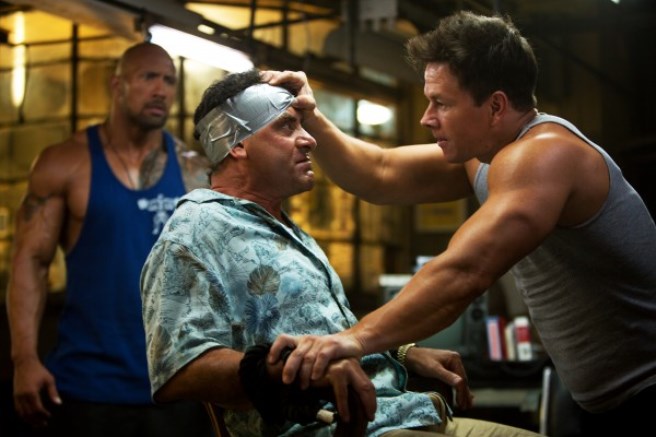 The results on screen are often entertaining in an over-the-top fashion, sustaining a rubbernecking captivation much like a horrendous car wreck. You just have to see how much crazier this thing gets, all the while muttering to yourself, “This was a true story?” It even gets to the point where the movie will remind you, via onscreen text as a man barbecues a batch of severed hands, that yes this is still a true story. Naturally there have been fictional inventions, character composites, and some details have been dropped to fit into the confines of a film narrative, but online research shows me that most of the larger plot beats are accurate, thus making the film even more compelling and disturbing. When the film is on, it feels manically alive with intrigue and absurdity. The problem is that it cannot keep this manic tone alive forever especially when actual innocent bodies start piling up (more on that later). There’s a certain uncomfortable tonal incongruity as the film develops and the comedy picks up a distasteful resonance. I love a well-executed dark comedy but just because something is macabre or unexpected does not automatically make it funny. Still, the movie has enough high-energy antisocial antics to keep you planted in your seat, laughing through bafflement.
Pain and Gain isn’t subtle in the slightest and yet it’s easily the most nuanced film of Bay’s career. Of course there are still the sleek cars, sexy babes, emphasis on style, and wanton destruction that are hallmarks of the man’s career, but the perspective is given a satirical prism, dropping us into the deluded, sub-American Psycho perspective of Lugo, a man with a very cracked view of the American Dream. The moral message reminds me of Marge Gunderson’s concluding musing in Fargo, telling a captured criminal, “There’s more to life than a little money, you know.” There’s some slight social commentary on wealth and the dirty tricks of capitalism, but really it’s the narcissistic delusions of a jacked-up criminal who believes he can succeed because he’s “seen a lot of movies.” You may even find yourself sympathizing with some of these knuckleheads, that is, until things get way out of hand. The screenplay by Christopher Markus and Stephen McFeely (Captain America: The First Avenger) is briskly paced and packed with bizarre details and even jumps into six different characters for voice over (Wahlberg, Johnson, Mackie, Shalhoub, Harris, and Bar Paly). For some characters it works as a great insight into their twisted logic but for others it’s just an easy set up for ridicule. The juvenile humor (did we really need a visual pubic hair joke?), candy-coated film palate, and sugar-rush, roid-rage plotting feel like a suitable match for the talents of the bombastic Bay.
The last thirty minutes of the movie will test your sensibilities of good taste. I’m all for having unlikable central characters just as long as the writer makes them interesting (what good is likeable but boring, the “friend zone” of characterization?). Some of movie history’s most fascinating characters have been scumbags and psychos. However, with that being said, I need my unlikeable characters to at least progress. When I’m stuck with a bad dude who keeps making the same bad mistakes, it can grow tiresome, and that’s where Pain and Gain ultimately lost me. Bay can’t quite keep up the charade of ironic bemusement forever, and a saggy second half starts to tread water, forcing the characters to act even more outlandish and inept. Did we need The Rock losing his big toe and then inexplicably giving it to a dog? It feels like the movie is filling time until the accidental murders come into being, raising the stakes. For a movie that’s 130 minutes, there should not be any need to fill time. During that long sad stretch, you start to feel disquiet, like the movie has lost its sense of perspective and the jokes have gotten too mean, too ugly, too outlandish. It doesn’t feel funny any more, and maybe that’s ultimately the point, but by the end Pain and Gain has soured. It overstays its welcome and then some.
 Its tone and connection to the real world raises an interesting and thorny question over whether something like this is appropriate. Should a story that involved the murders of innocent people end up becoming an over-the-top, stylized, lavishly glamorized Hollywood crime comedy? It has been over 15 years since the events of the Sun Gym gang, but is there a statue of limitations on good taste? Are we eventually destined for a vulgar film tackling the poor lives of the victims of 9/11? The answer is almost certain. What is off limits, or more pressingly, should anything be off limits to a comedic narrative? Is anyone really furious with Trey Parker and Matt Stone over their first film, Cannibal the Musical, transforming nineteenth century murder into song and dance? I doubt it, and yet there was something very off-putting about 2011’s 30 Minutes or Less, an unfunny comedy based around the true story of a pizza guy strapped with a bomb and ordered to rob a bank. The guy was blown to bits in real life (ha ha?). I guess I, as well as audiences, would have been more forgiving if the movie had been funny. I’m sure there would be fewer objections if Bay’s film had been more of a sober, contemplative drama on the sad acts of a bunch of desperate criminals, but with all the hyperbolic elements, machismo, and so-crazy-it-must-be-true plot turns, how could you turn this story into a serious drama? Not from the perspective of the nitwit criminals, at least. I don’t think the movie is ever positioning these guys as anti-heroes or excuses their excess.
Wahlberg (Ted) broke out as an actor thanks to a similar role as a wannabe star whose ambitions exceeded his grasp, and the man does dumb as good as just about anyone in Hollywood. It’s a specific kind of dumb, the angry, arrogant, pissy, self-involved kind of dumb that makes it acceptable to ridicule his character to no end. Johnson (G.I. Joe: Retaliation) gets to explore some interesting range as an actor, pacing around the demons of his character before just going hog-wild with the excess. Mackie (Gangster Squad) is arguable the most sympathetic of the group but also with the most to lose. Compared to his peers, he’s practically mild-mannered even though he takes injections into his penis. Shalhoub (TV’s Monk) is amusingly apoplectic and just enough of a jerk that you excuse his misfortune, at least for a little while. Ken Jeong (The Hangover) and Israeli model-turned-actor Bar Paly give the exact performances you would expect them to deliver. The best actor in the whole movie, though truth be told there isn’t a stinker in the bunch, is Emily Rutherford (Elizabethtown, TV’s The New Adventures of Old Christine) who plays Dubois’ wife. She has this calming, down-to-earth presence that seems to bring a small sense of peace to the madcap antics. She doesn’t have a lot of screen time but you’ll wish she had lots more.
Perhaps I’m being unfair to a movie that clearly isn’t intending to be anything but naughty, tacky, and gleefully excessive. In a way Pain and Gain reminds me of Tony Scott’s Domino, loosely based upon a true story but crushed to death by narrative kabuki and Scott’s characteristic excess. If I wanted to defend the much maligned Michael Bay, I’d argue what the real difference is between his excess and the excess of the more critically lauded Scott? Bay doesn’t have a slate of movies to his credit the likes of Top Gun, Crimson Tide, or True Romance. But isn’t flashy, artistic excess all the same when in the name of empty storytelling? Domino is also an apt comparison because it’s ultimately tiresome and far overstays its welcome, losing its audience with an endless array of odd sidesteps and moronic, deviant characters. While Pain and Gain has enough quirk and style to justify consideration, you may not respect yourself once it’s over.
Nate’s Grade: C+
Share this:

The Man Who Wasn’t There (2001)
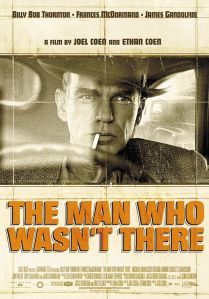 The Coen brothers dark, twisty entry to the world of film noir looks mind-blowing with its black and white lensing. And the story is great too. Billy Bob Thronton plays a barber who gives new definition to the word passive. One day a customer lets him in on an up-and-coming financial project and if Thronton were to provide some dough then surely he would rake it in. As with most film noir, the normal man is thus pulled into the web of intrigue and crime. The ball gets rolling after Thornton blackmails his wife’s tryst (James Gandolfini), who also happens to be her boss and his friend. Things get far more complicated from there and nothing seems to go right as Thornton makes one bad decision after another. The Man Who Wasn’t There is an engaging and smart drama with game bits of comedy strewn at key moments. The Coen brothers are a pair not very easily topped when it comes to excellence in films, and this latest entry is a wonderful addition to their resume.
Nate’s Grade: A-


 nathanzoebl
You must be logged in to post a comment.