Blog Archives
Little Miss Sunshine (2006)
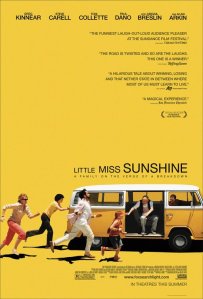 Slowly but surely, Little Miss Sunshine is gaining momentum as the breakout comedy of the summer. It’s gotten some of the most glowing reviews of the year and is poised to capture the hearts of not just fans of indie cinema but also patrons of the big suburban multiplexes, your red state soccer moms and NASCAR dads. After having seen Little Miss Sunshine, I feel like I must have missed the bandwagon.
Little Olive (Abigail Breslin) is bursting with shriek-worthy excitement. She just found out she’s a regional contestant in the national Little Miss Sunshine child beauty pageant. Her family crams into a beaten down, canary yellow Volkswagen bus and heads off on a cross-state journey for Olive. Along for the ride are Olive’s fractured family — older brother (Paul Dano), who has taken a vow of silence until he becomes a fighter pilot, stressed-out but supportive mom (Toni Collette), ambitious self-help failure dad (Greg Kinnear), a potty-mouthed, heroin-snorting grandpa (Alan Arkin), and a suicidal gay uncle (Steve Carell). It’s a long road to the pageant, especially with such an eclectic group of people whose only thing in common are their chromosomes.
 I just couldn’t shake the overwhelming feeling that Little Miss Sunshine should be more. It’s not really much of a comedy. There are some funny moments, and pushing the bus is a running gag with better legs than I would have guessed, but the film has a lot of stretches where the laughs are low to nonexistent. It’s not really much of a character piece either. None of the characters are that well defined or allowed to stretch out. The family members are all archetypes of indie film weirdness: the gay intellectual, the verbally inappropriate grandparent, the self-deluded father, the frazzled mother, the loner brother, and the precocious tyke. Little Miss Sunshine does a fine job of setting up its family of cracked characters but then seems to twiddle its thumbs when it comes to development. The only character insights come in a scattered few small moments with Olive. Dad is essentially poisoning his family with his self-help claptrap, casting the world into “winners” and “losers.” There’s a heartfelt moment brilliantly played Breslin where she confesses to grandpa that she doesn’t want to be a loser because her dad would stop loving her. Aside from that, Little Miss Sunshine seems to wind its characters up and then leave them be. I wanted more of just about everything but the movie wouldn’t budge.
The movie spends quite arguably too much time at the Little Miss Sunshine beauty pageant. Child beauty pageants are a well deserved, albeit easy, satirical punching bag, and they creep the hell out of me. Seriously, turning little girls into highly sexualized Barbie dolls seems cruel, unnatural, and very very creepy to me. There was a stupendous documentary that aired on HBO years ago called Living Dolls that traced the life of a six-year-old girl and her stage mother. It was a harrowing film, and the obsessive mother is one of the most disturbing villains I’ve ever seen in a movie, scripted or otherwise. In the film you see how people transform little girls into flirty, overly made-up little adults. It’s sickening.
The reason I bring this up is because Little Miss Sunshine because they lift a direct metaphor. In Living Dolls the main girl is playing one of those tiny slide puzzles where the finished result is an honest to God yellow smiley face. It’s a perfect metaphor of this child attempting to find happiness when no one seems to want her to live as a child. And then I saw the exact same moment in Little Miss Sunshine. Rip-off or accidental homage, you decide. In the same vein, every time Kinnear invokes the name of his literary agent, Stan Grossman, I kept thinking of Fargo.
In Sunshine, the family is aghast at the pageant scene but support Olive anyway. Then things get way too easy. The film concludes with the 5,785th rendition of the weirdos celebrating what makes them who they are, their weirdness, and sticking it to the thumb-nosing naysayers. Then the movie abruptly ends. That’s all, folks. Little Miss Sunshine was already built on the aching backs of two very familiar indie staples, dysfunctional families and road trips, and offers little else to justify its existence.
 It’s hard to really drag this film through the mud. It was proficiently made by the music video directing team of Jonathon Dayton and Valerie Faris (Smashing Pumpkins’ Tonight Tonight). The acting is generally good. The better actors rise to the top despite their limited character depth. Carell is a big name in comedy right now, and he gives a rather subdued, sarcastic performance that will resonate best with audiences. Kinnear is better at playing smug types than pathetic types. His character really is the villain of the piece, so it’s nice to see his transformation even if it is awfully spontaneous. Collette always looks to be on the verge of a nervous breakdown. Breslin (Signs) is pretty cute and will pierce your heart during the aforementioned talk with grandpa.
There are some amusing moments and fun pieces of dialogue, and the film has its heart in the right place. The screenplay needed to go through a few more drafts to strengthen character and story. I can honestly say my favorite part of Little Miss Sunshine was listening to its very Sufjan Stevens-like soundtrack full of meloncholic horns, cellos, violins, squeezebox and electronic whispers. I would recommend the soundtrack ahead of the movie.
I feel some shades of guilt as I gather my opinion, however I cannot deny the overwhelming urge that Little Miss Sunshine should have been more. It needed more comedy, more character depth, more attention to story, and more opportunity for its ensemble of actors to sink their teeth into the material. This appointed indie darling is intermittingly amusing, has some laughs, and may be worth a free afternoon or as a rental. To me, it’s also a big example of wasted potential. Little Miss Sunshine is a beauty that needs more work before it can shine on a greater stage.
Nate’s Grade: C+
Share this:

The Hours (2002)
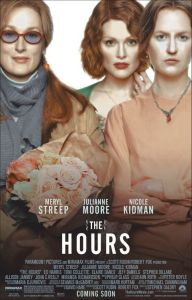 Okay, after watching the Golden Globes award show and seeing The Hours crowned with the highest prize, and hearing incessantly about Nicole Kidman’s fake prosthetic nose in the movie, it was time to venture into that darkened theater and see how good the awards-friendly The Hours was. Little did I fully realize what I was getting myself into.
Nicole Kidman plays Virginia Woolf, who is in the midst of writing her novel Mrs. Dalloway, where she proposes to display a womans entire life through the events of a single day. Julianne Moore plays Laura Brown, a housewife in 1951 having difficulty adjusting to a domestic life that she feels ill equipped for. Meryl Streep plays Clarissa Vaughan, a gay copy-editor in 2001 planning a party for a poet and former lover (an emaciated Ed Harris), who is suffering from the late stages of AIDS. These three storylines will be juggled as the film progresses, with each womans life deeply changing before the end of the day.
The Hours is a meandering mess where the jigsaw pieces can be easily identified. The attempt at a resolution for an ending, tying the three storylines together, is handled very clumsily. The film spins on and on that you start to believe the title may be more appropriate than intended. What this movie needed was a rappin kangaroo, post haste! The film is wrought with victimization and screams ”Give me an award already!” Before you know it youre being bludgeoned to death with what is profoundly the most over serious Lifetime network movie ever assembled. And there’s nothing fundamentally wrong with Lifetime movies but The Hours does not share the sensibilities of its TV brethren.
 Kidman, nose and all, gives a strong performance displaying the torture and frailty of a writer trapped within her own mind but too often relies on wistful staring or icy glares. Moore is effectively demoralized but cannot resonate with such a shallow character. Streep is the least effective of the three and fizzles among an over-stuffed assembly of characters.
The supporting cast is unjustly left for dead. The characters are seen as parody (Toni Collette as Moore’s un-liberated homemaker neighbor), extraneous (Claire Danes as Streep’s daughter, Allison Janney as Streep’s lover, Jeff Daniels as Harris ex-lover, you know what, almost anyone in the Streep storyline), one-note (the workmanlike John C. Reilly who plays yet another doting and demystified husband) or merely obnoxious (Moore’s brat child that refuses to separate from her). It appears The Hours is the three lead actress game, and everyone else is not invited to play along.
Stephen Daldry’s direction shows surprising stability and instinct after his art-house pandering Billy Elliot showed little. The technical aspects of The Hours are quite competent, especially the sharp editing and musical score, which just points out further how slickly hollow and manufactured the film is.
The Hours is an over-glossed, morose film that is too self-important for its own good. It sucks the life out of everything. And for all its doom and gloom and tsunami of tears, the only insightful thing The Hours is trying to pass off onto the public is that women are more depressed than you think.
Nate’s Grade: C
Share this:

Changing Lanes (2002)
 Don’t be misled by fancy marketing, Changing Lanes is no more a thriller than In the Bedroom (now that was some fancy misleading marketin’). At its core Lanes is a morality tale hiding under the clothing of thriller ilk. But while the film is surprisingly engaging the majority of it centers on Ben Affleck and Samuel L. Jackson doing a good or bad deed and countering one. And in this dilemma the deck is stacked for audience favorability. Jackson is a down-on-his-luck father fighting an impending divorce and trying to get a loan to purchase some real estate so his wife and kids won’t move away. Affleck is a cocky lawyer in a big firm who had an affair with his secretary (the chipped-tooth looking Toni Collette). Who do you think is the “good” guy? The film seems to bend over backwards to try and make Affleck not so bad, like showing him remorseful and pushed to the edge, under threats from his father-in-law and firm partner (Sydney Pollack), and being urged into a dark unethical territory by his own wife (Amanda Peet).
Jackson underplays his role, despite the snippets of vocal outbursts, and earns the compassion of the audience. Affleck plays Cocky Lawyer Man Who Becomes Humble and does a fine job. The supporting cast really shines in Changing Lanes especially Peet. Her one true scene involving her chilly sit-down with her husband is great in its sharp veer from what is expected.
Changing Lanes was directed by Roger Mitchell (Notting Hill) with a bit of nerves. Some scenes are shot from obtuse angles and the score has an inappropriate electronica taste. In the end though, Changing Lanes is an involving morality tale with some good lead performances.
Nate’s Grade: B
Share this:

Shaft (2000)
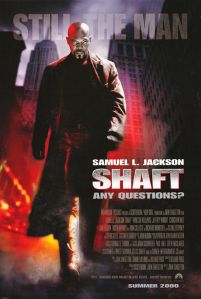 Samuel L. Jackson takes on director John Singleton’s remake – shut you mouth! I mean “newer” Shaft and spins it with effortless style and some surprising scenes of wit and even suspense. Shaft used to be a landmark in cinema, and for the black community as well, as it went full forward smashing taboos. It was more of a statement than good art because it wasn’t really art (the character in the novel was white, by the way). Jackson’s Shaft is more of a thug then the kinder gentler lady pleasure that was Richard Roundtree. This Shaft is never once preoccupied with being any landmark but doesn’t strive to be anything more then entertaining fun. The story is what surprised me most because it actually had interesting people and a well told tale. Taking a cue from the Batman franchise the villains are far more interesting and luminous then anyone else, and Christian Bale and a star-making performance by the always talented Jeffrey Wright end up making each of them a wonder on screen. Their chemistry together is worth the price of admission alone, even if you are tired of Bale playing white-collar pretty boys now (he still murders in each though!). Shaft is a loud and fast breath of summer but it’s one that surprising and very entertaining.
Nate’s Grade: B
Share this:

The Sixth Sense (1999)
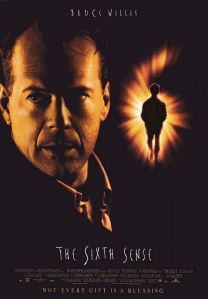 August is mostly thought of as a time of dead water for summer movies. But now I think it should be regarded as the best month for film this whole mediocre summer, and The Sixth Sense is one of the main reasons. Though the title kinda’ sucks.
In a summer low on genuine chills here’s one movie that offers honest-to-God-grip-the-armrest-chills. It’s very moody when it needs to be and creepy when it never has to be but is anyway, and constantly moving. The Sixth Sense also offers audiences something they haven’t seen this summer: real characters with depth. The characters leap from the screen and are slowly established as complicated, rounded, and very thoughtful people. Now that’s something that took me for surprise.
Bruce Willis achieves his quiet mode and teams up yet again with another child (a la Mercury Rising). Willis’ acting is solemn and just enough to drive his character through his quest. You haven’t seen Bruce Willis show this much emotion since he walked over glass in Die Hard! But the story of The Sixth Sense is a little tyke that comes from out of nowhere and redefines child acting. To say Haley Joel Osment carries the film is an understatement – he throws it on his back and runs a 4.3 with it. If Ana Paquan can win an Oscar for babysitting a piano then this kid deserves one too. This is the greatest child actor I’ve seen in years and I begin to wonder why Lucas chose his miscast young Anakin.
The best thing The Sixth Sense has is intelligence. It rewards those who stood up and paid attention with a knock-out terrific ending that wraps everything up you questioned before. And you will rerun things in your mind over and over when you leave the theater. My only complaint, and it is small, is that the direction could be tighter at times. But for everything The Sixth Sense has to offer I will gladly wait in line for seconds. The best summer chiller, and one of the best movies of the year. The title still sucks though.
Nate’s Grade: A


 nathanzoebl
You must be logged in to post a comment.