Blog Archives
Black Hawk Down (2001)
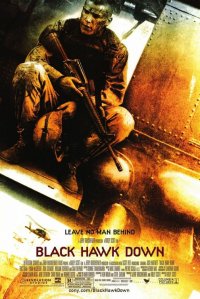 In the fall of 1993 Somalia was a nation being torn by civil war with feuding warlords and slowly being crippled by rampant hunger. The UN intervened to try feeding the starving nation but warlords like Mohamed Farrah Aidid cut off many of its shipments of food. The United States had plans to capture two top lieutenants of Aidid’s in the capital of Mogadishu. Over 100 Delta units and Army Rangers were sent into the heart of the Mogadishu market to execute the operation.
Things didn’t go well from the start as casualties began to pile up and first one, then two Black Hawk helicopters were shot down from ground fire. Medical vans and Humvees were continually blocked access to help the stranded soldiers by civilian roadblocks consisting of smoldering debris. It wasn’t supposed to take longer than 45 minutes. It ended up lasting over 15 hours. In the end 18 American lives were lost, over 70 were wounded, and over a 1000 Somalian lives were lost. What’s truly amazing is the courage the men displayed, and the fact that being surrounded by a sea of armed Somalians that more lives weren’t lost.
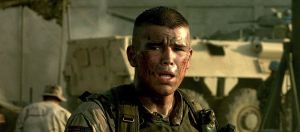 Black Hawk Down is essentially a two-hour action sequence. The emphasis of the film is on the stark recreation of the Somalia skirmish and it is indeed an achievement in grueling realism. You truly feel like you have been thrown into the middle of this firefight. With all the gunfire and chaos it leaves little time for getting to know characters. This is probably why they have names written on their helmets so the audience can attempt some semblance of who’s who.
The film is by no means for the faint of heart. Saving Private Ryan had some intense violence, but it was mainly condensed for the opening and closing 20 minutes. Black Hawk Down, on the other hand, is two straight hours of non-stop blood and gore. The violence and the intense realism are not gratuitous but indicative of the horror these men faced. If you can’t stomach a soldier plunging his entire forearm into the chest cavity of another to cut off a bullet wound – stay at home and read a good book.
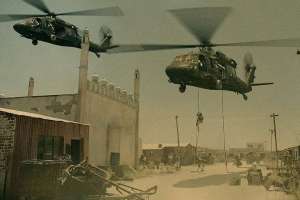 Ridley Scott is on an ultra-violent hot streak after directing big name Hollywood tokens like Hannibal and Gladiator. His handling of Black Hawk Down is masterful, just for the simple fact of keeping the audience free from confusion. Throughout the duration we know who is where, where they want to go, and the general geography of the hot spot. The staging of the entire battle is beautifully filmed and the recreation of the Mogadishu market place is amazing in its fine detail. Some criticism has been projected at the film for portraying the Somalians as basically black people with guns. This is entirely true, but one must remember that the film is told from the American point of view.
The acting, as expected in a war film, takes a back seat to the heroic histrionics and the fireworks. Josh Hartnett is sullen in his duty as Staff Sergeant Matt Eversmann but always a comfortable figure to see on screen amidst the chaos. Ewan McGregor plays a soldier promoted to action instead of desk work and adds some touches of humor to the fray. Tom Sizemore is the most recognizable person as the often-frustrated Lt. Colonel Danny McKnight who fearlessly strolls across the battlefield while bullets whiz by.
Black Hawk Down for some will be the right movie at the right time, though it was never intended to be. The riveting action is more than entertaining and worth admission price, but you might leave pondering on the sacrifice few know the full details. Just make sure to go to the bathroom before the film starts.
Nate’s Grade: A-
Share this:

Pearl Harbor (2001)
 It turns out we went to war in 1941 not because of Japanese aggression, Hitler’s dominance in Europe, or the protection of freedom and democracy. Sorry kids. The real reason we went to war was to complicate and then clear up Kate Beckinsale’s love life. At least that’s what director Michael Bay and screenwriter Randall Wallace would tell you with their indulgent epic Pearl Harbor.
We open in Tennessee in the 20s with two boys who dream of being pilots. Rafe (Ben Affleck) and Danny (Josh Hartnett) grow into strapping young lads who flash their hot dog flyin’ skills at basic training, which brings them chagrin from superiors but admiration from peers. Rafe falls in love with a young nurse named Evelyn (Kate Beckinsale), who goes against ARMY rule and passes Rafe in his eye exam portion when he has a slight case of dyslexia. But he’s just so cuuuute. The romance builds but Rafe feels like he’s grounded when all he wants to do is fly, and volunteers to fight in the RAF over in Europe. He promises he’ll be back to see his lovely Evelyn. Of course he gets into an accident and everyone assumes that poor dyslexic Rafe is fertilizing a lawn somewhere with his remains. Hence Danny slowly but surely develops something for Evelyn in their periods of mourning, and the two consummate their puppy love with a tango in parachute sheets.
All seems well until Rafe returns back from the dead throwing a wrench into Evelyn’s second date parachute plans. Thus the Hollywood favorite of the love triangle endures until the end when the two fly boys enlist in the Doolittle attack against Japan, months after the ferocious attack on Pearl Harbor. The real purpose of the Doolittle attack was not militarily, but merely for morale. The real purpose it serves in the movie is to shave off an end on our love triangle.
 Pearl Harbor allows us to follow a group of youthful and innocent starry-eyed kids from training to combat. Each seems pretty much exactly the same to each other. It’s near impossible to distinguish which character is which. It’s like the screenwriter didn’t even have the gall to resort to cliche supporting character roles, and he just made one character and duplicated it. The only one who was noticeable for me was the character of Red (Ewen Bremner, julien donkey boy himself), but that was simply because the man had a speech impediment. We also have our handful of young nurses alongside Beckinsale, and I had an easier time distinguishing between them; everyone had different hair colors.
]If you look in the pic, or the credits, you’ll see that two of the nurses would turn out to be Jennifer Garner (Alias) and Sara Rue (Less than Perfect), both stars of ABC shows, and ABC is owned by, yep, Disney. Coincidence? Probably. When they ran this on TV they actually advertised Jennifer Garner above Kate Beckinsale. That reminded me of when Seven ran on TV shortly after Kevin Spacey had won his well-deserved 1999 Best Actor Oscar for American Beauty, and they gave him second-billing in the advertisement over Morgan Freeman, the movie’s true main character.
Affleck has a hayseed Southern twang, but seems to mysteriously disappear for long stretches. Hartnett seems to talk with a deep creak, like a door desperately trying to be pushed open. Beckinsale manages to do okay with her material, but more magnificently manages to never smear a drop of that lipstick of hers during the entire war. We could learn a lot from her smear-defying efforts. Gooding Jr. is pretty much given nothing to work with. I’m just eternally grateful he didn’t go into a usual Cuba frenzy when he shot down a Zero.
Michael Bay has brought us the ADD screenings that are the past, loud hits of The Rock and Armageddon. Teamed up with his overactive man-child producer Jerry Bruckheimer once more, Pearl Harbor is less Bay restrained to work on narrative film as it is Bay free-wheeling. His camera is loose and zig-zagging once more to a thousand edits and explosions. Bay is a child at heart that just loves to see things explode. When he should show patience and restraint he decides to just go for the gusto and make everything as pretty or explosive as possible. This is not a mature filmmaker.
Despite the sledge hammer of bad reviews, Pearl Harbor is not as bad as it has been made out to be. The love story is inept and the acting is sleep-inducing, unless when it’s just funny. It doesn’t start off too badly, but twenty minutes in the movie begins sinking. The centerpiece of the film is the actual Pearl Harbor bombing that clocks in after ninety minutes of the movie. The forty-minute attack sequence is something to behold. The pacing is good and the action is exciting with some fantastic special effects. The movie is bloated with a running time a small bit over three hours total. Maybe, if they left the first twenty minutes in, then gave us the forty minute attack sequence, followed by a subsequent five minute ending to clear up our love triangle’s loose ends… why we’d have an 80 minute blockbuster!
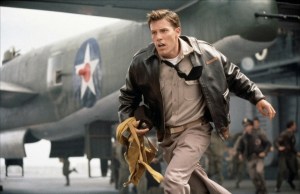 Pearl Harbor doesn’t demonize the Japanese, but it feels rather false with their open-minded attempts to show both sides as fair minded. It gets to the point where they keep pushing the Japanese further into less of a bad light that it feels incredibly manipulative and just insulting. It seems like the producers really didn’t want to offend any potential Pacific ticket buyers so the picture bends backwards to not be insulting. The only people who could be offended by Pearl Harbor are those who enjoy good stories. Oh yeah, and war veterans too.
The cast of Pearl Harbor almost reads like another Hollywood 40s war movie where all the big stars had small roles throughout, kind of like The Longest Day for the Pepsi generation. Alec Baldwin plays General Doolittle and is given the worst lines in the film to say. Tom Sizemore shows up as a sergeant ready to train the men entering Pearl Harbor. He has five minutes of screen time but does manage to kill people in that short window. Dan Akroyd is in this for some reason or other, likely because Blues Brothers 3000 has yet to be green lighted. John Voight is easily the most entertaining actor to watch in the entire film. He gives a very authentic portrayal of President Roosevelt. I still find trouble believing it was Voight under the makeup.
The blueprint for Pearl Harbor is so transparent. They took the Titanic formula of setting a fictional romance against a disaster, with the first half establishing characters and our love story, and then relegating the second half to dealing with the aftermath of the disaster. It worked in Titanic (yes, I liked the film for the most part), but it doesn’t work here. Pearl Harbor is a passable film, but the mediocre acting, inept romance, square writing, and slack pacing stop it from being anything more. Fans of war epics might find more to enjoy, especially if they don’t regularly have quibbles over things like “characters” and “plot.” To paraphrase that know-it-all Shakespeare: “Pearl Harbor is a tale told by an idiot. It is full of sound and fury, signifying nothing.
Nate’s Grade: C
Reviewed 20 years later as part of the “Reviews Re-View: 2001” article.


 nathanzoebl
You must be logged in to post a comment.