Blog Archives
Midnight in Paris (2011)
 Woody Allen hasn’t been this light-footed in a long time. Midnight in Paris is an effervescently charming film that flirts with overt sentimentality. But before you think Allen goes all gooey, the fatalist in him pulls back for some wisdom about the folly of nostalgia. Allen’s nebbish stand-in this time is Owen Wilson, assuredly better looking but on the same neurotic wavelength of his director. Wilson is a disgruntled Hollywood screenwriter visiting the City of Lights with his shrewish fiancé (Rachel McAdams) and her upper-class parents. One night a mysterious taxicab picks him up shortly after midnight. Wilson is transported back in time to his favorite era, 1920s Paris. He gets to rub elbows with literary and artistic giants, like Gertrude Stein (Kathy Bates), Ernest Hemmingway (Corey Stoll), Scott and Zelda Fitzgerald (Tom Hiddleston and Alison Pill), Salvador Dali (Adrien Brody), and others. He even falls for a lovely lady (Marion Cotillard) from that time period who served as a muse for several artists. Midnight in Paris is a far more enjoyable experience if you have a modicum of education in the humanities. Identifying the artists of old, albeit exaggerated cartoon versions of themselves, is part of the fun, fantasizing about interacting with the greats. But Allen is also playful with his storytelling, and for a while Midnight in Paris becomes a highly refined cross-time romance (think The Lake House written by Tom Stoppard). Midnight in Paris has been catching on with audiences, becoming Allen’s biggest hit in 25 years, and it’s easy to see why. It’s whimsical while being literate and romantic without being corny.
Nate’s Grade: B+
Share this:

Source Code (2011)
 Captain Colter Stevens (Jake Gyllenhaal) awakes on a train. His mind has been transplanted into the body of Sean Fentress, a doomed train passenger. Fentress, along with 200 others, were killed in an explosion on a commuter train heading in to Chicago. But this has all happened in the past. Colter has been quantum leaped into a top secret government program known as the source code. It uses people’s brain waves to simulate a recorded reality. The last thing Colter can remember is a firefight in Afghanistan, and now he’s aboard a train looking for a mad bomber. Whatever info he can retrieve will help the officials (Vera Farmiga, Jeffrey Wright) prevent a second terrorist bombing scheduled that day. Colter only has eight minutes to interact with the train passengers and deduce who the bomber is. After eight minutes, the train explodes and the reality resets itself again. Things get even more complicated when he falls for Fentress’ fetching female friend Christina (Michelle Mongahan). Can he save her? Can he save anyone? Can he get out of the source code?
Source Code manages to be a twisty, trippy little film that doesn’t so much knock you out but definitely packs a bit of a punch. Its simplicity is its very best asset. There’s a bomb on a train (ignore the questionable movie sci-fi physics). Colter has exactly eight minutes to learn what he can before he and everybody else blows up. Then the fun starts anew. The movie is less a time-travel flick than an alternate reality sort of experiment. Personally, I love movies that present a timeline and then slowly thumb away at the edges, stretching the narrative space, showing the audience the various intricacies of this tiny world. Whether it’s Pulp Fiction, Groundhog Day, or the propulsive fun of Run Lola Run, I enjoy a story that expands outward into a greater foundational complexity. I enjoy the clockwork of a story that shows me how the different pieces work together. I enjoy that through the variations I can experience a richer world, seeing what happens to a passenger as they leave the train, seeing how a character’s actions can impact another, seeing how altering that character’s action alters other forces in the story. That kind of narrative trickery, perfected in Groundhog Day, makes the story feel like a living creature because you witness the interconnected relationships of everything and everyone. It also makes it pretty fun to watch.
 Director Duncan Jones makes slick use of tight spaces like he showcased in 2009’s celestial sci-fi thriller, Moon. The quick pacing and collective rhythm of the movie helps contribute to its entertainment factor. Source Code is playful enough in design and execution. It remains consistently clever with its plotting, but what’s really surprising is that Jones is able to find a personal human story inside all the thriller trappings. Colter is trying to make sense of his situation, but he’s also trying to reconcile the idea of life, death, fate, and getting to speak with his parents who assume he was killed in Afghanistan (he’s been with the source code project for over two months). There’s a human face to all this, and while the love story feels tacked on and underdeveloped, Colter’s emotional turmoil and existential struggles to reassert his identity and find some peace from his life ring true. Gyllenhaal (Prince of Persia) is an ever capable lead who takes a near Hitchcockian leading man role and plays it straight to fine effect.
At the same time, Source Code tries to have it all with an ending that I don’t truly believe it pulls off. Spoilers will lurk, so skip the next two paragraphs those who wish to remain pure and chaste. The film does a fairly nimble job of setting up an appropriate, if mostly downbeat, ending. Colter doesn’t want to be a brain in a box; he doesn’t want the government using him as their newest tool for the rest of his unnatural days. He was pulled from the brink of death and he now just wants to die in peace. In the recorded reality of the source code, he’s allowed the chance that most of us will never have – he can find closure. Whereas he would have died on a desert battlefield, now Colter has an opportunity to speak to his father one last time, to say goodbye. The entire denouement of Source Code seems to be establishing a memorial for the people who were lost on that train, because once the source code is erased so too will they be. They’re electronic recreations but in the end it reminds you that they were real people, and now they get something of a proper sendoff, a fairly touching memorial to the people who will just be seen as numbers in a news report.
 And then… just as Colter makes peace with passing over, he passes over into another reality. The train doesn’t blow up. The people are able to get off. He gets to walk hand-in-hand with his new sweetheart. Jones doesn’t make it clear what really happens, which can lead to some mounting confusion. Did they really alter the past? Did they create a parallel dimension? In one dimension is everyone on the train dead whereas in another everyone lives, short of Sean Fentress? And how crappy is that? Yes, Gyllenhaal is a charming and terrific looking guy, but does no one shed a tear for the fact that he stole another man’s body? Sean Fentress may not have had the courage to ask out his pretty friend, but that doesn’t mean he deserved to have his identity hijacked and his existence more or less erased from time and space. It’s a weird blemish that the filmmakers don’t truly want to address, and why would they? The ending lacks commentary of any sort strictly because the movie wants to have it all. It wants the sad, mournful ending, it wants the happy “Everything’s gonna be okay” ending. It almost let’s you choose. But Source Code doesn’t come across so much as a film that begs to be opened for different interpretations so much as a film that didn’t want to upset anyone by picking an ending.
Source Code is nicely paced, nicely plotted, and it produces just as many intriguing questions as it does substantial thrills. Jones finds interesting ways to make the same material different. The various characters, converging storylines, and science-fiction mumbo jumbo are all nicely woven into a satisfying bite-sized sci-fi thriller. It fumbles with the landing, in my view; it seems like a pandering appeal to please every faction of the audience, or at least to confuse them with the illusion that they have gotten what they wanted. This is an intellectual sci-fi potboiler in disguise as a thriller. Roll with it, play along, don’t think too hard about the moral implications of its murky ending, and enjoy the ride.
Nate’s Grade: B+
Share this:

Shrek the Fourth (2010)
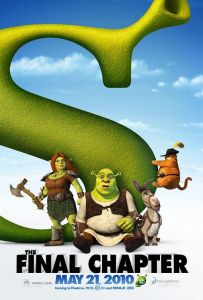 By taking a page, or even the entire script from It’s a Wonderful Life, Shrek tackles a mid-life crises and wonders how life would be if he had never saved his lovely wife Fiona from her tower (hint: it sucks). He wants his life back and makes a deal with the devious Rumplestiltskin. Except Shrek wakes up in a world where he was never born. While generally better than the third feature, this is still a noticeable step below the first two Shrek features. The tiresome plot device feels more like material for a lazy direct-to-video sequel rather than the (supposed) final chapter to the series. The film wants to be reflective and tap into our inventory of attachment to these characters, but time and again the movie doesn’t go far beyond the “don’t know what you got until it’s gone” cliché. Gags still feel too safe, the energy feels too loose, and the overall feel of Shrek 4 is casual. The novelty is gone. This is a rather middling trip to that big happily ever after. The story, with its reflexive moralizing, just makes the whole film feel slight; Rumplestiltskin is a villain of wasted potential, the characters feel poorly incorporated, and the general time-travel concept implies that the filmmakers have run out of stories to tell. As expected, Shrek 4 looks great, but that’s the only thing great about this once vaulted fractured fairy tale franchise. If this is the final chapter, then let it go with some fading sense of dignity.
Nate’s Grade: B-
Share this:

Hot Tub Time Machine (2010)
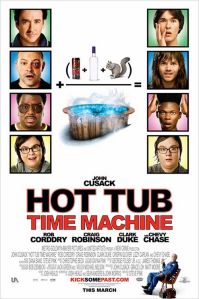 Not nearly as clever as the brilliant title may suggest, Hot Tub Time Machine is a fairly silly yet sloppy comedic enterprise. The purposely moronic nature of it leads to some raunchy enjoyment, and the premise involving a time-traveling Jacuzzi allows for some fun comedic situations. The trouble is that the movie shadows our foursome of dudes (John Cusack, Rob Corddry, Craig Robinson, and Clark Duke) too closely. The movie presents intriguing comedic setups but spends inordinate amounts of time dealing with the fractious falling out between the dudes. We spend more time talking about old friendships than we do the sheer possibilities brought about through time travel. The pacing has some turgid moments; it takes too long to reach the magic hot tub. There’s some good humor at first when the guys believe they must follow the exact path they tread before, lest the butterfly effect destroy the future. Then they decide to walk a different path, taking advantage of their knowledge of the future. The movie doesn’t fully take advantage of its own comedic possibilities and settles for lame payoffs, like an end credits sequence inserting Corddry into a Motley Crue video (it’s not funny). There are a few Farrelly Brother-level gross-out gags, but most of the comedy happens around these guys, not because of their characters. They themselves are not exasperatingly funny, so it’s disappointing when Hot Tub Time Machine flirts with fun comic scenarios (an outlandish bet on a sporting game, performing a modern song, the mystery of how the bellhop loses his arm, Duke making sure he will be conceived in the past) only to give up and spend more time with the guys hashing out their years-old squabbles. Enough with the personal growth and reflection. Get back to messing around with the space-time continuum.
Nate’s Grade: B-
Share this:

The Time Traveler’s Wife (2009)
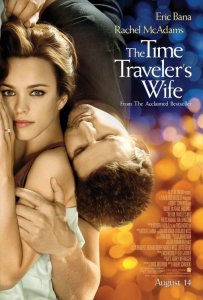 You think your romantic foibles are complicated? Based on Audrey Niffenegger’s best-selling novel, The Time Traveler’s Wife, we follow the life of Henry (Eric Bana), a librarian stricken with the unique genetic disorder of uncontrollable time travel. He first discovered this condition when he was six years old and disappeared out of his mother’s car, only to rematerialize and watch her die from afar. An older version of Henry happened to also be on hand and fill in his younger self on the details. Henry will randomly move backwards and forwards through time, and there’s nothing he can do to stop it. One of the side effects of spontaneous time travel is, naturally, nudity, as Henry travels in the buff a la the Terminator. So usually the first thing he must do when he winds up some place new is find some clothes. Henry seems destined to be a sad and lonely man, but then one day Clare (Rachel McAdams) enters his life, confessing that she’s known Henry for years and been waiting for this exact moment to arrive. She asserts herself and asks Henry for a dinner date that’s been in the works for some time. They fall in love, or fall further in love in Clare’s case, and try to make a relationship work despite Henry’s hiccups through time.
There’s a tenderness to the movie, though I found it tricky to fully engage in the characters. Much of the movie concerns the plot complications that befall such a strained and unique relationship. The flick gives new meaning to cold feet when Henry literally vanishes during his wedding, only to reappear as a mid-40s version of himself (hey makeup department, you couldn’t do more to effectively age Bana than add a dash of grey?). There is a great mind-bending section where Clare cheats (?) on Henry with… a younger version of himself. I was interested in the subdued proceedings and I felt underpinnings of empathy for Henry and Clare, but then my mind wandered into something a little darker and pessimistic. Now, The Time Traveler’s Wife is a polished traditional romance despite the sci-fi trappings but I started thinking about if what I was witnessing was actual romance? Henry first visits Clare as a child, telling her he will be her eventual husband. She falls in love with him in that moment and rejects all other suitors, knowing with absolute certainty that she will marry Henry. She just has to find him. And when adult Clare does meet Henry the librarian, he has never seen her before up to that point (it’s not as confusing as it may sound). She’s been waiting years to see his face again and she tells him that they are destined to get married. You see what’s at play here? The romantic plot is a loop where each character supplies the other’s conviction. Henry locked Clare into a life of looking for him and said they would marry, but then the adult Clare is the one who convinces Henry that they will indeed marry, and he tells young Clare this who will then convince Henry, etc. Is there any free will at play here, or is each partner in this relationship being manipulated by the certitude of the other? It’s sort of a metaphysical chicken/egg scenario.
 The best portion of the movie comes across during the second half when the movie focuses more on the emotional consequences of Henry’s condition. Early on Henry’s uncontrollable time traveling is played for laughs and some forced and somewhat trivial conflict (oh no, he missed another dinner!). Henry has a chilly relationship with his father (Arliss Howard) until, well, I’m not quite sure, but things improve. In the second half of The Time Traveler’s Wife, the drama gets more serious and intriguing when Clare and Henry attempt to conceive. Henry’s genetic disorder gets passed down to the baby fetuses, which means little babies are vanishing out of the womb and perishing before being zapped back inside. That’s a rather disturbing image and yet it is a thoughtful and plausible problem given the premise. As a result, Clare suffers through several traumatizing miscarriages. But they keep at it because Henry has seen his future lineage, also a time-traveler, and he knows that one of these pregnancies will go full term and become their eventual daughter, Alba (Tatum McCann). It was this storyline that stopped my mind from occasionally wandering and hooked my interest. Perhaps it’s cheap sentiment, but it’s hard not to feel for this loving couple when they endure pregnancies fraught with danger. The movie misses out on a dynamite dramatic opportunity with Alba. If I were adapting this to the screen, I would make sure to include Alba as a grown 30-something woman visiting her father on his deathbed, tearfully informing her dear dad on all the eventful moments that he won’t be around to experience. Picture an adult Alba talking about her own children to her dying father. There wouldn’t be a dry eye in the house. Hollywood, if you’d like to tack on an extra emotional ending to this movie, there’s still time. Call me.
It is here that I must address some key scenes that may pique curiosity. During Henry’s travels, he frequently visits the young child version of Clare. The first time Clare meets her future husband she is a little girl sitting in a meadow on the boundary of her family’s palatial estate. Henry, as he does every time he becomes unstuck through time, arrives in the nearby woods without a stitch on. Director Robert Swentke (Flightplan) and screenwriter Bruce Joel Rubin (an Oscar-winner for Ghost) work diligently to make sure the movie walks a very fine tone, and I confess that the scenes between loving child and naked time-traveling man escape creepy pedophilic overtones. Take that blurb for what you will in a romance: “Hey, no pedophilic overtones!”
 There are some other complications when it comes to this matter of unexpected time traveling. Firstly, the rules seem to be flexibly applied. At one point Henry is talking about how he cannot prevent his mother’s deadly car accident. The movie professed a destiny-entrenched approach to time travel, meaning every action you think you’re engaging out of free will was predetermined (the TV show Lost also subscribes to this theory). It cuts out time paradoxes. But then in another moment Henry uses his knowledge of the future to win the lottery. So which is it? Are the filmmakers trying to convince me that it was destiny for Henry and Clare to win the lottery, because I’m not buying it. Having a time-traveler for a boyfriend takes out some of the natural drama o relationships when one party can peak ahead. Relationships have danger and excitement and uncertainty to them, but when Henry can just matter-of-factly say, “We’re gonna be fine. We’re still together and in love fifteen years later, I saw it,” well it may make for good romance for some, but it makes for rather inert drama. How can you hope to win arguments? Naturally, the hefty book has been streamlined as much as possible for a mainstream moviegoing audience, which means that Henry’s scope of time traveling is scaled back. At one point he quantum leaps beyond his own lifetime, and because this has never happened before and is really only done to introduce a ticking death clock. I suppose there will always be inconsistencies when it comes to breaking the space-time continuum.
McAdams (The Notebook) is a great choice for the romantic center of the movie. She’s glassy-eyed and smiles so hard in her early sequences you think her dimples are going to explode off her cheery face. She is such a winning presence and her warm-hearted glow powers the character and the movie. Unfortunately, she doesn’t have very good chemistry with her onscreen mate. Henry is a victim of an existential cruel joke. Bana (Munich) is light-footed and makes Henry more than a space-time martyr. He’s somewhat amorphous as a character, a collection of niceties and genial, puppy-dog affection, which means that Henry is routinely upstaged by his genetic condition. However, when Henry faces the specter of his impending death is when the character gets a lot more attention and Bana is able to work his considerable talents. He gets ample opportunities to showcase his time-traveling buttocks. I don’t think too many women out there would be that put off if a naked Eric Bana magically materialized in their bedroom.
 The Time Traveler’s Wife is mildly reminiscent of The Lake House, and not just because of the time travel romantic complications. Deep down, these are traditional Hollywood romances with a fresh sci-fi coat of paint. The movie is best if you set the logic portion of your brain off so that inconsistencies and potential contrivances don’t distract from an intriguing story that presents some nice developments. There’s a tender love story here, though the characters don’t leave as much of an impression as they could have with such a plot-heavy romance. It finishes strongly and the mood throughout has a somber bittersweet quality, hammering home the “enjoy the time you have” message. McAdams is darling, Bana gets in the buff, their chemistry isn’t great, and the filmmakers refrain from the material getting overly sentimental or solipsistic. In a summer of relative disappointments, a tricky, clever approach at traditional romance is welcome amidst the explosions and wacky studio comedies.
Nate’s Grade: B
Share this:

An American Carol (2008)
 Being a conservative in Hollywood is like being a gay Republican – tough business. Director David Zucker has a notable history with comedy, having helmed Airplane!, the Naked Gun series, and the back half of the Scary Movies. He says that he converted to conservatism in the wake of 9/11, and Zucker actually wrote and directed a short for the 2004 Republican National Convention that was deemed too edgy for the Grand Old Party. Conservatives have also garnered the reputation for not having the best sense of humor, and Zucker’s An American Carol will do little to change this belief.
Michael Malone (Kevin Farley) is an egotistical, fat, liberal documentary filmmaker whose latest work is titled, “Die You American Pigs.” Catchy, ain’t it? Malone wants to abolish the Fourth of July (would we just skip to July 5th?) and plans to protest a Trace Adkins concert for the troops. A batch of inept Islamic terrorists want to bomb the concert and decide into tricking Malone into assisting their goal. He will score them media passes to get onstage at the concert venue. Following the Charles Dickens’ playbook, Malone is first visited by the spirit of his idol, John F. Kennedy (Chriss Anglin), who horrifies Malone by saying war is sometimes necessary (really, conservatives are trying to reclaim Kennedy?). Three spirits will visit him although he spends almost all of his time with the ghost of General Patton (Kelsey Grammer). The ghostly general takes Malone on a trip to see what the alternative versions of U.S. history had the country avoided war at all costs. Malone stays defiant until he meets up with the Angel of Death (also Trace Adkins, because?) and sees the error of his “America-hating” ways. I don’t want to spoil things too much but the movie ends with an expanded Trace Adkins concert saluting the brave men and women in the armed forces.
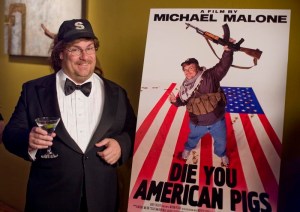 Some from the opposing political viewpoints will find An American Carol to be infuriating. To those angry few I say get over it, because this movie is simply too lazy to get angry over. It barely reaches 77 minutes before the credits roll. Zucker and company tend to stretch their canvas too broadly, to the point that they aren’t exaggerating to lampoon but setting up cheap jokes. Michael Malone is fat. Michael Malone smells. Michael Malone falls down. Liberals hate America and want the terrorists to win. It’s so easy to write this material because there’s nothing topical or nuanced or even socially relevant. The movie beats reliable figures of conservative agita. When the movie tries to slam college professors as being dippy hippies brainwashing teens about the insurmountable ills of America, it just gets dumb (those people spend 10-15 years studying in a specialized academic field). There is no teeth to any of this satire because it’s all just recycled caricatures with the wit ground down. There isn’t anything of true satirical substance here. I don’t even get some of the satire, like the ACLU is depicted as a cluster of zombies with briefcases. What does that mean? Needless to say, the skewering of Arabs is mostly cartoonish and offensive. The flick constantly makes fun of the documentary art form, saying they are inferior to “real movies.” Because Michael Moore has an Oscar does that mean that the history of documentary film has to be slandered as being nothing more than transparent propaganda (at an awards ceremony, the top documentary is honored with the “Leni Riefenstahl Award”)? Marginalizing an entire art form seems rash, especially considering that Moore’s Fahrenheit 9/11 grossed over $220 million worldwide. As of this writing, An American Carol, a “real movie,” has grossed seven million and counting.
The film deals in distasteful absolutes. Every idea is presented crudely in black and white. By the film’s standards, being anti-war and anti-troops are inseparably linked. In my mind, and this might be crazy, but it seems to me that the most pro-troops one could be would be hoping for them all to return home alive and healthy. An American Carol attempts to justify the ongoing War in Iraq, though it conveniently only ever flashes to combat in Afghanistan, the war that a majority of the public agrees with. It makes a case that war is sometimes necessary, though it has to flash back to Hitler and World War II to find a morally justified military engagement that everyone can feel god about. I agree that war is sometimes a reasonable option, but the movie paints all pacifists as wimpy appeasers. George Washington (Jon Voight) even steps in at one point to argue for the necessity of war in reference to the War on Terror. Did the filmmakers forget that Washington spent great expense to keep the nation out of foreign wars in his two terms? Isn’t it also condescending and objectionable to have Washington say freedom of speech is misused when it goes against the government? I think the Founding Fathers would realize the importance of freedom of speech, including offensive speech. Isn’t it also somewhat ironic to use slave-owners as mouthpieces for the merits of freedom? An American Carol says that disagreement is the same as dissent; so refusing to support one’s government blindly during a time of war is traitorous. Criticism is not anti-American. It’s insulting to all rationale human beings. Zucker and crew make their case look just as myopic and dismissive as those they choose to ridicule.
The acting neither hinders nor helps the material. Farley is a game comedian but he cannot do much with such lightweight material. There are several celebrity cameos including James Woods, Dennis Hopper, Bill O’Reilly, Mary Hart, David Alan Grier, Gary Coleman, Leslie Nielsen, Zachary Levi, Kevin Sorbo, and Paris Hilton. When Zucker is calling favors into the likes of Paris Hilton, you know things cannot be solid.
 Here’s the problem. It’s harder to satirize from a conservative point of view. Conservatism believes that the status quo is best or that things were better back in the day. Liberalism believes that society can always improve, so a liberal point of view would tweak the present situation in order to call attention to remaining improvements. A conservative point of view would make fun of that possible change. This is the same reason why documentaries, like it or not, typically have a more progressive bent, and it’s because the filmmakers are presenting a case for change or outrage. Why would anyone devote himself or herself for years to create a film that says the world is peachy? Now I’m not saying that conservatism and humor are conflicting concepts, but it just makes it harder to be smarter. Making fun of Good Night, and Good Luck is not trying hard enough. How dare George Clooney make a film about the media cowering and failing to question our elected leaders and have it be applicable to today’s world.
The Zucker gag-a-minute spoof style doesn’t necessarily translate well to political satire. I wasn’t expecting much with An American Carol. When they exploit 9/11, taking Malone to the wreckage of the World Trade Center to make its case, well the movie stops being a satire and just implodes. It hits its tired targets with a sledgehammer. The satire is extremely lazy, the slapstick is dumb, and the movie specializes in being obnoxious, coloring the world in two extremes. This isn’t satire. This is just cheap and petty. Seriously, making fun of Michael Moore is like four years too late. Moore is a figure worthy of satire but the best that the movie can come up with is he’s fat and hates America? That he’s angry because he couldn’t get girls when he was younger and all those studly military recruits did? That’s not satire, that’s just excessive name-calling. An American Carol presents a new low for Zucker and I think even he knows it. On the DVD commentary track, Zucker, co-writer Lewis Friedman (BASEketball), and actor Kevin Farley basically lambaste the final product, often criticizing their own movie. The derisive commentary track is more enjoyable than the film itself.
Nate’s Grade: C-
Share this:

Next (2007)
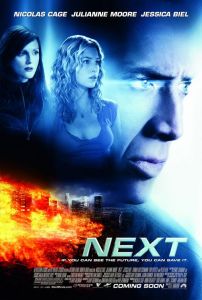 Nicolas Cage, channeling Tom Hanks’ greasy mullet in The Da Vinci Code, can see his own future but only two minutes ahead. Based on a Phillip K. Dick something or other (does it really matter at this point?), this half-baked sci-fi thriller keeps shooting itself in the foot by retreating back in time to reveal, over and over, that what was just shown was merely Cage seeing his future. Now it’s do-over time, hooray. This tricky concept is given little thought and Next hews close to tired thriller clichés and formulaic trappings. There’s the hot girl dragged into the fray (Jessica Biel, pretty but pointless), the shady government agents that need Cage’s help but don’t fully trust him, and the nondescript bad guys with a hidden nuke. Next had potential for disposable escapist entertainment, but man do they blow it big time. For a 90-minute film, there’s way too much setup and not nearly enough payoff. There’s about a grand total of two action sequences for the entire film, neither very good, and then the movie utterly collapses as half of it folds in on itself as one of Cage’s visions. In the blink of an eye, half of the movie we watch is erased; it’s a freakin’ cheat, especially when the movie slouches to a close right after. This easily forgettable sci-fi bobble is another nail in Cage’s coffin as a reliable actor.
Nate’s Grade: C-
Share this:

Southland Tales (2007)
 Richard Kelly is a talented writer/director who scored big with his first film, modern cult classic Donnie Darko. I was in love with the ominous yet inspired Darko from the moment I saw it, which, not to toot my own horn, was February 2002, way before the cult got started. I have been eagerly anticipating Southland Tales, Kelly’s writing/directing follow-up, even after its notorious 2006 Cannes Film Festival reception where critics readily cited terms like “indulgent,” “bloated,” “messy,” and, “disaster.” My love of Darko shielded me from such negative affronts, and so I watched Southland Tales undaunted and with as open a mind as possible. The regrettable truth is that even after Kelly shaved off a half-hour from the Cannes version, Southland Tales is every bit a mess as had been advertised; however, it is occasionally worthwhile and subversively ambitious.
Kelly begins his massive yarn with a nuclear attack on Abilene, Texas in 2005. America is plunged into World War III and fights, simultaneously, Iran, Syria, Afghanistan, and North Korea, while the conflict with Iraq continues. The Internet is now in control of the government, who passes sweeping security measures, chief among them IdentiCorp. This government arm uses thousands of trained cameras to keep watch over the lives of ordinary citizens, including when they duck into public bathroom stalls. Violent neo-Marxist groups have placed cells around the country, ready and willing to strike to destroy the last vestiges of American capitalism.
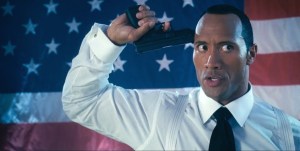 Fuel resources have almost run dry and the world looks to scientist Baron Von Westphalen (Wallace Shawn, hamming it up and having a good time) for a solution. The Baron has devised a substance known as Fluid Karma, which works under the properties of the churning oceans and will produce a radius of power. Fluid Karma also works as a powerful hallucinogenic drug and the Baron tested it on wounded Iraqi vets like Pilot Abilene (Justin Timberlake). Coldly narrating the film, Abilene stands guard outside the Baron’s laboratory and also peddles the drug on the side.
It is the summer of 2008 and the presidential election is months away. The Republican candidate, Senator Bobby Frost (Holmes Osborne), is in crisis mode. His spoiled daughter (Mandy Moore) is frantic because her husband, actor Boxer Santaros (Dwayne “The Rock” Johnson), has vanished. He’s awakened in the California desert with amnesia and shacked up with porn star Krysta Now (Sarah Michelle Gellar); the duo has written a prophetic screenplay called “The Power.” Krysta and a pair of tattoo babes (Nora Dunn) plan to blackmail the Frost campaign with video of Boxer frolicking with the adult movie star. They want the campaign to endorse Proposition 69, which would rescind the encroachments on civil liberties by the U.S. government.
A group of neo-Marxists, led by pint-sized Zora Carmichaels (Cheri Oteri), have kidnapped a police officer, Roland Taverner, and are using his twin brother Ronald (both played by Seann William Scott) to frame the police and Boxer. And I haven’t even begun to talk about Senator Frost’s wife (Miranda Richardson), the president of Japan having his hand lopped off in a loony sequence, the frequent inverting of T.S. Elitot’s quote about the way the world ends, a commercial where two cars literally have sex, and a rip in the space-time continuum that people are putting monkeys inside.
Extraordinarily messy and scattershot, Southland Tales has 1000 ideas rolling around inside without much traction. It’s as if Kelly thought he was never going to get the chance to make another movie again so he crammed every thought and topic he ever had into one 144-minute cross-pollinated jumble. The movie veers wildly and chaotically from political satire, to crude comedy, to sci-fi head-trip, all the way to Busby Berkley musical. There’s a little of everything here but few of the dispirited elements mesh and the film runs a good two hours before any sort of overall context becomes remotely approachable. One second the movie is satirizing a Big Brother control state and the loss of American civil liberties, and in the next second a character is threatening to kill herself unless Boxer allows her to orally pleasure him. You got, among other things, zeppelins, global deceleration, perpetual motion machines, Zelda Rubenstein, drugs, holes in time, twins, a murderous Jon Lovitz, ice cream trucks that house military-grade weapons, blackmail, Kevin Smith in a ZZ Top beard and no legs, reality TV, the American national anthem cut together with an ATM robbery, Biblical Revelation quotes courtesy of Timberlake, and, why not, the end of the world. What does it all mean? I have no idea but I credit Kelly for his ambition.
 Plenty of stuff happens for a solid two hours but little to nothing feels like it amounts to anything, and several subplots just get dropped. There are long stretches where I cannot explain even “what’s happening” from a literal description. This sprawling, magnificently self-indulgent meditative opus consists too much of side characters running into each other and having vague, pseudo-intellectual conversations that go nowhere. There are a lot of nonsensical speed bumps in this narrative. Sometimes the screen is just nothing but a series of newscasts overloading the audience with details on the reality of this alternative America; it’s filler. The conclusion is rather frustratingly abrupt; after slogging through two-plus hours of oblique questions it finally seems like we may reach some tentative answers, and then Kelly pulls the pin on his grenade and collapses his tale. Krysta tells Boxer in a moment of clarity, “It had to end this way.” Really? It did? This way?
The movie feels like a giant garage sale with scattered treasures hard to find but buried beneath loads of kitsch. Kelly clearly has bitten off more than he can chew and yet there is a bizarre undeniable power to some moments here. Roland (or is it Ronald) Taverner watches his mirror reflection a step behind; it’s unsettling and eerie and very cool. Timberlake has a drug-induced dance number where his scarred (both physically and mentally) Iraq veteran character is covered in blood, drinks beer, and lip synchs to the Killers’ song “All the Things I’ve Done,” which has the pertinent lyrics, “I’ve got soul but I’m not a solider,” and “You gotta help me out.” All the while, leggy dancing girls in blonde bobs strut and coo around him. It’s weird and tangential to the plot but it has a certain draw to it. The conclusion featuring the Taverner twins seeking forgiveness even generates some redemptive quality. Religious questioning and the philosophy of souls occupying the same realm plays a heavy part and gives the film an approachable reflection that tickles the brain, even if Timecop, sort of, visited the same ground, albeit secular, first (you’ll kind of understand when you see the movie). Southland Tales is grasping at profound and relevant messages, and yet some images achieve this easily, like a toy soldier crawling on the L.A. streets or a tank with Hustler stamped across its side for product placement. These simple images are able to transcend Kelly’s pop manifesto.
 None of the actors really equip themselves well with the outrageousness. Scott comes off the best but that’s because his character(s) is/are the only figure(s) the audience is given a chance to emotionally connect with. The Rock, listed for the first time simply as Dwayne Johnson, is an actor that I genuinely like and think has tremendous comic ability, as evidenced by 2003’s The Rundown. With this film, however, he comes across too constantly bewildered and shifty, like he really needs to pee and cannot find a bathroom. Gellar is woefully miscast and I think she knows it given her leaden performance. Southland Tales is the kind of film where every role, even the two-bit nothing parts, is played by a known face, be it Christopher Lambert, John Larroquette, Curtis “Booger” Armstrong, Will Sasso, and a horde of Saturday Night Live alums.
Kelly’s previous film succeeded partially because an audience was able to relate and care about the central characters, which is not the case with the comically broad Southland Tales. Kelly seems to work best when he has some restraint, be it financially or artistically; the director’s cut of Donnie Darko explained far too much and took some of the magic out of interpreting the movie on your own terms. Southland Tales runs wildly in the opposite direction and is a giant mess unseen in Hollywood for some time, though for the doomsayers comparing Southland Tales to studio-killing, self-indulgent, era-defining Heaven’s Gate, may I argue that Oliver Stone’s Alexander was far more self-indulgent, longer, wackier, and duller. Due to its unpredictable nature, you can never say Southland Tales is boring.
Southland Tales the movie begins as Chapter Four of Kelly’s saga, the first three chapters being made into comic books, and really, when I think about it, a comic book is the right medium for this material. The confines of narrative film are too daunting for Kelly’s overloaded imagination. Southland Tales is oblique, incoherent, strange, and unfocused but not without merit. I doubt Kelly will ever be given the same artistic legroom to create another picture like this, so perhaps Southland Tales has helped to reign in Kelly’s filmmaking. A reigned-in Kelly is where he does his best work, and I look forward to Kelly’s remake of Richard Matheson’s story, “The Box,” presumably with no dance numbers and sexually active motor vehicles.
Nate’s Grade: C
Share this:

Premonition (2007)
 Linda (Sandra Bullock) is having a unique martial crisis. Her husband Jim (Julian McMahon) has died in a horrific car accident and she must now raise their two daughters by her lonesome. Or so she thinks, because she wakes up the next night and Jim is alive and well and enjoying a hot cup of java. Linda is perplexed and finds herself living the days of this week out of sequence. One day Jim is alive and the next day he isn’t. She plots to use her knowledge to save her husband if it’s even possible to defy fate.
Premonition is in hopeless want to be a modern-day version of Kurt Vonnegut’s Slaughterhouse Five with the added sprinkle of a Lifetime movie. Linda is, like in Vonnegut’s classic sci-fi novel, unstuck in her time, however, the time has been pared down significantly to a mere week. Thankfully the movie has enough sense not to implicitly try to make sense of why this is happening to her, though she does visit a priest who has conveniently studied this sort of crazy thing (short answer: God is testing your faith). The problem with limiting the timeline to just seven days is that when Linda makes her quantum leaps the audience is left scrambling to figure out when she is. This works in placing the audience alongside Linda in confusion, but it gives no sense of overview or clarity and the events aren’t significant enough to warrant being memorable enough to connect cause and effect. The narrative structure is purposely jumbled but it’s also missing suspense if we never know what’s going on. Hey, I’m not even asking for much either, just some titles indicating the days would be helpful.
 The people that populate this film behave in completely contrite ways because the half-baked story demands it of them. When Linda finds her daughter’s face covered in scratches for the first time, she asks what happened to her. Instead of actually answering, the child remains silent because apparently that would spoil the dramatic surprise of her running into a glass door. Wow, that was worth it, and it must have been something so traumatic that neither of Linda’s daughters could casually mention it. A child would not behave this way. The only way this would make sense is if the contriteness got kicked up a notch and the little girl got a sliding door-bound case of laryngitis. Like romantic comedies, Premonition is a movie that needs to survive due to no one ever having a rationale conversation explaining all that they know to dispel misconceptions. This whole dumb sliding door incident is made even worse when Linda’s mother wants to have the children removed from their mother’s custody because of those scratches. Huh? Would she not know too that it was an accident? And just one more reason to hate this plot point: when Linda tells her daughters that their daddy is dead the little girl does not have scratches, however, in the timeline, she ran into the door the day before. The day after the death, and two days after she broke the door, the glass is replaced because I suppose that took priority over mourning. The discontinuity is terrible.
Also, when Linda gets the tiniest whiff that her (sometimes dearly departed) husband was even contemplating infidelity, she performs a full 180 on the spot and coldly considers letting him die as punishment. The speed of her abrupt about-face is a cheap roadblock to squeeze more tension out of this dumb story. I won’t even mention how lazy it is to have a priest who’s an expert on “unstuck time” living nearby.
The plot may be maddening, but I think Premonition was meant to be a comedy because it’s not an effective thriller. The movie’s feeble attempts at attaching scares to its central puzzle are astounding bad. This is the type of film that not only thinks a dead crow is spooky but that the mystery of what happened to the dead crow is integral to audience satisfaction. It’s hard to believe that Premonition preoccupies so much time with the mini timeline of one dead bird. There are cheap jump scares in abundance but no lasting tension of sense of unease because the filmmakers have left the audience in the dark. There is one horrendous moment where the funeral pallbearers drop the casket and Jim’s head snaps and rolls out. You know they’re not getting any repeat business.
Premonition has an ending that just lays there in utter defiance of taste, causing the audience to upturn their nose in disbelief as if they had just discovered someone defecating in a store aisle. The ending is terrible and grasps for some kind of deeper Twilight Zone level of irony, but instead what comes across is a clumsy, irritating, and plain idiotic excuse at futility. It really calls into question whether or not the movie had any point. Premonition was beyond redemption but its stinker of an ending and Linda’s voice over summation will cause you to roll your eyes at incredible speeds.
 Bullock is in new territory with Premonition, though she dabbled with time travel in last year’s The Lake House. She’s in way over her head and cannot effectively convey any of Linda’s increasingly ragged emotions. I laughed out loud several times as Bullock tried to express her growing apprehension, and her take on the line, “Because we’re running out of time,” had me in stitches. Her performance isn’t particularly embarrassing but more of an exasperating reaction to all the mess surrounding her. Bullock may want to stick to her romantic comedy wheelhouse.
Personally, if I was unstuck through time and needed some help figuring out important events, I would leave a lot of Post-It notes for myself filling me in on what I know. That would make sense; this movie doesn’t in any capacity. Bullock, writer Bill Kelly, and director Mennan Yapo need to wake up the day before they ever started to make Premonition and then they can spare us all. Then again, I suppose we can only fight fate one sliding door at a time.
Nate’s Grade: D+
Share this:

The Lake House (2006)
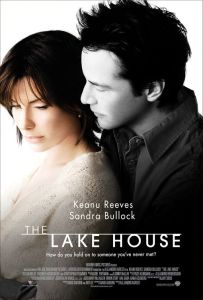 The first time I saw the trailer for The Lake House, a time-travel romance that reunites the stars of Speed, I said to myself at its conclusions, “If this lake house drops below 55 miles per hour…” I know, I’m a comedic genius, that much is obvious but what I was really reminded of was a 2002 film called Happy Accidents, a delightful gem of a movie with a similar time-travel romance. In that film you felt like anything could happen with its intricate plotting and off kilter, potentially seriously disturbed characters. Now it seems like Hollywood’s on board. The Lake House is based on an Asian film I’ve never heard of (though, in all honesty, I’ve never heard of 99.99% of them; sorry Asian cinema). This new East-West The Lake House doesn’t come across as that romantic but it’s hard to deny its points of interest.
Kate (Sandra Bullock) has taken a new job in Chicago and is moving out of a giant glass house on stilts that overlooks a lake. She leaves a note for the new resident, Alex (Keanu Reeves), an architect that struggles to fulfill his talent and his father’s (Christopher Plummer) legacy. Alex is confused; to his recollection, no one has lived in this house for years. Kate writes back and slips her notes into the nearby nostalgic mail box. But there’s something magical with this mail box. Kate is living in the year 2006 and Alex is living in the year 2004. Neither understands how it’s possible they’re even communicating by transporting letters through the mailbox. What’s even worse is that they’re falling in love with each other through their correspondence. Talk about your long-distance relationships.
 To go along with this kind of movie you really need to take it at face value. Once you start that slippery slope of questioning paradoxes of time travel or the narrative plot holes, you’ll be left in the cold for the remainder of the film. Yes, there are all sorts of logic paradoxes to clog the brain with, like the fact that every time Alex does something thoughtful, like plant a tree by Kate’s building, she won’t notice because she’s never had memories of anything being different. The characters themselves just shrug at the movie’s concept and accept this bizarre predicament. No explanation is given for this short circuit in the time space continuum, and frankly, no explanation is needed. The Lake House is not emphasizing the “why” but more the “what now?”
The Lake House is still a Hollywood romance in most senses. There’s little doubt that a happy ending is just around the corner, but at least the wrinkles and the road map to that point are not altogether predictable. The typical big moments are foreseeable, including that ever popular 11th hour misunderstanding, but The Lake House manages to tickle with surprise in the details of its journey. You don’t so much pull for the leads to get together but just see them tackle this mighty daunting obstacle before them.
The biggest flaw of The Lake House is that you never really believe these sad pretty people are falling in love. There is something indelibly romantic about falling in love with someone just from their words, constructing a potential soul mate with the few puzzle pieces given to you through long correspondence. Unfortunately, there’s nothing in those many pieces of parchment that Alex and Kate pass along that pinpoints why either pen pal would fall for the other. Both seem to have spotty luck with the opposite sex or are at least seeking more from a mate. But if The Lake House is any indication, these people have been chiefly seeking celibacy and verbosity in a mate. They talk about their lives, they talk about their pasts (in Kate’s case is a bit more extended), but it’s not too long before they start swooning and clutching those letters ever so tightly. The audience is left to fathom what invisible combination must have been unlocked that these sad pretty people have fallen for each other. While a lack of sustainable, let alone believable, romance in a romantic drama might be disastrous, at least The Lake House has a conceit strong enough to engage the brain even if it fails to engage the heart.
 The time jumps manage to keep the audience on its toes, plus there’s some fun in witnessing Alex and Kate try to locate each other and become bewildered. Director Alejandro Agresti (Valentin) and playwright David Auburn (Proof) play around with different techniques like split-screens and dissolves to present their lovers together. The conversational back-and-forth voice over does present problems; how exactly can they interrupt each other? The Lake House leans a little too hard on faith that we want to see these people end up together. Problem is that Kate and Alex are essentially void of depth; two characters defined more by the clunky subplots around them than their own personalities. Bullock and Reeves don’t help matters much, each perpetuating a vacant pretty android quality, like they’re waiting for a button to be pushed to explain human emotion.
I don’t know about you but if I was writing to someone in the past I’d use my knowledge and tell them to play certain lottery numbers or sports bets (“The Red Sox win what?”). Maybe it’s simply unromantic to start the basis of a relationship on gambling earnings. Then again, maybe it’s just unromantic to start a relationship with Keanu Reeves anyhow.
The Lake House is an old fashioned Hollywood romance but with some intriguing wrinkles and a playful structure. There’s a degree of predictability, the high-wattage stars fail to generate even low-wattage heat, but with the time-slip premise the film cannot be judge as familiar. The unusual situation and obstacles presented are more interesting than the main characters. Their love feels artificial and neither Kate nor Alex is rather deep, involving, or particularly smart (e-mail anyone?). Despite the limited help by the leads, The Lake House is a pleasant, different, if not terribly romantic Hollywood drama. For Hollywood, sometimes “pleasant and different” is enough for an enjoyable evening with the stars and someone special by your side. For everyone else, rent Happy Accidents.
Nate’s Grade: B


 nathanzoebl
You must be logged in to post a comment.