Blog Archives
Mamma Mia! (2008)
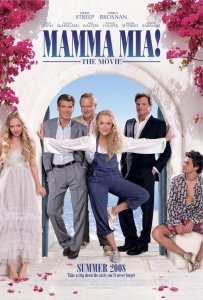 Mamma mia here we go again. This movie is going to be a middle-aged woman’s dream come true. It boasts a cast whose median age is in the mid 50s, one former yet still dashing James Bond, lots of good vibration getaway vibes, songs by a pop group whose heyday was over 30 years ago, and a heaping helping of girl power. In short, Mamma Mia will entertain the same mixture that made Sex and the City a monster hit, notably middle-aged women, teen girls, and gay males. I’ve seen the stage show and enjoyed it, as have millions of others around the world, but the movie fails to capitalize on reaching a broader audience. Mamma Mia is content to serve the faithful and delivers a less than satisfactory product. The world of cinema is not the best place for this material.
Raised all her life on a Greek island in a Mediterranean paradise, Sophie (Big Love‘s Amanda Seyfried) is getting married. Her disapproving mother, Donna (Meryl Streep), runs a hotel and has raised her daughter by herself. Then one day Sophie goes through her mother’s diary and discovers she has three possible fathers, Harry (Colin Firth), Bill (Stellan Skarsgård), or Sam (Pierce Brosnan). She invites all three to the island to vet her real father. In agitated response, Sophie invites her old gal pals Rosie (Julie Walters) and Tanya (Christine Baranski) to help her during this paternity crisis. Over time old loves will be rekindled, new love will bloom, and there will be a lot of singing.
 Let Mamma Mia stand as a future testament as to why you do not generally let someone helm a film when they have no film experience whatsoever. The creative talent behind the hit Broadway musical refused to grant anyone in Hollywood the rights to their worldwide sensation. So the stage director, Phyllinda Lloyd, is now also the film’s director, and oh my goodness was not the right choice. Her film inexperience shows with every second. The movie just doesn’t look right from beginning to end. There’s a noticeable “off” sensation due to Lloyd poorly shooting her scenes, editing her scenes, and directing her actors. I kept wanting, through sheer force of will, to nudge the camera angles, to change the composition a tad to make them more visually appealing, because Lloyd shoots the movie in bland static angles with minimal coverage. Mamma Mia looks so amateurish and fussily so, like Lloyd is purposefully thumbing her nose at the art of cinema. Lloyd also doesn’t bother to place any choreography in her scenes, and her actors just sort of spin and sway to the music like they were dancing in front of a bedroom mirror. It’s remarkable that a movie with so much riding on it looks so shoddy.
Presented in the reality of a stage, Mamma Mia is a shallow but fairly fun time. The movie version transports the musical into an actual Greek locale, which, to knock Lloyd yet again, she makes no real use out of (she mostly shoots her actors against rock faces and under harsh, glaring sunlight). What works on stage, when presented under the pretenses of the real world, comes across as incredibly cheesy and goofy beyond all relief (get a load of the high-stepping snorkerlers). The song and dance numbers, the character interactions, the sitcom generic plot (ripped off from 1968’s Buona Sera, Mrs. Campbell), they all start to transform into camp and beg for mockery. All of a sudden the entire island turns into a Greek chorus and provides backup during the impromptu singing. It’s strange and comes so late that it never feels properly established. The characterization is pretty slim, and once the movie establishes its characters it pushes the petal to the floor. The plot whizzes by in a whirlwind of one Abba song after another, with minimal breaks in between just to change setting and barely elbow the characters forward. I don’t think the actors had any chance to breathe in between the song numbers because I know I could barely exhale before another song assaulted my senses with forced giddiness.
But here’s the odd thing. The film is so silly and played to constant high-energy capacity that after a while Mamma Mia begins to wear you down. You may begin to smile, you may begin to clap, but you’ll be guaranteed to start humming the incredibly infectious tunes. Mamma Mia is essentially an Abba jukebox with a third-rate story strung along for the ride. As a story, it leaves much to be desired, but as a musical experience it makes you realize how glorious those Abba songs are. They’re like perfect pop bundles that somehow make you feel better even if the lyrics are more bittersweet than you realize at the time. The 18 Abba songs showcased, along with a few others during a weird curtain call sing-a-long, will certainly lift your spirits just as long as you concentrate more on the music than on the often-forced context.
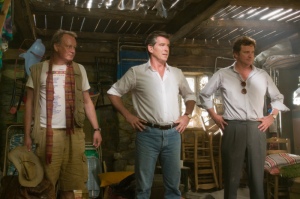 The actors are better than the material, clearly. Streep is her generation’s finest actress but she tries too hard to convince you of the great girl-power fun she’s having. The singing, on the other hand, is all over the map. Streep and Seyfried have the strongest voices of the bunch, which is good considering they also have the most musical numbers to sing and twirl to. Neither has a particularly sensational voice but then again they certainly distance themselves from their pitiful peers. Most of the other actors just have droning vocals but Brosnan, oh boy, I have to congratulate the man for having the courage he does. You feel embarrassed for the guy; I mean this is James Bond here. I found myself turning away whenever he opened his mouth, not wanting to look the man in the eye. Every time he started singing my theater crowd of Mamma Mia faithful began snickering and giggling. I almost feel so bad that I should send the guy a card saying, “Sorry about the singing, but hey, you’ll always have the paycheck.”
The real audience for a Mamma Mia movie is the fans of the Mamma Mia theatrical show, and the movie is tailored to their interests. The big screen version isn’t interested in converting new fans, hence the amateurish direction and disregard for reaching out for broader appeal. Mamma Mia the movie is pretty much a less zippy and ten times goofier version of the stage show except with bad singing. If that sounds like a fun evening out, then by all means enjoy. This is a mess of a movie and not a terribly good movie at that, and yet the power of those Abba songs will inject enough goodwill that you will forgive some of the movie’s transgressions. Some. Pierce Brosnan’s singing is something that cannot be forgiven nor forgotten.
Nate’s Grade: C+
Share this:

Sweeney Todd: The Demon Barber of Fleet Street (2007)
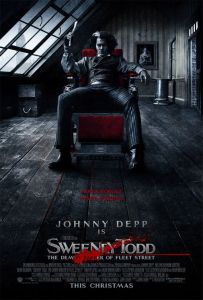 Famed musician/lyricist Stephen Sondheim’s tale of murderous barbers, cannibalism, and poisoned hearts first debuted on Broadway in 1979. Sondheim has been very protective of his material when it comes to film rights, but it wasn’t until the combination of visionary director Tim Burton and acclaimed actor Johnny Depp that Sondheim allowed his revered musical to be made into a movie. The result is faithful production that expands the scope of the musical while maintaining an intimate, chamber-music feel. Sweeney Todd flirts with being a masterwork but settles for being incredibly damn entertaining.
Benjamin Barker (Johnny Depp) returns to London after 15 years in prison on a flase charge. Judge Turpin (Alan Rickman, suitably creepy) wanted Barker’s wife for his own and conspired to have the barber sent away. Now under the auspices of Sweeney Todd, Barker has come back to seek his wife and daughter. He sadly learns that his wife is dead and his teenaged daughter, Johanna (Laura Michelle Kelly), is the ward of the Judge. Sweeney reopens his barber business above a flagging pie shop run by the eccentric Mrs. Lovett (Helena Bonham Carter). Sweeney plots his revenge against the Judge and his henchman, Beadle Bamford (Timothy Spall, suitable rat-like). Anthony (Jamie Campbell Bower), who traveled with Sweeney back to London, has set his sights on Johanna and intends to run away with her as soon as she can escape the Judge. Meanwhile, a rival barber named Pirelli (Sacha Baron Cohen) recognizes Sweeney from the old days and wants his silence paid for. It’s not too long before things get dicey, throats get cut, and people get turned into meat pies.
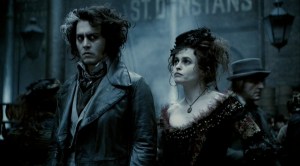 People unaware of the Sondheim musical are going to be in for a big shock. The film is about 80 percent sung, and the singing never rises to big, show-offery numbers of crescendo power vocals; the songs are more in the variety of speaking and vocals frequently overlap. The movie has greater clarity to the lyrics, and for the first time I as able to actually decipher Joanna’s words in the song “Green Finch and Linnet Bird.” Fans of traditional musicals, the kind that feature songs centered on female deer or large corn exporting states, may be aghast at how adult and violent the musical is. It’s just as much a grand horror movie as it is a musical. No doubt people are not generally accustomed to soaring medleys set to gashed throats and spurting blood. Sweeney Todd is captivating tale where almost all the characters are villains in some sense, and yet you do build sympathies even after innocents are killed and baked into flaky desserts.
Unlike other recent big screen versions of popular Broadway song-and-dance shows, Sweeney Todd is not simply the stage version transported to a bigger stage. This is a movie, through and through, and a perfect marriage. Burton is the perfect visionary to filter the twisted sensibilities of Sondheim’s masterpiece onto the silver screen. As a director, his work has been artistically backsliding since the start of this decade, but Sweeney Todd puts a firm stop to that. The technical aspects of Sweeney Todd are brought to life with great care and imagination. The Gothic sets are gorgeous and the costumes and cinematography are fitfully drab and dour, like everyone is living in a silent movie devoid of color; it takes a lot of hard work to create a near monochromatic playing field for the actors. And so when the blood does splash, and oh does it splash, the film pops with vivid color. Sondheim’s playful lyrics and rapturous music has never sounded better; it practically swoons.
The movie opens up the play in ways that a staged performance never could. Instead of keeping a distance from the bloodletting, usually something symbolic or as graphic as coloring a red line across a victim’s neck, Burton thrusts the audience right into Sweeney’s shop. The blood sprays in bright geysers and the violence is fully realized, fully felt, even if it’s never terribly realistic. The full weight of Sweeney’s vengeance and eventual destructive madness can be felt when the audience is witness to its wrath, and that includes the graphic murders. The medium of film ups the horror elements and transforms Sweeney Todd into a stronger work by amplifying the tension. The last scene with Mrs. Lovett is far more haunting than anything that could have been achieved on a stage. Burton also adds lots of dark humor thanks to his open visual palate, like during the song “By the Sea” where Mrs. Lovett fantasizes about her and Sweeney cozying up together in different scenarios. The film transports the viewer to the different pretend locales all the while Depp remains gruff and indifferent. He maintains the same curmudgeon from fantasy postcard after fantasy postcard. It’s the cheeriest segment in a grimly perverse musical that could rival Hamlet for dead bodies.
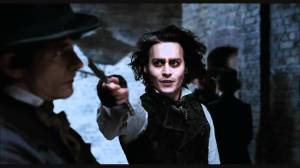 In an effort to slice a three-hour musical to a manageable two-hour movie, screenwriter John Logan (The Aviator, Gladiator) has pruned the story down to the essentials, namely everything that impacts Sweeney’s ultimate pursuit of vengeance. Johanna and Anthony, the hopeful lovers, have been pared down the most. Their only scenes now revolve around intruding upon Sweeney or helping him meet his venomous goals. The lecherous songs the Judge sings to himself about his lust for Johanna has also been cut (my wife was severely disappointed by this cut, saying, “You’ve got the Rick, come on!”). The most notable omission is the opening medley “The Ballad of Sweeney Todd” that serves as a Greek chorus-like overview of the sordid tale ahead. The song provides a lot of back-story and exposition that can be more easily covered by Burton fashioning visual flashbacks of Sweeney’s former life. The ballad and other absent songs are still used instrumentally throughout the film. Logan has also turned Toby (Ed Sanders), Pirelli’s assistant, into a much younger character, turning him into an urchin boy with fresh memories of life in a workhouse. I’m not entirely sure Toby’s protective song to Mrs. Lovett “Not While I’m Around” becomes an ode to puppy love and loses some believability. Also, normally Toby is played as a man-child who isn’t entirely whole in his mental faculties; however, the movie version turns him into a plucky Oliver extra. It seems less devastating and tragic.
But what about the singing? Depp won’t be knocking down doors on Broadway anytime soon but he delivers a very satisfying baritone that, while lacking in power or refinement, delivers in spades with emotion. His singing is full of great texture. His song “My Friends,” an ode to being reunited with his razors, is full of brio and nuanced longing, but he really shows his talent when Sweeney loses it. He’s a man obsessed with vengeance and when it escapes his grasp he snarls with scary intensity. When he launches into “Epiphany,” where he determines the whole human race is fit to have their throats slit, he barks at strangers on the street and howls at the sky, smiling at his glistening razors in hand. What can be forgotten with musicals is that there is so much more to a performance than simply an adept ability to sing the right notes. With Sweeney, Depp spins an incredibly rich performance that plumbs the dark recesses of a man whose only purpose is vengeance. In the end, when he’s saturated in blood and the full reality of his actions is upon him, Depp goes from remorse to psychosis to horror to acceptance in, like, a minute flat. Seeing such a classic Broadway character done justice by an actor of Depp’s immense talent is thrilling and a bit of a relief to Sweeney fans.
 Carter has the weakest, thinnest voice of the cast. Mrs. Lovett is a larger than life figure that has been played on Broadway by the likes of Angela Lansbury and Patti LuPone. The role is usually played more boisterous, more comically broad. It’s a juicy part and full of brash bravado. Carter stumbles through “The Worst Pies in London” and she seems to step all over her lines, rushing through and losing the comedic flavor. But like I said before, a performance is so much more than singing, and it is here where Carter imbues great complexity to her role. Her unrequited love for Sweeney consumes her and her relationship with Toby places her in an awkward predicament. Carter flashes a wealth of emotions through the power of her eyes. It’s a battle between maternal and sexual urges. Stylistically she resembles a rag doll someone tossed in the trash but it all works.
It’s refreshing and exhilarating to see a perfect marriage of material and artistry. Burton has transported Sweeney Todd into a faithful and jubilantly dark movie that doesn’t shy away from the grotesque. It’s a stirring, wonderfully Gothic rendition of Sondheim’s masterpiece. Sweeney Todd is blissful, spirited entertainment that’s not exactly for the squeamish, but this is one musical that can simultaneously touch the heart while turning the stomach.
Nate’s Grade: A
Share this:

Dreamgirls (2006)
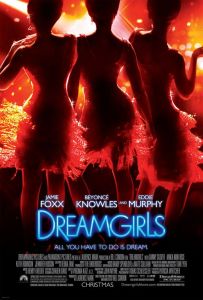 When the smoke cleared after the 2006 Academy Award nominations, there were some media members in disbelief. How could Dreamgirls, an expensive, glitzy musical that many perceived as the front-runner for Best Picture, fail to even get nominated in the Best Picture category? Theories abounded; the mostly white Academy couldn’t acknowledge a movie steeped in black culture, the film fell prey to backlash against a momentous hype machine that rubbed people the wrong way, or even that it was unfairly judged against recent musicals, like 2002’s Best Picture winner Chicago, instead of being judged on its own merits. After having now seen the film, I have an altogether simple explanation: the Academy thought there were better movies and I couldn’t agree more. Here are five reasons why Dreamgirls just didn’t cut it.
1) The film just falls apart after the halfway mark. The focus is on the rise of the all girl group the Dreamettes in the 1960s Detroit music scene. Effie (Oscar-winner Jennifer Hudson) is the strong-willed lead singer with big curves and a big voice. She’s pushed out of the way by her band mates so pretty face Deena (Beyonce Knowles) can front and sell records. Effie is our star and she doesn’t take the news well, and explodes in an emotional fury that results in the film’s true showstopper song, “And I Am Telling You I Am Not Going.” Trouble is, there’s still an hour of movie left. The second hour of Dreamgirls feels like a plot layover, as our characters don’t do much more than stuff their hands in their pockets and grumble. It’s astonishing how deflating the second hour to this movie is, and the film cannot sustain a viable interest or energy, leaving the audience to tap their toes to songs that already ended an hour prior. It’s a troubling sign when a film peaks at the halfway point and seems to only stall and sputter after.
 2) The songs are not that special. Dreamgirls would have been far more entertaining if what we got was some honest, soulful, groove-inducing Motown music. Instead, what we get is the same pop filler that the characters bemoan what commercialism has transformed their music into. None of these ditzy ditties are very memorable and many of them start to just blend together, thanks in part to montage-obsessed editing. The other focus of Dreamgirls is on the rise of Motown, how a very Berry Gordy-like figure, played by Jamie Foxx, patterned black music and made it hit for white listeners. I think this was the most depressing part of the film for me, the fact that I could have done without the music in a musical.
3) The tone lacks clarity and can be grating. For about 80% of the movie when the characters sing it’s on stage as performance. Then two characters sing their displeasure with each other and the audience is like, “What the hell?” I accept the laws that govern musicals, and people spontaneously bursting into song and choreographed hoofing does not bother me, but whatever the choice it needs to be consistent. When the audience is used to seeing the singing contained to the stage, it becomes jarring when it transpires in reality. Director Bill Condon (Kinsey, Gods and Monsters) cleverly worked around this problem in his screenplay for Chicago by placing all the song-and-dance moments as glimpses into one woman?s musical-obsessed psyche. It seems so careless and easily remedied, so what were they thinking?
4) Dreamgirls is desperate for Oscar attention. At the end of the movie, after an awfully messy run to the finish line, come the end credits, however they aren’t so much as end credits as they are “for your consideration” ads. When the director of photography credit appears you see a man in a camera crane. When the costume designer is credited we see her sketches and the real outfits side-by-side. Some of it is silly, like when the casting director is listed and we see, no kidding, a checkerboard of faces, like the movie is saying, “This is what a casting director does, look.” The sequence is moderately annoying and a little patronizing, but it is a splendid example of the filmmaking ethos. It feels like the over zealous studios thought that by throwing together a bunch of musical staples and covering it with fancy decoration that they could fool audiences into thinking they saw a full-blooded story.
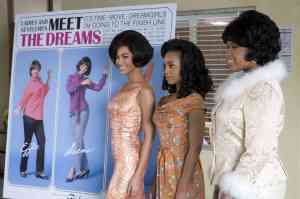 5) You fail to feel for any of the characters. In the rush of production numbers and period detail, the characters all suffer horrendously. The Dreamettes are obviously a take on the Supremes, and Deena is obviously supposed to be Diana Ross; they even recreate iconic Diana Ross pictures with her. By this token, it seems like the filmmakers felt they could slack off on characterization and just banish their actors to the ghettos of genre archetypes. I didn’t feel for anyone, even Effie once she got her walking papers for being essentially fussy, overweight, and sticking with her integrity. She tries to pick up the pieces of her life but even she seems disinterested once the stage lights no longer shine upon her. The characters have about a dewdrop of depth to them and can be summarized each by one sentence. Shallow characters and a less-than-compelling second half doom the movie.
There are enjoyable aspects to Dreamgirls, notably the performances from the supporting players. Eddie Murphy experiences nothing short of a career resurgence playing Jimmy Earl Haley, a groundbreaking soul singer with a fiery stage presence. Murphy puts his all into the performance and is such a live wire that Dreamgirls seems downright downtrodden without him. Former American Idol contestant Hudson has been collecting accolades for her diva-like performance, and while her singing is full of bluster and verve, I cannot say the same for her acting. She gives a solid overall performance but doesn’t try hard to hide her inexperience with acting. I wouldn’t have given Hudson an Oscar, but then I wouldn’t have given Oscars to a lot of the eventual winners (Julia Roberts, your hardware rightly belongs to Ellen Burstyn).
Film critic David Poland was nearly beside himself with Dreamgirls‘ omission from the Best Picture contenders. He argued that had it been nominated it would have won (I’m not sure how that logic works, but I do have a bridge I’d like to sell Poland). Dreamgirls is not bereft of technical charms and entertainment, but to posit this as anything above a mediocre musical is just plain madness. The characters barely leave an impact, the music is the same pop pap it laments, and the movie just simply peaks too soon. There’s nothing daring or innovative with this song and dance revue, and for long periods it feels like a pandering exercise in dress-up and nostalgia. I suppose in the end the Academy just thought there were five better movies than Dreamgirls, and, for once, I agree with them.
Nate’s Grade: C+
Share this:

Rent (2005)
 Rent is one of Broadway’s biggest sensations in the last decade and has become a cultural cornerstone for many. Jonathan Larson updated Puchini’s famous opera La Boheme, transplanting the setting to East Village New York, swapping TB for AIDS, and turning his characters into struggling bohemians fighting for their voices to be heard and love to be kindled. The musical also has an added sense of tragedy. Larson suddenly died on an aneurysm during the final dress rehearsal, sadly never getting to see his finished creation. Rent went on to win Tonys (including Best Musical), a Pulitzer Prize, and damn near the heart of every girl I went to college with. To say it’s been a smash is an understatement. And where ever there’s money and an insatiable audience, there will be Hollywood’s eyes. Now comes time for the Hollywood gloss with director Chris Columbus (Home Alone, Stepmom) and when Rent ditches the intimate confines of theater and hits the big screen, it’s much harder to hide its flaws.
The story takes place within the span of one year (or 525,600 minutes as you’ll be told repeatedly in song), covering Christmases from 1989 to 1990. Mark (Anthony Rapp, Dazed and Confused) and Roger (Adam Pascal) are roommates trying to keep warm during the winter in their giant New York loft. They’re flat broke and their former friend and current landlord Benny (Taye Diggs) expects a full year’s rent to be paid pronto. Roger is racking his brain trying to write that one perfect song; he’s also HIV positive, the unfortunate side effect of a relationship with a junkie. Mark is an aspiring filmmaker and has also recently been dumped by the impetuous performance artist Maureen (Idina Menzel) for … another woman, Joanne (Tracie Thoms), a lawyer. It must be noted that all three of these characters do not have HIV/AIDS; they’re in the minority. Tom Collins (Jesse L. Martin, Law and Order), a gay school teacher, is visiting Mark and Roger when he gets mugged in an alleyway. Angel (Wilson Jermaine Heredia), a drag queen with a heart of gold comes to his rescue. Both men have HIV but won’t let their shortened time stop them from falling in love with one another. Mimi (Rosario Dawson) lives below Roger and Mark and works as an exotic dancer down the street. She too has HIV from a nasty smack habit. She also has her heart set on Roger but he needs a little motivation. For a year these characters will interact and live, love, die, and sing a whole lot.
 The villain of the piece seems to be Benny by default (unless you count AIDS, poverty, and ignorance). Our unemployed band of heroes is upset because dear Benny expects them to, gasp, pay their rent. The scoundrel! Here’s what I don’t get; clearly Benny has a dream for a business and the other artists denounce this artistic dream because it involves money exchanging hands. Benny’s passionate about his dream and actually does something productive like make friends and influences with the business establishment, people with capital to bankroll an entrepreneur’s dream. It’s like everyone’s mad at Benny because he put a suit and tie on and got a job.
Besides, there is something inherently pretentious about Rent’s anthems of sticking it to the man and brash commercialism. Guess what, after 9 years Rent is a franchise. You can get Rent T-shirts, coffee cups, soundtracks, and practically anything that can be merchandised and marketed to the disenfranchised youth with disposable incomes. A musical about the soullessness of commercialism is itself a cash cow, so it rings a little hollow when the deadbeats thumb their noses at the evils of capitalism. Seriously, Mark just about gets hives at the thought of being a cameraman for a TV news show (he calls it “selling out”). In the end he quits his job so he can make his masterpiece … cobbling together home movie footage.
The film version of Rent is populated with 6/8 of the original Broadway cast (Dawson and Thoms are the only fresh faces). This is a well-intention move by Columbus but it backfires. It’s one thing to listen to 20-something bohemians fight for their artistic integrity and worry about food, shelter, rent. It’s quite another thing when the majority of your cast is in their late 30s. You’ve gone from a bohemian to a potential bum. I’m not condemning the pursuit of your artistic ideals and making your name in the world, but not at the price of food and shelter. I’m reminded of a line from The Big Lewbowski: “Your revolution is over! The bums lost. The bums will always lose!”
 It’s hard to feel for some of these characters, who come across as whiny, pretentious, or just plain misguided. Maureen is irritated that her life partner is upset that she was flirting during their engagement party. I mean, really, what’s to get upset about? It’s pretty bad when Rent kills off one of its main characters in a musical montage. A MONTAGE! Afterwards all the characters eulogize what made this person so great. Hey, all that character stuff would have been handier before the death, and then I would have felt something.
Some of these same problems exist with the original stage version, but Rent the movie, and especially Columbus as director, make some bad additions. The original stage version of Rent took place in modern day when it opened. Here, Columbus has dialed back the timeframe and set his story from 1989-1990 (someone forgot that a song references Thelma and Louise, which came out in 1991, but oh well). What makes this time jump shaky is that the film also adds a scene of the happy families championing each other over their racially mixed lesbian daughters’ engagement. They moved time backwards but people’s tolerance was moved forward. That’s not all. It’s bad enough that Roger has a Bon Jovi haircut for the entire film, but then Columbus adds scenes of his escape to New Mexico and we, the audience, are treated to Roger belting his heart out to nature on top of a desert gorge … just like in Bon Jovi’s “Blaze of Glory” music video. Maybe this finally explains why they transported the film to the 1980s.
Where the musical does strain credibility is its fear of fulfilling the dark end of Puccini’s opera. Moulin Rouge! is also based on Puccini’s tragedy and it had the guts and the ambition to end on a tragic note. I‘ve cried at the end of Moulin Rouge!, but I didn’t feel like misting up during Rent. (Spoilers) It’s rather terrible that Mimi can be brought back from the dead by the power of a cheesy rock ballad, and if this holds true, then Bon Jovi is wanted to the E.R., stat! The cheap fake-out ending for Rent is just the nail in the coffin. Everyone has AIDS and thus on borrowed time and yet we can’t have an adult ending dealing with tragedy.
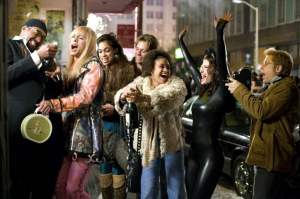 With all this in mind, some things in Rent really do work. The songs are catchy, somewhat fun, and the splashy lyrics follow suit. The cast collectively are entertaining and sing well, though Dawson can get a bit monotone at times. Some of the dance numbers are exciting and amusing, like the “Maureen: Tango” between Joanne and Mark chatting about the spotty behavior of their former and current lover. At one point we flash to them in full classic dress buffeted by a chorus line of fellow tango-ers. “La vie Boheme” is the sassiest and most electric song, finally piecing Larson’s sardonic, witty pop culture lyrics with a lively image. This is a musical that’s got clever lyrics, good singing, and catchy pop rock songs.
For many, especially the Rent heads, a movie version of their favorite musical will be bulletproof. They’ll be thrilled to enjoy an afternoon with their best friends on the silver screen singing their favorite harmonies. I’m sure fans of Rent and fans of broad musical theater will be pleased. For me, the movie falls apart when you pay attention to the story, the characters, the drama, and then the choices in adapting it to film. I just didn’t care for most of the characters and found the story dated, pretentious, and overly romantic, even if the majority of the characters do have HIV and/or AIDS. Columbus’ poor decision making turn Larson’s rock-opera into a movie that wants points for being different when everything about it has practically become marketable and cliché. I’d recommend buying the soundtrack instead of seeing the movie, because at least then you can turn it off when you reach your breaking point.
Share this:

Finding Neverland (2004)
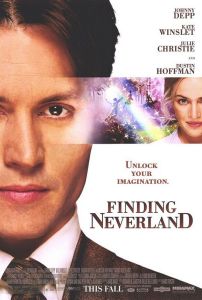 My friend George Bailey and I came to a similar conclusion during a recent conversation. There are a handful of movies, usually released around this time of year, that are packed to the gills with awards hype and general goodwill. Then I see them and feel underwhelmed for whatever reason and I walk out and feel that I should like the movie more than I do (if I do at all). I don’t know what to call it, societal guilt, elitism, but this is exactly what I felt when I left Finding Neverland.
J.M. Barrie (Johnny Depp) is in search of his next play. It?s 1903 London, and the financier (Dustin Hoffman) of his last play has taken a financial bath. Barrie’s also emotionally closed off from his wife (Radha Mitchell). One day in the park, Barrie stumbles across Sylvia (Kate Winslet), a widow managing four boys by her lonesome. Barrie takes a shining to her children and delights in spending long days with Sylvia and her boys. From his encounters with Sylvia and the boys, Barrie works up the inspiration to write a new story, called Peter Pan. Of course the public has its own gossip about a married man gallivanting about with a widow and her boys (think recent Michael Jackson scandals). Then there?s Sylvia?s mother (Julie Christie), who is set to put her house back in order starting with removing Barrie from their lives.
 The message of the movie is about the need for adults to slow down, open their imagination, and become bewitched by the power of believing. Because it’s not like there aren’t any other Hollywood movies out there that teach us to loosen up and enjoy life. Thank you Finding Neverland, I never would have found this out by myself. The message of belief overpowering all is also a bit naive, but then it works into the whole cross-stitching of sap the movie is generating.
Not even Depp can save the film. Long established as one of the most versatile and exciting actors, Depp finds ways to disappear into his oddball characters. In Finding Neverland, Depp sports an impressive Scottish brogue, but, sadly, this is the most impressive aspect about his performance. There had been much talk about Finding Neverland being Depp’s next opportunity at finding Oscar, but it would be a shame if Depp won for such a lackluster, artificial performance especially when he’s been brilliant so consistently in other movies. J.M. Barrie was somewhat eccentric, but in Finding Neverland he comes off as mostly vacant. The film tries to show that Barrie didn’t really fit in, but instead of becoming a showcase for Depp’s acting it becomes a showcase for Depp’s silence. The performance is so subtle that it doesn’t even come off as a performance. If Depp stood in the background of a movie, it would be akin to this performance.
Winslet has also been a very versatile actor. Her role in Finding Neverland never really deepens beyond Disadvantaged Woman. She’s been hit by adversity, she’s beset by four rambunctious kids and an icy mother, but that’s about all the film does for her characterization. Winslet is a tremendously talented actor, as evidenced by her Oscar-worthy performance in this year’s Eternal Sunshine of the Spotless Mind. So why strand her in a role where her character’s greatest acting moment is coughing fits?
Director Marc Forster (Monster’s Ball) has the frustrating habit of having two shot styles he shoots in. He decides between medium shots which usually involve two or three people, or large close-ups. While I was watching Finding Neverland I never once thought to myself that something was filmed in a visually interesting way. Some of Forster’s decisions seem unnecessary, like when he has to visually show us scenes of imagination instead of allowing the audience to, gasp, use their own imagination (hey, isn’t that the message of the movie?).
Finding Neverland tries so hard to be a three-hanky movie (and truth be told I heard a lot of sniffling in my theater during the last half hour), but what stops the film short is how unbelievably transparent everything is. Finding Neverland could have explored the rich complexity of an enigmatic figure like J.M. Barrie, but instead it settles for goopy sentimentality at every opportunity. Barrie becomes sugar-coated into an earnest father figure, and in the process key facts are sugar-coated as well. What do you mean? Well, Sylvia’s husband didn’t die until several years after Barrie wrote Peter Pan. Barrie’s wife didn’t have her affair until long after Peter Pan. Also, the original Peter threw himself in front of a train because of how upset he was about his connection to the famous character. I guess that’s why this is a biographical movie merely “inspired” by true events, much like Hidalgo.
The filmmakers rely on cloying tricks to make an audience care about its characters. The movie paints in very stark black and white tones, mainly “adults = shortsighted” and “children = special.” This is a film that is proud to take the easy road and makes little effort to cover its pride. It plays toward audience expectation and thus loses any long lasting magic.
Finding Neverland takes the easy road for audience-friendly sappiness. Barrie insists that 25 orphans be strategically placed around the theater on opening night of Peter Pan. Sure enough, the theater is full of old white men with monocles, and apparently they just don’t get the spirit of theater. The orphans laugh and squeal from the stage antics, and somehow this triggers all those old curmudgeons to learn to laugh once again. You see, all it takes is strategically placed orphans to make us laugh at life again.

When Sylvia is hanging laundry she starts to gently cough. If you’re smart, you’ll instantly figure out what trajectory is in store for her, but even if you miss this single cough don’t worry, because Sylvia will be doubled over with coughing later to spell it out for everyone. You can all but see the strings being pulled (the audience will cry… now!). All can be overcome in the end, those who didn’t understand will, and we’ll all be happier and live life to the fullest, in theory of course.
Finding Neverland wants to be Shakespeare in Love, another whimsical movie that shows how a writer utilized the people and events around them to pen a masterwork. Except in Shakespeare in Love there was a romance to fall back on, as well as some ripe comedy, but with Finding Neverland there isn’t anything to fall back on. It’s a Hallmark card mass-marketed to the largest possible audience.
Everything about Finding Neverland is disappointingly under whelming. The direction is shabby, the actors are marooned by their weak roles, and nothing is sacred in the film’s pursuit of that tearjerker ending. This is a movie for people that ask little of their movies, and yet I can reasonably see Finding Neverland becoming an audience favorite and riding good word of mouth all the way to awards season. Finding Neverland is a film that never takes flight because it’s too content to stay grounded by going the easy route.
[Nate’s Grade: C
Share this:

Chicago (2002)
January at the theaters is a tale of two kinds of films. One type are the studio bombs (take Just Married and Darkness Falls, please take them far away). The other type are the prestige pictures expanding their releases in hopes of garnering some of that Oscar magic. A lot of prestige films were released around the holidays and though not every one could be a winner, they were all better than Kangaroo Jack. Well, except for The Hours.
 Chicago (2002)
Premise: Roxie Hart (Renee Zellweger), hungry for fame, finally grasps it when she kills her lover and is put on trial. Silver-tongue lawyer Billy Flynn (Richard Gere) stirs up the media in her defense, as well as for another starlet killer, Velma Kelly (Catherine Zeta-Jones).
Results: A song-and-dance picture thats quite toe-tappin with imaginative numbers, even if I can only remember like two songs. A surprisingly steady Zeta-Jones really shines and Gere can cut a rug. Chicago is just lively fun. Blink and youll miss Lucy Liu in it.
Nate’s Grade: B
Share this:

Hedwig and the Angry Inch (2001)
 John Cameron Mitchell directed, adapted from his stage play and stars as the sexually confused rock mega-star Hedwig. Hedwig was a boy trying to escape from the constraints of soviet occupied East Germany. His lucky ticket came in with a GI who agreed to marry Hedwig and take him out of the country with him, but Hedwig had to go under the knife and become a proper lady before their escape was to ensue. When the sex change operation is botched it leaves Hedwig with a single nub-like inch left causing gender confusion (“Six inches forward, five inches back”). Dumped by his GI Hedwig turns to song and befriends a lonely and confused boy Tommy Gnosis (Michael Pitt). Their courtship seems to be going fine until Gnosis steals all of Hedwig’s songs and uses them for his own superstardom on MTV. Hedwig’s defense is to pack up a traveling band and to perform at various salad bars and trucker diners in the same town Gnosis travels to. It’s during these performances that Hedwig dishes about her unusual life.
Unlike most plays turned into films, Hedwig has been adapted for the medium of cinema. Animations, clever camera tricks and sing-alongs follow our story, making it an exhilarating film going experience. Hedwig is excitingly original and spilling over with passionate energy that can’t help but transfer to the audience. Mitchell proves himself a born filmmaker, but also a rock star. Many of the songs of Hedwig are quite listenable and could be found on some music channels. Hedwig is a trans hero for all of us and Mitchell delivers a fresh and resoundingly funny, sad, and technical achievement of a movie.
Nate’s Grade: A
Share this:

Topsy-Turvy (1999)
 Mike Leigh’s latest might prove to be the old Brit’s most daring and ambitious spectacle of memory. It’s the tale of English musical maestros Gilbert and Sullivan chronicling their rocky yet firm relationship and the bustle of theater life. The period is set down exquisitely with massive amounts of elegant costumes and set designs, all of whom do well to distract you from the plot. Oh I forgot, there isn’t one. The drawback to Leigh’s Topsy-Turvy is that it is less a movie and more of a recreation of Gilbert and Sullivan musical numbers. Each musical piece lasts in its enduring entirety unyielding to be edited in the least. Thus in between each interlude is a snippet of theater life and the insanity displayed much more fluently by 1998’s Shakespeare in Love. Topsy-Turvy degenerates into a Fantasia style movie — a musical number here, a snippet in between, then another musical number, and repeat for two hours and forty minutes. To theater lovers, and especially Gilbert and Sullivan enthusiasts, Mike Leigh’s celluloid account should prove a triumph and brilliant in its startling recreation of 1880s English life. But to any other audience members out there, boredom will set in quickly enough and you’ll be asking yourself when you leave if you bought a movie ticket or a theater ticket.
Nate’s Grade: C


 nathanzoebl
You must be logged in to post a comment.