Blog Archives
Those Who Wish Me Dead (2021)
 If I told you I had a movie where Angelina Jolie is on the run from a team of assassins and under the backdrop of a raging forest fire, you’d likely be intrigued. Then if I said that it was co-written and directed by Taylor Sheridan, one of the best screenwriters working today who excels at taking muscular genres of old and providing uncommon depth and poetry, then you might say, “Why aren’t we watching this right now?” Those Who Wish Me Dead, based on the book by Michael Koryta, is Sheridan’s second directing effort after 2017’s excellent Wind River, and while I would not classify it as a bad movie, it is easily Sheridan’s weakest film to date. There’s so much amazing potential here with these plot elements, this cast, and this rising filmmaker, and to only produce a square, straightforward 90s action throwback feels deeply unsatisfactory. There could have been so much more.
We follow Hannah (Jolie) and her team of Montana forest fire fighters. She is still recovering from a recent tragedy where she was unable to save campers from a fire. She’s been reassigned to a lonely lookout tower to deal with her guilt and PTSD. Along comes Connor (Finn Little) whose father is being hunted down by a team of hired assassins (Aidan Gillen, Nicholas Hoult). His father is killed but Connor escapes, finding refuge with Hannah and wary of trusting anyone new. The two of them make a trek to find help while the killers narrow their search and start a forest fire to provide a very attention-grabbing distraction for the local authorities.
 The problem with the plot description I just provided is that there really isn’t much more to anything. You can probably see the progression of Hannah’s character arc immediately, having to confront her past trauma through combating the forest fire and saving this young boy’s life to make amends mentally for those she could not save in her past. The Sheridan of his past work would recognize that familiar arc and provide extra nuance, commentary, and make the character more emotionally resonant. Unfortunately, this version only produces a lead protagonist that is, shockingly, disposable. You could have eliminated the entire character of Hannah from this movie for all the personal significance she provides for this story, and that stunned me. We don’t really get insight into he beyond generic observations. She doesn’t really bond with this kid in any meaningful way. She doesn’t really teach this kid anything generally useful for his own safety. This is the type of relationship dynamic where the adult teaches the kid some means of defense, and then in a pivotal moment in Act Three, the child uses that technique to save themselves or the adult. It’s textbook (think: Face/Off with the butterfly knife as but one example). This movie doesn’t do that. In fact, once this kid hands over to Hannah the “unseen paper carrying dead dad’s important information” then he also comes across as disposable. I guess he’s still a witness to murder but the valuable intel seemed more pertinent to thwart. The fact that these two characters can arguably be removed from the story, either entirely or far earlier, is not a good assessment of their value added.
The competing storyline with Jon Bernthal (The Punisher) is surprisingly the one that feels most attached to the events of the plot and could have been its lead vehicle. He plays Ethan, a small-town sheriff’s deputy who happens to be Connor’s uncle. Ethan also has a pregnant wife, Allison (Medina Senghore), and they both take up a generous amount of screen time. There’s a good reason for this because they’re the best part. The loving yet pointed interactions between the two of them are the best example of characterization evident in the movie. When Allison is confronted by the assassins, she’s sees through their law enforcement disguise easily. When the bad men want to torture her to get key information, she manages to subdue them and escape, all while being seven months pregnant. In two short scenes, this woman proves more capable and fearless and badass than our lead character.
 It’s easy to see a version of Those Who Wish Me Dead where the Ethan character and his drama completely cover the same narrative territory that Hannah offers. Ethan’s wife is pregnant, the baby is due soon, and yet Ethan feels scared and unsure about whether he has what it takes to be a father. He comes across a young boy on the run from big trouble and protects him, and over the course of their shared experiences, he bonds and discovers paternal capabilities within himself, he teaches the kid a thing or two about defense, and he becomes more self-assured about his own personal future. Admittedly, you could say that’s a simplistic character arc, but is the one presented any less simple where we watch a person haunted by trauma confront that trauma by the end? My point in this revisionary hypothetical is that this version would be more aligned with the plot elements that seem to get the most care and screen time. I know it’s based on a book, but it clearly feels like Sheridan has shown what parts he cares about more so embrace those parts.
It’s also quite easy to identify the parts of the movie Sheridan did not care as much about. There is a surprising sloppiness to much of the setup here, where key connecting information is excluded from the viewer perhaps out of a sense of trying to be ambiguous but also perhaps out of a sense of general indifference. I was confused why the assassins blew up a house in their opening moment, what information Connor’s father had stumbled upon, and even who these killers were and what their connections were with an unexpected Tyler Perry cameo where he appears to be their boss or handler or buyer or someone. The plotting can also be disappointingly redundant, as Hannah and Connor fall into a frustrating pattern of leaving the lookout tower, going back to the lookout tower, leaving the lookout tower again, repeat. Perhaps most egregiously, the raging inferno doesn’t even seem to matter. How can you make a movie about a forest fire where the forest fire barely matter in the scheme of things. It exists as an immovable obstacle but more so as a means of emotional catharsis for Hannah’s prior trauma. Far too often it feels like the fire is practically standing still, watching the actors from afar and not wanting to interrupt, and then at the very end, it’s comically overcharged, zooming at super speeds to compensate for its earlier lazy pacing. There aren’t any real specific survival scenarios tailored to the circumstances of a forest fire, which means this movie could have easily been a flood or earthquake or any disaster or none at all.
 Those Who Wish Me Dead reminds me of the vanishing mid-level thrillers that Hollywood used to crank out on a near weekly basis. That’s probably also part of the reason it feels like a throwback to an earlier time, a time where a big star could be thrown into a disaster and given evil-doers to topple and we’d all gladly gobble it down with a heaping helping of popcorn. Perhaps that unassuming nostalgia will prove enough for some people, especially in the wake of a year of minimal big screen blockbusters. There are still moments here that feel like the Sheridan of old, but too much of this movie cannot escape the gravity of being a dull action movie without anything to say and without characters to invest in. It’s not even that the movie is too simple, because simplicity can be its own virtue, but that it’s underwritten, with characters that could be exorcised completely from the narrative, and a batch of villains lacking entertaining personalities or memorable menace. It’s hard not to feel like everyone’s talents involved were wasted somewhat on something so basic, which is even more baffling when you again recognize those fantastic story elements. Chases. From assassins. Into a forest fire. There’s an obvious movie to be had there. Unfortunately, Those Who Wish Me Dead doesn’t capitalize.
Nate’s Grade: C
Share this:

Without Remorse (2021)
 Tom Clancy’s Without Remorse is Tom Clancy without Tom Clancy. It bears no resemblance to the famous author’s 1993 novel even though the entire production feels remorseless about being generic military thriller genre grist. There’s nothing to spark the imagination here, no signature action sequence or well developed turn of events, no colorful personalities or hissable villains. It’s all predictable from the opening credits onward, from the opening mission that cannot go according to plan, to the assumption of the short shelf-life for the pregnant wife in Act One, to the Obvious Red Herring Antagonist and the Obvious Real Antagonist played by the big name actor, to the presumptuous preparations for building a franchise in post-credit sequences. The best thing about Without Remorse is Michael B. Jordan as our lead Navy Seal seeking vengeance and climbing the ladder of international conspiracy. Jordan gives a far better performance than this material and movie deserves, always demanding your attention. He’s charismatic even in generic thrillers like this one, and it is the definition of a generic military thriller lost in the dull minutia of a thousand other similar movies. There’s really nothing separating this movie from the glut of direct-to-DVD action thrillers starring the likes of Bruce Willis (who filmed his part over a weekend). The motivation for the villain’s plot to kick-start another global war with Russia is laughable when there’s a ideological motivation within reach that would have worked and been interesting, namely declaring Russia already an enemy of the country and forcing those in power to fight the war they are ignoring. Instead, the stated rationale is so much dumber. If you’re a fan of these kinds of action thrillers, or the sub-genre that Clancy carved out for himself for decades, then you’ll likely find enough to pass the time with Without Remorse. It had glimmers where it could have stepped outside the mighty shadow of its influences. I wouldn’t have been surprised if this was starring Dolph Lundgren rather than Michael B. Jordan.
Nate’s Grade: C
Share this:

Wind River (2017)
 With just two finished movies attached to his resume as screenwriter, Taylor Sheridan has enjoyed immediate success. Sicario and Hell or High Water were both some of the finest films of their respective years. Sheridan has a classical sense of structure but he also pumps his big, bold Hollywood dramas with meaningful commentary and substance to communicate a systemic rot from within, whether it is the spiraling war on drugs, the rapacious banking industry, or an entire enclave of people that are ignored as an act of historical penance. When you come to a Taylor Sheridan movie, you leave feeling full on a banquet of superior screenwriting. Wind River is his next feast.
A young Native American woman, Natalie (Kelsey Asbillie), is found barefoot and dead in the snow on a Wyoming reservation the size of Rhode Island. A confluence of law enforcement officers investigate while questioning who has rightful jurisdiction, the state police, the Native police, or FBI Agent Jane Banner (Elizabeth Olsen). She’s frustrated that, while the coroner will confirm she was raped the night of her death, Natalie is not being dubbed a homicide because of the cause of her death. Jane seeks out the assistance of Cory Lambert (Jeremy Renner), a wildlife hunter for the Fish and Game Department who watches out for predators. He knows the land, he knows the people, he personally knows Natalie’s family, and he knows the loss of a daughter. Cory agrees to help Jane discover who is responsible for the murder and seek justice and, possibly, vengeance.
 This is a deeply felt character-driven mystery that examines the lingering damage and defenses of a group of people often left on their own and often forgotten. Sheridan is quickly establishing himself as cinema’s finest voice when it comes to a twenty-first century cowboy ideal, the taciturn, wounded man soldiering onward in an unfair world. Sheridan has a commanding sense of place and character, but his perspective rarely connotes judgment. He’s more an observer, a therapeutic device for his characters to finally express themselves and their brokenness and how the world made them this way. He can be downright poetic but his instincts are for a large canvas with Hollywood thespians. He writes meaty, distinguished, and humane characters all around, not just for the leads. One of the hallmarks of Sheridan’s writing is how precise and generous he can be with his stable of supporting actors. As the story develops, we see just how the death affects the small community, a community struggling to hold itself together anyway through poverty, drug abuse, and limited work opportunities (according to a 2012 New York Times feature, life expectancy on the reservation was 49 years). There is a pervading sense of hopelessness that carries over the land. The people in this movie feel real, lived in, and haunted, and the location feels exactly the same. The ending text leaves a stark reminder of this feeling like a world on our peripheral: no statistics are kept for missing Native American women. Nobody has any sense how high that figure could be.
The leading man of Wind River is Renner (Arrival) but the real star is his character, a gritty and experienced wildlife hunter with an abiding reserve of unresolved issues pertaining to his own teenage daughter’s murder. He has some beautiful monologues in this movie, exquisitely written by Sheridan to showcase characterization and back-story. The first is when he helps his grieving friend by sharing the routine he went through with his own personal loss, specifically how forgetting the person, and the pain of their loss, is the worst thing one can do to honor them. “Take the pain. It’s the only way to keep her with you,” he says. Renner delivers his best performance since 2010’s The Town and it’s one that asks him to slow things down. This isn’t a flashy role, and even though there are some stunning monologues, it’s a role that asks for more understatement. Sheridan has a clear favorite archetype but he finds ways to make each person distinct.
Elisabeth Olsen’s (Ingrid Goes West) character is intended as the audience entry point into the land and history, so as such she will suffer as the rookie who always seems to be out of her depth. This is exemplified by just about every assailant getting the drop on her, even after a meth head answered the door by spraying her with pepper spray. To her character’s credit, other characters befell these same missteps but they aren’t the next most significant character. She’s an outsider trying to find her footing in delicate territory. Olsen is the one asking questions often, pushing others to explain, which usually means much of her performance is reactive, with characters uncorking those fantastic monologues. However, her best moment is during the end, when Cory is talking her through a traumatic recovery. It’s so obvious that he’s saying the words he always wish he could have said to his daughter, and so the psychological projection becomes too much for Jane who breaks down sobbing, serving as therapeutic vessel for empathy. It’s a powerful scene and the closest thing to catharsis the movie has to offer.
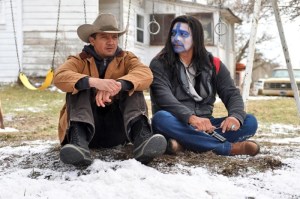 As such, the story is more a reflection and outlet for the characters, but it’s also an intriguing mystery until Sheridan decides to just throw up his hands and explain everything. Until the third act, the central mystery of who killed Natalie is filled with curious and dangling questions that are made all the more interesting from the unique setting and circumstances. Her lungs exploded from the cold after she ran, barefoot in the snow, for six miles for help before collapsing. That’s an interesting aspect I’ve never considered before when it comes to environmental dangers. Tracing back the events of her last night, Sheridan opens up an analysis on the precipitous lives of small-town America, except it’s a Native American reservation that’s sovereign from America. It’s an engrossing look into a culture and way of life few ever see. It’s a very unique setting that unfurls gradually over time, allowing the viewer to engage with the people, their fraying community, and the pain endured. And then the film hastily introduces its obvious culprits, shifts into an extended flashback sequence that explains everything, and zooms right into its tense climax. It all still works, don’t get me wrong. You’ll feel the mounting dread gnaw away at you during that flashback, and you’ll feel the rush of adrenaline during the shootout, and the sense of vindication by its conclusion. However, Sheridan was doing such a fine job at parceling out his elegiac story before that it almost feels like he quickly looked at the time and decided to rush into the finish.
This is also Sheridan’s first time behind the camera as director and he acquits himself well enough. A distinct sense of style doesn’t emerge but his directorial instincts follow his screenwriting strengths; the man knows when to get out of the way. The conclusion has a nasty snap of tension to it and the action hits its marks with power, having given quite the windup. Sheridan is best at directing his actors, who as stated above, give strong, emotive performances that linger with you. Wind River doesn’t prove that Sheridan has more to offer from a directing chair, but it does provide a baseline for a start to grow. I imagine from here on, having built up a reputation for writing critically acclaimed adult thrillers that big name actors flock to, that Sheridan will be directing the majority of his favorite scripts. He might not have the visual acuity or sense of vision that a Denis Villeneuve has, but he’ll reliably deliver strong performances from capable actors. He’ll also be the best steward for his stories, and I need so, so many of them.
Nate’s Grade: A-
Share this:

Sicario (2015)
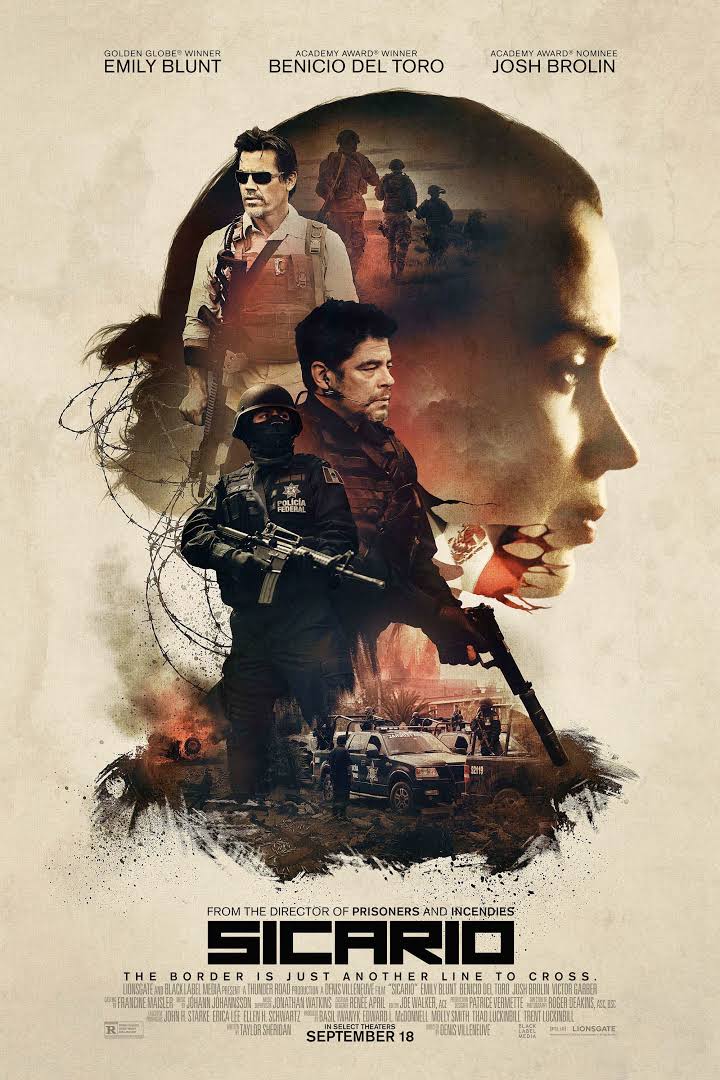 The word “sicario” is Spanish for hitman, we’re told in a helpful opening text. It’s a term that has greater meaning in the landscape of the war on drugs, a war that has ravaged Mexico and its citizens. Sicario, the film, is grim and gripping and director Denis Villeneuve doesn’t hold back from the brutality of its reality. Sicario is a flat-out tremendous film. It’s the most intense film I’ve sat through since 2012’s Zero Dark Thirty, so much so that for long stretches of the 121-minute film I was literally tearing my hair out with delicious anxiety.
Kate Mercer (Emily Blunt) is a Phoenix FBI Agent called in by her superiors with a very special offer. Matt (Josh Brolin), a government agent whose affiliation is classified, has a task force that he would like Kate to join. She’ll be taking it to the drug cartels by destabilizing their chain of power. Kate accepts the job. Alejandro (Benicio Del Toro) is a foreign agent in alliance with Matt, and he seems to be deeply knowledgeable of the cartel and their practices. As the chaos swirls and the team gets closer to the cartel bosses, Kate has to reckon with what she is part of.
Let Sicario be a blueprint for how to brilliantly develop suspense sequences in mainstream cinema. I’ve written about it before but the key to suspense and horror is simply characters we care about and the worry of what will happen next. Sicario places our characters in the middle of an ongoing battle and serves them up as the change agent, the proverbial stick rattling the hornet’s nest of deadly cartels. There’s a wonderful sequence when Kate joins up with the team for her first mission. She’s been told she’ll be based in El Paso but in reality she and a team of Army Rangers are venturing across the Mexican border into Juarez. They’re picking up a high-level cartel informant and transporting him back to American soil. The ride into the country sets the stage as the caravan of black SUVs tears through the streets of Jaurez, bracketed by Mexican state police vehicles. We’ve previously been told at what points a likely trap might be staged, and so we wait, taking in the terrain, the distance, the exits, the personnel. We’re already sizing up the Mexican state police cars; is that one on the take? It’s at the end that the scene coalesces into an even stronger whole, as we literally have a climax in traffic. The border entrance is backed up, and so Kate and our team wait, all the while identifying some suspicious armed men in traffic lanes parallel to their vehicles. They’re told they cannot fire until deadly force is used, and so they wait and we wait. It’s a top-notch sequence where you’re nervously waiting for the boil, waiting for the explosion.
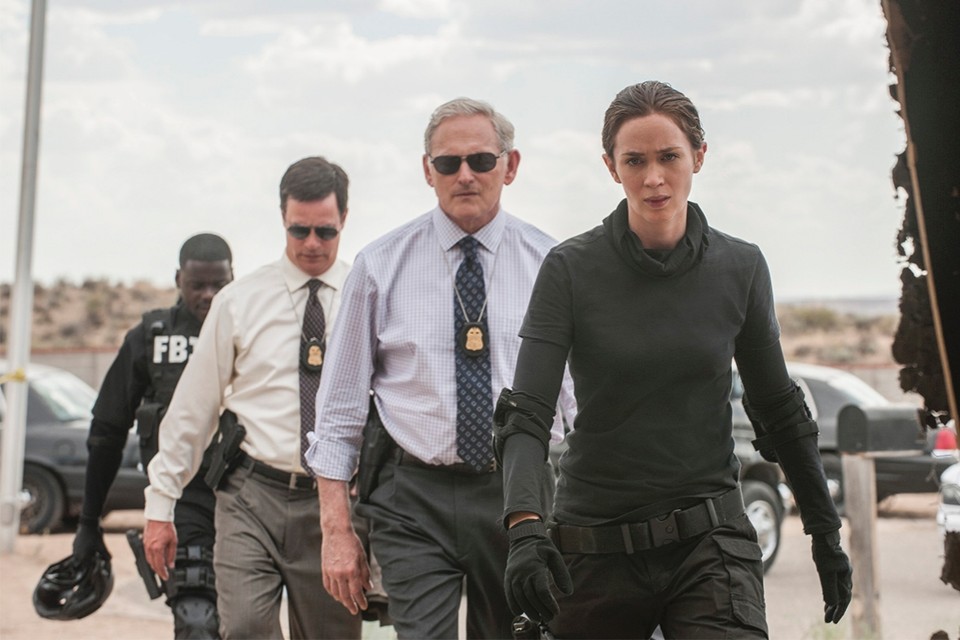 Writer Taylor Sheridan (best known as Deputy Chief Hale on Sons of Anarchy) has taken what could have been an empty Michael Bay-styled drug war thriller and given it a soul. Sheridan’s structure is ingeniously tied into his larger message about the moral futility of the escalating war on drugs. As Kate becomes more immersed into the costs of her new role, of the mounting ethical compromises and legal loopholes, she becomes a background player and Alejandro takes center stage. Rather than simply harden up and sacrifice her ideals for the sake of her mission, Kate holds true to her principles, even if she might be the only one continuing to stick to the rules and a need for oversight. It makes her a far more interesting character and it all comes to a terrific climactic scene that hinges upon two characters at a forceful crossroads, each with diametrically opposed viewpoints. For all the action, Sheridan has found a great way for his story to have a character-based climax that hits harder than simply killing the Worst Bad Guy. As we learn more about the reasons Kate was selected, her literal marginalization in the story makes thematic sense, especially as she’s unwilling to become a “wolf” in a “country of wolves.” Alejandro is that wolf, and in the last act he becomes the film’s focus as the pieces of their destabilization plan fall into place. There’s a scene with Alejandro that is so cold-blooded yet badass that it made my audience gasp. As the bodies drop and blood is shed, Sicario doesn’t lose sight of its characters even to the very end.
Sheridan’s script tackles its subject with a propensity for acknowledging the messy reality. There are no easy solutions and perhaps the best solution is really one that is at odds with conventional legality. The United States is losing the war on drugs, and innocents are suffering in droves. Matt’s cavalier attitude is in response to the overwhelming evidence that the war on drugs has done little except to enshrine certain violent elements into power. He’s trying to clear a path for Alejandro, but for what aim afterward is ethically questionable. When you’ve got nothing but bad solutions, perhaps the best option is still one that’s a step too far. Sicario tackles the harsh realities of the war on drugs without ever dragging out a soapbox. The messages and debates are suffused in every frame, every taut sequence, even pained expression. It’s a message movie where the morality and the escalating action go hand-in-hand.
With Prisoners and now Sicario, Villeneuve has proven to be one of our finest directors when it comes to making adult movies that get your palms sweaty. The execution of these suspense sequences left me breathless. Villeneuve uses long takes of aerial photography hovering over the topography of Mexico and the American southwest. It has the effect of feeling like you’re surveying an alien planet. Added with the ominous score by Johann Johannsson (The Theory of Everything), the tension can feel overwhelming at times. The menacing and percussion-heavy score makes it feel like an army is approaching. The movie also looks absolutely beautiful thanks to the cinematography from Roger Deakens. There are several lovely shots lit with the dying rays of sunlight, which I would admire further if my heart weren’t in my throat while watching. Villeneuve also knows when to pump the brakes, letting his film breathe, and letting his actors take center stage. There are several moments of restraint that allow the actors to flourish. From top to bottom, Sicario is a technical marvel that impresses as it continues to horrify.
Blunt as a badass is nothing new after her killer turn in last year’s vastly underrated Edge of Tomorrow, but there’s way more to her than being a superhero with a gun. She’s the moral conscience of the movie and you may discover, as she does, how irrelevant such a stance may be in this underground world. She’s trying to make sense of it all, trying to go along with what she thinks is right, or at least making a difference, and swallowing her frustrations. She saves the best for last in a finale scene that pushes her character to the breaking point of her ethics, and Blunt floors you. While Blunt is our entry point into this world, and Brolin is amusing as a cavalier rogue agent, this is very much Del Toro’s movie. Alejandro could easily be the slick movie-cool hitman, a soulless killing-machine, but he’s a haunted man who knows he’s damned and goes about his business with steely resolve. Benicio Del Toro can often be confused with doing little acting because he so naturally underplays his characters, but keep watch and you’ll see a man who inherently knows his character. There are subtle shifts and small reveals that open up Alejandro, who is so hardened that this will be all you get.

There have been some complaints citing the film’s lack of perspective from the Mexican side of the border, which is fair but also overlooking Sicario’s complexity. With its fear of cartel war violence spilling over into American neighborhoods, it’s not hard to see this film becoming supposed evidence in a xenophobic political campaign. Surely Donald Trump will be talking about Sicario. There is a small degree of representation with a minor character involved in the drug trade. The movie flashes back to him and his family a few times, setting us up to expect he’ll return at a pivotal moment later. He’s a completely unremarkable character and the brief scenes we spend with him made me anxious to get back to Kate and the main story. I didn’t care, and then he did reappear and I was quite surprised to find myself actively caring for this minor character’s well being. In a scenario where it seems like there’s a lack of vulnerability, this character provides it. He’s not a bad person per se as just another cog in a corrupt machine trying to provide for his loved ones. It’s a window into the larger ramifications of Kate and Matt’s actions. The very last bittersweet image doesn’t feel like victory, more like a warning of impending consequences that will befall innocents, and they aren’t Americans.
It’s rare to get a Hollywood thriller that excels at what it does and exceeds lofty expectations, but Sicario is that movie. Here is a thriller that excites, unnerves, provokes thought as well as terrible anxiety that you sweat in buckets over. The general feeling while watching Sicario is one of disquieting dread. The challenging and disturbing reality of the war on drugs blends with the brilliantly executed suspense sequences. The characters don’t get lost midst the clatter of violence, the direction enhances the actors and allows them to better inhabit their engaging characters, and the overall orchestration of all the many moving parts is so polished, so in tune, so electric that Sicario often does more than just entertain, it forces you to react. Leaving my theater was akin to coming down off an adrenaline high and I wanted to tell everyone I knew to see this movie. That’s the power of great cinema and Villeneuve has created a compelling feature that deserves to be soaked up and studied. This is exhilarating moviemaking, folks.
Nate’s Grade: A


 nathanzoebl
You must be logged in to post a comment.