Blog Archives
The Gorge (2025)
 While watching the action-thriller The Gorge, I kept thinking, “Wow, I’m surprised this didn’t get a theatrical release at all.” The Apple Plus original is the kind of movie you’d want to watch on the big screen, with large-scale action, atmospheric imagery, and a creepy sound design meant to elicit shudders. It has a dynamite premise that grabbed me right away: two elite snipers from the East and West, Levi (Miles Teller) and Drasa (Anya-Taylor Joy), are tasked with manning watchtowers overlooking a cavernous and mysterious gorge. They have heavy-duty Gatling guns to make sure whatever is in the gorge stays in the gorge. It’s a year-long tour of duty and both snipers are forbidden to communicate with one another. Naturally, out of boredom and necessity, they break the no-contact rule, first through white board messages, then through shared experiences and competitions, and finally coming face-to-face. For the first 45 minutes or so, The Gorge is actually a pretty lean and effective long distance romance of sorts. There’s ingenuity in the process of getting to know someone from across a large hole in the ground, and both actors have solid chemistry that will help make you silently yearn for a little global collaboration. The movie also has an intriguing scenario with tantalizing details that point to its secret history, until everything is literally spelled out in Act Three. The monsters, who look like a combination of Groot and zombies, are an unsettling character design, though I wanted more variety in their appearance. When the characters finally delve into the gorge for the majority of our climax, we got some new and nasty creepy crawlies, like a tree with rib bones like insect mandibles that ensnare like a Venus flytrap. Alas, I found the stuff inside the gorge to be fun and creepy with a great atmosphere to play upon what we can and cannot see, but it was the stuff above and outside the gorge that made the movie for me. That’s The Gorge for ya: come for spooky monsters, stay for the surprisingly involving romance between monster killers.
Nate’s Grade: B
Share this:

Moana 2 (2024)
 It’s hard not to see the DNA of its original incarnations as a TV series for Disney Plus, as well as the awkward adjustments to slap this together into a feature film. Unless you’re a super fan of the original Moana who needs any additional content, you’ll likely have a less than impressive response to Moana 2. It feels quite episodic from villains and storylines popping up for small increments of time only to go away and be replaced by a new storyline, to a new batch of characters meant to hold our attention while other main characters, in particular Maui (Dwayne Johnson), sit out for long stretches. The animation is a notable step down as well, and while it’s still pleasing to watch and far from bad, it’s lacking the detail and refinement of the feature team, especially with lighting, as everything in this world lacks shadows with such high key lighting washing everything out. Without Lin-Manuel Miranda returning, it’s obvious the songs will not be nearly as catchy and enchanting, and the tunes for Moana 2 are pretty instantly forgettable. I’m struggling to rethink any melody right now as I write this. It’s hard not to feel like everything is so slight, from the storytelling to the visuals to the songs to the inclusion of the beloved characters from the original. I loved Moana and consider it the best of modern-day Disney, and I’m clearly not alone from the box-office dominance that the sequel was able to achieve. I actually think I would have preferred future Moana adventures as a TV series because the mythology and world has more to explore. But that version of new Moana has been transformed, Frankenstein-style, into a releasable feature film, one that suffers in the transformation into something it’s not suited for. Disney made a billion dollars from this gamut, but the rest of us are left with a Moana 2 that had much further to go.
Nate’s Grade: C
Share this:

Kraven the Hunter (2024)
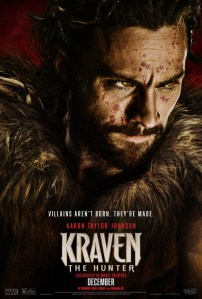 Kraven the Hunter feels like a movie that was never meant to be seen. That seems paradoxical considering the efforts of many talented people over years took place to bring the Spider-Man villain solo movie to some form of creaking, wheezing life. Since 2017, Sony has decided to create their own Spider-Man universes minus, of course, Spider-Man. They’ve been making solo movies about Spider-Man villains and while the Venom movies have been inexplicably popular, the rest have been regarded as unmitigated disasters. In 2022, Morbius was bad enough that Sony thought they could re-release it to capitalize on the memes and derisive entertainment factor. To no avail and a total lack of morbin’ time. In 2024, Sony released three Spider-Man villain movies, though Madame Web was never really a villain per se, but then again nobody really wanted a Madame Web movie anyhow, though it once again gave us some memorable memes. Now Kraven is reportedly closing out this shared cinematic universe experiment, and the president of Sony is blaming those mean ole film critics for the failures of these would-be superhero classics (always a smart movie, assuming audiences are incapable of making up their own minds). Delayed almost two years from its original January 2023 release date, Kraven the Hunter is the death knell of this enterprise and it comes to a thoroughly mediocre conclusion, feeling even more disposable, poorly developed, and mechanical, and ultimately a footnote to a footnote of superhero cinema.
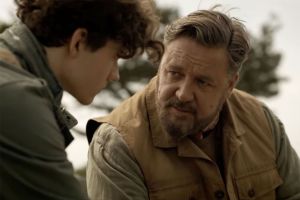
Kraven, nee Sergei Kravinoff (Aaron Taylor-Johnson, portraying his third superhero) is the son of a notorious Russian crime boss, Nikolai (Russell Crowe). One day on a hunting trip in Ghana, Sergei rescues his brother Dimitri (Fred Hechinger) from a lion. The lion injures Sergei and takes him for food, but thanks to a magic elixir from a tourist, Calypso (Ariana DeBose), who saves him. Now he has animal-like senses and speed and strength. As an adult, Kraven seeks out villains to bring to justice, but he’s also trying to square the legacy of his father and whether he is like dad. 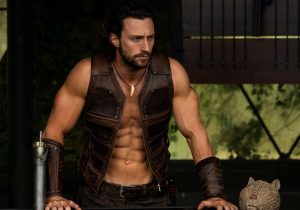
The problem with these Spider-Man-Minus-Spider-Man movies is making people get interested in the famous web-slinger’s rogues gallery. This usually means treating the character’s best known for trading punches with another hero as their own individual anti-hero, complete with a more villainous villain for our future villains to have to topple. Usually these villains (the actual individual movie antagonists, not the protagonists) are an imitation of our heroes (still referencing the future villains), the mirror version of them. So if your protagonist is going to be a vampire, then your antagonist is going to be a slightly more evil vampire. If your protagonist is an alien goo monster who likes to eat heads, then your antagonist is going to be a slightly more evil alien goo monster that likes to eat heads. You get the idea. However, you digest enough of these, and it all seems a bit too perfunctory, the main character having to defeat a version of themself. The main challenge is finding a way to make an audience care about these characters, and having them rescue a love interest or defeat a new-but-same villain with the implicit promise that maybe, if you’re patient enough, you might see them eventually try to murder Spider-Man, is not it. I’m not against the idea of giving these villains their origin tales, but it feels like in order to make them more palatable to a mass audience means they’re neutering the nature of these characters. The hypothetical future Sinister Six movie can’t all be six misunderstandings against Spider-Man.
Alas, Kraven is a real bore of an action movie even with its R-rating, the first for these Spider-Man villain movies. The added bloodshed and curse words don’t exactly make the movie feel more adult when we’re still dealing with plotlines like a super lion biting our hero and giving him super lion powers, much like the origin story of Spider-Man, or another villain suffering from a very silly and similar Amazing Spider-Man 2 Goblin-itus medical malady. This is not a serious movie in the slightest but that doesn’t mean it can’t be passably fun, but everyone is just so dour and passionless that it drains all entertainment. At least Madame Web was perplexingly interesting with its bad decisions. There’s such little energy to be had through the middling two hours. Kraven is gifted superhuman powers and he uses them to hunt down bad men and big game poachers, becoming let’s say Captain Planet if he watched nothing but Charles Bronson movies. There’s got to be an exciting movie there, or at least a more interesting one than what we eventually got here. It’s hijacked by some pretty rote family drama of a bad dad who was too hard on his kids and rescuing a kidnapped little brother who he feels guilty about leaving with the bad dad after Kraven got his new powers. The family drama is pretty rote and uninspired, with both of the other characters kept to the sidelines for most of the movie, which makes it hard to care that much about either of their impacts. The haphazard integration of a romantic subplot with Calypso is even more perfunctory when I would much rather see Kraven fall in love with a lion instead.
 I like J.C. Chandor as a director, and he’s someone who leaps at new challenges. His debut movie, 2011’s Margin Call, was an engrossing character piece about Wall Street traders and execs on the verge of the 2008 financial meltdown. It was so bare-bones that it was practically a play. His next film, 2013’s All is Lost, was the exact opposite: a movie completely told through visual storytelling and with a minimum of spoken words as Robert Redford tries to patch up his sinking boat. 2014’s A Most Violent Year was a slow-burn crime drama about the lengths people will go to escape their past and their nature. From there, Chandor has been circling larger studio projects, leaving 2016’s Deepwater Horizon and then replacing Kathryn Bigelow for Netflix’s action thriller, 2019 Triple Frontier. He’s a chameleon of a director and the only real point of interest I had with Kraven. What would he do in the superhero space? Well, the answer is not much. The visual flourishes we’ve seen before in other movies but without a sense of humor. Watching Kraven periodically run on all fours may make him more animal-like but it doesn’t look good. The movie gets lost in the convoluted mythology and rules of its characters and what they’re capable of, and so the action sequences feel cobbled together and short on imagination. The climax is during a stampede of buffalo but there’s no real danger here like dodging around the animals. They very conveniently allow space for our hero to fight his battle, thus becoming a thundering backdrop. Even if you’re overly generous, there’s not much here to excite the senses or even your morbid curiosity.
There is one line of dialogue that needs to be singled out for its absurdity. While Madame Web was ridiculed for its “researching spiders in the Amazon with my mother before she died” line, the filmmakers had the good sense to eliminate it from the final film, though not the good sense not to include it in their initial marketing. With Kraven the Hunter, there’s a character who talks about her mother and literally says, “She died and I never saw her again.” That’s usually how that works.
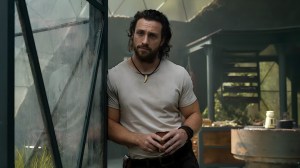 As the final piece of Sony’s Spider-Man villain spinoff universe, Kraven the Hunter brings this diversionary superhero franchise to a merciful end. The frustrating thing is that Kraven as a character can work, as recently demonstrated in the popular Spider-Man PlayStation video game sequel. He’s supposed to be the ultimate hunter, a force of nature, but that doesn’t mean he needs to carry his own movie, just like Morbius or Madame Web or any other Spidey villain. Launching these characters could have worked but needed much more imagination and care. Instead, it was Spider-Man movies without Spider-Man and, with the exception of the Venom movies with their goofy buddy movie appeal, audiences have responded with the indifference you would assume. It’s not enough for these movies to merely be adjacent to Spider-Man to be appealing. They need to be good, to be able to stand on their own, and to support an extended time with this character. It’s hard not to see the larger machinations for eager franchise-extension as the primary motivation. But if these are the impressions of the characters we’re getting, who would want any more? Turns out nobody was actively cravin’ another underdeveloped and mediocre superhero movie.
Nate’s Grade: C-
Share this:

Nightbitch (2024)
 Motherhood can be a real bitch, right? That’s the lessons for Nightbitch, a bizarre movie that juggles high-concepts and tones like a struggling new mother juggling time. Based on the novel by Rachel Yoder, Amy Adams plays Mother (yes, that’s how she’s credited), an artist who chose to become a stay-at-home mother to her two-year-old son, and her life has become an endless stream of days appeasing a small tyrant who she also unconditionally loves. Early on, Adams uncorks an imaginary monologue about demystifying the glamour of motherhood and the guilt she feels about not finding every tantrum and bowel movement a thing of bronze-worthy beauty. She’s grappling with significant changes, and that’s even before she thinks she’s turning into a dog. I can find thematic connection with motherhood and body horror, as our protagonist feels that she no longer recognizes her body, that she feels a lack of direction and agency in a life that no longer feels hers. The added body horror of transformation makes sense, but this element seems so extraneous that I wished the movie had exorcised it and simply stuck with its unsparing examination of parenthood. You would think a woman believing she is becoming a dog would dominate her life. The ultimate life lessons of the movie are rather trite: assert yourself, establish a balance to have it all, and fellas, did you know that being a stay-at-home parent is actually hard work? There are too many half-formed elements and plot turns that don’t feel better integrated, like flashbacks interwoven with Mother’s mother, not credited as “Grandmother,” as a repressed Mennonite in a closed community who disappeared for stretches. There’s also a few curious reveals relating to Mother’s perception of others that are unnecessary and obtusely mysterious for no real added value (“Why that library book died forty years ago….”). Adams is blameless and impressively throws herself into the demanding roll, going full canine with gusto as she trots on all fours and eats out of bowls. The problem is that all the dog material feels a little too silly when realized in a visual medium rather than a symbol of freedom and rebellion. Nightbitch is more bark than bite, and I’d advise viewers looking for an unflinching portrayal of motherhood to watch Tully instead and, if desired, pet your household dog at home to replicate Nightbbitch but better.
Nate’s Grade: C
Share this:

Nosferatu (2024)
 Director Robert Eggers’ remake of a famous rip-off of the most famous blood-sucker in literature is a finely crafted and highly atmospheric drop into the past, as should be expected from Eggers (The Witch, The Northman). It doesn’t redefine cinematic vampires but rather puts the story through the contemporary lens of a toxic ex-boyfriend who refuses to relinquish what he feels belongs to him. The story should be familiar to most, even if they never watched the original 1922 silent film, nor its 1970s remake by Werner Herzog. Bill Skarsgaard plays the mysterious and threatening Count Orlock, a wealthy Transylvanian outsider looking to relocate to the big city in Germany, primarily to prey upon poor Ellen Hunter (Lily-Rose Depp), the “one who got away,” so to speak. He haunts her dreams and drives her mad, with Depp mesmerized and convulsing most convincingly. From there it’s a battle between Ellen’s husband (Nicholas Hoult) and an expert in the occult (Willem Defoe) over whose will will win out. Skarsgaard is fascinating and chilling and you too may want to imitate the thick-as-stew Count Orlock accent afterwards. The technical elements of this movie are masterful, from production design, to costuming, to the gas-lit and moody photography. Eggers is a deeply sincere filmmaker who translates his passions and madness onto the big screen with loving care. Nosferatu is gorgeous and unnerving, though I’m hesitant to say it rivals Francis Ford Coppola’s Dracula movie for modern vampire artistic triumph and pure horniness. It’s a gussied-up B-movie with a deeply committed filmmaker to deeply realized genre filmmaking, and so Nosferatu is an entertaining remake that most vampire fans will be happy to sink their teeth into this holiday season.
Nate’s Grade: B
Share this:

Smile 2 (2024)
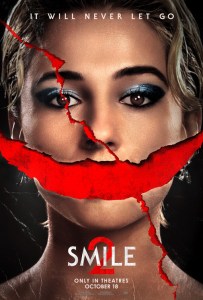 In 2022, thanks to genius viral marketing and the acknowledgement how deeply unnerving happy people can be, Smile was a surprise horror smash hit. Writer/director Parker Finn expanded on a previous short film and made serious money, which meant a sequel was a given. Finn returns to lead Smile 2 to even creepier genre pastures, this time following the mental demise of a pop star, Skye Riley (Naomi Scott) trying to make sense of this malignant curse. As much as I enjoyed the first Smile for its careful development and visceral intensity, I think Smile 2 might be even better.
From the opening sequence, it’s clear that we’re in the hands of a filmmaker that knows exactly what they’re doing. This is not merely another paycheck for Finn. He’s thought about how a sequel can build from its predecessor, stand on its own, incrementally build out the mythology, but mostly how to be an expertly made horror thriller designed to get under your skin. There were multiple sequences where I kept muttering variations of , “No,” or, “I don’t like that at all,” enough so that my wife in the other room would inquire what was directing these responses. Finn is tremendous at setting up the particulars of a scare sequence and allowing the audience to simmer in that anxious period of dread as we wait for something sinister to happen. He reminds me of James Wan and his ability to set up a nasty little scenario and then traps you inside awaiting the worst. There are sequences that compelled me to look away, not simply because they were overpowering, though the gore and makeup effects can best be described as impressively gross, but because the movie was finding different ways to make me uncomfortable, but in that good horror movie way. Finn’s camera makes what we should fear very clear, and his editing is precise. This is a movie that wants you to see the darkness and persistently worry about what’s coming just out of the frame.
 One of my minor complaints with the first Smile was that there wasn’t much below its grinning surface. Sure, the entire premise of a curse that spreads through witnessing horrific acts of self-harm lends itself toward the discussion of how trauma begets trauma, but beyond that the first film was more reliant upon supreme craft and well-engineered scares. There’s nothing wrong with a movie that exists primarily as a thrill ride as long as those thrills deliver upon their promise. However, with Smile 2, Finn uses the character of Skye Riley as a beginning point to discuss the toxic relationships that come with fandom. It should be very obvious for every viewer that Skye is going through some serious issues. She’s overcoming addiction, physically rehabilitating her body as well as socially rehabilitating her image, and trying to learn all her new choreography for an intense world tour. This is a woman who could use a significant break. And yet, as the movie progresses, you start to sense that there is this large machinery around her that needs her to perform because that is how she makes them all money. Even her own mother-as-manager (Rosemarie DeWitt) can seem questionable as far as her motivations; is she pushing her child because she knows it’s what best for her to focus on for recovery, or is she pushing her because the tour pays for her lifestyle? As the movie progresses, the characters fret that Skye’s increasingly bizarre behavior is going to ruin the tour first and foremost, and concern for her actual well-being is secondary at best. All these people have their paychecks attached to this woman fulfilling her contractual obligations. You can also extrapolate the intense pressure the industry places on people with mental illness and self-destructive personalities to conform to standards that are unfair and often un-meetable. You might question why more pop stars don’t have head-shaving outbursts.
Because we know that the evil entity has the power to alter our sense of sight and sound, it means the viewer must be actively skeptical about what is happening. Is this really happening? Is this sort of happening but elements are different? Or is this completely a hallucination? It makes the plot the equivalent of shifting sand, never allowing us to be comfortable or complacent. This can lead to positive and negative feelings. It keeps things lively but it can feel like the plot never really moves forward, at least in a cause-effect accumulation. It can often feel like the movie is moving in starts and stops, and if you’re not onboard for the craft, the acting, and the scares, then the results can likely feel frustrating, especially when large swaths of time are canceled out. For me, I enjoyed the extra sensory game of keeping me alert because it led to a barrage of surprises and rug pulls, some of them admittedly annoying, especially losing what amounts to maybe an entire act of the movie, but also they were a definite way to keep upending the narrative certainty. This sneaky approach also very viscerally places us in the paranoid mindset of our protagonist, as we too are unable to trust our senses and tense up with certain unsettling auditory cues. Mainly, I was having too much fun with the devious twists and turns, and some wickedly disturbing imagery from the director, that I felt like it was an ongoing thrill ride through a funhouse of insanity that kept me guessing.
 In a just world, Scott (Aladdin, Charlie’s Angels) would be at the front of the pack in the discussion for the Best Actress Oscar. This woman is put through the proverbial wringer and she showcases every frayed nerve, every degenerating thought with such verve and command. It’s essentially a performance of a woman completely breaking down mentally, but Scott doesn’t just go for broke, putting every ounce of effort into inhabiting the breakdown, she creates a character that reveals herself through the breakdown. It’s not just screaming hysterics and histrionics; there are different levels to her dismantling psyche, and Scott portrays them beautifully. I felt such great levels of dread for her because of how successfully Scott was able to anchor my emotional investment. She’s also portraying different versions of Skye, and some key flashbacks reveal just how toxic her former addict self was that she’s trying to put to rest. It’s a performance about metaphorical demons and literal demons haunting a woman, as well as guilt that is eating her alive. Scott allows us the pleasure of watching a first-class performance through her shattering.
There’s a curious motif to the movie that many will probably ignore but my wife and I fixated on, and so I feel the need to briefly discuss this so that, you too dear reader, can have this fixation as well. There are at least four scenes where Skye drinks a large bottle of water in a manner that can be best described as monstrously destructive. She drinks that bottle like a lost man in the desert finding his first drink of water. She attacks it. My best analysis is that this is a character detail about Skye’s addictive personality and sense of dependency, projecting the same all-consuming need onto water that she had previously for narcotics. One of the best laughs is when a doctor takes stock of Skye and says how dehydrated she is. Regardless, take in how desperately Skye Riley drinks and think about perhaps applying that technique next time you need a refreshing drink.
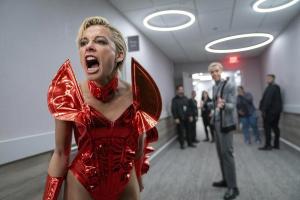 By its nightmarish conclusion, Smile 2 finds a fitting and satisfying end stop that promises a possible even bigger and more disturbing escalation for a Smile 3. Finn has established himself with two movies as a major horror filmmaker who can work within the mid-major studio system and still keep a perspective and integrity. I’m pleased that Smile 2 isn’t just more of the same old Smile, and in fact very few instances involve strangers with that signature facial expression. By the time you’re seeing the smile, it’s usually too late. I enjoyed the choice to find menace and darkness in a world of pop music brightness (the fake pop songs actually sound indistinguishable from what currently airs on the radio, bravo). I enjoyed the continuing tradition of casting famous Hollywood scions, like Jack Nicholson’s son playing Skye’s dead boyfriend (that family grin is uncanny, also bravo). What I really enjoyed was Scott’s uncompromising performance. Smile 2 has convinced me that Finn is the real deal, Scott might be one of our best modern scream queens and young actors, and to confirm introverted habits to avoid anyone who looks directly at me and smiles.
Nate’s Grade: A-
Share this:

Wicked: Part One (2024)

It’s shocking that it took this long for Wicked to make its way from the Broadway stage to the big screen. The musical, based upon Gregory Maguire’s novel, began in 2003 and while it may have lost out on the biggest Tony Awards that year to Avenue Q (it seems astonishing now but… you just had to be there in 2004, theater kids) the show has been a smash for over two decades, accruing over a billion dollars as the second highest-grossing stage show of all time. As show after show got its turn as a movie, I kept wondering what was taking so long with an obviously mass appealing show like Wicked. It’s the classic Hollywood desire of “same but different,” a reclamation project for none other than the Wicked Witch of the West, retelling her tale from her perspective. Well, Wicked’s time has eventually dawned, and the studio is going to feast upon its protracted wait. Taking a page from the YA adaptation trend that dominated the 2010s, they’ve split the show into two movies, separated by a full year, hoping to better capitalize on the phenomenon. I was wary about Part One being 150 minutes, the same length as the ENTIRE Wicked stage show, but having seen the finished product, and by “finished” I mean one half, I can safely say that Wicked is genuinely fabulous and deftly defies the gravity of expectations.
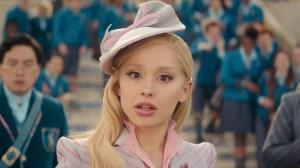
In the fantasy world of Oz, the green-skinned outcast Elphaba (Cynthia Erivo) is looked at with scorn, derision, and fear. She’s always been different and never fully accepted by her father who blames her for her mother’s death and her younger sister Nessarose (Marissa Bode) being stricken to a wheelchair. Nessa is going to study at Shiz University with all the other up-and-coming coeds of the land of Oz, including Glinda (Arianna Grande), a popular and frivolous preppie gal peppered in pink pastels. Glinda desperately wants to be taken seriously and become a witch, studying magic under the tutelage of the esteemed Madame Morrible (Michelle Yeoh). Instead, Morrible’s fascination falls upon Elphaba after she reveals her tremendous magical ability in a moment of extreme emotion. Now Elphaba is enrolled at the magic school and learning about the way of the world, and she’s stuck with Glinda as her roommate. The two women couldn’t be any more different but over the course of the movie, we’ll uncover how one became Glinda the Good and the other the Wicked Witch of the West.

At two-and-a-half hours long, again the length of both acts of the stage show, Wicked Part One only covers the events of the show’s first act, and yet it feels complete and satisfying and, even most surprising, extremely well paced. It’s hard for me to fathom what could have been lost to get the running time down as each scene adds something valuable to our better understanding of these characters and their progression and the discovery of the larger world. It’s a movie that feels constantly in motion, propelling forward with such winning ebullient energy that it becomes infectious. It’s also not afraid to slow things down, to allow moments to breathe, and to provide further characterization and shading that wasn’t included in the stage show. The adaptation brings the fireworks for the finale and raises the visual stakes and danger in a manner that feels exciting and compellingly cinematic. Considering the resplendent results, I feel I could argue that the movie is actually -here comes the heretical hyperbole, theater kids- an improvement over the stage musical. It makes me even more excited for a bolder, longer, potentially even more emotionally satisfying second part in November 2025.
One of my primary praises for 2021’s In the Heights was that director John M. Chu, who cut his teeth helming the Step Up movies, knows exactly how to adapt musicals to maximize the potential of the big screen. If you’re a fan of musicals, old and new, you’ll find yourself swept away with the scope and intricacy of these large fantasy worlds, the flourishes of costume and production design, as well as the creative choreography making fine use of spaces and the power of film editing. There’s a rousing dance sequence set in a library with shelves that rotate around the room, making the slippery choreography that much more immersive, impressive, and acrobatic. Even big crowd numbers are given the knowing framing and sense of scale to hit their full potential, from the opening rendition of Munchkinland celebrating the death of the Wicked Witch of the West complete with giant burning effigy that would make a Wickerman envious, to the introduction to the City of Oz where it appears every citizen has a jovial role to play in welcoming strangers to their enchanted capital city. Chu’s nimble camerawork allows us to really enjoy the staging and skills of the talent onscreen, bringing a beating sense of vitality we crave from musical theater writ large. Wicked is simply one of the best stage-to-screen adaptations in musical theater history and a joyous experience that allows the viewer sumptuous visuals.
At its core, the story of Wicked is about some pretty resonant themes like self-acceptance, bullying, the fear of what is different or misunderstood, and all of this is built upon an irresistible friendship between Glinda and Elphaba. The rivals-to-allies formula isn’t new but it is tremendously effective and satisfying, especially when both characters are as well drawn and deserving of our empathy as these two ladies. They’re each on a different meaningful character arc for us to chart their personal growth and disillusion with what they’ve been taught is The Way Things Are. One is starting from a disadvantaged position and gaining traction through an outward demonstration of power, and the other is beginning in a position of privilege and becoming humble and more considerate as she acknowledges the challenges of others in a manner that doesn’t have to reconfirm her enviable “goodness.” It just works, and both women are fantastic in their roles. I was on the verge of tears at several points and my heart felt as full as a balloon throughout because of the emotional engagement and heartwarming camaraderie between our two leading ladies. With all its razzle dazzle, Wicked is a story of feminine friendship first and foremost and emotionally rewarding to experience, with the soaring music as a bonus.
Let’s finally talk about the music, a key factor in the enjoyment of any musical, naturally. The music was written by Stephen Schwartz, the Oscar-winning composer for “Colors of the Wind” from Pocahontas as well as “Believe” from The Prince of Egypt. I found his Wicked numbers to range from good to astoundingly good, with catchy ear-worms like “Popular” to the anthemic power and sweep of “Defying Gravity.” The cheeky and toe-tapping “Dancing Through Life” is a showcase for Jonathan Bailey (Bridgerton) and benefits from the aforementioned creative library choreography. “I’m Not That Girl” is a heartbreaking ode to the girls who don’t think of themselves as enough, which is begging for a reappearance in Part Two. The only clunker is “A Sentimental Man” but that’s more the result of the deficiencies of Jeff Goldblum as a singer than the song. I await the reuse of themes and motifs that will make the music even more thematically rich in the eventual Part Two.

Count me as part of the skeptical throng when it was announced that Grande, who hasn’t acted in over ten years, was cast as Glinda. I’m here to say that she is uniformly great. The Glinda role is the more outwardly showy role and thus immediately more memorable. It’s the far more comedic role, in fact the main source of comedy in the show, and Grande has serious comedic chops. Naturally she excels with the singing and its purposeful miasmic bombast, but it’s the subtle comedic styling and the exaggerated physicality that impressed me the most, like a moment of her twirling on the floor as an added dramatic flourish. There’s one scene where she’s just marching up and down a hallway in full exuberance, kicking, dancing, and exploding with joy. I anticipated that Erivo (Bad Times at the El Royale) would be exceptional, and of course the Broadway vet is, as she brings such simmering life to Elphaba. There’s a strength in equal measure to her vulnerability, making the character fully felt. Erivo also delivers during the big moments, like the climax of the movie that can give you goosebumps in hiw it weaves together empowerment and defiance and self-acceptance. Together, the two women are an unbreakable pair of performers and heroes that we’ll want to see triumph over adversity.
After decades of belabored waiting, Wicked finally makes its journey from stage to screen and I must say it was worth every minute. The film, even at only one half, feels complete and richly realized, building upon the strong foundation of the stage show and its numerous winning elements and masterfully translating them to cinema, taking full advantage of the visual possibilities while also expanding upon the story and themes for further enrichment. While born in the early 2000s War on Terror Bush era of politics, Wicked’s themes of anti-immigrant fear-mongering as scapegoats still bears striking resonance today, as do the emerging warnings of fascism in Oz. If you’re a fan of The Wizard of Oz, musical theater, or even just grandiose spectacle that doesn’t dilute grandiose feelings, then step into Wicked and you too will feel like you’re floating on air.
Nate’s Grade: A
Share this:

Tarot (2024)
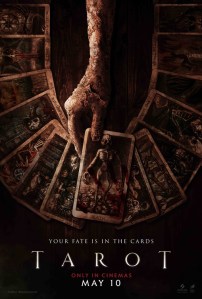 In the long line of horror movies about dumb teenagers stumbling onto curses, Tarot might be one of the most ineffective and ridiculous. First off, tarot readings are so detailed and specific, while also being vague to most of us unfamiliar with what you can find on the playing cards. This means the movie must constantly remind the viewer what the fateful readings were as well as the spooky imagery. Also, being a PG-13 movie, means that the terror is kept more on a psychological bullying level, where the teens have to “face their fears” but they’re not terribly personalized. One girl finds herself in a magician’s performance for ghouls and literally hides in a box only to be sawed in half. What was the personal fear there? Stage magicians? One guy is in a subway station and comes across a newspaper with his face on it and the headline, “You Die Today” (who says print media is dead…. wait a second). This is one of those movies that suffers because the rules of the curse are sketchy at best. We don’t know the escalation or how the teens might beat it. However, I wanted to almost applaud in amazement when the script practically plays an Uno Reverse card on its angry spirit (“If she’s killing everyone because they got their horoscope read, what if WE read HER horoscope to HER, huh?!”). The entire enterprise feels transparently like some studio exec optioned the concept of a tarot deck and said, “You know, make it haunted or whatever.” Unless you’re desperate for some derisive entertainment chuckles, skip Tarot.
Nate’s Grade: D+
Share this:

Beetlejuice Beetlejuice (2024)
 Usually sequels over thirty years later reek of desperation, trying to rekindle the past while usually only hoping to tickle people’s fading sense of nostalgia. Rare is the 30-year-plus sequel that excels by breaking free of its imitator and making us see the original in a new light. It helps to keep your expectations in check, especially for a project that is so miraculous as the original 1988 Beetlejuice. What a wild movie that was, an introduction to horror comedy for a generation, and a near-perfect balance of creepy, silly, and imaginative. From director Tim Burton’s career-launching sense of style, to Michael Keaton’s electric comedic performance, to Danny Elfman’s outstanding score, to the stop-motion visuals, fun and freaky makeup effects, and you had a madcap movie that felt like a unique discovery. Recreating that is near impossible, but if Beetlejuice Beetlejuice can recreate some of the elements and feelings that made the original what it was, then it can be considered a modestly successful late-stage sequel.
Lyrdia Deetz (Wynona Ryder) has become a long-running host of a paranormal TV talk show connecting people with messages from loved ones from beyond the grave. Her teenage daughter, Astrid (Jenna Ortega), is moody and embarrassed by her mother, feeling that she “sold out.” Mother and daughter return back to Connecticut to attend the funeral of Charles Deetz, Lyrdia’s father. Her pretentious and snippy stepmother, Delia (Catherine O’Hara), is trying to better commune with his spirit, and the entire town has become famous for its spooky seasonal history. Meanwhile, Beetlejuice (Keaton) is trying to avoid his former wife, Delores (Monica Bellucci), who naturally is seeking to obliterate him to ectoplasm. He’s still got his sights set on Lydia, who spurned his marriage hopes, and might be able to manipulate the Deetz family back into his control.
 Beetlejuice Beetlejuice gets the closest to rekindling that lightning-in-a-bottle alchemy from the 1988 original, serving as an appealing and enjoyable sequel. Nothing will ever be as original and wild and such a discovery as that first movie, which serves as a point of entry for many a Millennial fan who discovered that irresistible Tim Burton Neo-Gothic aesthetic. However, it recreates enough of the qualities that stood out about the original. The skewed sense of humor and surreal visuals, as well as goofy slapstick and vibrant imagination about life after death, it’s all such a fertile playground for Burton’s visual charms. The genius of the original was telling a ghost story from the ghost perspective as they learned about how to be better ghosts to try and scare their new living owners away. Given the world of the dead, there’s such tremendous storytelling and world-building possibilities here, explored richly in the animated 90s series for kids. Further stories in this universe have an automatically appealing power, and it’s just nice to watch Burton apply his specific aesthetic again, something fans haven’t really seen since 2007’s Sweeney Todd. I appreciated the weird morbid details and the practical production values; the Alice in Wonderland movies have shown that the “Burton look” isn’t best complimented by massive green screen sets. Having Burton, the “Burton look,” the original actors, with some exceptions (more on that later), and enough of that offbeat, chaotic, morbid tone return is a victory.
Beetlejuice Beetlejuice doesn’t so much alter our understanding of the world of the dead as established; it doesn’t radically rethink the landscape but it doesn’t repeat the same plot events either. I really liked the evolution of the adult Lydia as a jaded TV host. There’s a real dramatic punch to the reality that she sees the dead but has yet to see her deceased husband. She is incapable of reuniting with the man she misses the most, and she doesn’t know why. That yearning, paired with a lingering thematic mystery, can be a palpable storyline to explore. Pair that with some three generations of Deetz women trying to understand one another and work through personal resentments and we have fertile narrative ground. The three women were my favorite part of the movie, and their interactions and reflections on parenting and the challenges of trying to better understand one another are the foundation of the movie’s sense of heart. I really enjoyed the dynamic between the three, significantly upping Delia’s screen time and finding room to give her more dimension, an artist struggling in the wake of her grief. I’m a bit surprised that Ortega’s character isn’t more central to the drama. For all intents and purposes, she’s Lydia 2.0, so butting heads with Lydia 1.0 I guess feels redundant, so the story sends her off to find a cute boy in town and use that as an excuse for several unexpected needle-drop song use. There’s something inherently wrong watching a Tim Burton movie and hearing contemporary music. Imagine the Beetlejuice “Day-O” singalong but to, say, Sabrina Carpenter instead. No.
 Beetlejuice, as a character, is such an exciting agent of chaos, a horny ghost who operates on the same tonal wavelength as a Looney Tunes cartoon character. Even though the original movie is named after the guy, he’s only in the film for approximately twenty percent. Keaton was absolutely incredible in his comedic bravado, creating much of the character through his ad-libs and hair and makeup choices. Keaton is still fantastic in this go-for-broke sort of performance, a performance we’ve seen far less as he’s settled into a respectable dramatic acting career. It’s hard to remember, dear reader, but when Keaton was initially cast for Burton’s Batman, the fan base at the time was up in arms, considering Keaton more of an un-serious funnyman. It would have been easy to have Beetlejuice front and center for the movie, so it’s admirable that Burton and Keaton decided to keep his on-screen appearances short, leaving people wanting more. There’s a late turn of events that pairs Lydia and Beetlejuice together, and I wish this fractious pairing had been the bulk of the movie. The whole enemies-to-uneasy-allies would have put much more emphasis on their character dynamic and the comic combustibility. Still, seeing these characters come back and retain their appeal and personality without obnoxious pandering is welcomed.
The screenwriters find a clever solution for the Jeffrey Jones Dilemma. For those unaware, Jones, who portrayed Lydia’s father in the original, and best known for pugnacious supporting roles in movies like Ferris Bueller’s Day Off, Howard the Duck, and HBO’s Deadwood, was charged with soliciting a child for sexual exploitation. The movie continues with the character of Charles Deetz but without the involvement of Jones. The character gets his top eaten by a shark, so for the rest of the movie he’s a walking half of a corpse with a mumbly voice. It’s a clever way to include the character without the need for the actor.
With that decision to limit the Beetlejuice quotient of Beetlejuice Beetlejuice, it makes for a sloppier movie juggling a few underwritten subplots and side characters. The biggest non-factor is the return of Mrs. Beetlejuice. Here is a powerful antagonist who has the literal ability to suck out the souls of the recently dead and turn them into shriveled husks. She’s seeking vengeance against her ex and tracking him down through the netherworld. And yet, she could be completely eliminated from the movie without really affecting the other storylines. The whole Mrs. Beetlejuice/vengeful ex-wife character feels like a holdover from a different sequel script, clumsily grafted onto this other project, a vestigial artifact of another path not taken. There’s plenty of potential with the concept of the past victims of Beetlejuice coming back to seek retribution, and especially a trail of angry former lovers. It would explore the character’s history more meaningfully than an albeit amusing silent film interlude about how he married her during the era of the Bubonic Plague. We see how he died as a human, but there’s hundreds of years that can be illuminated from his failed schemes and odd jobs. Certainly there could be a whole club of ax-grinding malcontents sharing their mutual hatred of the Ghost with the Most. This character should better reflect Beetlejuice, and instead she’s just a monster on the prowl that eventually gets indifferently cast aside. It feels like Burton was looking for something for Bellucci to portray (Burton and Bellucci have officially been dating since 2023).
 She’s not alone as an antagonistic villain that pops up to provide momentary danger but is also hastily resolved to the point that it raises the question why they were even involved. There are three antagonists, not counting Beetlejuice, that appear throughout to threaten our Deetz family members in Act Three, each of them individually interesting and targeting a different member of the family for ill-gotten gain. Yet each one of these characters is conquered so easily that it nullifies their importance and overall threat. If Beetlejuice could, at any moment, just open a trapdoor to hellfire at a moment’s notice, what danger does any other character pose then? If a sand worm can just appear from nowhere and consume our pesky antagonist, then why can’t this be a convenient solution earlier? The defeats feel arbitrary, which make the antagonists feel arbitrary, which is disappointing considering that we have the full supernatural arsenal of undead possibilities to tap into. I enjoyed these characters for the most part, but it’s hard not to feel like they’re tacked-on and underwritten. The same can be said about Willem Dafoe’s police chief, a former actor who played a chief on TV and now tries to fill the role for real after death. I’m always glad to have more Dafoe in my movies (woefully underrepresented in rom-coms, you cowards!) but he’s just mugging in the corner, waiting for some greater significance or, at minimum, more memorably morbid oddity to perform.
Beetlejuice Beetlejuice is better than a desperate sequel cash-grab, though there are elements, ideas, characters, and jokes that could have been smoothed out, better incorporated, and developed to maximize the potential of the undead setting. It’s an enjoyable throwback for the fans of the original that does manage to tap into enough of those potent elements that made the original so memorable. It’s definitely less edgy and transgressive, maybe even a little too safe given the territory of spooky specters; the entire Soul Train bit felt like a bad Saturday Night Live sketch from the 1980. However, it’s still got enough of the charm and silliness to leave fans, old and new, smiling and wondering where it might go next in its wild world.
Nate’s Grade: B
Share this:

Ghostbusters: Frozen Empire (2024)
 I am a lifelong Ghostbusters fan, I enjoyed the 2021 reboot, and I come to the sequel, Frozen Empire, as one of those fans that grew up with the cartoon series in the 1980s. There is a contingent of Ghostbusters fans who dismiss the movie as merely a comedy about a bunch of schlubs who resort to paranormal shenanigans to make a buck, and these fans dismiss anything larger in world-building, mythology, or direct sincerity as missing the point. I disagree. There can be a vivid, flourishing world of supernatural beings and connections to the human world, if you can tell a compelling story with characters we want to follow. Frozen Empire is an okay TV episode expanded into movie form, finding little for most of the voluminous characters to do. There’s an ancient evil and tying back the legacy characters, who don’t present much meaning beyond extended cameos. The 2021 movie had me on an emotional level, saying goodbye to a character and seeing how that loss has affected multiple generations of his estranged family. The closest thing Frozen Empire features to emotion is young Phoebe Spangler (Mackenzie Grace) wanting to be treated like a responsible adult and making friends with a ghost girl. It’s kind of sweet, and it’s smart to tie this friendship into the larger threat. The movie has several side plots littering the peripheral, from Finn Wolfhard trying to catch Slimer and being trusted to drive the Ecto-One, to Paul Rudd trying to find his footing as a stepdad, to Kumail Nanjiani as a junk dealer learning to follow his family’s noble mission of protecting others. I liked learning more about Winston’s (Ernie Hudson) Men in Black-style secret agency of studying ghosts and testing out new supernatural tech, and it presents a fun new setting where we can learn more. The ultimate story about defeating an evil spirit, coming together as a team, and learning to give others room to succeed or fail all seem a little pat, a little too familiar. It’s fine that this movie has lower stakes, even with a would-be apocalyptic threat of ancient evil. Not every movie needs to avert the apocalypse. It feels like little thought has been given to extending the new characters from the 2021 movie. There are too many characters to service here, which is why everyone other than Phoebe feels like a nascent supporting character or overextended cameo at worst (did we need the return of Podcast?). It’s still a fun movie that any Ghostbusters fan will likely find enough to enjoy, but it also feels like it might be the last Ghostbusters movie, at least this iteration, and it ends with a reminder of what the franchise can be, at its best, but also a warning of what it can be without careful development and vision.
Nate’s Grade: B-


 nathanzoebl
You must be logged in to post a comment.