Blog Archives
Dear White People (2014)
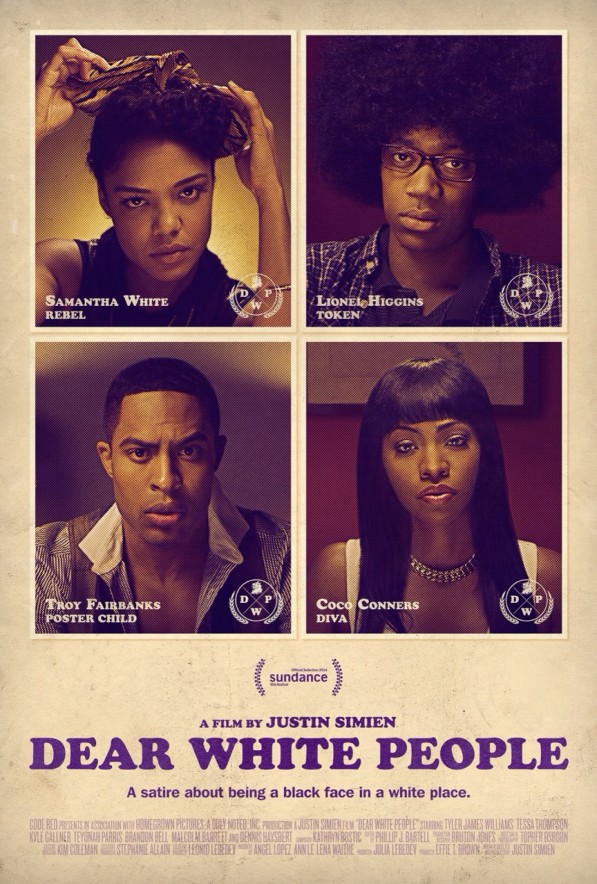 In an age where a vocal number of people believe racism died when Obama took office, or that the sins of the past are so old they have no more ramifications in today’s modern world, Dear White People is a blessed conversation-starter and a cogent argument to point to and enthusiastically say, “This!” Writer/director Justin Simien has put together a biting satire on modern race relations and the pressure to fit in where one can. This is more of a parable than a film, with some less than fully realized characters, but the commentary is rich and pointed enough that I was pinned to my seat. I wanted to hear what the characters would say next, and yes that’s also one of the film’s forgivable flaws, the fact that characters feel like they have speeches and political repartee rather than actual dialogue. In the fictional university of Winchester, every person is compromising who he or she is, pretending to be something they’re not, to fit an easily definable image. Everyone is using somebody for his or her own selfish gain. The storylines jostle around, relying on too many coincidences, but the actors are more than capable of drawing you in, especially the two leads played by Tessa Thompson (Selma, TV’s Copper) and Tyler James Williams (TV’s Everybody Hates Chris) as a gay journalist who doesn’t see himself fitting in with any of the established definitions of “black culture.” The commentary on reality TV and the media feels tacked on and undercooked, forgotten except that it lays a foundation to justify the film’s startling conclusion, a frat party where obnoxious white students dress up as grotesquely racist cartoons. Dear White People is a damning film that also plays it safe with its excoriating condemnations; it’s not as militantly ideological as some may fear or hope. This is no Bamboozled. And yet, it’s this middle approach that will make it more palatable for a mass audience. Oh, and did I mention it’s also funny? Whatever your color, take time to see this film.
Nate’s Grade: B+
Share this:

Boyhood (2014)
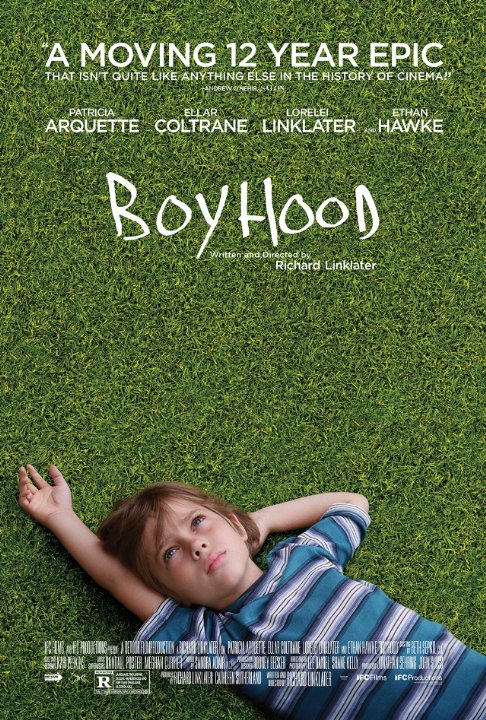 Richard Linklater is one of the most experimental filmmakers in the indie community, but just about everyone was caught unaware when he announced the completion of his newest project, Boyhood. For the past twelve years, Linklater and a small crew had been shooting a secret movie chronicling the life of a boy from age six to eighteen. The ensuing twelve years gave Linklater plenty of time to examine his narrative, and he also happened to make nine other movies while working on Boyhood. Now his covert pet project is playing to near euphoric reviews and plenty of early awards buzz. As big a fan I am of Linklater as a storyteller, especially with his brilliant Before trilogy, I feel hesitant to find fault in such an ambitious, sprawling project. This is a very good movie all around, but I have enough remaining reservations that keep Boyhood from being in the same league as Linklater’s best work.
Mason (Ellar Coltrane) and his older sister Samantha (Lorelei Linklater, the director’s own daughter) are living with their Mom (Patricia Arquette). She’s struggling to get by, with little help from their Dad (Ethan Hawke), who took off to Alaska to find work but really as a means of shirking responsibility. Dad comes back into their lives, Mom enrolls in school to provide a better life for her children, and along the way and many moves there are bad stepfathers that come in, new children and step-siblings, new schools, new boyfriends and girlfriends, and all the moments that add up to comprise a life.
Boyhood is less a film and more a cinematic experience that’s hard to replicate. It thrums with the natural rhythms of life, rising and falling on the small moments. Now there are a few larger scenes of drama, mostly concerning breakups and an abusive alcoholic stepfather, but otherwise the film follows the natural progression of not just Mason but his enter sphere of influences, namely family members, friends, girlfriends, etc. It’s a portrait of time beyond all else, and Mason’s parents are just as interesting to follow. Like their children, they too are in over their heads, looking for proper footing and a sense of identity, and in the ensuing 160-some minutes, we won’t just watch a boy become a man but two adults become responsible, accomplished, and determined caregivers. There is much to take in and to immerse one’s self in the refreshing minutia of life itself. The film feels authentic at every step, sometimes to its own detriment (more on that below), and it’s quite easy to plug into this relatable family drama and become engrossed. Don’t let the hearty length scare you, we are moving through 12 years and as such the segments don’t overstay their welcome. After every time leap, there’s a small game of trying to play catch up, noting all the differences, not just the actors growth spurts, but the new touchstones; before Mom was arranging a date with her psychology professor, and now they’re coming back from their honeymoon. It also allows us to watch the subtle transformation of characters but also watching the long consequences of anger. Dad takes Mason and Samantha out and is floored by the revelation that neither remembers a family camping outing that was filled with laughter. What they remember, starkly, are the shouting matches between mom and dad. It’s a definite wake-up call.
 Because of its in-the-moment nature, it’s difficult to single out storylines that play out significantly better than others. Each person is going to respond better to different moments, the points of relatability and comfort. I loved a scene where Dad plunges into the awkward territory of having the Sex Talk with his teen daughter. It’s just as awkward and funny as you’d expect, but they plow along and it’s a small moment where Dad shows his own growth as a responsible parent, a man who understands the world his children will enter and the pitfalls that await, who wants them to do better than he did. It’s a funny scene sure enough but it’s also a clear shift in Dad as a character. The allure of realism is rarely broken throughout the film, which imbues the film with a bracing sense of honesty in its details. There aren’t any big inspirational speeches (maybe one by a teacher), mostly talks meant to bridge the gap of understanding. There aren’t any eureka moments, in fact Mom even bemoans the absence of feeling something more significant when her children have left the nest. There aren’t any singular-defining dramatic moments because we are all the sum total of many moments, good and bad. The greatness of Boyhood is that it is a film of moments but moments you want to indulge in, like lingering nostalgic memories. It’s a richly pleasant experience.
My friend and critic colleague Ben Bailey asked me whether this story would have been irreversibly different or worse had they just cast several young actors or used makeup as a primary force to illustrate the passage of time. After giving it a good ponder as any critic should, the conclusion I came up with was a surprising… “No.” With the 7 Up documentary series, or Linklater’s own Before trilogy, the passage of time is also a reflection of us, allowing us to likewise catch up with the familiar faces but reflect upon our own lives. Plus it’s a work in progress, a series that matures and evolves and with each additional segment becomes a stronger and more compelling whole. With Boyhood, we get the entire passage of time all in one movie, and it just doesn’t play the same. With the other series I’ve mentioned, we get entire movies to dig into these people at different pit stops in their lives. With Boyhood, it’s less so. Here we get the (to our knowledge) full story, and watching the actors age is its own interesting experiment, but is this story really aided by this approach? I have my doubts, at least to the degree to justify the 12-years-in-the-making gimmick that has captured most of the media attention. It’s just as interesting to compare and contrast the other actors, notably Mason’s onscreen parents. 2002 Ethan Hawke is still the young reckless heartthrob, whereas 2014 Ethan Hawke has a bit of a paunch, lines around the eyes, and the gradual acceptance of his changing life style. But does the gimmick add any greater thematic impact to the film other than the odd notoriety of watching a visual yearbook for a select series of actors?
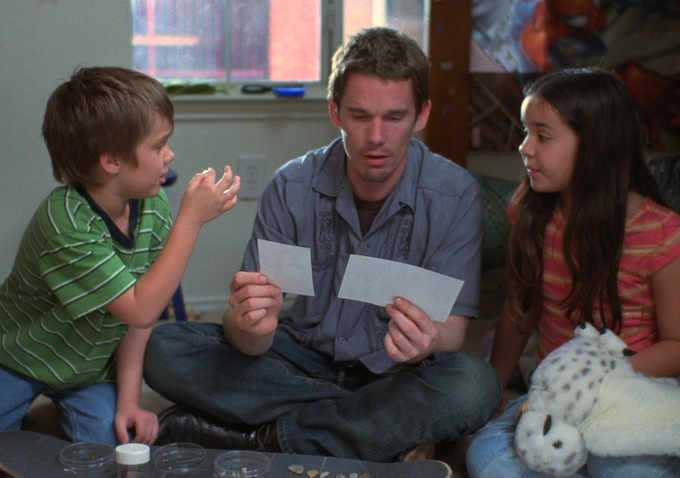 The other quibble I have is larger, mostly that the movie is tied to a character that is rather something of a bore. As a child, Mason is more reactionary to the world around him, taking in all these experiences, especially the hurtful remarks of adults and the long-term effects of all that marital discord and abusive stepfathers. He’s quiet, a bit lackadaisical, generally procrastinating and stretching rules, but he’s really just a boring kid who grows into a boring teenager. Now there are certainly plenty of relatable qualities to him that extend beyond his external situations and family conflicts. Plenty will be able to relate about the struggle to fit in, the points of self-discovery, and the initial buzz of a romantic mingling, among other coming-of-age moments. The problem is that Mason is struggling with finding his own onscreen identity. It would be foolish to have this kid suddenly know with divine clarity who he is and what he wants to be, but would it be breaking the confines of realism to give this character a personality? He ends up becoming this blank canvas for the audience to project themselves onto. If we’re going to spend nearly three hours watching the emergence of a character, it needs to be someone the audience can engage with so that their journey has a lasting emotional impact. Mason is an ordinary teenager, which means he’s an otherwise shrug-worthy figure for this massive of an undeserved spotlight.
Perceptive, funny, warmly affectionate, and well made in just about every capacity, Boyhood is an enjoyable movie from start to finish, another fine achievement for director Richard Linklater. It is a movie about a young man coming into his own, but it’s also a film about those around him doing likewise, maturing, aging, but mostly gaining some stronger sense of themselves and stepping out to make this happen. It’s a tale of life told in micro and macro, and while it lacks the cumulative impact or the 7 Up series of the Before films, it certainly has enough measured drama and honest reflections to stir a bevy of feelings with its audience. I only wish the main character was a more interesting focal point for this twelve-years-in-the-making project, especially with all that added time for Linklater and company to double back and alter their narrative. The character quibbles, and the ultimately unnecessary gimmicky nature of its conceit, are enough to blunt its overall longstanding resonance for me, but this is still a very fine movie and one that no other filmmaker working today could deliver. I just wonder what other secret films Linklater is keeping from us.
Nate’s Grade: B+
Share this:

Fruitvale Station (2013)
 In the early hours of New Year’s Day in 2009, 22-year-old Oscar Grant was forcefully escorted off the Oakland transit system by armed officers. He was believed to be involved in some sort of gang-related scuffle on the train. Over the din of confusion, shouting, and anger, Oscar was shot and killed by a transit cop. His death sparked waves of outrage in his hometown and grabbed national headlines. Ryan Coogler was so passionate about Oscar’s death that he decided to write and direct a movie detailing the last hours of Grant’s life. He snagged Michael B. Jordan and Octavia Spencer (The Help) to star, attached Forrest Whitaker (Lee Daniels’ The Butler) as a producer, and the ensuing film, Fruitvale Station, debuted at the 2013 Sundance Film Festival and won the top honors. Thanks to Coogler, many more people will have a chance to get to know Oscar Grant as a person rather than an unfortunate statistic.
Coogler creates a remarkable debut film for himself, one where the details of life feel richly realized and observed. Sure there are obvious symbolic metaphors introduced like boiling lobsters and a lost dog that dies in Oscar’s arms (yes, foreshadowing), but as a whole Fruitvale Station feels like real life transposed onto celluloid. Coogler also works hard to humanize all the participants in his film, save for the transit cops at the end. There is a refreshing lack of judgment throughout the film as people are allowed to be the ambiguous creatures we are. No more so than Oscar. He has moments that make you wince, but mostly we watch a man struggling to get his life in order. He’s terrific with his daughter, loving and naturally attentive; he puts his family’s needs ahead of his own when it comes to money; he even helps a stranger learn how flash fry a fish, though there’s a hint of flirtation guiding his actions. But he also can’t hold onto a job, has trouble being more actionable in his life’s decisions, and temptation is always banging on his door to lead him back to prison. He’s a complicated man and Jordan (Chronicle) masterfully brings the man and his complexities to life. This is a star-making performance by Jordan (as was his turn on The Wire) and I was stunned at how easily Jordan dissolves completely into his role. There isn’t a physical nuance or line delivery that feels false. It’s a sympathetic humanization and Jordan’s performance is a gift. Combined with Coogler’s deft handling, Fruitvale Station is engrossing.
 For much of the film I felt like I was attending a funeral. It’s hard to watch at times, especially watching Oscar’s family wait at the hospital for the news we already know is coming. It reminded me of 2006’s United 93, where the overwhelming sense of dread held over every scene, every innocuous moment held the extra weight that it would be the last time this person was doing this or talking to this person; the dread of waiting for the end we all know is coming. Coogler opens his film with real phone video recordings of the death of Oscar Grant, so from the first moment on we’re awaiting the horrible inevitability. I suppose it gives every moment an extra dimension of pathos, and to some this may be cheap and easy, but it all comes down to perspective. Surely if you knew the final day of your life, you’d likely find extra meaning in the simplest things, bidding goodbye in a thousand different subtle ways. This message isn’t exactly new; it was already old when Thornton Wilder hammered it home in his 1937 play Our Town. Carpe Diem, seize the day, live every moment like it’s your last, stop and smell the roses; you get the idea. And so, the entire running time of Fruitvale Station is a mournful examination on the contradictions, complexities, and connections of a single human life.
Oscar Grant is not lionized as a saint nor is he vilified as some mindless thug without redemption. Carefully, Coogler constructs a complicated man struggling to right his life. Through flashbacks we see he’s spent time in prison, and he’s got a quick flash of a temper that can lead him into impulsive and violent confrontations. It’s significant that we see this prison flashback to summarize completely the life Oscar is trying not to return to. The temptation is always present to fall back on old patterns of comfort, namely cheating on his girlfriend (he has a lot of girls’ numbers in his phone) and going back to selling drugs to make ends meet. Oscar’s ongoing struggle with personal responsibility has cost him his supermarket job (he was late far too often), and he’s kept this news to himself, choosing not to worry those close to him. But his options are limited as an ex-con, let alone a guy fighting his own demons, but he keeps fighting because the Oscar we see, the glimpses of what he could become, are one who wants to be better. He dumps his supply of drugs rather than go through with a sale. The gesture is noble but also partially self-destructive from a pragmatically financial way of thinking. He’s in a deeper hole, money-wise, but he seems committed to making the change. A late encounter with a kind stranger also provides the possibility of a new job, a new chance, one that seems all the more tragic because we know it is a promise that will never be captured. Oscar Grant was likely never going to be a man who changed the world. He was an ordinary man. But we still mourn the death of ordinary men, even those who have made mistakes and are fallible.
 It’s impossible to view Fruitvale Station without its relevant connections to the Trayvon Martin case of 2012. Both of these men were black youths deemed to be “up to no good” with quick judgment skewed by prevailing racial bias. Both men were killed for being viewed as threats due to their race and gender. However, unlike Trayvon, we have a litany of witnesses and video evidence documenting the senseless execution of Oscar Grant. That transit officer argued he mistook his tazer for his gun because, surely, a suspect who is already handcuffed, face down on the ground, and having his head pressed down with the boot of an officer, surely that man needs to be tazed just for good measure. That officer, by the way, served 11 months of a two-year prison sentence for involuntary manslaughter (justice served?). It’s senseless tragedy built upon miscalculated racial alarm, and the reason we have a movie, the reason there were riots in Oakland, is because this specific case had witnesses. How many other innocent young men die every year because someone wrongly and hastily deemed them to be “up to no good”?
Coogler isn’t trying to stir the pot of racial animus or deify Oscar Grant into some martyr for the cause. Fruitvale Station only follows the last day of Oscar Grant’s life but in doing so it becomes an illumination of a human life. Oscar was an ordinary man before he met so unfortunate an end, but Coogler wants us to remember him not simply as a newspaper headline, but as a person. It’s a worthy endeavor that succeeds heartily but may prove to be dull to many, including several of my own friends and critical colleagues. I can’t argue that the life of Oscar Grant is notable to follow beyond the sad final twenty minutes. But that doesn’t bother me, because with the talents of Coogler and Jordan and their indomitable sense of purpose, the film becomes a fitting portrait of Oscar Grant as a human being and a life lived, not just a life prematurely extinguished. It’s powerful, upsetting, brimming with emotion and fury, and it’s also eerily relevant to today and will, I fear, only continue to be more relevant as the next Oscar Grant or Trayvon Martin captures the national spotlight. Coogler’s excellently realized film is a eulogy to an ordinary man, flaws and all, but also a call to do better.
Nate’s Grade: A-
Share this:

In a World… (2013)
 Actress Lake Bell’s writing/directing debut, In a World, is a comical look inside the world of voice acting, particular in the field of movie trailers. It’s an interesting world and told with enough comic acumen by Bell (TV’s Children’s Hospital), a serious student of vocal artists. She plays Carol, a woman who breaks into the trailer voice over biz, causing ripples in a field dominated by baritone-voiced men, like her legendary father (a perfectly unctuous Fred Melamed) who holds to sexist dictum. There’s a cute romance involved with Demetri Martin, an effective subplot about Carol’s sister having an affair, and an ongoing commentary about the uncomfortable infantilized voice many young women utilize. The story is threatened by a percolating mistaken identity rom-com convention, but thankfully regroups for a third act pitting father against daughter in vocal performance, as it should be. As a director, Bell has a steady feel for her scenes, following a subdued comic rhythm that also feels eccentric without going overboard. As a writer, she gives her characters space to grow, to make mistakes, and to triumph but not without complications. As an actress, Bell is charming and a terrific lead anchor for a film filled with likeable, quirky characters. In a World is a little movie but it’s effortlessly cute, winning and pleasant in the right places, and filled with a great cast of comic actors. Beware: upon exiting the film, it is unavoidable that you will do your own fake trailer “In a world…” impressions.
Nate’s Grade: B
Share this:

Escape From Tomorrow (2013)
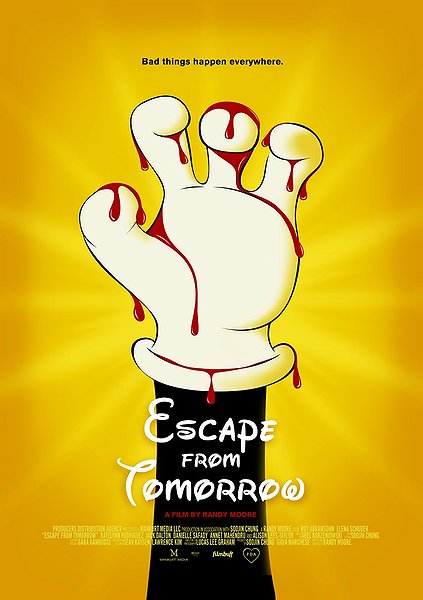 Escape From Tomorrow built a wave of buzz coming out of the Sundance Film Festival, namely because it was a bizarre, psycho-sexual little indie film shot secretly on the premises of Disney World and Disney Land. Writer/director Randy Moore shot his movie in secret, unbeknownst to Disney and the park employees. He was so paranoid about word getting out what they had done that Moore edited the film in another country. There is palpable fear at the reach and power of Disney’s coffers, enough so that a character mentioning the very D-word is silenced, and so I recall early on that people predicted Disney and its armada of lawyers would never allow Escape From Tomorrow to be released. Rather than get litigious, the Mouse House has decided to simply clam up, refusing comment. It’s a smart move, because besides a passing novelty, no one is going to remember the oh so monotonous Escape From Tomorrow in a matter of months.
The wisp of a plot involves a family vacationing at a Disney park. On the final day, the father (Roy Abramsohn) has been told he has lost his job. The rest of the day follows suit as the father loses his grip with reality, interpreting sinister signs throughout the park. He also keeps running into a pair of French teen girls who enjoy holding hands, being flirty, and singing. After the third or fourth time, the father starts to trail the girls, eerily entranced. They warn him that dire things will befall him if he doesn’t go with them.
 Take away the ballsy, surreptitiously recorded angle, the “how did they do that?” factor, and ultimately is there a movie here worth watching? I would definitively say… no. Admittedly it’s interesting to dissect how this guerrilla-style stunt was accomplished, watching scene after scene and figuring out what was shot in the parks unbeknownst to tourists and employees, what was likely shot on a set, where the cuts marry the two, and what techniques the director and his crew utilized to film a movie without blowing their cover. I think many of the scenes had to be improvised, at least the dialogue within the park, because starting and stopping and repeating lines in public, out in the open, would seem suspicious (the cursing would also seem to be courting danger). The Disney theme parks have millions of visitors, so people recording every action would not seem out of the ordinary. Escape From Tomorrow works as a stunt, with the audience picking apart the magic trick simultaneously as it’s performed.
However, a stunt is all that Escape From Tomorrow is because from a thematic, subtext standpoint, this movie is a mess. There just isn’t enough weirdness going on here and whatever small doses of it we get is given precious little connection to any larger theme. It feels like the filmmakers settled on the most facilely subversive idea – Disney Land, the happiest place on Earth, is not. Undercutting all of Disney’s famous family-friendly iconography with the occasional weird thing is not enough. A kid has black eyes. Ten minutes later a stranger makes an offensive comment. Ten minutes later something in a ride that is supposed to be happy looks mean instead. The majority of the movie plays out like you’re watching someone’s boring vacation. You don’t care about the characters. There is no plot to speak of, and that can be acceptable in an atmospheric film that serves as a visual descent into madness. There just isn’t enough madness here. Escape From Tomorrow is far too tedious to be effective. Long stretches are just watching the family traverse the theme park, notably with the father always running into the French teens. There is far too much padding, little connection from scene to scene, and the end is just a confusing muddle groping for a deeper meaning. Midway through, when the father is captured and held underground at Epcot, it looks like the movie is going to take that next step, ramping up the weirdness. Well that conflict is readily solved and then we’re back to the occasional boring out-of-place item. I want to say that Escape From Tomorrow is like David Lynch’s vacation video, but that is giving too much undeserved praise. This is like the deleted scenes of David Lynch’s vacation video.
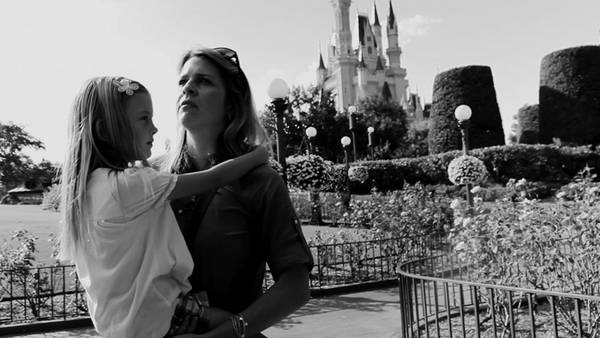 My colleague Ben Bailey countered my negative option with the idea that Escape From Tomorrow is meant to be a dark comedy and to view it through that lens; all right then, because as a “comedy” it still is half-baked, meandering, and poorly executed. The incongruous imagery, often sexual or demonic, is rather cheap in the sense that it’s just flipping the staid Disney script on wholesomeness with no more subversive substance than a moody teenager scribbling on his notebook. The Disney princesses double as high-priced courtesans? Okay, now go further rather than just taking a standard Disney character and making it adult in a shallow manner. There’s a scene where the father escapes by squeezing a tube of Neosporin to lubricate his hands out of confines, and oh boy, the white liquid shoots onto hanging pictures of female body parts. What a riot. Taking a cockeyed, perverted look at Disney is not the same as developing comedy, and even that cockeyed view is lame. I think that the father’s lustful pursuit of the French girls is meant to be comedic, but it was only creepy. When he sneaks up to spy on them in their bathing suits, how else should I interpret that? If this is supposed to be a comedy then Escape From Tomorrow is an even larger misfire.
Escape From Tomorrow is a nonsensical, plodding, superficial film, and it adds up to a whole lot of nothing. There isn’t a grander statement or sense of commentary. There is just scene-to-scene weirdness that grows old rapidly. I commend the ingenuity of the filmmakers for being able to secretly record a movie at one of the most heavily trafficked locations in the world. I don’t think the filmmakers had any clear vision of what they wanted to say with their movie, settling on “weird crap at Disney Land,” and then putting all their time and energy into planning how to pull off this coup, never mind the fact that the finished product was not nearly worth the effort. If you’ve ever wanted to be trapped on a bad vacation, then enjoy, movie masochists.
Nate’s Grade: C-
Share this:

Don Jon (2013)
 Joseph Gordon-Levitt, one of the most talented and, yeah I’ll say it, dreamy young actors working today is proving to be more than a pretty face. Don Jon is his assured writing and directing debut, and it shows that every man has one more reason to feel insecure compared to Gordon-Levitt. The titular Jon (Gordon-Levitt) is a New Jersey lothario who sleeps with lots of women but the real thing just can’t measure up to his porn. The schism between reality and sexual fantasy is too much. Jon tries to reform his porn-addiction ways when he meets a hot lady (Scarlett Johansson) but old habits are hard to break, especially when he has to wait before sleeping with a woman. The narrative isn’t terribly deep or that developed but remains entertaining throughout, buoyed by feisty performances and stylish direction. The editing, sound design choices, and smooth camerawork made me feel like I was watching a promising Scorsese student. I found Don Jon to be a far more successful look at sex addiction than the recent sex addict drama, Thanks for Sharing. The parallel between porn and Hollywood rom-coms, both an inflated fantasy of relationships, doesn’t really stick, and Jon’s family is a bunch of loud Italian stereotypes, but the lead guy is a self-possessed lunkhead anyway, so it makes sense for his family to follow suit. Don Jon is funny, sexy, and an enjoyable diversion at the movies. What it really does, though, is provide the first notch in what may prove to be an exciting directorial career for its star.
Nate’s Grade: B
Share this:

Short Term 12 (2013)
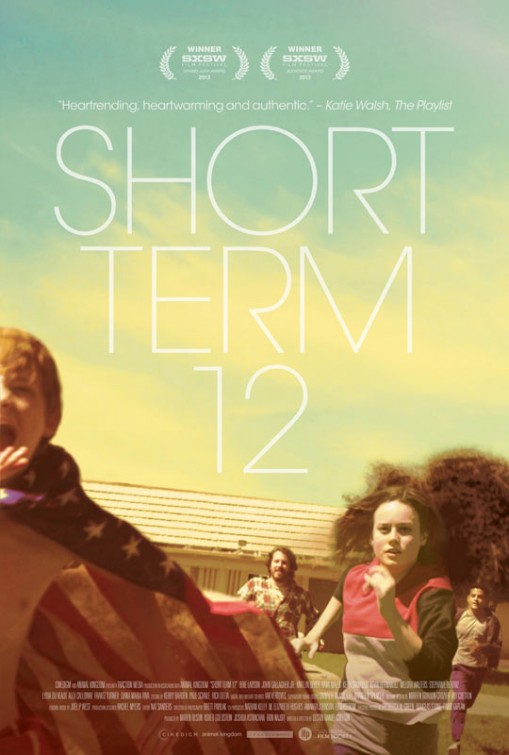 It’s rare for a movie to be emotionally devastating while also being overwhelmingly inspirational and hopeful, but Short Term 12 achieves the nigh impossible.
Short Term 12 follows the inhabitants of a small foster care center in Middle America. Many of the kids have been taken from their biological parents because of abuse, neglect, imprisonment, or death. Many have never known a stable home life. And many will age out of the system at 18 and be trusted to make something on the outside by their lonesome. Grace (Brie Larson) is the lead counselor for the center. She’s dating a co-worker, Mason (The Newsroom’s John Gallagher Jr.) and pregnant, unsure of where to go from here. As the center prepares for Marcus’ (Keith Stanfield) age-out departure, they welcome Jayden (Kaitlyn Dever) to their abode. Jayden’s well-connected father is getting his life in order for full custody, but it also becomes clear that her home life is a danger to her well-being. Grace fights to get Jayden to open up, then she fights to keep her safe, all the while forcing Grace to deal with her own long hidden pain.
 It’s so easy to get engaged in this movie. The very setting calls for plenty of drama and pain to be explored, and it will be, but that doesn’t mean that the film goes overboard with histrionics. The characters are written with such naturalistic ease, allowing an audience to understand them without judgment. These people, be they the foster kids or the counselors, feel refreshingly, exceedingly, magnificently like flesh-and-blood people. The characters feel lived in, their struggles feel real, and their responses are sincere. The foster care system in this country is grueling. A counselor needs a big heart, thick skin, and an immeasurable supply of patience. There are a lot of abused kids in the system, just hoping to find an adult who wishes to love them, to nurture them, to care. The kids don’t want pity; they are perturbed when they’re referred to as “underprivileged youth.” What they really want is respect and sincerity. Highly charged emotions are a given considering the circumstances of the characters, but what makes Short Term 12 exceptional is that they are fully earned. We don’t just feel for these kids because they’ve suffered, we feel for them because they are presented as characters instead of martyrs. I was emotionally moved throughout, tearing up several times, feeling heartbroken at turns and then brimming with buoyant hope at others. It’s a balancing act the movie masters.
Writer/director Destin Cretin (actually remaking his 2008 short film of the same name) explores these characters in gentle waves, allowing the characters to open up in ways that don’t feel forced. You learn about these characters and their history bit by bit, sometimes through creative expression where one must read between the lines. Marcus might seem to be one character, then his rap song he writes reveals an aching degree of personal pain, and then the revelation for why he wants to shave his head, which at first just seems like an average teenage compulsion, will break your heart all over again. You yearn for these kids beyond measure, wanting them to taste delayed happiness in this world, but you also understand why they’re so guarded, why the system grinds together as it does. This is no polemic overburdened with speechifying and soapboxes. It doesn’t really make any larger points about foster reform or the people who run the system. Instead Cretin gives every participant in the film complexity, empathy, and humanity. Even Grace’s supervisor, easily set up for quick blame about decision-making, is allowed empathy. You feel the man’s plight as he tries to make the best out of a bad situation, which is exactly what the counselors are trying to do themselves with their charges. Cretin’s emphasis is on his characters and not necessarily on making overt political attacks. I knew within minutes that I was in for something special. You can feel it with the dialogue, how easily Cretin is shaping character without splurging on exposition. These people come alive under Cretin’s watch, and you’ll be pulled in within mere moments.
This is also fundamentally a star-making performance for Larson. The young actress has had visible roles in Scott Pilgrim vs. the World, 21 Jump Street, and TV’s The United States of Tara, but nothing prepared me for the power of her performance. Larson’s character has plenty of personal pain and secrets and a gnawing sense of futility, but she pushes forward, trying to make a difference somehow in this world. You feel her intensity and determination but you also feel her setbacks and uncertainty. Larson never strays outside the emotional bounds of her character, staying true to her aims. Grace is no saintly and selfless figure. She’s paying a real price keeping her own pain bottled up, focusing completely on others so that she doesn’t have to assess her own damage, but Jayden forces her to examine her own history. Larson serves as the dependable emotional anchor of some very choppy waters. In a just world, Larson’s name would be bandied about come awards season, but the overall small, understated nature of Short Term 12 and its limited release leaves me in doubt. However, there is no doubt that Larson gives a deeply humane, gripping, heartfelt and marvelous performance.
 The character relationships are just as compelling and provide a rich texture to this world. The dynamics within the foster center are interesting, nothing as simplistic as slotting kids into staid high school types. There are divisions within the home, chiefly between Marcus and an antagonistic Luis, but it’s also invigorating when you witness the various kids come together in solidarity and community, when they look out for one another. Jayden is surly at first but won’t let on how truly hurt she is that her father missed her birthday. Marcus leads the other kids and they all make a slew of birthday cards to cheer her up, make her feel that someone out there cares. It’s a small gesture, and yet when it plays out it hits with a wallop. The relationship between Grace and Mason is sweet and frustrating, representing a romantic coupling of two people with an obvious connection but also enough baggage to derail potential long-term success. Gallagher Jr. is a nice fit for the part. I really enjoyed how Mason is developed as the film progresses. Initially he seems like a pseudo-cool authority figure, then a scruffy screw-up, then a sincere and grateful individual worried about Grace and aggravated by his inability to help her.
There are movies that feel true in a broad sense but clumsy with the fine details, and vice versa, but Short Term 12 is that rare movie that feels so authentic that it could have been a documentary. Sure there is convenient plot developments and a tidiness that life just doesn’t want to provide, but the overall impression is remarkably genuine. The characters feel like actual people, their world feels recognizable, and their struggles feel familiar and relatable and raw. Short Term 12 doesn’t glorify the counselors, nor does it demonize or sanctify the kids under their care. Here is an unblinking look at the sheer weight of the work of trying to provide for those in need. The movie is a potent drama with several heartbreaking incidents, but I don’t want to scare people off with the impression that Short Term 12 is all artsy doom and gloom. On the contrary, the film is resolutely hopeful in the face of such dire adversity. The perseverance of the counselors, as well as the kids striving for independent lives, is what I walk away with. Not the abuse, not the systematic neglect, but the indomitable perseverance of the human spirit to transcend damage and to succeed anew. This is the long-lasting impact of this superb movie. It’s not about the pain inflicted, rather the human connections forged and the optimism of recovery. Not everything will get its happy ending, but it is inspiring to watch people put it all on the line, thanklessly. Short Term 12 is the kind of movie you bug your friends until they finally watch it. Ladies and gents, commence bugging.
Nate’s Grade: A
Share this:

The Spectacular Now (2013)
 I say this as a fan but John Hughes was probably the best and worst thing that happened to the modern teen movie. He certainly brought an extra level of pathos and relatability to the genre, but then again he also dealt in stereotypes, often languishing his characters to stock archetype ghettos (the Jock, the Prep, the Nerd, etc.). In the ensuing decades, it’s been hard to break as many teen films, of those aimed at teenagers, have casually dealt in these easy labels. That’s why something like The Spectacular Now is such a welcomed respite. Here is a teen movie that aims to tell a story about people and their problems, not simply a regurgitation of high school cliques and clichés. This isn’t a film where all the pieces magically come together; this is a high school movie that more closely approximates real life. This is more Cameron Crowe than John Hughes material.
Sutter (Miles Teller) is the most popular guy in school, or so he’d tell you. He’s the life of every party, the kind of guy who everyone enjoyed, and the guy who could charm the pants off any girl. He’s recently broken up with his girlfriend Cassidy (Brie Larson), though still harboring serious feelings for her. Of course the best way to get over the old girl is with a new one, and Sutter sets his sights on Aimee (Shailene Woodley). She’s a smart, somewhat quiet gal that immediately takes a shine to the spotlight that is Sutter’s affections and attention. He’s not entirely over his old girlfriend, still angling to get back together, but also Sutter’s whole perspective could be summed up as an extreme case of carpe diem. The kid is partying like there’s no tomorrow because he’s convinced he has no real future, so he’s going to live it up while he can.
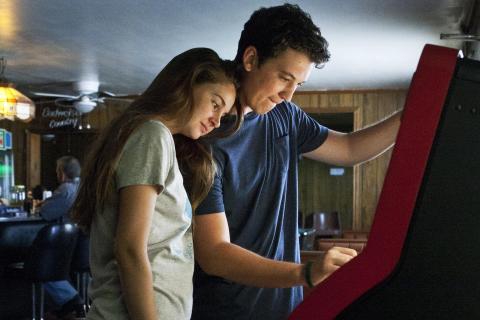 You’ve easily seen this movie before but it’s rare to see it given so much depth, maturity, and care. At heart, this is the story of Sutter learning he’s a screw-up and getting his life back in order, learning some self-control and responsibility, and winning over the good girl. But The Spectacular Now is so much more than that, and it’s especially sadder than you may have expected with its wise-talking, charming protagonist. This is the story of a teen coming to grips with parental abandonment, gaining insight into his own delusional detours to avoid pain, and the horrible realization that he is, in his present reckless condition, a bad influence dragging down the future of the girl he genuinely cares for. That’s a lot of heavy emotional drama and none of it revolves around the clichéd staples of teen movies, like those checkpoints such as prom and the Big Test. This is the story about one damaged man coming to terms with the state of his damage and gaining the courage to change his direction. He’s an alcoholic but the movie doesn’t ever put the narrative on hold for soapbox preaching. If anything, Sutter’s alcoholism is handled so subtlety, with most character silently acknowledging but unsure or indifferent to act, that it may strike a few chords with audience members. Then there’s the fact that none of this is heavy-handed; the filmmakers have done a fabulous job of giving each character credibility. They behave like real human beings. Even the easily slotted antagonists, namely Cassidy and Sutter’s deadbeat dad, are given shades of recognizable humanity and depth. Even though Cassidy waffles in her feelings for her ex, I cannot dislike her because her character portrayal is so honest. She’s struggling with her feelings for a screw-up with redeeming qualities. That’s fairly relatable, even if she’s not our winsome romantic lead. The filmmakers drag a typical teen movie story into our real world setting, adding depth and telling observance. You will recognize many of these characters.
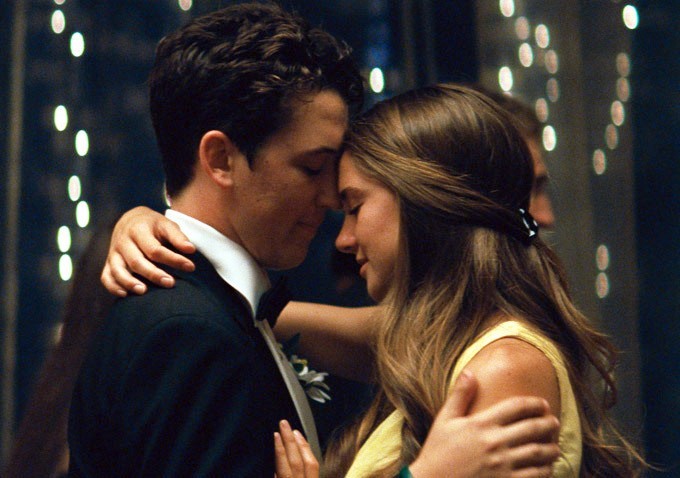
There are few superlatives to describe the cuteness of the blossoming relationship between Sutter and Aimee. It’s so smooth and relaxed yet completely believable, and the two actors have such a warm and natural chemistry with one another, enough that I seriously contemplated if they dated outside the film (rumored but nothing conclusive). You feel their budding affections, the sweet swoon of young love, and the hiccups along the way. Woodley (The Descendants) does an outstanding job with her mannerisms and affectations; her awkwardness around her feelings is adorable, but not in that prefabricated cutesy way often ascribed to the oft-mentioned Manic Pixie Dream Girl roles. She’s a fairly normal teenager on the fringes of high school, keeping her nose down and looking ahead. In movie terms, you couldn’t readily classify a gal like Aimee, and that’s because she’s a real character fully fleshed out by the screenwriters and the actress. Woodley’s performance is near invisible of acting tropes and constraints. She just dissolves into the character as all exceptional actors do.
But this is Sutter’s movie and, in accordance, Teller’s (Rabbit Hole) film. The young man puts on an acting camp in this film, shedding the various layers of armor from his sad clown of a character. As I said, we’ve seen this character before, but Teller and the screenplay are able to give Sutter such extraordinary depth. The carefree life-of-the-party character is turned into an introspective character study, essentially examining the darker side of Ferris Bueller. He’s using alcohol and his blithe attitude to blunt the pain that he fears he’ll end up like his old man, that his life has already peaked and he’s not even out of high school. Teller is such a successful charmer that he already wins you over to his side despite some boorish behavior because we see that the guy has a good heart. In the film’s opening, he’s propping up his friend to finally get the guy a girl, and the ensuing mess ends Sutter’s own relationship. The last act involves Sutter coming to grips with the negative impact of his actions, notably on Aimee. Teller is so effective at giving you glimpses of the sadness eating him whole. His concluding scenes when he finally breaks down feel like a hard-fought victory for the character as he confronts his doomed fate. At every turn, Teller impresses, and compounded with Woodley, they form an unbeatable team of sterling young acting talent.
 Special mention to Kyle Chandler (Super 8) for his pivotal walk-on roll as Sutter’s bad dad. He’s so pathetic and so desperate and so wonderfully realized by Chandler. He doesn’t get a Big Scene, he doesn’t get a Big Speech, he doesn’t even do anything out of the ordinary for a shifty, unreliable, selfish drunk, but those few minutes he’s onscreen, it all becomes so deeply sad and clear where Sutter’s life is headed without intervention.
The only depiction that I had trouble believing was Sutter’s almost consistent drinking and driving. Throughout the film, he has his trusty Styrofoam Big Gulp cup with him, spiked with booze. The man hasn’t graduated high school yet and is already a high-functioning alcoholic. Because of this I can believe that people would not be alarmed seeing him drive after imbibing a few drinks. However, the man is constantly drinking while behind the wheel of an auto and several times he appears completely trashed. I find it alarming as well as a bit far-fetched that not one character, not even Aimee, would raise objection to Sutter’s continued dangerous behavior. We also witness several scenes of Sutter drinking in bars. It’s conceivable he has a fake ID at his disposal, and it’s even more conceivable that he could talk his way into any establishment, but it’s more food for thought. Then again maybe this is just one of those towns where nobody cares about innocent lives being snuffed out by drunk drivers.
The Spectacular Now is an earnest film that doesn’t overdo it, providing challenging life lessons to fully formed, complex, believable characters. It doesn’t sugarcoat the heartache and harsh reality out there for vulnerable teens. It’s a charming romance tied up with an insightful character study of one young man hiding his sadness and anxiety of life’s disappointments with humor and booze. Thanks to the tremendous acting of its onscreen pair, you root for Sutter to turn his life around because you see value in him as a person, even if he doubts it himself. You’re on his side from the start, and you know how nicely he matches up with Aimee. You want this movie to pull off the spectacular, and for long stretches it feels just as if that will happen. The ending aims for ambiguity but is far more hopeful than its source material. I was charmed thoroughly by this film and its lead characters but even more I was thoroughly engaged in their dilemmas, moved by their struggles, and encouraged by their perseverance and growth. The Spectacular Now (extra points for never even having a character spout the title) is a funny, warmhearted, measurable restrained, knowing film that could open eyes. It may not be spectacular to some, but it’s surely a great film.
Nate’s Grade: A-
Share this:

The Way, Way Back (2013)
 A throwback to the youthful summer movies of the 80s, The Way, Way Back is a delightful coming-of-age film that manages to excel at both comedy and drama. Oscar-winners Jim Rash and Nat Faxon (co-writers of 2011’s The Descendants) graduate to directors, guiding the famous cast with ease yet squeezing enough satisfying emotional truth into the formula of a screwy, Meatballs-style comedy. We follow 13-year-old Duncan (Liam James) as he spends the summer with his mother (Toni Collette) and her bully of a boyfriend (Steve Carell). My one gripe is that the film spends far more time than it needs to establish just how unequivocally awkward Duncan is. You will likely cringe. When Sam Rockwell enters the picture as a charming goofball water park employee who takes Duncan under his wing is when the movie ascends to a new level of comedy. The Way, Way Back hums along with its own sense of charm, presenting familiar characters/scenes but giving them added texture and relatability. You will be surprised at how much you feel for these characters, you may get a bit misty at points, especially when they behave like people and not zany cartoons. Carell as a bad guy is a real eye-opener; he’s a passive aggressive bully rarely seen in movies. James is an authentically awkward teen but you also buy every step of his journey. It’s just such a sweet, enjoyable, and cute movie, exuding charm and sincerity. Here is a movie that just makes you smile. You’ll leave The Way, Way Back feeling warm and fuzzy, and Rash and Faxon have another winner on their hands.
Nate’s Grade: B+
Share this:

The Kings of Summer (2013)
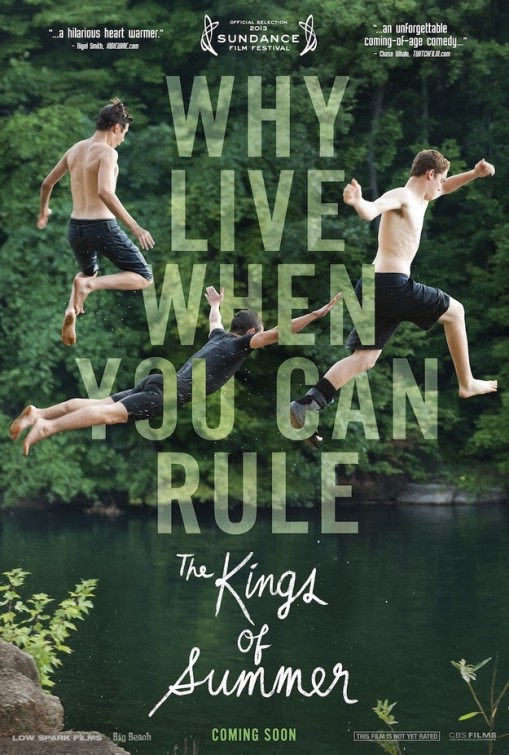 Working part-time at a movie theater in the summers, I come across, let’s say, an interesting selection of customers with… interesting opinions. One middle-aged woman openly opined, while looking at the poster for the coming-of-age comedy The Kings of Summer, that she’s had enough with movies told from a teenage male perspective. While this same woman had very specific and narrow demands for an acceptable movie, she got me thinking. Why do we get so many coming-of-age movies from a male perspective? Let’s forget the easy answer that Hollywood has a lot more male filmmakers than female. There’s always that sense of romance with coming-of-age films, a nostalgic look back at a supposedly simpler time that now seems better appreciated. Maybe men are just more prone to romanticizing the past while women look forward to the future. Or maybe there are really just more men calling the shots about films get made. Whatever the reason, the woman didn’t go see The Kings of Summer, and judging by her attitude, I don’t think she missed out.
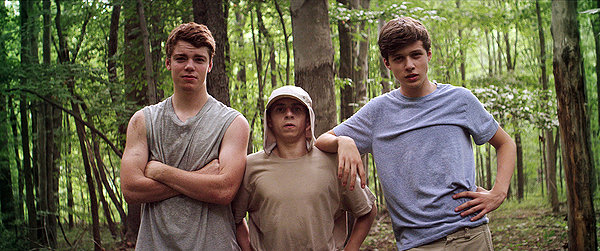 Joe (Nick Robinson) has just finished his freshman year in high school. He has a long summer ahead butting heads with his no-nonsense father (Nick Offerman). Then Joe gets the brilliant idea. He and his pal Patrick (Gabriel Basso), who is also sick of his annoying parents, will build their own home in the woods, a sanctuary where they can set the rules. Joe and Patrick pack up their belongings, find a quiet spot in the woods, and build that dream home. Biaggio (Moises Arias), a weird and gangly kid, takes an interest in the youthful declaration of independence and joins in. The guys invite girls over, explore the wilderness, grow patchy wisps of facial hair, and live out their fantasies of roughing it like real men. Of course it helps when a Boston Market is just down the road.
From start to finish, The Kings of Summer kept me laughing. I did not expect the comedy to be as consistent and thorough as it was, but writer Chris Galletta has a sure handed way of making the comedy derive from the situations and characters. Even with some outsized elements, notably Biaggio and the fact that the boys home-away-from-home is way too advanced for a kid who blundered through shop class, the humor never feels forced. That is an accomplishment, though the script also overly relies on Biaggio to say outlandish or weird lines. I especially enjoyed his one-scene pep talk with his father late in the movie. That confidant sense of humor goes a long way to relax an audience, allowing us to attune to the mellow waves of the film. It’s fun to watch the guys try to forage a life out in the woods, slowly learning how hard this whole survivalist lifestyle may actually be. The adults are viewed as blithe buffoons or hardasses, though they don’t come across as caricatures. Credit the attention paid to Offerman’s (TV’s Parks and Recreation) character as Joe’s father and credit Offerman’s uncanny ability to make gruff parenting endearing. This is an easy film to like, to go along with the flow, and to enjoy. It never really falters in entertainment and routinely has another joke at the ready to make you smile. It’s a sweet movie that does enough to keep you charmed.
While pleasant, I had to stop and reflect that there was absolutely very little to these characters. The boys all kind of blend together in their youthful romanticism of freedom and rebellion of lame parents, but you’d be hard-pressed to describe them beyond core physical descriptions. The moments that do supply character development are mostly broadly comedic or somewhat generic in their coming-of-age tropes, notably the broken heart administered by a guy’s crush. Example: Biaggio is essentially little more than a walking punchline machine. While quite funny and well acted, every line of his dialogue feels like a punchline. He comes from nowhere. At one point, Joe advises Biaggio that a girl may be interested in him, but Biaggio demurs and says that won’t work out. All right, here we go. Here’s where the movie sheds some light on him. Biaggio admits to being gay. The very next line involves him confusing gay with cystic fibrosis. It’s a funny joke but it turns a moment where a character was getting added dimension and just manufactures another punchline. Again, The Kings of Summer is a very pleasant film going experience, and one that made me laugh consistently, but objectively, the impact is too limited because of the lack of proper characterization.
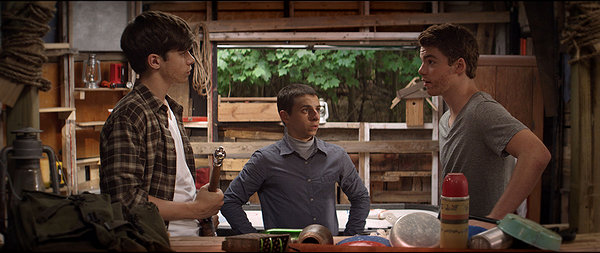 And I suppose this leads into a bigger question of whether this lack of substantial characterization even matters. Coming-of-age movies, like any subgenre in film, have their own expectations and conventions. We all have our different tolerance levels for narrative familiarity, and depending upon the genre, familiarity may be a necessity. Fans of coming-of-age films want to see those familiar elements. They want to see the bonds of friendship, the neglectful parents, the first crushes that lead to first heartaches. It’s just like fans of romantic comedies finding comfort in the two leads hating one another until, inevitably, they love each other, or the public sing-alongs. I think many coming-of-age films at some level tend to be somewhat broad or generic to make them more relatable. Perhaps I’m just being too generous to formulaic pictures. If you’re a fan of coming-of-age movies then you’ll probably be quite forgiving of the shortcomings in The Kings of Summer. Me, I prefer Jeff Nichols’ Mud and its more textured, empathetic look at adolescence in a working poor Missouri riverbed community.
Director Jordan Vogt-Roberts (TV’s Mash Up, Funny or Die Presents…) makes the film look beautiful. The romanticism of the youth running away to live in nature is improved with some spectacular looking natural settings and compositions. The film was primarily filmed in Cleveland and northern Ohio, and as a native Ohioan, I have to puff my chest. Vogt-Roberts is also skilled at handling his actors and balancing tone; while I criticize the over reliance on comedy at the expense of fleshing out characters, the tone is not divergent. It plays within the same cohesive wavelength throughout. If there is a breakout actor from this movie, it would have to be Arias (TV’s Hannah Montana, The Middle). The kid has a tremendous ability to tap into an oddball character, making him quirky rather than insufferable. He also has a unique look to him, and that’s got to be a plus for a working actor. Just ask Steve Buscemi.
Genial and undemanding, The Kings of Summer isn’t anything close to royalty in the coming-of-age genre but it’s consistently funny and enjoyable. The acting is good, the jokes work, and the movie’s out after 90 minutes. It’s a nice summer diversion but doesn’t contain the resonance to be considered more than that. The weak characterization and broad humor, while opening its wide appeal, also makes the film less substantial. It’s sweet and funny but little to distinguish it from other sweet and funny coming-of-age entries. If you’re a fan of the genre or looking for a mellow and pleasant evening at the movies, think of The Kings of Summer. Just don’t think it’s going to be anything more.
Nate’s Grade: B


 nathanzoebl
You must be logged in to post a comment.