Blog Archives
Bigger, Stronger, Faster* (2008)
 Chris Bell came from a roughly normal family in Poughkeepsie, New York. He and his brothers were a little chubby but saw weight lifting as their ticket to success. In the 1980s, Bell and his brothers idolized muscle-bound heroes like Arnold Schwarzenegger, Hulk Hogan, and Sylvester Stallone. Muscles were the answer for the Bells. Chris Bell became a teenage weightlifting sensation and moved out to California to follow his dreams at Gold’s Gym, just like Arnold. Bell’s older brother, Mike “Mad Dog” Bell, actually had a career as a professional wrestler on the national televised stage, though he was always the one getting beat up. Bell’s younger brother, Mark “Smelly” Bell, could lift hundreds of pounds. Both Mad Dog and Smelly have been using steroids for years. Chris Bell decided to make a documentary that examines both his family’s interest in steroids and the culture that bigger is better. Bigger Stronger, Faster* *The Side Effects of Being an American is that final product, and it radiates with sadness and anger.
Don’t let the subject matter fool you. This is less an expose over steroids then it is a penetrating and somewhat sobering look into the intensely competitive culture in America to “be the best” and shuttle the rest. Bell uses a clip of Patton addressing his recruits, saying, “Americans love a winner and will not tolerate a loser.” Bell interviews a wide variety of subjects, from doctors on both sides of the issue, and when he gets to sports fans the general line of thinking is that steroids are awful, unless, that is, they can help my team. If the dominant culture is pushing athletes to be the best that they can be, or else, then is it any wonder that taking steroids would seem customary? Should we as a nation chastise athletes that we, as a nation, pressured into juicing up to attain the glory we expect, nay, demand from our competitors? It seems like the same folks that are shaking their fists and bemoaning the impure state of athletics are shirking their own responsibility for contributing to the toxic mindset to win at all costs. In many ways, bodybuilding and muscle-bound athletes can fall prey to the same distorted mentality as those suffering under anorexia and bulimia. Both groups have significantly dissatisfied body images, one wants to continue getting smaller and the other wants to continue getting larger. Bell interviews Gregg Valentino, who has biceps that looks like five-pound sacks full of ten pounds of potatoes. He says the ladies are repulsed but the men come up to him in awe. Mad Dog says that he knows he was “destined for better things” and cannot find any sliver of satisfaction in living a normal life. His brother points out that Mad Dog has a good job, a loving family, and a wife who goes along with all of the emotional turmoil but still supports her man. Can’t he be happy with just being who he is?
 When the film shies away from Bell’s personal connection to the topic, the movie isn’t as compelling, though it is rather informative. Steroids have been painted as a scourge; however, the scientific evidence doesn’t bare this out. In the end, anabolic steroids are a supplement and have risks just like any other supplement or drug on the market. Bell has plenty of data to argue that legal drugs, like tobacco and alcohol, kill tens of thousands more a year than steroids (I think the doc informs that the yearly deaths attributed to steroids is around 3). The reason our society is so misinformed about steroids is because of heightened media hysteria and the likes of overly anxious lawmakers. Bell speaks with clear disdain when he reports that in 2004 Congress spent eight days covering the topic of steroids and grilling baseball stars; that eight days was longer than Congress spent deliberating the Iraq War, the response to Hurricane Katrina, and over health care. When Congress covered the steroid topic in the 1980s they interviewed heads of national public health offices, and those wise experts stated that the health risks from steroids had been exaggerated. So Congress just ignored their testimony. I get it, steroids serve as a boogeyman because few actually know what it does or, frankly, what is actually is. There are many different kinds of steroids, some of which are used all the time with societal approval, like cortisone shots intent to aid inflammation. Where people seem to have issues is over anabolic steroids, which is an extra boost of testosterone. Bell points out that the side effects of steroids are almost always completely reversible after the user stops taking the drug. How many other drugs, legal and illegal, can make a similar claim?
A very interesting side step the film takes is over the issue of legal dietary supplements. The dietary supplement industry does not require FDA approval to sell products. This means that the FDA must prove that a product is unsafe to take it off the shelf, rather than the more traditional approach where the drug company must prove that their drug is safe before selling it to the masses. It should also be no wonder then that the supplements that people buy in giant bottles at health food megastores are likely not much more than placebos, if you’re lucky (one supplement package advertised its “new legal formula”). Bell hires a few illegal immigrants and concocts his own dietary supplement with rice powder. He bottles it, labels it as “The Juice,” and can sell it for a gigantic profit margin, and it’s all legal.
Is performance-enhancement just apart of being an American and living out the American dream? Tiger Woods got laser eye surgery and can now see better than 20/20, so is that an acceptable performance enhancer? What about the United State’s fighter pilots who regularly are prescribed “go pills” to boost their energy levels? It’s suitably alarming to discover that the United States is the only country to make it mandatory for its fighter pilots to take amphetamines. Of course not everything Bell touches upon as performance-enhancing drugs measures up credibly, like when he mentions beta-blockers for people with performance anxiety. I don’t think tamping down anxiety is akin to enhancing performance since it merely allows the performer to perform with what they already have. Bell’s documentary has loads more questions than answers, but the best part of the film is that it doesn’t hide from contradictions but instead magnifies them and asks for an ongoing debate.
 Bell’s film is wide-ranging, lucid, and unexpectedly funny, but the most compelling moments occur when Bell looks at his own family history. Both of his brothers will likely be life-long steroid users because they feel that it doesn’t give them an edge but evens the playing field. Mike’s little brother, Smelly, is not content to go from lifting 700 pounds to 600 pounds. Neither brother has the courage to open up to loved ones about the steroid use. Smelly teaches teen boys and they idolize him, quoting his encouraging assertions that the kids don’t need drugs to go places. The hypocrisy is sad and I wonder what Smelly’s kids will think once they catch the documentary. Bell’s mother is brought to tears trying to determine where she feels she went wrong as a parent. Two of her boys are rampant steroid users and have equated muscles with self-importance, but it’s the admission that Bell himself once tried steroids that shatters her. When Bell also enlightens his mother that her own brother was the source of steroids then she just shuts down. She pleads with her son to stop because she can only take too much. Bell was brought up to believe that cheating is wrong and inherently un-American, and yet the system is practically rigged to reward cheaters. Carl Lewis and other 1988 U.S. Olympians actually tested positive for banned supplements but were given a pass, as the Olympic Committee blamed the results on “inadvertent use.”
Bigger, Stronger, Faster is a clear-headed and entertaining movie that challenges the audience to reconsider its feelings over steroids. The film is informative and presents counter arguments and thankfully plays out multiple sides to controversial and complicated issues. By the end of the film, Bell isn’t necessarily pro-‘roids but asking that we better scrutinize the culture that pushes for greatness at any cost. Human beings willingly destroy their bodies out of a desire to simply forever be better. When perfection is adopted as the norm then it’s no wonder that millions of Americans will never be remotely satisfied with whom they are. Bell encounters a 50-year-old body builder at the gym he works at. This man is packed with muscle but he says he’s forever “in training” and still waiting for his big break, whatever that may be. He currently lives in his car, but he justifies his plight by saying that if he can out-lift and out-bench others then he’s the winner. This man could not be a more perfect symbol of the price of winning at all costs. The asterisk in the film’s title is what truly tells all.
Nate’s Grade: B+
Share this:

Blades of Glory (2007)
 When the movie sticks to skating, it can often get hilarious with the on-ice performances and flashy, crafty costumes. Will Ferrell works his doughy man-child schtick and generates mostly amusing results.
Nate’s Grade: B-
Share this:

Rocky Balboa (2006)
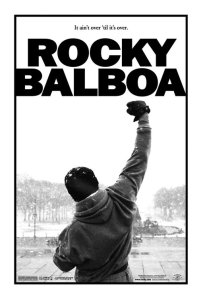 The idea of another Rocky movie, already 16 years since the last installment, sounded as good an idea as a punch to the face. Sylvester Stallone is an actor bottoming out after tons of high profile shit-for-hire jobs, and it looked like the industry was ready to yawn and put him to bed for a long winter?s nap. The idea of a Rocky 6 seemed like a thinly veiled vanity project for Stallone, going back to his bread and butter to try and resurrect some kind of acting pulse. Well, I reasoned, it couldn’t be any worse than Rocky V. I figured we were entering Godfather III territory and that is a scary place. But then I saw Rocky Balboa and realized what Stallone had in mind, and that is a proper sendoff to wipe the acid taste of Rocky V from the collective mouth of the populace. The great big lug can hang up his gloves and rest easy with a job well done.
Rocky (Stallone) has settled into a comfortable retirement. He owns a restaurant named after his deceased wife Adrian, and he regales diners with boxing tales and poses for pictures. His son (Milo Ventimiglia) is trying to make it as a businessman and distance himself from dad. Rocky rediscovers “Little Marie” (Geraldine Hughes), the same girl in 1976 he advised against smoking. She’s got a kid, a lousy job, and a weary perspective. Rocky reconnects with her and gets her to work in his own restaurant. She’s hesitant but he assures her that good ole Rock isn’t expecting anything in return for his kindness.
 Then one day ESPN runs a computer simulation pitting fighters of different eras. Rocky in his prime is paired against the current heavyweight champ Mason “The Line” Dixon (real-life boxer Antonio Tarver). Computer simulation Rocky KO’s computer simulation Dixon and the debate starts. The knock on Dixon is that he has no heart and the current level of boxing competition is beyond barrel scraping. Could an aging fighter from the past last 10 rounds with the current untested champ? Boxing promoters visit Rocky’s restaurant to convince him to an exhibition bout. Rocky mulls over the decision, not wanting “to get mangled and embarrassed.” Ultimately, he feels that he still has something to prove and decides to step back into the ring one more time.
The story is much like past Rocky installments. He spends a lot of time mulling over whether to fight or not, then trains, then we get the fight, though usually it’s some rematch of a Rocky setback. Rocky Balboa doesn’t stray far from the well-worn formula. The character has actually benefited with time and become an underdog once more, one with all sorts of new issues like calcified joints and arthritis. I would have loved a longer training sequence to show how a, presumably, 60-year-old man gets back into shape and how he plans to utilize his strengths (“hurtin’ bombs”). I agree with my friend George Bailey, somewhere along the line Stallone perfected the montage, and Rocky Balboa has an excellent training montage set to the same bom-bom horn theme that will still get your blood pumping.
The film presents some interesting characters but doesn’t spend much time with them. Rocky’s son has to deal with the long shadow his father casts and the idea that, no matter what he accomplishes, he?ll still be seen more as scion than individual. There’s a lot of meat there but Rocky Jr. only gets to huff at dad and then joins the team. Once everyone officially joins the Rocky team they essentially blend into the background of various faces shouting things like, “Come on!” and “Go Rocky!” The biggest supporting player is Hughes who gives a stirring speech for Rocky to confirm that this old man still matters. She has a great sadness to her and the character is played with non-threatening sexuality. Rocky isn’t about to jump anyone’s bones just yet, even years after Adrian’s passing.
 The only reasoning I have for why a so-so plot works as well as it does is because of our warm attachment to Rocky. Arguably the greatest movie figure in the last 30 years, Rocky could do it all, even get a Soviet crowd in Moscow to cheer for the American during the Cold War (don’t neglect to give Rocky his due for the breakup of the Soviet Union). Rocky Balboa, the character, is an old shoe that fits Stallone exceedingly well. Stallone has always been a mumble-heavy droopy dog of an actor, best described like Rocky’s new pet as a “cute ugly.” In short, the man never seemed to fit whatever character he played, and you don’t need to see Stop or My Mom Will Shoot for proof. But Rocky is his masterpiece, and after five sequels and 30 years, America loves its prized prizefighter. When you see the good soul trying to do right you forget all of Stallone’s many cinematic transgressions and you simply fall in love with the character all over again. Old feelings are reawakened and Stallone works his big-hearted, optimistic palooka charm. I watched Rocky Balboa and got swept up. Finally, the great American character can step away with the proper and fitting sendoff he deserves. In some ways, Rocky Balboa feels like a eulogy, as we reflect back on old times and how much these people have meant to us through the years, and the desire to see a lasting legacy intact.
It’s that sense of history that gives this new Rocky movie its heart. It is quite invigorating to see characters in new stations in life when we’ve seen glimpses of these characters for decades. It’s like a high school reunion that can include turtles. Stallone, who also wrote and directed this new movie, really has a strong shopworn affection for his blue-collar characters and a love of Philadelphia. It’s easy to feel the same warm and fuzzy feelings.
Rocky Balboa is a welcomed and surprisingly emotional end for one of American film’s greatest characters. Stallone puts the gloves back on and, like Rocky, still has “stuff in the basement” he needs to get done before he can rest. This is probably the best Rocky movie since the original and time has only made the characters more resonant and endearing. In 1976, Rocky defined the underdog and became well woven into our culture. Who would have guessed that 30 years and countless parodies later Rocky would still pack a punch? Stallone has earned his sendoff. Now about the idea for a Rambo 4.
Nate’s Grade: B
Share this:

Talladega Nights (2006)
 When it comes to clowning around, no one does stupid more smartly than Will Ferrell, a man perpetually in a state of arrested development. Talladega Nights: The Ballad of Ricky Bobby succeeds both as a satire on uplifting, redemptive sports movies and on the culture of NASCAR. The product placement is obscene in this movie, but then again, the same can be said with NASCAR racing. PowerAde had a contractual obligation to be cited at every family meal prayer, which itself turns into a competitive sport. Title buffoon Ricky Bobby (Ferrell) is so arrogant that he gets an ad for Fig Newtons on his windshield (“This ad is dangerous… but I do love Fig Newtons.”). Even the title is a perfect send-up. The redneck riffs are never very mean-spirited, but I like that the Southern bar keeps disco on the jukebox to “profile.” The sports clichés are picked apart, like the absentee father (Gary Cole) reappearing to learn the error of his ways. There’s a heavy reliance on slapstick and pretty much everyone in the movie is either a cad, a buffoon, or a jackass, so there are limits to that comedy.
True to 2004’s Anchorman, this movie hits its high points with the spontaneous moments of tangential weirdness, from sports announcers explaining how to put out invisible fire to Ricky Bobby learning to drive with a live cougar as a co-pilot. Talladega Nights doesn’t quite hit the absurdist highs of the infinitely quote-able Anchorman, and the movie spins its wheels all too often, but it’s got a greater number of solid belly laughs than most any movie out there today. Sacha Baron Cohen plays Jean Gerard, the gay, French Formula-One driver that upsets the stock car world. Cohen has great fun in an English language mangled performance Peter Sellers would have loved. When Ferrell and Cohen are face to face, you feel like anything can happen between these two quick-witted comedy titans. Ferrell has assembled another game cast of gifted improvisational artists and their blend of loony comedy feels like jazz. The downside with such a huge cast of very funny people is that not everyone gets the face-time they deserve (Oscar nominee Amy Adams comes to mind).
Talladega Nights is a big broad comedy with a great cast and some inspired chuckles. What other movie this summer could climax so perfectly with a man-on-man smooch and the observation, “You taste like… America”? Only one, baby, and it’s Ricky Bobby.
Nate’s Grade: B
Share this:

Murderball (2005)
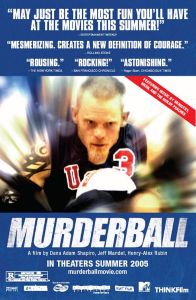 A fascinating look into the world of international wheelchair rugby, a high-octane game of bumper cars. This is a mere 80-minute movie and yet the wallop it packs can be felt long after. In such a short amount of time you get to understand the people, you really get involved in their drama and social situations, their competitive nature. Murderball explores so much of a little-seen world; I love the segment where they frankly talk about sex after their accidents. The help video that advises what sexual positions may be best for people in wheelchairs is hilarious. I never thought about it but there has to be quad groupies out there licking their lips. Mark Zupan comes across as nothing short of a superhero, and he’s just being himself. The film is surprisingly moving and poignant, with many uplifting scenes without ever getting sentimental. This movie earns every emotion. The people featured don’t want to get sentimental, they don?t want your pity; they just want to be treated the same how they were before their accidents. The wheelchair rugby bouts are exciting, with lots of interesting camerawork and useful animation. I loved immersing myself in this unusual sport, learning the point system depending upon the ability of movement with each person. This is an expertly crafted documentary with tight, rock-solid editing (it won an award for it at Sundance). You get this wealth of emotions and stories in at 80 minutes with enough time to close on an extended montage at the 2004 Paralympic games in Athens. It?s incredible seeing them turn their wheelchairs into these chariots of destruction. You get a great sense of the people and their world. This is the best documentary since the exceptional 2002 doc Spellbound, and Murderball is nothing short of the BEST film of 2005.
Nate’s Grade: A
Share this:

The Longest Yard (2005)
 Does anyone else remember an episode of South Park from the 2004 season where Eric Cartman dresses up as a robot named AWESOM-O? The best part of the episode came when Cartman stumbled into a Hollywood meeting and they asked the robot to pitch a movie idea. He came up with idea after idea of Adam Sandler in some wacky yet predictable situation, each a slight variation from the last. The Hollywood execs ate it up and scribbled everything down, chanting, “Goldmine!” I imagine The Longest Yard remake, the latest Sandler comedy vehicle, came about through similar creatively bankrupt circumstances.
Paul Crewe (Sandler) is at a low point in his life. The once star quarterback has been banned from football for throwing a game. His girlfriend (Courtney Cox) thinks they should split, and after being chased by police for drunk driving, he?s been sent to prison. The warden (James Cromwell, your go-to guy if you need someone old) has big plans for Crewe. He wants the young stud to organize an all-inmate football team to play against the cruel guards. Crewe gets help from a fellow inmate Caretaker (Chris Rock) and they set about finding the right men for their team. A former Heisman-winning football player (Burt Reynolds), who happens to be in the same prison, becomes the coach. Slowly but surely the group becomes a team united to get some revenge on their tormentors.
The Longest Yard is an Adam Sandler comedy in the worst way possible. The film is sloppy and sophomoric but generally unfunny. It sets its comedy heights on kicking people in the nuts and making fun of gay people. Mission accomplished. The sex jokes, while in abundance, generally fall flat because the movie is so ineptly transparent when it comes to comedy. It lets all the air out of the supposed punch lines. The humor is typically homophobic but infuriatingly also anti-women. You see, one of the guards is taking steroids in a bottle with a giant label that says, “Steroids?”(so much for keeping a low profile). The boys replace the steroids with -hee hee- estrogen pills. And in three days time, which would of course have no effect in such a short period, the guard is now crying, and overly emotional, and empathetic, and he has hot flashes, though I don’t know how in the world a man comes to that conclusion. Apparently it’s funny because women are weak and care about each other. I would be offended by this whole joke if it wasn’t so incompetently done. The Longest Yard exists in its own inept world where inmates have cells within arms reach of each other and there’s a prison football league. Lest we forget, this prison also keeps a star system to rank its inmates. Little did you know of Roger Ebert’s unorthodox side projects.
 Sandler plays Adam Sandler as he does in most of his Hollywood flicks. He’s likable, he’s a goofball, and it all works out. I wonder if we’ll ever see the true thespian side of Sandler again, like in Paul Thomas Anderson?s deconstructionist Punch-Drunk Love. Rock’s abrasiveness is toned down but he also loses his comedic edge. He’s basically another stereotypical black character in a movie making tired jokes about the difference between black people and white people. Cromwell and Reynolds both appear to be having fun mucking it up with the youngins. The rest of the supporting cast have their moments but aren’t very memorable. The movie fills out the athletes by having real football players and wrestlers.
What’s worse is that The Longest Yard wants to also be taken as a serious movie. This causes some intensely jarring scenes intended for dramatic impact but they just stick out sorely and are misplaced. Every time the movie goes from kicking people in the nuts to dealing with something like racism or death, the movie flounders from the tonal whiplash. The original movie was more of a prison drama than a sports movie, let alone a comedy. The Sandler remake wants to be all three and isn’t good at any of them.
This movie is so formulaic that it could have been written on a string of napkins, likely only totaling three. The Longest Yard feels like 2005’s greatest example of a cut-and-paste studio approved movie. Of course the embattled hero will once again face his demons and his past. Of course the motley crew of idiots and convicts will come together for something greater than themselves. Of course the evil guards will all get their comeuppance in appropriate ways. I expected all this from the start, but where The Longest Yard goes terribly wrong is when even the details can be correctly guessed. I watched the film with a couple friends and we accurately guessed every character move, scene transition, character development, and sadly, every punch line. This is a film that spells everything out, including the jokes. Here’s an example of the film’s shortsighted thought process: the dastardly warden soaks the player’s field and makes it all muddy with the intention of demoralizing the team. What? These are prisoners, and you think mud is going to demoralize them? Don’t even get me started on how insane it is sending Burt Reynolds into the game as a running back. There’s more attention spent on the limp football scenes than the story or the comedy.
 Another example of how weak the comedy is comes during the football game. It’s being telecast on ESPN and Chris Berman is providing the play-by-play. His sidekick in the booth is an inmate who doesn’t say anything. Berman even broaches this fact on air. Now, if The Longest Yard knew the facets of comedy, the natural payoff for this sequence would be for the silent inmate to say something at the very end, something funny or unexpected or even verbose. Instead, the film has the inmate talk two or three times and he adds no comedy. That’s The Longest Yard in a nutshell: all set-up and no return. And seriously, stop with the Rob Schneider cameos already.
The humor is a cocktail of physical slapstick and the occasional one-liner. There just isn’t anything satisfying to the comedy The Longest Yard has to offer. The jokes typically don’t build to anything greater and the humor is simply immediate with no lasting results. There’s nothing that will make you keel over with laughter, nothing that rises above a smirk or a slight giggle. The jokes are way too predictable and there’s nothing funny about the expected. That’s why most people don’t chuckle when the mail arrives. This just isn’t an entertaining comedy, plain and simple.
The Longest Yard is a tirelessly formulaic affair that is so ham-fisted with comedy it can’t even deliver jokes properly. This is a dumb, sanitized, audience-friendly easily digestible piece of puff that will get caught in your throat. This is a Franken-movie, with various parts crammed together for the best possible results by some studio overlord. The Longest Yard‘s comedy is sophomoric and generally insipid, the drama is a complete misstep and tonally out of place, and the football scenes are vapidly jazzed up. This is a sports move that doesn’t work as a comedy and a comedy that doesn’t work as a sports movie. Sandler’s devout army of fans will likely be satiated with this latest effort, feeling the flick to be stupid fun. For me, it was just stupid. Very stupid.
Nate’s Grade: D
Share this:

Cinderella Man (2005)
 Let’s talk a little about screenwriter Akiva Goldsman. This is the man responsible for travesties like Lost in Space and the franchise killing, pun-crazy Batman and Robin. There’s plenty of junk writers in Hollywood and plenty of good writers just saddled by junk to make a living, and either might apply to Goldsman. How in the world did he become a Hollywood go-to guy?It probably has something to do with Ron Howard. Goldsman adapted the screenplay for Howard’s film A Beautiful Mind and both walked away with Oscars. Suddenly the man who wrote Mr. Freeze saying, “You’re not sending MEEE to the COOLER,” had an Oscar on his mantle. Goldsman and Howard, in retrospect, seem like a match made in heaven. They both enjoy big Hollywood event movies that spoon-feed an audience and shave off the gray areas. Cinderella Man serves as the duo’s second collaboration and it’s exactly what you would expect a big Hollywood event movie to be from them.
Jim Braddock (Russell Crowe) is an up-and-coming New Jersey boxer who’s on a warpath to the heavyweight title. His wife Mae (Renee Zellweger) loves him dearly and he dotes on his three kids. Life seems so perfect in 1929 America. And then the Depression hits. Braddock breaks his hand in a fight and his skills slip tremendously. The boxing commission revokes his license and Braddock is forced to take a dock job to provide for his family. Times are tough and there doesn’t appear to be a way out, until Braddock’s old boxing manager (Paul Giamatti) offers him a one time only bout in the ring. Braddock is seen as a has-been but he knocks his opponent flat out. More fights come and so do more victories, and Jim Braddock seems destined for a remarkable storybook comeback. But then there’s the reigning champ Max Baer (Craig Bierko), an arrogant playboy. Baer also is a ferocious fighter and has actually killed two men in the ring. The championship leads through him and Braddock is unafraid. Mae is terrified she’ll become a widow and pleads with her husband not to fight. But now that he’s been through the gutter, Braddock knows what he?s fighting for: the survival of his family. To do that, he?s headed for a title match with Baer.
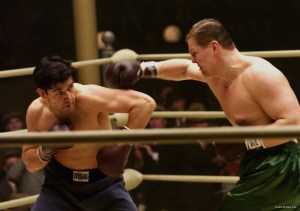 What elevates Cinderella Man from an “okay” film into a “mostly good” film is the singular brilliance of Russell Crowe. This man is simply one of the most amazing actors we’ve ever seen, and he’s been on an incredible hot streak since 1999’s The Insider (forget 2000’s Proof of Life, please). Yet again mastering another accent, Crowe excels at playing a noble man with guarded emotions and honest intentions. He’s an actor that can display such an intense wealth of emotions in the same moment. When he visits his old boxing bosses, hat in hand, begging for enough money to turn the electricity back on, Crowe has laid a sucker punch to your emotions. It’s getting to the point where I will go out and see any movie Russell Crowe stars in just to soak up his brilliant performance. He can throw a phone at my head anytime. Crowe’s stellar and resonant acting will hopefully be noticed come Oscar time; however, I doubt much else of Cinderella Man will be remembered.
Crowe’s sparring partner doesn’t fare as well. I’ve liked Zellweger in a lot of her roles (even the sappy One True Thing), but she’s entirely miscast as Braddock’s underwritten stand-by-your-man wife. She scrunches her face too much and squints for most of the movie.
Two great actors make the most of their meager roles. Giamatti serves as Braddock’s growling pit dog of a corner man and works up a good froth. Bierko almost transcends the film’s one-note villain caste and becomes a figure of showboating sensuality. He struts in the ring with a gallant pride that’s fun to watch, even though you know Howard?s whispering in your ear, “Booooo. Don’t like him. He’s the mean man. Booooo.”
The production design on Cinderella Man is great and really recreates the look and feel of the 1930s in all walks of life. The cinematography, on the other hand, seems washed out and overly dark in spots, though it may have just been my theater?s projection. I miss Roger Deakins, DP on A Beautiful Mind. Deakins knew how to beautifully light a scene and capture the audience with a precise, eye-pleasing angle. In contrast, Cinderella Man seems to think that sepia tones defined the time period of the 1930s.
Howard still has little to no trust in his audience. He can’t rely on the performances of his actors to express their motivation. We know why Braddock is fighting during the Depression, Howard. We don’t need split-second cuts of his family for reminders. It’s almost like Howard wants to point to the screen and tell the audience what to feel. It should be obvious by now but ambiguity doesn’t work here. That’s why Braddock is seen as almost saintly (never mind the connections to organized crime). That’s why Baer is seen as dastardly (never mind that in 1933 Baer heroically wore a Jewish star and knocked out Hitler’s favorite prize fighter, Max Schmeling). It seems that the details just get in the way when Howard wants to turn true-life stories into calculating crowd-pleasers.
At the docks, just in case we don’t get how tragic the Great Depression is (you know, in case you forgot what either the words “great” or “depression” meant), Howard has to bend over backwards to show someone stepping over a newspaper declaring how high unemployment is. When Braddock finds a friend in Hoovertown (Central Park turned into a neighborhood of shanties) we see him run over by a horse and buggy as another man crushed by the system or a runaway metaphor. When Baer fights in the ring Howard makes sure to get that sneering close-up of our villain. And surely anyone who’s a womanizing playboy must go down for the good of the nation. Howard is aggressive in his pandering.
Thanks to Goldsman and Hollingsworth’s mawkish script, Cinderella Man has the myth of complexity to it when it’s really content to go the easy route. It plays this story too close to the rules: embittered hero with humanity intact, stalwart wife, cocky villain, the grumbling manager. Cinderella Man is stripped of complexity and Goldsman and Hollingsworth want to lead the audience by the nose. When Braddock promises his son in a heart-to-heart that he’ll never split up the family, we know it’s only a matter of time before it happens. Their script is also full of workmanlike dialogue that does enough to just push the story forward but give little shading to its people (Zellweger’s, “You are the champion of my heart, Jim Braddock” is particularly not great.
 Cinderella Man really is a film more about the Depression than boxing, except for its pummeling and gritty final act of non-stop boxing. The script paints an almost insulting idea that the Depression was good for people to learn important life lessons, like family comes first, hard work will be rewarded, and one man can heal a nation. Seabiscuit fell into this same trap with its depiction of the Depression but at least Gary Ross’ film dealt with characters that weren’t tired genre archetypes. Cinderella Man could be described as “Seabiscuit in a boxing ring,” as yet again the triumph of an underdog pulls the country back together and gives the common man something to believe in. What I’d like to see is Braddock vs. Seabiscuit in a ring or even on the horse’s turf. Then we can finally decide once and for all who is responsible for getting America out of the Depression (somewhere FDR is spinning in his wheelchair-accessible grave).
The film does come alive when Braddock steps into the ring. The boxing matches are finely choreographed and pack a real wallop. You can practically feel the bruises and taste the sweat during the 15-round bout between Braddock and Baer. These scenes give you a good understanding of the progression of a boxing match and the real strategy that can turn a loser into a winner. Howard also has a smart visual cue during these lively moments. Whenever a bone gets broken, like Braddock’s hand, we cut to an X-ray shot of that scene and see the bone snap. It might seem old in a CSI-drenched landscape of entertainment but it’s effective and neat.
Cinderella Man is a rousing, heartstring-tugging crowd-pleaser that will inspire hope and redemption. Until you look at it more objectively. It?s easy to get sucked into Howard’s underdog tale and that’s because it’s been tailored to satisfy your emotions. Crowe rises above this heavy-handed yesteryear yarn with a riveting performance. I’m positive most people will walk away from Cinderella Man feeling uplifted and touched and would view me as being overly cynical. But with a maudlin story by Goldsman that simplifies the details, Cinderella Man feels like a feel-good-movie that’s been rigged. These people have no trust in their audience, so why should you put your trust in them?
Nate’s Grade: C+
Share this:

Spellbound (2002)
 The field of super spellers heading to Washington D.C. is more varied than you could possibly imagine. What is truly amazing, and equally heart-rending, are the scenes showing working-class families encourage their children to excellence. Angelas parents fled Mexico to give a better life for their family in Texas. Her father has been a rancher for 30 years and does not speak a word of English. Its incredible to see the amount of pride her parents have when they see her compete. She says she’s doing it for them. Ashley lives in the projects outside of Washington D.C. She exudes confidence as she makes long treks from school to the cramp apartment her family lives in. Her mother had never expected her child, from her background, to compete for spelling contests but becomes her biggest and most vocal cheerleader.
Spellbound also shows the fanatical level of commitment some of these kids have. Neils father pushes his son to the extremes and the two go over 4,000-8,000 words a day. Neils parents even hire a spelling coach and he gets instruction from his schools foreign language teachers on the history and spelling of foreign words. The commitment most of these kids show is jaw-dropping and obsessive. Ted is the exact opposite. Hes so nonchalant about the spelling bees that it almost seems like hes battling complacency in his small town. His younger brother has the films best line: “It was so exciting. If I had blood pressure it would be through the roof!”
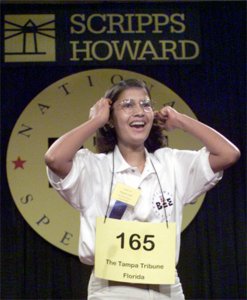 My favorite speller is April. She and her parents live in a dying town. Her father worked in a asbestos factory until it was shut down. He now operates a tavern across from the decaying factory. The family struggles to get by but has so much visible love for their daughter, so much undying support for April. I saw April’s parents as the type you might be embarrassed to say something weird to your friends (“Mom, you are so out of it, geez.”) but the same type that you secretly thank everyday you have. April declares herself a pessimist and doubts the distance she’ll go in the national bee. This is the kind of instantly likeable and compelling character Hollywood has forgotten how to create.
With Spellbound we get to know our hopefuls so well that were saddened before the national bee even begin because, at best, only one of them will win. And, as corny as it sounds, they are all exemplary examples of winners.
Spellbound is the most thrilling movie I’ve seen in ages, totally walloping the heady pretensions of certain action movies. This film will make your palms sweat and then some. Your heart races wildly when it isn’t in your throat. Several films like The Sweet Hereafter or American History X have brought me to tears through their adept expressions of sadness; Spellbound may be the first film thats ever brought me to tears (about five times) just for pure vicarious happiness and joy. To see these kids achieve will, and I know this is so cheesy and blurb-y, but it will make your spirit soar and want to cheer. I’ve since watched the film several times on DVD, and I must report how surprised I am that I end up crying every time, though at different spots. This is a joyous movie, pure and simple.
Spellbound is an uplifting movie for everyone that is guaranteed to have some lasting, triumphant resonance. If you cant feel for these kids I suggest you check if your heart is defective. This is a great example of what film can do, what the American dream can mean for people, and the great diversity an academic competition can inspire. Spellbound is thrilling, heartwarming, and sunnily satisfying. You’ll fall in love with these kids and their hopes and dreams.
E-X-C-E-L-L-E-N-T. Excellent.
Nate’s Grade: A
Share this:

Rollerball (2002)
 The year is 2005 and the number one sport, at least in the former Soviet Union for some reason, is a mixture of roller derby, football and some kind of ESPN X-game. The man behind Rollerball is Alexi Petrovich (Jean Reno), who still thirsts for that lucrative cable contract with the U.S. and just might do anything to get it. Play suspicious music here.
Jonathan Cross (Chris Klein) is an NHL draft pick in trouble with the law after a stupid high speed street race. His pal Marcus Ridley (LL Cool J) tells him of a new extreme sport catching on in Central Asia, and Jonathan accepts his offer. The two are enjoying their success in Spandex but start to have reservations when they notice Petrovich including more violence as a ratings booster. Jonathan can’t just look the other way. Because he’s the good guy. So after a botched escape (shot infuriatingly all in what seems like night vision green) he collects his fellow ballers to rebel against Petrovich and whatever. As you can easily see, the story of Rollerball is not exactly its strong point. Not that there is a strong point in Rollerball.
 The original Rollerball came out in 1975 and was full of political themes like corporate dictatorships and Orwellian observations on a dominated, passive society where war and nationalism have been replaced with a roller sport. Though the themes of this James Caan vehicle were a bit heavy-handed at times, the action was rather impressive especially as the corporations try their best to squash Caan in a bloody onslaught of an ending. The 1975 Rollerball had a political message and some nice action. What does the 2002 version have? Try banality and plenty of it.
Klein came to the limelight through movies like American Pie and Election, and if his dimwitted deer-in-headlights look wasn’t doing it for you before then God help you with his performance in Rollerball. Rebecca Romijn-Stamos plays Klein’s teammate and lover on the Rollerball circuit. Reno deserves a trophy for even delivering the majority of his lines with a straight face.
Oh how the mighty have fallen John McTiernan. You once directed such great 80s action movies like Die Hard, The Hunt for the Red October, and Predator but now you spend your days remaking old Norman Jewison films. It began with the lukewarm remake of The Thomas Crown Affair and now a boring re-cooking of Rollerball follows it up. Can a remake of F.I.S.T. or Fiddler on the Roof be the only thing we have to look forward to now?
 The most jarring problem with Rollerball, and there are so many to choose from, is the hack editing choices made. The way the movie plays one wonders if they threw all their footage in a wood chipper and grabbed whatever pieces they could and glued them into a movie. Scenes exist but appear in no discernible pattern or order. All one sees in their chair is a whirl of colors and you might be wondering if you stepped into Kaleidoscope: The Motion Picture.
The story behind this Rollerball was that it was originally slated to come out August of 2001 but after test screenings that left people howling the studio bumped it to the winter and cut it from an R to a more commercial PG-13. Lost in this cost-cutting maneuver are gore (which you would think would be important for a violent future gladiator sport) and a nude scene involving Romijn-Stamos. Which version would you have rather seen?
Rollerball is a laughably noisy and empty film that will leave your head spinning for all the wrong reasons. It’s likely the worst flick you’ll see for 2002 right now, that is, until the following week when Britney’s near-certain train wreck of a film debut opens. But until that time Rollerball is the true champion – of boredom and stupidity.
Nate’s Grade: D
Share this:

Michael Jordan to the MAX (2000)
 IMAX’s next trip is an NBA’s dream of promotion but also an indication of what exactly they’re missing — that is a basketball God. Jordan to the MAX is basically a pat documentary featuring Jordan’s upbringing and his dreams. It’s all the typical uplifting never-stop-trying stuff that’s routinely handed out to the kids. What makes this documentary worthwhile though is the format it’s presented in. Seeing Jordan do his numerous acrobatics in slow-mo on IMAX’s 50-foot screen makes him seem even more immortal then he already is considered to be. You can see the grace and overwhelming talent he possesses in every flexing of muscle and bead of sweat. It’s quite impressive and worth the remaining dull moments.
Nate’s Grade: B-


 nathanzoebl
You must be logged in to post a comment.