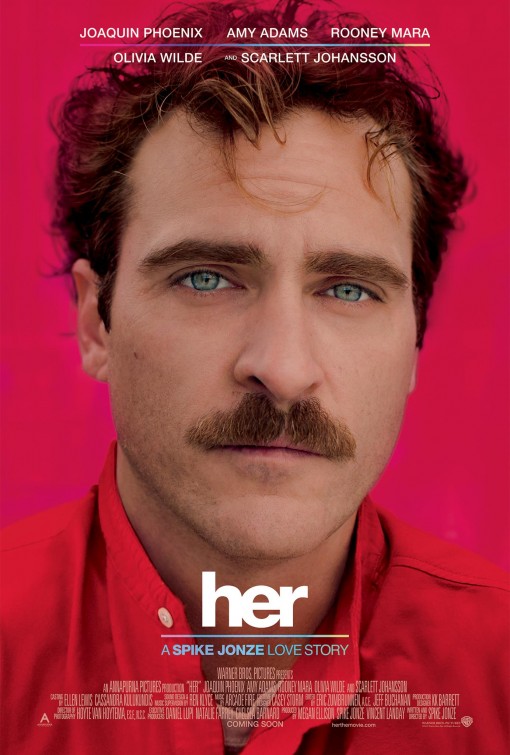
 It’s been several years for Spike Jonze since he escaped the turmoil around Where the Wild Things Are, an ambitious adaptation that ran afoul with studio execs over the oppressively sad tone (I agreed with the execs). He’s one of the most stylish visual directors working today, but Her is something very different for the man. For starters, it’s a film Jonze wrote himself; no collaboration with Charlie Kaufman this time. It’s also a pared down love story, focusing heavily on two characters and their exciting and emerging union. There are no visual tricks, no gimmicks, no overt special effects, nothing to distract from the central relationship commanding the screen. It’s a different kind of film from Jonze but one that’s just as brilliantly well made as his best. Her is a beguiling winner.
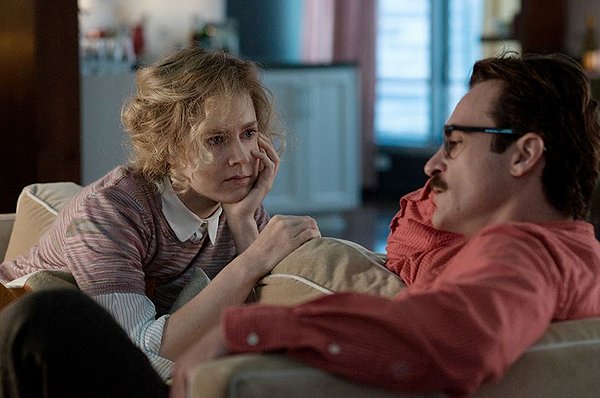
Theodore (Joaquin Phoenix) is a man struggling to get his life back together. He’s a star at his job where he writes other people’s personal letters for them, but he’s a sensitive soul still refusing to sign the divorce papers from his ex-wife, Catherine (Rooney Mara). He doesn’t want to lose that part of his life. After watching an ad, Theodore buys a new computer operating system (OS) that promises to be the most lifelike possible. He pops the software onto his computer and, voila, the voice of Samantha (Scarlett Johansson) emerges, chipper, helpful, and compassionate. Theodore is a new man with her assistance, and soon they grow even closer together on a romantic scale. Theodore and Samantha embark on the greta unknown together, but can a relationship work when it’s with a voice in your computer.
 It’s been weeks since I first watched Her and I keep thinking back upon it, turning it over in my mind, finding more and more to like about this captivating little movie. It’s a tenderhearted and poignant movie that also manages to have something to say about human connection. And this really is a love story, and an engrossing one at that, despite the fact that it’s man and machine. The romance between Samantha and Theodore is never looked down upon, marginalized, the setup to some punch line about how nerd can’t get dates with real women. You think the film might go there, and then Theodore’s co-workers just shrug when the truth comes out and treat his relationship like any other. I suppose you could make all sorts of analogues, but they are unnecessary because Samantha truly feels like another person. She’s given complexity, curiosity, impulses, and, yes, as voiced by the husky-voiced Johansson, an alluring edge. Because she’s a disembodied voice minus form, theirs is a relationship built upon intellect, conversation, personality, and a burgeoning connection, though they do cover the sex part as well. In fact, the climactic (pardon the pun) vocal exploration is simultaneously awkward, funny, heartfelt, and yes, even a little sexy, and the music crescendos to give it even more oomph. Samantha is learning just as much about herself as Theodore is. Their relationship is opening both of them up to the possibilities they might never have sought. In that respect, Jonze’s film falls under that sweet spell all engaging romances achieve where our spirits are lifted and we swoon along with the onscreen coupling.
I’ve found it tricky to talk about Her at least in describing the premise to other people; comparing Samantha to Siri has helped rather than just referring to her as an “operating system.” One concern I had was that Jonze was just going to deliver the premise in a very expected manner and Her would serve up more of the same. But he doesn’t. While this is a light science fiction film, it is extremely well developed and thought out. Jonze has taken remarkable care to flesh out his story and enrich the not too distant future world. It felt like a world that could reasonably exist. I enjoyed the fact that there were so-called surrogates for hire, people that would serve as the physical embodiments of the OS personalities, providing a different kind of encounter, one meant to converge intimacy with touch. I could see these people existing if this were the future. Even better, Jonze takes great care to develop the central relationship between his lovers, so that every unique complication is given some form of respectful coverage. They discuss the limitations but not just what you would assume. Yes Samantha has no body, but she can also be in many places at once, doing many things at once, and simply will outlive all her carbon-based life form companions. Can they make this last? Even with the technological component, old problems can rear their head, particularly jealousy, like when Samantha begins communicating with other OS personalities. Then there’s Theodore’s lingering divorce with his wife, a woman who can stir up old feelings and doubts. Without giving too much away, the end manages to be hopeful, melancholy, expected, and satisfying.
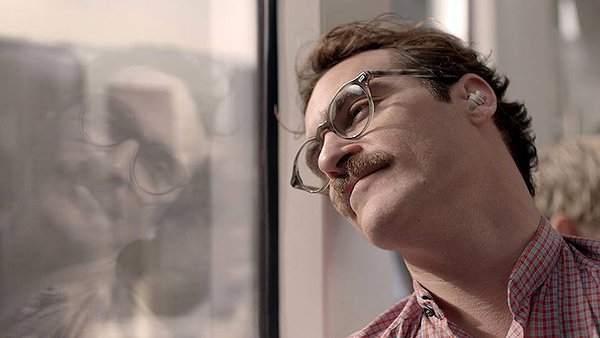
 Jonze also manages to slide in some subtle jabs about the state of communication and connection. There’s an early shot where Theodore is riding a train and everyone on board appears to be talking except that they’re all talking to their OS, each person an isolated unit. Theodore’s job also seems like a perfect social commentary as well as a clever conceit for a man who has unsurpassed skill with words but difficulty with the flesh-and-blood interaction. It works directly with the theme of the film. I also find it humorous, and a bit subversive, that Theodore has long-standing relationships with clients. He’s been writing letters for certain couples for years going all the way back to their first meeting. Think about that, this couple’s communication and courtship rest upon the words of an intermediary paid for his services. These people could go their entire lives thinking their partner is the author of such wonderful, heartfelt, observant words. That’s the dearth of honest communication plaguing human relationships, but it’s not a new problem. We’ve all ducked hard conversations. Many of us would love to have someone come in and do the dirty work while we sit back and reap the rewards. But a relationship built upon deceit or convenience will ultimately fall apart, or, in this new age of technological isolation and greater deception, will it?
Jonze’s direction seems invisible, like we’re dropping in on these characters and peaking on their lives. The overall technical aesthetic of Her is a clean, simplified look and feel for a love story that manages to be new and familiar. The production design has an eye-catching degree of colors, which bathe the film in a consistently dreamy, gauzy aura, echoing the screenplay’s warm heart. The score by the Canadian alternative band Arcade Fire is low-key but just as vulnerable, resonant, and special as the characters in the film. It’s mostly pared down piano trinkles but the reoccurring motifs stick in your head, elevating Jonze’s film. When Samantha takes up composing songs to express her sum total feelings of a moment, capturing a snapshot of a particular time as she refers, it’s nice to have talented musicians able to bring this to life.
Phoneix (The Master) gives such a tender, vulnerable performance that you worry that he’s going to be crushed by life. He has this remarkable way of making you want to hug Theodore, like he’s this sad puppy that just needs a good home. There are moments in the film where just one perfectly executed crinkly-eyed crooked smile tells me everything about this character. Phoenix plays his character as a good-hearted, amiable, and deeply romantic individual, and the sheer strength of his performance will knock you back. Theodore has such great pools of empathy, and a poet’s soul, which allows him to excel at his job but it also makes relationships hard. A relationship takes work, and Theodore may have not been up to the labor, as his ex-wife argues. Personally, I found a lot of striking points of similarity with the character and I think others will as well. Who hasn’t, in a moment of dark-clouded funk, wondered if they’ve reached the apex of their emotional experiences, that everything will somehow be lesser variations? Who hasn’t feared that they somehow tapped out on their ability to love as powerfully as before? As Theodore is picking up the pieces of his life, trying to determine his new sense of self, we’re learning alongside him exactly how Samantha is changing him.
 Before this movie, I would have said a Johansson (Don Jon) performance minus her body would be a travesty, but damn if she doesn’t give a performance that is worthy of the Oscar buzz. It’s easy to understand why Theodore falls for Samantha, and you will too. Johansson has never been this winsome and loveable but she’s far more than some idealized Super Girlfriend to be placed precariously on a pedestal. She’s learning too, making choices, some of them bad, and exploring the consequences. The depth of emotion she’s able to convey with a character only heard audibly is impressive. Samantha is a fully formed character that wants to be treated as such, and Johansson give her all the shadings of a living being. She’s inquisitive, funny, curious, but also eerily human in her mannerisms, like when she uses short breaths when feeling awkward even though she has no use for breath, obviously. Johansson is so easily sultry, voice included, but Samantha is not relegated to some high-tech toy, some quirky sexual fantasy. She feels real, which is why their relationship feels genuine and so moving and charming.
Who knew the most affecting love story of 2013 would involve a man and his computer? Her is an insightful, touching, and rewarding movie that hits you on many levels, satisfying all of them. It’s a smart film that explores the various complications of its premise while widening its scope further, it’s heartfelt and humble as it approaches relatable matters of love and loss and feeling adrift, it’s sweetly romantic while at the same time being tethered to reality, finding a perfect balance, and at its core it’s the tale of two people, one human and one mechanical, that find happiness in one another. People will likely pick the movie apart to search for personal messages from Jonze about his own divorce from filmmaker Sofia Coppola in 2003. Maybe that stuff is buried in there, but Jonze has crafted something far more applicable and enjoyable. Her is an openly romantic film that doesn’t shortchange heartache, and it posits that love is love no matter whom it’s directed at. Her is an extraordinary sort of movie and one I plan on revisiting again. Give this unconventional romance a chance and you may be delightfully surprised.
Nate’s Grade: A



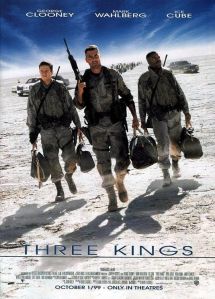 Action with actual thought. Surreal and marvelously shot, but the only qualm is that the characters shift far too easily from foolish gold-seekers to moral people crusaders. It’s too fast and too unbelievable. But the innovations visually and the pumped-up storytelling and action are marvelous. Spike Jonze steals the show, but it’s not hard to guess what happens to him when the title of the movie is called Three Kings, there are four characters, and you’re the only one name not above the marquis.


 nathanzoebl
You must be logged in to post a comment.