Blog Archives
Heart of Stone (2023)
 Heart of Stone is pre-molded for the Netflix formula of star-driven action vehicles and spy thrillers that are meant to pass the time and do little else to stimulate your thinking or entertainment. These expensive and generally disappointing genre movies feel remote and mechanical, as if the almighty Netflix algorithm thought, after housing and documenting thousands of action movies, that it too could make a competent spy thriller.
Rachel Stone (Gal Gadot) belongs to MI-6 but also another organization, The Charter. They’re a clandestine peace keeping force powered by a super A.I. known as The Heart. Super hacker Keya (Alia Bhatt, RRR) is after the Heart, and she’ll wreck havoc until she gets it.
There are plenty of recognizable genre elements and inspirations here, but the problem with Heart of Stone is that it never gets beyond feeling like another bland summation of its formula-laden parts. You’ve seen bits and pieces of this movie before, so the viewing experience becomes a personal guessing game of how long it will take for Heart of Stone to utilize this genre cliche or that cliche. There’s no surprise or verve or quirk to be had here. Everything is pulled from a big bucket of cliches and then reassembled to best simulate a genre movie that you mostly remember seeing before. This lack of effort and finesse can make the movie quite a slog to sit through. The lack of imagination translates even to its generic title. See, her last name is Stone, and she works for a secret organization where people have code names after playing cards. Do you get it? This clunky name generator title feels like something that some feeble social media post would ask as it really intends to steal your identity from security questions.
 I keep going back to the very core construction of the plot and scratching my head in confusion. Stone is part of MI-6, a spy agency, but she’s also part of ANOTHER even more secret spy agency, which she must keep secret from her fellow secret keepers already doing their spy thing. Why do we need the extra layer of subterfuge? What does this add? The situation where the very deadly and skilled person is hiding in plain sight, the Superman pretending to be the bumbling Clark Kent, is already there with her being a hidden spy, so why do we need a second layer? It’s a complication that doesn’t add anything of value. She’s already on a mission and getting tech help from her own spy team and agency, and she’s also given even more secret tech help from the other more secret spy agency. It’s redundant. It’s not like TV’s Alias or Hydra in the Marvel movies where there was an opposition force within the spy agency, actively working against its aims. It also has the detriment of prolonging the eventual revelation and inevitable betrayal from within the team (don’t act like you didn’t see this coming from the opening mission). We all know it’s coming, so then I think that perhaps the filmmakers will use this extra time with these co-workers to better develop them, give them intriguing dimensions, or at least complicate the relationships with our protagonist who is actively lying to them about who she is. Nope. She does take care of one guy’s cat.
Another element that made little sense to me was the chosen villain. Spy and action movies lend themselves to larger-than-life characters that aim at world destruction and big swings. This movie introduces us to a super hacker who excelled in her field. Okay, and? The character feels more like a hostage than the antagonist that is masterminding the world-trotting schemes. There’s nothing of interest to this Keya character; she’s practically amorphous, so poorly defined that any other character can project onto her. I kept waiting for the motivation for why she’s resorted to her schemes, what she would want to do with the secret supercomputer, something to better add dimension or at least context for this character. Her motivation is just as frustratingly vague as the rest of her, as it’s revealed quite late that she wants the supercomputer to right the wrongs of the world, though what exactly those are, and whether she has a personal connection, who knows? She’s so bland as a villain that (mild spoilers) when she’s eventually deposed by another villain, I felt a little surge of relief that maybe someone else could do better villainy.
Even familiar genre movies can be saved with well constructed and exciting action, like those Chris Hemsworth Extraction movies that coast off the fumes of the most tortured military action cliches. Alas, there is no relief for Heart of Stone. The action is supremely bland and lacking better connections to the characters and their plights. It’s usually just chases and shootouts. There’s one sequence that takes place inside a floating satellite station, and I thought that for once things might get interesting. The subsequent action is just another fist fight and beating the other person to grab a thing before everything explodes from a gas leak. This could have just as easily taken place in a warehouse or a boat or a house or a basement or anywhere. Why introduce a fantastical setting and then ignore utilizing those unique aspects? I guess it does lead to a debris chase that reminded me of Black Widow’s finale. There is a mid-movie chase through the streets of Libson that has some life to it as we watch cars careen at high speeds, but it’s also nothing we haven’t seen before and better in a dozen other movies with more conviction than this one.
 Gadot has rocketed to fame from her Wonder Woman status and she can be a charming screen presence, but let’s acknowledge there are definite acting limitations as well. I challenge you, dear reader, to think of a beloved Gadot performance outside of her Amazonian warrior woman. Were you floored from Triple 9? Or Keeping Up with the Joneses? Or Death on the Nile? There’s a reason the producers decided to just make everyone on Wonder Woman’s ancient island mirror Gadot’s Israeli accent. With that said, Gadot seems so thoroughly bored here. It might be the groan-inducing dialogue that confuses what constitutes banter and quips; take for instance a moment when a member of the spy team remarks about her haphazard driving, “Are you trying to kill us?” and Gadot woodenly replies, “Actually quite the opposite.” The movie is filled with these lackluster quotes and genre buzzwords but without any real meaning behind the words. It’s a movie going through the motions, and Gadot is following suit. It’s not that she’s bad here. She’s never asked to really try.
The conclusion of this review is as good a place as any to talk about the implications of the story, something that Heart of Stone doesn’t seem slightly interested in. The “heroes” of the super secret spy agency have a supercomputer that makes scarily accurate predictions, enough so that the spy agency takes them on blind faith as operating orders. Nobody really asks whether this is a good thing, except for a scant reference by our antagonist before they decide to jump ship and join Team Follow the A.I. Nobody explores the more existential question of whether these things are accurate because the machine was right or because the people were just doing what the machine said, thus making these things become accurate because of the engineering direction. There’s a Minority Report aspect about free will and abdicating this to machines that is begging to be better explored. Unfortunately, this all-knowing supercomputer is just any other disposable spy thriller element jumbled together to best resemble another disposable product. I read that Netflix intended for this to be the start of a franchise, and without an intriguing world, lead character, spy agency, or set of ongoing conflicts, it’s hard for me to envision anything Heart of Stone could offer that people would request a return visit. If you need something loud and derivative to take a drowsy nap to, then Heart of Stone is the next The Grey Man.
Nate’s Grade: C-
Share this:

Death on the Nile (2022)
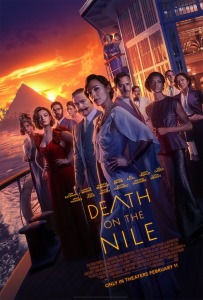 I am admittedly not the world’s biggest Agatha Christie fan, so once again reader, as you did with my review of 2017’s Murder on the Orient Express remake, take my critique with caution, especially if you are a fan of the illustrious author’s many drawing room murder mysteries. Kenneth Branagh returns as director and as the world’s greatest detective, Hercule Poirot, with arguably the world’s greatest mustache (as I said in 2017, it appears like his mustache has grown its own mustache). Death on the Nile takes the murder-on-mode-of-transport formula and leaves us with a gaggle of red herrings and suspects to ponder until the inevitable big conclusion where our smartypants detective reveals everything we had no real chance of properly guessing no matter the clues. Again, these kinds of impossible-to-solve mysteries are not for me, but I know others still find antiquated pleasures with them (Christie was the best-selling author of the twentieth century after all). What I don’t find as pleasing, and I’m sure even ardent whodunit fans would agree, is how cheaply this whole production looks. The budget was almost twice as much as Orient Express but it’s really a chintzy-looking cruise ship with one of the most obvious green screens for a big budget film. It takes away from the grandeur quite a bit, especially knowing the original 1978 movie was shot on location in Egypt. Another aspect that didn’t work for me was the added back-story for Poirot, including the explanation for why he grew his preposterous mustache. Did we need a mustache origin story? Did I need an attempt to better humanize this fastidious detective? If you were a fan of the overly serious and stately Orient Express, and of Christie in general, I’m sure there’s enough to recommend a new Death on the Nile. Branagh clearly has passion for this character and as a steward of this cherished material. However, for me, it took too long to get the movie really rolling, the characters were too lackluster, and there are too many tonally bizarre and uncomfortable moments, like Gal Gadot quoting Cleopatra while being, I guess, dry humped by Armie Hammer against an Egyptian relic. As Poirot’s mustache, which will be given top-billing in the third film, would say, “Yikes.”
Nate’s Grade: C
Share this:

Hotel Rwanda (2004)
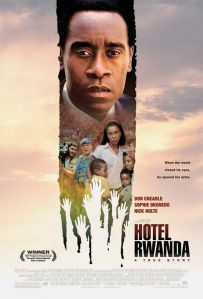 Hotel Rwanda almost didn’t get off the ground. You see, veteran supporting actor Don Cheadle is a favorite actor for directors but he’s not exactly box-office gold. Initial producers of Hotel Rwanda wanted none other than Will Smith to star. I don’t know about you good people but a sobering, challenging movie shedding light on the Rwandan genocide would lose some credibility if Smith was the above-the-title star. Producers also wanted Denzel Washington as a candidate; a better choice but still not right. The true-life portrayal of Paul Ruseabagina needed to be done by an actor that didn’t look like he could kick your ass. Paul was an ordinary man that didn’t ask to be a hero, not a hero looking for a fight. Cheadle was the perfect man for Hotel Rwanda. It just took a while for it to happen.
Back in 1994, Rwanda underwent a tumultuous civil war. In Rwanda, there are two ethnic groups, the Hutus and the minority Tutsis. Though the two look indistinguishable, there is an underlying tension because way back when Rwanda was under Belgian colonial control, the Belgians separated the Rwandan people by arbitrary rules like nose size, skin tone, etc. There is a rising tide of Tutsi resentment (radio propaganda refers to them as “cockroaches” needing to be exterminated). The Rwandan president has been assassinated and Hutu radio broadcasts are already pointing the finger at Tutsis.
 Paul Ruseabagina (Cheadle) is a Rwandan hotel manager that stocks up favors by scratching the backs of the right people. The wheels of Rwandan authority need to be constantly greased, and Paul knows when to deploy a well-timed gift, joke, or bribe. Paul?s wife Tatiana (Sophie Okonedo), a Tutsi as well as their children, is concerned when she starts seeing neighbors taken away at night. Paul assures her that their Tutsi relatives will be safe. Hutu rebels begin to start corralling neighborhoods to root out any Tutsis. Paul and his family retreat back to the hotel. As the violence increases more refugees arrive at the hotel for sanctuary, but Paul must keep the illusion that the hotel is still operational to ward off violence.
The United Nations promises to do something, but they remain only peacekeepers and not peace enforcers. The commanding officer (Nick Nolte) laments that he has only a handful of U.N. peacekeepers in charge of the whole nation. The United Nations and the West does do something: they evacuate all the white people. Citizens of Western nations are escorted out of the conflict, while they leave the rest of Rwanda to its own devices. Paul?s clinging hopes for Western involvement get bleak, and he assumes the responsibility for saving as many lives as he can, Hutu or Tutsi.
Cheadle gives one of the best performances of the year and he’s been nominated for a Best Actor Oscar. The strength of his character’s power lies in Paul’s ordinariness. He’s not a figure of intimidation, nor is he some kind of altruistic saint. There’s more than a passing resemblance to Oscar Schindler in Schindler’s List. Like Schindler, Paul is a man reluctantly pulled into risking his life for others and by the end he becomes consumed with saving as many lives as he can. Cheadle is so commanding that he can make you wince just by watching the weariness in his eyes.
There’s a moment late in Hotel Rwanda, where Paul is stalking the hallways trying to find his wife and children. And in an instant he suddenly remembers careful instructions he gave to his wife. Paul nearly bowls over with the sudden pang of terror but keeps his stride. It’s a sharp and powerful moment where the audience thinks alongside Paul and experiences the same awful gasp. In that moment, as well as countless others, Cheadle has worked his way so deep into his character that the two are one in the same. Cheadle has long been one of the most underrated actors, and now with Hotel Rwanda there is no doubt that Cheadle is one of the greatest living actors we have.
But Hotel Rwanda is not just a one-man show. Sophie Okonedo also garnered a Best Supporting Actress Oscar nomination. Okonedo is no pushover and she does more than needle Paul when it comes to the well being of their family. She’s a strong, caring, thoughtful woman. What makes her even more impressive is that, as a Tutsi, she could be murdered at any time. She gives an equally powerful performance of a woman finding strength amongst her own fear.
Writer/director Terry George keeps the emotion high by smartly relying on restraint when telling his portrait of horror. The events of the Rwandan genocide are so appalling, that it would have been so easy, and even understandable, had George loaded his film with scene after scene of graphic violence to jar the viewer. However, George refrains from numbing an audience with violent depictions, and instead chooses quieter, more somber moments that turn out to be far more terrifying than just seeing blunt violence. Hearing an aid worker recount witnessing a massacre of children to wipe out the next generation of Tutsis will chill you to the bone. There are some disturbing moments, like when Paul takes a very bumpy ride in the mists, but George refuses to numb an audience and works our emotions to a breaking point.
 Hotel Rwanda is sobering and very emotional, but you will also leave the theater with an overwhelming feeling of shame. It’s easy to watch films about dated atrocities like depictions of the Holocaust. You can say, “Well, I wasn’t alive. If I was, and people like me, surely we would not sit back and let such actions take place under our watch.” Not this time. Not with Hotel Rwanda. Everyone seeing Hotel Rwanda more than likely was alive in 1994, and we did exactly as a character warned: we watched what was happening on TV and went back to eating our dinners. Nolte’s U.N. rep tells Paul that the West refuses to see him and Rwandans as valuable (“You’re worse than a n****r [to them]; you’re an Af-ri-can.”). You?ll feel many emotions while viewing Hotel Rwanda and the deepest and longest lasting may be shame.
The film is clearly in the genre of “outrage cinema,” normally a genre that overpowers a viewer’s emotions. In lesser hands Hotel Rwanda would have been unrelenting to maintain a level of shock. George allows an audience to feel for the story’s characters before he lets the horrors loose. The result is that an audience attaches itself to characters because of who they are, not just because of the anguish they endure. As the intensity of the situation mounts we feel stronger ties to the people of Hotel Rwanda. That is good cinema.
Hotel Rwanda is an emotionally gripping portrait of the dignity found during our darkest days. George has skillfully created a sobering movie. Cheadle and Okonedo deliver wrenching performances as the faces of good amongst ongoing genocide. This isn’t like Black Hawk Down where the faces of screaming, angry black people merge into one black form the audience uneasily grows to hate. In Hotel Rwanda, the heroes are everyday Africans, the bad guys are everyday Africans, and the West is the apathetic referee unwilling to act. Hopefully after George’s film, it’ll be hard to hear about a million massacred and go back to eating your dinner.
Nate’s Grade: A


 nathanzoebl
You must be logged in to post a comment.