Blog Archives
Hell of a Summer (2025)
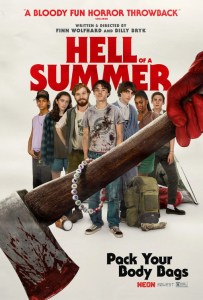 You’ve likely seen this kind of movie before, and co-stars/co-writers/co-directors Billy Bryk and Finn Wolfhard (yes, the Stranger Things actor has directed a movie by age 19) are counting on that. Hell of a Summer is a summer camp slasher movie with horny camp counselors trying to score before they get murdered by a masked assailant. The tone, however, is decidedly more heightened and goofy, aiming for more of an unassailable offbeat comedy like Wet Hot American Summer. It works because the horror/thriller elements, and the general mystery of who is the real killer, are never really that compelling, clear pastiche but no more than that. The real entertainment value comes from the silly characters navigating familiar teen troubles like relationships, growing independence, and the scary uncertainty of being an adult, with a heightened seriousness amidst the ridiculous, approaching camp-levels but without being obnoxiously self-aware. That’s why I credit Wet Hot American Summer as its primary influence. There’s a loosely experimental yet admirably confident air to the presentation. Even when the jokes aren’t landing or the pastiche is getting old, I held out with hope that another strange moment might catch my fancy in short order, like Wolfhard being obsessed with the hydration of his peers, or Bryk having a crisis of self-doubt when people suggest the killer is targeting the “hottest counselors” and he’s not been targeted yet. It makes for a silly, inoffensive bauble of a movie with clear affection for its genre influences. If you can’t get on the movie’s comic wavelength, it will make for a slog of 90 minutes. Hell of a Summer might make you smile enough to warrant one pleasant viewing, and who knows, this might just be the beginning of Finn Wolfhard, directing titan.
Nate’s Grade: C+
Share this:

Heart Eyes (2025)/ Fear Street: Prom Queen (2025)
Slasher movies have been a popu;ar staple of horror, enough so to go through different phases of resurgence and ironic reinterpretation. They rose to prominence in the 1980s but are still wildly popular today, perhaps proving that there’s something timeless about a masked maniac chasing after dumb teenagers with his or her weapon of choice. Mix in heavy amounts of blood and gratuitous nudity, and it’s easy to see why this cost-effective entertainment strategy continues to endure. Two new 2025 slasher movies show the highs and middling lows of this horror genre known for its graphic kills and little else.
 Heart Eyes is ostensibly about a romance-hating masked killer who stalks happy couples on Valentine’s Day and gets all stabby with their insides. However, it’s really a pretty charming romantic comedy that just so happens to also have a healthy amount of gore. The clever screenplay follows many of the same tropes we come to expect from the rom-com genre but now with a twist. It’s Boy Meets Girl, as Jay (Mason Gooding) and Ally (Olivia Holt) are forced to work together to save a romantic ad campaign gone wrong. It’s Girl getting over the pain of her recent breakup with the emergence of a handsome new man in town. It’s Guy and Girl butting heads before creating sparks. And then they’re chased repeatedly by the masked killer. They yell, “We’re not even a couple,” but it makes no difference; their chemistry is just that undeniable. In that regard, this murder menace is actively driving these two would-be lovebirds together, forcing them to rely upon one another for survival, and revealing parts of themselves. If you cut out all the horror parts, it would still work as a romance, but it’s even more entertaining to watch how the two genres, both beholden to their formulas, mash so bloody well. The banter is witty, the silly are over-the-top gory, and this is a rare movie that could be loved by gorehounds and foolish romantics. It’s an elevation that is self-aware but not obnoxiously, more silly tongue-firmly-in-cheek. You can tell there is a love for both of these genres from the filmmakers. Heart Eyes is a fun and refreshing spin on the old.
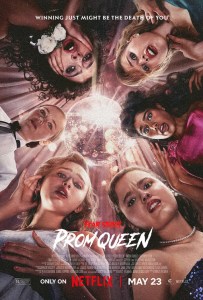 The newest Fear Street movie, based on the scream teen novels by R.L.Stein, is by far the weakest in the Netflix horror anthology series. Prom Queen is a pretty straightforward rehash of your 1980s high school movie staples of horny teens, bitchy popular girls, the less popular girl striving for Prom Queen and having to reconcile the changes she’s willing to make to be a winner, and a knife-wielding killer. Ah, the nostalgia. The issue is that there’s nothing separating this movie from, say, Prom Night, either the 1980 original or the PG-13 remake in 2008. The most thought put into this movie is the gruesome kills with some decent gore, but the whole movie doesn’t even play like a cartoon. It plays like a TV special you’ve watched before, something not just outdated but that’s been iterated upon iterations, a bland copy of a copy of a copy. The mystery of who might be the killer has some slight fun but the culprit should be easy enough to suss out when you take into account what actors have names that you remember. There’s nothing wrong with emphasizing the more gruesome exploitation elements of the genre, but the kills aren’t that memorable or clever, nor are the characters that interesting even as generic stock roles. I found myself confusing many of the multiple Prom Queen candidates (why are there so many pale brunettes?). The previous Fear Street movies released in 2022 had an interesting gimmick connecting them with the history of the town going back centuries to explain its crushed nature. Prom Queen just exists in this space without doing anything to connect to the larger Shadyside mythos and cross-generational storytelling. It feels so dreary and perfunctory and rather boring, shuffling along like a zombie wearing the husk of Fear Street. It’s just not fun. It’s not outlandish enough to be silly and too dumb to be self-aware. It’s mostly unimaginative cliches warmed over and unrelated to a far more stylish and ambitious horror series. This is a Prom Queen that deserves a bucket of blood and social ostracism instead of any accolades.
Nate’s Grades:
Heart Eyes: B+
Fear Street: Prom Queen: C-
Share this:

In a Violent Nature (2024)
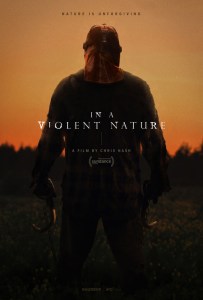 In a Violent Nature is going to be a very trying movie by design. Its entirety follows its very Jason-esque supernatural killer in near real-time as he goes through the woods and eventually kills several unlucky locals and partying teenagers. That means it’s several long sequences of watching the back of this hulking zombie killer walk through the woods and eventually get closer to victims. The actual kill scenes have some impressively nauseating gore, which might serve as a reward to the audience for enduring the lengthy walking. Seriously, this guy perambulates like a boss. He walks. And walks. And walks. Occasionally, he’ll kill someone in gruesome fashion, but most of his journey, and by extension the movie’s journey, is tagging along on his extensive nature hike. Is that going to be interesting to the average horror fan? Probably not. It’s designed to wear down your patience. The filmmakers clearly understand what effect their creative choices would have, and they went through with them anyway. It’s not like writer/director Chris Nash is lacking in style. His segment in 2014’s The ABCs of Death 2, “Z for Zygote,” is ingeniously horrifying. There is a great moment here where our killer’s hand is reaching toward the screaming face of his soon-to-be victim and then Nash performs a match cut with the same hand, now dripping with blood, reaching out for a desired necklace moments later. It’s quick and also subversive, denying the viewer our first opportunity at onscreen violence. This is a movie that works primarily in the realm of denying its target audience what it wants, and that is kind of fascinating to me. I don’t know if it’s enough to make me declare In a Violent Nature as good, but this movie seems destined to work on a different level than good/bad.
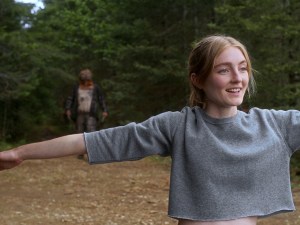 And yet, the movie invites a deeper contemplation through its very experimental nature. We’re walking side-by-side with this undead specter as he tromps through the woods looking to reclaim his special token, and it’s boring by design. I hate using that as an excuse because the movie does get rather tedious at parts, and yet it challenged me to engage more with the movie on an intellectual level, to examine its deliberate creative choices. Just about every slasher movie is designed around the clockwork killing of its easily disposable characters, usually dumb teenagers, by some powerful malevolent force. However, just about every slasher I can recall places the viewer in the perspective of the dumb teenagers engaging in dumb teenager antics, usually drinking and trying to engage in premarital sex. Let’s not pretend those characters are generally any more nuanced or well written than the villain stalking them. Instead of spending all our time with these character archetypes and the occasional pop-in from the villain, it’s reversed. It’s the dumb teenagers that pop-in while we’re on the journey with the slasher fiend. Does it make the kills hit harder because of the long stretches leading up to them because we see how many close calls there have been? Because this guy is trying his best? I don’t know, but the cries of In a Violent Nature being unbearably tedious makes me reflect on whether tedium is, by nature, part of the slasher genre, and perhaps we’ve all ignored the formula because of regular intervals of blood and boobs. Are dumb teenagers that much better company than a silent brute going for a walk?
It was around the halfway point where I began to question whether this approach was causing me to develop empathy for our supernatural killing machine. The back-story is tragic, being a young child tricked by kids he thought were his friends, only to plunge to his death from a water tower. Children can be cruel, and if this was one’s ever-lasting memory of human interaction, then I would understand coming back as a murderous revenant. He also didn’t ask to be brought back to life. The dumb teenagers stole his mother’s necklace and his goal is to simply reclaim it. Yes, he’ll kill plenty of people that had nothing to do with bringing him back, collateral damage from messing with forces that humans should never mess with. He’s just on the hunt for his dear departed mother’s keepsake. In essence, he is looking for the item to return back to the land of the dead, to end being pulled back into corporeal existence. When you look at that context, every dead teenager becomes one step closer to finding that necklace and going back to his eternal slumber. Perhaps our big bad is suffering and looking for that pain to cease. When you’re quite literally walking beside this figure for the duration of the movie, it sparks a personal reflection whether you may be unexpectedly developing empathy. Is it simply projection and all proximal, spending all this time with only one character? Is this a human byproduct of wanting to imbue emotional depth to characters for our sense of engagement? I cannot say. When you walk a mile, or more accurately several, in another (dead) man’s shoes, maybe you start to see the world in his weary, irritable perspective and want that big nap back.
 I have no idea how each viewer will respond to In a Violent Nature. I was wrestling with different mixed feelings, including boredom. I don’t think traditional fans of traditional horror will find the long slog worth taking its time to smell the proverbial flowers. I imagine most will grow restless, antsy, and maybe even angry, and that response is entirely valid and understandable. The novelty of watching the killer stalk his future victims in real time can be one of those ideas that, upon execution, feels better as a short film than as a feature experiment. I admire the gusto of embracing this approach and flipping the slasher script into what amounts to an unorthodox nature documentary between predator and prey. It’s an interesting approach that invites ongoing textual analysis with the genre, the depiction of the characters and their tired archetypes, as well as what makes these movies worth our time and passing investment. Likely there will be more people that shrug and deem In a Violent Nature a dull bore, but I’m also positive there will be people who find themselves unexpectedly thinking and feeling things they didn’t anticipate. Ultimately, it’s a movie I can begrudgingly admire more than engage with, but I appreciate taking the familiar and presenting it in a way we’ve seldom witnessed before.
Nate’s Grade: C+
Share this:

Winnie the Pooh: Blood and Honey 2 (2024)
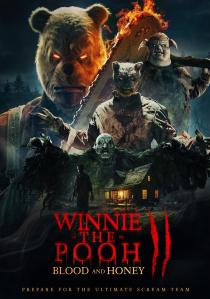 The first Winnie the Pooh: Blood and Honey was, unquestionably, my worst film of 2023. It wasn’t merely a bad horror movie, it was a depressingly cynical cash-grab with such little forethought of how to subvert the wholesome legacy of its classic characters. As I said in my review: “The startling lack of imagination of everything else is depressing, as is the fact that this movie has earned over four million at the global box-office, hoodwinking enough rubberneckers looking for a good bad time. The problem is that Winnie the Pooh: Blood and Honey is only a bad bad time.” Oh, dear reader, I wasn’t looking forward to the inevitable deluge of follow-ups, as writer/director Rhys Frake-Waterfield would resupply his surprising success with further sinister revisions to public domain properties. He’s planning on a “Poohniverse” crossover event with a combination of Pooh, evil Pinnochio, vengeance-fuelled Bambi, and a traumatized or villainous Peter Pan. Again, schlocky movies that lean into their schlock can be wonderful things, but a movie that does next to nothing with its subversive hook, with the history of its cutesy iconography, and could be easily replaced with any other menacing slasher killer is beyond lazy, it’s insulting. I figured there could be nowhere to go but up with a sequel, and while Blood and Honey 2 is an improvement in just about every way, it’s still not enough to qualify as a fun or ironic treat.
Wakefield and new co-writer Matt Leslie (Summer of 84) completely rework the mythology and history established in the first movie, which is now revealed to be the literal movie-within-a-movie of the account of the Massacre of the 100 Acre Wood where Pooh and Piglet slaughtered a troupe of bad-acting British coeds. In this prior film, it was established that Pooh and his buddies were angry with Christopher Robin (Scott Chambers, replacing Nikolai Leon) when he left for college. They felt abandoned and grew feral and monstrous, rejecting the ways of man (though still wearing the clothes of man and driving the cars of man). However, now in the sequel it’s revealed they were always feral and blood-thirsty and it was Christopher who incorrectly remembered them as cute and fluffy. This scene makes for the hilarious visual of a child waving innocently at a blood-strewn manimal lurking about. Also, Christopher had a young brother who was abducted by the creatures of the 100 Acre Wood and never seen again. Also also, there was a mad scientist who was creating human-animal hybrids from missing children, so the blood-thirsty animals might not be actual animals after all (can you see where this is going?). While the first Blood and Honey movie did nothing with the characters, this movie actively gives them a tragic history with some twists and turns, enough to lay a mythos. The use of hypnotherapy-induced flashbacks isn’t exactly smooth or subtle, but I’ll take it. At least this movie provides a distinguishing plot that makes some use of its particular elements. Don’t mistake me, dear reader, this is faint praise at best, but after enduring the creatively bankrupt first film, it’s like a desperately needed oasis. Ultimately, it might all just be a mirage but at least it’s something to those of us who suffered!
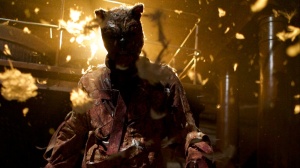
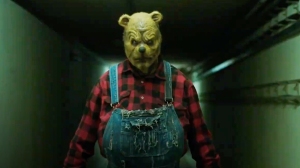 In the grand sequel tradition, bigger is better, and now instead of two ferocious beasts wreaking havoc, it’s four, with the addition of Owl (Marcus Massey) and Tigger (Lewis Santer). None of these monsters has a particular style or attitude that distinguishes them. I guess Tigger calls people “bitch” a lot and slashes people. There is one point where hapless cops are investigating a crime scene and say, “Let’s bounce,” and Tigger says from the luxury of the shadows, “Hey, that’s my line.” I figured they’d incorporate the signature Tigger bounce on his tail, but perhaps that was too expensive to perform or that bounce was more a byproduct of the Disney version of the character, still under copyright, and not the available A.A. Milne version. The animal costumes look better than the cheap Halloween masks of the original, though for my money Owl looks more like a turkey vulture wearing cray paper. I’m sure we’ll get Kanga in the inevitable third movie in 2025 where her zombie baby leaps out of her pouch to feed on brains. There is a snazzy addition late into the proceedings where Pooh is welding a fiery chainsaw. It makes little sense for the character but it’s cool, so it’s excusable in lapsed movie logic.
I was hoping for more unique kills, twisted takes related to the characters, like Pooh turning some poor soul’s head into a honeypot. The kills are just grizzly and extensive, favoring quantity over quality. There are plenty of decapitations, gougings, impalings, and other fraught and violent encounters, nearly all of them featuring squealing, terrified women. It’s always women that seem to get the worst in these movies, but of course this is a feature and not a bug of the genre back to its 80s heyday. It gets relentless but I suppose at least these girls aren’t having their tops mysteriously fall off while they’re being butchered. A third act rave set piece features maybe two dozen kills and risks becoming tedious slaughter. It got to the point where I was hoping not to see another cowering person hiding behind a corner because it meant the sequence was going to be even more unbearably long (I’m not personally cut out for the Terrifiers).
 In between the spillings of blood and guts is the attempts at human drama, namely Christopher Robin trying to live a normal life while also re-examining his past. Apparently people think he’s to blame for the massacre from the 100 Acre Wood, and so he’s become a pariah, whose very presence unsettles others. He’s trying to find steady work in a hospital setting but he’s blacklisted from pursuing his career because of the negative attention his name generates. He even has a romance with a single mom so that when the Robin family is inevitably skewered we have other characters that can be personally threatened to provide meaningful stakes. The life of Christopher Robin and his discovery of repressed memories makes for a surprising story foundation for Blood and Honey 2, especially when the plot of its predecessor was mostly Christopher being held prisoner and the baddies casually roaming and killing coeds. I think Chambers is a better actor as well, and he’s posed to be the writer/director of Neverland Nightmares, which just began principal photography a month and a half ago as of this writing. Good luck, guy.
While the budget has increased tenfold, Blood and Honey 2 is still a scuzzy, sleazy slasher movie at heart. If you’re in the mood for a low-budget exploitation movie heavy with gore, there may be enough to qualify this sequel as moderately mediocre, which again is a marked improvement from what I declared the worst movie of 2023. I’ll credit the influence of co-writer Matt Leslie to try and put some standards in place for this runaway gravy train of IP allocation. What’s scariest of all is what Frake-Waterfield’s unexpected success has wrought, encouraging imitators to jump on his now proven novelty act. There’s a 2025 Steamboat Willie horror movie called Screamboat as Steamboat Willie has now entered the public domain (but not other versions of Mickey). Will it be any good? I sincerely doubt it. Will it make money from curious horror hounds looking for an ironic twist on a wholesome childhood fixture? Most assuredly. This is our present. This is our future, and it’s the legacy of Frake-Waterfield and his ilk that stumbled onto a lucrative novelty act. Winnie the Pooh: Blood and Honey 2 is just bad, and for that it’s an improvement.
Nate’s Grade: D+
Share this:

The Strangers: Chapter 1 (2024)
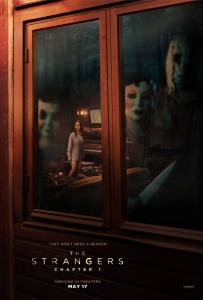 The most terrifying part of The Strangers: Chapter 1 is during its closing seconds, as text appears to inform all of us woeful viewers: “To be continued.” Oh no. Chapter 1 is intended to be the first in a new trilogy bringing back the essential concept of the 2008 home invasion thriller, that the masked attackers have no agenda, no motivation, and are being sadistic silent tormentors just because. The explanation, “Because you were home,” was a key revelation to the original, and here this famous line gets re-worked and has the same clumsy impact as Madame Web trying to reword that Spider-Man oath (“When you take on the responsibility, great power will come“). Not that the dialogue is the strong point of this thriller, with clunky expositional lines as nakedly transparent like, “Today is the third day of our three-day road trip around the country,” followed by, “Or our five-year anniversary.” It’s in the annoying, “Yeah I work here too” kind of lazy exposition. But you’re here for the scares, of which Chapter 1 has precious few because I think these are the most unimpressive and lackadaisical home invaders I’ve ever seen. I think the Wet Bandits might give these goons a run for their money (I’d watch Kevin take on The Strangers). Much of the movie is spent waiting, or checking places around the cabin, sometimes while one intruder plays the piano for ambience. One could make an argument they’re toying with their prey, but I would counter that I just don’t think they’re good at their whole enterprise. It doesn’t help that the main couple are so boring and undeveloped and I found it hard to fear for their well-being. As far as memorable scares or set-pieces or ingenious obstacles or overcoming said obstacles, it’s a big miss on all counts. A home invasion scenario can be exciting and terrifying, and it can be delicious fun to turn the tables on the attackers. This movie has so little that even the core ideas feel stretched beyond their breaking point. It’s hard to even feel much reverence for the original here, as The Strangers: Chapter 1 feels more like the steady, unrelenting squeezing of all IP for any possible drops of renewed audience interest. If this is what Chapter 1 has to offer, please spare us the rest. Fun fact: if you want to know what director Renny Harlin (Die Hard 2, Cliffhanger) has been doing lately, well here’s your underwhelming answer.
Nate’s Grade: D+
Share this:

Scream 6 (2023)
 When horror franchises dramatically shift their locations to somewhere new, like New York City, it’s usually a bad sign that the series is desperately looking for new creative life. Not every franchise can rebound like a Leprechaun in Space. Most of them just become another Jason Takes Manhattan, where now instead of Character Group A running and dying from the masked killer, it’s now Character Group B running and dying from the same masked killer. It’s more reminiscent of cartoons where the backgrounds might change but the on screen events are stuck in the same drab routines. The Scream franchise was rebooted with 2022’s satisfying fifth installment, so I hoped that a sixth Scream could at least exceed where so many others have failed. Those hopes were quickly fulfilled in what I consider to be one of the best sequels of the seminal slasher series with all of its air-quote irony.
There are more than a few entertaining new turns as the bloody hi-jinks head to the Big Apple. It feels bloodier and gorier than most of the Scream movies, but it also has well-developed suspense sequences that work extremely well at making you squirm. Every brutal burst of violence elicited a “oomph” exhalation from me, and I found myself tensing up as the initial scene constructions transformed. I was quite enjoying myself from set piece to set piece. Take for instance an escape that requires the characters to flee from one high-rise window to another across an alley via a rickety ladder. Or take a subway escape packed with masked Halloween revelers to make you paranoid who among the many Ghostfaces might be the potential killer (I enjoyed the other costumes of horror old and new – I saw you Midsommar May Queen). Even a hide and seek sequence inside a convenience store can be thrilling. All credit to returning Scream 5 directors Matt Bettinelli-Opin and Tyler Gillet, the same pair that delivered 2019’s wonderfully twisted Ready or Not. These gentlemen have proven that they know how to squeeze the most tension from any scenario no matter how bizarre. I loved that the opening kill (Ready or Night alum Samara Weaving) goes in a different direction, revealing the culprit right away, and then it goes in even another direction. There are still some new cool tricks to be had with the sixth installment in a 27-year-old horror series.
 I was asked if you had to watch any of the prior Scream movies to enjoy Scream 6, and while it’s not necessary, you will be missing out on some of the larger connective tissue and themes. You should definitely have familiarity with Scream 5 since it’s a direct sequel and continuation of the core (four) characters. I was surprised how much more emotional resonance I found with the Carpenter sisters than any of the other characters, new or legacy, from the earlier movies. I think it was smart having Sam (Melissa Barrera) be the daughter of the first Ghostface as was her seeing visions of her late father, this time as an adult Skeet Ulrich, which might have been the wrong choice considering the character never lived to be this age (is her imagination doing one of those age approximations you see for runaway kids?). Our lead heroine is trying to navigate where her instincts are taking her, which might be a darker path that she feels trepidation about ignoring for only so long. Sam’s therapist balks when he discovers her actual parentage, which makes him maybe the worst therapist. Her relationship with her younger sister Tara (Jenna Ortega) is more complex than any of the close friendships of Sydney Bristow. Even with all the carnage and bloodshed, Scream 6 still finds breather moments to let the sisters react realistically to their dilemma and how it affects their own relationship. I’m glad these characters returned because they serve as the emotional focal point of an otherwise famously glib franchise.
The biggest drawback from Scream 6 is the tacit understanding that this will not be the final film in the franchise given its box-office success, the first film to cross the $100 million-dollar threshold since 1997’s Scream 2. This feels like a culminating climax as the characters now view their lives not as their own but as part of a “franchise,” which means the stories will keep going on beyond them and that nobody is safe, not even the “leads.” For a series entrenched in heavy meta-textual irony, it feels like it’s reaching the end of its genre self-awareness cycle when the movie acknowledges itself as its own IP. The scope of the movie is retrospective, not just reaching back and acknowledging the history of where things began for the legacy characters but for every movie. Each one of the former Ghostfaces is being collected and commented upon, with murder nerd Easter eggs left at each crime scene or in its contextual arrangement. It’s the kind of totality that I would expect from a movie franchise coming to an end, and nodding at its various twists and turns, finding places to even include elements from the lesser beloved Scream sequels. There’s even an unspoken satirical jab at the number of characters that miraculously survive, as if the film is throwing up its hands and saying why not, as if this is the last movie and the rules of who survives and who dies are inconsequential because we’re subverting expectations, as we’ve been explicitly told, so expect the unexpected.
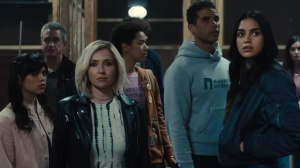 The other aspect of this drawback involves some slight spoilers but I’ll try and tread lightly. After our genre-savvy movie geek explains the stakes of this new episode, the characters start to review one another as potential suspects, and the new supporting characters even cast an accusing eye on the returning characters saying they could have cracked from their trauma. There’s emphasis on the drive to subvert expectations and break away from the patterns of old.
And here is where I’ll venture into some light spoilers so if you want to skip ahead to the next paragraph, please do so, dear reader. There is an ongoing thread where an Internet subculture has re-framed the Carpenter sisters as the real villains of their own horrendous story, and it’s an intriguing element that brings the echo chambers and confirmation bias and novice sleuths-in-the-making of the Internet to further examination. It’s reminiscent of any bottom-feeding conspiracy that asks people to pick apart their reality for “the real story” magically hidden in plain sight. The Scream franchise is famous for its fun guessing game of who the real killers could be from our gallery of suspects, and Scream 6 is no exception. However, the subversion that could have really separated this Scream from its elders is by having the killers actually be… nobodies (the Rian Johnson twist). What if the mask comes off and it’s a brand new character? I’m sure many viewers would feel like they had been betrayed, but then the point emerges that it’s simply some conspiracy theorist who has gone full-tilt crazy into the cult and taken matters into their own hands, attempting to hold “the real killers” to account or to prove they were truly guilty. And the larger point is that the “fake news” has already won out. It doesn’t matter what happens from here, what news coverage should stamp out ignorance, because you can’t pull every cult member out of their self-inflicted cocoon of delusion, which means there will always be more to take their place. That’s the legacy of what has transpired, that there will never be a real escape any longer. I thought that would be such a jarring and thematically intriguing and summative ending.
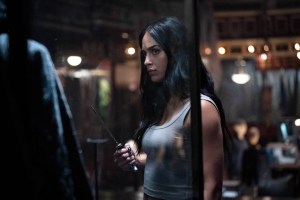 For the many fans of the slasher series, I believe Scream 6 retains plenty of the same pleasures of its prior movies while stretching out into new and interesting directions. It helps that I cared about the central sisters, at least enough by the low bar of horror movie standards. It’s bloody, fun, twisty, and satisfying enough that it could have served as a capper for the entire franchise. But it won’t be. I look forward to this new creative team re-evaluating trilogies better than Scream 3 did. In the meantime, this is a bloody good time to be had for long-term fans and newcomers from the 2022 reboot alike.
Nate’s Grade: B
Share this:

Halloween Ends (2022)
 If you’re a fan of the hallowed Halloween horror series, I can understand why Halloween Ends can be a disappointment, since it dramatically steers away from the formula that has carried this franchise since its beginning. However, if you are like me and find Michael Myers to be one of the most boring slasher killers, and too much of the slasher genre to be rote and repetitive, then this movie might actually be something of a welcomed surprise. Ends might be the least Halloween movie since the third film, the failed 1982 sequel that tried to establish life outside of the hulking menace that is Myers, and then the series shortly retreated back to its familiar bloody formula. Ends might be the least amount of screen time Myers has ever had in any film in the franchise, excluding the third movie; he doesn’t even get his first kill until almost an hour in.
The 2018 reboot was a mixed bag of a horror movie but it ended on the strongest note, with three generations of Strode women fighting together to end their torment. Unfortunately, the series had to continue because the 2018 movie made so much money for the studio, so we’ve been given two rather perfunctory sequels. It’s clear director David Gordon Green and his co-screenwriters, including actor Danny McBride, didn’t really have a desire to continue, and so they spent the sequels exploring other avenues of Haddonfield. I wasn’t a fan of 2021’s Halloween Kills, but the subplot about the mob of scared citizens becoming vigilantes was at least something new and added to a larger understanding of the trauma of this terrorized community. I can say the same with Halloween Ends, namely that the things that were most unexpected and tertiarily related to Myers were what I enjoyed the most. Halloween Ends is messy and disjointed but at least it’s interesting even as it strains to justify its existence and even seems slightly disdainful as well.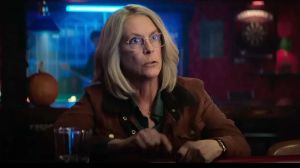
It’s Halloween time again in Haddonfield and the citizens are still psychologically recovering from the events of the prior year, as featured in Halloween Kills. Nobody has seen Myers since he killed Laurie’s (Jamie Lee Curtis) adult daughter. In fact the Myers’ estate has been demolished, at long last, and the town is trying to move on from yet another massacre. Laurie is trying to transition into domestic territory, watching over her granddaughter Allyson (Andi Matichak) as she works at an urgent care center. The real star of the movie isn’t Laurie but Corey (Rohan Campbell), a teenager who accidentally killed a child he was babysitting years ago. Corey is a pariah in town as he tries to get his life back on track, with the meager options that Haddonfield offers for someone with his baggage. He is befriended by Laurie, who introduces the lad to Allyson, and the two instantly connect as outsiders unfairly maligned by their town. These star-crossed lovers get more complicated when Corey begins to tap into his darker impulses and discovers the location of a recuperating Michael Myers. How far will he go?
Because Myers is such a colossal bore as a character, so readily deemed pure evil as to remove anything remotely interesting, I was grateful that Halloween Ends chooses to be something else for most of its running time, precisely the evolution of a killer. Characters that are just born as soulless evil don’t require much in the way of understanding or back-story. This movie decides to spend the majority of its time setting up a protégé figure for the big bad boogeyman, so much so that you could cut the scant Myers appearances in his subterranean lair and make the first half of this a completely different movie. It’s proof that Green and his screenwriters weren’t just coasting from creative inertia of delivering the same-old same-old. There is an actual story here that wants to explore elements of the franchise that have been dormant and chronicle how a young man can fall onto a dark path and lose himself. It’s the appeal of the dark side, and it’s personified in one young man’s journey. It’s the serial killer origin structure, and it mostly works. I was far more interested in Corey than anything else happening in Ends. The prologue establishes him as misunderstood and an outcast, blamed for an accident that nobody seems to think was actually an accident. It’s about how the ailing town treats this young man and how he tries to reform after tragedy, only to be met with suspicion and resentment. Getting to know Corey’s limited world and watching him succumb to his darker impulses, it’s like a little side story that you never would have known existed in the larger Halloween universe so often dominated by the endlessly wheel-spinning Laurie vs. Michael drama. I’m not going to say that the screenplay was nuanced and populated with three-dimensional characters, and the pacing of Corey’s descent is indeed rushed, but I appreciated the efforts to try something different.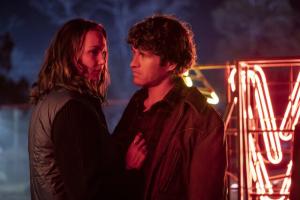
Another issue I have is that first-half Laurie and second-half Laurie feel like two totally different characters. This version of Laurie Strode feels like a completely different character from the prior two Halloween movies that shaped her as a grizzled, obsessive, survivalist loner. This version is making awkward meet-cute small talk in grocery stores and burning pies she’s determined that her granddaughter will eat because of nascent Strode family traditions. Who is this woman? I know some time has passed from the previous movie, but where is the response or lingering grief over the loss of her daughter, the same person she spent years preparing to defend herself against the return of Myers and then was killed by him anyway. For all the weight given to this passing, it feels like an afterthought and that is bizarre. It’s as if Laurie’s daughter never existed for all the impact that her murder has on this story. Once Corey and Allyson become a romantic pair, that’s when something clicks over with Laurie and she recognizes the danger this boy represents, and then she becomes the overly protective mother (granted, her instincts are correct, but the characterization is blah). There was potential to explore the continued strained relationship between the different generations, but Allyson mostly comes across as the naïve child who just wants to run away with her dreamy new broody boy. Had the characterization for Laurie and Allyson been more coherent, and meaningfully tied to the past events in the new trilogy, I think it would have better aided the aims of the Corey examination.
Say what you will about the Halloween series stretching things out over its two lesser sequels, but Green and company add a definitive end note to their title. The degree to which the movie seeks definitive closure is almost comical. It feels like Green is saying to the studio, “Okay, this time it’s really, really over. There is absolutely no coming back from this. That’s it.” This sequence of finality goes so many steps beyond confirming its ending that I began to chuckle to myself at the absurdity of the movie telling its audience that this is the serious end. We go beyond beating-a-dead-horse territory into making the dead horse into a vase that is then shattered, and then the pieces thrown into a fire, and then the ashes launched into space. Of course, all of this will depend on the box-office viability of the movie and whether or not its parent company wants to squeeze even more money from the 40-year franchise (maybe an H50 in 2028?). After all, picking and choosing specific sequels to eliminate from franchise canon has become more popular, as evidenced by the 2018 movie blinking every sequel out of existence for its timeline, so all of these would-be definitive events can just be erased as easily by another sequel. That’s the nature of popular horror: everybody dies but nobody ever stays dead for long. 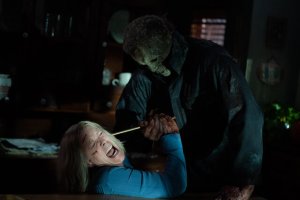
As slasher thrillers go, there’s probably not enough going on here to appeal to your baser desires, as there is no real memorable or gruesome kill. As a character study, there’s not enough careful development and plotting to reward exploring an offshoot to this universe. It’s fascinating to me, at best a middling fan of the Halloween series, how this sequel seems to simply not care about being a Halloween sequel, hence the shelving of Myers for so long, as well as the inconsistent characterization of Laurie and lack of follow-through, and the shirking of extensive gore and terror. I loved the strange detail that the friend group that bullies Corey aren’t a group of roided-out jocks but… marching band geeks (granted, with unchecked privilege). I loved how the movie goes above and beyond to persuade its conclusive ending, even closing out on the “Ends” of the title. You can almost feel certain degrees of disdain that Green and company have to create this added content, a misshapen denouement to the better climax in 2018. I guess there’s nothing stopping anyone from pretending these sequels are non-canonical, and it’s likely only a matter of years before the studio does the exact same thing to reignite the series. Halloween Ends is a strange, frustrating sequel that struggles to be a Halloween movie, for better or worse.
Nate’s Grade: C
Share this:

Scream 5 (2022)
 The fun of the Scream franchise has been its meta-textual commentary, wry jabs at horror, and the guessing game of who the killer culprit(s) could be, and Scream 5 or Scr5am (what it SHOULD be called) is a good-fun B-movie that knows precisely what it wants to be and plays to the strengths of the franchise. We haven’t had a Scream sequel since 2011, and the landscape of horror has changed as well as the landscape of multi-media entertainment. There are new satirical horizons to be targeted. This is the first Scream after the death of legendary horror director Wes Craven, but it’s in good hands with the directors and writer of 2019’s bloody excellent Ready or Not. The fun, knowingly goofy elements are retained, and the filmmakers clearly have love for what they’re sending up. There’s a sequence of languishing shots of a character opening fridge doors and pantry doors and I felt everyone in my theater tense for the eventual reveal of the killer on the other side. Moments like these are the good kind of tension-release giggle that Scream can get away with. The plot is sufficient to gather the “legacy characters” back to the site of the original murders for a new stab at rewriting the movie franchise. There’s even some plot elements that are surprisingly resonant and deeper for a satirical slasher franchise, like tear-filled discussions over loss, abandonment, mental illness, and personal responsibility. There’s a sister-to-sister reconciliation that plays like a straight drama, and it plays well. There’s nothing terribly gruesome or memorable about the kills, and some of the meta-commentary can feel like talking in circles, especially as characters knowingly enact scenes from the original. It’s a copy of a copy, meant to mock Hollywood’s reboots, but it’s still a copy of a copy. Sometimes the knowing winks are obvious, like a shower sequence recreating Hitchcock’s angles, and sometimes the potential homage feels lost in translation. Still, Scream 5 is a fun, ironic, bloody hoot of a movie, and for fans of the franchise a more welcomed return to the creative heights of the original movie.
Nate’s Grade: B


 nathanzoebl
You must be logged in to post a comment.