Blog Archives
Green Hornet (2011)
 Unassuming, impetuous, and with a lowbrow sense of duty, The Green Hornet gets by on its self-aware, campy, chummy tone thanks to co-writer/star Seth Rogen. The slimmed-down comedian plays a news media playboy who tries to right his life by becoming a super hero with his deceased father’s assistant, the kung-fu connoisseur Kato (Jay Chou, making a very poor English acting debut). Where the movie works best is when it upends formula convention, like making every character insecure about their personal standing, including the villain (Oscar-winner Christoph Waltz), who is aggravated that the “Green Hornet” is dazzling criminals with his digital age marketing. When the film thumbs its nose at convention, it plays like a mischievous prank on super hero/crime fighting tales. Green Hornet is a movie that at times is too busy, too childish, bordering on a bromance between Rogen and Chou. But with director Michel Gondry (Eternal Sunshine of the Spotless Mind) at the helm, there are enough quirky visuals to keep things interesting to the noisy climax. Rogen and his film can never be accused of being too serious, and given the material that’s a blessing.
Nate’s Grade: B-
Share this:

Observe & Report (2009)
 During the middle of a mean prank, a police officer walks out of hiding and says, “I thought this would be funny but it?s really just sad.” That’s my feelings with Observe and Report, the second mall cop comedy of 2009. Writer/director Jody Hill specializes in pained, awkward, tasteless humor, but with this it’s like he made a comedy and forgot to put jokes in it. The ongoing joke is how crazy a bipolar mall security guard named Ronnie (Seth Rogen) is, but it’s hard to laugh when he just keeps coming across as scary. Hill’s movie has more in common with Taxi Driver than other comedies. We follow one dangerous man with delusions of grandeur who has violent tendencies. The humor can be daring, off-putting, and extremely risqué, like a date rape joke where Anna Farris wakes up in the middle of the act and encourages Ronnie to continue. What is the point of all the provocative envelope pushing, in the end? Is Hill trying to lock his movie into a ready-made cult status? I enjoyed Hill’s TV show Eastbound & Down starring Danny McBride (who makes a cameo here as a crack dealer). That show succeeds with a blustery, unhinged, delusional lead character because we know the character is a vulnerable loser lashing out because he realizes he is a loser, we can empathize and eventually root for the brute. Rogen, often a chubby teddy bear in comedies like Knocked Up and Zack and Miri Make a Porno, is lashing out because he won’t stay on his meds. He’s too dim to even realize his lowly place in the universe, so his bluster and rude behavior is ultimately just repellent because it provides no insight to his character. And yet, after having said all that, the movie is consistently interesting, if you want to call it that, and goes in unforeseen directions. This is a challenging movie and the biggest challenge is to try liking it. Good luck.
Nate’s Grade: C
Share this:

Funny People (2009)
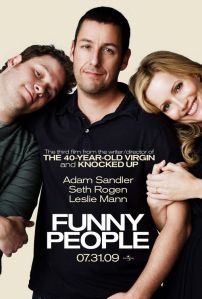 In two short years, Judd Apatow has become the king of comedy. He’s co-written and directed two bona fide hits that will go down as comedy classics (40-Year-Old Virgin, Knocked Up), and produced gut-busters with heart, like Superbad and Forgetting Sarah Marshall. The Apatow brand of comedy centers on characters and less on contrived set pieces. He’s built up enough comedy capital in Hollywood that he felt he could write and direct a project less ideally commercial, something tagged as being more personal and serious like in the James L. Brooks mold. Funny People is the mixed results. I applaud Apatow for trying to grow as an artist, but as the saying goes, if it ain’t broke don’t fix it. Funny People is a broken movie that isn’t funny enough to be fully redeemed.
George Simmons (Adam Sandler) is a famous comedy actor that has made several hit Hollywood comedies. He may live in a giant mansion but his life is extremely isolated and lonely. He has no real close friends and years ago he drove away the love of his life, Laura (Leslie Mann). He has no one to comfort him in his time of need. This prickly man has been informed that he has a terminal blood disease. Simmons decides to go back to his comedy roots, to stand-up, and it is there that he meets the young comedian Ira Wright (Seth Rogen). Ira has grown up with the comedy of George Simmons, so he is flabbergasted when the man himself asks Ira to write jokes for him. Ira’s roommates, fellow stand-up comic Leo (Jonah Hill) and crappy sitcom actor Mark Taylor Jackson (Jason Schwartzman), can’t believe his dumb luck. Ira and Simmons build an unorthodox friendship, and Ira is the only person George has confided in about his disease and his fear of dying. And then something amazing happens. George Simmons gets better. He’s got a new lease on life and he aims his attentions on the girl that got away. Laura is married to Clarke (Eric Bana), a handsome Australian businessman, and she has two adorable kids (Apatow’s own girls), which makes it a very poor time to restart her romance with George.
 Funny People is the first Apatow-helmed film that feels sadly incomplete, even at two and a half hours. The movie is staggeringly sloppy when it comes to plot structure and character work. First off, when a character is informed that he has a terminal illness at minute three, it doesn’t have the impact that it would if the audience got to know and feel for that individual. In fact, the first half of this movie feels like, and this may get confusing, the second half of another movie. It centers on a selfish character coming to grips with his choices in life, mostly wrong, and beginning to reconnect with people once more, building a mentor friendship and finding the “one that got away.” But there are segments during this first half of Funny People where the impact just cannot be felt because the dramatic legwork has not been achieved. Watching Simmons’ estranged family berate him through tears doesn’t have much of an impact when they discover the news. Seeing George Simmons spend his potential last days jamming with Jack White and other musicians is cool, but it doesn’t come across as anything but another indication that the fake George Simmons is famous in this alternative Los Angeles. It doesn’t have setup, like Simmons talking about one of his life’s pleasures is strumming the guitar or playing before things got complicated. So it’s basically just another celebrity cameo snapshot. While I’m on the topic, the multitudes of celebrity cameos are strangely unfunny, save for a bit where Sarah Silverman describes her lady parts.
This is also the first Apatow comedy where it feels like twenty percent of what I saw promised from TV spots, trailers, making-of specials (there was a good one on Comedy Central to check), the advertising unit if you will, was not in the movie. This gave me the distinct impression that even at a lengthy 150 minutes that Funny People feels misshapen, that there are swaths of material on the cutting room floor that would have assisted the narrative and sad amount of underwritten supporting characters. I’m not saying Funny People would necessarily be a better movie at three hours length, but it would at least feel more fully formed and satisfying.
 The main problem with the film, outside of the reverse plot structure, is that everything just goes slack during the uneven second half. George and Ira spend about an hour of the movie with Laura and her family, and it feels like one long uncomfortable detour. Part of the squirmy feeling is intentional, as the audience is supposed to be in Ira’s shoes and see George’s homewrecking as the bad decision train wreck it is. But I also felt uncomfortable because George kept extending his stay day after day and I was getting impatient. I wanted these characters to head back to L.A. and deal more with the Ira/George relationship. During this second half, Ira becomes a background figure that is good for nervous reaction shots. This stalls all the character work that had been done up to this point and Ira goes to pause mode for an hour. This second half section isn’t particularly funny, it isn’t romantic, and it gives little insights into the past between George and Laura. She has established a nice living for herself, with two cute kids and a hunky husband who seems to be a good father when he’s around. In fact, despite the movie’s insistence that Clarke is a cheater (thus ensuring the movie law that it is then acceptable to cheat on him), I found myself liking the hyperactive and sensitive lout. Every plot movement in this second half feels wrong, some of it intentional, but it makes Funny People feel like it has been hijacked and taken hostage. Where did the movie I was kinda liking go? What happened here? This hour feels like a separate movie and one that Funny People would have benefited from simply being dropped entirely.
Perhaps I’ve been watching too much Mad Men in anticipation of its third season, but this movie also disappoints by failing to delve into the creative process of comedians. Despite its running time and subject matter, there isn’t that much standup witnessed. Usually the movie will display about one line or one bit and then cut back to the characters offstage again. We don’t get to see the evolution of comedy or the professionals talking shop about what makes a good joke. There isn’t even much collaboration, so we don’t get to see multiple minds banging out jokes together. There’s a comedian named Randy (Aziz Ansari) who is popular with audiences because he’s loud and spastic, and all the other comedians hate him, but then the movie doesn’t return to this. Go back to this topic. I want to hear more about the divisions within the comedy world, the people that feel like they are more pure or textured in their funny compared to the people that play to the crowd and lap up the easy yuks. Ira’s character work is mostly explored through his changing standup persona, where he seems to gain more confidence and a voice. But there’s this whole other storyline where Ira is a “joke thief” and takes other people’s material and repackages it as his own. This is an interesting story and provides conflict and glimpses into the character of Ira as an insecure and ethically challenged opportunist in a competitive field. It makes him a more dynamic character. I saw more of this storyline in the making-of special for Funny People, and sadly it is only hinted at in the final product. The other comedy players, like Ira’s roommates and his quasi-love interest (Aubrey Plaza), are barely explored as people and professionals.
Apatow comedies are notable for being character-based, but Funny People doesn’t seem too concerned with establishing characters that you want to be around. I found little reason to care. I found most of the characters to not be engaging; some were unlikable but most were simply flat. George Simmons is supposed to be a selfish man, though there’s something inherently selfish about being famous in Hollywood. Comedy itself is inherently selfish, where individuals guard their observations and exploit personal stories for the endorphin highs of audience approval. Is successful comedy linked to selling out? Funny People occasionally visits the dark recesses that comedians utilize for material, like self-lacerating humiliation and family trauma that gets aired out as a means of therapy. Simmons is a selfish and lonely guy and the point of the whole movie is that even after a near-death experience, he’s still selfish and lonely. He’s said he’s changed but has he really? That seems to be the movie’s cosmic joke. This is clearly a personal movie for Apatow, which might explain why it has less resonance for an audience that isn’t as steeped in the history of comedy or the rigors of fame. I just don’t have the same point of interest.
 Sandler revealed his acting talent in 2002’s beguiling Punch-Drunk Love, and in Funny People he plays a completely different character than his other adolescent roles. He doesn’t pander to be likable at any point, and he’s generally standoffish from beginning to end. He hasn’t done a lewd, crude movie in over ten years, and this return to raunch rekindles the Sandler I remember listening to constantly in the mid 1990s. This role isn’t as taxing for him as an actor, nor is he given too many chances to reveal deeper layers to George Simmons. I think this is by design from Apatow. Rogen is less his charming self and during the second half of the movie he pretty much shifts his eyes and makes pained faces. He feels at ease in the stand-up sequences, probably because Rogen performed stand-up comedy when he was 13. Mann gets her biggest acting role in years and cries enough, but it made me realize that she works best as an actress that can steal scenes rather than an actress who has scenes built around her. I think Bana (Star Trek) actually comes off the best. He showcases an exuberance for comedy not seen before, and when his character gets emotional it still manages to be funny and believable.
In the end, Funny People just isn’t that funny. There aren’t any particularly clever comedic setups, the characters don’t get many chances to be humorous even as comedians, and the movie just goes slack during its uncomfortable and uneven second half. The Hollywood satire lacks bite, and the best bits are saved for the scathingly unhip and formulaic “Yo, Teach!” sitcom of Schwartzman’s. Apatow is more interested in purging a personal tale onto the screen rather than fashioning a relatable mainstream comedy. I feel that the salutations that Funny People is “more challenging” and “serious” are unwarranted. This is certainly a different movie but is it any more serious than navigating the uncertainty and awkwardness of an unplanned pregnancy or beginning sexuality at middle age? I don’t think so. Beyond this, the movie doesn’t establish its plot well and spends far too much time in side diversions, failing to round out characters and ignoring intriguing premises and storylines. Even the camaraderie, usually a hallmark of Apatow productions, feels lost as the characters have much more friction. On a personal note, I saw this movie while I was on vacation in the Outer Banks. On our car ride back to our beach house, my then-partner and I got into a car accident. We were both physically fine but her little Ford Focus was totaled. I will now forever associate Funny People with a car accident. If that isn’t enough of an on-the-nose metaphor, while we waited along the hot road for police and tow trucks, I thought to myself, “I just wish the movie was worth this.” It wasn’t.
Nate’s Grade: C
Share this:

Drillbit Taylor (2008)
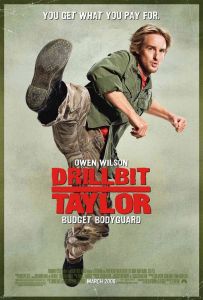 This is a case where a movie feels stuck between two different aims. The premise of a group of geeks hiring a bodyguard to protect them from high school bullies feels dramatically dated, like an idea that John Hughes could have cranked out over a weekend in the 1980s. Owen Wilson stars as a homeless Army vet that agrees to be the bodyguard but he intends to fleece the kids of their money. Eventually the film culminates in the geek trio violently fighting the bully, which is kind of a weird climax to a mainstream teen-centered film. The main bully is actually psychotically dangerous and the movie exists in a realm where every adult character is a cretin or a moron. Don’t even think about security in the school. The jokes aren’t as lively or clever as the movie would like to think, but special credit must be awarded for collecting a group of teen actors that look authentically geeky. Drillbit Taylor is a safe vehicle for Wilson because he’s played a variation of this zen-cool character in many movies. I’m honestly surprised that Seth Rogen is a co-writer and that Judd Apatow produced this flick. This is noticeable below their standards. This movie isn’t anything special and it’s tonally all over the place, but then it does have some funny situations, some amusing character interplay, and some dependable slapstick. Think of it as a sanitized PG version of Superbad combined with an 80s movie.
Nate’s Grade: C+
Share this:

Zack and Miri Make a Porno (2008)
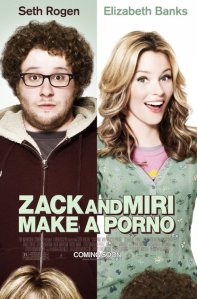 It’s amazing how integrated pornography has become in our culture. Merely a few decades ago people had to wear disguises to venture out to a ratty theater to watch an adult movie alongside plenty of folks in raincoats helping to add to the sticky floors. Nowadays releasing a sex tape is considered a career boost. Porn stars have replaced supermodels as rock star arm candy, porn has become more socially acceptable, and a wealth of bizarre and explicit possibilities exist just a few keystrokes away. In the end, it’s all fantasy with bad acting.
And yet Kevin Smith’s newest comedy, Zack and Miri Make a Porno, got in trouble with advertisers because of people getting in a tizzy over the goofy word “porno.” Major League Baseball was told that a father was uncomfortably asked by his son what a “porno” was after seeing a commercial during a ball game. Heaven forbid our nation’s parents have to deal with an uncomfortable subject, so baseball banned any ads for the movie. Many newspapers nationwide have refused to list the full title. The original poster was deemed too inappropriate so Smith and crew devised a poster of stick figures. Poster version 2.0 then came under fire for being attractive to children because of the stick figure art. It seems Zack and Miri is getting it at both ends (no pun intended).
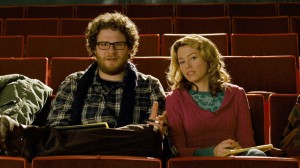 Times are tough for lifelong friends Zack (Seth Rogen) and Miri (Elizabeth Banks). They’re scrambling to pay their bills and keep the electricity in their apartment during a chilly winter in Pennsylvania. Inspired by a conversation with a chatty gay porn star (Justin Long) at their tenth year high school reunion, Zack believes amateur porn can solve their money woes. The two will make their own porn video and sell it to the alumni list from their graduating class, who, Zack rationalizes, would buy a porn if they knew someone involved. Zack convinces his coffee shop co-worker Delaney (Craig Robinson) to help fund the project. Delaney agrees as long as he can have a say in casting; after many years of marriage he is eager to see something new. The team also recruits a squeaky-voiced stripper (current porn starlet Katie Morgan), an old bachelor party performer (former porn starlet Traci Lords), a cameraman (Jeff Anderson), and a man free from any inhibition (Jason Mewes). But Zack and Miri must confront their unspoken feelings for one another as they approach their own sex scene. Can they go from platonic friends to lovers?
Being a Smith film, naturally Zack and Miri is outrageous and often hysterical. The film manages to become witty and dirty at the same time, often stringing together vulgarities in exciting and imaginative ways (the curious “Dutch Rudder” as a means of escaping being deemed gay). Smith has a love of the profane. The movie is vulgar like most Smith movies but the beauty of its filth is in the sparkling, rapid-fire dialogue that adds eloquence to the scatological. This is Smith’s comedic brand, the verbose dirty joke. As in other Smith comedies, the true humor is not found in set pieces and set-ups but in the everyday camaraderie of the cast and through casual conversations. Smith writes characters that you just want to listen to for hours. Zack and Miri does have some funny moments that are specific to the production of randy moviemaking, like an unforgettable de-clogging that “frosts” a cameraman. The joke is swift. However, akin to the Judd Apatow brand of comedy, this is a movie where the charm is watching the characters interact, regardless of setting. I do think the movie unfortunately missed plenty of other potential gags on the silly minutia of homemade pornography. How about the crazy duties for a sound design? Imagine a guy trying to recreate the many weird bodily sounds during sex. I’m mildly shocked that Smith didn’t even touch the vagaries of pubic hair style.
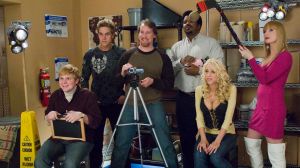 What the movie does nicely is dwell upon the distinction between love and sex. Now I’m not conveniently forgetting the thousands of movies that have come before and dealt with the topic of intimacy and carnality, but Zack and Miri goes into the nuts and bolts (no pun intended) of an industry that has turned intimacy into a mass-market business model. Zack and Miri stress out about their Big Scene and try to convince themselves that it won’t mean anything, but of course their body language betrays them. The actual deed is an obvious turning point for the twosome and count this as one sex scene that is actually, well, emotionally climactic and, yes, sexy. Though the camera only stays at shoulder-length and alternates between two angles, the actors convincingly convey an array of genuine feelings, notably love. It’s not easy for an actor to display honest-to-goodness love, but Banks and Rogen achieve this feat. The aftermath of their onscreen coupling extends into a seemingly unnecessary third act that divides them apart in a contrived fashion. Seriously, the typical third act misunderstanding in standard romantic comedy fluff is alive and well in a Smith vehicle. The characters do not react to this misunderstanding in a realistic manner; one character would rather be sequestered than easily prove their innocence.
While Zack and Miri has plenty of laughs and a nice, mushy center, I cannot help but feel mixed about the results. The characters are not nearly as sharply drawn as they have been in other Apatow comedies, even other Kevin Smith movies. I can go back and remember the multiple dimensions of the funny people that populated Superbad, Sarah Marshall, 40-Year Old Virgin and others, but Kevin Smith’s latest comedy suffers in comparison. Zack and Miri are the only characters with moderate sums of characterization, and yet their unspoken love is essentially the bulk of that. Neither character is well defined or explored in a substantial way that doesn’t involve the other. I get that the movie is a romance. But I expect more from characters than to be defined by whom they desire. I just wanted more. Yes Zack is a slacker who says he’s just looking for a good time, though we know he has his sights set on more, and yes Miri is a gorgeous gal with a lot of patience, but these characters are staples of Kevin Smith movies. The assorted side characters have fun moments but are mostly insignificant. There’s the stripper with a heart of gold, the been-around-the-block type, the henpecked husband, the secret freak behind the button-down exterior, the loudmouth, and the sex-crazed dude. Zack and Miri establishes the idea of filmmaking as a community by introducing this lot, but the movie then forgets to incorporate the supporting characters in meaningful ways. They’re mostly used for jokes that fail to extend beyond the immediate. A late scene involving Delaney’s angry wife (Tisha Campbell-Martin) relies on too many grating “white boy” japes that I tuned out. I’m not intending to slam Smith’s film, but the lack of character work hampers the audience investment in the central romance.
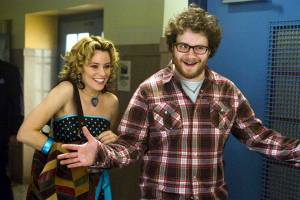 What is lacking on paper is nearly compensated by the great performances from Rogen and Banks. Both are on loan from the Apatow comedy company, and both are skilled at being raunchy one second and heartfelt the next. Rogen finds his comic groove easily and is an enjoyable schmo that taps hidden ambition in the most unlikely of scenarios. It really is Banks who comes across as the star of the flick. She can talk trash with the boys but she is radiant during the film’s dramatic moments, selling Miri’s emotional highs and lows with crinkling smiles and fluttering eyelashes. Banks has always been a solid actress underutilized by most of her marginal film roles. With Zack and Miri, Banks showcases a devilish comedic gleam. Of course yet again the audience must believe that a beautiful gal with a beaming smile would be down on her luck finding a good guy.
In the end (no pun intended), Zack and Miri Make a Porno is a crude romantic comedy that might have benefited by more attention spent on the romance or the comedy. The tone never breaks as sharply as with Chasing Amy, arguably still Smith’s finest accomplishment, but the dirty humor and the gooey romance have a hard time expanding because of the presence of each other. Too often the ribald humor doesn’t feel fully realized because the dirty jokes are just window dressing for the romance, and I had trouble fully engaging with the romance because the characters haven’t been rendered to have substantial depth. Smith may have been better served by making his movie longer; the film is barely an hour and 40 minutes long. Zack and Miri Make a Porno is a sweet movie with a dirty mind but it does not measure up to recent comedies like the best of Apatow’s brand. Smith is a talented wordsmith who certainly knows how to make an entertaining comedy, and Zack and Miri certainly entertains, but like pornography, it just made me want something more fleshed-out and real (no pun intended).
Nate’s Grade: B-
Share this:

Pineapple Express (2008)
 There’s something to be said about a comedy that requires an audience to puff illegal substances in order to fully be entertained. Somewhere along the line the Judd Apatow comedy unit went down a wayward track with the stoner comedy, Pineapple Express, an amiable goof of a comedy at best. The premise is solid, two stoners (Seth Rogen and James Franco) witnessing a murder and on the run. Rogen and Franco have a great rapport with one another that translates to plenty of good vibes and humor (Danny McBride steals the show as a seemingly indestructible low-rent drug dealer). But the movie veers off into action territory with bloody violence that really harshes your mellow, man. Pineapple Express never really settles on a consistent tone, so when the movie fully transforms into a strained guns-a-blazin’ action caper, the comedy has totally vanished. The realistic violence is intended to get the laughs. When people get shot, it’s ugly, and when ear lobes get blown off it’s just plain gross. There’s no room for humor in the third act and the action is lazy and uninspired. If Rogen and his writing partner Evan Goldberg (who scripted the much funnier Superbad) were aiming to create an action parody, then they didn’t push nearly hard enough. After the movie ended, I thought back to last year’s superior action parody, Hot Fuzz, which had a consistent tone and packed jokes as hard as punches. As a sober moviegoer who has never inhaled any such wacky tobaccy, Pineapple Express just kept eluding me. The movie is too slipshod, too misshapen, and it completely goes up in smoke by the end.
Nate’s Grade: C+
Share this:

Superbad (2007)
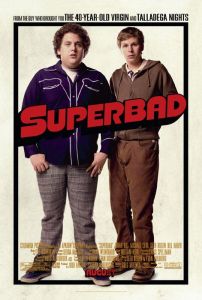 Seth Rogen makes me feel like a slacker. I’m two months older than him, but already he’s broken out as a comic actor on great-but-cancelled shows like Freaks and Geeks and Undeclared, and now he has risen to headlining star thanks to the runaway success of Knocked Up. Now here comes Superbad, a comedy he’s co-written with his friend Evan Goldberg, and I haven’t even gotten one movie off the ground or, for that matter, a starring role in any TV series, canceled or on the air. Oh well. At least Rogen’s consistent attachment to quality projects makes me a happy, if marginally envious, moviegoer.
Seth (Jonah Hill) and Evan (Michael Cera) are high school seniors looking to score with the ladies. Their nerdy friend Fogell (Chistopher Mintz-Plasse) has a scheme to get himself a fake ID, and the trio seizes upon this opportunity to become important figures in the teen circuit. With the promise of the fake ID, Jules (Emma Stone) has asked Seth to provide all the alcohol for a house part that she’s throwing that night. Not only that, Evan’s unrequited crush Becca (Martha MacIsaac) is going to be there. Seth and Evan figure that this party will be the best chance they have ever had to get lucky thanks to the miracles of what some would call, “liquid panty remover.” They just have to get the booze first. Fogell’s ID lists him as simply as McLovin. He is set back when his attempt to purchase alcohol is interrupted by a robber. He’s interviewed by Officers Michaels (Rogen) and Slater (Bill Hader) who take a shine to McLovin (“It sounds like a sexy hamburger”). The threesome spend a madcap night drinking, busting crime, sharing worldly wisdom, and running away at the faintest sign of other police officers.
 First off, Superbad is raucously funny. It’s plenty profane and has several memorable moments, like Seth’s imaginative scenarios for buying alcohol and a dance that goes in a very unexpected direction. The humor is timeless and built around the nervous interaction between the sexes; there are very few jokes that reference pop culture or dependent on a specific context. I imagine what makes Superbad hilarious will still make it hilarious in 20 years to a new audience that can relate to the same trials and tribulations of teen life, though perhaps at that point we will be replaced by robots.
What separates Superbad from other offensive sex comedies is that it’s really a story about male friendship. I don’t mean in the tacky, Hollywood vein of working together for a common goal, which is commonly to lose one’s virginity. Superbad is another entry into the Judd Apatow (40-Year Old Virgin, Knocked Up) school of comedy that professes that a comedy should be character-based and that those characters should be painfully human. This is no mere genre movie. Underneath all the boobs and booze discussion is the pain and worry of a long-standing friendship being able to survive. Seth and Evan have been close friends all of their lives, but many good friends have grown apart in time thanks to their lives moving in different places. There’s unspoken tension between the two of them and Seth is concerned he’s about to be abandoned by the person that means the most to him. Many films touch upon the indelible companionship between men but few can accurately articulate the authentic love that can foster bonds of friendship. Superbad explores the exploits of real friendship, and while it’s chock full of funny the film also has its fair share of moderately touching moments. You really do care about the characters and want them to triumph. Fogell’s ascension to becoming a confidant, cool lady’s man is one of the summer’s true pleasures. Apatow’s fingerprints are all over this, and that is a glorious thing.
But this isn’t some phony Porky’s-style high school sex comedy with male fantasy set pieces and lots of dunderheaded beauties prone to bouts of frequent nakedness. Superbad is a relatively realistic portrayal of high school life in the world of movies. This isn’t a school ordered by cliques of entrenched stereotypes like the jocks, the Goths, etc. In fact, I don’t think Superbad makes any social distinction between the students.
 Superbad is a celebration of the glories and anxieties of the male members’ member. Even for a teen sex comedy, the film is very phallus-centric, complete with a hilarious anecdote about a “treasure chest of dick drawings.” It seems Seth, at a young age, was stricken with the unique compulsion to draw a phalanx of penises. The anecdote is quite unexpected and funny and underscores how often the penis prevails in the minds of young men. The boys discuss at length the life and times of the penis, especially how women can compliment this. The constant dick-chat may get old after a while for most of the female audience in attendance (a.k.a. those without), and I can’t exactly blame them, but Superbad does convey, in a convincing manner, how much teenagers think about sex (“You know how many foods are shaped like dicks? The best kind”). Some have argued that there’s an undercurrent of misogyny with Superbad, but I feel like those detractors are missing the deeper point. These guys are totally terrified of women and go through one wild night just to avoid actually confessing their feelings to the objects of their affection. These guys don’t hate women, they’re just frightened and utterly bewildered by them, and so they rely on what pop culture and their peers have taught them is the way to a woman’s heart: booze.
The movie is taken to an extra level of excellence thanks primarily to the outstanding comedic performances by its cast. Cera was a star of brilliant understatement on TV’s Arrested Development, and when it comes to portraying awkwardness, Cera is king. The gangly teen is a textbook example on high school awkwardness; he feels uncomfortable in his own skin. He seems antsy to leave most scenes. His self-effacing smile, wide-eyed gawk, and nattering stutter are spot-on signals of clumsy, confused, and embarrassed teen life. Cera is a master with impeccably punctuated line deliveries. The kid could make any line funny by flawlessly placing a pause in the right place. Arrested Development was a great showcase for Cera’s comedic chops, and now Superbad is a juicy platform for the funniest straight man on the planet (and he’s only 18 years old).
 Hill has been a supporting player in previous Apatow productions, but this is his first major role. Hill is the loud, boorish, vulgar, and more outlandish half of the duo. When he gets worked into a frothy rage you can practically feel his indignant teen spittle. What makes Hill special is that, in an instant, he can go from foul-mouthed cretin to a vulnerable buffoon. In the end, when the police bust a party, Seth runs on instinct and his instinct is to save his friend. It’s the versatility of Hill that allows Superbad to channel the sweet, gooey center behind all the sex-obsessed hijinks.
Not all the different elements of Superbad seem to fit together. The cops subplot is played very broad and relies on a lot of physical comedy; it feels at odds with the genuine teen comedy that is the heart and soul of the movie. The subplot is indeed full of laughs and it turns McLovin into a legendary teen character, but it feels like a separate movie, albeit an interesting one. For a male-dominated comedy, the female roles are pretty sparse but even those take heed not to slip into empty stereotypes. Becca and Jules are portrayed as sensible and approachable.
In short, Superbad is super good, and it’s thanks to relatable characters, a sweet sensibility, plenty of raunch, and some excellent performances. Apatow has opened the 2007 summer with a winner and now he closes it with another one.
Nate’s Grade: B+
Share this:

Knocked Up (2007)
 Judd Apatow scores again. The man has a long history of creating memorable and heartwarming character-based comedy, and Knocked Up is another winner. This man creates thoroughly human and engaging stories that focus on our own foibles and triumphs. Apatow wrote and directed yet another poignant, clever, and uproarious comedy that has so much more below the surface and becomes universally appealing.
Alison (Katherine Heigl) is out on the town celebrating her promotion at the E! Entertainment Channel. She’s going to go from behind the camera to in front of the camera. It’s at this Los Angeles club where she meets Ben Stone (Seth Rogen), a doughy Jewish slob of a man content to drift through life penniless and high. Their night of partying leads to a drunken one-night stand. Eight weeks later Alison is going through extreme nausea and can’t figure out what kind of flu bug she has, that is, until she remembers her one night out. She locates Ben and informs him that she is pregnant and, yes, he is the father. The two decide to try and make it work, forging a relationship as they plan on becoming parents. Alison’s sister Debbie (Leslie Mann) and her husband Pete (Paul Rudd) and their two kids are a potential glimpse into the future. Pete and Ben hit it off real well, to the point that Alison feels like her mate might not be the one for her even if his DNA is growing inside.
 Naturally, this is a comedy where sex is at its very inception. The humor is ribald and playfully profane. I believe one of the greatest compliments you can give a comedy is when you cannot single out a single set piece or moment as an instant standout. Knocked Up is packed with many wildly funny scenes but it also has killer one-liners from start to finish and sharp pop-culture references (Ben on an exercise bike: “Matthew Fox? From Lost? You know what’s interesting about that guy? Absolutely nothing.”). Ben credits the flick Munich for the ability to get Jews laid. Ben watches the 2003 version of Cheaper by the Dozen with horror, saying that 12 kids is no laughing matter. The roommates are plotting a flesh-friendly website that notes the time and location of celebrity nudity in films. This commercial venture plays right into the frat house lifestyle for this band of stoners that bet their friend not to shave his beard for a year for free rent.
Knocked Up is bawdy and hilarious, sure, but it’s also far more realistic and a lot more emotionally involving than any romantic comedy Hollywood has offered in years. Apatow seems to have mined his personal parental experiences for a lot of hard-earned truths. The film is most natural when it showcases the male perspective of prolonged adolescence and an unplanned pregnancy, but Knocked Up also has a mature and thoughtful view on marriage and feminism. We see the array of personal challenges a woman would go through but the movie still manage to slip in humor amidst the uncertainty. There’s a montage looking for the right gynecologist. The gauntlet of sexual positions is explored while pregnant, with Ben afraid that his child’s first impression will be daddy’s manhood constantly poking it. When Alison and Debbie go shopping for pregnancy tests we see them fill their cart with every kind of tests, and then test after test comes back positive. “Hey this one has a smiley face,” says Debbie, before realizing, “Oh, that’s not a good thing.” Debbie then tests the reliability of the tests herself and for a brief moment panics when she thinks she may be pregnant for a third time. She then calms down and says, sarcasm-free, “Whoa, that would have sucked.” The inclusion of Debbie and Pete offers a whole other relationship viewpoint, something that Alison and Ben can learn from. She’s paranoid and blunt, and he’s apathetic and passive-aggressive, and Alison is terrified that she and Ben are doomed to a similar fate. The insights into marriage and secrecy are realistic and give the film so much more meat to its bones. This isn’t just a movie about what to do with an unplanned pregnancy; it’s fully about male-female dynamics and what it takes to make a family work.
 In the end, you really care about these characters because Knocked Up is a raunch-fest that has a sweet gooey center of sentiment. Ben is pushed into adulthood by this unexpected development and, as they say, puts away childish things after a lot of trial and error. There’s an undercurrent of emotional vexation under most of the comedy, like when Pete confesses that he doesn’t know if he can accept love, and Ben cannot pity this because he sees his love being rejected. Alison doesn’t quite have as big of an arc, but she never gets callously cast to the side and forgotten. She too has a lot of growing up to do very quickly, and when both characters welcome their newborn into this world it’s rather moving and exciting to experience it alongside them. Ben’s confesses to his child that not putting a condom on was the best decision he ever made. In any other movie this ending conversation might seem trite or hokey, but Apatow has paid so close attention to his characters that the emotional payoff is earned and rewarding.
Another hallmark of an Apatow production is how perfect the cast seems with one another. There’s a real camaraderie with the actors and it produces natural onscreen chemistry and amusing improvisation. Rogen and Rudd, teaming again after 40-Year Old Virgin, can riff off one another for a whole movie and I would gladly pay to watch. I loved when the two boys go to Vegas, take mushrooms, see Cirque Solei, and then freak out in their hotel room (“There are five different kinds of chairs in this room”). I was laughing so hard I had tears in my eyes, and I’m sure the crux of this moment was born from the freestyle exchange between the actors. Ben’s roommates have a believable kinship to them as a collection of amicable oddballs and stoners. Mann and Heigl also seem believable as sisters, much more so than would Anne Hathaway, who was originally cast as Alison but left due to creative differences (I guess the difference was she didn’t wish to be apart of a good movie). The Knocked Up cast work together like a truly wonderful team that appreciates the material and each other.
Rogen is destined for stardom after this movie. He can make anything funny with exceptional comic timing and line delivery that never feels forced. Hearing his unique giggle at the end of jokes, you can sense that this sweet and amiable guy would crack himself up and for good reason. Rogen was great in 40-Year Old Virgin and is even better in a bigger dose. Heigl gets to play more familiar notes, from stressing that work will discover her little bun in the oven to the expected birthing scream session. She has a good rapport with Rogen and brings a lot of warmth to her role. Rudd is so effortlessly charming and easy going. Mann plays a perfect bitch, but she also has a nice scene where she explodes at the realization that her days of youth are finally behind her. Special mention must go out to Kristen Wiig. She steals every scene she’s in as an E! Channel employee that makes plenty off-the-cuff passive insults against Alison during two staffer meetings.
 I’ve read online that several leftist bloggers are angry and flabbergasted that Alison does not get an abortion. They argue Ben is a fat and unappealing slob, she’s an attractive career woman, and not having an abortion in this situation is, as one put it, “stupid.” Excuse me, but this may be the first mainstream comedy that actually discusses the prospects of an abortion (or as one character deems it, a “smashortion,” as not to offend the delicate sensibilities of his roommate). I also take umbrage to anyone saying 1) choosing not to have an abortion is a bad decision, and 2) that these critics would be so daft to miss the point that if Alison had an abortion there would be NO MOVIE.
Knocked Up is a very funny and very wonderful sex comedy for adults, but it also happens to be an endearing and heartfelt romance. The cast is excellent, the comedy rarely misses a beat, and Apatow is a instant classic hitmaker. Just like The 40-Year Old Virgin, Apatow has explored a deeply personal topic for all the comedy and pathos he could wring from the material. Knocked Up is nothing short of a knockout. I hope you’re happy with your decision Anne Hathaway. I know I am.
Nate’s Grade: A
Share this:

The 40-Year-Old Virgin (2005)
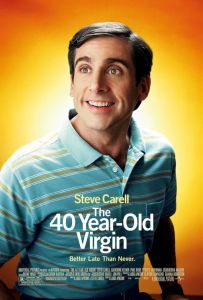 Yes it’s an uproarious sex farce, that’s a given from the ads, but this movie is also surprisingly sweet and genuinely moving. A lot of credit goes to star/co-writer Steve Carell and co-writer/director Judd Apatow, creator of some of the best, most honestly funny TV series unjustly cancelled. Apatow is a master at mining human comedy for pathos, where you get a great sense of character and really feel for those onscreen, and yet nothing feels cheap or unwarranted, all the while deriving comedy from the situations. We need more men like Apatow in the film industry. Carell can do it all whether it’s deflecting his insecurity, which we feel so bad when he comes up with outrageous things he’s overheard to make himself seem like one of the guys. The supporting cast is top-notch. They’re basically the stock roles in a sex comedy and yet they bring so much more to the table, with a true-to-life boys-will-be-boys camaraderie that you can identify with. The character relationships in The 40-Year-Old Virgin really elevate the story and the jokes and make the film something really special. It’s not merely a barrage of gross-out humor; it’s a nice story with some very tender moments. This is a movie that goes well beyond its gimmick premise, never feeling like a skit blown up into a feature film. It mixes in psychology, heartbreak, awkwardness, but also insights into loneliness and human connection. The best character-based comedy in years.
Nate’s Grade: A
Share this:

Donnie Darko (2001)
 Donnie Darko (Jake Gyllenhaal) is your normal malcontent teenager in late 1980s Reagan America. He bickers with his older sister, worries over the right moment he’ll kiss his new girlfriend, and tries to ignore the advice of many imprudent adults. Donnie’s your typical teenager, except for his imaginary friend Frank. Frank is a sinister looking six-foot tall rabbit that encourages Donnie into mischief and gives a countdown to the impending apocalypse. And I haven’t even gotten to the time travel yet.
One night as Donnie wanders from his home at the behest of Frank, an airline engine mysteriously crashes through the Darko home and lands directly in Donnie’s room. The airlines are all at a loss for explanation, as it seems no one will take responsibility for the engine or knows where it came from. Donnie becomes a mild celebrity at school and initiates a relationship with a new girl, Gretchen Ross (Jena Malone). One of his classes consists of watching videos of self-help guru and new age enlightenment pitchman Jim Cunningham (Patrick Swayze). His school has even, under the persistence of self-righteous pain Kitty Farmer, persuaded Cunningham to speak and try to help students conquer their “fears.”
 Donnie is also seeing a therapist for his emotional problems and taking medication for borderline schizophrenia. Around this time is when Donnie starts to inquire about a strange old woman, obsess over the possibilities of time travel, as well as see weird phosphorescent pools extend from people’s chests. He also floods his school at the urging of Frank. This is no Harvey type rabbit.
The longer Donnie Darko goes on the more tightly complex and imaginative the story gets. First time writer-director Richard Kelly has forged an excitingly original film that is incredibly engaging with charm and wit. He masterfully mixes themes of alienation, dark comedy, romance, science fiction, and a sublime satire of high school. Donnie Darko is the most unique, head-trip of a movie unleashed on the public since Being John Malkovich. Kelly has a created an astonishing breakthrough for himself and has ensured he is a talent to look out for in the future.
 Gyllenhaal (October Sky) is superb as disenchanted Donnie, a Holden Caulfield for middle suburbia. His ghastly stare conveys the darkness of Donnie but his laid-back nature allows the audience to care about what could have merely been another angst-ridden teenager. Swayze is hysterical as the scenery-chewing Cunningham. The rest of the cast is mainly underwritten in their roles, including stars Drew Barrymore (who was executive producer) and ER‘s Noah Wyle, but all perform admirably with the amount they are given. Not every plot thread is exactly tidied up but this can easily be forgiven.
Donnie Darko is a film that demands your intelligence and requires you to stay on your toes, so you can forget any bathroom breaks. The film is one of the best of 2001 but also one of the funniest. You’ll be honestly surprised the amount of times you laugh out loud with this flick. The theater I saw this in erupted every half a minute or so with boisterous laughter.
Donnie Darko is a film of daring skill and great imagination. You don’t see too many of these around anymore.
Nate’s Grade: A
Reviewed 20 years later as part of the “Reviews Re-View: 2001” article.


 nathanzoebl
You must be logged in to post a comment.