Blog Archives
Mom and Dad (2018)
 The appeal of the indie thriller Mom and Dad is its frenetic, gonzo, absurdist spirit that accelerates into delicious dark comedy with a maniacal glee seldom seen in movies. The nature of the movie and its bloody violence will put off many viewers; however, if you have a healthy appetite for the bizarre and tonally incongruous, then Mom and Dad will serve as a thrilling and hilarious treat.
The Ryan family, father Brett (Nicolas Cage), mother Kendall (Selma Blair), teen daughter Carly (Ann Winters), and young son Josh (Zackary Arthur), are a typical suburban family with their share of secrets and antipathy. It’s a normal day until it isn’t. While at school, a mob of parents forms to collect their children. A rumor of a terrorist strike has circulated widely. But when the parents get close to their children they viciously harm them. It seems someone or something has flipped that parental instinct to protect one’s child at all costs. Now the urge is to kill one’s young. Carly and her friends escape the school mob and have to survive their homicidal parental units.
 I didn’t realize it while watching but it became obvious in hindsight that this was the fodder of one of the debased, juvenile, and altogether hyperactive minds from the Crank movies, a series best described as debased, juvenile, and hyperactive. Brain Taylor takes a Twilight Zone premise and shoots it full of adrenaline and mescaline and whatever else was lying around on the ground. The action gets going in a relatively efficient fashion, establishing our family unit, and then setting them up for a collision course. From the 45-minute mark onward, it becomes more a self-contained thriller inside the family home, pitting our kids against their homicidal elders. It reminded me a tad of Don’t Breathe in its ability to set up a playing field and have its characters find organic ways to get into trouble, escape it, and get into worse trouble. It’s a series of moving pieces that feel elegantly arranged on the playing field. It keeps the movie barreling forward while still finding room for surprises and payoffs, including a glorious late Act Three payoff that I had long ago forgotten about its setup. It’s not quite dues ex machina because there’s more to come after, but it made me so happy.
This is a movie that strangles the concept of tone, and yet it decidedly knows what points to hit up the darker comedy, what moments need more drawn out suspense, and what moments can straddle the difference. The build-up of dread can be beautifully applied and then turned for laughs. Take for instance a moment when a teen girl comes home and notices an open blender with margarita mix, implying her mother is home. Just as a signifier of terror, it’s kind of fun, but then she leans closer and reaches into the open blender, her hand picking the blades. We’re leaning in, waiting for the blender to turn on all of a sudden, and then… she walks away, and the moment passes. Then we laugh to ourselves about how something so ordinary was turned around to be menacing. Taylor finds other little moments like this to assure the audience he’s thought through the premise and found ways to properly develop it to its potential. I was covering my face at parts in tense anticipation and I was cackling to myself at other times.
Cage (Snowden) is one of the few actors that seems to get exponentially more compelling to watch the nuttier he acts, and his crackpot zeal can elevate bad movies into something approaching unintended hilarity, like 2006’s woeful Wicker Man remake. There are few actors that go for broke regardless of how silly they eventually come across. In the wrong hands, this is an attribute that can betray Cage’s efforts and sink a movie. In the right hands, like Taylor’s, it provides the spark of madness needed to push a movie into another level of irascibility. Cage finds humor in the strangest of places, and it’s not a derisive sort of humor but more a genuine delighted bafflement at the character. If you love crazy Cage, you’ll have plenty to love in Mom and Dad.
 Blair (Hellboy 2) is the more restrained parent while still getting scenes to cut loose. She’s having terrific fun getting to play bad. When she’s teamed with Cage, they form a darkly funny couple bonding over their shared intent for murder. It becomes an oddball romantic comedy in the darkest sense. Blair also impresses in her scenes of dramatic response. She’s one of the last parental figures to succumb to the hysteria, so we get to witness her process the shock and confusion of the day. There’s a great scene where she’s present in a hospital birthing room. Blair scrambles to save the newborn and try to understand what is happening, and it’s a personal kind of fear and betrayal that registers.
One of the more surprising aspects of Mom and Dad was how it’s able to build the parents as characters in clever and genuinely sincere ways. This is a crazy movie, and that’s its main appeal, but it can also find room to take things seriously. Taylor will momentarily pause the action to insert choice flashbacks that are enjoyable little asides, monologues that provide texture to the world and the characters. The flashback relating to a pool table’s demise opens up an entire analysis of a rocky marriage, a middle-aged man raging against his life’s mediocrity and the faded glory and promise of his youth, and the despair of losing your sense of self through parenthood. It builds and builds and allows the actors to unload. It doesn’t serve as significant a narrative point as other character-based flashbacks setting up ironic convergences. It’s just Brett and Kendall being able to voice their insecurities and disappointments. It’s about this point where the movie positions both as unswayable evil forces, so giving them a chance to come across like genuine human beings before they’re kill-crazy cartoons is unexpected and effective.
I know I’m having a great time with a movie when the worst thing about it is the last few seconds. Mom and Dad just sort of ends. It almost feels like there was some kind of editing accident and you may turn and say, “Wait, is that it?” I didn’t want Mom and Dad to end. This is a raucous dark comedy with an anarchic spirit but a strong sense of pacing, tone, and structure, layering in surprises and escalations dutifully while still finding equitable space to better shade the characters. If you’re looking for a risky dark comedy that will make you feel a tad crazier for watching, give Mom and Dad a whirl. This is the kind of movie you might hate yourself for loving.
Nate’s Grade: B+
Share this:

Downsizing (2017)
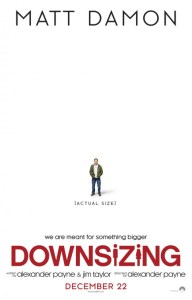 Alexander Payne is not exactly the first name you would think of when it comes to science fiction. The man has a history of road trip comedies, average Midwestern men, mid-life crises, and the colorful miscreants of society. The fact that the director of Sideways and The Descendants is tackling The Incredible Shrinking Man is a bold move. Payne is outside his comfort zone with Downsizing, and it shows at points. While never quite satisfying the possibilities of its premise, Downsizing is still worth watching for its memorable moments and for the sheer brilliance of one outstanding performance.
In the not-too-distant future, science has developed the technology to shrink human beings to five inches tall, approximately 1/100th of their size. A middle-income couple can live like the top one percent because their money goes further. Paul Safranek (Matt Damon) is a schlubby, regular guy suffering from the ennui of a job he hates and a life that feels unfulfilled. He and his wife, Audrey (Kristen Wiig), decide to undergo the downsizing procedure, which is irreversible. Paul’s wife backs out at the last minute but he doesn’t find out until after he’s gone small. Now with a McMansion all to himself, Paul has to readjust to what he thought his new life would be like. He moves into a condo and shirks the offers to join the parties of his hedonist neighbor, Dusan (Christoph Waltz). Paul finally decides to live life and embraces new experiences, the biggest befriending Ngoc Lan Tran (Hong Chau), a one-legged Vietnamese cleaning lady who was downsized against her will for being an overseas political activist. Paul feels drawn to this woman and she opens his eyes to the larger world around him.
 The strangest part of Payne’s movie is that the main thrust of the story could have been told without all of the science fiction dross. This is very much a romantic comedy/drama that follows the formula of a man jilted at the altar who has to get his life back together, finds someone new who changes his perspective on life, and then they get together by the end. You could have plucked this story and set it in an ordinary world and it still would have worked, which begs the question whether the world of Downsizing is properly applied. The consumer commentary seems muddled, with the rationale for downsizing being helping the planet, reducing the population so to speak, but really it’s an escape into a fantasy of wealth. People are downsizing so they can live in luxury and leisure. This should set up Payne for his incisive brand of satire as he skewers the selfish and self-righteous foibles of mankind, except that doesn’t really happen. Sure, eventually in the second half the movie opens up its tiny world a little wider, revealing the not-so-hidden subculture of immigrant labor toiling away to keep everything stable and pretty. It’s obvious social commentary and rarely does it go a step further than just recognition. And so the film becomes another in a long line of movies about a man who must be shaken from his malaise and enjoy the possibilities of life he never knew existed. Downsizing eventually ignores its sci-fi conceit to tell a relatively ordinary tale of self-actualization.
Payne’s premise would have best been explored through the more open parameters of a television series. Downsizing is an interesting concept that leads to other natural questions over how this tiny world operates and also how it interacts with the larger community. There’s a small scene where a drunk overhears Paul’s plan to shrink and argues that little people shouldn’t be granted the same voting rights as “normal-sized” citizens. The normies contribute more to society and should be given more credit, he argues, before being shooed away. This political division could have made for an interesting topic of reflection itself, but like many of Payne’s pit stops, it comes and goes after whetting your appetite for further examination. What about a story where downsizing is a punishment to do away with the “undesirables” of a nation? A TV series would have allowed more room to explore, with finer nuance, the details and possibilities of this fanciful world. Payne allows his movie to breathe, taking extended jaunts on different ideas but rarely enough to satisfy your sense of curiosity. The last act takes place at the original downsized colony in Norway, though at their diminutive size I wonder if it took them months to travel in Dusan’s yacht. It’s meant to think about what will come after humankind has passed the point of no return when it comes to climate change. Paul has to rethink what he wants his legacy to be and what meaning his life will have, which then pushes him into a rather simplistic choice of go with the girl or the cause. Given the rest of the movie’s focus, you shouldn’t be surprised what decision he ultimately makes.
 However, the real reason you should legitimately see Downsizing is for the astounding, star-making, can’t-take-your-eyes-off-her performance by Hong Chau (Inherent Vice, Big Little Lies). I cannot recall another movie where a character comes in at the halfway mark and just takes over completely, single-handedly lifting the movie up. Every moment she is onscreen is made better. You’ve never seen a character in a mainstream movie quite like Ngoc Lan Tran. She’s a political dissident, amputee, and lower-class cleaning woman who teaches Paul about the class divides. Tran is tragic, comic, caustic, lovable, and Chau is an acting revelation. I’ve read several reviews that found her to be a cringe-worthy, borderline racist depiction of an Asian woman meant to be laughed at, and I strongly disagree. At no point was I laughing at Tran because of her status, her ethnicity, or her broken English cadences. I was laughing because she was a force of nature that blew away the pretensions of others, that cut to the chase, and spoke her mind in a carefree and honest manner. Her matter-of-fact affectations are so perfectly delivered in accordance with the character’s personality. There are moments where her character is being set up for one thing and Tran goes entirely in another direction, and whereas you might have laughed at the start she surprisingly earns other emotions. Take for instance a scene where Dusan tries to ditch her by making an excuse about a sudden travel commitment. Tran takes this moment and turns it into a genuinely poignant monologue about the unexpected nature of fate. By the end she’s crying out of sheer elation, and those tears are not meant for ridicule. Downsizing realizes what an asset it has and makes her the deserved focal point of the second half. You’ll fall in love with her too. Chau doesn’t just deserve an Oscar nomination; she deserves to win everything.
Downsizing is an episodic high-concept comedy where the shrinking is irrelevant to the main storyline that evolves over two plus hours. This is an adult movie that explores some mature topics with surprising time and scrutiny, and then it can also be a simplistic rom-com that misses the mark on larger, Swiftian social satire. It’s another story in a long line of disaffected, middle-aged men finding their groove again, except then it becomes the story of a Vietnamese activist and her unique persona. Hong Chau is the reason you should see Downsizing above all. She doesn’t so much steal her scenes as just take full ownership over the back half of the movie. Her performance is so uniformly excellent that you wish the rest of Payne’s uneven movie could meet her commitment. There are a lot of ideas here that seem to get brushed aside for the conventional formula of a romantic union, even if the pairing is rather unconventional. Downsizing is an entertaining movie that doesn’t quite amount to more than the sum of its little parts.
Nate’s Grade: B
Share this:

The Killing of a Sacred Deer (2017)
 Greek filmmaker Yorgos Lanthimos might just be the most perversely ingenious creative mind working in movies today. After Dogtooth and The Lobster, I will see anything that has this man’s name attached to it, especially as a writer/director. Lanthimos’ latest, The Killing of a Sacred Deer, is a challenging revenge thriller, a macabre comedy, a morality play, and a generally uncomfortable watch that is just as alienating as it is totally brilliant.
Steven Murphy (Colin Farrell) is a heart surgeon with a loving family that includes his wife, Anna (Nicole Kidman), teen daughter Kim (Tomorrowland’s Raffrey Cassidy), and young song Bob (Sunny Suljic). Then there’s Martin (Barry Keoghan), the lonely son of a patient who died on Steven’s operating table. He won’t leave Steven alone and doesn’t understand boundaries, even trying to hook up Steven with his lonely mother (Alicia Silverstone, yep you read that right). Martin even takes an interest in Kim. However, once Steven’s son falls victim of a mysterious illness and becomes paralyzed, Martin makes his true intentions clear. He’s poisoned all three of the Murphy family members and they are destined to die slowly unless Steven kills one of them. He has to choose which family member’s life to take with his own hands, or else they all die.
 It’s hard for me to think of whom exactly to recommend this movie to because it is so intentionally off-putting. It’s intended to make you awkwardly squirm and question what you are watching. This will not be a fun watch by most accounts unless you’re a very select person who has a dark sense of humor and an appreciation for something different. Lanthimos seems to be purposely testing his audience’s endurance from the start. We open on several seconds of black to test our patience and then an extended close-up of real open-heart surgery. My pal Ben Bailey had to shield his face from the screen. From there, the movie defies your expectations at most turns and digs further into its depths of darkness. This is one of those movies where you wonder whether it will go “there” and it most assuredly goes there and beyond. One minute you’ll be cringing, the next you’ll be cackling, and the next you’ll be deeply unsettled, and then maybe back to laughing if you’re like me. Much like Lanthimos’ other movies, his deadpan sense of comedy is his prescription for an absurd world. It’s a movie where you have to actively work to adjust to its bizarre wavelength, but if you can, there are rewards aplenty. I can’t stop thinking about it.
Unlike The Lobster, this doesn’t exist in a completely parallel universe but more of a cracked, heightened version of our own. Lanthimos’ breakout film, 2009’s Dogtooth, dropped the audience into a strange world and expected us to catch up. This is similar. The flatly comic conversations become a sort of absurdist poetry. Everyday moments can be given one extra strange beat and become hilarious. Scene to scene, I didn’t know what would happen. The movie allows its story to properly breathe while finding room for its characters to discover intriguing diversions and insights, like Martin’s recollection of how he and his father eat spaghetti the same way. There’s an unusual sexual kink that involves giving oneself completely to another that makes more than one appearance, enough to question the connection between them. The very geneses of that kink I think alligns with a character’s god complex, but that’s my working interpretation. It made me rethink about the aberrant concepts of sexuality in Dogtooth, a.k.a. the nightmare result of helicopter parenting. The handling of pubescent sexuality, and the idea of incorrectly applying information learned from other settings, is just one more tool to make the audience uneasy. Killing of a Sacred Deer exists in a closer approximation of our world in order for there to be a better sense of stakes. Somebody is going to die, and if Steven cannot choose then everyone will die. This isn’t a fantasy world but a real family being terrorized by a demented and vengeful stalker. This gangly teenager is more terrifying and determined than just about any standard slasher villain.
 This is a modern-day Greek tragedy literally inspired by an ancient one. Prior to the Trojan War, Agamemnon was hunting and killed one of the sacred deer belonging to Artemis. The angry goddess stranded Agamemnon’s ships and demanded a sacrifice in order for the winds to return. He had to choose one of his family members to kill, and Iphigenia got the short end of that one. Euripides’ classic work gets a fresh retooling and Lanthimos is not one to merely stand on ceremony. He smartly develops his premise and takes it in organic directions that feel believable even given the ludicrous circumstances. That is Lanthimos’ gift as a storyteller, being able to make the ludicrous feel genuine. After the half-hour mark, where Martin comes clean, the movie really takes off. Does Steven tell his family and how much? Does he take matters into his own hands to convince Martin to stop? Is he actually culpable for the death of Martin’s father? Once the reality becomes clear and people starting getting increasingly sick, the movie becomes even direr. Steven is given the unenviable position to choose life and death, though he frequently shucks responsibility and only continues to make matters worse. Once his family comes to terms with the reality of Martin’s threat, they each try different methods to argue their personal favor to dear old dad. They vie to be father’s favorite or, at least, not his most expendable loved one. It’s a richly macabre jockeying that had me laughing and then cackling from the plain absurdity. Lanthimos presents a tragedy and forces the audience to simmer and contemplate it, but he doesn’t put his characters on hold either. They are adapting and have their own agendas, mostly doing whatever they can to campaign for their lives at the expense of their family (Vin Diesel’s Fast and Furious character would loath this movie with a sleeveless fury).
The end deserves its own mention but fear not dear reader I won’t spoil it. It’s a sequence that had me literally biting my own hand in anxiety. I was pushing myself backwards in my chair, trying to instinctively escape the moment. It’s the culmination of the movie and feels entirely in keeping with Lanthimos’ twisted vision and the depiction of Steven as a weak man. There’s a strange sense of inevitability to it all that marks the best tragedies. I don’t know if I’ll sit through a more intense, uncomfortable few minutes in 2017, and yes I’ve seen, and appreciate, Darren Aronofsky’s mother! of difficult 2017 sits.
As much as this is a thriller it also feels just as much a satire of overwrought Hollywood thrillers. The killer isn’t some shadowy evil genius. He’s just a very determined teenager in your neighborhood. There are several moments that are difficult to describe but I know Lanthimos is doing them on purpose as a critique of thrillers. At the end, a character shakes a generous heaping of ketchup onto a plate of French fries, and we’re meant to get the lazy metaphor of the sloshing ketchup as spilled blood. However, under Lanthimos’ heavy direction, the shot holds longer, the accompanying soundtrack becomes an operatic crescendo, and the whole thing turns comic. Lanthimos has to know what he’s doing here, commenting on the lazy symbolism of dread in overwrought thrillers. There’s another instance where Martin has severely bitten into Steven’s arm. Martin’s apologetic and promises to make it right and then proceeds to bite a chunk of flesh out of his own arm and spit it onto the floor as an offering. That would have been creepy enough but then Lanthimos goes one step further. “Get it, it’s a metaphor,” Martin explains. It’s one in a series of moments where Lanthimos goes a step further into pointed genre satire. It’s possible I’m reading too much into the rationale behind some of these oddities but I don’t really think so. It seems too knowing, too intentional.
 The Killing of a Sacred Deer is a movie that invites discussion, analysis, and just a general debriefing in the “what the hell did I just watch?” vein. This is a movie experience that calls upon the full range of human emotions, and sometimes in the same moment. Lanthimos’ modern Greek tragedy serves up a self-aware critique of its own genre, as he puts his personal stamp on the serial killer thriller. This is also an alienating film that doesn’t try to be accessible for a wider audience. It almost feels like Andy Kaufman doing an experiment replicating Stanley Kubrick (and it was filmed in Cincinnati). Even if you loved Lathimos’ most high profile work, The Lobster, I don’t know if you’d feel the same way about Killing of a Sacred Deer. It wears its off-putting and moody nature as a badge of honor. I found it equally ridiculous and compelling, reflective and over-the-top, sardonic and serious. Dear reader, I have no idea what you’ll think of this thing. If you’re game for a demanding and unique filmgoing experience and don’t mind being pushed in painfully awkward places, then drop into the stunning world of Lanthimos’ purely twisted imagination. Killing of a Sacred Deer just gets better the more I dissect it, finding new meaning and connections. If you can handle its burdens of discomfort, The Killing of a Sacred Deer is one of the most memorable films of the year and also one of the best.
Nate’s Grade: A-
Share this:

Suburbicon (2017)
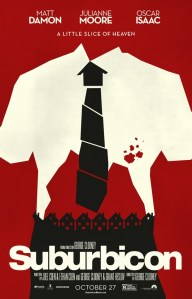 Suburbicon began as a script written by Joel and Ethan Coen back in the 1980s. They shelved it and went on to other stories and justifiable acclaim. George Clooney came across the old screenplay and rewrote it with his longtime partner Grant Heslov (Monuments Men). Clooney’s version of suburban strife is a wash and also easily the worst effort of Clooney’s Oscar-nominated directing career. I wish Suburbicon would make up its mind on which of the three different movies it wants to tell. This is possible proof that Coen brother stories should best be left chiefly to the Coens.
Set amidst the 1950s, an African-American family moves in to an all-white suburban neighborhood and instantly changes the climate. The Mayers have upset the other middle-class white neighbors who want them gone, and they don’t mind subjecting this black family to all forms of harassment to get the job done. Meanwhile, Gardener (Matt Damon) and his wife (Julianne Moore), her twin sister (also Moore), and his son, are threatened by loan shark goons. The family is never the same but there’s more than meets the eye to this domestic tragedy, and the costly cover-up ensnares everyone in danger.
 This is a movie that feels badly stitched together with competing ideas and storylines. Two of these competing movies are so haphazard and lazily explored that it feels like Clooney and company tacked them on for some sort of extra failed social commentary about The Way We Live Now. The shame of it is that either of these vestigial storylines could have existed as their own compelling movie. The integration of the suburbs with a black family brings about an intense reaction. Fellow suburbanites harass the family at all hours of the day, destroy personal property, and do everything to let them know they are unwelcome in this “good-natured” community. The reactions are so virulent and disgusting, and all for a family just existing on the block, shopping at the same grocery store, thinking they too were eligible for the American Dream. There’s a movie there in its own right because, as evidenced in Suburbicon, it’s just background for a larger indictment on suburban values hypocrisy that never generally materializes. At no point does Clooney give the racist response any depth, nuance, or even a deserving spotlight. The only thing we learn is that it’s wrong, which should already be obvious. The entire storyline feels so unfairly attached to another unrelated movie. This family’s story is worth telling right rather than just having something else to cut back to.
Then there’s the larger satire on suburbia itself and its reported family values philosophy. Just because bad people exist and bad things happen in a “nice” community does not mean your satirical work is done. You’re just supplying air quotes to your location. This is the most facile form of irony, lazily slapping together something vulgar against an idyllic setting of morality. That’s why I had no interest in The Little Hours, a comedy that looked to be built around one sole joke, unexpectedly offensive nuns (“Oh ho, that pious person used profanity, and that will never not be funny”). Suburbicon is a story that could have existed in any setting, which further devalues any attempt at legitimate social satire. This isn’t about The Way We Live Now or Even Then.
If you look closely you can see the bones of a Coen brothers’ story here, the only movie of the three that could have worked for Suburbicon. An insurance fraud scam that involves murder and complications is a juicy start for a thriller with some dark comedy edges. This aspect of the movie is the most compelling because it’s obvious that the most attention has been paid to it. Also, there are reversals and unexpected turns that keep the story twisting and turning while accessible. However, the impact of the story is limited by the fact that none of the characters are generally likeable or that interesting. You won’t really feel anxiety over whether or not these people get away with their scheme, which deflates the film’s acceleration of tension despite the best efforts of Alexadre Desplat to replicate an ominous Carter Burwell, a.k.a. “Coen brother,” score. If you don’t care about the characters then they better get into some crazy escalating collateral damage. For a while, it feels like Clooney and Suburbicon understand this principle and begin to ratchet up a body count, though oddly it’s far too fast. Oscar Isaac (The Force Awakens) turns up as a nosy insurance investigation and is taken care of only in his second appearance. The film doesn’t take the time to force the characters to luxuriate in the unease. It just goes straight for the sudden violence, and after awhile it becomes pat and expected.
 This is Clooney’s weakest directorial effort yet. He’s clearly working from the visual framework of the Coen brothers’ classics, using the cookie-cutter production design of colorful suburbia for intended kitschy menace. Even some of the camera angles feel like something lifted from the Coen brothers. Alas, Clooney is not the Coens. He is a director capable of great things depending upon the subject matter, but this movie is a misfire from the start. Clooney cannot decide what the tone is supposed to be, so different actors seem to be operating in their own separate, competing movies. Damon (The Martian) is at either turn hapless or malevolent. I never knew what his read on his character was supposed to be. Moore (Kingsmen: The Golden Circle) is so over-the-top as a distressed housewife that you think she might start bouncing off the walls. It’s only Isaac that feels like he finds the sweet spot of what Clooney must have been going for, and thus it’s even more disappointing about his character’s limited screen time.
Messy, tone deaf, and lacking greater commentary, Suburbicon is a fatally flawed, overbearing dark comedy that has things on its mind and no clear idea about how best to articulate them. It feels like dissonant movies badly stitched together. The overall execution is lazy and relies upon the simplest form of irony to substitute as subversive suburban satire. The tone veers too wildly and the actors are desperate for some better sense of grounding. The characters are pretty flat and poorly developed. It’s an altogether mess that has a few inspired moments and a whole lot more uninspired. The victimized black family deserves to have their own movie and not be the backdrop of somebody else’s broad comedy. The racism is far too real to mesh with the comic goofiness of the rest of the criminal shenanigans. Clooney needed to settle on the movie he wanted to tell. I doubt the final version of Suburbicon that I saw is close to the Coen’s original screenplay. There may have been a good reason that they originally shelved it. Clooney shows that replicating the Coen look and style can be a fool’s errand even by an otherwise talented director. This is the worst Coen brother movie and it’s not even theirs.
Nate’s Grade: C-
Share this:

The Lobster (2016)
 When people decry the relentless slate of sequels, remakes, and redundancy from the Hollywood assembly line, they’re looking for something original and different, and there may be no movie more different this year than Yorgos Lanthimos’s The Lobster. David (Colin Farrell) is the newest guest at the Hotel, a place for singles to find their true love. He has 40 days to fall in love with a compatible mate or else he will be transformed into an animal of his choice (hence the title, David’s choice). The people at the hotel are all in competition to find their mate. Outside the confines of the hotel, in the woods, are dreaded single people, those who ignored the rules of society. They are to be feared and hotel guests are rewarded for capturing wild singles on weekly hunting trips. One way or another, David is going to have to decide his place in society as a person or animal.
The Lobster is daringly different, wildly imaginative, and drops you into the middle of its cracked, alternative landscape and expects you to pick things up as you go. It’s something that the writer/director already achieved with chilling, car-crash fascination in Dogtooth, a dark parable about extreme parental protection that crossed over into abuse. This is a world that opens with a distraught woman driving a long distance just so she can shoot a donkey in the head. Who is this woman? Why would she purposely murder this animal? Why is she so emotionally invested? And with that jarring act of peculiar violence, we’re off. We’re never told how this world came to be, it just simply is. There isn’t any extensive exposition save for one initial sit down David has with hotel management to determine what animal he’d like to turn into at the end of his stay if unsuccessful in love. There’s a genuine sense of authenticity to this deeply weird place and the characters all play it with straight-laced absurdity, which makes the satire land even harder. It sells even the most bizarre aspects, like the ongoing visual incongruity of wild animals just trotting around the background. You can sit back and think, “I wonder what that peacock’s story was, or that donkey, etc.” Its abnormal background pieces that add to the context of the world. I loved discovering new little wrinkles and rules to Lanthimos’ world that made perfect sense within its parameters. In a world where coupling is the only goal, of course masturbation would be a punishable crime. I enjoyed that there are other means guests have to stay at the hotel, chief among them hunting down the loners in the woods, which allow the more awkward or anti-social guests added time at the expense of others. Even in a world this bizarre, there are people who are making their own way, including the revolutionaries in the woods (more on them later). The movie is exceedingly funny and so matter-of-fact about its peculiarities to make it even funnier.
 The movie straddles the line between skewed ironic romance and cynicism, so I’m not surprised it’s rubbed people the wrong way. This can be a pretty dark movie and that’s even before the violence against animals/former people. It’s certainly written from the point of view of someone who is single and those currently in that category will likely relate the most to the film’s strident social commentary. “It’s no coincidence the targets are shaped like single people,” a man says in reference to target outlines. The pressures can seem absurd in their own regard, and the film has a clever concoction where the “happy couples” are merely two people who share a superficial physical trait. These two people are near-sighted. These two people get nosebleeds. These two people have a limp. Even the characters are named after their physical depictions, like The Limping Man and Short-Sighted Woman. It’s not exactly subtle but the satiric effect is still effective. The hotel manager says, to a newly cemented couple, “If you encounter any problems you cannot resolve yourselves, you will be assigned children, that usually helps.” The humor can be very dry and very dark, never stopping to inform you where to laugh. There’s a sad woman played by Ashley Jensen (TV’s Extras, Ugly Betty) who is desperate for companionship, offering sexual favors to any man who might just alleviate her loneliness. She is ignored and often threatens to kill herself, and then one day she does it by jumping out a hotel window, but she’s not successful. It’s one more dark, awful ironic point of suffering for this woman, and she screams in agony while others ignore her, including a clearly affected David, still trying to play indifferent to win over the hard-hearted woman he sees as his best way out of the hotel. It’s a hard moment to process but one that made me admire the film even more for the cold courage of its convictions.
Supplementing the dark satire is an off-kilter romance that emerges halfway through the film once David escapes the hotel. He finally meets up with the source of our narration, the Short-Sighted Woman (Rachel Weisz). It’s here that the movie shows glimmers of hope for the hopeless as David and this woman are drawn to one another. They’re in a world of outcasts but the rules of those in the forest do not allow coupling. They reject the expectations of the ruling order, and so they must remain resolutely single. the only time David and the Short-Sighted Woman can be open with their affection is when they go undercover into the city, posing as a couple, and getting a chance to kiss with abandon, all as a cover of course. They build up their own secret non-verbal language to communicate their feelings, much like a couple builds its own personal shorthand and inside jokes. The loners are only to listen to music individually and dance the same, but David and the Short-Sighted Woman synch their CD players to listen to the same track, to simulate like they are sharing a dance together even if not in proximity. It’s here where The Lobster becomes a beguiling and surprising love story and one where the heartless may grow a heart, watching two odd people find one another in such an odd world. However, Lanthimos does not let this emergence of romance blunt his message. The loner leader (Lea Seydoux) suspects coupling in her group and goes to some pretty drastic lengths to test the fortitude of feelings between David and his secret girlfriend. It’s like getting cold water dumped on the runaway spell of optimism. The fitting ending is left in ambiguity for the audience to determine whether they were meant to be after all.
It’s also in the second half of The Lobster that the movie loses some of its grandeur and momentum. We’re introduced to a new primary setting with new rules to adapt to and a new order to follow, and there’s a general interest to discovering another competing area of this landscape with a diametrically opposed social order. They punish people by mutilating parts that come into affectionate contact with another person. We see a couple with bandages around their red, swollen mouths, and then the reference of the “red intercourse” makes your imagination fill in the horrific blanks. David has left one regime dictating his life to another regime dictating his life, but they just aren’t as interesting. It feels like the film is starting to repeat itself. I would say the second half world building isn’t as compelling as the first but that’s why the romance emerges, something for the audience to root for. Now that he’s finally found someone he connects with they’re not allowed to be together. There’s never a shortage of irony in a Lanthimos movie.
 The actors are perfectly in synch with the strange rhythms of this world, and Farrell (Fantastic Beasts and Where to Find Them) and Weisz (The Light Between Oceans) deserve special attention for their committed performances. Farrell gained 40 pounds for the role, which seems to have translated right into his stint on season two of HBO’s True Detective. He’s a schlubby guy that’s still mourning the deterioration of his marriage and larger society is insisting he get over it. He has only 40 days to recover or he’ll be plucked from the ranks of humanity. There’s great sadness tinged in his nonchalant responses to the absurd realities of this world, and Farrell keeps finding ways to make you laugh and wince. Weisz is our placid voice into the strange new world and it helps establish a sense of grounding as well as connection to her character when she eventually emerges. She injects a palpable sense of yearning to her character, especially once David is in reach and they begin their relationship. It’s got the cute romantic comedy staples but on its own terms, and seeing Weisz smile warmly is a pleasure in a morbid movie.
The Lobster is a romance for our age and an indictment of the romance of our age, an era where the swipe of a finger on an app is the arbitrator of contemporary dating. It’s a satire on our fixation of coupledom and being in relationships even when they’re not sensible. It’s a cracked fairy tale that punctuates the romantic love we’ve watched distilled to an essence in Hollywood movies. It’s a surreal and dark movie that manages to become emotionally moving and poignant, leaving on a note of uncertainty enough for different factions in the audience to interpret as either hopeful or hopeless. The Lobster is a unique movie with a singular artistic voice that dominates every shape of the narrative, the characters, and the boundaries of this fantastic alternative world. I imagine my depth of feeling for the movie will only grow the more I watch it. This isn’t an overwhelmingly dark or unpleasant movie without the presence of some light. It’s not an overly off-putting movie without an accessibility for a curious audience, whether those people are single or in happy relationships. The movie is inventive, transporting, but still relatable, rooting the nexus of its weirdness on the same awkwardness and anxiety everyone feels with the prospects of prolonged romantic courtship. If 2016 was a year that celebrated the oddities of cinema getting their due, then The Lobster is a captivating and unusual creation deserving of its spotlight and surefire future cult status amidst lovers of the weird.
Nate’s Grade: A
Share this:

High-Rise (2016)
 Watching High-Rise left me in an agitated state of bafflement. I was desperately trying to fumble for some kind of larger meaning, or at least some kind of narrative foothold from this indie movie about a high-rise apartment complex where the rich reside at the top and the lower classes below. I was holding onto hope that what came across as messy, incoherent, and juvenile would magically coalesce into some sort of work of satiric value. This hope was lost. Director Ben Wheately’s (Kill List) movie is disdainful to audience demands, disdainful to narrative, disdainful to characters that should be more than vague metaphorical figures against the British class system. The social class commentary is so stupidly simple. At one point, the upper floor rich talk about how they have to throw a better party than the lower floor plebs (slobs versus snobs!). The movie lacks any sort of foundation but just keeps going; I would check how much time was left every fifteen minutes and exclaim, “How is there still more left?!” This is a chore to sit through because it’s so resoundingly repetitive and arbitrary. You could rearrange any ten minutes of the movie and make nary a dent in narrative coherence. There are some striking visuals and weird choices that keep things unpredictable; it’s just that I stopped caring far too early for anything to have mattered. Tom Hiddelston plays a doctor in the building and becomes the intermediary between the oblivious rich and the rabble rousing and vengeful poor. I can’t tell you why anything happens in this movie. I can’t say why the characters do what they do, why the events happen, why anything. It’s all just weightless materials for Wheatley’s empty impressionistic canvas. As society breaks down, things get violent and yet the movie is still boring. I was hoping for something along the lines of Snowpiercer but I got more of a pulpy Terence Mallick spiral of self-indulgent nothingness. High-Rise is a highly irritating and exasperating movie and I know it’s destined to be a future favorite of the pretentious. If anyone says it’s one of his or her favorite movies of all time, please kindly walk in the other direction as fast as you are able and then tell an adult.
Nate’s Grade: D
Share this:

Birdman or (The Unexpected Virtue of Ignorance) (2014)
 Expecting a comedy from Mexican director Alejandro Gonzalez Inarritu would have preposterous. The man was known for his cinema verite of suffering, notably Babel, 21 Grams, Biutiful, and his best film, Amores Perros, roughly translated to Love’s a Bitch. Perhaps there isn’t much of a shift going from tragedy to comedy. Inarritu’s newest film, Birdman or (The Unexpected Virtue of Ignorance), has been wowing critics and audiences alike, building deafening awards buzz for its cast, Iarritu, and the superb cinematography, but will it fly with mainstream audiences? This may be one of the weirdest Oscar front-runners in some time.
Riggan (Michael Keaton) is an actor best known for playing the superhero Birdman in the early 1990s and walking away from the franchise. He’s still haunted by that role (sometimes literally) and struggling to prove himself as an artist. He’s brokered all his money into directing, adapting, and starring in a theatrical version of Raymond Carver’s short story, “What We Talk About When We Talk About Love.” The show is in previews and about to open its run on Broadway but it’s already got a rash of problems. The leading man needs to be replaced immediately. The supposed savior is famous actor Mike (Edward Norton), an undeniably talented but temperamental actor who pushes buttons to find some fleeting semblance of “truth.” Mike’s girlfriend, Lesley (Naomi Watts), is growing tired of his antics and desperate for her own long-delayed big break. Laura (Andrea Riseborough) is Riggan’s “girlfriend” and co-star and may be pregnant. Sam (Emma Stone), Riggan’s personal assistant and also his detached daughter, is fresh from rehab, and spiteful against her neglectful dad. Toss in Riggan’s best friend/manager/play producer (Zach Galifianakis), Riggan’s ex-wife (Amy Ryan), and a feared theater critic (Lindsay Duncan) who is determined to kill Riggan’s show to send a message to the rest of Hollywood polluting the integrity of the theat-tah. Oh, and throughout all this, Riggan hears an ominous voice that alternating encourages him and humiliates him.
 It’s an industry satire, a bizarre comedy, a father/daughter drama, an examination on identity and the complicated pulls of affection and admiration, and a stunning virtuoso technical achievement. As a movie, Birdman is hard to pin down or categorize. It’s a movie that you definitely need to experience on your own rather than have described (don’t stop reading, come back…), and that is a reason enough to see the film, a rare aspect among modern movies. It’s an artistically offbeat movie and yet it ultimately is about one has been actor looking back on his career and coming to terms with his own impact with pop-culture, art, and his family. It’s about a man struggling to find his place in his own life, beset at all odds by doubters and traitors and obstructionists. The refreshing aspect about Riggan is that he’s a has-been but not a sad sack; he’s fighting from the beginning, sometimes pathetically and sometimes in vain, but the man is always fighting to regain his dignity, to reclaim his life’s narrative, and to fight for his legacy. Riggan, after all, set the stage for the modern superhero industry that currently dominates Hollywood bean counters. He was too just soon, and the parallels with Keaton (Batman) are superficially interesting but there’s more of an original character here than a reflection of the actor playing him. He’s neurotic, egotistical, hungry, and fighting for respect, like many actors, and the film flirts with the façades people inhabit. Many of the characters are emotionally needy, desperate for validation wherever they can find it.
Another strength of the film is that it finds a moment for each of its talented ensemble players to shine, chief among them Keaton. The actor hasn’t had a showcase like this in some time and he is a terrific guiding force to hold the entire story together. Whether it’s marching in his tighty whities or working through his complicated degrees of neuroses, Keaton is alive in a way that is electrifying. We see several highs and lows over the course of two hours, some moments making us cheer on Riggan and others making us wince, but he comes across more like a person than just the butt of a joke. It’s also just fun to watch him adopt different acting styles when he steps on stage, including one early on where he’s purposely too stilted. It’s so comforting to watch Norton (The Grand Budapest Hotel) get to be great again, not just good but great. Early on, you see the appeal of Mike, his allure, and Norton keeps pushing the audience, as well as the characters, back and forth with his wealth of talent. Stone (Amazing Spider-Man 2) spends most of the film as the sulky daughter but she gets to uncork one awesomely angry monologue against her loser dad. The thawing father/daughter relationship ends up supplying the film with its only degree of heart. Watts (The Impossible) is comically frazzled for the majority of her time but gets a memorable character beat where she breaks down in tears, realizing her dream of “making it” might never materialize. Riseborough (Oblivion) also has moments where he sadness and vulnerability cut deep. The supporting characters aren’t terribly deep but they all have a moment to standout.
It’s a decidedly offbeat film that dips into the surreal though never dives completely inside. The movie is rather ambiguous about whether or not the fantastical flourishes are a result of Riggan being mentally ill, or at the least overtaxed with stress. Is there really a Birdman or is it a voice in his head, a manifestation of his ego or a ghost to remind him of the past when he was a star? Does Riggan really have the powers he seems to believe he does, including the ability to make objects move with his mind? Innaritu playfully keeps the audience guessing, treating the bizarre in an offhand manner reminiscent of magic realism. The bizarre embellishments blend smoothly with the film’s darkly comic tone. It’s a funny movie but one that you laugh at between clenched teeth.
 Is it all the unblinking camerawork a gimmick? I don’t think so. While the story can engage with its weirdness and surreal unpredictability, the long tracking shots bring a heightened reality to the unreal, they bring a larger sense of awe to the proceedings, watching to see the magic trick pulled off to the end. If anything, it’s an extra thrill to the script and greatly compounds the artistic audaciousness of the film, but I think it also channels the live-wire energy of theater, of watching actors have to walk that tightrope of performance and blocking, weaving together to pull off the ensemble. It makes the film medium feel more like live theater. Thematically I think the style also connects to the anxious mentality of Riggan. In the end, I don’t truly care that much whether it’s a gimmick or not (though I vote it is not) because the camerawork is rapturous. Made to resemble an entire two-hour tracking shot, it is a joyous thrill to watch these technical wizards do their thing, to watch the best in the business perform a visual magic trick over the duration of two hours. Even if you don’t care for the overall movie you can at least be entertained by the imaginative and thoroughly accomplished cinematography by Emmanuel Lubezki, fresh from his Oscar for Gravity and who should be clearing shelf space for the next bushel of awards he’s destined to win with this film. It’s an intoxicating experience to behold, though the film is structured into 10-minute or so chunks for feasibility. If you want to watch a real cinematic magic trick, check out the film Russian Ark, which is an entire movie, performed in one uncut single tracking shot.
I’m still wrestling with the debate over whether Birdman is an artistically ambitious romp or a truly great movie. Much like the characters in the film, I’m wrestling with whether I have confused my admiration with adoration. It’s a movie that I feel compelled to see a second time, and maybe a third, just to get a handle on my overall thoughts and feelings. That may be a sign that Birdman is a film for the ages, or maybe it’s just a sign that it’s not as approachable and denied a higher level of greatness by its obtuseness. Inarritu’s surreal showbiz satire is plenty entertaining, darkly comic, and a technical marvel thanks to the brilliant camerawork. The percussion-heavy musical score is another clever choice, naturally adding more urgency and anxiety to the proceedings. Birdman is a strange and beguiling movie, one that deserves to be seen, needs to be experienced, and stays with you rolling around in your brain. That sounds like a winner to me.
Nate’s Grade: A
Share this:

Dear White People (2014)
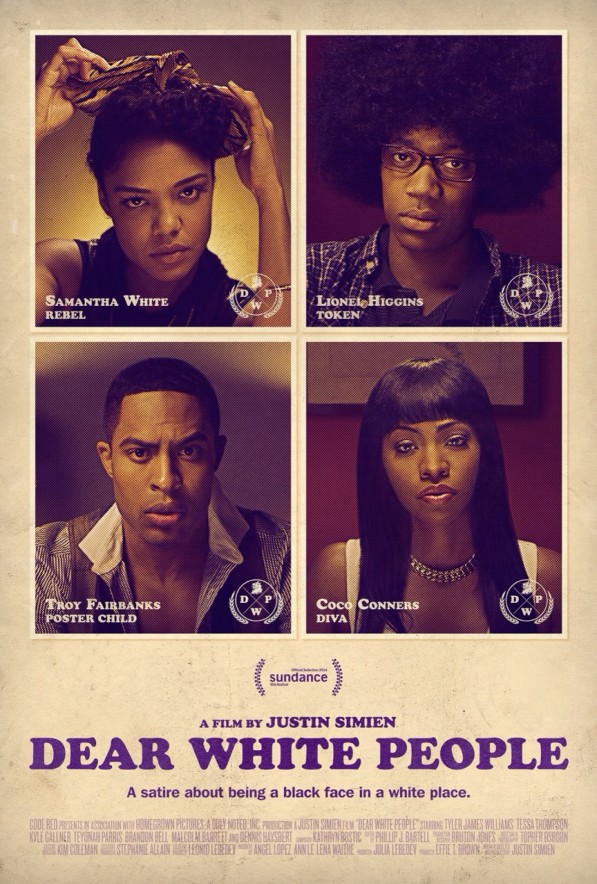 In an age where a vocal number of people believe racism died when Obama took office, or that the sins of the past are so old they have no more ramifications in today’s modern world, Dear White People is a blessed conversation-starter and a cogent argument to point to and enthusiastically say, “This!” Writer/director Justin Simien has put together a biting satire on modern race relations and the pressure to fit in where one can. This is more of a parable than a film, with some less than fully realized characters, but the commentary is rich and pointed enough that I was pinned to my seat. I wanted to hear what the characters would say next, and yes that’s also one of the film’s forgivable flaws, the fact that characters feel like they have speeches and political repartee rather than actual dialogue. In the fictional university of Winchester, every person is compromising who he or she is, pretending to be something they’re not, to fit an easily definable image. Everyone is using somebody for his or her own selfish gain. The storylines jostle around, relying on too many coincidences, but the actors are more than capable of drawing you in, especially the two leads played by Tessa Thompson (Selma, TV’s Copper) and Tyler James Williams (TV’s Everybody Hates Chris) as a gay journalist who doesn’t see himself fitting in with any of the established definitions of “black culture.” The commentary on reality TV and the media feels tacked on and undercooked, forgotten except that it lays a foundation to justify the film’s startling conclusion, a frat party where obnoxious white students dress up as grotesquely racist cartoons. Dear White People is a damning film that also plays it safe with its excoriating condemnations; it’s not as militantly ideological as some may fear or hope. This is no Bamboozled. And yet, it’s this middle approach that will make it more palatable for a mass audience. Oh, and did I mention it’s also funny? Whatever your color, take time to see this film.
Nate’s Grade: B+
Share this:

Seven Psychopaths (2012)
 Writer/director Martin McDonagh only has one movie to his name but the man has already accrued legendary status in some circles. The 2008 dark comedy In Bruges didn’t create much of a blip at the box-office, but its blend of absurdist comedy, dark drama, shocking violence, and languid contemplation found a rabid cult following. I have several friends who regard In Bruges as the best film of 2008 (WALL-E still reigns supreme for me but I quite enjoyed In Bruges).McDonuagh’s latest, Seven Psychopaths, reminds me of Barton Fink: both are about struggling writers, both are satires of the film industry, and both have sudden splashes of violence and a serial killer who pushes the protagonist to artistic completion. In other words, Seven Psychopaths is a fun film and a great time at the movies.
Marty (Colin Farrell) is experiencing some killer writer’s block. He’s stuck on his new screenplay titled “Seven Psychopaths.” His buddy Billy (Sam Rockwell) is eager to help out. The guys run afoul of another psychopath, mob boss Charlie (Woody Harrelson), due to Billy’s side business. He kidnaps rich people’s dogs and then his partner, Hans (Christopher Walken), returns them and collects a reward. Billy and Hans have kidnapped the wrong shih tzu, and now Charlie and his muscle is going to make them pay.
 The refreshing thing about the bloody, wickedly entertaining Seven Psychopaths is that it constantly surprises you. This is such a rarity with modern movies, particularly Hollywood movies that attract as notable a cast as this one. McDonagh is wonderfully adept at throwing narrative curveballs. There were a few surprises where I literally jumped in my seat. You constantly think you have the movie figured out, and then it goes down a different alley and becomes more interesting. One of the pleasures of having psychopathic lead characters is that they are impulsive and do not have to follow the normal purview of logical decision making. They might just call the bad guys and divulge where they are hiding. They can do anything at any moment, and part of that unpredictability is what makes the movie feel so electric, so creatively alive. I must stress that McDonagh surprises in ways that feel satisfying and yet believable given the world he’s concocted. Part of the fun in the first half is just figuring out who the seven psychopaths will be. It’s not like it’s some laconic chamber piece mystery but the psychopaths are an eclectic mix from the real to the fictional to real characters doubling as inspiration for fictional ones. I think in the end there may only be six psychopaths, unless McDonagh is counting himself amongst the numbers.
McDonagh also has a blast deconstructing the very kind of movie that he’s providing. Marty bemoans writing another rote psychopathic killer movie where the violence is fetishized and the bad guys are mythologized into idols. You think the film is headed in one direction, in the Guy Ritchie-style standoffs and shootouts, and then it takes a less traveled path, one where it criticizes these sorts of movies and ponders existential questions about the nature of self-expression and death. It began as a care-free movie about thugs and writers and transformed into a movie that manages to have something to say about life, philosophy, and the cyclical nature of vengeance. Two of our three main protagonists are pacifists and remain so to their imperilment. At one point, a character narrates how this story as a proper movie would end, and it covers all the nihilistic clichés of vengeance and epic body counts. But then Marty, and McDonagh as well, wants to turn away from the expected, from violence for the sake of violence, from the exploitation of stylized suffering. McDonagh doesn’t forget to entertain while he’s making you think in between those handfuls of popcorn. The female characters in the movie (Abbie Cornish, Olga Kurylenko) are generally wasted, in different senses, but McDonagh uses this as another charge against this type of film (a boy’s night out of carnage). This is an accessible movie that can be enjoyed on a whole other meta level. I loved the various gear changes. For me it took the pulpy action material and elevated it to another level of genius.
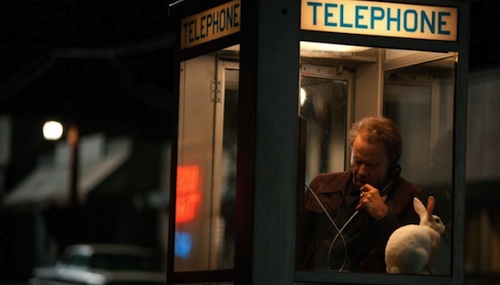 McDonagh still maintains his darkly sardonic streak of humor that made In Bruges such a riot. I was laughing throughout Seven Psychopaths; chortles, snorts, giggles, big belly laughs. With its heedless violence, obviously this will not be a film that runs on every person’s wavelength of funny. The very opening involves two mafia hitman debating whether shooting somebody in the eye takes actual precision or just dumb luck. It’s the sort of mundane conversation you’d see in a Quentin Tarantino movie, and also the precursor to something nasty and ironic. McDonagh’s sense of humor is similar to Ritchie or the Coen brothers, but the man establishes his own sense of wicked whimsy. The absurdist dialogue is always a hoot and can generate serious malice, especially when delivered by stern psychopaths. Rockwell (Moon) in particular is outstanding and delivers a virtuoso performance of the unhinged. The man just radiates energy. You’ll feel jacked up just watching him. I keep waiting for this underrated actor to break out with each star-making turn, and his comedic zing is played to perfection in Seven Psychopaths. In contrast, Walken (Hairspray) is rather reserved as he underplays his character, one of the saner men he’s played. It feels like the passing of the torch from the older generation of psychopath to the newer generation.
Being a colorful movie about colorful bad guys, and girls, you’d expect there to be some grade-A oddballs, and McDonagh does not disappoint. Some of the psychopaths in question have little bearing on the story plot-wise. There’s Zachariah played by the impeccable Tom Waits (The Imaginarium of Doctor Parnassus). He answers an ad that Billy set up for psychopaths to share their stories to Marty. His tale involves cross-country spree killing of serial killers, rabbit petting, and the love of his life, and partner in crime, leaving him. As far as plot, this little aside has little significance to the plot other than setting up a superb joke to end the movie with. But the character is so interesting, multidimensional, and played with equal parts aloofness and sincerity by Waits, that you can’t imagine the movie without him. Several of these psychopaths could have been the stars of their own movie, from the vigilante killing mob thugs to the tale of one father’s long path to vengeance. Even the fictional psychopath, the Vietnamese man (Long Nguyen) seeking vengeance against G.I.’s, could have enough weight to carry a feature film. The amazing part of the movie is that you don’t feel like any of these characters are shortchanged. McDonagh finds ways to emotionally ground his characters, allowing the audience to empathize amidst the bloodshed and loony characters. We care about Hans and his ailing wife; we care about the friendship between Marty and Billy. It’s real for these characters and so it feels real to us, despite the hyper-real flourishes of the movie.
If you’re a fan of In Bruges, or just dark comedies mixed with sudden violence, then you’ll probably find something to enjoy with Seven Psychopaths. You don’t have to be nuts but it helps. McDonagh has crafted another winner with sharp dialogue, a twisty plot full of surprises, incisive commentary on movies and movie expectations, as well as some sincere soul-searching and poignancy. This baby has it all, folks. Above all else, it’s just a blast of fun. the actors all seem to be having the times of their lives, notably Rockwell, and the morbid laughs and off-kilter thrills should cement another McDonaugh film for cult status. Seven Psychopaths is a palyful movie along the lines of Kiss Kiss Bang Bang and even Adaptation. It’s bursting with ideas and comments and jokes. when you leave the theater you almost want to get back in line and start the ride all over again.
Nate’s Grade: A-
Share this:

The Campaign (2012)
 Broad and oafish for political satire, The Campaign has some decent belly-laughs to it with the main point that our national political environment has become a parody of itself. It’s Will Ferrell doing his usual boorish boob stuff and then there’s Zach Galifianakis as an effete, weird, family values doofus. When it gets looney, The Campaign is at its best. I loved a town hall that descended into a mob chanting their willful opposition to Rainbow Land. I enjoyed that Ferrell’s punching of innocent creatures was turned into a running gag. Having a racist old man pay his Asian maid to talk like an old black mammy because he misses the good old times? That is downright inspired and I giggle just thinking about it. The campaign commercials were perfect, and who knew Dylan McDermott could be this funny as a political ninja? The problem is that the movie works best as a series of scenes but doesn’t add up to much more. Some of those scenes are hilarious, and others are just passable lowbrow entertainment. Then the movie tries to foster a happy ending, with the evil business tycoons (an obvious avatar of the Koch brothers) foiled. I do not believe that satire can have a happy ending. It undercuts the angry, sardonic message of the movie. It’s just not the right fit for the genre. Alas, The Campaign tries to insert some pathos into the mix and it feels false and far too tidy. As for summer comedies, the movie has a few killer jokes and an amiable presence, plus a very short running time so as not to wear out its welcome. Like most politicians argue… you could do worse.
Nate’s Grade: B-


 nathanzoebl
You must be logged in to post a comment.