Blog Archives
The Crow (2024)
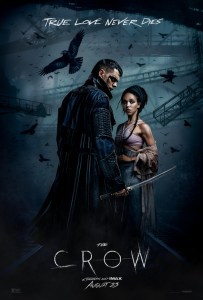 It’s been over twenty years since there’s been a movie based upon James O’Barr’s iconic graphic novel The Crow, and it’s been almost thirty years since there was a theatrically released movie. It’s a franchise that seems easy enough to make into a movie: a victim of violence comes back from the dead with some supernatural guidance to seek vengeance on those who killed them. Slather it in a moody atmosphere and some nice character beats, and you have yourself a born winner, like the 1994 movie that became a staple for a generation of disaffected teenagers. So why has it been so hard to bring this franchise back to life? There have been many starts and stops, with different directors and actors becoming attached and leaving over time, including Bradley Cooper, Luke Evans, Jason Momoah, and Alexander Skarsgard. Apparently, the producers finally found a story they felt could support a Crow reboot, or so they hoped. It crashed pretty hard at the box-office upon release. Despite its omnipresent placement on many worst of 2024 lists, I didn’t hate The Crow 2024. It has some serious problems but it also has some intriguing ideas that could have worked in a better version. It’s far less egregious than the 2005 Wicked Prayer where a literal plot point is stopping a climactic consummation between a villainous Tara Reid and David Boreanaz. It couldn’t be that bad, could it? It’s not, but it needed a lot of work.
Eric Draven (Bill Skarsgard) meets the love of his life, Shelly (FKA Twigs), where one meets all the hot and available singles these days – in drug rehab. She’s on the run from a criminal enterprise after she kept an incriminating video, so once she and Eric escape from their rehab center and try and make a go at a new life on the outside, the goons find them and kill them both. Except Eric’s spirit is sent to a purgatory netherworld and tge mysterious man Kronos offers to send him back to get vengeance. It seems this crime syndicate is led by Vincent Roeng (Danny Huston), who happens to be perpetuating his lifespan by offering fresh innocent souls to Hell. With the supernatural power of a guardian crow providing him invulnerability, Eric seeks to stop these bad people from dooming any other souls and maybe he can save Shelly’s soul in the process.
 Let’s tackle some of the more noteworthy mistakes of the reboot before I begin providing the compliments and where I think the movie actually has some worthy ideas. The biggest creative mistake is delaying the tragically fateful murder that spurs the entire movie until 45 minutes in. For contrast, the original movie has its Eric and Shelly getting killed through an opening montage. It doesn’t waste any time getting to the real premise of the material, the supernatural revenge tale. If you’re going to delay that key turn by so long, then that relationship better pop off the screen, or the chemistry has to be amazing, or the characters are so in depth and charming that with the considerably increased time we will feel a deep pain at the loss. If you’re putting more weight on the love story and their connection then you have to back it up, and this movie cannot. Therefore, it’s drawing out its necessary supernatural transformation to a point that there is only a measly hour left for all that superhuman stalking and avenging.
In the original, Eric (Brandon Lee) tracked down the gang responsible for his and his wife’s murder and each member got their own section where they established their character. Each section allowed us to learn more about the powers Eric now had at his disposal as well as how they might change him. The structure allows the bad guys to learn about their predicament and plan a defense. It allows the exciting elements from the premise to develop and adapt. With The Crow 2024, there’s one initial attack where Eric discovers he can bounce back from bullets, then there’s one ambush on a car carrying our bad guys, and finally there’s an extended assault at an opera that gruesomely kills every disposable henchman money can buy. That’s it. Eric isn’t picking them off one-by-one or even working up the food chain to the really bad guys. The bad guys don’t even seem that threatened, as Vincent is still going about his routines, albeit with more armored guards. It makes the whole Crow parts of The Crow feel small and underdeveloped. This is the first Crow movie where the titular bird, the symbolic partner from the underworld, doesn’t even connect in any meaningful way. It’s just a background “caw.”
 The entire inclusion of a villain who traffics innocent souls begs for further examination and probably a more formidable opponent. Vincent confesses he’s hundreds of years old and his agreement is with the Devil himself, so you would think this man would have learned some tricks in the ensuing hundreds of years. He has some vague super power where he can whisper suggestions into the ears of his victims and they’ll do what he commands, but does he use this power when he’s battling Eric or trying to flee from Eric? No. The demonstration of this super power basically resorts to being a more personal form of torture. Vincent doesn’t even seem worried about an undead warrior coming for him. Maybe that’s centuries of accrued over confidence, but if that’s the case, then make us love to hate this arrogant bastard. Also, if he’s had a successful transactional arrangement with the Devil for literal centuries, shouldn’t Ole Scratch have a thing or two to say about his soul supplier being brought to cosmic justice? If innocent souls are so much more delicious to the Prince of Darkness, there’s more to lose, and maybe that even brings the horned one into the fray, or he designates a promising underling or nepo baby demon, and then Eric has to fight the literal powers of Hell as well protecting his target, which raises the question how far is he willing to go to seek the vengeance that he craves.
That question is actually one of the more interesting points because this version of The Crow directly connects the hero’s strength to the power of love. This is where putting more emphasis and time with the love story could have worked… had the love story been compelling. I like that it’s not his hatred that gives him his powers but his love for Shelly. The movie also provides a more urgent reason for Eric to make these bad men feel his crow-y wrath: he can retrieve her from Hell if he thwarts Vincent and his soul-trafficking gang. Even though she’s dead, he can still save her, and that is meaningful and provides a better motivation for our protagonist. I don’t know why, and it seems like this Kronos guy could be far more active and helpful as an otherworldly guide, but it’s an effective goal to drive our hero to slay his targets. I liked that late in the movie, after he receives some upsetting news about Shelly, his conflicted feelings are detracting from his super powers. There’s a direct and personal sense of causality. His doubts in whether he loved Shelly are manifesting as physical vulnerability. This approach could have worked had the filmmakers given the audience an engaging love story. The movie also feels built around hiding the acting limitations of Twigs (Honeyboy). She tries but this performance feels so listless and lacking a spark or charisma that could convince why Eric would risk it all for her.
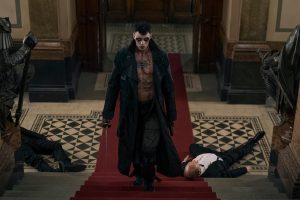 There’s one notable action sequence and it deserves some kudos for its morbid invention. When you have a hero that can take all the slings and arrows of outrageous fortune, it can lessen the stakes when it seems like they lack a credible weakness (call it the “Superman problem”). However, what I liked about the 2024 Crow is that even though he’s an undead warrior, that doesn’t mean Eric is somehow superior at fighting. He can take more punishment but that doesn’t mean he’s become an exemplary martial arts fighter, agile gymnast, or trained marksman. He’s still just a lanky guy, albeit one with washboard abs, the sculpted physique one naturally develops while recovering from substance abuse, of course. I enjoyed that this version of Eric was still struggling in his fights and could fall down and be bested. For his big assault scene at the opera house, he prioritizes a sword as his weapon of choice. At least that necessitates proximity to take out his opponents. The extended and very bloody fight scene is inventively gruesome; at one point, Eric uses the sword sticking out of his chest to lean forward and impale a henchman pinned on the floor. He even shoots through holes in his body to take out henchmen grappling him from behind. It’s the most thought put into utilizing the possibility of its premise. I don’t know why the rest of the movie couldn’t exhibit that same level of thought and creativity.
If you’re a fan of the comic or the 1994 movie, you’ll more than likely walk away from this newest Crow with some degree of disappointment. It wasn’t worthy of a placement on my own worst of the year list. Rather, it appears as a middling dark thriller that has some interesting creative choices that fail to pan out because the follow-through wasn’t as good as the idea. With a few more revisions, I think this basic approach could work, emphasizing the love story and devoting precious time to make it more impactful than just an innocent woman being avenged. However, by not fulfilling the possibility of these choices, instead we’re stuck with a lackluster romance eating up 45 minutes of screen time that could have been used for more satisfying supernatural action. By its sloppy end, I was just left shrugging. If this is what twenty-plus years of development wrought, maybe we needed a little longer for better results.
Nate’s Grade: C
Share this:

Ghost in the Shell (2017)
 When news broke that Hollywood was going to make a live-action version of the much-beloved 1995 anime Ghost in the Shell, fans were understandably nervous and excited. The original movie was a major hit that crossed over into the mainstream much like Akira, another movie Hollywood has long been trying to bring to life (run away, Jordan Peele!). People got extra worried when they heard that Scarlett Johansson was going to play the main character and cries of “whitewashing” were hurled across the chasm of the Interwebs. The “white washing” charge, which in context is possibly misapplied, might have been the smaller worry. The 2017 Ghost in the Shell remake is missing just about everything that made the original a standout. It’s a ghost, if you will, of its former, superior self.
In a cyberpunk future, Major (Scarlett Johansson) is an android fighter working for a special operations group tasked with taking down cyber criminals. The Major was injured in a terrorist attack and her brain was placed in a robotic shell (looking like ScarJo is one of the upgrade features). Every so often she gets hallucinations of events she cannot recall. After an encounter with the hacker criminal Kuze (Michael Pitt), a fellow android, she begins to doubt the true intentions of her superiors and what they have told her.
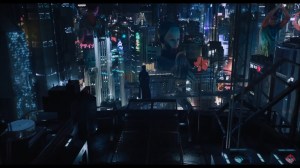 If you’re a fan of the original Ghost in the Shell, you might be depressed from what the live-action Hollywood adaptation does to its noteworthy source material. If you’ve never seen the anime, then you might find some scraps of entertainment to be had in what is essentially a drizzly cyberpunk product dumbed down for the largest mass audience that would be adrift with any minor hint of ambiguity. The 2017 Ghost in the Shell is not a good movie and it’s an even worse Ghost in the Shell movie. First off, we don’t need live-action versions of superior animated films just to have them, and this same statement goes for the equally underwhelming Beauty and the Beast remake. Just because a film lacks “real people” does not mean it is missing some crucial element, and I bristle at the notion that animated films are somehow inherently inferior or not “real movies.” With that being said, Ghost in the Shell will invariably disappoint fans of the original anime. There are visual signifiers and shots that it mimics with fealty; it’s just the overall story, characters, narrative complexity and mystery, and everything else that lacks that same level of fealty. Who cares if the main character is a shell of herself because, hey, they recreated this one shot fairly accurately, and that’s why we go to the movies, right?
Whereas the original was thoughtful and trusted the intelligence of an audience, the 2017 Ghost in the Shell resorts to explaining everything all the time, and even that it does badly. This is a muddled and frequently incoherent plotline, and the magnitude of its ineptitude is even higher considering how stupidly obvious the screenwriters make every twist and turn. This is the most obvious, simplistic conspiracy you could possible write. When Major wakes up in the opening scene and is being told what happened, the audience should already be alert with suspicion. This secret conspiracy goes in the most obvious direction (the good guys might not be the good guys after all) in a manner that should be transparently obvious to anyone except those unfortunate souls who have never seen another movie before in their lifetimes. So much of the plot is the untangling of this mystery, the Major’s real back-story, who the true villains are. To make it as obvious as possible and still devote so much time is not a good decision. The movie is constantly tagging characters to explain all exposition, leaving no subtleties to chance. The sadder part is that the plot is still muddled for long stretches even with all this handholding to straighten things out for the neediest.
 The world building and themes are kept at a distance, further denying the movie depth and substance. With any science fiction world, let alone one borrowed from other famous cinematic influences, it’s important for the viewer to get a sense of how the world operates. This can be done with small moments and larger moments, enough to properly contextualize this brave new world. With Ghost in the Shell, we’re told that mankind has become increasingly intertwined with machines and that cybernetic enhancements are en vogue. Except we never see this in the outside. We see loads of floating hologram advertisements, an overblown visual motif, but outside of our three main characters, this aspect that they felt merited inclusion in text before the movie gets underway is weirdly absent. It makes the characters feel less like they belong in an environment that makes sense. The larger themes of self-identity, the nature of humanity, and the questions over body autonomy are glossed over with the faintest of observations. Major is discovering her identity, but it leads her to what may be the most tired of conclusions. You would think having a robotic body would create some sort of existential reflection. You would be mistaken. Sure, Major feels unsure of herself and out of place, though why should she since we’re told man-robot hybrids are all the rage in this vague future landscape. I’m surprised someone didn’t just start explaining what the title meant at any given point.
The movie feels entirely surface-level and that’s where it has one redeeming value — its visual presentation. Director Rupert Sanders (Snow White and the Huntsman) is an above average visual stylist who benefits from strong production design and cinematography. At least the visual aesthetics could keep my attention, even if part of that attention was occupied in playing a compare-and-contrast game with certain scenes. The special effects are suitable and stylish enough, borrowing more than a few elements from the original. The action sequences are relatively muted, occurring in bursts but never really developing further. There’s an initial attack, then a response, and sometimes a chase, but that’s about it. The tech also doesn’t seem to factor in the combat. The strike team has the ability to communicate telepathically, but if they can do this why would they ever turn off this secret channel? It’s also lazy as it means we can just focus on filming scenes and record whatever dialogue we need later, as if the screenplay was incomplete.
 The 2017 Ghost in the Shell live-action version is a disappointing cyberpunk thriller that pays lip service to its source material, copying the movements but losing sense of the substance and soul. I’d advise people to merely watch the 1995 anime instead or the TV series that followed. It all feels like an expensive, slick, yet peculiarly ramshackle production that loses sight of the bigger picture by worrying at every turn whether a mainstream audience is going to need help understanding the most obvious. Johansson can be a great actress, which is important to remind yourself because she goes on kickass heroine autopilot with this movie. The action is short and inadequate, the visuals are impressive albeit derivative to the source material and its myriad influences, and the story has nuance, ambiguity, philosophy, reflection, and general substance replaced with a generic conspiracy structure that renders much uninteresting. The 2017 Ghost in the Shell doesn’t quite go to the insulting derisive lows of the Dragonball Z live-action remake, but it’s certainly not a good use of anyone’s time, and that includes you, the audience.
Nate’s Grade: C
Share this:

Snow White & the Huntsman (2012)
 Snow White & the Huntsman is meant to be a darker, splashier, more action-packed retelling of the classic story, and when compared with the earlier 2012 Snow White venture, Mirror, Mirror, it certainly merits all those descriptions. With Twilight star Kristen Stewart at the helm, this movie seems tailored for teens looking for some girl power. I have no problem with reworking fairy tales to suit our modern-day cultural interest, but just giving a person a shield and a sword does not instantly make them a warrior. And just plopping Snow White into a medieval war does not instantly make this a movie worth watching.
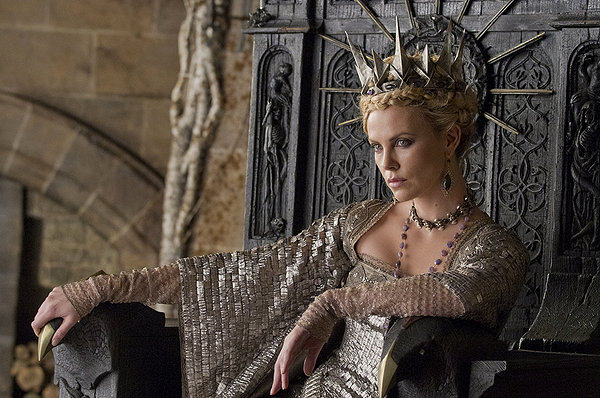
The wicked Queen Ravenna (Charlize Theron) killed the king and installed herself on the throne. She sucks the youth directly from ingénues to keep those good Theron looks of hers. She is the fairest of them all but she is warned that one day the king’s daughter, Snow White (Stewart), will overtake her in fairness. Snow’s been living in a prison cell for about ten years since her evil step-mom took power. She escapes her imprisonment and flees to the Dark Forrest beyond the castle grounds. The Queen’s powers will not carry over into the Dark Forrest (for whatever unexplained reason), so she hires the Huntsman (Chris Hemsworth) to retrieve Snow White. The Huntsman changes sides, allies himself with Snow, and some dwarves, and then everyone bands together to retake the kingdom under Snow’s stout leadership.
 Snow White & the Huntsman falls victim to that age-old screenwriting curse of failing to show us its work. I get so sick of movies, or any narrative really, that heaps praise upon some person and then never shows us any convincing evidence. If somebody is said to be a great poet, I want to hear one of his or her great poems. If somebody is said to be a great leader, then I want to see him or her inspire. To make up for the plot shortcomings, the screenplay reminds us at every moment of downtime how special Snow White is, how glorious she is, how different she is, how she is the only one to bring down the tyrannical rule of Ravenna. At no point did I believe any of this. Just because I have characters tell me, ad naseum, that someone is special doesn’t make it so. I need to see the evidence, and from what Snow White has to show, it is not that impressive. She’s somewhat resourceful, escaping from captivity, but she’s not exactly a figure of compelling strength, magnetism, or inspiration. She gives one “rally the troops” speech that gets the townspeople all fired up to go to war; it’s no St. Crispin’s Day speech, but even if we’re grading on a curve, it’s a pretty weak motivational speech. There’s no reason these people would line up behind this displaced damsel other than the fact that the plot requires them to do so. This Snow lady has, much like the infamous Bella Swan, the personality of a dead plant, and all the proclamations to the contrary will not change that fact. Snow White is just not an interesting of compelling person, period.
There are two reasons why Stewart is completely wrong for this part. First off, when we’re objectively talking about one who is “fairest of them all,” and Charlize Theron is in your movie, you’re going to lose every time. I’m not saying Stewart is wretched looking; quite the contrary. Debut director Rupert Sanders finds ways to film her that make her look lush and vibrant. Some would argue “fairest of them all” is not in references to physical beauty, which it has always been, but to the fact that Snow’s heart is so pure and good. If that’s the case, that’s just stupid. Then why even make it Snow White if the nemesis to the evil queen is simply somebody who is morally just? You could have had a commoner play the role and that would have brought about more interesting class conflicts. Secondly, Stewart is such a modern era actress, someone who has so effectively channeled the rhythms of a blasé generation of young people, that dropping her into a medieval time period is jarring. She doesn’t fit. Everything about her aloof acting style screams modern times. Maybe that’s why her speaking is kept to a minimum. She can ride on horseback, dress in Joan of Arc armor, but she’ll never strike anyone as a fitting Epic Heroine. I feel that her acting has blended with the sullen nature of Bella Swan to the point that it’s hard to separate the two. I’m not a Stewart hater at all. I actually think she can be quite a capable actress (see: Speak, Adventureland, the upcoming adaptation of Kerouac’s On the Road) when paired with the proper material. Snow White & the Huntsman is not the proper material.
Aside from casting errors, this dark fairy tale doesn’t find any time to settle down and develop anything that could approximate characterization. Case in point: all we know about Snow is that she is a princess, everyone tells us how beautiful she has always been, she runs away, and then leads a rebellion, then she become queen (don’t pester me about spoilers). What else do we know about her? She’s defined entirely by outside forces, especially the charitable words of others. Snow White is not a character but a symbol, the prophetic Chosen One. She’s really a placeholder for every lazy archetype needed for epic fantasy. Stewart cannot connect with the material, so she seems to wander around, mouth agape, almost like she’s stumbling drunk through the whole movie. It seems that Snow White & the Huntsman just provides us the familiar elements of the story (evil stepmother, huntsman, dwarves) and expects us to fill in the rest with our own wealth of knowledge over the famous fairy tale. The rote insertion of a long-lost childhood friend/eventual love interest (Sam Claffin) is made tolerable only by the fact that he does not eventually become a love interest. This Snow doesn’t need a man, and good for her.
Sanders’ background in commercials definitely shows in his superb visual palate. The man knows how to frame a beautiful shot, and the visual highpoint is Snow’s hallucinogenic shamble through the Dark Forrest. Without the narrative traction, though, the movie starts to resemble one very long, very excruciating perfume ad, particularly when Snow comes across a white horse just laying down in the surf. Some of Sanders’ “ain’t nature great” creations deeper into the forest reminded me very strongly of Miyazaki’s Princess Mononoke, especially with the godly stag. Despite its considerable faults, Snow White & the Huntsman is a great looking movie. Sanders’ crisp visuals are further enhanced by wonderfully theatrical costumes from multiple Oscar-winner Colleen Atwood (expect another award on that mantle come 2013). Queen Ravenna has more eye-catching outfits than Cher in her heyday. They seem to be made out of interesting organic elements, like a gown accented with diminutive bird skulls. She may be a ruthless tyrant, but man does that lady know how to dress. The fashion choices became so exotic and intriguing that it provided another reason for me to hope we’d get more time with the queen. The production design by Dominic Watkins (United 93) is fittingly medieval. At least there’s always something nice to look at with this monotonous bore.
I don’t really get the geography of this kingdom. By all accounts, it looks like one poorly guarded castle, one poor mud town, and a deep expanse of forest. The fact that it’s labeled as the Dark Forrest seems shortsighted, since it takes a few hours continued walking to come across all sorts of other civilizations, including our scarred matriarchal society. And then there are dwarves too. It all feels so listless, lacking any sort of connective tissue to help round out this magical world. After a while, it just becomes an assortment of cool stuff just put into a movie because it’s cool. The fact that none of these magical creatures or assorted villagers ever pop back again, except for our coronation in the resolution, means they were meaningless to this story other than being a rest stop.
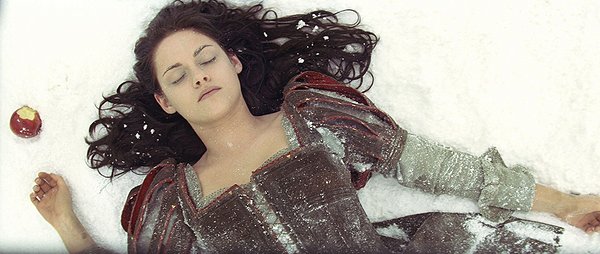 The screenplay is surprisingly rushed; rarely do we spend more than five minutes in any location. I was interested in a city of women with self-inflicted facial scars to protect themselves from Ravenna coming for them. Just as things start to get interesting, it’s like the movie gets antsy and has to keep moving, and we’re off again. It’s hard to work up any sort of emotional engagement for anyone when we just spend a few minutes with these characters. The brisk pacing also gives the impression that the characters really don’t matter in the end. If it weren’t for a scene where the Huntsman blatantly explains every feeling he has to a comatose Snow White, we’d know nothing about him. The Huntsman is grieving over the loss of his wife, and oh she just happens to have been killed by Ravenna’s creepy albino brother (Sam Spruell). The pigment-challenged dolt confesses this convenient bit of information at a strange time. Why confess to killing a man’s wife when you’re battling to the death? Confess afterwards. It’s another example of lame screenwriting and nascent characterization. Even the queen gets a bizarre throwaway bit of characterization. For whatever reason, we have a flashback to when she was a child and her mother forced her to drink the magic immortality elixir. Why did we see this? It’s too late to make her sympathetic. And yet, even this brief glimpse at Ravenna’s back-story makes her more interesting than our feckless Snow White.
The bleakly brilliant Young Adult renewed my fondness for Theron as an actress. For a while, she seems to really sink her teeth into the role, lapping up the villainy in a satisfyingly menacing manner. It’s at this lower level of burn, the quiet intensity, where Theron is most enjoyable. When the movie requires her to raise her voice is when things start to go bad. She shrieks in such a campy, over-the-top, weird overly enunciated style. Any hope of secretly enjoying this movie died with Theron’s stagy agitation. Hemsworth (The Avengers) adopts a thick Scottish brogue but does little else. At times I found that he looked remarkably like a cartoon tough guy; just something about his face lends itself to clean, burly definitions. The best actor in the movie is Bob Hoskins (Mrs. Henderson Presents) as a blind dwarf, and perhaps that sentence alone should say all that needs saying.
This film is more Lord of the Rings than fairy tale. It’s got some battles and some siege action to pacify the men folk, but this is obviously aimed at the ladies. It’s a feminist, Robin Hood-esque reworking of the Snow White tale, recasting the damsel as action heroine, and I’d have no problem with this revision if: 1) the film made her an actual character, 2) it had been played by anyone other than Kristen Stewart. It’s got all the familial elements but they have no context in this reworking; it lacks internal logic. If I did not have sufficient background knowledge about this tale, I’d be left wondering why any of this should make sense (apples are poisonous now?). At every turn, the movie has to tell us why things should matter rather than showing us. There’s no evidence onscreen why this Snow White lady deserves any fuss. Snow White & the Huntsman is a movie obsessed with appearance and precious little else. Snow White & the Huntsman is one boring, truculent, dreary chore of a movie that goes on far too long. Just because it’s darker doesn’t make it more mature or exciting. Fairest of them all, my ass.
Nate’s Grade: C


 nathanzoebl
You must be logged in to post a comment.