Blog Archives
People We Meet on Vacation (2026)
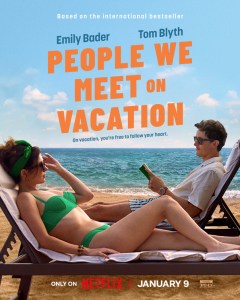 I’ll readily confess, I enjoy a good romantic comedy. I’ve even written a few rom-com Web series. Who doesn’t want to be captivated by charming characters, witty, banter,, and a yearning for a romantic coupling? The Sony-by-way-of-Netflix-acquisition People We Meet on Vacation is based on popular author Emily Henry’s 2021 breakthrough novel of the same name. I was expecting lots of fizz and frivolity, which can be had in doses, but I think the adaptation makes a few key mistakes that hampered my rom-com good time vibes. People We Meet on Vacation is not whom I was expecting, and maybe that’s me being too demanding, or maybe my travel companions made me think about switching seats.
I’ll dispense with the exact plot details further into this review, but the story in general is thus: Girl and Guy are friends but maybe also secretly like each other but also sometimes have other people, boyfriends.girlfriends, that they’re supposed to like more instead. Eventually, they grapple with these confusing feelings while also visiting global tourist destinations as “platonic vacation buddies.”
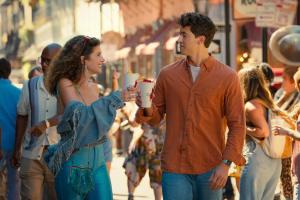 First, I didn’t buy the main characters as close friends. We’re introduced to them as they travel home to small-town Ohio together for the holidays from their freshmen year at Boston College, and they’re immediately bickering and annoying and can’t stand one another. The film is following a friends-to-lovers path, but I guess at first it decided to become an enemies-to-friends storyline. Even as the animosity thaws, I never really bought what compelled these characters to be best friends, so much so that they make a plan to make a trip every summer across the world together (the disposable income these newly indebted college grads have access to blows my mind; he’s a teacher!). The premise is workable, and as you would expect there are feelings that begin to get messy over the years of vacation, but I never felt the core friendship, so whether or not they ruined it with a burgeoning romance never felt like a credible threat for me. What is there to ruin exactly? We’re jumping from vacation to vacation summers apart, the gaps are meant to serve as storytelling glue; we’re meant to just assume, “Oh, they became good friends,” without seeing it for ourselves. I think this misstep could have been avoided simply by making the two of them less acrimonious in their earliest introduction. Make the friendship credible, and even better, make me like them together and see that they bring out other sides in one another that others fail to elicit.
This could also be a factor of my second misstep, namely the casting. I did not feel a flicker of chemistry between Emily Bader (My Lady Jane) and Tom Blythe (young sexy Snow in 2023 Hunger Games prequel), and I think it’s mostly the guy’s fault. I was getting 2011 Oscar hosting flashbacks. Here me out, dear reader. In 2011, Anne Hathaway and James Franco were hired as hosts to have the awards show appeal to a younger demographic (begin knowing laughter). Franco’s energy was so low that critics joked he might have been stoned the whole time. As a result, Hathaway had to overcompensate for his dearth of charisma and energy and was stuck doing far too much. In People We Meet on Vacation, our female lead, Poppy, is a chatterbox extrovert, and our male lead, Alex, is a sullen introverted homebody. Naturally, opposite personality dynamics can make for engaging relationships, but the work needs to be careful. I found Alex to be a bore. The most he gets pushed out of his comfort zone is by skinny dipping and, separately, pretending to be on a honeymoon for free drinks. That’s it. That’s Mr. Wild on Vacation (more on that next). Most of the time he’s just converting oxygen to carbon dioxide on screen. As a result, Bader has to go above and beyond, talking circles around her taciturn scene partner and bowling him over with personality, so much so that her outsized personality begins to flirt from charming to dangerously annoying. The misaligned character dynamics and characterization form a ceiling of my engagement.
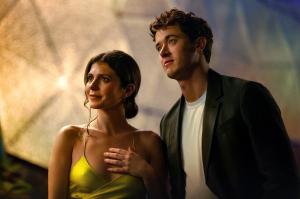 Thirdly, I was expecting more of a flirty freedom from the premise. Poppy works as a travel writer and fantasizes about being someone completely new on vacation. With that concept, you would assume the story would explore that dichotomy, the woman who uses these trips to reinvent herself, try on different versions of herself that can be dramatically different, adopting new personas and exploring aspects of herself that she didn’t feel comfortable embracing as regular ole Poppy. This seems like the most obvious direction to take the story with a title like People We Meet on Vacation (the new people we meet are… ourselves). Astonishingly, the movie is not that. There is only one instance of Poppy and Alex leaning into the freedom afforded to them through their vacations to pretend to be different people. While in New Orleans, they pretend to be newlyweds and this grants them free drinks, and this new persona gets Alex to dance provocatively; he even does The Worm. Does this different version of Alex lead to anything more? No. It would make sense with all their free drinks for this to be the moment that Alex and Poppy get even closer, imitating newlyweds, and cross a line of their friendship. Does this happen? No. That’s a whole other international vacation where the characters aren’t pretending to be other people. We can break this down on an even smaller level. Maybe the characters have events in these vacations that push them out of their comfort zones and challenge them in ways that change them as people, like discovering an aspect of themselves they hadn’t given thought to before. If you’re going to Tuscany, do something that’s unique to Tuscany. Do something that matters. It never feels like the travel is actually making an impact on these two characters. Rather, the vistas change but the focus is always on their will they-won’t they, which isn’t dependent on their setting. They could have just gone down the block for the same results. At 118 minutes long, some of these various vacations might have been consolidated if they are so inconsequential.
Lastly, when the movie isn’t separating itself from the pack by embracing its unique story elements, it falls back on the familiar cliches of the genre. I’m talking stuff that even a layman to rom-coms would even know, things like the big kiss in the rain, the big Act Three dash, usually out of an airport. It’s stuff like that, and cliches by themselves are not inherently bad but they have to feel authentic to the characters and stories. It might be a cliche to simply say that you need to make the cliches your own. If I genuinely cared about the characters, and felt their chemistry, then I wouldn’t be nitpicking and noticing the cliches as much. It just so happens that a shaky adaptation can make reliance on genre cliches more noticeable.
 Now, I know the majority of this review has been critical of People We Meet on Vacation, and that’s mostly because I think this movie could have been better from some pretty obvious missteps. The version of People We Meet on Vacation is… fine. It’s consistently cute and amusing and harmless, an afternoon movie that can pass the time well enough especially for those predisposed to romantic comedies. It’s a fairly good-looking movie with an impressive war-chest for music licenses, including Ms. Taylor Swift. My middling frustrations with the movie seem to be echoed by many of Henry’s fans, that whatever made this story special seems to have been emptied, replaced with cozy genre cliches. I liked the ending, cliches and all, because it felt fitting for those characters, their different dynamic, and felt it had been sufficiently set up to serve as a payoff. I wanted more moments like this, that felt unique to this story, to these characters, and actually made use of their specific settings. No other characters in this movie matter other than our leads, so it’s a shame that I didn’t feel particularly excited for their eventual coupling. I didn’t find their characters repellent or mean-spirited, just ordinary, lacking a distinct personality. They were blandly likeable but the kind of people you’d meet and forget easily, vacation or no. People We Meet on Vacation is an agreeable movie that had the possibility for more, and that’s what lingers longest for me.
Nate’s Grade: C+
Share this:

Regretting You (2025)
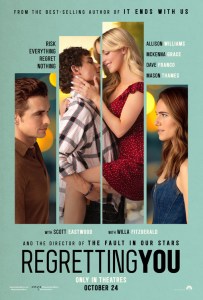 I do not care for Colleen Hoover as an author. She exploded thanks to social media and has, as of 2024, sold over 34 million books, primarily romantic dramas, primarily featuring wounded women trying to get back on their feet. She is a full-blown publishing phenomenon. Hoover has become so prolific and successful that she takes up an entire shelf. She’s already joined the ranks of your James Pattersons, Stephen Kings, Danielle Steels, the familiar names of authors that can be found in grocery checkout lanes. Her popularity is indisputable. Her quality is another matter, and that’s where I have trepidation with Hoover as a storyteller. Admittedly, I have never read any of her novels, so take all criticisms with a degree of incredulity. I’m making my judgement based entirely on the movie adaptations of her novels. Again, this might be an unfair guide considering if I did the same thing for, say, Stephen King, it would be easy to form a scathing opinion of the man’s literary work. 2024’s It Ends With Us made me deeply uncomfortable with its misplaced attempts to romanticize domestic violence. It wasn’t just misguided but it offered little insights into the mentality of abuse victims, instead slotting this disturbing story element into the awkward love triangle expected from the genre. It wasn’t good. Next, we have Regretting You, based upon Hoover’s 2019 novel of the same name. At this point, I’m wondering if I need to hold a regular spot in my annual worst of the year lists for the slew of Hoover adaptations to come.
In 2007, Morgan Grant (Allison Williams) and her friend Jonah Sullivan (Dave Franco) are clearly in love. I guess it’s too bad they’re seeing other people. Both are also dealing with pregnancies. Morgan marries Chris (Scott Eastwood) and has her baby, Clara. Jonah abandons his pregnant girlfriend, Jenny (Willa Fitzgerald) but comes back many years later to have another baby together (I guess Jenny terminated her earlier pregnancy but it’s never really dealt with). Cut to present-day, and teenage Clara (Mackenna Grace) is smitten with the charming film school aspiring Miller Adams (Mason Thames), a guy ripped out of a quirky rom-com. Then the big tragedy happens: Jenny and Chris die in a car accident, the same car, and it’s revealed the two were engaging in a longstanding affair. Morgan and Jonah must try and navigate these complex feelings of betrayal while also determining how much to tell Clara.
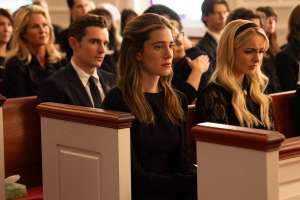 Just glancing through that brief plot synopsis, there are a LOT of elevated, dangerously soapy story elements packed into a two-hour movie, and that’s not including Clancy Brown as a cranky grandfather who Miller feels indebted to take care of as he’s scheduled to begin chemotherapy. There’s a lot going on here, and I’ll just state that there are two movies jostling for dominance that should have been split. The teen storyline does not fit next to the adult storyline. Every time it jumps from one to another, it was tonal whiplash and it became so much more dissonant. That’s because the teen storyline is awash in the burgeoning feelings of new love that we see in many YA tales and teen-centric rom-coms. It’s new and hopeful and very familiar for the teen drama genre. The adult storyline is awash in grief and betrayal, with both spouses trying to make sense of their pain and heartache and uncover what they can of what they didn’t know. One of these stories is bubbly and sunny and comedic, and one of these stories is tragic and searching and painful. They do not work in tandem, each taking away from the appeal of the other.
In particular, the adult drama deserved its own showcase to really explore the details of its complex feelings. Discovering after death that your spouse was not who you thought they were is so conflict-rich, especially that they were linked to another person experiencing that same shock and loss and confusion, it’s a recipe for real anguish and an unknown path of healing. Morgan and Jonah should never have known one another, let alone had an unrequited romance that hangs over them as adults. All this does is set up the obvious coupling, cruelly killing their spouses so these two can finally be together as destiny demands. It would have been far more intriguing for them to discover one another through this shared betrayal, but then again that might remind people of Random Hearts, but then again I doubt anyone recalls much about this 1999 movie that has an 18% rating on Rotten Tomatoes. This is where the real drama lies, but like much else of Regretting You, it’s unexplored and replaced with tropes and predictability. The exploration of grief and anger isn’t even given its proper due. Morgan primarily sits on her couch and drinks wine throughout the day. Jonah at one point rejects his new baby thinking he’s not the biological father. This conflict is, like many others, resolved so simply, merely having Morgan tell him to man up. These characters should be discovering unexpected aspects of themselves through this unique circumstance. These two characters should be striving to process their varied emotions but it’s all too easily distilled into a predictable payoff to their decades-in-the-making romantic matching. It’s reductive and boring.
 The YA-styled romance is also too familiar and underdeveloped as its adult drama. Miller (I hate that his first name is “Miller” – apologies to all first-name “Miller”s out there reading) is the kind of kid who loves movies but never seems to talk about what he loves about them or even make references to them. He wants to be a filmmaker but we don’t see his projects. That’s because Miller isn’t so much a character but being a dreamy ideal boyfriend, a sweetheart who is always concerned for Clara’s well-being and is so respectful of her boundaries and desire to wait to be intimate. He requests help moving a town limits sign a couple blocks every so many days with the intention of eventually having the ability to order from his favorite pizza place that said his home was out of their delivery zone. This is the kind of cute, whimsical activity we expect from the Manic Pixie Dream Girls of romantic comedies. If you think harder about this it actually becomes nonsensical. Why would the pizza shop change their earlier refusal because now there is a sign in front of Miller’s home that says it’s within city limits? It’s only a single sign. The house hasn’t physically moved, the distance is still the same, and the store’s GPS would still indicate as such (“But-but there’s a sign, and even though the sign is inaccurate, you should abide by it”). This is only a silly detail that I don’t mean to harp on but it’s indicative of the lackluster character writing. Because of this there’s really no genuine conflict between the two young lovers. He’s a dull dreamboat ideal.
Really, the only drama present with Clara is when she will discover the harsh truth about her father, and so you’re just waiting for this eventual Sword of Damocles to fall, to have her question why her mom would make this choice. In some regard it makes sense, to hide a painful truth from her daughter, to delay further having to process it herself, but it’s also something that cannot be contained forever. She’s going to find out eventually, and then she’s going to be additionally upset that her own mother withheld this news from her. It’s not like Morgan has complete ownership of this information. It likely would be common knowledge that they died together, in the same car, and it’s hard to believe rumors would not emerge, with classmates snickering behind her back through the school hallways or taunting her directly. It’s a shame that this looming hard truth is the only thing that Clara has going for her in this movie. Their relationship is generally conflict-free, or what conflicts there are are so easily resolvable. She’s young, in love, and her dreamy boyfriend easily ditches his girlfriend, the one obstacle to their union. This is because Clara is not her own character, not even a reflection of her mother; she is only a plot device to be plucked into tears.
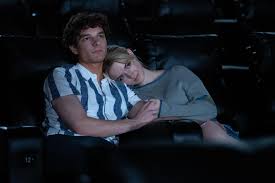 There are a few creative decisions that caused me deep confusion. Chief among them is the choice to have the same actors play their mid-to-late 30s selves as their high school selves. The opening high school graduation just establishes the four characters’ relationships, the obvious fact that Jonah and Morgan feel something for one another but oh well, and that there are unexpected pregnancies. From there the movie makes a sizable time jump but doesn’t make that clear this has happened. So we went from Morgan at a graduation party to Morgan chatting with Clara, and I thought she was a younger sister. Why would I have automatically assumed this is now the 16-year-old daughter that we had just confirmed was a zygote in the previous scene especially when Williams is made to look exactly the same over those 17 or so years? I don’t think the opening was even necessary. They could have established these character histories without a direct flashback where Jonah literally says that maybe they’re with the “wrong people” as he stares deeply into her eyes. This is also the kind of movie that has no faith in its audience, and yet we’re intended to catch the big time jump. Clara sees a movie at Miller’s theater, and he asks her why she’s crying at the conclusion of a Mission: Impossible sequel. She says it’s because her dad took her to a lot of movies. We get it. She associates the movies with her father who she dearly misses. But then the movie adds an additional line where she literally says, “That’s why I’m crying.” Thanks, movie. Ugh.
Something amusing to me that I doubt anyone else would really notice is the design of the movie theater. Miller works at an AMC movie theater so there are a few sequences, including the big rom-com rush to greet one another and have the big swooning kiss moment. Because the movie is a Paramount production, there are only posters present promoting other Paramount movies, 2025 releases like The Running Man and the latest Mission: Impossible, but then also classic movies like Sabrina and The Godfather. God forbid a movie theater advertise other titles from competing film studios. Perhaps this is just a very singularly loyal theater. Anyway, as a person who worked at a movie theater for over a decade, this little incongruous detail stuck with me. It’s the same thing with Miller’s bedroom. All of his posters are Paramount movies, which means he just loves that studio so much. Maybe that’s why he works at a movie theater that plays exclusively Paramount movies (the corporate synergy reminds me of young Christian Grey having a Chronicles of Riddick poster in his childhood bedroom brought to you by Universal). Perhaps somehow Miller doesn’t even know the existence of non-Paramount movies and is in for a world of shock when film school students talk about stuff like Godard and Cassavetes and Fincher and Tarantino, and he’ll just be so pitifully confused.
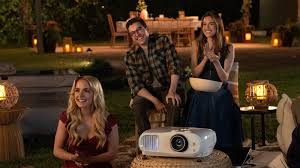 With a title like Regretting You, it allows for so many ready-made quips, especially when the finished movie isn’t quite up to snuff. The term “soap opera” is usually referenced as a pejorative, that a movie has so much heightened incidents to be distanced from the nuance of adult reality. However, just because something is soapy in scope doesn’t mean it cannot be fascinating and engrossing in execution. The films of Pedro Almadovar (All About My Mother, Talk to Her, Parallel Mothers) are often, on paper, a random assembly of soap opera histrionics, and yet the man’s creativity and empathy finds, almost without fail, ways to really open up and explore the details of his characters and their unique emotional states. The premise of Regretting You could have done this, but the desire to be appealing to teenagers with the YA-styled teen romance, sabotages the exploration of grief and betrayal into a clipped and frustratingly tidy little package. It’s not good storytelling, folks, but it had some potential to be. There are two more Colleen Hoover film adaptations slated for 2026, and most definitely more even after, so it’s best to prepare dear reader because It Ends With Us wasn’t actually predictive with its title. It only begins.
Nate’s Grade: C-
Share this:

Wicked: For Good (2025)

To paraphrase a famous debate line, I knew Wicked, Wicked was one of my top films of 2024, and you, Wicked: For Good, are no Wicked. Obviously that’s not completely true as For Good is the second half of the adaptation of the popular Broadway musical, of which only the first act compromised the prior movie released a year ago. The problem was that the first Wicked movie felt complete, and had there never been another second after, it would have served as a fitting and even moving portrait of the unknown back-story to the Wicked Witch of the West and the implied propaganda that would taint the perception of the citizens of Oz. The movie was two hours and forty minutes but it felt extremely well-paced and developed. It felt, more or less, complete, even though I know it was only adapting half the musical. In short, it did too good of a job, and now Wicked: For Good suffers as a sequel because what’s left to tell just isn’t as compelling or as emotionally or thematically coherent as its charming predecessor. Plus, all the banger songs were clearly in the first movie.
After the events of the first movie, Elphaba (Cynthia Erivio) has assumed the mantle of the Wicked Witch of the West and is sabotaging the Wizard of Oz’s (Jeff Goldblum) plans at expansion and animal abuse. Glinda (Ariana Grande) is the Wizard’s public ambassador and the “good witch” to inspire the masses, even though she doesn’t possess actual magical abilities. Glinda wishes dearly that Elphaba will change her mind and decide to work with her and the Wizard. However, Elphaba wants to expose corruption, and the Wizard is at the top of her list of the corrupt and powerful needing to be toppled for good.

For Good suffers from the adaptation struggles the 2024 Wicked film was able to avoid. The first movie was an effervescent treat built upon a poignant friendship and some killer songs given the full showstopper visual treatment. It was a vibrant adaptation, and while it expanded upon the stage show significantly, the extra time with the characters felt like breathing space, and it all contributed to what felt to me like an extremely well paced and well developed and arguably complete movie experience. Now the second act of a musical is almost always the shorter of the two, and For Good is about 30 minutes shorter than its predecessor. The filmmakers even added two new songs for Oscar eligibility and further padding, neither of which are winners (more on the songs later in the review). That sense of care is not present in For Good, as characters are frustratingly repeating beats they already worked through. Take for instance Glinda, who begins the first movie as an entitled popular girl used to getting her own way, and by the end of the movie, she’s grown to see the world differently and through her sisterly friendship with Elphaba, she has a more empathetic and grounded perspective. She has already changed for the better, and yet in For Good it feels like the movie kicks her character growth backwards. She has to again learn that maybe the Wizard and others are not the best people in charge just because they are. Wicked is a victim of its own success. The character development and arc was so well realized in the first movie that Glinda feels like she’s repeating lessons she’s already learned. I also don’t buy Elphaba being seriously tempted by the Wizard’s offer of collaboration after all she experienced and learned earlier. It’s irksome to have the characters seem curiously different from where we left them in 2024’s Wicked. There is also a character relationship revelation that I and many others had figured out FROM THE OPENING SCENE of the first movie. Behold, dear reader, For Good doesn’t even address this until the last twenty minutes of the movie and it does absolutely nothing with this revelation. I was flabbergasted.
The biggest time-waster and padding is when Wicked drags The Wizard of Oz characters and plot incidents awkwardly into its own universe. Granted, the entire enterprise is supposed to be the unknown back-story for the villain of The Wizard of Oz which gives it its identity. Except Dorothy and her lot are not essential at all to telling this story, as evident with the sense that the 2024 Wicked could feel complete. Dorothy and her motley crew of locals, some of whom are made up of previously established characters, are given the Rosencrantz and Gildenstern treatment, meaning they’re primarily kept off-screen and incidental. You don’t even see Dorothy’s face once. These characters feel annoyingly tacked-on and inconsequential to the story we’ve already spent three hours with. They’re knowing nods for the audience and they’re also making efforts to better pad out the running time. I don’t fully comprehend their importance in this new retelling. The treacherous Madame Morrible (Michelle Yeoh) sees the presence of Dorothy as an advantageous development, like she can use her as a Chosen One to thwart Elphaba. It’s never remotely explained why this makes sense. Why this person versus any other Oz citizen? Dorothy possesses special shoes but we’ve seen what can be accomplished with them. They’re not really some superpower or a weapon, more an item of personal attachment for Elphaba she would like returned. In this retelling, the entire inclusion of Dorothy and her friends is a means to an end for a public ruse. It might seem odd to say this Wizard of Oz back-story would have been better minus Dorothy but there it is.

Now it’s time to discuss the actual songs for this movie musical. The best known and most popular tunes were all in the first act and thus the first movie. The songs for For Good are a combination of middling ballads and continuation of the leitmotifs and themes of the previous one. There’s perhaps a bigger emotional current when characters bring back melodies and lyrics from the first movie to expand or contrast, like “I’m Not That Girl.” Did you want another song with Goldblum singing? The biggest number is “For Good” where Elphaba and Glinda face off and admit their shared sisterly love for one another, but again this was already established by the end of 2024’s Wicked. It’s more explicitly stated through song but the sentiment was evident to me already. Adding further disappointment, returning director John M. Chu (Into the Heights, Crazy Rich Asians) lacks the same thoughtful staging of the musical numbers in this edition. He is a filmmaker who innately knows how to adapt stage musicals into the medium of film, and he did so splendidly with 2024’s Wicked. With For Good, the staging lacks a real immersion and visual dynamism, often murky or overly saturated, like “No Good Deed” being performed almost entirely with intrusive sunsetting silhouettes dominating the screen. The less engaging songs, added with less engaging visual staging, make the movie feel longer and less jubilant. I don’t know if “For Good” has the intended emotional crescendo simply because this movie isn’t nearly as good.
As a personal note, the 2024 Wicked was the last movie I saw in theaters with my father while he was alive. We were supposed to see Gladiator II together as a family after Thanksgiving but he wasn’t feeling up to it, and then a little more than two weeks later he was unresponsive. I’m happy Wicked was such a pleasant and enjoyable experience for him, but as we left the theater, he asked me, “Wasn’t there supposed to be more?” We had seen the stage show when it toured through our city many years ago, and I remarked that there was going to be a whole second movie adapting the second act of the musical and it was going to be released in a year. He nodded and I felt the silent acknowledgement shared between us: he would not be around to see the conclusion, that it was a future unavailable to him. So it’s hard for me to not have some melancholy feelings with For Good, and I’ll admit maybe that’s influencing my critique.

Wicked: For Good is a frustrating, disappointing extension of what had been a sterling and magical original movie. It doesn’t outright ruin what came before it but confirms for me that 2024’s Wicked could stand on its own. The songs aren’t as good. The staging and visuals aren’t as good. The character development feels repeated and occasionally confounding. The plotting is stretched and unsatisfying. The inclusion of the more direct Wizard of Oz characters feels arbitrary and unnecessary. The actors are still charming and affecting and sing wonderfully, but they’re also unable to defy the gravity of the material they’re stuck with. If you’re a super fan of the source material, albeit the original story by L. Frank Baum, the 1939 Wizard of Oz movie, the Gregory Maguire book, the 2000s stage musical, or even the first movie, you will probably find enough to sing along to and walk away fairly happy. I loved the 2024 Wicked and was left mostly cold at the concluding half but I realize I very well may be a curmudgeonly minority here. My advice would be to consider the 2024 Wicked a complete movie and skip For Good.
Nate’s Grade: C+
Share this:

Sorry, Baby (2025)
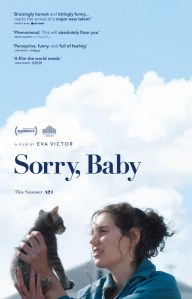
Sundance favorite Sorry, Baby takes several serious subjects and provides its own little bittersweet treatise through a character study of one woman navigating her complex feelings after being assaulted by her college professor. Written, directed, and starring Eva Victor, the movie feels like a combination of one of those small-town slice-of-life hangouts and something a little more arch and peculiar, but it still coasts on its vision and authorial voice. Victor’s portrait rings with honesty and empathy as her character, Agnes, wants to live a “normal life” but doesn’t quite understand what that might be. Her best friend is pregnant from a sperm donor, she’s adjusting to her workload as a literary professor at her alma mater (in an ironic twist, she occupies the same office as her former mentor and attacker), she’s flirting with the possibility of a romance with a nice neighbor (Lucas Hedges), and she just adopted a stray cat. The present, suffused in indecision and depression, is juxtaposed with flashbacks to her before, immediately after the assault, and the infuriating aftermath. This is where some of Victor’s darker sense of humor arises, like when Agnes is consoled by university officials who tell her there’s nothing they can do because her attacker has resigned but, hey, they’re also women, so, you know, they get it. Sorry, Baby walks a fine line between making you wince and making you want to laugh. It’s an impressive debut for Victor on many fronts, though I wish I felt like it amounted to something more emphatic or emblematic. It can feel more like a lot of self-contained scenes than a full movie, like Agnes going through jury selection before being excused when she has to confess her own history and her conflicted view of her attacker. I really enjoyed the concluding monologue Agnes gives to a newborn, explaining that the world she’s just entered will probably eventually hurt her but that there’s still good people and goodness that can be found. It’s heartfelt but in-character and feels completely on her own terms. Sorry, Baby is a little slow and a little closed-off, but it also deals with trauma and perseverance in a manner that doesn’t feel trite, condescending, or misery-prone.
Nate’s Grade: B
Share this:

Elizabethtown (2005) [Review Re-View]
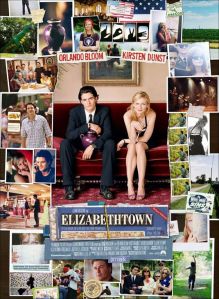 Originally released October 14, 2005:
Cameron Crowe is a filmmaker I generally admire. He makes highly enjoyable fables about love conquering all, grand romantic gestures, and finding your voice. His track record speaks for itself: Say Anything, Singles, Jerry Maguire, Almost Famous (I forgive him the slipshod remake of Vanilla Sky, though it did have great artistry and a bitchin’ soundtrack). Crowe is a writer that can zero in on character with the precision of a surgeon. He’s a man that can turn simple formula (boy meets girl) and spin mountains of gold. With these possibly unfair expectations, I saw Elizabethtown while visiting my fiancé in New Haven, Connecticut. We made a mad dash to the theater to be there on time, which involved me ordering tickets over my cell phone. I was eager to see what Crowe had in store but was vastly disappointed with what Elizabethtown had to teach me.
Drew Baylor (Orlando Bloom) opens the film by narrating the difference between a failure and a fiasco. Unfortunately for him, he’s in the corporate cross-hairs for the latter. Drew is responsible for designing a shoe whose recall will cost his company an astounding “billion with a B” dollars (some research of an earlier cut of the film says the shoe whistled while you ran). His boss (Alec Baldwin) takes Drew aside to allow him to comprehend the force of such a loss. Drew returns to his apartment fully prepared to engineer his own suicide machine, which naturally falls apart in a great comedic beat. Interrupting his plans to follow career suicide with personal suicide is a phone call from his sister (Judy Greer). Turns out Drew’s father has died on a trip visiting family in Elizabethtown, Kentucky. Drew is sent on a mission from his mother (Susan Sarandon) to retrieve his father and impart the family’s wishes. On the flight to Kentucky, Drew gets his brain picked by Claire (Kirsten Dunst), a cheery flight attendant. While Drew is surrounded by his extended family and their down homsey charm and eccentricities, he seeks out some form of release and calls Claire. They talk for hours upon hours and form a fast friendship and stand on the cusp of maybe something special.
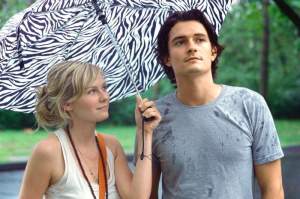 I think the most disappointing aspect of Elizabethtown for me is how it doesn’t have enough depth to it. Crowe definitely wears his heart on his sleeve but has never been clumsy about it. Elizabethtown wants to be folksy and cute and impart great lessons about love, life, and death. You can’t reach that plateau when you have characters walking around stating their inner feelings all the time, like Drew and Claire do. They might as well be wearing T-shirts that explain any intended subtext. Crowe squanders his film’s potential by stuffing too many storylines into one pot, thus leaving very little attachment to any character. Elizabethtown has some entertaining details, chiefly Chuck and Cindy’s drunk-on-love wedding, but the film as a whole feels too loose and disconnected to hit any emotional highs. If you want a better movie about self-reawakening, rent Garden State. If you want a better movie about dealing with loss, rent Moonlight Mile.
This is Bloom’s first test of acting that doesn’t involve a faux British accent and some kind of heavy weaponry. The results are not promising. Bloom is a pin-up come to life like a female version of Weird Science, a living mannequin, possibly an alien with great skin, but he isn’t a real compelling actor. He has about two emotions in his repertoire. His whiny American-ized accent seems to be playing a game of tag. He’s not a bad actor per se; he just gets the job done without leaving any sort of impression. To paraphrase Claire, he’s a “substitute leading man.”
Dunst is chirpy, kooky and cute-as-a-button but is better in small doses. Her accent is much more convincing than Bloom’s. Sarandon deserves pity for being involved in Elizabethtown‘s most improbable, cringe-worthy moment. At her husband’s wake, she turns her time of reflection into a talent show with a stand-up routine and then a horrifying tap dance. Apparently this gesture wins over the extended family who has hated her for decades. Greer (The Village) is utterly wasted in a role that approximates a cameo. Without a doubt, the funniest and most memorable performance is delivered by Baldwin, who perfectly mixes menace and amusement. He takes Drew on a tour of some of the consequences of the loss of a billion dollars, including the inevitable closing of his Wildlife Watchdog group. “We could have saved the planet,” Baldwin says in the most comically dry fashion. Baldwin nails the balance between discomfort and bewilderment.
 Elizabethtown wants to be another of Crowe’s smart, feel-good sentimental field trips, but it falls well short. I was dumbfounded to see how little the story progressed. It lays the groundwork for a menagerie of subplots and then, in a rush to finish, caps everyone off with some emotionally unearned payoff. To put it simply, Elizabethtown wants credit and refuses to show its work. The film is packed with characters and ideas before succumbing into an interminable travelogue of America in its closing act, but what cripples Crowe’s film about opening up to emotional growth is that the movie itself doesn’t showcase growth. We see the rough and tumble beginnings of everyone, we see the hugs-all-around end, but we don’t witness that most critical movement that takes the audience from Point A to Point B. The results are beguiling and quite frustrating. Take the subplot about Drew’s cousin, who can?t connect to his father either and wants to be friends to his own son, a shrill little terror, instead of a father. Like most of Elizabethtown‘s storylines, these subplots die of neglect until a half-hearted nod to wrap everything up. Father sees son perform and all is well. Son does little to discipline child but all is well. Elizabethtown is sadly awash in undeveloped storylines and characters and unjustified emotions, and when they’re unjustified we go from sentiment (warm and fuzzy) to schmaltz (eye-rolling and false). I truly thought Crowe would know better than this.
Crowe has always been the defacto master of marrying music to film. Does anyone ever remember people singing Elton John’s “Tiny Dancer” before its virtuoso appearance in 2000’s Almost Famous? Crowe has a nimble ear but his penchant for emotional catharsis set to song gets the better of him with Elizabethtown. There’s just way too many musical montages (10? 15?) covering the emotional ground caused by the script’s massive shortcomings. By the time a montage is followed by another montage, you may start growing an unhealthy ire for acoustic guitar. Because there are so many unproductive musical numbers and montages, especially when we hit the last formless act, Elizabethtown feels like Crowe is shooting the soundtrack instead of a story.
Elizabethtown is an under-cooked, unfocused travelogue set to music. Crowe intends his personal venture to belt one from the heart, but like most personal ventures the significance can rarely translate to a third party. It’s too personal a film to leave any lasting power, like a friend narrating his vacation slide show. Elizabethtown is gestating with plot lines that it can’t devote time to, even time to merely show the progression of relationships. The overload of musical montages makes the movie feels like the longest most somber music video ever. Bloom’s limited acting isn’t doing anyone any favors either. In the end, it all rings too phony and becomes too meandering to be entertaining. Elizabethtown is a journey the film won’t even let you ride along for. This movie isn’t an outright fiasco but given Crowe’s remarkable track record it can’t help but be anything but a failure.
Nate’s Grade: C
——————————————————
WRITER REFLECTIONS 20 YEARS LATER
I truly hope some day Cameron Crowe reads this. I owe him an apology.
I’ve always considered Elizabethtown the turning point in Crowe’s career, where things took an errant path that he’s been stuck on ever since, though there were certain warning signs with 2001’s Vanilla Sky. I was disappointed by this movie and the ensuing twenty years have only made me think back less favorably, since this was the juncture where Crowe’s hit-making streak of such tender, personal, and tremendously entertaining studio dramedies came to an end, where the Crowe projects afterwards felt more like Crowe was chasing after the idea of what makes a Cameron Crowe movie and losing his sense of self. I selected Elizabethtown for my 2025 re-watch mostly because I’ve never gone back to it in the proceeding two decades but also because it’s an important switch point in a popular artist’s career. What I wasn’t expecting when I re-watched the movie was to be so taken in by it considering my own personal circumstances.
 This is a movie about grief, about putting one foot in front of the other, about coming to terms with mistakes and regrets, and ultimately looking ahead. It’s still a little corny, and it’s still got some flaws, but in 2025, having lost my own father not even a year ago as of this writing, Elizabethtown hit me square in the chest. It made me a mess of emotions and I could plug myself into this bittersweet yet gentle nudge of a film. Even the amiable tone and gentle, searching nature worked for me, as it felt like it was expertly channeling the fog of grief upon experiencing significant loss. Your body is sort of operating on autopilot and you feel outside yourself, like you’re watching a documentary about your life. You feel numb and recognize you’re in pain but you never really want to talk about it yet you crave human connectivity, and even when people awkwardly ask the question, “Are you doing okay?”, while the answer is obvious to all parties, you’re still unexpressively grateful for someone else granting the kindness of reaching out. This movie encapsulates this drifting feeling of loss and shock better than any I can recall. And in Crowe’s universe, which is like a more filled-in and colorful version of our own, strangers will take a moment to recognize your emotional pain and give you a hug. It’s a universe that cares about you, where even a guy getting married in your same hotel wants to invite you to his reception. There are no cynics in a Cameron Crowe universe, or at least if there are, they will be converted by the end like a Charles Dickens tale. It is a universe supremely about feeling and connectivity, and that’s what Drew (Orlando Bloom) has to learn.
Drew is under personal and professional crises. He’s been cast off at his job as an athletic shoe designer because his big design was recalled to the cost of a billion dollars. He says he’s begun cataloging “last looks” by co-workers, when people think this will be the last time they see him again. It’s a nice detail that comes back but also gets us thinking about the later drama with life and death, how every one of us will give our last looks to the people in our lives, we just won’t have the same sense of clarity. Drew is traveling to Kentucky to retrieve his father’s body and return home to his immediate family. This is intended to be a pit stop, a brief sojourn with extended family he doesn’t really see often, a respite before he gets his life back together. These significant loops in life become a natural reflective point, and that’s where Drew is coming from. His life has seemingly bottomed out, and the movie functions as his therapy session to process his grief and his shattered self-image. His sister, an undervalued Judy Greer, keeps asking if he’s had his “big cry” yet, and reminds him that it’s coming. By the end of the movie, it’s not Drew having come full-circle and found his way out of his grief fog. The whole movie is about just setting him up to actually address the loss and feel the completeness of his sadness. Under this perspective, the movie’s many menial supporting characters that dot the plot feel like gentle well-wishers. I complained about them in 2005 but in 2025 it makes the entire world feel like therapy accessories.
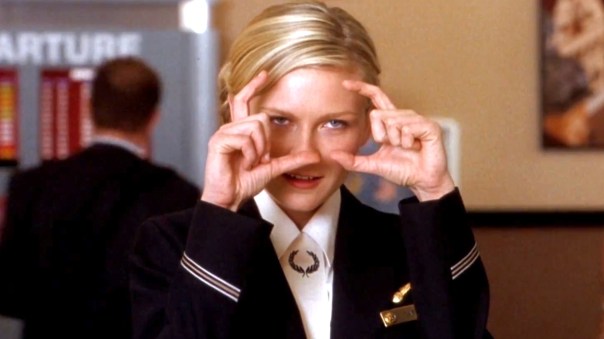
 Much of the movie is also pinned on the romance between Drew and quirky flight attendant Claire (Kirsten Dunst), and it was her performance that coined the term Manic Pixie Dream Girl (MPDG). She can definitely fit that mold but there’s a more subtle sadness to her that you see along the edges, like she’s putting so much effort into maintaining this front in public lest the mask drop and she has to deal properly with her own loneliness and disappointments. I think a more accurate depiction of the MPDG trope as a transparent sop to male fantasy is 2004’s Garden State with Natalie Portman’s spunky character. There is a sense that Claire’s off-screen long-distance bad boyfriend, Ben, is actually made up, an excuse to stop her from getting too close. She uses the term “tourist” to describe herself and Drew, and it’s fitting. The reality of her job makes her feel like she’s constantly in motion without setting down roots, prone to a thousand superficial human interactions that get washed from her memory as the day resets. It’s a transitory life and it can make a person feel outside of themself, questioning which version is their true self. The romantic dance between Claire and Drew really is all about both of them working up the nerve. It’s less a relationship that is fully formed and banging the drum of love; it’s far more an infatuation, where each side is circling over whether to risk the fun for something more. Under that guise, I’m more forgiving of the movie not exactly “showing its work” as I criticized in my original review. It’s not there because they aren’t there. This isn’t a relationship but a flirtation and friendship coalescing. It’s sweet and pleasant, like much of the movie, falling right in line with Crowe’s compassionate, humanist vibes.
It’s hard to exactly quantify but Elizabethtown is more of its moments and the gradual pull that is tugging Drew toward his ultimate destiny, which amounts to self-acceptance and fully processing his grief. I originally castigated Drew’s mother (Susan Sarandon) trying out new hobbies as a means of busying herself in the wake of her husband’s demise, including turning the wake into a standup comedy audition. The jokes themselves can be a little cringey or in poor taste for a funeral, but the overall effort is about this woman trying to define her life now that her partner, the old sturdy definition, has departed. I see something similar with my own mother in the wake of my father’s death. I’m not expecting my mother to start making boner jokes like Sarandon, but I see how this identity crisis can become all-too familiar. I love the absolute chaos of the actual wake that erupts into a literal flaming bird while the family band jams out to Lyndard Skynard’s “Free Bird,” and as that famous guitar solo hits the stratosphere, the movie’s built-up pressure all seems to come to a head, and the continued playing of the song despite all the chaos is its own defiant act of catharsis. It unbounded something inside me as it does for the characters. Then there’s the extended conclusion where Drew drives all over with his father’s ashes and with Claire’s travel guide, notes, and curated soundtrack as companion. It’s a lot, but it’s also the final stretch that gets Drew to finally accept his feelings, to finally feel the totality of loss but also that totality of love, and while his father may be gone, that does not eliminate the lessons and love and memories that live within him. Having this personal deeper dive happen on a father-son road trip actually feels rather fitting and poignant even.
 This is the third Cameron Crowe movie I’ve re-examined for my twenty-year re-reviews and it’s also my last. I never formally reviewed any of Crowe’s follow-up movies after 2005. I’ve already talked about how his career has taken a different track in other re-reviews, but I’ve come around on Elizabethtown, and that makes me wonder if maybe I’ll be more charitable to We Bought a Zoo or Aloha in time as well. In 2005, I found Elizabethtown to be a disappointing grab bag of Crowe’s touchy-feely familiarity, and now twenty years later, the movie really gelled for me. Perhaps I needed to go through a similar experience as the protagonist to be more open to its charms and artistic waves, or perhaps I’m getting nostalgic for Crowe’s kind of big-hearted romantic storytelling that hasn’t exactly been proliferating cinemas for some time. Perhaps I’ll watch Elizabethtown again years later and feel completely different, but I kind of doubt it, because now this movie is linked with my own reconciliation of grief after my father’s passing. It’s now been elevated from a disappointment from a revered filmmaker to something personal and passingly profound. It exemplified the foggy feelings and desire for connection for me post-funeral. As Claire says, “We are intrepid. We carry on.” Responding to failures and regrets should continue to resonate, and so Elizabethtown might actually become a personal movie I cherish over the years. It’s not the masterpiece that Almost Famous is, an all-timer, but hardly any other movies will rise to that level. I’ll accept Elizabethtown on its own terms in 2025, and those were the exact terms I needed to feel more whole.
So thank you Cameron Crowe. It took twenty years but I’ve come around. This isn’t a folly, a failure, and certainly no fiasco. It’s actually a sweet and moving tale about trying to find your direction in the face of grief and shame and just finding your way out the other side of the fog. For me, this whole movie was about the universe working through a million cheerful helpers to nudge Drew back onto his feet, including our love interest, which seems less damnable if the entire movie is achieving the same results. For a person looking through tragedy and asking why, it’s just enough encouragement, wisdom, and empathy to feel nourishing without feeling overwhelming, and it doesn’t feel phony at all to me in 2025.
Elizabethtown was what I needed. I love you dad and miss you every day.
Re-View Review: B+

Share this:

KPop Demon Hunters (2025)
 I’ve watched KPop Demon Hunters four times in the last week on Netflix, so I may be a bit partial to it. Sony Animation’s newest genre-bending stunner is an action musical with surprising heart to ground the supernatural multi-dimensional battles between the forces of good and evil. Our main characters are the three young women who form the Korean pop group Huntrix; they play sold-out arenas by day and slay demons by night, working toward sealing a barrier that will protect mankind from soul-sucking demons. They meet their match when the demons form their own boy band, the Saja Boys. Handsome, charming, and media savvy, the Saja Boys begin pushing Huntrix out of the top spot and stealing their fans and their souls. It’s a cute premise buoyed by spry and colorful animation with terrifically designed and pleasing action sequences. It also helps that every song is an absolute banger, with some exceptional melodies and anthemic choruses. It may prove impossible to resist the songs, making those dastardly yet dreamy demons all the more likeable. What works just as well is the character work put into establishing the friendship between Huntrix, whose lead singer, Rumi, is keeping a secret that she is herself part demon. She finds herself drawn to Jinu, the leader of the Saja Boys, who seems more complicated than simply being a remorseless creature. He has plenty of real remorse and feeling, as Rumi has plenty of self-repression and shame, and they find the other more complex and mysteriously appealing as they feel out a possible romance. There’s a lesson here about self-acceptance and being open with the ones you love, and it’s effectively developed to the point that, during the grand climax, with the crowd chanting in unison with our ladies, affirming that solidarity, you too might get a little misty of the eye. That’s the amazing part of a movie literally titled KPop Demon Hunters: it can have you bopping your head one minute and drying your eyes the next. The animation can get exaggerated into cartoon comic absurdity (eyes literally pouring popcorn another person gobbles down), but it’s the sincerity and messages about acceptance and tolerance that rise highest. Plus there’s that music. It’s all such a vibrant blast, and it’s got the infectious jams of the summer all in a tight yet playful and poignant 90 minutes.
Nate’s Grade: B+
Share this:

Heart Eyes (2025)/ Fear Street: Prom Queen (2025)
Slasher movies have been a popu;ar staple of horror, enough so to go through different phases of resurgence and ironic reinterpretation. They rose to prominence in the 1980s but are still wildly popular today, perhaps proving that there’s something timeless about a masked maniac chasing after dumb teenagers with his or her weapon of choice. Mix in heavy amounts of blood and gratuitous nudity, and it’s easy to see why this cost-effective entertainment strategy continues to endure. Two new 2025 slasher movies show the highs and middling lows of this horror genre known for its graphic kills and little else.
 Heart Eyes is ostensibly about a romance-hating masked killer who stalks happy couples on Valentine’s Day and gets all stabby with their insides. However, it’s really a pretty charming romantic comedy that just so happens to also have a healthy amount of gore. The clever screenplay follows many of the same tropes we come to expect from the rom-com genre but now with a twist. It’s Boy Meets Girl, as Jay (Mason Gooding) and Ally (Olivia Holt) are forced to work together to save a romantic ad campaign gone wrong. It’s Girl getting over the pain of her recent breakup with the emergence of a handsome new man in town. It’s Guy and Girl butting heads before creating sparks. And then they’re chased repeatedly by the masked killer. They yell, “We’re not even a couple,” but it makes no difference; their chemistry is just that undeniable. In that regard, this murder menace is actively driving these two would-be lovebirds together, forcing them to rely upon one another for survival, and revealing parts of themselves. If you cut out all the horror parts, it would still work as a romance, but it’s even more entertaining to watch how the two genres, both beholden to their formulas, mash so bloody well. The banter is witty, the silly are over-the-top gory, and this is a rare movie that could be loved by gorehounds and foolish romantics. It’s an elevation that is self-aware but not obnoxiously, more silly tongue-firmly-in-cheek. You can tell there is a love for both of these genres from the filmmakers. Heart Eyes is a fun and refreshing spin on the old.
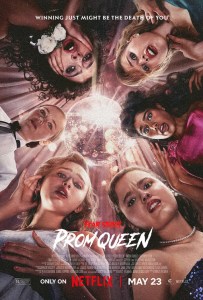 The newest Fear Street movie, based on the scream teen novels by R.L.Stein, is by far the weakest in the Netflix horror anthology series. Prom Queen is a pretty straightforward rehash of your 1980s high school movie staples of horny teens, bitchy popular girls, the less popular girl striving for Prom Queen and having to reconcile the changes she’s willing to make to be a winner, and a knife-wielding killer. Ah, the nostalgia. The issue is that there’s nothing separating this movie from, say, Prom Night, either the 1980 original or the PG-13 remake in 2008. The most thought put into this movie is the gruesome kills with some decent gore, but the whole movie doesn’t even play like a cartoon. It plays like a TV special you’ve watched before, something not just outdated but that’s been iterated upon iterations, a bland copy of a copy of a copy. The mystery of who might be the killer has some slight fun but the culprit should be easy enough to suss out when you take into account what actors have names that you remember. There’s nothing wrong with emphasizing the more gruesome exploitation elements of the genre, but the kills aren’t that memorable or clever, nor are the characters that interesting even as generic stock roles. I found myself confusing many of the multiple Prom Queen candidates (why are there so many pale brunettes?). The previous Fear Street movies released in 2022 had an interesting gimmick connecting them with the history of the town going back centuries to explain its crushed nature. Prom Queen just exists in this space without doing anything to connect to the larger Shadyside mythos and cross-generational storytelling. It feels so dreary and perfunctory and rather boring, shuffling along like a zombie wearing the husk of Fear Street. It’s just not fun. It’s not outlandish enough to be silly and too dumb to be self-aware. It’s mostly unimaginative cliches warmed over and unrelated to a far more stylish and ambitious horror series. This is a Prom Queen that deserves a bucket of blood and social ostracism instead of any accolades.
Nate’s Grades:
Heart Eyes: B+
Fear Street: Prom Queen: C-
Share this:

Anora (2024)
 The critically-anointed Anora is the indie of the year, winning top prize at the Cannes Film Festival, the first for an English-speaking movie in over a dozen years, and poised to be a major awards player down the stretch, some might even say front-runner for top prizes. It starts like a deconstruction of Pretty Woman, with Mikey Madison (Scream 5) playing Anora, a stripper who recognizes the advantageous possibilities flirting with a young rich Russian scion, Vanya. He wants her to be his girlfriend, and over a sex-fueled week, he’s so smitten that he wants to make Anora his wife. This whirlwind relationship hits the wall, however, once Vanya’s family inserts themself into his life, determined to annul the hasty marriage at all costs.
The movie becomes infinitely better at the hour mark when the exasperated extended Russian family comes into the picture. You worry they might be menacing, as they don’t want this stranger with access to the family wealth, but they’re far more bumbling, and Anora transforms into an unexpected comedy. It certainly wasn’t an authentic romance. Clearly Vanya was a meal ticket more than a three-dimensional romantic interest. The kid is an immature, annoying dolt, so we know Anora isn’t legitimately falling in love with him. The scenes of them building a “relationship” could have been cut in half because we already understood the nature of the two of them using one another. The last hour makes for a greatly entertaining turn of events as the unlikely and bickering posse searches New York City for a runaway Vanya. The movie feels propulsive and chaotic and blissfully alive. Ultimately, I don’t know what it all adds up to. Anora isn’t really a sharply drawn character, but none of the characters are particularly well developed. The pseudo-romantic fantasy of its premise, becoming a “princess” of luxury, isn’t really deconstructed with precision. It’s an unexpectedly funny ensemble comedy at its best, but I’m left indifferent to what other value I can take away. It’s well-acted and surprising, but it’s a vacuous side excursion made into a full movie that somehow has bewitched movie critics into seeing more. Perhaps they too have become overly smitten with Anora’s surface-level charms.
Nate’s Grade: B-
Share this:

Wicked: Part One (2024)

It’s shocking that it took this long for Wicked to make its way from the Broadway stage to the big screen. The musical, based upon Gregory Maguire’s novel, began in 2003 and while it may have lost out on the biggest Tony Awards that year to Avenue Q (it seems astonishing now but… you just had to be there in 2004, theater kids) the show has been a smash for over two decades, accruing over a billion dollars as the second highest-grossing stage show of all time. As show after show got its turn as a movie, I kept wondering what was taking so long with an obviously mass appealing show like Wicked. It’s the classic Hollywood desire of “same but different,” a reclamation project for none other than the Wicked Witch of the West, retelling her tale from her perspective. Well, Wicked’s time has eventually dawned, and the studio is going to feast upon its protracted wait. Taking a page from the YA adaptation trend that dominated the 2010s, they’ve split the show into two movies, separated by a full year, hoping to better capitalize on the phenomenon. I was wary about Part One being 150 minutes, the same length as the ENTIRE Wicked stage show, but having seen the finished product, and by “finished” I mean one half, I can safely say that Wicked is genuinely fabulous and deftly defies the gravity of expectations.
In the fantasy world of Oz, the green-skinned outcast Elphaba (Cynthia Erivo) is looked at with scorn, derision, and fear. She’s always been different and never fully accepted by her father who blames her for her mother’s death and her younger sister Nessarose (Marissa Bode) being stricken to a wheelchair. Nessa is going to study at Shiz University with all the other up-and-coming coeds of the land of Oz, including Glinda (Arianna Grande), a popular and frivolous preppie gal peppered in pink pastels. Glinda desperately wants to be taken seriously and become a witch, studying magic under the tutelage of the esteemed Madame Morrible (Michelle Yeoh). Instead, Morrible’s fascination falls upon Elphaba after she reveals her tremendous magical ability in a moment of extreme emotion. Now Elphaba is enrolled at the magic school and learning about the way of the world, and she’s stuck with Glinda as her roommate. The two women couldn’t be any more different but over the course of the movie, we’ll uncover how one became Glinda the Good and the other the Wicked Witch of the West.

At two-and-a-half hours long, again the length of both acts of the stage show, Wicked Part One only covers the events of the show’s first act, and yet it feels complete and satisfying and, even most surprising, extremely well paced. It’s hard for me to fathom what could have been lost to get the running time down as each scene adds something valuable to our better understanding of these characters and their progression and the discovery of the larger world. It’s a movie that feels constantly in motion, propelling forward with such winning ebullient energy that it becomes infectious. It’s also not afraid to slow things down, to allow moments to breathe, and to provide further characterization and shading that wasn’t included in the stage show. The adaptation brings the fireworks for the finale and raises the visual stakes and danger in a manner that feels exciting and compellingly cinematic. Considering the resplendent results, I feel I could argue that the movie is actually -here comes the heretical hyperbole, theater kids- an improvement over the stage musical. It makes me even more excited for a bolder, longer, potentially even more emotionally satisfying second part in November 2025.
One of my primary praises for 2021’s In the Heights was that director John M. Chu, who cut his teeth helming the Step Up movies, knows exactly how to adapt musicals to maximize the potential of the big screen. If you’re a fan of musicals, old and new, you’ll find yourself swept away with the scope and intricacy of these large fantasy worlds, the flourishes of costume and production design, as well as the creative choreography making fine use of spaces and the power of film editing. There’s a rousing dance sequence set in a library with shelves that rotate around the room, making the slippery choreography that much more immersive, impressive, and acrobatic. Even big crowd numbers are given the knowing framing and sense of scale to hit their full potential, from the opening rendition of Munchkinland celebrating the death of the Wicked Witch of the West complete with giant burning effigy that would make a Wickerman envious, to the introduction to the City of Oz where it appears every citizen has a jovial role to play in welcoming strangers to their enchanted capital city. Chu’s nimble camerawork allows us to really enjoy the staging and skills of the talent onscreen, bringing a beating sense of vitality we crave from musical theater writ large. Wicked is simply one of the best stage-to-screen adaptations in musical theater history and a joyous experience that allows the viewer sumptuous visuals.

At its core, the story of Wicked is about some pretty resonant themes like self-acceptance, bullying, the fear of what is different or misunderstood, and all of this is built upon an irresistible friendship between Glinda and Elphaba. The rivals-to-allies formula isn’t new but it is tremendously effective and satisfying, especially when both characters are as well drawn and deserving of our empathy as these two ladies. They’re each on a different meaningful character arc for us to chart their personal growth and disillusion with what they’ve been taught is The Way Things Are. One is starting from a disadvantaged position and gaining traction through an outward demonstration of power, and the other is beginning in a position of privilege and becoming humble and more considerate as she acknowledges the challenges of others in a manner that doesn’t have to reconfirm her enviable “goodness.” It just works, and both women are fantastic in their roles. I was on the verge of tears at several points and my heart felt as full as a balloon throughout because of the emotional engagement and heartwarming camaraderie between our two leading ladies. With all its razzle dazzle, Wicked is a story of feminine friendship first and foremost and emotionally rewarding to experience, with the soaring music as a bonus.
Let’s finally talk about the music, a key factor in the enjoyment of any musical, naturally. The music was written by Stephen Schwartz, the Oscar-winning composer for “Colors of the Wind” from Pocahontas as well as “Believe” from The Prince of Egypt. I found his Wicked numbers to range from good to astoundingly good, with catchy ear-worms like “Popular” to the anthemic power and sweep of “Defying Gravity.” The cheeky and toe-tapping “Dancing Through Life” is a showcase for Jonathan Bailey (Bridgerton) and benefits from the aforementioned creative library choreography. “I’m Not That Girl” is a heartbreaking ode to the girls who don’t think of themselves as enough, which is begging for a reappearance in Part Two. The only clunker is “A Sentimental Man” but that’s more the result of the deficiencies of Jeff Goldblum as a singer than the song. I await the reuse of themes and motifs that will make the music even more thematically rich in the eventual Part Two.

Count me as part of the skeptical throng when it was announced that Grande, who hasn’t acted in over ten years, was cast as Glinda. I’m here to say that she is uniformly great. The Glinda role is the more outwardly showy role and thus immediately more memorable. It’s the far more comedic role, in fact the main source of comedy in the show, and Grande has serious comedic chops. Naturally she excels with the singing and its purposeful miasmic bombast, but it’s the subtle comedic styling and the exaggerated physicality that impressed me the most, like a moment of her twirling on the floor as an added dramatic flourish. There’s one scene where she’s just marching up and down a hallway in full exuberance, kicking, dancing, and exploding with joy. I anticipated that Erivo (Bad Times at the El Royale) would be exceptional, and of course the Broadway vet is, as she brings such simmering life to Elphaba. There’s a strength in equal measure to her vulnerability, making the character fully felt. Erivo also delivers during the big moments, like the climax of the movie that can give you goosebumps in hiw it weaves together empowerment and defiance and self-acceptance. Together, the two women are an unbreakable pair of performers and heroes that we’ll want to see triumph over adversity.
After decades of belabored waiting, Wicked finally makes its journey from stage to screen and I must say it was worth every minute. The film, even at only one half, feels complete and richly realized, building upon the strong foundation of the stage show and its numerous winning elements and masterfully translating them to cinema, taking full advantage of the visual possibilities while also expanding upon the story and themes for further enrichment. While born in the early 2000s War on Terror Bush era of politics, Wicked’s themes of anti-immigrant fear-mongering as scapegoats still bears striking resonance today, as do the emerging warnings of fascism in Oz. If you’re a fan of The Wizard of Oz, musical theater, or even just grandiose spectacle that doesn’t dilute grandiose feelings, then step into Wicked and you too will feel like you’re floating on air.
Nate’s Grade: A
Share this:

Emilia Perez (2024)

Movie musicals can be sweeping, invigorating, and at their very best transporting, They mingle the high-flying fantasies and visual potential of the cinema, and we’ve gone through many waves of kinds of musicals. Today, we’re in an outlandish world of the outlandish musical, an experience in ironic air 210quotes, where stories that you never would have thought could be musicals would then dare to be different and attempt to be musicals. The much-anticipated Joker sequel, Folie a Deux, dares to be a challenging jukebox musical of old favorites. The French movie Emilia Perez tells the story of a cartel leader that undergoes a sex change and tries to do good with her second life. Both movies are deeply interesting messes as well as experiences I don’t think work as musicals.
In contrast, Netflix’s Emilia Perez is like an entire season of a telenovela streamlined into a two-hour-plus movie that manages to also, for better or worse, be a musical. It is filled with many outlandish and provocative elements you would never expect to be associated with singing and dancing, like a sex change surgery center. This movie mixes so many genres and tones that at one point it feels like you’re watching a crime thriller about Mexican cartels and their manipulation of those in power, and then the next moment it feels like you’re watching an absurd rendition of Mrs. Doubtfire, where a spouse has adopted a new identity and uses this to spend time with their kids they otherwise would not be able to do so. It’s a wild film-going experience; I can’t recall too many musicals that use street stabbings in syncopation with percussion. Because of its go-for-broke ambitions and veering tones, Emilia Perez is destined to be a cult movie, some that fall in love with its bizarre mishmash of elements, but most will probably be stupefied by the entire experience and questioning why, exactly, this was made into a musical.
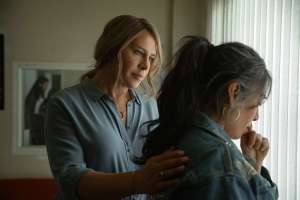
In Mexico City, Rita Castro (Zoe Saldana) is a savvy defense lawyer tired of living in the shadows of her buffoonish bosses that rely upon her writing prowess to win cases. Someone sees great potential with her, and it happens to be Manitas del Monte (Karla Sofia Gascon), the head of a dangerous cartel. He wants Rita to find the international means to finish the process of Manitas surgically becoming a woman. Under the gun, metaphorically and literally, Rita finds the doctors who will transform the dangerous him into a new her. Manitas then fakes their death, leaving his old life behind to start anew, including their children and wife, Jessi (Selena Gomez). Manitas becomes the titular Emila Perez, but rather retire in luxury, she wants to do good, and Emilia begins a non-profit organization that exhumes bodies, victims from the cartels, to provide closure for their widows and grieving families. Emilia then invites Jessi and their kids to come live in her estate, explaining she is a formerly unknown “aunt” to Manitas. Now Rita is trying to run Emilia’s organization, keeps Emilia from going too far in revealing her identity, and looking out for her own sake considering she’s one of the few that knows about a life before Emila Perez.
I know there will be hand-wringing and cultural tut-tut-ing about the movie’s implicit and explicit themes dealing with trans issues, exploring one woman’s exploration of self and securing the identity she’s always wanted through the lens of a lurid soap opera trading in stereotypes. It’s a lot of movie to digest, and while it feels entirely sincere in every one of its strange creative decisions, it’s also the kind of movie whose tone can invite snickers or derision, like the sex change clinic where a heavily bandaged chorus repeats words like, “vagioplastia” and “penoplastia.” It’s a movie with extreme feelings to go along with its extreme plot turns, but the whole movie feels like it’s trying to settle on a better calibrated wavelength of melodrama.

I think this could have been significantly improved by director/co-writer Jacques Audiard (Rust and Bone, A Prophet) had he embraced more of the movie’s outlandish reality breaking through. Too few of the musical numbers actually do something more than witness someone singing. The opening number, one of the best, involves Rita trying to compose a defense through the streets of Mexico City, while a crowd sweeps around her, often stopping to chime in as an impromptu chorus, sometimes setting up props for her use. It’s a great kickoff, the energy crackling, and I was looking forward to what the rest of the movie could offer. There’s only one other musical number that recreates this significant energy and engagement, a fundraising dinner for Emilia’s organization amongst the powerful members of society. While Emilia speaks at a podium, Rita struts around the floor, sashaying between the tables, and informing the audience about all the dirty deeds and skeletons of the assembled muckety-mucks. She’s literally manhandling the frozen participants, dancing atop their tables in defiance, and it’s a magnificent moment because of how it breaks from our reality to lean into the storytelling potential of musicals. These sequences work so well that it’s flabbergasting that Audiard has, essentially, settled for far less creatively for too much of his movie’s staging. The big Selena Gomez song is just her listlessly singing to the camera while shifting her weight while standing, like the laziest music video of her career. Why tease the audience with the crazy heights as a musical if you’re unwilling?
And now let’s tackle the music, which to my ears was too often rather underwhelming.It sounds like temp music that was intended to be replaced and never was. It’s lacking distinct personality, catchy or memorable melodies, anthems and themes, the things that make musicals enjoyable. The best songs also happen to be the best staged sequences, both involving Rita. These songs have a different vivacious energy by incorporating a hip-hop style of syncopation. “El Mar,” the song during the fundraising dinner, offers an infectious chorus adding extra percussive elements like people slamming fists down onto tables, listening to plates and glasses rattle. These are the moments that enliven a musical and convey its style and panache. Alas, too many of the songs lack that vitality, and can best be described as blandly competent and too readily forgettable.

It’s a shame because Saldana is giving her finest screen performance to date (to be fair, I never watched her Nina Simone biopic). The actress best known for being the strong warrior in sci-fi franchises like Avatar, Guardians of the Galaxy, and Star Trek plays an intriguing character with a rising fire of purpose and paranoia. Early on. Rita is ambitious but unhappy, practically dowdy in appearance, and she begins to come alive under her new role for Emilia. Saldana is electric as she sings and dances and slips effortlessly between Spanish and English, possibly to her first Oscar nomination. She’s the standout, which is slightly strange considering the role of Emilia Perez should be the breakout. Gascon, a trans actress, is quite good in such an outsized role, and gets to play her pre-transitioned identity as well under gobs of masculine makeup and tattoos. The fault isn’t with Gascon’s performance, the issue is that her character has such amazing potential but feels criminally underdeveloped. There is a world of issues of self-identity, culture, repression, shame, anger, jealousy, desire, to name but a few, that could be richly explored from the perspective of the leader of a deadly gang wanting to become a woman. The character is left too inscrutable for my tastes, leaving behind so much unobserved drama. As a result, even though the movie is literally named after her, Emilia Perez feels like a projection more than a character, and if that was indeed the point, then we needed more conflict about that friction.
Emilia Perez is a lot of things all at once; campy, ridiculous, sincere, crazy. It’s messy but it’s an admirably ambitious mess, one that even the faults can be the unexpected charms for someone else. I didn’t fall in love with this genre-bending experiment, although I found portions to be fascinating and others to be confounding. I don’t even think the musical aspects were finely integrated and explored, and so they feel like more of a gimmick, a splashy attempt to marry the high-art of musical theater with the perceived lower-art of grisly crime thrillers and melodrama. It earns marks for daring but the execution is haphazard and scattershot at best. There are moments that elevate the material, where the musical elements feel confidently integrated and supported with the dramatic sequence of events, providing an unexpected and rousing response. However, those moments are few and far between, and the absence only further cements what could have been. Emilia Perez might be your worst movie of the year, a grave miscalculation in tone and storytelling, or it might be a transporting and wild experience, one that can lock up multiple Academy Award combinations for its artistic bravura, a middle-aged Frenchman telling the story of trans empowerment through the guise of a Spanish-speaking musical framework. It sounds like so much and yet paradoxically I was left disappointed that it wasn’t more.
Nate’s Grade: C+


 nathanzoebl
You must be logged in to post a comment.