Blog Archives
American Hustle (2013)
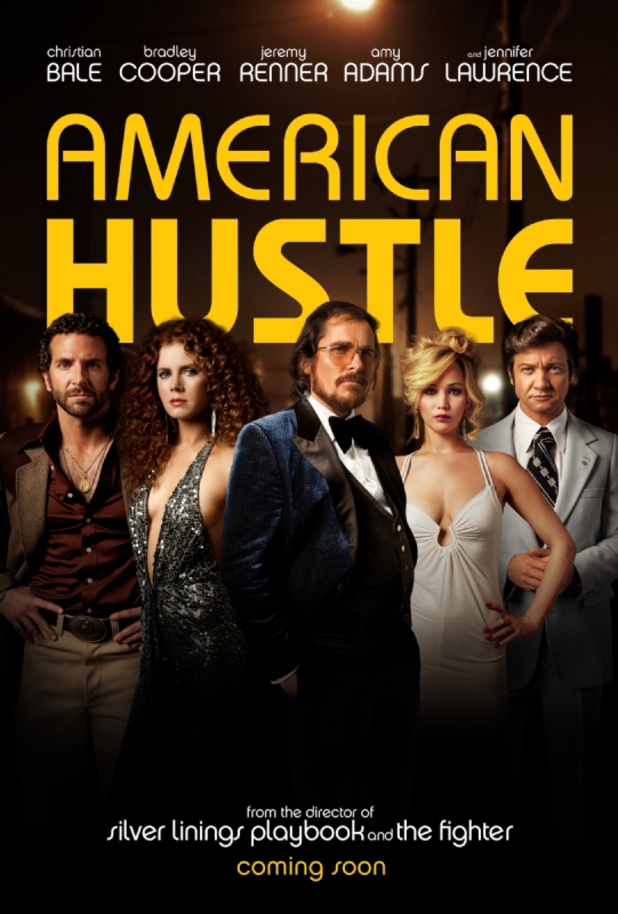 With two movies, writer/director David O. Russell has vaulted to the top of Hollywood. Previously known for his own difficult behavior, Russell’s last two films, The Fighter and Silver Linings Playbook, were both critical and commercial hits (Silver Linings made over $230 million worldwide). Both brought a bushel of Oscar nominations as well, making Russell one of the hottest directors for actors and producers. But a new side seems to have emerged over these last two movies, one less of Russell the domineering director and one of Russell the open collaborator. It feels like he’s just hitting his stride too. American Hustle is Russell’s latest and it’s sharply written, engrossing, lively, surprisingly comic, and readily entertaining.
In the late 1970s, the FBI set up an undercover sting to nail political corruption, ultimately nabbing several U.S. congressmen and one standing U.S. Senator. Richie DiMaso (Bradley Cooper) is an FBI agent who snags the perfect assistance. To catch a crook you have to think like a crook, and so Richie has strong-armed a pair of lucrative con artists into helping him. Irving Rosenfeld (Christian Bale) is a professional down to his elaborate hairpiece. He’s used to fleecing desperate people and selling phony artwork to the gullible, but he’s been too shy about making too much noise. If you stay small, you go unnoticed. Irving’s partner in crime is Sydney Prosser (Amy Adams), a kindred spirit who has reinvented her self. She and Irving are in love, and now they’re trapped by Richie to set up New Jersey mayor Carmine Polito (Jeremy Renner). The one unpredictable element is Irving’s young wife, Rosalyn (Jennifer Lawrence), who could blow up the whole operation with her careless and self-involved tantrums.
 Russell has once again given audiences one of the most entertaining films of the year, this time allowing them to participate vicariously in a con game, trying to anticipate the twists and turns and assessing everyone’s personal angle. This is a fictionalized rendition of the Abscam case (the opening text drolly says, “Some of this actually happened”) and it gives us a slew of meaty characters that have something going on. The central point elaborated in this pop crime caper is that we’re all cons, we’re all pretending, on some level, to be different people; Russell’s film just takes this notion to the extreme. Irving and Sydney are trying to escape lives of ordinary malaise, of being victims, of the more powerful dictating their options for them. With Sydney, she’s pretending to fall for Richie, but we don’t fully know which side she may choose to end up on. Richie is trying to also escape his dull life of desk jobs and lower middle-class dinners. His ambitions get hold of him, and with Irving’s aid, he catapults himself toward achieving those oversized dreams of his, never mind the ethical lapses in nabbing the bad guys. For Carmine, he’s so fiercely devoted to his community that you don’t doubt his loyalty for a second. He’s a man who sincerely wants to help others and is knowledgeable enough about how the world works, knowing he may have to grease some wheels to get the progress started. He is the most moral figure of the five main players and you may find yourself rooting for him to escape the snare closing in on him. Then there’s Rosalyn who has her hooks in Irving, looking for a sense of stability for her and her child. She’s a volatile cocktail of emotion but she knows what she needs to do to keep Irving anchored to her needs, though she’s also cognizant enough to latch onto a better provider if one materializes. Mixing and matching those characters, you have an eclectic mix of personalities clashing, many at odds with one another as far as goals, and the conflict stirred up is delicious.
Russell also attaches on his Martin Scorsese filter, delivering a freewheeling film about criminals from their wizened point of view, explaining the ins and outs of their hustle with flamboyance, style, and vigor. While the opening is a tad slow, including an opening minute watching Irving work his almost breathtaking comb over hairstyle, we plow right along into this world of hustlers and con men, learning tricks of their trade (hint: desperate people are desperate) and the tools to stay ahead of detection. We’re awash in multiple perspectives, each with voice over, a frenetic camera, and emboldened editing. It’s the Scorsese approach given studious application to the Abscam affair. It’s a great thing that Scorsese is the finest living filmmaker and devoting a two-hour-plus homage to the man’s most stylized crime pictures is a plus. Russell’s movie feels alive but also hungry, like many of his characters, restlessly searching for something. The scenes land but they don’t feel like they’re standing still; everything is propulsive in this movie. The small operation of Irving and Sydney is taken to the big leagues thanks to Richie’s ego, and the FBI’s desire for splashy headline busts, but wider exposure also exponentially multiplies the danger. Once the gambling scheme attracts the investment of the Mob, that’s when everyone has gone too far. I was clenching my fists in suspense toward the end, worried that our fictional cons may be too far in to survive.
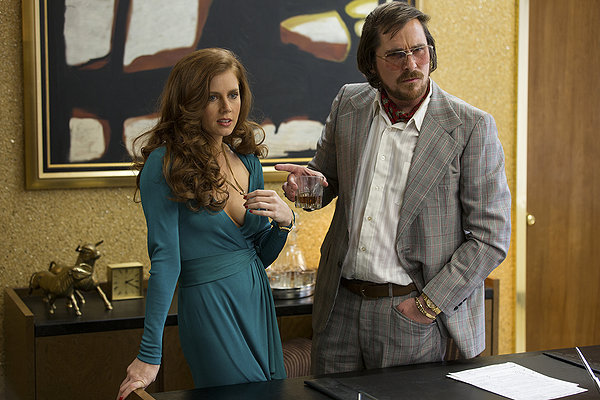 Russell hasn’t lost his magic touch with actors. His last two films have netted seven acting Oscar nominations and three wins, and the cast of American Hustle meets that same level of excellence. Perhaps even more so than The Fighter, the characters are given a very broadly comic brush, easily and routinely stepping into a carnival row of over-the-top behavior. It provides plenty of entertainment of the mishap and absurd variety, but there are also lone piercing moments of great empathy with these messy people. Mostly, the various actors all seem to be in a great syncopation, each one contributing where the other left off, building a great and compelling picture. When this ensemble is firing, it’s hard to beat. Special mention to comedian Louis C.K. (TV’s Louie) making the most of every scene he’s in as an FBI party pooper. His running gag involving a personal ice-fishing story is one of the film’s best jokes.
Bale (Out of the Furnace) is our guiding voice in this world, a flimflam man of the first order who fools maybe even himself. He’s got his own code of ethics and a heart behind that pot belly (another physical transformative performance by Bale the chameleon). He’s briskly entertaining but my only complaint is that, by being so suave and slick, he seems a tad too low-key at points given the risk involved. I know it’s part of the act, but from an audience standpoint, it makes him seem a tad too modulated. His equal is Renner (The Bourne Legacy) who is so earnest that it practically breaks your heart when he oversteps into morally murky territory.
However, Bale’s performance is compensated by the sheer craziness of the Silver Linings co-stars, Cooper and Lawrence. Cooper (The Place Beyond the Pines) is a lawman but also the film’s biggest antagonist. He gets drunk with power and the credit he’s receiving at the FBI. He’s also a deeply insecure man who is trying to style himself like Irving and Sydney as a posh reinvention. Cooper gives him a manic energy and taps back into his reservoir of eager-to-please egotism. Lawrence (Catching Fire) is the most unpredictable character. She acts on impulse, flirts with sabotage, and soaks up the spotlight she’s so rarely afforded. Lawrence is having the time of her life playing a loud, shrewish, vampy housewife who has a noticeable habit of starting house fires.
Beforehand, I would have thought that Lawrence and Adams should have swapped roles (still an interesting experiment), but having now seen the film, each suits them well. Adams (Man of Steel) is the saddest character of them all to me because she’s the bruised dreamer anxious to be anyone but who she really was. She relishes the con, more so than Irving, and ties much of her self-identity to her shyster skills.
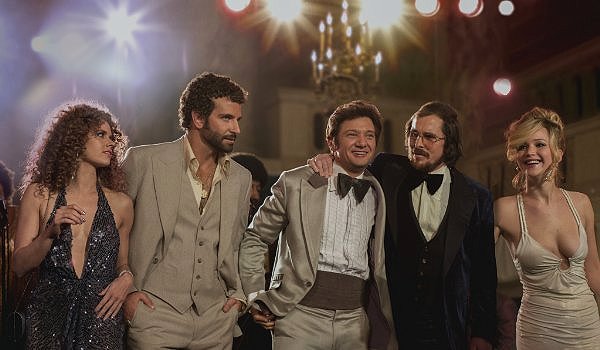 I’ve been dragging my feet writing my review and I’ve been trying to determine why, beyond, obviously, holiday-related sloth. American Hustle is readily a good movie that provides plenty of entertainment, meaty characters, and fun, but why do I keep feeling like it’s missing one undetermined ingredient? I can’t even articulate what at the moment but after having seen the film two times now, I feel like perhaps my emotional involvement was stunted. It’s a finely tuned script that delivers big performances for big-time actors, with a dandy ending that manages to dish out satisfying conclusions to its bevy of wheeler-dealers. But why didn’t I care more, why didn’t I feel more resonance by the time the end credits landed? The best theory I can surmise at this time is that we’re caught up in the con game, where everyone is pretending to be somebody else out of necessity or desire, that when it’s all over, we reflect on what a fun ride it’s been with fun characters but do we feel like we’ve gotten anywhere? I feel like I was more interested in the characters than attached to them. Again, American Hustle is still a sensationally entertaining movie and this paragraph is but a quibble, but it’s enough to thwart me from fully embracing and celebrating Russell’s film (confession: having already seen Scorsese’s brilliant Wolf of Wall Street, this could be coloring things for me with Russell’s Scorsese homage).
American Hustle is a fun ride with arresting performances, oodles of style, energy, and comedy. It’s a crime caper of the first order, easing you into this world and watching people play all sides. Even better, we’re given a volatile mix of personalities that clash, forming new and lasting conflicts, some of which could endanger the entire operation. These are interesting people to spend time with and so we can excuse the indulgences of a 140-minute movie that offers even more with this fantastic cast. Russell with a Scorsese filter is an even more improbably entertaining filmmaker. This is a crowd-pleasing sort of movie, much like Silver Linings, that doles out punchlines and payoffs with aplomb. It’s easy to go along for the ride, laugh uproariously, and then by the end sort of wonder whether it was all worth it. The emotional detachment to the characters may be a minor complaint for a film this largely satisfying, but since we’re spending so much time on our characters, I think I would have preferred something a tad more substantive by the end. It’s a great ride, with great characters and great humor, but there is a nagging concern that it may have been a better ride than a story. Regardless, American Hustle is an enjoyably alluring con that mines the absurdist fashions, personalities, and political overreach of the 1970s, painting a tale of criminals who may be the real heroes of the American dream.
Nate’s Grade: A-
Share this:

Stardust (2007)
 Director Matthew Vaughn is about as far away from his previous film as he can get. 2005’s Layer Cake is about as far from princesses and unicorns and pixie dust as can be expected. He turned down X-Men 3 to helm this adaptation of famed comic scribe Neil Gaiman’s graphic novel, Stardust. In style with one of the film’s characters, allow me to say to Vaughn, well played, sir.
In turn of the century England, Tristan (Charlie Cox) is trying to woo Victoria (Sienna Miller), the haughty town hottie in the small village of Wall. The town is called such because there is a winding stonewall that runs alongside that people are forbidden to cross. He’s given seven days to retrieve a fallen star for Victoria to prove his affection for her. In order to do so, he needs to venture beyond the wall, and beyond the wall is another world altogether. The fallen star is a result of an dying king (Peter O’Toole) hurling his enchanted necklace to the heavens. The jewelry collides with a star and causes it to crash to earth. But it’s no smoldering rock taking refuge in that crater; the star has actually taken the form of a slender, long-haired blonde woman named Yvaine (Claire Danes). I can only hope other astral bodies that crash into this planet will result in the same lucky outcome. But Tristan is not the only one after the fallen star. Three very old witches have taken notice and seek to cut out the star’s heart and consume it, which will grant them youth once again. The oldest witch (Michelle Pfeiffer) uses the last bit from the previous star to shed her wrinkles, but every time she uses a speck of magic she loses part of her much-desired youth. Also on the hunt for the star are the king’s ruthless sons, each trying to retrieve their father’s necklace and declare themselves the next king, and each trying to bump off their family competition.
 Stardust is very much in the fractured fairy tale style of The Princess Bride, complete with nudges and winks. The movie works more with the macabre, but this only seems to heighten its magical qualities. I loved the ongoing wisecrack-filled commentary from the increasing number of ghost princes (“Well played”), and I loved that each was stuck in limbo Beetlejuice-style looking as they did when they died. Stardust is stuffed with hocus pocus hokum but it never seems foolish; the movie takes great steps to present the rules and characters of its universe, and as all of the assorted creatures race toward a showdown, Stardust makes total sense. It doesn’t betray the logistic parameters it establishes for such a fantastical parallel world. It means that if you can accept the opening 20 minutes than you should be fine for the duration of Stardust. The film spins a familiar tale of hidden princesses, races against time, battles over a throne, and wicked witches, but it handles the material with aplomb. Stardust‘s biggest asset, beyond the cheeky sense of humor Vaughn instills, is that literally anything could happen next. Suddenly there’s a flying pirate ship out to harness lightning, or a goat-turned-inn keeper, and it’s all so exciting what could be waiting around the corner next.
Vaughn assembles a lot of pieces and then keeps the momentum strong. He makes judicious use of special effects and keeps the audience involved with all the story’s moving pieces. Vaughn has taken the usual fantasy quest framework and channeled the imagination and dry wit of Gaiman. Not every moment runs as smooth as possible, and some are downright awkward, but Stardust stokes a nice balance between high-flying adventure and doodle-on-your-notebook romanticized love. Vaughn’s steady control and vision allow the material to really shine because the audience can open themselves to the magic of the movie.
The acting ensemble brings a lot of enjoyment to this enchanted tale. Pfeiffer is a bewitching villain and relishes her bad girl role; she’s a devious delight but is even better when dealing with the physical comedy of her increasingly aging body. De Niro is immeasurably enjoyable thanks to a role that conflicts with audience expectations for the famous force of movie masculinity. I was howling with laughter watching him cross-dress, swish, and become a giant exaggerated gay stereotype. It might seem trite or offensive to some had it not been for the setup and the film’s tolerant philosophy. Danes delivers a performance that seems to teeter on camp. She ramps up her vocal inflections thanks to her hyper English accent and seems to perform like she’s in front of a mirror and testing out all of her facial muscles. A bit odd. Cox fits snugly into the Hollywood slot of bland male lead.
 The one main drawback for the film is that the screwball bickering between Tristan and Yvaine never really works. The constant arguing rarely comes across as funny and is too poorly veiled to camouflage the film’s romantic intentions. The romantic setup is pretty formulaic. The audience will know right away that Tristan is not meant for his conceited and high-maintenance village girl, and that true love is staring him in the face along the course of his most fantastic voyage. We know from the first second of their meeting that their combative relationship will in time transform into a romantic relationship. But that’s not to say Stardust isn’t a romantic fable. Its heart is simple but it is genuine. While its path is predestined and unshakable, this does not stop the audience from feeling something between Tristan and Yvaine and their eventual coupling. I may be going soft, or perhaps Stardust just won me over completely, but I found myself even slightly moved by the romantic climax.
Stardust is assembled, like most fairy tales, from the working parts of other tales. It’s rather predictable with its big moments (boy meets star girl, boy loses star girl, boy regains star girl), but oh what a fun time the film has from point to point. Stardust is vibrantly alive and cheerfully creative and watching the film almost becomes a dizzying experience. It has a sweet and gentle romance at heart, and its knowing whimsy and charms are hard to resist. You’ll never look at Robert De Niro the same way again.
Nate’s Grade: A-


 nathanzoebl
You must be logged in to post a comment.