Blog Archives
The Counselor (2013)
 The magnitude of author Cormac McCarthy’s involvement should not go understated in discussions over The Counselor. The acclaimed, Pulitzer Prize-winning author has written modern classics often exploring the darker side of humanity. McCarthy’s first screenplay must have seemed like a hot commodity for all of Hollywood. It attracted director Ridley Scott (Prometheus) and a score of A-list actors. The anticipation was that McCarthy could match the brilliance of his prose. The Counselor, a dreary and lackluster thriller in every conceivable way, proves that McCarthy still has an uphill learning curve when it comes to serviceable screenwriting.
The titular Counselor (Michael Fassbender) seems to have a nice life. He’s just proposed to his girlfriend, Laura (Penelope Cruz), and their sex life is vigorous. Then an old client, Reiner (Javier Bardem), invites the Counselor in on a shady drug transportation deal. The allure of easy money is too much for the Counselor to resist. Naturally, things do not go according to plan. A Mexican cartel intercepts the transport truck, bodies pile up, and the stakes get very personal for the Counselor.
 To be blunt, if McCarthy had submitted this script under a different name, it never would have made its way to the big screen. This is the award-winning author’s first screenplay and it shows. The pacing is shockingly slack, with the film rarely having any sense of life onscreen. I’m not a slave to the standard three-act structure of Hollywood screenwriting, but you need to produce something that keeps pushing the film forward, heading to a finale that seemed inevitable. McCarthy’s script is bogged down with pointless scene after pointless scene, little arias that get away from him, indulging his characters to monologue at length about philosophical nonsense. There are lengthy conversations about diamond shapes, the very nature of existence, and all sorts of Matrix Reloaded-like lingual excesses. These characters talk round and round; it feels like there aren’t even other characters in the room. Their lengthy, pretentious conversations also do little to push the narrative along or reveal essential bits of character. You get to hear one crime kingpin talk about his favorite poet. Great, but what can you say about him beyond the fact that he’s well read? Every character in this movie, from top to bottom, is a vapid space. Some of them have interesting aspects/quirks, like owning cheetahs or masturbating on car windshields, but not one character can be described as interesting. Beyond the terms “ruthless,” “pragmatic,” and “naïve,” I cannot even fathom a way to describe anyone in this film. They don’t even really work as plot devices because that would imply causality. When you couple the void of characterization with ponderous, rambling dialogue, then you’re already sabotaging your entertainment chances.
The plotting is muddled beyond all comprehension. I like to consider myself a pretty sharp moviegoer, but I was left scratching my head far too often. With a paucity of characterization and some idle pacing, I was confused as to what exactly was going on, sometimes even just at a literal level. What was this plan? How do all the players fit in? Why are the betrayers acting as they do? Who works for whom? Why should I be shocked about revealing the identity of a betrayer when it was made all too obvious in a previous scene (note: this is so directly transparent that it cannot count as foreshadowing)? Why does the appearance of a DVD signify finality after a previous phone conversation already did the same thing? And most of all why should I care? Watching this movie is like traveling through a long, impenetrable fog. There are serious, ongoing clarity issues, which make those florid digressions and overall pointless character nattering to be even more maddening. There are well known actors that come in just for single scenes, and then those scenes amount to little to nothing on the overall bearing of the plot. The Counselor doesn’t feel like a fully formed story; it feels like a collection of 30 scenes served as disposable sides for actors during preliminary auditions.
Even worse, for a film about drug deals gone badly, murder, and Cameron Diaz masturbating on a windshield, The Counselor is deathly boring. I grew restless before the halfway mark and just kept hoping beyond all evidence that the film was going to find some direction and pick up the intrigue. It did not. The film’s essential story structure, criminals getting in over their heads and paying a price, is a familiar one. This structure can work to marvelous results both grand (Goodfellas) and small (Things to Do in Denver When You’re Dead). Hell, even McCarthy’s own novel lead to the brilliant, Best Picture winner No Country For Old Men. Look at how the Coen brothers approach the macho, nihilistic material as opposed to its author. They created a sense of all-consuming dread with efficiency, elegance, and their characteristic macabre sense of humor. Watching The Counselor, it’s like the turgid knockoff of a McCarthy novel. When I got home I felt like I had to watch a Quentin Tarantino movie to wash the bad taste out of my mouth. Tarantino is given to long indulgences of elaborate dialogue as well, but he makes his characters interesting, with personalities that grab you and stand out, and listening to his dialogue is a pleasure unto itself.
McCarthy’s brand of ruthless killing has its peculiar intrigue, but again it only functions as morbidly fascinating little asides. The use of tripwire is given high priority by the killers onscreen, decapitating a speeding motorcyclist and cutting into the jugular with another character. It’s a strange, harrowing, and gruesome manner of death, but is it at all practical? I know I’m treading dangerous waters bringing the concept of reality to a murky film, but what killer decides to set up a wire approximately neck high across a road? It seems likely that another car would travel that same road in the hours of buildup. It also seems highly lucky to adjust the wire to the exact height to cut into the neck. I’m no professional killer but it seems like a lot of setup and guesswork. I have to imagine there are far easier ways to kill a speeding cyclist or a man walking along the street. Attention professional hit men of the movies: stop making your job more difficult than it has to be. Nobody is awarding you a ribbon for Most Inventive Kill.
 There are plenty of pretty faces in this movie, genuine acting talent, and to strand them with precious little characterization is an outrage. Fassbender (12 Years a Slave) is a little too sly to play naïve, and his later actions lack a necessary sense of desperation to sell his emotional plummet. Cruz (Pirates of the Caribbean: On Stranger Tides) is so effortlessly sensual but is put on the sidelines early and stuck in the damsel-in-distress box. Brad Pitt (World War Z) is the slick snake charmer we’ve seen plenty of times before. But the worst lot goes to Diaz (Bad Teacher). She’s supposed to be mysterious and threatening as Reiner’s sexually adventurous girlfriend but Diaz plays things so stone-faced serious. This poor woman is given the most unerotic, bizarre sex scene in modern history to enact, and I don’t know whether to applaud or pity her. Sure she gets to uncork some meaty monologues about Malkina’s trenchant world perspective, but this is the movie that will be defined by Diaz humping a windshield. At least the movie plays this out somewhat realistically, with Reiner more horrified than aroused. What did that outrageous scene add up to? Also, Penelope Cruz plays a “Laura” and Cameron Diaz a “Malkina”?
I know it’s a petty thing but it really irritated me how often people refer to Fassbender’s character as “Counselor.” The end credits do reveal this to be his name. If you thought it got irksome hearing Leonardo DiCaprio say “ole sport” after every other sentence in The Great Gatsby, then enjoy the repetitive declaration of Fassbender’s lone job title. “What do you think, Counselor? I don’t know, Counselor. I’d think things over, Counselor.” Do people really refer to somebody by this title as their name, and so frequently? He also doesn’t seem to be a competent lawyer at all.
The Counselor is such an unforgivably boring slog, languid and rudderless when it should be thrilling and complex. The characters are nonexistent, the plotting is muddled and confusing, the dialogue often laborious and roundabout, and the overall film is too meandering to properly engage an audience. Even talented people can produce bad movies, and here is further proof. With this cast, with this crew, there is no excuse for The Counselor to be overwhelmingly stilted and tedious. I cannot fathom what attracted the talent to this film beyond the cache of working on “Cormac McCarthy’s first screenplay.” If the results of The Counselor are any indication, I don’t know if we’ll be seeing too many McCarthy screenplays in the future, or at least McCarthy scripts that haven’t been vetted by other writers who better understand the contours of the medium. His florid arias and abstract, directionless plotting can be forgiven on the page but not on the screen. Scott doesn’t help matters, taking great care to film the luxury of the lifestyles on screen. What we’re left with is a tepid movie about bad people meeting bad ends, with little entry for an audience to care or even find entertainment. The art direction is given more care than the characters. In the weeks leading up to its release, The Counselor adopted a tagline from a quote by Laura: “Have you been bad?” It was turned into the Twitter hashtag promoting the film. Well, Counselor, you’ve been very bad.
Nate’s Grade: C-
Share this:

Prometheus (2012)
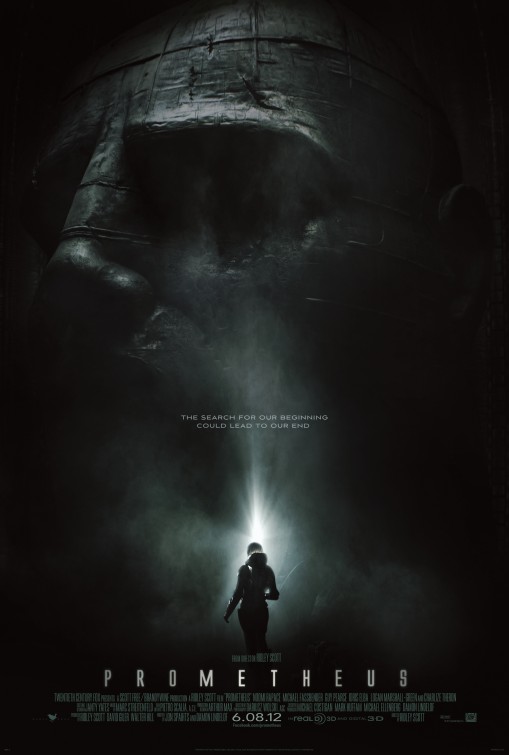 Ridley Scott has always wanted to go back to the Alien franchise that began with his 1979 sci-fi staple. There have been a lot of coy discussions over whether his big-budget sci-fi spectacle Prometheus is indeed an Alien prequel or not. Scott keeps hinting it has the DNA of the franchise but exists on its own. This movie has some Big Questions on its mind, like where did we come from, but the biggest question out there is whether it really is an Alien prequel or not. Well rest assured, that question will be sufficiently answered. Now if you have more than that, you will be left empty-handed with this gorgeous but ultimately confounding sci-fi thriller.
In 2089, a team of archeologists, lead by Elizabeth Shaw (Noomi Rapace), discover an ancient star map from 30,000 years in mankind’s past. This is not the only ancient illustration displaying the same constellation. Sure enough, in every ancient civilization across the globe, the same star pattern. Shaw believes it is an invitation and th key to finding the “engineers” who may be responsible for life on Earth. Four years later, the wealthy Peter Weyland (Guy Pearce) has funded a trip to that exact point in space, which harbors a moon that seems extraordinarily like Earth and capable of sustaining life. The ship is run by Meredith Vickers (Charlize Theron). who keeps asserting her company’s authority on this mission. Along for the ride is a cocksure pilot (Idris Elba), an android named David (Michael Fassbender), and Shaw’s own lover, a scientist in his own right, Charlie Halloway (Logan Marshall-Green). When the gang gets to that moon, they uncover large buried structure with some nasty surprises inside. Suffice to say, they should have stayed home.
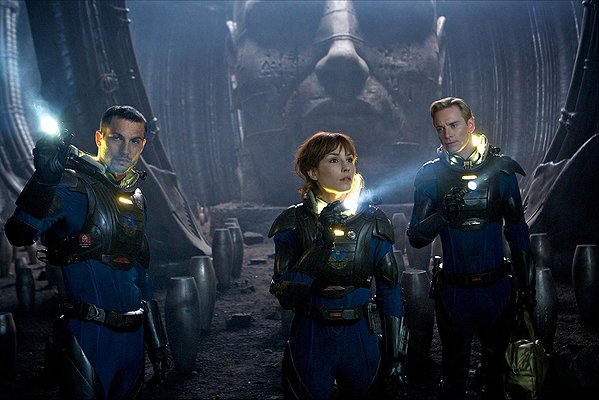 You can always count on Scott to deliver a visually extravagant picture, and Prometheus is packed with stunning, arresting visuals that fill up the big screen with lovely detail. The scale of some of these sets is massive, and your eyes just want to soak up every detail. The alien world is vast and eerie and you just want the characters to spend the rest of their lives exploring it (Scott shot in Iceland but it looks remarkably like a whole different world). The interior sets on the space ship are also sleek and cool. There’s a terrific sense of immersion in the movie. Scott has always done a great job at building worlds that feel completely lived-in, and Prometheus is another example of his talents. The special effects are astonishing but best when not dealing with the biological life forms. The giant spaceship is incredible; its inhabitants? Not so much. Apparently our DNA grandfathers looked like giant Michelin men (thankfully we take more after our mother’s side). Prometheus demands to be seen on the biggest screen possible.
Prometheus harkens back to the original Alien in its suspenseful “haunted house in space” setup. The movie has some terrifically taut moments and a great overwhelming sense of dread. The scientists let curiosity get the better of them, so they poke their heads in dark corners, touch unknown alien material, and get up close and personal with things better left unmolested. If slasher movies elicit a “Don’t go in there” audience response, then Prometheus certainly elicits a “Why are you touching that?” reaction. And yet, deep down, we want them to keep pushing further because like the best suspense films, we can’t stand the tension but we really want it to keep going. Probably the most memorable scene of them all involves Shaw performing her own hurried abdominal surgery to remove an alien from inside her. It’s creepy and caused me to wince repeatedly, but man is it fun and gruesome and a nice payoff to an earlier setup. The rest of the movie is pretty standard with its thrills, including the canon fodder supporting characters getting picked off unceremoniously, and the large-scale devastation climax. The movie delivers the goods when it comes to entertainment and suspense, though mostly in the first half. It’s almost like the movie is awed by the visuals as well, and then halfway in remembers, “Oh yeah, we got to do more than just poke at things,” and then it’s a rush to the end with a cascade of conflicts that don’t seem properly developed.
The film lays out a very essential question about the origins of mankind and plays around with theological concepts but it only plays in the shallow end of the philosophical pool. The screenplay by Jon Spaihts (The Darkest Hour) and Damon Lindelof (co-creator of TV’s Lost) deals with the conflicting origin stories via religion and observable science but never goes into specifics. “Religion” is always symbolized as a cross necklace that Shaw wears and her falling back point upon what she “chooses to believe.” The discovery that our alien forefathers have a similar appearance would be a huge revelation, except the movie spoils it with a clumsy prologue that shows us right off the bat what the “engineers” look like. Prometheus actually posits an Intelligent Design argument for human existence, albeit one the Raelians have been promoting for years, the idea that intelligent life outside our galaxy seeded Earth. Yet the one scientists on the crew, the one who objects to 300 years of evolutionary evidence, remains mum on the matter. I suppose the filmmakers didn’t want their monsters-in-space movie to be bogged down with that much pithy philosophy, but I would have appreciated some meatier conversations other than, “Should we touch this?” It’s not nearly as thought provoking or as compelling as it thinks it is.
As I sit here and I write this, the plot becomes a wispy memory of strong set pieces and eerie mood, but I cannot connect the story. It makes little sense and by the end of its 124 minutes we’re left with hardly any more answers than we started with (some spoilers to follow). Our genetic “engineers,” as they call them, remain pretty nebulous. I suppose one could argue that it would be impossible to fully understand an alien race’s habits and purposes without resorting to pandering, but that strikes me as a cop out (I’m reminded of Spielberg’s similar approach in Kingdom of the Crystal Skull, where the characters that wanted to know were punished for their intellectual curiosity by alien forces). Why did these super aliens create life on Earth and leave maps to a planet that was little more than a weapons depot? Why would these superior beings create life hundreds of thousands of years ago and then leave clues 35,000 years ago that would lead to the destruction of their little experiment? The motivation seems rather hazy. It’s not like the aliens created life on all these planets and waited to be contacted so that they knew their little biological Easy Bake oven was done and then they could reclaim a new planet. It’s not some imperialist empire or colonization scheme; it appears to just be wanton destruction. That seems like a waste of effort. Did these aliens keep checking back, see our ancestors hunting and gathering and go, “Oh my Space Deity, I can’t believe we created life on this planet? We were so wasted. Well, just wait until they conquer space travel and then we’ll kill them with a weird biological weapon.” If your desire is to destroy life, why even have a waiting period? If these “engineers” wanted to destroy Earth why not do it when there was far less clean up? Is there some kind of parent-child relationship I’m just not getting here?
 Fassbender (X-Men: First Class) makes the biggest impression as the fastidious android, David. He’s by far the most interesting character and he’s not even human. It doesn’t take long to figure out that David has his own agenda, and Fassbender plays the character with this eerie passive-aggressive arrogance. You get the sensation that he looks down on his human clientele, but you don’t know what lengths he will go. “How far will you go to get your answers?” he asks before doing something very not nice. He makes statements like, “Who doesn’t want to kill their parents?” and there’s an icy placidity to him; he’s just off enough to be menacing and unsettling without going overboard. Fassbender is excellent.
The rest of the cast cannot be at fault for failing to measure up to Fassbender (is that a Shame joke I stumbled upon?). Rapace (Sherlock Holmes: A Game of Shadows) is given top billing and does an admirable job of being a kickass heroine, which we already knew she was fully capable of in the Swedish Girl with the Dragon Tattoo trilogy. She even has a Ripley-esque haircut, which I doubt is a coincidence. Theron (Snow White & the Huntsman) gets to once again practice her ice queen routine, but I wish she had more to do than occasionally glower and bark orders. Her character’s secret background should be obvious to anyone well versed in the film economy of characters. Elba (TV’s superior Luther) tries to stick it out with some twangy Texas accent but can’t make his way through. His natural British accent pokes through routinely. Then there’s Guy Pearce (Lockout) as the wealthy benefactor who bankrolled the whole project. Apparently he was hired to film viral videos as himself, because in the movie he’s like a 100-year-old man in some pretty poor makeup (he resembles old Biff in Back to the Future: Part 2). Why hire an actor of Pearce’s caliber if you’re just going to hide him under a veil of old-age makeup? The actors do what they can but the film doesn’t give them much to work with. They’re stock roles and absent development. You don’t notice for a long while because you’re so caught up in the exploration and the gorgeous visuals, but when the end comes you realize that you hardly knew these people.
After all the pre-release coyness about whether this belonged in the Alien universe, Prometheus seems to be a victim of its own sky-high hype. The movie is moody and dark and intriguing and visually magnificent, but the plot does not hang together at all. The central mystery of the origins of mankind is given a face to start with, but that’s about it. The confusing story tries to mask its plot holes but eventually they just overtake the movie. It’s an entertaining movie in the moment but Prometheus pretty much evaporates as soon as you leave the theater and start thinking, “Hey wait a minute, that didn’t make any sense.” Why are mankind’s “engineers” a regretful bunch of jerks? Scott’s visuals are impressive, the film has a killer mood that’s hard to shake, but the plot is pretty shaky and reliant on supposedly smart people making pretty dumb decisions (why yes, I’ll try and touch the alien snake monster thing). That’s fine for basic thrills but it doesn’t elevate the movie into something headier, meatier, and more satisfying, like the original Alien. Prometheus was never going to meet the unattainably high expectations of fans stoked by tremendous trailers and the promise of Scott’s triumphant return to sci-fi, but much like the characters in the film, I was glad to go on this journey but wished I had more to take home with me.
Nate’s Grade: B
Share this:

Robin Hood (2010)
 So what happens when you make a Robin Hood movie that doesn’t have any Robin Hood? What’s the point of revisiting the legend when you don’t even bother incorporating the elements that made it legendary to begin with? It’s not like they sacrificed familiarity for historical accuracy. Director Ridley Scott’s film spends more time setting up the various pieces of a Robin Hood tale; it’s a prequel at best. This is mostly a historical drama about the English faring off French invasions (the opening text also identifies the setting as the wrong century). The film still manages to be relatively entertaining. The production design and cinematography are top-notch, the acting is robust, Russell Crowe makes a good, if aged, Hood, and the action sequences are thrilling and visually striking. The problem is that there are few action sequences and way too much yakking about foreign policy and Medieval politics and debt. I don’t think people were clamoring for a big-budget Robin Hood revival that explores in depth the financial consequences of an overextended military on the English treasury. This is just not an appealing origin story. The movie resorts to having Hood pose as Maid Marion’s (Cate Blanchett) husband, and it’s as eye-rollingly contrived as any sitcom setup. Originally, the film was designed so that Crowe would play both Hood and the villainous Sheriff of Nottingham (barely seen in the movie). While that is a terrible and senseless idea, at least it would have made the film worth watching from morbid curiosity. Robin Hood isn’t a bad film, but it barely ranks as a Hood outing, and it’s steps behind the delightfully cheesy Kevin Costner version.
Nate’s Grade: B-
Share this:

Black Hawk Down (2001)
 In the fall of 1993 Somalia was a nation being torn by civil war with feuding warlords and slowly being crippled by rampant hunger. The UN intervened to try feeding the starving nation but warlords like Mohamed Farrah Aidid cut off many of its shipments of food. The United States had plans to capture two top lieutenants of Aidid’s in the capital of Mogadishu. Over 100 Delta units and Army Rangers were sent into the heart of the Mogadishu market to execute the operation.
Things didn’t go well from the start as casualties began to pile up and first one, then two Black Hawk helicopters were shot down from ground fire. Medical vans and Humvees were continually blocked access to help the stranded soldiers by civilian roadblocks consisting of smoldering debris. It wasn’t supposed to take longer than 45 minutes. It ended up lasting over 15 hours. In the end 18 American lives were lost, over 70 were wounded, and over a 1000 Somalian lives were lost. What’s truly amazing is the courage the men displayed, and the fact that being surrounded by a sea of armed Somalians that more lives weren’t lost.
 Black Hawk Down is essentially a two-hour action sequence. The emphasis of the film is on the stark recreation of the Somalia skirmish and it is indeed an achievement in grueling realism. You truly feel like you have been thrown into the middle of this firefight. With all the gunfire and chaos it leaves little time for getting to know characters. This is probably why they have names written on their helmets so the audience can attempt some semblance of who’s who.
The film is by no means for the faint of heart. Saving Private Ryan had some intense violence, but it was mainly condensed for the opening and closing 20 minutes. Black Hawk Down, on the other hand, is two straight hours of non-stop blood and gore. The violence and the intense realism are not gratuitous but indicative of the horror these men faced. If you can’t stomach a soldier plunging his entire forearm into the chest cavity of another to cut off a bullet wound – stay at home and read a good book.
 Ridley Scott is on an ultra-violent hot streak after directing big name Hollywood tokens like Hannibal and Gladiator. His handling of Black Hawk Down is masterful, just for the simple fact of keeping the audience free from confusion. Throughout the duration we know who is where, where they want to go, and the general geography of the hot spot. The staging of the entire battle is beautifully filmed and the recreation of the Mogadishu market place is amazing in its fine detail. Some criticism has been projected at the film for portraying the Somalians as basically black people with guns. This is entirely true, but one must remember that the film is told from the American point of view.
The acting, as expected in a war film, takes a back seat to the heroic histrionics and the fireworks. Josh Hartnett is sullen in his duty as Staff Sergeant Matt Eversmann but always a comfortable figure to see on screen amidst the chaos. Ewan McGregor plays a soldier promoted to action instead of desk work and adds some touches of humor to the fray. Tom Sizemore is the most recognizable person as the often-frustrated Lt. Colonel Danny McKnight who fearlessly strolls across the battlefield while bullets whiz by.
Black Hawk Down for some will be the right movie at the right time, though it was never intended to be. The riveting action is more than entertaining and worth admission price, but you might leave pondering on the sacrifice few know the full details. Just make sure to go to the bathroom before the film starts.
Nate’s Grade: A-
Share this:

Hannibal (2001)
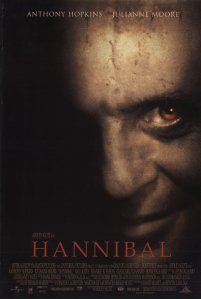 Trying to sequelize Silence of the Lambs is surely harder than trying to sequelize The Blair Witch Project. The novel Hannibal by Thomas Harris I don’t think will be confused as a necessary burst of creative ambition, and more of a chance to cash in on the love of Hannibal Lector. Though I’ve not read a line from the book from what I’m told the movie is faithful until the much hated ending. Starting a film off a so-so book isn’t a good way to begin, especially when you lose four of the components that made it shine Oscar gold.
 The element that Silence of the Lambs carried with it was stealthily gripping psychological horror. It hung with you in every closed breath you would take, surrounding you and blanketing your mind. I mean, there aren’t many serial killer movies that win a slew of Oscars. Lambs excelled at psychological horror, but with Hannibal the horror turns into a slasher film more or less. What Lambs held back and left us terrified Hannibal joyfully bathes in excess and gore.
Julianne Moore, a competent actress, takes over from the ditching Jodie Foster to fill the shoes of FBI agent Clarice Starling. Throughout the picture you know she’s trying her damndest to get that Foster backwoods drawl she used on the original down. The problem for poor Moore though is that her character spends half of the film in the FBI basement being oogled by higher-up Ray Liotta. She doesn’t even meet Hannibal Lector until 3/4 through. Then again, the title of the film isn’t Starling.
Anthony Hopkins returns back to the devil in the flesh and seems to have a grand old time de-boweling everyone. Lector worked in Lambs because he was caged up, like a wild animal not meant for four glass walls, and you never knew what would happen. He’d get in your head and he would know what to do with your grey matter – not that he doesn’t have a culinary degree in that department in this film. Lector on the loose is no better than a man with a chainsaw and a hockey mask, though he has a better knowledge of Dante and Florentine romantic literature. Lector worked bottled up, staring at you with dead unblinking calm. He doesn’t work saying goofy “goody-goody” lines and popping out of the shadows.
 Since the director, screenwriter, and female lead didn’t show up for the Lambs rehash, it feels a tad chilled with Ridley Scott’s fluid and smooth direction. The cinematography is lush and very warm.
Gary Oldman steals the show as the horribly disfigured former client of Lector’s seeking out revenge. His make-up is utterly magnificent and the best part of the film, he is made to look like a human peeled grape. Oldman instills a Texan drawl into the character yet making him the Meryl Streep of villainy.
Hannibal is no where near the landmark in excellence that Silence of the Lambs was but it’s not too bad. It might even be good if it wasn’t the sequel to a great film. As it is, it stands as it stands.
Nate’s Grade: B-
Reviewed 20 years later as part of the “Reviews Re-View: 2001” article.
Share this:

Gladiator (2000)
 Director Ridley Scott has given the world of cinema some of its most unforgettable visual experiences. But can Scott breath new life into a genre whose heyday was when a badly dubbed Steve Reeves oiled his chest and wrestled loincloth-clad extras in the 1950s?
The year is roughly 180 AD and Rome is just finishing up its long-standing assault on anything that moves in the European continent. General Maximus (Russell Crowe) merely wants to retire back to his loving family and get away from the doom and war that has plagued his life. This is made all the more difficult when the ailing Emperor bypasses his treacherous son Commodus (Joaquin Phoenix) and decides to crown Maximus as the Defender of Rome. Because of this Commodus rises to power through bloody circumstances and has Maximus assigned to execution and his family crucified. You’d think crucifixion would be so passé by now. Maximus escapes only to be sold into slavery and bought by a dirt-run gladiator training school. As he advances up the chain and learns the tricks of the primal sport he seeks but vengeance for his fallen family.
Gladiator is an absorbing and sweeping spectacle of carnage and first-rate entertainment. The action is swift and ruthlessly visceral. The first movie in a long time to literally have me poised on the edge of my seat. The blood spills in the gallons and life and limb go flying enough your theater owner may consider setting down a tarp.
 What Gladiator doesn’t sacrifice to the muscle of effects and action is storytelling. Are you listening George Lucas? Gladiator may unleash the beast when the rousing action is loose, but this is coupled with compelling drama and complex characters. Phoenix may at first seem like a snotty brat with an unhealthy eye for his sister (Connie Nielsen), but the further Gladiator continues the more you see in his eyes the troubled youth who just wants the love of his father that was never bestowed to him. Maximus is a devoted family man who regularly kisses clay statues of his family while away, and must ceremoniously dust himself with the earth before any battle.
The acting matches every sword blow and chariot race toe-for-toe. Russell Crowe marks a first-rate staple of heroism. Every calculating glare he exhibits shows the compassion and ferocity of this warrior. He becomes a rare breed – an action hero who can think and actually act. Oliver Reed, in what sadly was his last role, turns in a splendid and charismatic turn as the head of the gladiator school of Fine Arts and Carnage. Mysteriously everyone carries a British accent closer to them then a toga two sizes too small. Even Crowe who is nicknamed “The Spaniard” speaks like he walked out of Masterpiece Theater.
The effects and visuals are a sumptuous feast. The aerial shots of Rome and the Coliseum are simply breath taking. Gladiator rivals American Beauty for the most rose petals used in a movie, except in this one they don’t shoot out of Mena Suvari’s breasts.
Ridley Scott’s track record may be hit or miss but Gladiator is definitely one sorely not to be missed.
Nate’s Grade: A-
Reviewed 20 years later as part of the “Reviews Re-View: 2000” article.


 nathanzoebl
You must be logged in to post a comment.