Blog Archives
Constantine (2005)
 I’ll admit it; I’m a sucker for Christian mythology played against thriller and action settings. I may be the only person to have watched all of The Prophecy flicks, and probably the only person that eagerly chows down on the cheesy sequels to The Substitute, yet shy away from seeing the first film. I’m captivated by the imagery, the discussion of Heaven and Hell and its mythical logistics, and just the psychology of supernatural biblical beings. With this in mind, I was strongly anticipating the release of Constantine. What I got wasn’t exactly what I expected but I’d be lying if I said I wasn’t entertained.
John Constantine (Keanu Reeves) is a very troubled man. Since his youth he’s had to live with his gift that allows him to see through earthy disguises and witness angels and monstrous demons walking among us. He’s parlayed this ability into a modest side job of exorcising demons and sending them back to Hell. Constantine figures his loyal service should grant him passage into the pearly gates, but Archangel Gabriel (Tilda Swinton) reminds him that that’s not how it works. Constantine is doomed to go to Hell because he tried taking his own life, and if that’s not enough he also has terminal lung cancer from smoking like a chimney. “In other words, you’re f***ed,” Gabriel confides to Constantine.
 Police detective Angela Dodson (Rachel Weisz) is investigating the suicide of her twin sister (also Weisz). She swears her mentally disturbed sis wouldn’t do such a thing, and she seeks out the help of Constantine. He challenges her beliefs, stating that God and the Devil (Peter Stormare) have a wager over the souls of mankind but cannot directly interfere. But now something is breaking this rule and it looks like demons may be getting closer to entering our plane, and it looks like Angela’s dead sister may have known more than people would have thought.
The plot of Constantine is rife with contrivances, aborted subplots, underwritten and nearly forgotten supporting characters, and sketchy logic (staring at a cat can transport you to Hell? No wonder I’m a dog person). Often the film feels overwhelmed by good special effects, as they seem to be the crux of the film?s purpose of being and not, on the other hand, a theological playground of ideas. Constantine gives veiled glimpses of something smart, but routinely shuts that door to focus more on annoying jump scares.
In fact, Constantine seems rather old-fashioned with its theology, still clinging to the Roman Catholic belief that suicide is a one-way ticket to the fiery abyss. I understand its use as motivation for our lead, but will progressive audiences accept something they may find archaic? I suppose it could be worse. Constantine could have briefly gone to Hell for eating meat on a Friday.
It’s interesting that after spending two years making The Matrix sequels, Reeves would choose to attach himself to another big-budget theological action flick. His acting never really rises beyond morose loner but somehow he does make for a satisfying, brooding hero. Reeves? low-key monotone speaking voice allows him to spout cheesy dialogue with a straight face and mercifully keeps the audience grounded.
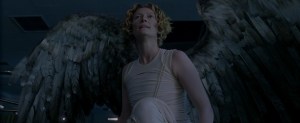 The true stars of Constantine are the memorable supporting players in this celestial smack down. Swinton uses her androgynous looks to forge what David Bowie might be like as an angel: angular, mysterious, waif, and somewhat creepy. Stormare delivers a performance so kooky and tic-heavy, that it could only be compared to the weirder moments of Christopher Walken. Both actors liven up the film and seem to be having the most fun by far with their cheeky roles.
The genius of Constantine is in its one-upsmanship game it holds with the audience. Granted, suspension of disbelief is needed to even go along for the ride, but when we start learning that Hell has its own line of bibles (and they’re longer) we’ve gone beyond suspension of disbelief and into wacky Anne-Heche-speaks-to-aliens land. While sitting through Constantine, we the audience think, “There’s no way this movie could get any sillier.” And then it does! We think, “Alright, that was crazy. Now there’s no way after that this film could get any sillier.” And then it does! Constantine is an amazing ascent into movie madness. After a while, I became drunk from the film’s insanity and wanted it to get even crazier, if possible. It almost seems like there’s a drinking contest between the movie and the audience, and Constantine isn’t afraid to piss its pants to win.
By the time Lucifer shows up, clad in all white like Tom Wolfe, and the Dark Lord appears to have Tourette’s Syndrome and/or a speech impediment, Constantine has hit the bottom of its Kool-Aid cup. Sure the film’s cinematography is slick, and the premise is intriguing, but the real draw of Constantine and the real enjoyment of the flick is how bat-shit crazy it is. I cannot even think of comparable films. I hope David Lynch was taking notes if he saw this.
For a while there, it seems director Francis Lawrence wanted Constantine to be a companion to Wesley Snipe’s Blade character. Maybe the two of them can set up a play date and go destroy otherworldly creatures. There’s a visually striking sequence late in the film involving Constantine in a room full of demons. He’s “contaminated” the water system by placing a giant cross inside, thus holy-fying the water before he can bottle it and sell it to the masses. He holds a lighter to the sprinkler system, demons growling all around him ready for their kill, and then water sprays down across the room. “Holy water?” one female demon says in a stunned voice, watching her flesh sizzle away. Then Constantine marches through the wet room blowing away demons into splashes of ash with his comically unwieldy cross-shotgun. It’s filmed wonderfully with dark hues and is a great idea; however, it’s a bit of a rip-off of the opening sequence in the first Blade.
 This seems to be a repeated sentiment in Lawrence’s direction. He has a sharp visual eye and several camera angles come from odd yet exotic places, but his film is borrowing so heavily from so many other films. What you’re left with is the impression of a stylish if very derivative looking action film. One exception is when Lawrence shows us glimpses of the blistering burnt orange world of Hell. It seems Hell is an exact model resemblance of Earth, only with the fire, brimstone, and crawling demons with their heads sliced open (there is a scary level beneath the surface where we witness a sea of people being tortured). The second or third time we traveled to Hell, I began to wonder what my house would look like and the logistics of upkeep for the homeowner in Hell. Surely the heating bills wouldn’t be the same.
Constantine is funny, frustrating, confusing, gorgeous, and just plain insane in the ole membrane. The film exhibits a rare and engaging form of insanity that may glue audience eyeballs to the screen to see what happens next. I’ve seen Constantine twice (don’t ask why) and even though I knew all the weird plot turns I still found myself getting an enjoyable contact buzz from the film. Who knows how long such a novelty can sustain itself, though. Comic book fans, especially those with a spiritual bent, should get a kick out of Constantine as will anyone else searching for a pristine example of how wonderfully out of control Hollywood moviemaking can be. Sometimes in a good way.
Nate’s Grade: B-
Share this:

The Mummy Returns (2001)
 Does this mean the following sequels will be called The Mummy Forever and The Mummy and Robin? Our tale takes place ten years after the first. Our archeological heroes in Brendan Fraser and Rachel Weisz are now married and the proud parents of a blonde English boy (Freddie Boath) – who of course, gets into as much trouble as his parents do. Supposedly there’s this buried army of dog warriors from an Egyptian God. The trick is, you have to defeat their leader The Scorpion King to gain control over their ranks. So our good guys stumble upon setting things in motion accidentally, while our bad guys raise Imhotep (our mummy from the first one) with plans of him toppling The Insect Marvel.
 The story of Mummy redux deals a lot with past lives and destinies. It seems miraculously everyone in our story is related to one another be it past or present (and we ain’t talking inbreeding). They fulfill their destinies – or whatever, mainly just fight with pointy things.
Many of the same characters return from the first one, almost like an ongoing serial. There’s the cowardly bumbling brother-in-law (John Hannah), the Arabic prince sworn to protect society form the evils of mummy-ness (Oded Fehr), and hell, even the damn mummy himself (Arnold Vosloo). We even get more of Vosloo’s dead girlfriend from the first picture. She has the honor of sharing a grotesque screen lip-lock with the decaying mummy. Talk about commitment.
Somehow pro wrestler The Rock (Is he in the phone book as “Rock, The”?) got into this film. His role is The Scorpion King, a cursed uber warrior of ancient Egypt. As you would expect from someone so elegantly named after a large, un-moving, mineral – The Rock’s acting is largely un-moving. He has one line in a different language, poorly delivered as well, then has five minutes of screen time battling people two feet smaller than him with the pearliest whites this side of the Nile. He shows up again later as a scorpion/human hybrid but is replaced with (say it with me class) CGI.
The acting is pure cornball, but to some degrees pleasantly so. We can’t have people taking themselves too seriously while being chased by little dead pygmy babies. Fraser seems to be leading the way for the next generation of action stars. Adewale Akinnuoye-Agbaje appears in a small role as one of the big bad’s henchmen. After watching him for years on Oz it was a personal pleasure to see him on screen. Boath is the real surprise. If he were grating (like some lil’ Star Wars kid) I’d root for any undead creature to suck his nine year-old bones dry. He is fun to watch and acts like a kid, not a child actor acting like a kid.
 The Mummy Returns will enchant you if you were enchanted by the first one. My stance on the mummy’s predecessor was that it was a tongue-in-cheek dose of cheese and adventure. It was nothing to write home about but it was a fun popcorn flick. However, The Mummy Returns throws the gauntlet down with the “bigger is better” rule of thumb almost tripling everything the first tried. It practically throws everything at you in its onslaught including a CGI kitchen sink. You’ll get computer everything. It’s almost like the producers are having a mummy wholesale – “everything must go!” As in reference to there is so much computer generated images in this film that it could be classified as the first living cartoon.
The action in The Mummy Returns is relentless. The pacing is fast and must be the bane to all those people who must squirm in their chair afraid they will miss something – you will. Most movies move through plot points, like from A to B. With The Mummy Returns, on the other hand, everything just bleeds together in a linear mess. It’s rather exhausting to watch.
The Mummy Returns continues to have its tongue firmly planted in cheek. Except with its onslaught it almost resembles a scene from Species with said tongue going in cheek then outside of brain cavity. If you’re hungry for an all-you-can-eat version of a movie, then The Mummy Returns might whet your appetite.
Nate’s Grade: C+
Share this:

Enemy at the Gates (2001)
 Enemy at the Gates tells its tale over the pivotal Battle of Stalingrad where over a million Russians lost their lives to repel the German advancement. The Russians at this point were throwing boys as young as school kids into the battle and arming some of them with nothing. It was an attempt to create wave upon human wave to overrun the Germans. The Battle of Stalingrad was a decisive moment in WWII, but how Enemy of the Gates portrays it – the battle was nothing. The entire war was turned by two men.
The beginning to the film (and also the best part) shows the immediacy of the war and is very parallel to the Omaha invasion. People are shepherded into box cars onto a train, then arrive on the river and travel by barge to the ports of Stalingrad, then are sent up a hill one with a rifle and one with the rifle’s ammunition, and then thrown into the battle on the other side. Literally, an hour could pass from leaving home and death. Enemy at the Gates doesn’t paint a pretty picture of the Russians themselves (this is a Hollywood film after all) and displays the Russian war tactic of firing on your own men if they have the gall to retreat.
 A survivor of the slaughter is Vassily Zaitsev (Jude Law), a rural farm boy with a great shot. He takes out a slew of Germans that have him and fellow Russian Danilov (Joseph Fiennes) trapped in the ruins of a city. Once back to friendly quarters Danilov decides to turn Vassily into a hero and prints numerous propaganda fliers and articles about his many triumphs to increase the morale of the faltering Russian army. Vesilly becomes a hero and a celebrity, though he continues to have his doubts if he can live up to his inflated image.
Rachel Weisz (The Mummy) plays the peppy patriotic girl who comes between our two mates creating an awkward Hollywood favorite: the love triangle. The very fact that she, and other women, are out there on the front lines defending their Motherland should not be taken as something in the advancement of feminist ideals in WWII Russia – at this point in the war them Ruskies would arm dogs and squirrels if they could.
Enemy at the Gates introduces its villain as an expert Nazi sniper played by recently Oscar nominated actor Ed Harris. Harris plays the character cold, yet sincere, like he is following the ways of war but not because he wishes to. He has a duty and he will accomplish it, down to the meticulous wire if he must. Harris’ sniper is sent in to assassinate Vassily Zaitsev and more importantly kill the morale of the Russians. This sets up the film’s showdown between the Law and Harris. Two men who are patient and silent killers dueling to see which one of them blinks first. A cat and mouse game amongst the fallen remains of a once proud city.
At least that’s how it happened in real life. The two men played a waiting game that went on for over two days to see whom would move first. The Nazi slipped and wound up dead. But this standoff where you couldn’t move for fear of being shot at any moment of weakness would’ve been fascinating alone to tell, especially if done straight. Instead we get Hollywood’s Saving Private Ryan.
 A rather peculiar aspect associated with Enemy of the Gates is the amount of people that die from being shot in the head. I mean, I actually looked and counted, there was maybe two people in this film that did not die from bullets that were not exploding through their heads. It gets a little silly as it goes and almost becomes an unintentional joke as we go on with 15… 20… 40 some CGI shots of bullets zipping through people’s foreheads. And the way the snipers are portrayed has it seem like a slasher film – you duck your head around that corner you are instantly dead!
Director Jean-Jacques Annaud’s previous film was the pretty but oh-so-mind-numbing-long Seven Years in Tibet. Here he takes the torch from Spielberg and plays with all the Ryan elements; dabbling with some blues, and muddy browns, and wreckage and what not. Annaud’s film is less a war film and more of a war propaganda film showing the strong effects it can attribute. Annaud also has the distinction of having the most awkward sex scene I’ve ever seen in a film. Weisz comes into where Law is sleeping and sneaks under his blanket. Except Law is sleeping in a row of other soldiers all lying on the cold cement ground with rubble all around them. The scene is very awkward to sit through and I feel will become notorious for it.
The movie isn’t all bad. Some scenes do have good tension and excitement. Law and Harris give credible performances, and Bob Hoskins appears for a very memorable role as Nikita Khrushchev. Enemy at the Gates is a war movie played with Hollywood elements that are as clear as day and weigh down whatever chance the film had. And would it have killed the cast if they could have tried a Russian accent!?
Nate’s Grade: C+


 nathanzoebl
You must be logged in to post a comment.