Blog Archives
The Time Traveler’s Wife (2009)
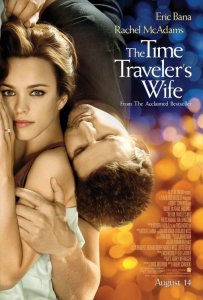 You think your romantic foibles are complicated? Based on Audrey Niffenegger’s best-selling novel, The Time Traveler’s Wife, we follow the life of Henry (Eric Bana), a librarian stricken with the unique genetic disorder of uncontrollable time travel. He first discovered this condition when he was six years old and disappeared out of his mother’s car, only to rematerialize and watch her die from afar. An older version of Henry happened to also be on hand and fill in his younger self on the details. Henry will randomly move backwards and forwards through time, and there’s nothing he can do to stop it. One of the side effects of spontaneous time travel is, naturally, nudity, as Henry travels in the buff a la the Terminator. So usually the first thing he must do when he winds up some place new is find some clothes. Henry seems destined to be a sad and lonely man, but then one day Clare (Rachel McAdams) enters his life, confessing that she’s known Henry for years and been waiting for this exact moment to arrive. She asserts herself and asks Henry for a dinner date that’s been in the works for some time. They fall in love, or fall further in love in Clare’s case, and try to make a relationship work despite Henry’s hiccups through time.
There’s a tenderness to the movie, though I found it tricky to fully engage in the characters. Much of the movie concerns the plot complications that befall such a strained and unique relationship. The flick gives new meaning to cold feet when Henry literally vanishes during his wedding, only to reappear as a mid-40s version of himself (hey makeup department, you couldn’t do more to effectively age Bana than add a dash of grey?). There is a great mind-bending section where Clare cheats (?) on Henry with… a younger version of himself. I was interested in the subdued proceedings and I felt underpinnings of empathy for Henry and Clare, but then my mind wandered into something a little darker and pessimistic. Now, The Time Traveler’s Wife is a polished traditional romance despite the sci-fi trappings but I started thinking about if what I was witnessing was actual romance? Henry first visits Clare as a child, telling her he will be her eventual husband. She falls in love with him in that moment and rejects all other suitors, knowing with absolute certainty that she will marry Henry. She just has to find him. And when adult Clare does meet Henry the librarian, he has never seen her before up to that point (it’s not as confusing as it may sound). She’s been waiting years to see his face again and she tells him that they are destined to get married. You see what’s at play here? The romantic plot is a loop where each character supplies the other’s conviction. Henry locked Clare into a life of looking for him and said they would marry, but then the adult Clare is the one who convinces Henry that they will indeed marry, and he tells young Clare this who will then convince Henry, etc. Is there any free will at play here, or is each partner in this relationship being manipulated by the certitude of the other? It’s sort of a metaphysical chicken/egg scenario.
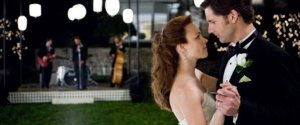 The best portion of the movie comes across during the second half when the movie focuses more on the emotional consequences of Henry’s condition. Early on Henry’s uncontrollable time traveling is played for laughs and some forced and somewhat trivial conflict (oh no, he missed another dinner!). Henry has a chilly relationship with his father (Arliss Howard) until, well, I’m not quite sure, but things improve. In the second half of The Time Traveler’s Wife, the drama gets more serious and intriguing when Clare and Henry attempt to conceive. Henry’s genetic disorder gets passed down to the baby fetuses, which means little babies are vanishing out of the womb and perishing before being zapped back inside. That’s a rather disturbing image and yet it is a thoughtful and plausible problem given the premise. As a result, Clare suffers through several traumatizing miscarriages. But they keep at it because Henry has seen his future lineage, also a time-traveler, and he knows that one of these pregnancies will go full term and become their eventual daughter, Alba (Tatum McCann). It was this storyline that stopped my mind from occasionally wandering and hooked my interest. Perhaps it’s cheap sentiment, but it’s hard not to feel for this loving couple when they endure pregnancies fraught with danger. The movie misses out on a dynamite dramatic opportunity with Alba. If I were adapting this to the screen, I would make sure to include Alba as a grown 30-something woman visiting her father on his deathbed, tearfully informing her dear dad on all the eventful moments that he won’t be around to experience. Picture an adult Alba talking about her own children to her dying father. There wouldn’t be a dry eye in the house. Hollywood, if you’d like to tack on an extra emotional ending to this movie, there’s still time. Call me.
It is here that I must address some key scenes that may pique curiosity. During Henry’s travels, he frequently visits the young child version of Clare. The first time Clare meets her future husband she is a little girl sitting in a meadow on the boundary of her family’s palatial estate. Henry, as he does every time he becomes unstuck through time, arrives in the nearby woods without a stitch on. Director Robert Swentke (Flightplan) and screenwriter Bruce Joel Rubin (an Oscar-winner for Ghost) work diligently to make sure the movie walks a very fine tone, and I confess that the scenes between loving child and naked time-traveling man escape creepy pedophilic overtones. Take that blurb for what you will in a romance: “Hey, no pedophilic overtones!”
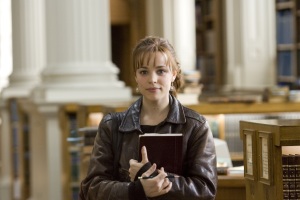 There are some other complications when it comes to this matter of unexpected time traveling. Firstly, the rules seem to be flexibly applied. At one point Henry is talking about how he cannot prevent his mother’s deadly car accident. The movie professed a destiny-entrenched approach to time travel, meaning every action you think you’re engaging out of free will was predetermined (the TV show Lost also subscribes to this theory). It cuts out time paradoxes. But then in another moment Henry uses his knowledge of the future to win the lottery. So which is it? Are the filmmakers trying to convince me that it was destiny for Henry and Clare to win the lottery, because I’m not buying it. Having a time-traveler for a boyfriend takes out some of the natural drama o relationships when one party can peak ahead. Relationships have danger and excitement and uncertainty to them, but when Henry can just matter-of-factly say, “We’re gonna be fine. We’re still together and in love fifteen years later, I saw it,” well it may make for good romance for some, but it makes for rather inert drama. How can you hope to win arguments? Naturally, the hefty book has been streamlined as much as possible for a mainstream moviegoing audience, which means that Henry’s scope of time traveling is scaled back. At one point he quantum leaps beyond his own lifetime, and because this has never happened before and is really only done to introduce a ticking death clock. I suppose there will always be inconsistencies when it comes to breaking the space-time continuum.
McAdams (The Notebook) is a great choice for the romantic center of the movie. She’s glassy-eyed and smiles so hard in her early sequences you think her dimples are going to explode off her cheery face. She is such a winning presence and her warm-hearted glow powers the character and the movie. Unfortunately, she doesn’t have very good chemistry with her onscreen mate. Henry is a victim of an existential cruel joke. Bana (Munich) is light-footed and makes Henry more than a space-time martyr. He’s somewhat amorphous as a character, a collection of niceties and genial, puppy-dog affection, which means that Henry is routinely upstaged by his genetic condition. However, when Henry faces the specter of his impending death is when the character gets a lot more attention and Bana is able to work his considerable talents. He gets ample opportunities to showcase his time-traveling buttocks. I don’t think too many women out there would be that put off if a naked Eric Bana magically materialized in their bedroom.
 The Time Traveler’s Wife is mildly reminiscent of The Lake House, and not just because of the time travel romantic complications. Deep down, these are traditional Hollywood romances with a fresh sci-fi coat of paint. The movie is best if you set the logic portion of your brain off so that inconsistencies and potential contrivances don’t distract from an intriguing story that presents some nice developments. There’s a tender love story here, though the characters don’t leave as much of an impression as they could have with such a plot-heavy romance. It finishes strongly and the mood throughout has a somber bittersweet quality, hammering home the “enjoy the time you have” message. McAdams is darling, Bana gets in the buff, their chemistry isn’t great, and the filmmakers refrain from the material getting overly sentimental or solipsistic. In a summer of relative disappointments, a tricky, clever approach at traditional romance is welcome amidst the explosions and wacky studio comedies.
Nate’s Grade: B
Share this:

Red Eye (2005)
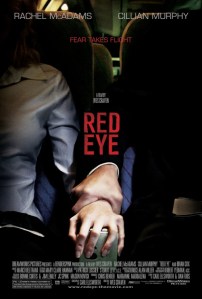 Red Eye is something of a comeback for Wes Craven, the horror master that’s been somewhat grasping at straws for several years (for further proof see Cursed). The concept is ripe for tension and the film has little fat on it, clocking in at a meager 80 minutes. It’s divided like so: 20 minutes set-up, 40 minutes on the plane, and 20 minutes off the plane for the conclusion. Red Eye is so enjoyable when we’re trapped on that flight, catching the icy stares of Cillian Murphy, that I personally would love an additional 20-30 minutes more in the air. There’s a nice chain of cause and effect, as the audience is with Rachel McAdams (fast becoming the Hollywood It girl) as she tries to think her way out of her jam, each time thwarted by the chilling Murphy once more. It’s a great duel of wits. The last act of the film is too conventional and predictable to close out such a great claustrophobic pressure cooker. It’s also a bit insulting that she’s ultimately rescued by a man after we watch 80-minutes of her plucky ingenuity and courage. Red Eye is a solid thriller carried by two great performers on the rise.
Nate’s Grade: B
Share this:

Wedding Crashers (2005)
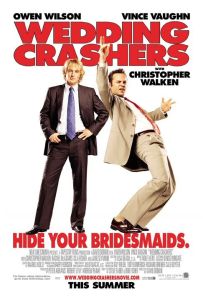 My friend Amanda Evans is quite possibly the biggest Vince Vaughn fan in the United States, nay, the planet Earth. She used to watch Dodgeball every day. Her brother-in-law even went so far as to stage an intervention for her Vaughn addiction. She has been talking about Wedding Crashers for months and months and counting down the days like a kid waiting for Christmas. It’s safe to say that Amanda loved the movie but how would your otherwise non-obsessed moviegoer feel?
Jeremy (Vaughn) and John (Owen Wilson) are divorce attorneys by day and ladies men come nightfall. Both men crash weddings they were not invited to with the strict purpose of getting laid by horny bridesmaids. They have got their honey hunting down to a science, from what relative they’re related to, to when to cry, to whom to slow dance with to convince those bridesmaids that they’re sweet gentlemen. Jeremy says that one day when they?re old men they’ll both look back on these days and smile. John retorts, “We’re not that young.”
The Super Bowl of all weddings is the daughter of the Secretary of the Treasury (Christopher Walken). John has his eye on his other daughter Claire (Rachel McAdams) while Jeremy sets his sights on the Secretary’s other daughter, the wild and vivacious Gloria (Isla Fisher). The only problem for John is that he’s actually falling in love with Claire, oh and she’s engaged to a real jackass (Alias‘ Bradley Cooper). Jeremy and John are such big hits at the wedding that the Secretary invites them both to vacation with his family at their summer home. Jeremy is hesitant and wants to stick to the love-em-and-leave-em lifestyle he and his buddy are so accustomed to, but John drags him along convinced he can win Claire over.
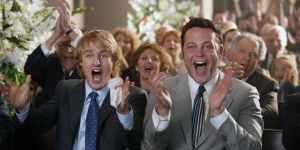 Vaughn kills in every single scene. He hits punchline after punchline like some king of comedic prizefighter. His mile-a-minute delivery gels ever so nicely with Wilson’s homesy charm and drawl. These two have never been matched before as leading men but now their marriage seems like a match made in heaven. Their chemistry is off the chart. Wilson is essentially the straight man to Vaughn. In most comedies, “straight man” is just another term for boring. However, Wilson gets his shots in as well especially with his give and take with Vaughn, who is in a comedic zone all his own.
Not to be out done by the men, both McAdams and Fisher give great performances. McAdams (Mean Girls) is a rising star and it’s easy to see why. She’s a beautiful woman but also has some good teeth for comedy. In comedy terms, she’s the romantic interest, which means she’s an even straighter (read: boring) man than Wilson’s straight man. And handed with all this, McAdams still shines as a leading lady you can fall in love with. The true scene-stealer of Wedding Crashers is Fisher (Scooby-Doo), who goes hilariously tit-for-tat with Vaughn. You might walk away believing she’s truly out of her mind. Fisher has a physical gift for comedy that hasn’t been showcased before, but with Wedding Crashers she gets unleashed and we?re the better for it.
After the brilliant work of McAdams and Fisher, most of the supporting cast’s performances comes off as being too forced. Cooper is a wide-eyed grinning jackass that?s obvious from the get-go. He plays the role so big that his eyebrows seem permanently pressed to the top of his head. There’s also the weird introverted son who Typical Crazy Grandma berates as being “a homo.” But not only is he gay hes also a freak. The role seems quizzically garish and even a bit homophobic. Jane Seymore jumps at her role as mom in heat, but the film forgets about her fast after an awkward encounter with Wilson. Walken can make me laugh just by watching him stare (and he did), but even he isn’t given much more to work with besides the supportive dad role. It seems odd for a comedy with such huge belly laughs to have several supporting players grind the film’s funny down. All of this is excusable though because the far majority of the film’s attention and laughs are derived from our central quartet.
Wedding Crashers is a raunchy delight. You know you’re in good hands when, in one scene, Wilson and Vaughn are dipping bridesmaids on the dance floor and it cuts to these same bridesmaids now falling topless onto hotel beds. This is one R-rated comedy that proudly wears its rating on its sleeve. And for a sex comedy, there’s a surprising amount of laughs mined just out of an adult discussion on sex, which cannot be curtailed or couched with euphemisms and soft language. I don’t know whether to credit the screenwriters or the off-the-cuff improving of Wilson and Vaughn, but Wedding Crashers proves there’s still more under the sun to talk about and giggle.
Usually with movies revolving around hedonistic characters, they meet one of two ends: 1) they find that One True Girl that makes them want to go straight, or 2) they meet their hedonistic match and rethink their ways now that the shoe is on the other foot. Wedding Crashers doesn’t give you one of these options, oh no, it gives you both. Sure things gets awfully predictable after a great rush out of the gate, but the interplay between Wilson and Vaughn and some genuinely funny gags should keep most laughing until the surprise cameo at the end by the founder/guru of the wedding crashing rule book (it should be no surprise if you’ve seen any movie with Wilson and Vaughn the last three years). The climax is a bit drawn out and Wedding Crashers is still another comedy built around deception whose climax involves apologizing for said deception. It’d be tiresome if the movie weren’t so damn funny.

Despite the sleazy premise, Wedding Crashers has a sweet and gooey center. These are two men who know exactly what women want and they’re eager to give it to them. They just don’t know what they really want, but when they find it both Jeremy and John set their minds to romantic conquests outside of the bedroom. It’s this gooey center that makes the characters likeable despite any misgivings an audience may hold over their wedding crashing plot.
Two hours is a near eternity for most comedies and Wedding Crashers seems to lose its sprint in the last 20-30 minutes. The film starts getting repetitious and overly predictable with few laughs to cover up. Wilson and Vaughn still make it work but the setup seems to have been taken as far as it will go and then some.
Wedding Crashers is a loud, jovial, ribs-in-the-elbows funny return to the crass classics of the 1970s R-rated comedy. Vaughn and Wilson are perfectly matched and McAdams and Fisher shine like stars. Wedding Crashers is a bawdy good time that will leave you aching from laughing so hard. This movie is profane, simple, crude, and joyously so. It does run out of gas toward its protracted climax and some of the supporting performances feel forced, but Wedding Crashers is easily the funniest film of the year. Amanda was foiled in seeing the film three times the weekend it opened. She had to settle for only seeing it twice. I don’t think she has slept since (UPDATE: Amanda has since seen the movie five more times).
Nate’s Grade: B+


 nathanzoebl
You must be logged in to post a comment.