Blog Archives
Valentine’s Day (2010)
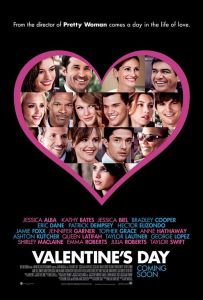 Imagine every romantic comedy cliché and sappy platitude about love stirred together into one giant gelatinous conglomeration of hollow sentiment. That’s Valentine’s Day. Regardless of your thoughts on the holiday, this movie, which aims to celebrate our national day of love, might have the opposite effect. This movie makes He’s Just Not That Into You look like When Harry Met Sally. It?s a fairly large ensemble with plenty of mega-watt stars, but it’s too bad that nobody knows what to do. Jessica Alba’s character literally runs her course an hour into the film and yet she still makes meaningless appearances. This overstuffed Hallmark card has ridiculously safe, candy-coated storylines sanded so that there is no hint of edge or wit (Anne Hathaway is the most ludicrous PG-13 phone sex operator you will ever find). The resolutions of most of these storylines will be predictable to anybody who has ever read a greeting card. Jamie Foxx is supposed to be a bitter TV reporter popping up everywhere reporting about the ills of V-Day. Think he’ll have a change of heart by the film’s end? The cast does offer their small pleasures (there are SIX Oscar nominees/winners in this movie!), except for the kid who has a crush on his teacher (Jennifer Garner). He was insufferably annoying. So was his movie.
Nate’s Grade: D+
Share this:

Stranger than Fiction (2006)
 Ever think your life would make for a good story? Be careful what you wish for. Harold Crick (Will Ferrell) is hearing voices. They aren’t telling him to kill or do anything subversive. In fact it’s just one voice, an English woman, and she isn’t instructing Crick to do anything. No, she’s more so just… narrating. She comes in and out and expresses the doldrums of Crick?s life. He’s an IRS agent whose life revolves around order, repetition, and numbers. We can even see his inner tabulations thanks to some snazzy onscreen visual effects. Crick is sent to audit Anna (Maggie Gyllenhaal), a baker with a disdain for civil servants and authority. Crick is stricken by this shrewd beauty and finds himself wanting her, something the Narrator affirms for him. Crick’s life takes a dour turn when the Narrator lets on that Harold Crick had set in motion his “imminent death.” Crick is confused and seeks advice from Professor Hilbert (Dustin Hoffman) an expert on literature. Then they figure out the Narrator is Kay Eiffel (Emma Thompson), a famous writer who has the unfortunate habit of bumping off every one of her main characters.
Make no mistake, Stranger than Fiction is funny, but it’s a different kind of funny than most people are accustomed to with Ferrell. In my theater, I kept an eye on a gaggle of teenagers sitting several rows in front of me. I just wanted to observe their body language and what I saw was a lot of fidgeting, getting up for trips to bathrooms and popcorn, and lots of whispery talk. I can only imagine the disappointment of those teenagers expecting Ferrell to rip his clothes off and run around like a buffoon. They were likely busily thumbing away at their ever-present cell phones, text messaging their friends. People that are looking for a wild, sidesplitting, slapstick comedy are going to shaking their head. Stranger than Fiction is funny, but it’s in a very dry, witty way, much like British humor; it’s a humor you can admire for being clever but might not make you roll in any aisle.
 The biggest fans of Stranger than Fiction will be bookworms. This is a very literate movie that works better for those with an appreciation or outright love of literature and storytelling. Professor Hilbert doesn’t initially believe Crick until he learns that Crick’s narrator said, “Little did he know.” That, ladies and gents, is all a professor of literature needs. He has to rule out what kind of story Crick may be apart of, so he subjects Crick to a series of hilarious questions along the lines of treasure-inheriting, nemesis-making, and magical-creature befriending. Crick keeps a notebook to tally examples in his life that may point to whether he is part of a Comedy or a Tragedy. Professor Hilton even explains the difference: in grand Shakespearean tradition, a comedy ends with people getting hitched and a tragedy ends with people getting snuffed. This is all fabulously witty and extremely fun, but I can think you’ll see why hard-core fans of Old School and Talladega Nights might be heading for the exits.
Writer Zach Helm has created a wonderfully whimsical tale that’s trippy but manages to still have warmth and a firm heart. It’s far more embraceable a movie than, say, Adaptation, and less smug. He has a smart sense of humor and loves deconstructing literature, like the Jasper Fforde (The Thursday Next books) of screenwriting. We are really sucked into the movie from the moment we can hear Thompson. The story has an innocence to it and this existential comedy feels out there but still grounded; it’s surprisingly poignant and full of dramatic revelations. Even better, Helm has done something that few have achieved: he wrote a story-within-a-story that works. Kay’s narrative voice is highly droll in her observations on Harold Crick’s life. It sounds like a genuine novel, and on top of that, a novel I would enjoy reading. Stranger than Fiction is all the proof I need that Helm is a talent to keep track of.
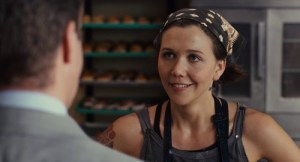 The performers all seem to have the same affection for the material. Ferrell is making that leap from funnyman into leading man, the same dramatic territory Robin Williams first tiptoed in Good Morning Vietnam and, likewise, Jim Carrey approached in The Truman Show. Ferrell won’t turn any heads but he underplays his performance maturely, playing a sad but sweet drone of a human being finally taking charge of his life under very insane circumstances. There’s a quiet moment toward the end where Ferrell is told he must accept his fate and he sits, shell-shocked, tearing up, his voice getting softer with every word. It’s only a moment but it piques my interest in what Ferrell may have in the tank. The comedy he can do in spades, including a desperate moment when he tries narrating his own life to coax his Narrator out of hiding.
Who will turn heads, however, is Gyllenhaal. I can already see a nation of teen boys falling in love with her tattooed, punky baker. To them I say, get in line pals, Gyllenhaal has made me dot my I’s with hearts ever since her star-making performance in 2002’s kinky romantic comedy, Secretary. She’s easy to fall in love with and expresses a fragile compassion to her role. The romance between Anna and Crick is unexpected but these two people need each other, and you feel that need as you watch their eyes light up as their relationship blossoms. Late moments between them add to the tenderness of the film and you will be on your knees pleading Crick is spared so he can return to loving Anna. I think Wreckless Eric’s “Whole Wide World” will become a potential staple on romantic teenage mix CDs sent to their sweethearts from now on.
Thompson and Hoffman have appealing supporting performances. Thompson has marvelous fun thinking of different grisly outcomes in store for Crick. Her interaction with the hospital staff to see the “not gonna make it people” is a howl. But Thompson is too good of an actress to play it straight. Once she discovers the life-altering implications of her writing she is crushed by guilt, obsessed over killing good people cruelly. Frankly, if I had anyone narrating my life, Thompson’s voice would definitely rank high. Hoffman plays a dedicated literary professor like a straight man, and everything seems on the level for him, even the fantastic. It’s a nice touch for a film that doesn’t require broad strokes.
 The movie doesn’t have the depth of feeling or dark turnarounds that I know Charlie Kaufman would have done. Stranger than Fiction has a lot of fun with a very ripe premise, and is very intellectually stimulating, but you do feel like it could have gone further, exploring the reaches and implications of its metaphysical setup. What if someone who read Kay’s manuscript thought it was such a masterpiece, a shining light of literature that could move mountains, that they knew Crick must die, and that they must kill him to make certain of it. Or what about the relationship between author and character, and the role each has over the other and perhaps a battle over the future, a typewriter, and a happy ending at the end of a tunnel. However, while all of these options would further explore the novel premise, it would betray the movie’s whimsical tone. This isn’t a very dark movie. It has an authentic sweetness to it, and Crick is a gentle and kind man, and to do anything too heavy would work against the film’s tone. The movie explores existential queries and the topics can be grim, but ultimately Stranger than Fiction is life affirming.
Stranger than fiction also has a buoyant, unexpectedly pleasing romance to it. Again, it doesn’t show the depth of love and human feeling that Kaufman’s Eternal Sunshine could, but this is an unfair comparison. This romance is more a subplot that carries increasing weight thanks to heartwarming performances and the winsomely adorable Gyllenhaal. The romance in Eternal Sunshine was the story, and everything else was outside variable coming into contact. It might sound dismissive to call Stranger than Fiction as decaf Charlie Kaufman, but it really is a compliment. Kaufman is the most exciting, brilliant, creative, insightful, and whacked out screenwriter working today. I would give one of my kidneys to write even one story that could be described as decaf Kaufman. Stranger than Fiction may not examine as many themes, conflicts, or relationships as Kaufman might with the material, but this movie is a sweet fable that floats by like a fluffy cloud on a sunny day. It’s just so damn pleasant you sort of soak it in and fall in love, not wanting to leave.
Stranger than Fiction is strange, all right, but gloriously so. Scribe Zach Helm has concocted an existential fairy tale aimed for bookworms and outsiders. The premise is clever but the film doesn’t stop there, and Helm explores the implications of his premise with whimsy, charm, and a sweetness that is hard to rebuke. The wacky story seems reminiscent of Kaufman’s works, but it has a more heartwarming and embraceable appeal. Great performances from a game cast help to push the material even further into excellence. It has a small handful of flaws, perhaps a too limited scope, but that doesn’t stop Stranger than Fiction from being one of the best stories of 2006 and one of the best movies too.
Nate?s Grade: A-
Share this:

Chicago (2002)
January at the theaters is a tale of two kinds of films. One type are the studio bombs (take Just Married and Darkness Falls, please take them far away). The other type are the prestige pictures expanding their releases in hopes of garnering some of that Oscar magic. A lot of prestige films were released around the holidays and though not every one could be a winner, they were all better than Kangaroo Jack. Well, except for The Hours.
 Chicago (2002)
Premise: Roxie Hart (Renee Zellweger), hungry for fame, finally grasps it when she kills her lover and is put on trial. Silver-tongue lawyer Billy Flynn (Richard Gere) stirs up the media in her defense, as well as for another starlet killer, Velma Kelly (Catherine Zeta-Jones).
Results: A song-and-dance picture thats quite toe-tappin with imaginative numbers, even if I can only remember like two songs. A surprisingly steady Zeta-Jones really shines and Gere can cut a rug. Chicago is just lively fun. Blink and youll miss Lucy Liu in it.
Nate’s Grade: B
Share this:

The Bone Collector (1999)
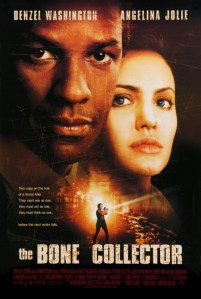 Another serial killer movie? Didn’t we as an audience learn our lesson already with Kiss the Girls? Apparently not with this latest adaption of standards and predictability that does nothing more then reinvent the old blaming the butler routine. And may I affimingly add that whoever the critic who gasped that this is on par with the masterpieces of Silence of the Lambs and Se7en either is lying through their teeth or has their children’s college education payed exclusively by Universal.
The Bone Collector has fancy gloom, grit, and gore, but it has no substance whatsoever. The script has the feel of being pasted together from leftovers of earlier better movies. It takes one illogical shift after another until the supposedly “surprise payoff” ending comes charging in but echoes more of a unified feel of rip-off instead. Contrivances are in abundance with every scene, and further prove the superiority of Lambs and Se7en in how well they achieved perfectly tuned thrills. The Bone Collector‘s biggest disappointment is in its utter lack of substantial entertainment when the core of the movie is Angelina Jolie getting dirty in dark places wielding a flash light. This kind of stuff may have worked at summer camp around the fire to scare people, but on the big screen the only ones to cower in terror will be the extensively naive.
Not to lambast this clunker too much, because there is some credible acting from the star leads. Denzel Washington at least makes his role non-laughable which is saying a lot in respect, and Jolie looks like she is a fresh talent but this ain’t her vehicle to hitch on to. Her “gifted” police specialist at finding evidence doesn’t seem to special to me with the easily found clues that anyone could trip over.
The suspense in The Bone Collector boils down to flashes of gore and jumps to frighten instead of the meticulous psychological and intense battles in Lambs and Se7en. The serial killer genre is at a glut again, and The Bone Collector is merely the fat of that over-extension that would serve best to be cut loose.
Nate’s Grade: C-


 nathanzoebl
You must be logged in to post a comment.