Blog Archives
Promised Land (2012)
 Actors Matt Damon and John Krasinski co-wrote Promised Land, which has been labeled as the anti-fracking movie. I wish. While it does take a suspicious view of the practice of extracting natural gas via high-powered underground water jets laced with chemicals, the movie feels too timid to really land home its points, settling on a familiar narrative of the redemption of one man working for The Man. The character development feels like it happens overnight rather than through a gradual process. Damon begins as a corporate raider, a guy selling false hope to the economic downtrodden, and ends up an altruistic environmental fighter. I mostly found him to be a pompous jerk. The scenes with Damon squaring off against Krasinski, an environmental activist, are easily the best, giving the movie a bristling energy it otherwise lacks. Krasinski provides a fine foil and some snappy competition until a late preposterous plot turn muddies everything up. I feel like the writers, as well as director Gus Van Sant, wanted to lure in wary moviegoers with something more broadly appealing (the evolution of one man) versus a more alarmist, message-heavy movie. That’s fine, but at least give me a better story. Promised Land even falls into the trap of having he Damon/Krasinski competition come down to a woman (Rosemarie DeWitt) they both fancy. Because otherwise it wouldn’t feel serious, right? It’s a solidly acted movie, with some nice turns by veterans like Frances McDormand and Titus Welliver (TV’s Lost), but the movie just doesn’t live up to the promise of its potential.
Nate’s Grade: B-
Share this:

Lincoln (2012)

Steven Spielberg’s long in the works biopic of Abraham Lincoln could have easily been retitled, The Thirteenth Amendment: The Movie, such is the narrow band of focus. Lincoln is an engrossing, handsomely mounted study in the political machinations that went into passing the 13th amendment to outlaw slavery. Unless you’re a fan of history or politics, I can’t imagine that this movie is going to prove that engaging for you. This is a big movie about Big Moments with lots of people with beards giving speeches. Daniel Day-Lewis does a tremendous job as our titular sixteenth president, giving the man more foibles and traces of humanity than I can remember from any screen portrayal. Liam Neeson (The Grey) had long been attached to be Spielberg’s Lincoln, but I cannot fathom any other actor in the role after seeing Day-Lewis’s amazing work. I think he’s a shoo-in for his third Oscar. It’s intriguing to witness what a political animal Lincoln was, able to play off different sides to get his way. In the end, you may even feel a stir of patriotic pride, inspired by the good that government can grant with the right leaders for the right causes. The supporting cast all provide great performances, from Sally Field as the volatile Mrs. Lincoln, to James Spader as a conniving lobbyist, to Tommy Lee Jones as a stubborn curmudgeon… so basically Tommy Lee Jones. Just about every speaking part is a recognizable character actor. Who’s going to turn down the prospect of a Spielberg Lincoln movie? The tighter window of focus allows the movie greater depth as an important political juncture in our nation’s history, but Lincoln could have also been the 19th century equivalent of that Schoolhouse Rock song, “I’m Just a Bill.” This is an easy movie to admire but I think a more difficult film to love, to fully embrace.
Nate’s Grade: B+
Share this:

2016: Obama’s America (2012)
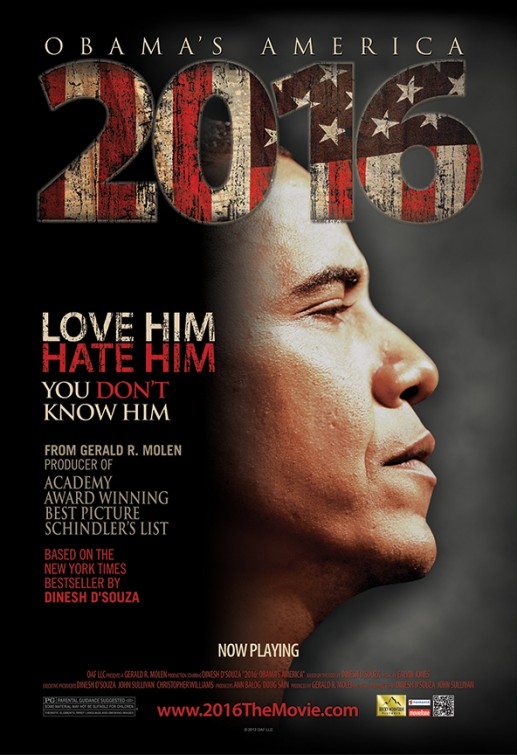 Dinesh D’Souza, noted conservative pundit and author, has risen to mainstream attention thanks to his documentary 2016: Obama’s America, a little movie making some big noise at the box-office. Co-written and directed by John Sullivan (Ben Stein’s Expelled), the film rationalizes that the American people don’t really know the true Barack Obama. D’Souza uses Obama’s own words from his best-selling memoir Dreams From My Father to try and decipher who the president is deep down, and D’Souza theorizes that the most powerful man in the world is really just trying to appeal to an absentee father. D’Souza visits the globe and promises to shed light on the “real” Obama, or, at least, the “real” Obama that fits into the narrative of a narrow political polemic.
After viewing 2016: Obama’s America, I am at a loss for words. This won’t last long, trust me.
This pseudo-documentary is such an intellectually dishonest, disingenuous, feeble-minded character attack, relying on heavy amounts of guilt-by-association, armchair psychology, factual whitewashing, leaps in logic, and ugly race-baited visual associations to remind its public that Obama is an “other.” I tried to be as objective as possible assessing D’Souza’s takedown on America’s first black president. I tried to analyze his rhetoric, his process of laying the case for his outlandish, paranoid claims. I tried to remove all personal politics from my assessment, and I still will attempt to keep them at bay, to simply review this as a “film.” What Obama’s America truly aspires to be is the evidence that your crackpot uncle cites as proof that his dismissive opinion of the president, that he’s not to be trusted, that he’s trying to destroy the country from the inside out, is correct. In this fashion, D’Souza is trying to give cover for the crackpots.
Let’s start with D’Souza’s fundamental thesis that supposes that Obama’s entire motivation is to live out the ideals of his father. He’s trying to impress his absent father. I cannot buy this broad generalization, and D’Souza keeps returning to it like he’s the only one who can see this obvious conclusion. I find it hard to believe that the father Obama saw once in his life is really the guiding force of his worldviews. Therefore, the more information D’Souza spills about Obama’s father the more he’s repeating the same conjecture without making any concrete connection. He interviews friends of Barack Sr. in Kenya and asks for their views of President Obama, a man they’ve never known. There is a litany of interview subjects with tenuous connection to Obama, most are always a step or two or more removed from the man himself. We get his mother’s college professor and Obama’s half-brother living in Kenya. That’s about as close as the movie gets. Often the interview subjects will disintegrate into weak hearsay (“I interviewed a guy who knew his father, so I guess I have some credibility.”). I also found it odd how when his interview subjects refer to his radical father, they keep repeating the name “Barack,” and not specifying senior or father. It happens so often that the intended association is quite transparent. Here’s a clue you’re dealing with a crank: D’Souza tries to make hay out of the fact that Obama’s book is titled “Dreams FROM My Father” and not “Dreams OF My Father.” Rarely has one preposition been given such (half-assed) psychological insight. The fact that the movie purports to get at the “real Obama,” and this is the scraps it offers, robs the movie of any desperately desired insight or credibility.
 The movie, especially the first 20 minutes, is also the story of D’Souza and his personal journey of why he feels America is the greatest land of them all. Just because the man was born the same year as Obama, got married the same year, and comes from a foreign country (though Obama is an American citizen who only spent four years abroad, but I digress), doesn’t mean somehow D’Souza has been given such psychic insight into the mind of Obama. Like Michael Moore, D’Souza inserts himself and his life story into his narrative when it’s not essential.
This would also work as an excellent case study in psychological projection. Since we don’t get people close to Obama, we get lots and lots of conjecture and people offering their “esteemed” analysis of the man. These so-called experts do what the man’s worst critics do, which is ignore the reality of Obama and project their radical interpretation of the man. An even-keeled centrist is a boring narrative, so now he becomes a Marxist, a socialist, a leftist radical, an enemy of the American way of life. This just doesn’t jibe with a pesky thing known as the facts. If Obama is really the socialist he’s labeled, then he’s a horrible socialist. No public option? Recycling the Republican health care plan from the 1990s, including the mandate? Relaxing more gun control laws than Bush did in his entire presidency? Stepping up record numbers of drone attacks in Afghanistan and Pakistan? Does that sound like a guy who’s “weirdly sympathetic to jihadists”?
D’Souza and his interview subjects even take the step of saying that Obama’s even-keeled style is really just a front, that deep down he’s a raging black man just like failed presidential candidates Jesse Jackson and Al Sharpton. The reason we don’t see this font of anger is because, and here’s the ingenious part, Obama knows how to manipulate us all! He’s secretly hiding his surplus of radical anger through emotional pragmatism. Not only that, Obama is manipulating race relations to lull us into complacency, because he knows white America wants to be assuaged of feeling racist, so we’ll appreciate and advance an African-American man of merit. Excuse me? Does that make sense to anyone, that instead of just being, you know, a pragmatist, Obama is secretly exploiting white guilt to advance, because otherwise how would this man become president unless we were all duped? None of that holds together. D’Souza’s 2010 book was called The Roots of Obama’s Rage (he also penned the 1995 book The End of Racism, so I guess he was just a little early on that one). The fact that two years, or less, into his presidency, D’Souza is ready to lambaste the man as “rageful” makes me think that D’Souza just cannot perceive objective reality like the rest of us.
D’Souza and company also take any opportunity to de-legitimize the man’s accomplishments. Obama didn’t win the presidency because he was an eloquent, charismatic, intelligent, and compelling political figure, not to mention that he got ten million more votes than John McCain. Could Obama have achieved the historic because of his accomplishments? According to this movie, Obama won the 2008 presidential election because of one thing: he was black. You see foolish reader, America as a nation wanted to assuage any collective white guilt over the transgressions of our ancestors, so we all (myself included) voted for the man as a declarative statement once and for all that we are not racist. Maybe a handful of people were motivated by such a ludicrous notion, but all 69.5 million Obama voters? This is not the film’s only simplistic generalization. We also have a psychological expert on what an absentee father does to a child. This is not a unique situation in our culture, nor is it one that prescribes a catchall response. Just because one person grows up without a father does not mean they will rigidly follow the same path in life; there are too many variables to prescribe one fate.
 The most telling moment occurs when D’Souza visits Kenya to trace Obama’s father’s life. He interviews the president’s half-brother and tries to needle him that his distant, famous relative is callous. “Why hasn’t he helped you out here?” D’Souza presses. “He has a family of his own. I can take care of myself,” the half-brother reasons, adding, “He’s got other issues to take care of.” This is the only member of Obama’s actual extended family that D’Souza manages to snag an interview with, and he shuts down his line of inquiry pretty succinctly. Later, the man gives some rather hostile views of Israel, which is meant to signal that any possible points he made should be invalidated.
Then there’s just the disingenuous and petty digs that omit key clarifying facts. D’Souza keeps railing against Obama as an anti-colonialist. First off, who in this day and age is going to champion colonialism, a system where the strong take from the weak? And why is colonialism even a relevant prism for the twenty-first century? Again, D’Souza offers little evidence to tie his theories to the man he’s critiquing. One of his key pieces of evidence is that Obama returned a bust of Winston Churchill back to England. For D’Souza, this is a sign of his distaste for Churchill as a colonialist. However, the facts are that the bust was on loan and scheduled to return to England anyway, before Obama took office, and there’s another bust of Churchill that remains in the president’s private offices. What an inconvenience the actual facts make. I’d like to share my friend and PSP colleague Ben Bailey’s thoughts on this specific matter:
“Little known fact I just learn from the Obama 2016 documentary: The bust of Winston Churchill that used to be kept in the White House was actually a magical artifact that protected this country from socialism as long as it was in America. Naturally, the Anti-Colonialist Obama’s first action upon taking office was to send that shit back. The other bust of Churchill that still resides in the White House does not have any magical powers, so it was kept.”
D’Souza also hammers home the notion that Obama opposes the British rule of the Falkland Islands, a tiny group of islands off Argentina’s coast. Another casual fact-checking venture proves this is false. The U.S. refused to endorse a declaration of Argentina’s claim of ownership. And these are just the petty examples of D’Souza’s argument approaching snide, dickish territory.
There are also the demonstrably false assertions, like Obama’s desire to destroy America’s superpower standing. D’Souza likes to obfuscate the eight years of Bush, speeding over him quickly in a timeline, lumping the national debt explosion under “Bush and Obama.” Conservative pundits like to lambaste the president for the dour economy, which has improved over the past four years, but they also conveniently forget the mess the man inherited. To ignore eight years of policies that helped lead to near financial ruin, two wars that Bush also left off budgets and Obama did not, among other things, is to remove all context. It’s like setting your house on fire and then blaming the next guy for trying to put it out: “Why haven’t you fixed everything yet, pal?” Record debt and financial ruination did not suddenly appear one day in January 2009 when a Democrat took office, despite what some choose to believe. Forgetting the eight tumultuous years of Bush, and their far-reaching complications, is a disservice to history and an ignorant understanding of how we got where we are now.
 Then there’s D’Souza’s dangerous assertion that Obama wants to weaken this country by cutting defense spending and our number of nuclear warheads. Anyone that talks about seriously reducing debt and the deficit and doesn’t offer slashing defense spending, a huge part of the pie, is simply not committed to their goal. Like not one dollar of defense spending is wasteful, and any cuts would endanger the security of American life? We’re drawing down two wars; do we need to keep spending like they’re still active? Also, Obama wants to reduce the world’s nuclear arms, and what’s so wrong with that? How many warheads do you need? Are 1,500 warheads not enough to blow up the world ten times over? The notion that any reduction in arms or spending accompanies “weakness” is fanciful. Obama doesn’t want to weaken this country by reducing America’s nuclear stockpile while the world continues to wield these weapons. He wants to reduce all the world’s nuclear arms to zero, an ambition D’Souza callously dismisses as fantasy. You know who also wanted to reduce nuclear weapons to zero? Ronald Reagan, D’Souza’s hero. As per his 1984 speech: “My dream is to see the day when nuclear weapons will be banished from the face of the Earth.” Even Superman was for limiting nuclear arms!
Now, as a piece of pure agitprop, Obama’s America suffers as well. D’Souza is no conservative alternative to Michael Moore, an expert at crafting a cohesive message with needlessly duplicitous measures. There is no subtext here; it’s all text. There are literally slasher movie violin shrieks on the soundtrack when D’Souza and an interview subject discuss the debt under Obama. There’s the image of thorn-covered vines covering the Middle East, threatening Israel to become the “United States of Islam.” There is no connecting of the dots, there’s only wide conjecture and baseless fear mongering. What this movie becomes is one long string of codes and buzzwords and dog whistles, meant to elicit a certain response from its likely audience. How many times does the phrase “Third World” need to be repeated? D’Souza even tries to turn Hawaii as a stalwart of radicalism with ONE interview from a guy who makes unsubstantiated claims. D’Souza also reminds the audience, as a wink to the birthers out there, that Obama’s birth was reported in two Hawaiian newspapers. What other purpose is there to mention this ordinary fact other than to appeal to the birthers in a coded manner? There’s a lot of juxtaposition between foreign cultures, Kenya, Indonesia, but what about the fact that Obama spent a far majority of his life in the United States? The man spent four years in Indonesia, and D’Souza makes it sound like this was the central formation of the man’s worldviews, not as he grew into maturity, went to college, and practiced law. Surely Obama became the man he was when he was seven years old, just like the rest of us.
D’Souza collects a conservative rogue’s gallery of people who must have had tantamount influence on Obama, including old targets like Bill Ayers and Rev. Wright. This is a continuation of guilt by association, a common tactic in 2008. Obama’s half-brother in Kenya talks about the West’s need to “tame Israel,” so D’Souza relies on us to make the connection just like with his father. If Obama’s family thinks this way, surely the son they have seen so rarely must be in lockstep? Because nobody ever differed in political views from his or her family.
 2016: Obama’s America, which hilariously predicts the end of the American empire circa 2016 (I guess a Republican president won’t be able to fix things), is a documentary that will convert no one. It’s constructed entirely to reinforce the alarmist notions of the president’s most fringe detractors. D’Souza doesn’t deal with facts because they get in the way of his exaggerated narrative of a fictional Obama, a man who is destroying our country in a quest to prove himself to his absentee ghost of a father. There’s plenty of logical inconsistencies, conjecture, and psychological projection and little evidence besides the expert opinions of people who knew a guy who knew a guy who knew Obama Sr. There’s plenty of unintentional comedy to be had, however, like a ludicrous racism-is-dead visual reenactment where a black man is upset because people at a bar are purposely giving him the cold shoulder (racists!). A minute later, they come out with a birthday cake and everyone in the bar, including the tattooed biker dude, erupts in applause for the heralded black man (see how wrong you were, world?). The basic assertion that Obama’s presidency is his attempt to live out his father’s ideals doesn’t stand up to scrutiny. It marginalizes a complex, educated man, saying he’s just a daddy’s boy, just like the film marginalizes the president’s historic election by saying it was simply an outpouring of white guilt (what about non-white people?).
I repeat: this pseudo-documentary is such an intellectually dishonest, disingenuous, feeble-minded character attack. It’s slimy, snide, petty, and wallows in conjecture and fear mongering. When the denizens in my theater applauded by film’s end, I felt a great sadness wash over me. If these people thought this appalling film was effective, was compelling, was informative, and was accurate, then I fear what prism these people choose to view the world through. Because 2016: Obama’s America isn’t just a horrid example of propaganda, it’s also the worst movie of the year, bar none.
Nate’s Grade: F
Share this:

The Campaign (2012)
 Broad and oafish for political satire, The Campaign has some decent belly-laughs to it with the main point that our national political environment has become a parody of itself. It’s Will Ferrell doing his usual boorish boob stuff and then there’s Zach Galifianakis as an effete, weird, family values doofus. When it gets looney, The Campaign is at its best. I loved a town hall that descended into a mob chanting their willful opposition to Rainbow Land. I enjoyed that Ferrell’s punching of innocent creatures was turned into a running gag. Having a racist old man pay his Asian maid to talk like an old black mammy because he misses the good old times? That is downright inspired and I giggle just thinking about it. The campaign commercials were perfect, and who knew Dylan McDermott could be this funny as a political ninja? The problem is that the movie works best as a series of scenes but doesn’t add up to much more. Some of those scenes are hilarious, and others are just passable lowbrow entertainment. Then the movie tries to foster a happy ending, with the evil business tycoons (an obvious avatar of the Koch brothers) foiled. I do not believe that satire can have a happy ending. It undercuts the angry, sardonic message of the movie. It’s just not the right fit for the genre. Alas, The Campaign tries to insert some pathos into the mix and it feels false and far too tidy. As for summer comedies, the movie has a few killer jokes and an amiable presence, plus a very short running time so as not to wear out its welcome. Like most politicians argue… you could do worse.
Nate’s Grade: B-
Share this:

J. Edgar (2011)
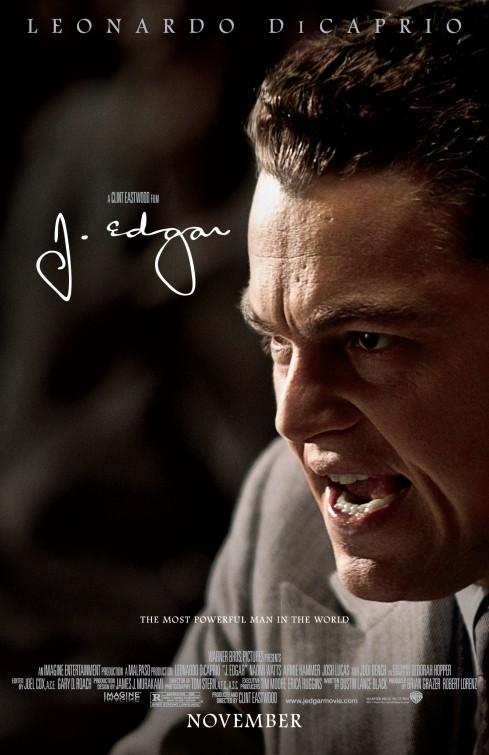 J. Edgar has all the qualities you’d want in a high profile, awards-friendly movie. It charts the life of legendary FBI head J. Edgar Hoover, it stars Leonardo DiCaprio in its title role, and it has Oscar-winner attached as screenwriter (Dustin Lance Black) and director (Clint Eastwood). The only way this movie could be bigger awards bait was if Hoover personally challenged Adolf Hitler to a duel. At a running time of 137 minutes, J. Edgar misses out on explaining why this complex man was who he was, a difficult prospect but I would have at least appreciated some effort.
J. Edgar Hoover (DiCaprio) was, at his height, said to be the second most powerful man in the United States. The first director of the Federal Bureau of Investigations served under eight presidents and for over 50 years. The man rose to power fighting against radicals and Bolshevik terrorists in 1919. Hoover successfully arranged for America to deport foreigners with “suspected radical leanings.” He was appointed to head the, then, Bureau of Investigations, where Hoover remade the agency in the image he desired. His agents were going to be clean-cut, college-educated, physically fit, and God help you if you had facial hair. Hoover also fought to bring modern forensic science into investigations and trials, proposing a centralized catalogue of fingerprints, which at the time was dismissed by many as a “speculative science.” Hoover also amassed an extensive system of confidential files on thousands of American citizens he felt were potential threats or if he just didn’t like them. Hoover wasn’t afraid to bully presidents with this secret catalogue. On a personal level, Hoover was admittedly without any friends or interests outside the agency he felt responsible for. His life was defined by three close personal relationships: his mother (Judi Dench), whom Hoover lived with until the day she died; Helen Gandy (Naomi Watts), his loyal secretary and confidant of 40 years; and Clyde Tolson (The Social Network’s Armie Hammer), an FBI agent that Hoover shared a decades-long unrequited romance with. Upon Hoover’s death in 1972, Tolson was given Hoover’s burial flag, and Tolson’s own grave is a mere couple plots away from J. Edgar’s.
 The movie feels trapped in a closet alongside Hoover. The guy was rather enigmatic and hard to nail down, but I would have appreciated Eastwood and Black at least trying to figure the guy out. They treat the subject with such fragility, such sympathetic stateliness about his more salient personality points. It feels like Eastwood doesn’t want to get his hands too dirty, so the provocative material, like the gay stuff, is kept to very period appropriate acts of discretion. A handholding in the backseat of a car is practically scandalous given the treatment on the gay material. The oft rumored cross-dressing aspect is hinted at but explained, in context of the scene, as Hoover’s way of mourning the loss of his mother. With Hoover, there was only his public persona of a moral crusader, a face that he never removed even in his private moments. The guy could never embrace happiness, only duty. It feels like Eastwood couldn’t decide on what stance to take, and thus the film settles on a bloodless examination that won’t upset any of the, presumably, delicate sensibilities of the older audience members. A towering figure of moral certainty, extreme paranoia, righteous conviction, a vindictive streak against his mounting collection of enemies, and a shaky hold on the truth, all in the name of protection against America’s many real and imagined enemies – I feel like the blueprint has been established for the eventual Dick Cheney biopic. It’ll just be slightly less gay.
Let’s talk more about the gay factor. It feels like this area is where Eastwood definitely could have pushed much further, but the old school director seems to be of the opinion that a biopic need not pry nor speculate. Excuse me, but you’re telling me about a man’s life, the least you could do is dig deeper. A domineering mother, who said she’d rather have a dead son than one of those “daffodils,” and the moral restraints of the time, are easy enough to identify why Hoover was a repressed homosexual. That doesn’t separate him from probably a far majority of homosexual men in the first half of the twenty-first century. What makes Hoover, a repressed homosexual, tick? This is no Brokeback Mountain style whirlwind of untamable emotion. Eastwood keeps things chaste, choosing to view Hoover as a celibate man. Hoover and Clyde becomes inseparable “companions,” eating every dinner together, going away on trips, and enjoying the pleasure of one another’s company – the life of the lifelong “bachelor.” But that’s as far as the movie is willing to go (remember the scandalous handholding?). There are hints about how socially awkward Hoover can be, a guy who seems downright asexual at times. He proposed to Helen on a first date where his attempts to charm included showing off his card catalogue system at the Library of Congress (“I bet you show this to all the girls…”). You get the impression he’s not comfortable with this necessary area of human biology. That’s fine room to start, but J. Edgar doesn’t do anything but start its characterization ideas. It gives you ideas to toy with and then moves along. The relationship with Clyde hits a breaking point when Hoover discusses, during one of their weekend getaways, the prospect of finally choosing a “Mrs. Hoover.” Naturally Clyde does not react well to this development, and the two engage in a brawl that ends in a shared bloody kiss. This is about as passionate as Eastwood’s movie ever dares to get.
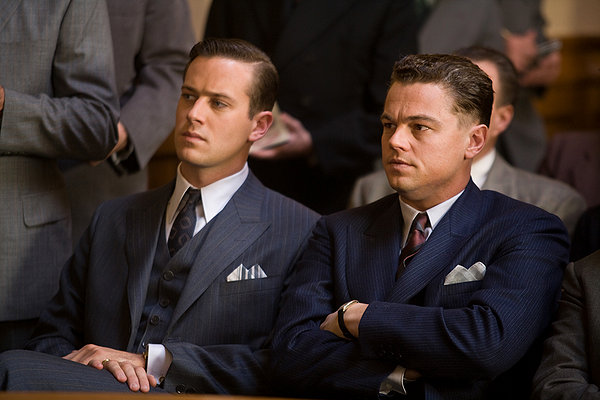 I expected more from the Oscar-winning writer of Milk. Black’s lumpy script can often be confusing, lacking a direct narrative through line. Some leaps in time can just be confusing, like when J. Edgar is asking his junior agent typist what figure was most important in the 20th century thus far. The agent answers, “Joe McCarthy,” and then we have a new agent sitting there, and Hoover asks again. Finally we have another agent who responds with Hoover’s desired answer, “Charles Lindbergh.” I suppose we’re left to assume that Hoover fired his typists until he found one who mirrored his own thoughts. There is also far too much time spent over the Lindbergh baby case. I understand it’s the so-called Crime of the Century and, as Black sets up, a situation for Hoover to prove his bureau’s value when it comes to modern criminal science. It just goes on for so long and rarely offers insight into Hoover. Sans Clyde, the majority of the supporting characters offer little insight as well. Hoover’s mother never goes beyond the domineering matrimonial figure. Helen seems like a cipher, rarely giving any explanation for her decades of loyalty despite clear objections to certain choices. She’s too often just a “secretary” there to move the plot along by introducing more characters of minimal impact. With Hoover being such an enigmatic and closeted figure, the supporting characters could have been the areas we found the most insight into the man. Nope.
The entire plot structure feels like a mistake. Hoover is dictating his memoirs so we primarily flash from the 1930s, when Hoover was making a name for himself, to the 1960s, when Hoover is fighting a secret war against, of all things, the Civil Rights movement and Martin Luther King Jr. (he was convinced King was tied to communists). The back-and-forth nature of the story can lead to some confusion over facts and timelines, but the concept of Hoover dictating his memoirs means that the movie becomes a greatest hits compilation, a showcase of Hoover’s finest hours in an attempt to win public support back. He can explain his obsessions and justify his overreaches. That’s why Hoover’s entire catalogue of secret files on thousands of American citizens, including presidents, is given such short shrift. Why would he want to discuss his own subversive tactics hunting subversive elements? The only time the screenplay discusses this secret catalogue is when Hoover and Clyde want to have a good laugh over Eleanor Roosevelt’s lesbian paramour (irony?). Richard Nixon covets these files, so Helen swears that upon the death of her boss that she will shred every page before Tricky Dick can get his hands on them (J. Edgar is rated R for “brief strong language,” and they are all provided by potty-mouthed Nixon). Black attempts something of an Atonement-styled ending with an unreliable narrator, but the effects are slight and only superficial and too late.
 At this point it’s probably going to be rare for DiCaprio (Inception, Revolutionary Road) to give a dud performance. The actor isn’t the first name you’d think of for a Hoover biography. Regardless, the guy does a great job especially with the emotional handicaps given to him by Black’s script and Eastwood’s direction. Given all the emotional reserve, it’s amazing that DiCaprio is able to make his character resonate as much as he can, finding small nuances to work with. Hoover’s clipped speaking style, likely the most readily recognizable feature of the man, is here but DiCaprio does not stoop to impression. He’s coated in what looks like 800 pounds of makeup to portray Hoover in the 1960s. The old age makeup looks good on DiCaprio, though the same cannot be said for his inner circle. Older Clyde looks like he is suffocating behind a gummy Halloween mask; the man looks like he is mummified in his own liver-spotted skin. Older Helen just looks like they powdered her face and added some gray to her hair.
The movie seems to take its emotional cues from its subject; far too much of J. Edgar is reserved, hands-off, and afraid to assert judgment on what was a highly judgmental man of history. What makes Hoover compelling is his array of contradictions. He’s defined by three personal relationships (mother, Clyde, Helen), all of whom he could never have. That’s got to mean something. Instead of exploring these contradictions in any meaningful psychological depth, Eastwood seems to take his hand off the wheel and the film just casually drifts along, steered by the self-aggrandizing of Hoover himself, given so much room to explain detestable behavior in the name of protecting America. J. Edgar is a handsomely mounted biopic with some strong acting, but from Eastwood’s impassive direction (his piano-trinkle score isn’t too good either) and Black’s lumpy script, the finished work feels too closed off and arid for such a controversial subject worthy of closer inspection.
Nate’s Grade: B-
Share this:

The Ides of March (2011)
 The Ides of March is that rare political thriller that pulls the curtain away to come to the stolid conclusion that our entire political system is incontrovertibly stuck in the muck. This is a deeply cynical movie that posits that politicos are just about spinning truth, cutting backroom deals, attaining power and influence, and living to fight another day. Even the ones who champion integrity have plenty of salacious skeletons in their closet. So while Ides of March is in one way a liberal reductive fantasy, casting co-writer and director George Clooney as an Obama-style change agent, and Clooney can assert all the rabble-rousing missing from the current occupant of the White House, it still sticks to its deep-seated cynicism. There is nobody that looks good by the film’s end. Ryan Gosling stars as a magnetic campaign director trying to push his guy over the top by winning the all-important Ohio Democratic primary. As the primary gets closer and the race gets tighter, Gosling has to cover up potential scandals while skillfully using his intimate knowledge of them for opportunistic deal making. The film moves at a great clip, the dialogue is intelligent, the characters are rich and ambiguous, and every one of the sterling thespians gets at least one big scene to stretch their acting muscles. The film has plenty of intriguing twists and turns, as the pieces all fall into play for one final power play. If you’re a fan of smart political thrillers, then do not beware The Ides of March.
Nate’s Grade: B+
Share this:

The Tillman Story (2010)
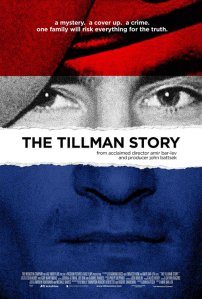 Perhaps better than any movie I’ve ever seen, the searing documentary The Tillman Story explores the nature of shared grief and whether a family is even entitled to privacy when the world feels like it has a shared pain in their loss. This documentary focuses on former NFL star Pat Tillman who enlisted in the Army Rangers in 2002 and was killed in 2004 in the mountains of Afghanistan. He was hailed as a hero of battle, saving his men from enemy ambush, but the truth was really far less sensational but just as damaging. Tillman was killed by friendly fire, a fact the Army admitted only with their backs against the wall. Tillman was their most famous soldier and became a recruiting poster for the post-9/11 armed forces. The doc recounts Tillman’s family struggling to get a straight answer from Army officials and government goons who felt the truth could not compare to a good story. While recreating the events that lead to Tillman’s death in a mostly commanding manner, the doc’s real draw is exploring the idea of a family who has had their private mourning torn away, who are trotted around the nation to events memorializing their son, turning him into whatever symbol best serves personal agendas (conservative pundits are seen in stubborn disbelief when it comes to processing the news that Tillman read Noam Chomsky, thought the Iraq War was illegal, and was going to vote for John Kerry in 2004). What gets lost in all that patriotic maneuvering is a complicated man who didn’t want to become a myth.
Nate’s Grade: B
Share this:

Client 9: The Rise and Fall of Eliot Spitzer (2010)
 Alex Gibney, the Oscar-winning documentary filmmaker behind Enron and Taxi to the Dark Side, rolls out his third 2010 entry in what must have been a rather exhausting year for the man. The focus is on former New York attorney general and governor Eliot Spitzer and his fall from grace after being linked to a high-end prostitution ring. Gibney charts the man’s rise and fall in a fairly straightforward and engaging manner, though you start to wonder if there’s really enough material to fill out a two-hour feature. Spitzer speaks candidly and will not humbly vanish as some may wish; the man is an intriguing mixture of righteousness, ego, and humility. What’s most fascinating about Client 9 (named after Spitzer’s name in the FBI sting) is that Spitzer gained a wealth of enemies when he went after Wall Street largesse and greedy shenanigans, and they all want to be on camera. No one with a serious grudge against Spitzer, including men who have since been convicted of crimes and ethics violations, refuses an interview. Gibney draws together a fairly convincing thesis on the take-down of Spitzer, a cabal of powerful execs, politically motivated prosecutors in the Bush administration, and government officials who reject accountability. It’s all circumstantial evidence, to be sure, but there’s a mountain of it. There is a definite conservative-backed coordinated effort to sully and embarrass the man. But ultimately, Spitzer admits that he is responsible for his sins. You will never get full satisfying clarity as to why he sought out the comfort of prostitutes in the first place. I don’t think even Spitzer knows for sure. But that’s an age-old mystery that can’t be tied up in two hours.
Nate’s Grade: B
Share this:

Casino Jack and the United States of Money (2010)
 Alex Gibney is a masterful documentary filmmaker, having crafted Enron: The Smartest Guys in the Room and the Oscar-winning Taxi to the Dark Side. His latest doc chronicling the rise and fall of corrupt lobbyist Jack Abramoff is insightful, clear-eyed, and entertaining like his other work, but something’s missing here and it’s hard to put my finger on it. Gibney’s doc lacks the fire and outrage of his previous exposes, so Casino Jack doesn’t hold your attention as strong. It focuses closely on Abramoff’s scandals and his influence peddling and gives shrift coverage to bigger issues about our government being for sale to the highest bidder. The lack of attention to a bigger picture hurts the movie’s power. But ultimately I think what makes Casino Jack lacking is that it is missing one very key participant — Abramoff. Gibney interviewed the man several times in prison but Abramoff declined to be involved after pressure from federal prosecutors. By all accounts, Abramoff is a charismatic, larger-than-life figure, whose Reagan era College Republican idealism transforms into greed and out-of-control hubris (Abramoff foolishly wrote every single thought down in e-mail). His absence is noticeable and blunts the storytelling angles the film can take. With Abramoff’s side, there could be much more insight and dirt. Casino Jack is a solid viewing but not up to snuff for Gibney. Wait for the Kevin Spacey film later this year.
Nate’s Grade: B
Share this:

In the Loop (2009)
 This is one of those movies that are so sharp, so bristling with intelligence, that you practically need to have a remote control glued to your mitt so that you can rewind and catch all the jokes. I turned the subtitles on myself just to make sure I could get everything. This British comedy is a wicked satire of the miscommunication and blunders that lead the U.S. and Britain into declaring war on a Middle Eastern country. There are some topical jabs but so much of the humor comes from the fractious character interaction; there is a real joy to watching these larger-than-life personalities clash over the course of two nations. It’s fascinating and biting and plays out like a more profane version of The West Wing. The cast is fantastic from top to bottom, with special notice going to My Girl‘s Anna Chlumsky all grown up and perfect with comic timing, and Peter Capaldi as the fearsome, fire-breathing British Director of Communications who can split an epithet like nobody’s business. You might expect his head to burst with how apoplectic he can get. This may be the most quotable comedy in years; every line of this screenplay is gold. There are Hollywood comedies that would kill for just one or two of the choice lines here, but In the Loop is chock full of the funny. It’s a machine gun spray of comedy. Something this scathing and this brilliant doesn’t come along every day.
Nate’s Grade: A


 nathanzoebl
You must be logged in to post a comment.