Blog Archives
Bombshell (2019)
 More an expose on toxic work environments than anything overtly political, Bombshell is an effective true-life drama about the many pitfalls, humiliations, traps, harassment, and compromises that women face in the workforce. We follow the downfall of news magnate Roger Ailes (John Lithgow), the imposing man who built the Fox News empire and who also bullied his employees and solicited sexual favors from the many women who were on his payroll. Margot Robbie plays an invented character meant to provide that entry point into Ailes the creep in creepy action. She’ll be harassed and pressured for sex by a man described as “Jabba the Hut,” and Robbie is terrific in her big dramatic moments portraying what the pressure and shame does for her ambitious anchor. The other two main characters wrestle with how far to go in a corporate culture of keeping secrets from very powerful, very dirty old men. Gretchen Carlson (Nicole Kidman) is consulting lawyers for a personal harassment lawsuit against Ailes the person, not Fox News, but she needs other women to come forward. Megyn Kelly (Charlize Theron) is struggling with the scrutiny she has endured after then-presidential candidate Donald Trump turns his small Twitter thumbs against her. The Fox bigwigs won’t go on record to defend her, and their journalists, because they need Trump to drive ratings. The movie uses several Big Short-style narrative tricks to help tell its sordid tale, including swapping narration and fourth-wall breaks; a run through of hearing from Ailes’ past victims in their own words is striking, especially a woman who says she was only 16 at the time. Part of the fun are the many many cameos and just watching actors portray different Fox News personalities (Richard Kind as Rudy Guiliani!). The makeup is also phenomenal and Theron looks unrecognizable as Kelly. The film itself doesn’t feel like it’s telling you anything you already don’t know about the subject; people will compromise their morals for personal gain, power leads to exploitation, women are unfairly treated, and it’s easier to fall in line than stand up to power. There’s still a thrill of watching the downfall of a serial abuser, and the acting is strong throughout, but Bombshell can’t shake the feeling of being a slicker, more star-studded TV movie version of recent history. Even with the urgency of the topic, it feels light, and not because of its use of incredulous humor. I could have used more behind-the-scenes details, and maybe that’s where Showtime’s miniseries The Loudest Voice comes in, retelling the same story with Russell Crowe as Ailes. It’s a solid movie on a very pertinent subject and worth seeing but it also makes me wish for a harder-hitting, more widely sourced expose on this very bad man who felt forever protected by the status quo of power.
Nate’s Grade: B
Share this:

Long Shot (2019)
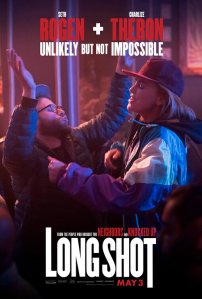 Secretary of State Charlotte Field (Charlize Theron) is preparing for the moment she feels her whole life has been leading up to: a presidential run. the current president (Bob Odenkirk) has decided not to run for a second term and wants to endorse her. Charlotte and her team of dogged, loyal assistants (June Diane Raphael, Ravi Patel) are sifting through ways to improve her negatives as a candidate, and that’s where Frank Flarsky (Seth Rogen) comes in. He’s an activist journalist that has just been fired and he also happens to personally know Charlotte; she was his babysitter. He comes aboard her campaign with the condition that she really fights for what’s important and not cave to the powerful lobbies and interest groups. He rewrites her speeches and the two of them grow closer together, bonding over their past and a possible future, not just as president but as boyfriend-girlfriend. They must keep their feelings a secret for the time being. If the press found out it might kill her candidacy before it ever really began.
The film’s biggest strength is the emphasis with the leading characters and the crackling chemistry between Rogen and Theron. It’s a fairly familiar dynamic between the more buttoned-up personality learning to cut loose and the more wild and impulsive personality learning a degree of self-restraint and responsibility. And to be fair Long Shot does pull from this familiar foundation for a starting point with its odd couple dynamic. However, it goes further by making their differences more attuned to politics and compromise. Fred is unwilling to back down for the things he knows are right and would rather have nothing than a watered-down version of the important issue he had been fighting for. Charlotte is more the political animal and used to working with others, including scoundrels and morons, in order to affect change. She’s about incremental, pragmatic change for the greater good and he’s about ideological purity as a moral imperative. This isn’t just a small character quick either; it’s a defining conflict between both characters and a subject that gets further examination as Charlotte confronts the realities of running for president and the many compromises of self and vision may or may not be needed.
 Being a woman running for president is an obstacle course of having to deal with latent sexism and other people’s expectations of what is socially appropriate. Charlotte is going to be judged harsher for the same behaviors men will be excused for; this isn’t a new observation by any means (apply your favorite double standard here) but the film makes you understand the pressure and scrutiny that befalls her at every turn. It defines her character, which is why finding someone she can unwind with and be her true self away from the cameras is such an understandable and desirable escape valve. She’s running to inspire little girls that they too can be president but at she also has to assess the cost of how much she’s willing to hide or lose from herself in order to get across that finish line, and if she does, what will be left? That’s the role for Alexander Skarsgard, the Justin Trudeau-like Canadian prime minister, who represents what is left of a person after bowing to opinion polls. Again, this isn’t new material, especially as anyone who can recall the 2016 presidential election will recall the questions of physical and mental fortitude that only seemed attached to one candidate and not as much the other. What this political reality does is provide a relevant substance for the romance and comedy portions of the film, making the characters feel more human. When Fred is articulating just what he must do to serve as a secret boyfriend for Charlotte, and a potential future they would have, you can hear his heartbreak with each new syllable. You also realize that he shouldn’t have to endure that and maybe these two are destined not to be together because of how unfortunate our politics and media environment have become.
Rogen and Theron are a blast together and have a fun rhythm they play off each other for unexpected comedy beats. His mellow vibes and good-natured joviality, as well as general awkwardness around people in power, are a nice fit with her sterner self. The best parts of the movie are just watching both of these actors enjoy their company. I won’t say that the romantic spark became overly apparent but what was undeniable was how well they paired as an onscreen buddy duo. With each new movie and every different role, Theron proves she’s one of the best actors of her generation. She can kick your ass, she can make you cry, she can win your heart, she can make you bust a gut. In short, Charlize Theron can do anything. She has several disarmingly funny moments, like when she’s high on ecstasy and pulled into an international crisis and has to maintain her cool. Rogen could easily fall back on his ease playing the oafish, insecure, crass characters of his past, but he does a fine job imbuing his charm, energy, and authenticity with Frank. Rogen is an anxious and generous scene partner who typically elevates his costars, and he and Theron as so good together that it sells their romance even better than the writing.
 Thankfully, Long Shot is consistently funny and bases much of its humor on the characters and their needs and developments. The movie isn’t just a retread of the incredulous fantasy of some ugly dude successfully romancing a beautiful woman. We’ve already had this dynamic explored in another Rogen comedy, 2007’s Knocked Up (in another universe where Katherine Heigl’s career didn’t stall, I could have seen Long Shot serving as an unofficial reunion for her and Rogen). There are jokes to be had about the unbelievable nature of this central romance and Rogen’s overall appearance, and that’s expected. What made me happier was that these wisecracks served a purpose to highlight how professionally damaging this potential relationship could be for Charlotte’s chance of winning office. They didn’t just feel like gratuitous put-downs. The joke emphasis is heavily tilted in favor of our two leads but there are nice moments with the supporting cast, like Raphael’s constant passive-aggressive comments, Bob Odenkirk’s buffoonish sense of betrayal with TV being turned against him, Randall Park’s frankness, and Skarsgard’s awkward and obsequious flirting. I don’t think the filmmakers fully knew what to do with O’Shea Jackson Jr. and provide some last-minute character shading that felt clumsy.
Long Shot follows the Judd Apatow rom-com formula closely and demonstrates that if you get funny, talented people together, provide them solid characterization and realistic conflicts, you can produce a winning romantic comedy that matters. Rogen and theron make an excellent team, the political content is savvy without getting too far into the weeds, and the romance is sweet and agreeable, with two genuinely enjoyable people coming to realize what they would be willing to risk for the other person. Long Shot is a reliably funny, bawdy, and heartwarming little movie with a little more on its mind than gross-out comedy set pieces. It’s worth seeking out this summer. I’d happily vote Theron for anything, especially if she was running for elected office as Furiosa. That’s a candidate that get results.
Nate’s Grade: B
Share this:

The Front Runner (2018)
 In 1987, former Colorado senator and governor Gary Hart (Hugh Jackman) was the leading Democrat in primary polling and a sure bet to take on George H.W. Bush for the White House. In three weeks time, his campaign was in tatters and he folded. It all stems from a supposed affair he was conducting with Donna Rice (Sara Paxton). They deny anything but Gary acts like he has something to hide, evading the media’s questions about his marriage and his past history with infidelity. Enough time has passed in the political landscape to take a deeper dive into Gary Hart’s disintegration in the spotlight, and the moment serves a tipping point for changing media coverage. Journalists talk about the “old days” where candidate infidelity and ailments were just ignored as a gentleman’s agreement of sorts between the gatekeepers, but should they have? While a candidate’s martial relations are significantly less important than policy and governance, they do reflect character and what he or she (but, let’s face it, mostly he) acts with authority. Strangely, The Front Runner wants to paint the hungry journalists digging into Hart’s past as the real enemy, going above and beyond the bounds of ethics for crass sensationalism. This is directed and co-written by Jason Reitman (Tully, Up in the Air), a shrewd storyteller with a knack for human drama, which makes the “both sides are bad” equivocation all the more curious. Jackman is strong and has several scenes of righteous speeches talking about how he didn’t sign away his privacy, except when you run for president, you kind of do, and the American public deserve to know if their leaders abuse power. The movie favors long takes with a wide supporting cast of players that speak like they stepped out of an Aaron Sorkin workshop (an exchange celebrating the “integrity” of news anchors wearing bad suits feels ripped right from Sorkin’s unguarded typewriter). The film is nicely sympathetic to the “other woman” in this scenario and treats her like a human being with dimension. The PR recovery and shady deeds of Hart’s team reminded me of the Chappaquiddick, which placed an unfavorable scrutiny on Ted Kennedy and his team of political spin masters after his deadly car accident. It all makes for an entertaining movie with solid performances and interesting character shading, but its perspective is too wobbly, trying to lay the blame on everyone it can find.
Nate’s Grade: B
Share this:

Vice (2018)
 If Oscar-winning funnyman Adam McKay can take the arcane, convoluted world of finance and spin it into one of the most entertaining, accessible, and enraging films of that year, then just imagine what he could do with the life of Dick Cheney?
We follow Dick Cheney (Christian Bale) from his early days as a college washout, to Washington intern to Donald Rumsfeld (Steve Carell), to youngest chief of staff in a White House administration, to Wyoming Congressman, and eventually Vice President to George W. Bush (Sam Rockwell) where Cheney redefined the VP role as a defacto second president. This is the story of his 60 years shaping the annuls of political power.
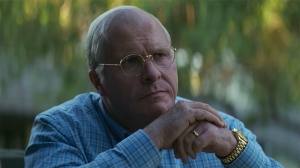
 If you have one reason to watch Vice, it’s the staggering performance by Bale (Hostiles). As is custom, the man completely transforms himself into his subject, gaining weight, building muscle in his neck to simulate the Cheney shoulder hunch, and going unrecognizable in startling older age makeup. He doesn’t just look the spitting image of Dick Cheney but he sounds like him too, exhibiting his cadences and mannerisms, and fully inhabiting the man every second he’s onscreen. It’s a compelling, captivating turn that ranks up there with Bale’s best. He’s beyond great but strangely nobody else is. Amy Adams (Arrival) plays Lynne Cheney, Dick’s wife and shrewd political partner, and her worst acting moment is her introductory scene where she lays into the young Cheney. It’s like an audition where the actor is hitting the wrong notes too strongly. Adams regains herself as the film carries on but never has a standout scene. Nobody else other than Bale is given the material to stand out. Rockwell (Three Billboards) and Carell (Beautiful Boy) are enjoyable and aided by impressive makeup, especially old Rumsfeld, but they’re given one note to play. Their roles become more impression than performance and both men drop out of the movie for long periods of time. The next best actor might by Tyler Perry (Gone Girl) as Colin Powell, and maybe that’s because Perry is used to brokering nonsense with his own array of nonsensical characters. He’s already the weary adult.
The meta interludes and fourth wall breaks that helped The Big Short succeed conversely are part of the problem with Vice. Most Americans know a decent amount about the Iraq War and its documented fallout, so there’s less need to have celebrities interject and explain complex scenarios and institutions (the absence of Margot Robbie in a bubble bath will always be felt). The narration by Jesse Plemons (Game Night) doesn’t feel necessary, and his ordinary identity becomes a guessing game for most of the film, trying to link him with Cheney. I was thinking he would be an Iraq War soldier and get killed later on, that way establishing a stand-in for the thousands of men and women who are no longer walking this Earth as a direct result of Cheney’s misguided action. Nope. When his identity is finally revealed you’ll go, “Oh,” and that’s it. Because he wasn’t really a character, he was a narrative device and one that didn’t stand for anything larger. The visual metaphors can also be very, very obvious. There are consistent cuts to Cheney fly-fishing in a river, meant to evoke him luring others into his desired machinations. Even the end credits feature fly-fishing imagery, in case you had forgotten about this enduring metaphor. The conclusion literally involves a heart being removed and the sequence cut along a more figurative betrayal, and you can feel McKay vigorously pointing at the screen and yelling, “See, it’s because he’s heartless, get it? Do you get it?” We get it. The documentary-style and comedic techniques that allowed The Big Short to be as entertaining and accessible, and one of the best films of 2015, are paradoxically the things that seem at odds with Vice.
 The meta breaks are meant to provide a degree of comedy to the picture, which is generally absent comedy otherwise, unless you count the rise of Cheney’s reign as the darkest of comedies. I suppose Cheney’s nonchalant recognition of his heart attacks (he’s had five) could be a potential comedic lifeline if you’re being generous. One second we’re told people don’t speak in Shakespearean soliloquies in real life, and the next second the Cheneys are talking in Shakespearean verse. When it looks like the Cheneys will drop out of public office to spare their gay daughter Mary (Alison Pill) the inevitable storm of harassment, the movie has a fake-out end credit sequence to sum up their hypothetical lives. To demonstrate Cheney’s knack for making the most ridiculous statement sound statesmen, he recommends that the Oval Office team put miniature beards on a part of their anatomy and perform an adult puppet show, which draws solemn nods of approval from the others. It’s a joke that feels too glib, like the intended point is being lost by the lewd nature of the comedic aside. The only meta aspect that feels earned is the final one, where Cheney turns to the camera and directly addresses the audience, acknowledging he can feel their contempt but refuses to apologize for his actions in order to keep people safe. Because he’s having the final say, because he’s offering a rebuff to his movie, it feels more earned and fitting, and it would have had even more power if it were the only break in the movie rather than the last. It’s hard to call this a comedy; it’s more an incredulous indictment looking for its mob.
I honestly think a straightforward biopic might have been the better route for Cheney. The first half of the film is more interesting and successful because it is the more illuminating half. I never knew that Lynne Cheney’s father likely killed her mother. That’s a pretty bold charge on behalf of the filmmakers. The early Cheney years are the moments the majority of Americans don’t know about, whereas the later years have been well documented by a slew of hard-hitting documentaries, books, and journalistic exposes. There are whole movies about topics like the Valerie Plame leaking (Fair Game), the mounting mistakes after the invasion of Iraq (No End in Sight), the administration’s policy on torture (Taxi to the Dark Side, Standard Operating Procedure), the drumbeat to the war and snuffing out of critical journalism (Shock and Awe, Lions for Lambs), the missing WMDs (Green Zone, Body of Lies), the Bush deferment memos (Truth), the long-term consequences for those servicemen who survive (The Hurt Locker, The Messenger, Stop-Loss, Last Flag Flying, In the Valley of Elah, American Sniper, Thank You For Your Service) and anything that Michael Moore sets his sights on. This list is not exhaustive by any means. Because of that the film seems to become a rudimentary montage once the Iraq War kicks off, sprinting through the rest as an intended tableau of hubris as Cheney’s star and influence falls. I would rather have learned more about Cheney’s early years in the Nixon, Ford, and H.W. Bush administrations and gleaned more personal insights into the man before he becomes this shadowy, mythic figure that seems downright Machiavellian in his control of government. It’s interesting to watch Cheney and his cohorts plot their unchecked executive power behind the back of President Bush, but then what?
 It’s the “then what?” question I keep revisiting with McKay’s film, trying to figure out the larger intended message, themes, and dire warnings. I feel like because of the expanse of time covered, and the meta quirks applied, that the film too often feels like it’s just scratching the surface of Cheney, providing a slight gloss to a political caricature. The biggest takeaway is the slippery slope of the “unitary executive theory,” a term you’ll hear often, that basically follows Nixon’s own words: “If the president does it, it’s not illegal.” This questionable interpretation of Article II of the Constitution gives the president powers that approach a monarch, which seems antithetical the Founders’ intents. McKay warns that any president could take advantage of this theory to do whatever he or she (sad trombone noise… sigh) desires. This is clearly meant to draw a line right to President Trump, but it’s not like the 45th president needs sketchy legal cover to do his misdeeds. The idea that the Justice Department memos would be a lurking danger is quaint. A bad man with power is not going to look for the rules to allow him or her to break them. The idea that a president could be above the law is also a legally specious argument and one I don’t believe our courts would readily back, even with the “unitary executive theory” (at least I hope so). With that in mind, Vice becomes a cautionary tale about the expenditure of power but lacks the adequate follow-through.
Vice is a tricky biopic for a tricky subject and I wonder if it would have worked better being stripped of its prankster, meta interjections and tricks. It’s a condemnation of Dick Cheney but it doesn’t feel like it goes far enough if McKay’s eventual thesis is that the current world problems began, or were grossly exacerbated, by the actions of Cheney. Climate change warnings going unheeded, ISIS formations going ignored, the generational consequences for unsettling the Middle East, and laying the foundation for an authoritarian strongman to be an acceptable political position for millions of Americans. These charges are clearly intended to be a denunciation of Cheney’s legacy, but the end results play out somewhat differently, like a slap on the wrist. I think Dick Cheney could even watch this movie and nod in appreciation. That seems like a mistake. McKay is still a talented writer and filmmaker that knows how to keep his movie flowing and entertaining, buoyed by an outstanding performance from Bale. It’s a movie with great components but seems to clumsily get in its own way with its presentation. If you’re going to expose Dick Cheney as a heinous manipulator of power that has wrecked havoc for billions, then maybe you don’t want to dilute your message.
Nate’s Grade: B-
Share this:

Fahrenheit 11/9 (2018)
 Does muckraking filmmaker Michael Moore even matter anymore? That’s the question in the wake of the tepid opening of his newest documentary, Fahrenheit 11/9, a spiritual sequel to 2004’s Fahrenheit 9/11, which impressively grossed over $110 dollars (the next highest grossing doc is about $80 million away). Moore has been a loud progressive voice, a champion of the little guy, a provocative and some might argue deceptive filmmaker for three solid decades, but have we simply tuned him out? His last two movies (Where to Invade Next, Capitalism: A Love Story) have done middling business and he seemed to have lost a step. If anything can animate the Moore of old, it should be the stunning ascendancy of President Donald J. Trump.
I was expecting a take-down of our 45th president, but Moore doesn’t really go in for an extended catalogue of the mounting scandals, setbacks, and prevarications of the Trump Administration. It would be hard to keep up with the 27/7 news cycle that seems to fly from one Trump scandal or offensive statement to the next, creating an endless loop of scandals and headlines that can inure the public to negative attention (Trump is certainly counting on this as he games his base to disbelieve any and all negative coverage as “fake news”). By its a nature, a documentary takes a lot of time to fashion, and if Moore had simply made a two-hour catalogue of Trump outrage, it would have been instantly dated (he does sneak in some Helsinki footage of Trump cowing to Putin’s version of events). To be clear, Moore criticizes Trump and his cronies for the lasting damage he feels they are inflicting upon democracy and civility, but this Fahrenheit sequel is really all about the American people, namely those who have grown apathetic or too complacent in the notion that society will be safe and sound without direct and responsive action. There’s a renewed passion here that was solely absent in the last few Moore documentaries.
 Moore states that Trump is not an isolated incident but a symptom of bad actors unchallenged for too long. This includes the media and especially the Democratic Party, including the Clintons and President Obama. There is more time actually spent railing against the shortcomings and decision-making of Democrats than there is on the Republicans. Lest you think Moore is blaming anyone and everyone for the rise of Trump, he even points the finger at himself and his own complacency. He regrets the times he could have stood up and challenged Trump, like on Roseanne’s daytime talk show in the 90s, or to his mouthpieces, like when he’s chummy with Kellyanne Conway on election eve. Back when Trump was still a Democrat, Jared Kushner was a producer on Moore’s 2007 doc, Sicko, which was also amazingly distributed by Steve Bannon’s company. Moore argues he too fell into the trap of complacency, of assuming Hillary was going to win comfortably, that a self-serving, unqualified candidate such as Trump would never be elected president, that the sensible American people would set things right. Moore’s film relives the slow, sickening realization of that fateful night by first crafting a montage of incredulous voices promising Trump had no chance (in a two-person race), and then he veers from the upbeat Clinton election party, complete with vaulted glass ceiling waiting to be ceremonially shattered. As the night wears on and tears give way, the glass ceiling would remain intact. It’s a painful moment to relive for any person hoping for the alternative, and Moore wants his audience to remember that shocked, stomach-churning feeling so it can be prevented in the future.
Moore’s thesis is that the only hope for our society pulling out of its tailspin is for new blood to be injected into politics and government. The resulting two-plus-hours seems to throw a lot of anecdotes and selective statistics at the wall to see what sticks. We jump from a teacher’s strike in West Virginia, to Alexandria Ocasio-Cortez as she canvasses before her upset in New York’s 14th district, to the Parkland High School students staging their own resistance movement for gun control, to the Flint water crisis. It makes for a somewhat haphazard documentary because it feels more like its parts than the sum, losing a sense of momentum. Fahrenheit 9/11 had the Iraq War to act as a narrative focal point, and it was timely and tangible and raw. Fahrenheit 11/9 is missing that central drive, which is why it feels like it’s too episodic. Thankfully his stunts and fitful attempts at humor, usually Moore’s weakest aptitude, are kept to a minimum so as not to further dilute the urgency of his message. His best section on Flint could have been an entire movie unto itself.
 Moore’s personal connections to Flint, Michigan run deep and he has featured the city in every documentary going back to his first daring film, 1989’s Roger and Me. It feels like this beleaguered city can never catch a break. The government switched its local water supplies in 2015 and effectively gave every child in Flint lead poisoning, a condition that literally alters DNA and the DNA of future generations. This will affect the children of the children of Flint. It’s that insidious and tragic. The corrosive water pipes were a result of opportunistic greed, of trying to create a new pipeline for donors to Michigan governor Rick Snyder. It’s here that Moore sends up Snyder as a pre-Trump data point, a businessman with no experience elected to public office who took extra powers, blessed hand-picked emergency managers to circumvent local electoral choices, eschewed checks and balances, and installed cronies and crooked business partners into office. Snyder and his government knew about the lead poisoning for months and did nothing, and then they tried covering it up by telling doctors to doctor the numbers. It’s this segment of the film that feels most impassioned, most excoriating, and most impactful. If these elected leaders could knowingly poison a generation of children for profit, it could happen to you next. It’s here that Moore serves up his biggest criticism of Obama, who visited Flint after the water crisis gained national attention after months of suffering. He performs a stunt, which he swears was not a stunt, where he drinks a glass of Flint tap water to help his parched throat. You can feel the pained anguish of the Flint locals as one of their heroes, a man who was supposed to be a different politician, a man of the people, looks like another disingenuous politician.
But of course there is still time to ridicule Trump and his narcissistic tendencies. Moore argues that Trump has been hiding in plain sight the whole time and we’ve just ignored all his bad behavior and warning signs. There’s a searing montage of Trump’s gross obsession with how attractive his daughter Ivanka is, from talking about her future breasts as a little baby, to saying on a talk show that if she wasn’t his daughter he could see them dating. If you’re going to vomit during this screening, it will be here. Trump’s open admiration of dictators and strong men (he has said more positive things about Kim Jong-Un than John McCain) and his disdain for independent law and order, democratic norms, and American moral standing leads Moore to one apocalyptic conclusion. He warns that when, not if, some kind of terrorist attack happens and Trump demands new powers to combat this new reality, we will have willingly given away our democracy to a dilettante. Moore talks about shying away from direct Trump-as-Hitler comparisons but then throws up his hands in defeat and employs a few talking heads to make the connections more concrete. He even uses Trump rally audio and plays it over a Hitler speech, which was the funniest moment for me because of the bizarre dissonance (Trump is a much worse speaker). There will be people that tune out specifically because of the Hitler comparisons, deeming Moore an alarmist, which the man might agree with. He’s trying to sound an alarm to wake everyone up out of complacency, to get out and vote, to run for office, and to be more involved in their government so that it’s more representative of the 330 million people rather than an elite cadre of special interests with vast outputs of capital.
 Fahrenheit 11/9 is a call to action to Moore’s ever-decreasing audience. It’s emotionally affecting and persuasive at points but it’s also too scattershot and lacking momentum, especially after Moore makes the conscious decision to keep Trump as a background presence, the latest malignant symptom of an apathetic voting public. Moore’s central argument is that too many of us, himself included, became complacent and now our democracy is in peril from a wannabe tyrant who doesn’t care about inflicting lasting collateral damage. If our country ever needed Moore, it would be now, but his time might have already passed as an influencer. The last time Moore was breaking through into the cultural conversation was with Sicko in 2007, years before the formation of the ACA. Since then we’ve seen the rise of social media, YouTube, and the instant commentaries of media old and new, all trying to one-up one another in expediency and exclusivity. Is Moore just another member of the old guard he laments has become obsolete? Fahrenheit 11/9 is better than I thought it would be but it still left me wanting more of Moore. But if his message is anything, don’t count out Moore and the American people just yet, because with the right push, it can all come roaring back.
Nate’s Grade: B
Share this:

The Post (2017)
 Even with the added timely benefit of championing a free press in the era of Trump, Steven Spielberg’s The Post is a movie held together by big speeches and Meryl Streep. It’s the story of the Pentagon Papers but it’s told from the wrong perspective. It’s told through the reference of whether the owner of the Washington Post (Streep) will or will not publish and how this endangers her family’s financial control over the newspaper. Plenty of dismissive men doubt her because she’s a woman. It’s simply one of the least interesting versions of an important story. Streep is her standard excellent self and has a few standout moments where you can actively see her character thinking. I just don’t understand why all these talented people put so much effort into telling this version of this story. I missed the active investigation of Spotlight, how one piece lead to another and the bigger picture emerged. There was an urgency there that is strangely lacking with The Post. The question of whether she will publish is already answered. It feels like the screenplay is designed for Big Important Speeches from Important People. Tom Hanks plays the gruff editor of the newspaper and Streep’s chief scene partner. They’re enjoyable to watch, as is the large collection of great supporting actors (Bradley Whitford, Carrie Coon, Sarah Paulson, Tracy Letts, Matthew Rhys, Jesse Plemons, Bruce Greenwood, and a Mr. Show reunion with David Cross and Bob Odenkirk). This is a movie that is easier to admire than like, but I don’t even know if I admire it that much. The film has to call attention to Streep’s big decision and the stakes involved by underlining just what she has to lose and reminding you how brave she’s being. When Streep leaves the U.S. Supreme Court, there’s a bevy of supportive women lined up to bask in her accomplishment. It’s a bit much and another reminder that The Post doesn’t think you’ll understand its major themes. It’s a perfectly acceptable Oscar-bait drama but it sells its subject short and its audience.
Nate’s Grade: B
Share this:

Mark Felt: The Man Who Brought Down the White House (2017)
 We’ve seen this story before, the efforts to uncover the Watergate scandal and its sloppy cover-up from the perspective of Washington Post reporters Woodward and Bernstein who tirelessly collected clues, followed leads, and investigated the facts. That movie was All The President’s Men and was terrific. This movie is all about Mark Felt, the man who was the “Deep Throat” confidential informant, and it’s a bit less than terrific. It’s hardly even a movie because Felt’s story just isn’t that interesting. The film offers little new insights into Felt as a character or his personal struggles working against his own government. The FBI director is portrayed like a glowering Bond villain. The other characters come in and out, leaving little impact except to remind you that they’re famous. Felt’s personal life is also a bore, including Diane Lane in a thankless role as his alcoholic wife distraught over Felt being passed over as the new FBI director. He also has a missing daughter who ran off to a commune. There’s one moment where Felt feels paranoid and tears apart his office, but then we simply move on. There’s not enough here to justify a full-fledged movie. Whatever writer/director Peter Landesman (Concussion) does it’s not enough to make this story interesting, and that’s because Felt’s involvement in Watergate is minimal at best. All the President’s Men was about journalists uncovering the evidence and putting together the pieces. This movie is just about a guy who knows everything and has to get it out there. It’s inherently less interesting. Even the subtitle of The Man Who Brought Down the White House seems misinformed; I’m fairly certain that was Nixon. The Mark Felt story was told better when he was merely a minimal figure in someone else’s Watergate story. Just watch All the President’s Men instead.
Nate’s Grade: C
Share this:

Beatriz at Dinner (2017)
 Billed as a Trump-era satire, and given the fact that the premise involves a middle-aged, working class Mexican immigrant going head-to-head with a rich, bilious, selfish real estate tycoon who proudly skirts the law, you’d be expecting fireworks. That’s quite a culture clash and writer Mike White (School of Rock) serves up the making of a delicious and squirm-inducing evening as the titular Beatriz (Salma Hayek), a holistic massage therapist, is marooned at the house of a rich client (Connie Britton). They’re hosting a very famous, very influential business tycoon (John Lithgow), and his demeanor and perspective couldn’t be more opposite from Beatriz. As the night wears on, and the wine is consumed, Beatriz confronts these privileged and oblivious people. The most frustrating part about Beatriz at Dinner is that all the pieces are there for a terrific movie but White’s script goes slack in the second half. The film never really escalates the drama and you keep waiting for more confrontations. I think perhaps I wanted the stage play version of this story, a dialogue-driven debate between two combative characters buoyed by a sense of righteous indignation. Hayek is quite good and reminds you what kind of actress she has at her disposal. Her wounded expressions say volumes. The other problem is that this 85-minute movie ends on a note of baffling nihilism that left me cold. It’s like White threw up his hands and declared that as long as there are powerful men in the world like Trump, with an oversized influence the common man cannot compete with, then why bother trying to heal the world and make it a better place? It’s an abrupt ending and one that doesn’t feel in keeping with the character. I wish someone would take this story and adapt it for the stage and give it the treatment it deserved before White sacrificed all for his fatalistic message about the futility of trying in the Trump era.
Nate’s Grade: C+
Share this:

Risk (2017)
 Documentary filmmaker Laura Poitras won an Oscar for her 2014 film Citizenfour that followed Edward Snowden in his last hours as a free man. It was exciting, insightful, and had an exclusivity that made it a must-watch for a pertinent political issue. Apparently, she made that movie in between work she had already started on a feature documentary about Julian Assange and Wikileaks back in 2011. Risk, the finished product years in the making, is clearly no Citizenfour. The one selling point it has is its exclusivity, being trusted alongside Assange and recording all sorts of personal footage. Except what we end up getting is meaningless stuff like Assange getting a haircut and being interviewed by Lady Gaga. Strangely, the most compelling moments of the documentary occur off screen or are hastily cast aside in voice over by Poitras. The filmmaker herself was drawn into the story when she started having a sexual relationship with one of the head Wikileaks guys, a man who she later says was abusive to her friend and was accused of being sexually abusive to others. That angle should have been the focal point of the movie, a filmmaker acknowledging she’s lost her objectivity and questioning the motives of the men who might have good ideals but not be good people. There aren’t any new insights into Assange or Wikileaks or its fallout, and its connections to the 2016 presidential election hack, which would provide the film with a spark of relevancy, are haphazardly addressed in a truncated closing ten minutes. There really isn’t a compelling reason for this documentary to exist, and the reasons it should have don’t materialize. Go watch Alex Gibney’s Wikileaks doc or Poitras’ own Citizenfour instead.
Nate’s Grade: C
Share this:

Tickled (2016) / The Lovers and the Despot (2016)
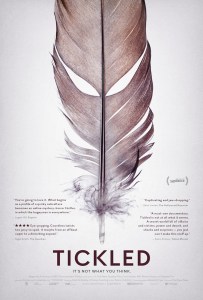 Some of the greatest stories are so bizarre and unpredictable that they could only come from real life, and documentaries are a terrific showcase for the strange-but-true realities of our world that have escaped notice. Two of the more fascinating documentaries of 2016 are also two of its most strange films that have to be seen to be believed. Tickled begins as an innocuous look into amateur competitive tickle videos online, an obvious minor fetish industry that swears by its integrity as legitimate sport. A curious New Zealand journalist is then beset by homophobic harassment, personal attacks, and legal threats, which only makes him more determined to unravel the source of these tickle videos. It reminds me of 2010’s Catfish except this story actually has the stakes that film ultimately lacked. It’s an investigative piece of journalism that involves working through false identities, spooked video participants that have had their lives ruined from persecution, interviewing lackeys on hidden video, and ultimately discovering the true source behind the web of lies, a man that uses his privileged class position and wealth to intimidate and exploit others. It’s a movie that starts off goofy and just becomes darker, more serious, and downright sad by the end, leaving you with the sinister impression of the danger of a powerful bully using Internet anonymity to satisfy his repressed kinks including emotional sadism. Tickled could be better as it feels disorganized and padded out, including an extended trip to another tickle fetish vendor. The ending leaves something to be desired as well and will send you online to scour for more information. Still, the story is naturally intriguing and the filmmakers don’t mess up a good thing by allowing the curiosity to grab an audience.
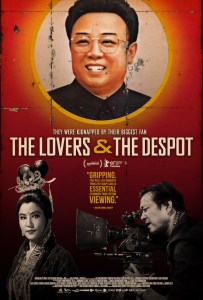 The same can be said for The Lovers and the Despot, a film that leaves you wanting more just because its own true-life tale is so engrossing and deserving of further examination. North Korean dictator Kim Jong-il was so frustrated with his country’s film industry that he kidnapped his favorite South Korean filmmaking husband and wife team, actress Choi Eun-hee and director Shin Sang-ok. The couple made over 17 films for the dictator and had to earn his trust before they could plot an escape. This is a fascinating story about the power and entitlement others feel of art, with Kim Jong-il desperate for world recognition through the cinematic arts. He gave the couple a blank check and unrivaled artistic freedom, enough that some in South Korea suspect that Shin defected to the North rather than having been kidnapped. There are astonishing gets for this doc, namely Kim Jong-il’s actual audio conversations secretly recorded by Choi Eun-hee. When the couple defected to an American embassy, the U.S. government had never heard the dictator’s voice before, and here it was thanks to an actress. It feels like there’s so much more to this story that’s missing, either from the interview subjects’ reticence to share too much or the filmmakers reluctance to embrace more of the Cold War paranoia thriller trappings the story can veer into. There are some insights into the despot but they mostly fall into daddy issues. The omnipresent threat of the dictator is best visually showcased during the funeral marches for his father and then eventually Kim Jong-il himself. The masses are in a state of hysterical grief that crosses into parody, until you realize that these people are adopting a false front to protect themselves and their families just like Choi. Those not “properly grieving” could be punished, and so the miles of people wailing and hyperventilating becomes a chilling symbol of the hold one man has on the country even after death. The Lovers and the Despot is a fascinating story of artists held hostage by their biggest fan, who happened to be a ruthless dictator. It’s naturally compelling but you wish that someone else might better realize its potential on a second crack.
Both films follow the powerful exploiting others for their whims and both movies leave a little something to be desired for, but both are prime examples on how documentaries can shine a light on the wealth of human experiences we wouldn’t believe in other movies.
Nate’s Grade:
Tickled: B
The Lovers and the Despot: B


 nathanzoebl
You must be logged in to post a comment.