Blog Archives
Melania (2026)

Let’s tackle the reality that reviewing a documentary like Melania is practically beyond the point. This movie wasn’t created by artists who felt they had a compelling and insightful story to tell, a revelatory depiction of the human condition that would cause us all to sit back and reflect on ourselves. No, this movie was created to appease and suck up to one important orange-hued ticket-buyer. Amazon bought the rights to the movie for a staggering $40 million dollars, pledged an additional $35 million in marketing, and put out all the stops to open the documentary on the residing First Lady in 1700 screens nationwide. For those not in the know, documentaries are not big moneymakers; the highest-grossing doc of 2025 was Becoming Led Zeppelin at $16 million. Only thirteen documentaries have ever grossed over $70 million worldwide and only 39 have grossed more than $30 million. It’s hard to fathom that Amazon imagined this would become a runaway hit. They’re not that deluded. Think less of Melania as a documentary and more as a transparent corporate bribe by Amazon and its CEO, Jeff Bezos, who sure would like favorable consideration from the current administration that interferes in every facet of media to better protect the ego of a soon-to-be octogenarian who needs everyone to constantly be showering him with effusive adoration (le sigh). Welcome to our new American ecosystem, where all corporations are expected to bend the knee in fealty so as to procure favorable dispensation from a mad king always in need.
What is even the point of reviewing something like this? It’s so obviously manufactured in bad faith. Well, dear reader, I guess it comes back to my own martyr complex: I suffer so that you may be spared the same fate. Unless you’re a diehard MAGA member, Melania will be a torturously facile example of unserious people elevating other unserious people for an audience of the unserious to be patronizingly pat on the head and told that, yes, theirs is the true voice of America’s solemn destiny.

The film follows the 20 days before the second inauguration of Donald Trump as the American president. For those of you, especially in endangered minority communities, wondering what Melania Trump was going through when it came to designing the drapes and White House color patterns, fear not! Most of the movie is listening to Melania’s strained narration while we watch handlers and assistants flit about and primp the soon-to-be First Lady while handing her samples. Never has insider access felt so tedious!
Did I mention that this movie is directed by none other than Brett Ratner, disgraced filmmaker who was jettisoned from Hollywood as a Me Too reckoning following decades of harassment? Ratner has never directed a documentary before and it shows. Opening the doc with the Scorsese-esque notes from the Rolling Stones’ “Gimme Shelter” feels like sacrilege. It’s even worse when played over the start of Melania strutting through her Mar-a-Lago mansion to a fleet of cars. It plays like self-parody but you know nobody has the awareness for that. Ratner asks her such incisive questions like, “What is your favorite recording artist?” like it’s a Tiger Beat interview. Late in the film, he’s heard on camera wishing the president “sweet dreams” in the most sycophantic voice. Really Ratner’s here like everyone else, seeing the craven opportunity to get into the good graces of the president. Ratner has been pushing to get Rush Hour 4 greenlit, a sequel that I don’t even think Chris Tucker (current age: 54) and Jackie Chan (current age: 72) are eager to launch. Not that it matters to Ratner, but it’s been almost TWENTY YEARS since 2007’s Rush Hour 3, which also featured a cameo by notorious sex pest Roman Polanski. Sure enough, in the wake of Melania’s release, Trump was pushing for a Rush Hour 4, as clearly the man whose brain is always stuck in the 1980s has his finger on the pulse of the cultural zeitgeist. All Ratner had to do was make a 100-minute fluff piece about the president’s third wife and, voila, one sexual predator in the highest office in the land can ensure that another sexual predator can get his dream project, which I repeat is depressingly Rush Hour 4, off the ground. Also recall that Ratner was literally seen canoodling on a couch with pal Jeffrey Epstein and a group of young women who were certainly there by choice. Ugh.
I actually think a figure like Melania could be an interesting subject for a hard-hitting documentary. The Slovenian model becomes the third wife to a notorious philanderer and crook, enough that he was famously having sex with adult film actress Stormy Daniels while Melania was recovering from the birth of their son. From the outside, this relationship appears entirely transactional, with Trump getting a new, younger, more desirable wife, though not desirable enough to stop having affairs with other women (note: this is a condemnation of Trump, not on any perceived shortcoming of Melania). For her, she gets the security of a man of riches and with that security is the tacit understanding that he can do whatever he wants and she will have to accept it. Getting an insider’s account of all the debauchery and debasement of being Trump’s current wife could be extremely insightful and would make Melania genuinely empathetic for one of the rare times in public life. Granted, she’s made her calculation and stood silent while her husband’s regime has terrorized millions at home and endangered the lives of millions abroad, so let’s cap that degree of empathy. Still, she has a perspective that could be very illuminating under the right circumstances. It’s just that we’ll never see that kind of perspective. It’s too off-brand. It goes against her agreement with the money-man. I don’t fault her for wanting to stay in her echelon of riches and comfort any more than I would, say, a duchess who prefers a pampered life to starving on the streets. I get it, but it doesn’t excuse the lasting damage of being the pursed-lip silent partner to a degenerate with total power. Imagine a documentary about Eva Braun but it’s all about her favorite throw pillows. Not exactly the most interesting angle to take for someone so close to such disruptive and systemic abuses of power.

I take particular umbrage with one angle the documentary takes, setting Melania up as a celebration of immigration, a reflection of the American Dream. It’s more than a little hypocritical for this movie to elevate the immigrant story of Melania while the administration of her husband is targeting anyone it deems insufficiently American, namely people of color regardless of their actual citizenship. When the government’s special masked police are rounding up indigenous people to deport to adhere to an unrealistic and damningly racist daily quota, you know they’re not targeting the “worst of the worst.” Are the “worst of the worse” the day care workers? The family-owned pizzeria? The spouses of American soldiers? Those seeking asylum from persecution and death from hostile governments? The immigrants who have navigated the byzantine system of immigration to become official citizens and who are abducted by ICE for appearing at their court appointments? To manufacture Melania as a symbol of the celebration of an immigrant’s journey is farcical when the Trump Administration is built upon the elimination of immigrants from every facet of society. It isn’t a coincidence that the administration has lowered immigration numbers to a paltry 7500 in 2025 and most of those are white South Africans. She’s quoted as saying, “No matter where we come from, we are bound by the same humanity.” Uh huh. Tell that to Stephen Miller and his dogged desire to Make America as Alabaster as Possible Again.
There’s just not enough material here to cover a feature film, which is why the shallow movie often feels like an overly padded infomercial propping up its star. There are long stretches where you’re just watching people walk or listen to performances. It’s filling time. The whole enterprise feels like you’re watching someone else’s lackadaisical wedding video. There are perhaps two or three memorable moments caught on camera. The first is Trump complaining that the college football championship game being held the same day as his presidential inauguration is a conspiracy against him. His reasoning is that they’ve had the inaugural date for “centuries.” The next is Melania turning the funeral of President Jimmy Carter into her own grief about losing her mother. Melania takes reverence walking through the halls of the Capitol, remarking about the military defending the rights of the Constitution, which is quite ironic considering Donald Trump fomented an insurrection that gleefully attacked police officers to try and overturn an election in defiance of the Constitution. There’s also the line from his inaugural speech that is particularly galling in 2026: “My proudest legacy will be that of a peace-maker and unifier.” Yes, surely history will remember Trump as an instrument of peace when he’s not bombing girls’ schools and pledging to annihilate civilizations as well as other blatant war crimes.
Rather than continue to tell you about the many creative and moral shortcomings of this enterprise, why not provide a sampling of some of the best critical hits on this movie? Here you go:
“I’m not even sure it qualifies as a documentary, exactly, so much as an elaborate piece of designer taxidermy, horribly overpriced and ice-cold to the touch and proffered like a medieval tribute to placate the greedy king on his throne.” – Xan Brooks, The Guardian
“To say that Melania is a hagiography would be an insult to hagiographies.” – Frank Scheck, The Hollywood Reporter
“Melania the movie isn’t a documentary; it’s a protection racket.” -Sophie Gilbert, The Atlantic
“A soothingly looped AI screensaver.” -Amy Noicholson, Los Angeles Times
“Call it a document, instead, of 20 days in the First Lady’s life circa January 2025, with all the weight and depth of a Post-it.” -Liz Shannon Miller, Consequence
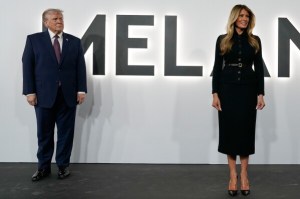
“Ratner’s film plays like a gilded trash remake of Jonathan Glazer’s The Zone of Interest in which a button-eyed Cinderella points at gold baubles and designer dresses, cunningly distracting us while her husband and his cronies prepare to dismantle the Constitution and asset-strip the federal government.” -Xan Brooks cooking again, The Guardian
Anyway, don’t watch Melania. I was never going to appreciate this movie. It was not made for me. It wasn’t made for you either. It wasn’t made for anyone but the First Lady, who had editorial control over the movie, so why would you expect anything other than a stage-managed image-consulted propaganda puff piece on her air of dignified grace and style? Hearing her somnambulant narration over her gilded life and the pageantry of a second inauguration of the most destructive president in American history, it’s enough to make you zone out. While wars are being waged, prices are soaring, neighbors are being rounded up into camps of concentration by masked goons, and corruption and graft reign supreme in a government run by the worst people imaginable, it’s hard not to find a soft-pedaled vanity project like Melania as an offense to the senses. If there are bigger wastes of time at the movies in 2026, it will be a truly hellacious year. This is not being best. This is not being best at all.
Nate’s Grade: F
Share this:

One Battle After Another (2025)
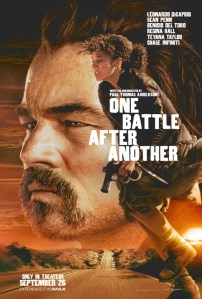
Over his thirty-year career, writer/ director Paul Thomas Anderson (PTA) has developed a mystique and reputation like few other auteurs working in cinema. He’s a visionary filmmaker whose first few movies count among my favorites of all time (Boogie Nights, Magnolia) and whose latter output can leave me shrugging and sighing (Licorice Pizza, Inherent Vice, The Master). My decade-plus-long observational bon mot has been that Anderson decided to make amends for his plot-heavy early movies with more airy, far less plotted vibes-movies. One Battle After Another is something far different from Anderson. He’s making his own version of a $150-million studio action movie, with big ideas and Leonardo DiCaprio as lead (DiCaprio has long regretted passing on Dirk Diggler, still Mark Wahlberg’s acting high-point, so thanks Leo). PTA is using the big-budget storytelling of action cinema to tell something new and personal and politically relevant behind all the gunfire and daring car chases. It’s been dubbed the movie of the moment and perhaps the one to beat for the 2025 Academy Awards. Now that I’ve finally watched all 150 minutes of Anderson’s opus, I’m not as high on it as others but do acknowledge it is a thrilling, engrossing, and occasionally frustrating work from a visionary artist.
Bob (DiCaprio) used to run with a leftist military group known as the French 75. He fell in love with Perfidia (Teyana Taylor), one of the leaders of the group, and together they had a baby, little Willa. Perfidia runs off, unable to settle down, leaving Bob to raise their daughter under a different identity. Sixteen years later, that old life comes back to Bob. It so happens Colonel Steven J. Lockjaw (Sean Penn) had an ongoing sexual tryst with Perfidia during one of their stings. There’s a chance that Willa (Chase Infiniti), now a teenager wanting to live a normal life, is actually his biological daughter. He needs to capture her under any circumstance and possibly dispose of her in order to be admitted to an exclusive white supremacist cabal within the U.S. government. Bob is forced back to action to find and protect Willa but he’s not exactly in the best shape. He’s been a burnout for so long. Can he now be a hero?
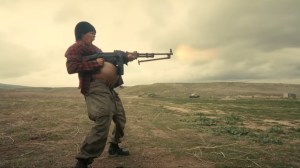
While the movie was filmed throughout 2024, and supposedly has been in the works for over twenty years by Anderson, One Battle After Another feels extremely timely and relatable in these troubled political days of ours (even the title expresses what it’s like to get up and try and process the daily barrage of horrifying news in this Trump Administration 2.0 Era). Anderson’s screenplay, loosely adapted from Thomas Pynchon’s 1990 novel Vineland, proposes a right-wing U.S. government swept up in fascist impulses that is highly militarized and declares war on immigration, rounding up primarily Hispanic men, women, and children and locking them away in camps. It’s also a law enforcement unit that pose as protestors to create a rationale for enacting physical violence and intimidation against peaceful protestors. At the core is a secret society of white supremacists running the show. Short of a concurrent documentary, it will be harder to find a movie more politically topical to the status of life in 2025, especially for the many shaking their heads and wondering how exactly we got here. Pynchon’s original novel was about the transformation of 1960s America to the 1980s, and it feels highly relevant to our 2025 times where there yet again seems to be great upheaval and conflict over those in power operating said power against the governed. It’s impossible to watch One Battle After Another and not think about the headlines. It’s not exactly the escapism many might be seeking. There’s never been a leftist paramilitary group as organized and as successful as the French 75 (they have their own affiliated convent – nuns with guns). The movie isn’t leftist wish-fulfillment to take down the current administration. It’s more a father-daughter battle to reunite in the face of state terror. It certainly has its fiery political commentary, but it’s more a family striving to stay together.
I did quite enjoy that the movie undercuts Bob as our hero, using him more as an entry point into other characters in this story, others who have a much larger impact and prove more capable. The character of Bob serves as a gateway for the other characters to really take over and shine, and it’s smart to use the familiar archetype of the old gunslinger being called back into action past his prime to atone for the sins of the past. We’ve seen this kind of character before, but Bob is kind of hapless and far out of his depth, and it makes the movie so much more entertaining. The rest of the movie exists in a more familiar action-thriller setting, albeit with some fun house mirror edges for pointed satire, but Bob is this bumbling, stumbling dope from a stoner comedy whose been copy-pasted into a different genre. He provided explosives for the French 75 but that doesn’t mean he’s got a wealth of clandestine knowledge and cunning at his disposal, especially since he’s normally inebriated. Now sixteen years later, the archetype would typically have to pull out their old skills that have calcified over a long hibernation, but Bob doesn’t have those skills. When he has an opportunity to take the big heroic shot, he misses. When he has the opportunity to make a daring escape, he falls off the side of a building. When he has to remember the coded exchanges of old, he can’t remember all of the parts. The climax doesn’t really even involve him as he’s playing catch-up for most of the extended conclusion. He’s more like the Big Lebowski waking up in, say, No Country for Old Men and desperately seeking shelter.
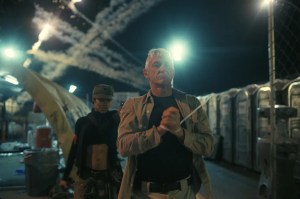
However, Anderson’s empathy for his characters of all stripes shines through, and while Bob is presented as diminished or bumbling, he’s not a complete moron without any redeeming qualities. His most resounding positive quality is his complete dedication and love for his daughter. We’ve seen this kind of story before, the overbearing parental figure trying to drill their child to be prepared for when danger inevitably arises, and the child growing resentful and distant to the parent because of that demanding and limiting home life. Then trouble strikes and the child has to rely upon those seasoned skills they practiced while that paranoid and obsessive adult was ultimately proven right for their unorthodox parenting. Bob’s love for Willa is what has shaped his life for these past sixteen years. He’s the parent who stayed, the one who settled from his old life to take on the responsibility of raising a child as a new life. He’s the one who changed her diapers, the one who shows up for parent-teacher conferences even if it’s to lecture the teachers about the curriculum while lighting up a joint. His love for his daughter is the thing that drives him forward and keeps him going. You feel that love between them, and in the climax of the movie, it becomes something poignant about the connection between these two over such extreme circumstances. There’s an ongoing question over the paternity of Willa but this never for a second changes Bob’s view of his daughter or his willingness to do anything to save her. If he was a Liam Neeson-styled master spy with a particular set of skills, the journey wouldn’t feel as rewarding. With Bob being punched down by the universe again and again but still going, it makes us root for him more.
Penn is completely enthralling as Lockjaw. His danger is never downplayed, and he’s frequently shown as a man who will use his considerable means of power to get what he wants, but Anderson also finds interesting ways to lampoon him and complicate him. I loved that the secret white supremacist society Lockjaw is so eager to join is called the Christmas Adventurers Club. It’s so stupidly anodyne that it sounds like a rejected title for a Boxcar Children novel. The members even pledge, “Merry Christmas. Hail Saint Nick.” It’s so stupid but so are many of the associative slogans of these right-wing groups (I learned the Proud Boys are named after a cut song from Disney’s animated Aladdin, “Proud of Your Boy,” and no I am not kidding). These men are indeed dangerous but they’re also not insurmountable, and I think that’s an important distinction. They’re small, angry, racist men trying to forcibly reshape the world but they are a minority of a minority clinging to power to reject progressive reforms. Lockjaw’s big problem is that he has a tremendous attraction to African-American women, the type of people he should see as inferior. The movie’s momentum is kicked into gear all because Lockjaw wants to be accepted in this special club. Penn is incredible in how he brings to life the snarling contradictions of this man, someone so aggressively challenging but who is also given to gnawing insecurities. Even the way Penn holds his body and walks is an indication of who this man is, with stick firmly planted in rear. He’s scary but he is also stupid, a fine encapsulation of our present political quandary. I’d expect him to be the current front-runner for Best Supporting Actor at the Oscars but it is still plenty early for predictions.

I do wish those engaging supporting characters had more to do besides Lockjaw. Even at 150 minutes, there isn’t much development for Willa to really grow as a character. She’s the target for the chase, and she’s the one trying to understand what is happening as it happens. It would make sense for her to have been the protagonist as she has the most to learn. For far too much of the movie she’s just a passive passenger, being shipped from one location to another. I wish we had more moments to really grapple with her perspective and her shifting opinion about her father and his past. I do enjoy that she’s the real star of the climax but at that point I wished we had seen far more of her resilience and determination and making use of what her father had been teaching her, not simply trading coded conversations. If she is the future, the possibility of turning this world around as someone declares by film’s end, then maybe let’s spend a little more time with her being active and reflective and taking more ownership of her survival. It’s as much her movie as it is Bob’s but he gets far more generous screen time over those 150 minutes.
The same can be said for Willa’s mother, Perfidia. I never found her that interesting as a character. She’s a true-born revolutionary from a family of revolutionaries, but some part of her is drawn back to Lockjaw, whether it’s simply the transactional exchange of sex for protection and assurances, or maybe something more, perhaps the power play of dominance over the very kind of bad men in power she wanted to control. She runs away from a domestic life with baby Willa because she knows she’s ill-suited for it. From there, she gets captured and turns on her former comrades to enter Witness Protection, which she runs away from. I kept waiting for her to resurface in a meaningful way in the story since we’re shown that she escapes into Mexico (Lockjaw lies that he killed her rather than admit she ran off). However, Anderson only utilizes the character as a catalyst, a means of entangling the two men into a paternal showdown. It’s disappointing that Perfidia is reduced to such a nothing of a character when there was much to explore.
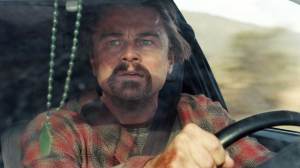
And now comes the part of the review where we talk about Anderson’s bold leap into action filmmaking. He’s not the first prestige indie darling to make a grand genre jump into action-thriller bravado. One thinks of Sam Mendes tackling Skyfall with aplomb, Paul Greengrass with the Bourne series, Patty Jenkins going from Monster to Wonder Woman, Lee Issac Chung going from Minari to Twisters, and of course the big man himself, Christopher Nolan. It can be done with the right filmmaker understanding the key tenets of action, in particular how to connect the various set pieces and conflicts with the characters and their emotional state and chain of needs and priorities. I was impressed with Anderson’s sense of scope and his ability to wring tension. There aren’t really many strict action scenes. Much ink has been spilled on the climactic chase that utilizes a series of rolling hills as the focal point of this battle, and it’s immersive and exciting and different. I’d also be lying if I said I wasn’t a little disappointed by it. This is because this sequence, up until the very very end, is all about one car tailing another. It’s taut and extremely well photographed, but ultimately it amounts to two cars following one another until one clever conclusion. It’s not really a sequence that changes and finds organic complications. It has the makings of a great action sequence but stalls. I thought back to 2014’s Snowpiercer and the sniper shooting match at two different points in the train, where each participant was waiting for the train to curve just so to better facilitate their shot. That was geography as advantage. Overall, Anderson is definitely making his version of an action movie but I don’t feel like he’s fully committed to the planning and development of those sequences. It feels more like ironic subversion when the genuine article would have been more appealing and impactful and just novel.
While One Battle After Another doesn’t rise to the capital-M masterpiece that so many of my critical brethren are falling over themselves to proclaim, it is a good movie with bold artistic swings. It thrums with energy and empathy. It’s probably PTA’s most accessible movie since There Will Be Blood or arguably Boogie Nights. I enjoyed the different characters and the brimming conflict and how much of the movie is grounded on the character relationships and their perspectives. There is a clear command of craft here like every PTA movie. He’s definitely passionate about bringing this world to life, which is eerily relevant to our own politically tumultuous times, but he still finds room for satirical mockery that doesn’t diminish the tension of the villains. It’s a universe I wanted more explanation and exploration, and the most interesting character by far is Benicio del Toro as a humble town sensei who is at the forefront of an immigrant underground railroad. I was never bored and often quite entertained but I stepped away wanting more, and maybe that’s greedy of me or an entitlement of the viewer. One Battle After Another flashes such terrific intrigue and personality that I wanted more refinement and development to better accentuate its mighty potential.
Nate’s Grade: B
Share this:

Saturday Night (2024)/ September 5 (2024)
Recently two ensemble dramas were thought to have awards potential that never materialized, and I think I might know at least one reason why: they are both undone by decisions of scope to focus on either a single day or a 90-minute period to encapsulate their drama.
 With Saturday Night, we follow show creator Loren Michaels (Gabriel LaBelle) the night before the premiere episode of the iconic sketch TV series, Saturday Night Live. The story is told in relative real time covering the last 90 minutes before its initial 11:30 PM EST debut in 1975. We watch Michaels try and deal with squabbling cast members, striking union members, failing technology, his ex-wife (Rachel Sennot) who also happens to be a primary producer of the show, muppets, and studio bosses that are doubtful whether this project will ever make it to air. I understand in essence why the real-time setting is here to provide more pressure and urgency as Michaels is literally running out of time. The problem is that we know the show will be a success, so inventing doubtful older TV execs to add extra antagonists feels like maybe the framing by itself was lacking. Think about Air but you added a fictional exec whose only purpose was to say, “I don’t think this Michael Jordan guy will ever succeed.” There are interesting conflicts and subplots, especially with the different groups that Michaels has to manage, but when it’s all stuffed in such a tight time frame, rather than making the movie feel more chaotic and anxious, it makes those problems and subplots feel underdeveloped or arbitrary. I would relish a behind-the-scenes movie about SNL history but the best version of that would be season 11, the “lost season,” when Michaels came back to save the show and there were legitimate discussions over whether to cancel the show. Admittedly, we would already know the show survives, but does the public know what happened to people like Terry Sweeney and Danitra Vance? Does the public know what kind of sacrifices Michaels had to make? That’s the SNL movie we deserve. Alas, Saturday Night is an amiable movie with fun actors playing famous faces, but even the cast conflicts have to be consolidated to the confined time frame. This is a clear-cut example where the setting sabotages much of what this SNL movie could have offered for its fans.
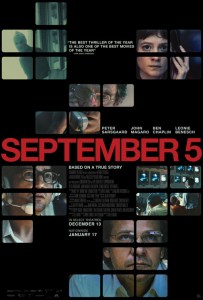 With September 5, we remain almost entirely in the control room of ABC Sports as they cover the fateful 1972 Munich Olympics after the Israeli athletes are taken hostage by terrorists. It’s a subject covered in plenty of other movies, including Steven Spielberg’s Munich and the 1999 Oscar-winning documentary One Day in September, but now we’re watching it from the perspective of the journalists thrust into the spotlight to try and cover an important and tragic incident as it plays out by the hour. It’s an interesting perspective and gives voice to several thorny ethical issues, like when the news team is live broadcasting an oncoming police assault, which the terrorists can watch and prepare for as well. The movie is filmed in a suitable docu-drama style and the pacing is as swift as the editing, and that’s ultimately what holds me back from celebrating the movie more. It’s an interesting anecdote about media history, but September 5 fails to feel like a truly insightful addition to the history and understanding of this tragedy. It’s so focused on the people in the studio and restrained to this one day that it doesn’t allow for us to really dwell or develop in the consequences of this day as well as the consequences of their choices on this fateful day. The movie feels like a dramatization of a select batch of interviews from a larger, more informative documentary on the same subject. It’s well-acted and generally well-written, though I challenge people to recall any significant detail of characters besides things like “German translator” and “Jewish guy.” It’s a worthy story but one that made me wish I could get a fuller picture of its impact and meaning. Instead, we get a procedural about a ragtag group of sports journalists thrust into a global political spotlight. There’s just larger things at stake, including the inherent drama of the lives at risk, than if they’ll get the shot.
Nate’s Grades:
Saturday Night: C+
September 5: B
Share this:

Heretic (2024)/ Conclave (2024)
Recently, two religious-based, single-location thrillers have emerged from the confines of indie cinema, and this combination is so rare that I felt a unique opportunity to review them both.
 Heretic is a chamber movie about two teen Mormons (Sophie Thatcher, Chloe East) proselytizing to a middle-aged man (Hugh Grant) one dark and stormy night. He invites them in and seems kind and welcoming, but looks can be very deceiving. He has some very strong opinions when it comes to the nature of belief, and he will test both of these young Mormons on the faith of their convictions as he puts them through a series of trials and lectures. That last part might stun people, but Heretic is actually at its best during its lengthy lecture sequences. It might remind people of a nattering Reddit atheist being unleashed, but the movie really comes alive when Grant is challenging the roots of their belief systems as well as the historical contexts of religions. The Mormon ladies push back as well, countering some of the arguments so it’s not so one-sided. There’s a clear point of view to the movie but I wouldn’t say it’s didactic. The thrills ratchet as the two women start to fret about what this man has in store for them, how they might escape from his labyrinthine house, and how to signal for help. Unfortunately, the revelations can never quite match the fun of the mystery of motivations, and once it gets into a really convoluted place of switcheroos, then I think it loses momentum. The performances are all outstanding, led by Grant’s magnetic about-face turn as a snide villain. The same self-effacing charms he worked so well in the realm of rom-coms have a new eerie manipulative quality, luring his prey into his fiendish trap. The end attempts to go a bloodier and more ambiguous route that I don’t know it earns, but by that time, even after stalling out for the last act, Heretic won me over by virtue of its creepy convictions.
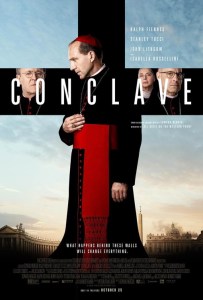 Conclave is an electioneering movie that places the viewer in the middle of the fraught voting process to determine the next pope of the Catholic Church. Ralph Fiennes plays a cardinal tasked with leading the conclave, the gathering of Catholic cardinals who will stay until a nominee has won a majority of their secret votes. Except it’s all not so secret as multiple candidates are openly campaigning for votes, trying to persuade different factions to support their candidacy. Each round of voting without a winner resets the field of play and leaves sides scrambling to reclaim footing. The movie is surprisingly very easy to get into, a crackling political thriller about the behind-the-scenes machinations and politicking for the highest office in the Catholic Church. There is a bevy of twists and turns and plenty of juicy revelations and betrayals, as these holy men start acting a little less holy to eliminate their competition or sully their chances. The constant churning is enough to keep things unsettled and intriguing, but there’s also a larger question for our protagonist, a man of faith who told the prior pope that he wished to leave his faith only to be denied by the pontiff for reasons we aren’t quite sure. Why did this pope specifically pick him for this position? The movie also asks deeper questions about the nature of power and leadership, namely are the people actively seeking it the right candidates for the right reasons? The very end of the movie knocked me out with a twist that I dare say nobody will rightly see coming, but it made me want to applaud. Conclave is an intelligently crafted thriller with weighty ideas and engaging performances.
Nate’s Grades:
Heretic: B
Conclave: B+
Share this:

Reagan (2024)

My seventy-five-year-old father doesn’t get out to see as many movies as he used to, but one he was dead-set on seeing in theaters was Reagan. My sister took him and he came back singing the movie’s praises, celebrating Dennis Quaid’s portrayal of the 40th president of the U.S. of A. and extolling the virtues of this trip down Boomer memory lane. I’m glad my father enjoyed the movie. I’m glad the filmmakers could provide him two hours of uplift and entertainment, especially during times like these where my whole family can use the escape from present-day worries. I’m also retroactively relieved that I didn’t see the movie with him, though as a dutiful son and his movie buddy for decades, I would have. I’m glad because our opinions on the overall artistic merits would have been significantly different, and I wouldn’t want to rain on my father’s personal enjoyment (that’s what the written word is for).
For the benefit of analyzing Reagan as a movie first and foremost, I’ll reserve my reservations about his political legacy for the end of the review, but even as a standard presidential biography, Reagan the movie is a disappointing and reductive trip through one man’s Wikipedia summation of a career. I’ve become much more a fan of the biographies that choose a seminal moment from a public figure’s life to use as a framing device for the larger legacy (think 2012’s Lincoln focusing on the passage of the thirteenth amendment). I’d prefer that approach to the more familiar cradle-to-grave structure that often feels like a zoom through their greatest hits where none of the events are granted the consideration or nuance deserved. With Reagan the movie, we’re sprinting through history, although Reagan doesn’t even become president until an hour in. Instead, the focus is unilaterally on Reagan’s opposition to communism and the Soviets. Obviously distilling eight years of a presidency into a couple hours is a daunting and improbable task, the same difficulty for distilling any person’s complicated life into an accessible two hours of narrative. Still, you should have expected more.

For those coming into the movie looking for a critical eye, or an even-handed approach to this man’s faults and accomplishments, the movie condenses itself into a narrow examination on communism and the Cold War, a story we already know proves triumphant. The cumulative problem with Reagan the movie is that it doesn’t really add to a deeper understanding of the man. With its streamlined narrative and pacing, the movie sticks to its Greatest Hits of Reagan, especially his speeches. There are several famous Reagan speeches littered throughout the last act of the movie, and it doesn’t do much for a better understanding of the man delivering those remarks as just hitting upon people’s memories of the man in public venues. It would be more insightful to watch the team behind the scenes debating their choices. The movie portrays Reagan the man more like Saint Regan, arguing if there are any presentable faults they should be readily forgiven because it was all in pursuit of morally impregnable goals (he remarks that the vicious right-wing contras remind him of George Washington and the early colonial army…. yeah, sure). The filmmakers are too afraid to say anything too critical but also to reveal anything truly revelatory about their subject. So the movie becomes a glossy nostalgic-heavy drama without much in the way of drama because Reagan will always persevere through whatever hardships thanks to the power of his convictions, which will always be proven right no matter the context and repercussions. The movie seems to imply all his decisions led to the fall of the Berlin Wall, so it all must have worked out, right? Well, not for everybody, movie, but we’ll get to that in due time.
The filmmakers elect to frame the movie through a curious narrator – a retired KGB officer (Jon Voight) that has followed the life and times of Ronald Reagan going back to his early days. Apparently, this Soviet spy saw true greatness in Reagan way back and thought he might become a threat to the continuation of communism. It’s a strange perspective to be locked into, the enemy complimenting Reagan from afar and ultimately crediting the man’s faith in God as the reason that America triumphed over the Soviets. It means then that every scene has to be linked to our KGB narrator, and sometimes that can get questionable, like when he’s talking about Reagan’s time as a teenage lifeguard, or the time Reagan was being bullied by local kids, or Regan’s intimate conversations with his first wife, Jane Wyman (Mena Suvari). The scenes in Hollywood are so clunky, especially a dinner where the movie wants us to look down on Dalton Trumbo, blacklisted Hollywood Ten writer. This man stood for his principles and suffered a real backlash, and you want me to think of him as misguided and part of some liberal communist cabal (the movie also includes a picture of Oppenheimer as part of its Soviet influence targets)? By insisting upon a narrator that’s not Reagan, that means this KGB spy it also means that we’re seeing the world of Ronald Reagan through an interpreter’s prism, which makes the scenes even more curious for being such an unexpected cheerleader over Reagan’s amazing instincts and abilities. It would be like having Stalin narrate a biopic about FDR and showering the president with gushing praise.
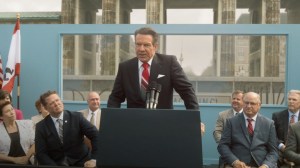
Limiting the movie’s focus to Reagan’s lifelong battle against communist forces makes for a much cleaner and more triumphant narrative, and also leads to an ending we all know is coming, not that surprise or nuance is what the primary audience is looking for. The movie posits that Reagan pursued becoming the country’s chief executive for the selfless mission of standing up to the nefarious forces of communism. Then again, in the opening moments, the movie also tacitly implies that maybe it was the Russians who shot him back in 1981 when it was really an incel who thought he might impress Jodie Foster. Those opening moments also present a cliffhanger to come back to, as if there’s a gullible portion of the audience that is hanging on pins and needles in anticipation whether or not Reagan really was killed back in 1981 (“But… but if Ronnie dies, then who was left to beat the commies?”). It’s a very selective narrative framing that makes the movie easy to celebrate because Reagan is presented as America’s steadfast defender who stood up for our apple-pie American values and brought down the Soviets. Reagan certainly played his part in helping to facilitate the collapse of the Soviet Union, but he was one man coming in at the end of a chain of events spanning decades. I liken it to having a group project in school where you and your cohorts work steadily all week, and then the day it’s due, a kid who’s been absent all week except for that day comes onto the project, adds some contributions, and then takes credit for everything accomplished. Reagan gets his due but so do the other U.S, presidents, secretaries of state, and lots and lots of ambassadors that also helped reach this monumental conclusion. However, the biggest contributor to the collapse of the Soviet Union belongs to the Soviets themselves and their rejection of living in a reality in conflict with the dogma of their political leaders (sound familiar to anyone?).
The screenwriters also position the Great Communicator as being so powerfully persuasive that all it took was one speech and everyone was left helplessly in thrall of this man’s honeyed words. It takes on such a grandiose scale that makes Reagan look like a superhuman. The movie sets up its climax over whether or not Reagan will say “tear down this wall” in a speech at the Brandenburg Gate in 1987, which heightens the drama to a level of self-parody. Is there any spectator wondering if Reagan will eventually say the words that became famous? Beyond the false drama of whether or not Reagan will utter this phrase, the movie tries to fashion some unconvincing behind-the-scenes hand-wringing over what it will mean if Reagan says these words while in Germany. As if the man has ever been shy about denouncing communism and the Soviet state beforehand. The movie also exists in a world where every world leader and responsible adult is glued to a TV set watching Reagan speechify at any key moment. Hilariously, after Reagan does indeed say “tear down this wall,” the film cuts to Margaret Thatcher watching and solemnly saying, “Well done, cowboy.” The rousing music reaches a crescendo, the Reagan team celebrates like they just landed a man on the moon, and the implication is that now that Reagan has put these four words together in sequence, well that Gorbachev fella has no choice now. The movie is set up like this speech is the final blow that pushes the Soviet Union into the dustbin of history. And yet, the next scene of the Berlin Wall coming down has a helpful on-screen designation of time: “two years later.” So Ronnie gave his amazing speech and it immediately led to the end of East Germany… two years later. Does George H. W. Bush get all the credit for being president when the Soviet Union actually collapsed in 1991? I’m sure we can find a speech somewhere where he said something bad about them, and if Reagan the movie is an indication about political persuasion, all he had to do was say the words out loud. Then the wicked communist curse is broken, but few people knew that, only those who worked for Ronnie.

The movie goes to this magical solution time and again, as Reagan is able to solve any crisis with just the right combination of words. Whether it’s Vietnam protestors he cows into retreat by shushing them, or even a debate where all he has to do is throw out a joke and the opposition must crumble because nobody can recover in the face of a joke; the movie presents time and again a silly and reductive version of politics where all it takes is for people to hear the cherished words of Saint Reagan and be converted. Look, Reagan was an influential figure and inspired a generation of Republican leaders to follow in his wake, and yes his telegenic skills were an asset to his understanding of how to handle issue framing. But to reduce everything down to his overwhelming oratory powers of persuasion makes it seem like everyone in the world is falling prey to a linguistic cheat code they are unaware of. It’s the kind of deification that we might see in a North Korean movie extolling the powers of Kim Jong-Un (“He golfed a hole-in-one with every hole”). This is what a hagiography does rather than an honest biography, and that is why Reagan becomes a relatively useless dramatic enterprise except for those already predisposed to wanting to have their nostalgia tickled and their worldviews safely confirmed.
I wasn’t exactly expecting, say, an even-handed review over Reagan’s legacy, but there’s something rather incendiary about how it distills all of the opposition to Reagan and his policies. Our KGB narrator intones that not everybody was a fan of good ole Ronnie, and then in an abbreviated montage we get real news footage of protestors with placards condemning the Reagan administration for ignoring the AIDS epidemic, for tax cuts for the rich, for supporting the apartheid government of South Africa, for gutting social safety net programs, etc. The handling of the Iran-Contra scandal is hilariously sidestepped by the same Reagan who is shown on screen being so dogmatic about sticking to law that he fired all the striking air traffic control workers. It’s not enough that the movie reduces all relevant critical opposition to Reagan to a brief music montage, it’s that the movie then quickly transitions directly to a map of the 1984 electorate with Reagan winning in a landslide, as if to say, “Well, these cranky dead-enders sure were upset by these issues, but they must be wrong because the American people overwhelmingly re-elected him.”
I never found Quaid’s performance to be enlightening or endearing, more mimicry that settles into an unsettling cracked-mirror version. It always felt like an imitation for me, like something I’d see on Saturday Night Live in the 1980s with Phil Hartman. He holds the grin and nasally voice but delivers little pathos. It’s not exactly the actor’s fault when the screenplay gives him such little to do. There was a real opportunity to better humanize him toward the end as his mental decline was becoming more of a force. Instead, it’s relegated to the very end, as a gauzy way to usher the man off the stage with our sympathies. Voight (Ray Donovan) gets the most lines in the whole movie and really seems to savor his Ruskie accent. Curiously, his character is talking to a promising KGB pupil trying to learn where they went wrong and it’s not set up to be Vladamir Putin, himself a former KGB agent. The only other significant supporting role that lasts is Nancy Reagan played by Penelope Ann Miller (The Shadow, Carlito’s Way) and she’s relegated to the suffering spouse on the sidelines that always has the steel spine and the word of encouragement. Her best moment of acting was her embarrassment as a captive witness to Ronnie, before his step into politics, awkwardly dancing on stage with the PBR players as a shill for the beer company.

Let’s be honest about who Reagan is aimed at, an older, mostly conservative audience looking back at the time of Reagan’s reign and thinking, “Those were the good old days.” It’s not made for people like me, a progressive who legitimately believes that many of our modern-day problems can trace their source from the eight years of the Reagan administration. I’m talking about the trickle-down-economic fallacy that girds so much Republican magical thinking when it comes to taxes. I’m talking union busting, I’m talking his “welfare queen” projection, I’m talking the selling of arms for hostages (bonus fact: the Reagan campaign was secretly negotiating with Iran not to release the hostages until after the election to better doom Jimmy Carter’s chances of re-election), I’m talking about making college education far more expensive by massive cuts to state funding, I’m talking the rise of the disingenuous “textualist” judicial philosophy that only seems to mean something when its proponents want it to, I’m talking about training and arming Osama bin Laden to fight the Soviets in Afghanistan (wonder why the movie chose not to include this since it is Reagan fighting communism), and so on and so on. Naturally none of these are held to scrutiny by Reagan the movie because it’s from the writer of God’s Not Dead and the director of Bratz.
Suffice to say, Reagan has many notable shortcomings depicting a president who, with every passing year, only seems to add to his own shortcomings in legacy (the Party of Reagan has willfully given up all its purported principles to become the Party of Trump). If you’re looking for an overly gauzy, sentimental, and simplistic retelling of what people already know about Ronald Reagan, then this movie is for you. If you’re looking for anything more, then this is the New Coke of presidential biopics.
Nate’s Grade: C-
Share this:

Oppenheimer (2023)
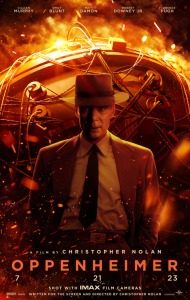 I finally did it. I watched all three hours of Christopher Nolan’s Oppenheimer, one half of the biggest movie-going event of 2023, and arguably the most smarty-pants movie to ever gross a billion dollars. It was a critical darling all year long, sailed through its awards season, and racked up seven Academy Awards including Best Picture and Best Director for Nolan, a coronation for one of Hollywood’s biggest artists whose name alone is each new project’s biggest selling point. I’ve had friends falling over themselves with rapturous praise, and I’m sure you have too, dear reader, so the danger becomes raising your expectations to a level that no movie could ever meet. As I watched all 180 lugubrious minutes of this somber contemplation of man’s hubris, I kept thinking, “All right, this is good, but is it all-time-amazing good?” I can’t fully board the Oppenheimer hype train, and while I respect the movie and its exceptional artistry, I also question some of the key creative decision-making that made this movie exactly what it is, bladder-busting length and all.
As per Nolan’s non-linear preferences, we’re bouncing back and forth between different timelines. The main story follows Robert Oppenheimer (Cillian Murphy) as an upstart theoretical physicist creating his own academic foothold and then being courted to join the Manhattan Project to beat the Nazis in the formation of a nuclear bomb. The other timeline concerns the Senate approval hearing for Lewis Strauss (Robert Downey Jr.), the former head of the Atomic Energy Commission (AEC) with a checkered history with Oppenheimer after the war. A third timeline, serving as a connecting point, involves Oppenheimer undergoing a closed-door questioning over the approval of his security clearance, which brings to light his life of choices and conundrums.
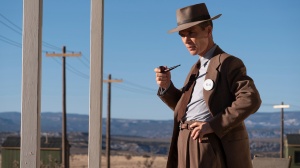 If I was going to be my most glib, I would characterize Oppenheimer in summary as, “Man creates bomb. Man is then sad.” There’s much more to it, obviously, and Nolan is at his most giddy when he’s diving into the heavy minutia of how the project came about, the many brilliant minds working in tandem, and sometimes in conflict, to usher in a new era of science and energy. Of course it also has radical implications for the world outside of academic theory. The world will never be the same because of Oppenheimer dramatically upgrading man’s self-destructive power. The accessible cautionary tale reminds me of a Patton Oswalt stand-up line: “We’re science: all about ‘coulda,’ no about ‘shoulda.’” Oh the folly of man and how it endures.
For the first two hours, the focus is the secretive Manhattan Project out in the New Mexico desert and its myriad logistical challenges, all with the urgency of being in a race with the Nazis who already have a head start (their break is Hitler’s antisemitism pushing out brilliant Jewish minds). That urgency to beat Hitler is a key motivator that allows many of the more hand-wringing members to absolve those pesky worries; Oppenheimer says their mission is to create the bomb and not to determine who or when it is used. That’s true, but it’s also convenient moral relativism, essentially saying America needs to do bad things so that the Germans don’t do worse things, a line of adversarial thinking that hasn’t gone away, only the name of the next competitor adjusts. This portion of the movie works because it adopts a similarly streamlined focus of smart people working together against a tight deadline. Looking at it as a problem needing to surmount allows for an engaging ensemble drama complete with satisfying steps toward solutions and breakthroughs. It makes you root for the all-star team and excitedly follow different elements relating to nuclear fusion and fission that you would have had no real bearing before Nolan’s intellectual epic. For those two galloping hours, the movie plays almost like a brainy heist team trying to pull together the ultimate job.
 It’s the time afterwards where Oppenheimer expands upon the lasting consequences where the movie finds its real meaning as well as loses me as a viewer. The legacy of the bomb is one that modern audiences are going to be readily familiar with 80 years after the events that precipitated their arrival, and they haven’t exactly been shelved or become the world war deterrent hoped for. As one of Oppenheimer’s physicists says, a big bomb only works until someone creates a bigger bomb, and then the arms race starts all over again fighting for incremental supremacy when it comes to whether one’s military might could destroy the world ten times or twelve times over. When Oppenheimer begins having reservations of what he has brought into this world is when his character starts becoming more dynamic, but it’s also too late. He can’t undo what he’s done, the world isn’t going back to a safer existence before nuclear arms, so his tears and fears come as short shrift. There’s a scene where Oppenheimer’s wife, Kitty (Emily Blunt), castigates him and says, “You don’t get to commit the sin and then make all of us to feel sorry for you when there are consequences.” Now this is in reference to a different personal failing of our protagonist, but the message resonates; however, I don’t know if this is Nolan’s grand takeaway. The movie in scope and ambition wants to set up this man as a tragic figure that gave birth to our modern world, but like President Truman says, it’s not about who created the bomb but who uses it. Oppenheimer is treated like a harbinger of regret, but I don’t think the story has enough to merit this examination, which is why Oppenheimer peters out after the bomb’s immediate aftermath.
It reminded me of an Oscar favorite from 2015, Adam McKay’s The Big Short, a true-ish account of real people profiting off the worldwide financial meltdown from 2008. It fools you into taking on the perspective of its main characters who present themselves as underdogs, keepers of a secret knowledge that they are trying to benefit from before an impending deadline. Likewise, the conclusion also makes you question whether you should have been rooting for this scheme all along since it was predicated on the economy crashing; these guys got their money but how many lives were irrevocably ruined to make their big score? With The Big Short, the movie-ness of its telling is part of McKay’s trickery, to ingratiate you in this clandestine financial world and to treat it like a heist or a con, and then to reckon whether you should have ever been rooting for such an adventure. Oppenheimer has a similar effect, lulling you with its admitted entertainment factor and beat-the-deadline structure. Once the mission is over, once the heroes have “won,” now the game doesn’t seem as fun or as justifiable. Except Oppenheimer could have achieved this effect with a judicious resolution rather than an entire third hour of movie shuffled throughout the other two like a mismatched deck of cards.
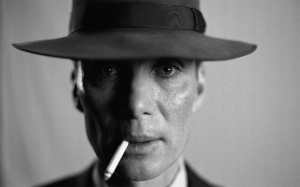 The last hour of the movie features a security clearance interrogation and a Senate confirmation hearing, neither of which have appealing stakes for an audience. After we watch the creation of a bomb, do we really care whether or not this one testy guy gets approved for a cabinet-level position or whether Oppenheimer might get his security clearance back? I understand that these stakes are meaningful for the characters, both essentially on trial for their lives and connections, but Nolan hasn’t made them as necessary for the audience. They’re really systems for exposition and re-examination, to play around with time like it was having a conversation with itself. It’s a neat effect when juggled smoothly, like when Past Oppenheimer is being interviewed by a steely and suspicious military intelligence office (Casey Affleck) while Future Oppenheimer laments to his project superior (Matt Damon) and then Even More Future Oppenheimer regrets his lack of candor to the review board. The shifty wheels-within-wheels nature of it all can be astounding when it’s all firing in alignment, but it can also feel like Nolan having a one-sided conversation with himself too often. It’s another reminder of the layers of narrative trickery and obfuscation that have become staples of a Christopher Nolan movie (I don’t think he could tell a knock-knock joke without making it at least nonlinear). The opposition to Oppenheimer is summarized by Strauss but I would argue the man didn’t need a public witch hunt to rectify what he’s done.
Lest I sound too harsh on Nolan’s latest, there are some virtuoso sequences that are spellbinding with technical artists working to their highest degree of artistry. The speech Oppenheimer gives to his Los Alamos colleagues is a horrifying lurch into a jingoistic pep rally, like he’s the big game coach trying to rally the team. The way the thundering stomps on the bleachers echo the rhythms of a locomotive in motion, driving forward at an alarming rate of acceleration, and then how Nolan drops the background sound so all we hear is Oppenheimer’s disoriented speech while the boisterous applause is muted, it’s all masterful to play with our sense of dread and remorse. This is who this man has become, and his good intentions of scientific discovery will be rendered into easily transmutable us-versus-them fear mongering politics. The ending imagery of Oppenheimer envisioning the world on fire is the exact right ending and hits with the full disquieting force of those three hours. The meeting with Harry Truman (Gary Oldman) is splendid for how undercutting it plays. Kitty’s interview at the hearing is the kind of counter-punching we’ve been waiting for and is an appreciated payoff for an otherwise underwritten character stuck in the Concerned Wife Back at Home role. The best parts are when Oppenheimer and Leslie Groves (Damon) are working in tandem to put together their team and location, as that’s when the movie feels like a well orchestrated buddy movie I didn’t know I wanted. The sterling cinematography, musical score, editing, all of the technical achievements, many of which won Oscars, are sumptuously glorious and immeasurably add to Nolan’s big screen vision.
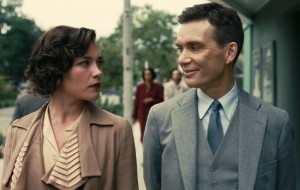 I think I may understand why the subject of sex is something Nolan has conspicuously avoided before. Much has been made about the sex scenes and nudity in Oppenheimer, which seem to be the crux of Florence Pugh’s performance as Jean Tatlock, Oppenheimer’s communist mistress through the years. The moment of Oppenheimer sitting during his hearing about his sexual tryst with an avowed communist leads to him imagining himself in the nude, exposed and vulnerable to these prying eyes and their judgment. Then Kitty imagines seeing Pugh atop her husband in his hearing seat, staring directly at her, and this sequence communicated both of their internal states well and felt justified. It’s the origin of the famous “I am become death” quote where the movie enters an unexpected level of cringe for a movie this serious. I was not prepared for this, so mild spoilers ahead if you care about such things, curious reader. We’re dropped into a sex scene between Oppenheimer and Jean where she takes a break to peruse his library shelves. She’s impressed that he has a Hindu text and pins it against her naked chest and slides atop Oppenheimer once again, requesting he read it to her rather than summarize it. “I am become death,” he utters, as he reads the Hindu Book of the Dead off Pugh’s breasts while they continue to have sex. Yikes. A big ball of yikes. If this is what’s in store, please go back to a sexless universe of men haunted by their lost women.
It’s easy to be swept away by all the ambition of Nolan’s Oppenheimer, a Great Man of History biopic that I think could have been better by being more judiciously critical of its subject. It’s a thoroughly well-acted movie where part of the fun is seeing known and lesser known name actors populate what would have been, like, Crew Member #8 roles for the sake of being part of this movie (Rami Malek as glorified clipboard-holder). Oppenheimer takes some wild swings, many of them paying off tremendously and also a few that made me scratch my head or reel back. It’s a demonstrably good movie with top-level craft, but I can’t quite shake my misgivings that enough of the movie could have been lost to history as well.
Nate’s Grade: B
Share this:

Reality (2023)
 Reality is a film experience where the devotion to verisimilitude is at the sacrifice of drama. The dialogue is reportedly taken one hundred percent from the FBI recordings of their questioning of the preposterously named Reality Winner, played by Sydney Sweeney (Euphoria). She works for a branch of U.S. national security and smuggled a classified document and submitted it to journalists to expose Russia’s intent to hack U.S. voting systems in the 2016 presidential election. The movie takes place more or less in real time as two FBI agents (Josh Hamilton, Marchant Davis) come to Reality’s small home in Augusta, Georgia, begin a search, and question her duties, behavior, and security clearances at her work. We’re inundated early with mundane details of asking about dogs and yoga class coverage while FBI agents are raiding Reality’s home, and the movie doesn’t allude to what everything is about until halfway through. Again, strictly sticking to the script of the government encounter limits creatively where and what the actors can do, so the overall inert feeling is, I suppose, part of the appeal for writer/director Tina Setter’s movie, based on her stage play. I think some people will read the protracted build-up as unsettling in its stubborn ordinariness, or that withholding the juicy drama only makes the collateral mystery and suspicions stronger. Reality is an interesting story told in a frustrating and gimmicky fashion that lessens its dramatic impact. If I just wanted to watch actors re-enact the transcripts, I’d seek out a documentary. I’m thinking of something like 2012’s Compliance, based on a true story and told over the course of one day, but it was harrowing and made me have to watch with my fingers covering my eyes because of the grueling drama that would not look away. There are a few interesting visual quirks here, like actors blinking out of a scene when they say words redacted from the transcript, but mostly it feels too stage bound. Sweeney comes unglued in pretty convincing manner as her different defenses and obfuscations crumble through the interrogation. Reality is a well-meaning movie meant to better frame one young woman’s extraordinary actions through an ordinary lens, but I kept getting antsy for the movie to drop its gimmick and accept that there was more inherent drama in this story than what was going unsaid while we discussed yoga and dogs.
Nate’s Grade: C+
Share this:

Amsterdam (2022)

It’s been seven long years since writer/director David O. Russell made a movie. He was prolific from 2010-2015, making four movies, which were nominated for a slew of Oscars, especially in multiple acting categories. Three were also nominated for Best Picture and Russell was nominated for Best Director three times as well. It was quite a vaunted run of mainstream and critical success, with devoted actors like Christian Bale and Jennifer Lawrence eager to sign up for Russell’s quirky ensembles (it helps when both won Oscars playing Russell roles).
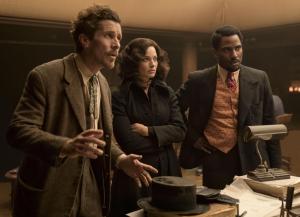
It’s natural to want to take some time off after such a busy creative period, but as the years stretched on, and after the Me Too accountability movement, Russell’s on and off-set behavior gathered more scrutiny and rebuke. His volatility had been known, like his screaming fit he had on the 2004 I Heart Huckabees set with Lily Tomlin. Even George Clooney recounts stepping up to Russell’s bully behavior on the set of 1999’s Three Kings (rumor has it Clooney was the one who released the Huckabees footage). On 2013’s American Hustle, Amy Adams said she cried repeatedly from Russell’s bullying and felt intimidated and isolated. Then there were the renewed revelations from Russell’s own niece who had been transitioning and accused Russell of inappropriate touching when it came to her changing body. Russell even admits to this, though he defends his actions by saying he was given tacit permission, or so he says. With all of this controversy and harassment swirling around Russell, it’s a wonder who would want to continue working with this kind of person. I guess as long as he was producing at his peak level, studio execs would excuse his bad behavior and keep funding his ballooning budgets. Well Amsterdam might just be the end of Russell’s star-studded big studio ride.
In 1933 New York, Burt Berendsen (Bale) is a WW1 veteran making ends meet as a doctor who specializes in veteran care. He and his best friend Harold Woodman (John David Washington) are framed for a murder and on the run, and the only way to clear their good names is to uncover a conspiracy that leads to a possible government coup. Helping the fellas out is Valerie Voze (Margot Robbie), a nurse who makes art from the shrapnel she recovers from inside war vets, and a wealthy socialite who also happens to be in love with Harold. Together, the three friends bumble their way through danger and mystery and crazy mishaps.
This is a mess of a movie, a waste of its top talent, and an excess of Russell’s excesses. The director has established a certain style since 2012’s Silver Linings Playbook, a movie I still to this day genuinely love (it was my top movie for that year). It’s a style that communicates mania, a nervous energy, and it made sense for Silver Linings Playbook as the movie was following a bipolar protagonist given to uncompromising bouts of mania. It makes less sense with each additional movie, but this improv-heavy, experimental, loose sensibility has become the default style for the director, and it feels misapplied. It leads to Russell bombarding his actors with questions or different requests in the moment, keeping them guessing, and actors have gone forward saying they never knew what they were shooting on the day and the shooting never stopped. This indulgence leads to stories that feel like a lot of elements are sloppily thrown together with the undying hope that somehow it will all come together in the end. With Amsterdam, it doesn’t.
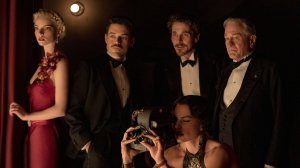
It’s not a great sign when I can say that the entire first hour could be jettisoned. There’s little sense of urgency for far too long, and what is presented feels almost comically unrelated, like even Russell can’t believe his silly characters are in real danger. The uneven pacing creates many dead spaces that feel like an awkward improv detour that you wish could have been avoided. We’re introduced to Bert as a drug addict, and then as a World War One veteran helping other veterans with facial scars and wounds, Bert’s relationship with his pal Harold, then their history in France during the war, then their introduction to Valerie and their kinship, then we have a mysterious death that also leads to a secondary love interest, which requires more setting up of the first love interest and her disapproving family, and then we get police investigating and warning about the first death and then a second murder, this time blamed on our characters, and they’re off to clear their names by… reuniting with Valerie and then bumbling through more characters before, finally the movie presents what it’s actually about well after a full hour-to-80 minutes of movie. It is exhausting and feels like a meandering alternative story that was clumsily grafted onto the Business Plot of 1933. The first half of the movie feels like a slipshod screwball comedy, and then once the particulars of a fascist conspiracy to overthrow the president are introduced, it’s like watching Looney Tunes characters try and foil Adolf Hitler. It just does not tonally work.
The Business Plot is a lesser known event in history, glossed over by the fact that the chief perpetrators more or less got away with their insurrectionist planning. They never did succeed in overthrowing FDR and installing their puppet, but they also did not get prosecuted in the end and most of the media dismissed the scheme as hogwash. It’s undetermined how advanced this plot eventually got but a coup was discussed by a consortium of business leaders. It feels like Russell is applying what he learned from 2013’s American Hustle, which introduced a crazy group of fictional criminals and then, in its last hour, explored the real Abscam criminal sting of the 1980s. I can see themes that Russell thinks are still prescient today, like a dark element desiring to overthrow the U.S. government because it didn’t get its way, as well as the collusion of big business in political king-making, seeking shells that will do what their benefactors demand. The problem is the themes behind this scheme are too serious for Russell’s trifling antics. Think about retelling the insurrection on January 6th but for the first hour it’s two bumbling bank robbers who keep finding themselves in the worst possible situations, ending at the U.S. Capitol. If you’re going to treat the rise of fascism, assisted by corporate overlords, as a serious threat, and something relevant for today, then maybe don’t have most of the movie be wacky nonsense.
Russell’s past films have often glided on energy and in-character authenticity, but this one feels so grasping and desperate. When the master plan to reveal the conspiracy and its shadowy participants is throwing together a big veteran’s show, I was reminded of the movies of young Mickey Rooney and Judy Garland where the solution to any dilemma was to put on a show. Then at one point the literal Nazis are singing loudly in German and are being confronted by our characters and the good patriotic Americans counter by singing “America (My Country ‘Tis of Thee)” and I had to stop the movie and just let out a deep sigh. I think Russell was going for the famous reference in Casablanca, also against Nazis, but it just flounders into unintentional comedy, accentuated by the antsy energy that treats it like camp. There are a couple of spots that I laughed out loud, though I doubt that was the intended response, like watching Taylor Swift abruptly run over by a car. The attempts at actual humor are winding and often lead to little, and the characters feel like more of a collection of quirks than firmly established personalities and perspectives to anchor a movie. What does Bert having a false eye add besides something for Bale to fidget with? What does Chris Rock have to do here? What does Anya Taylor-Joy have to do here? Most egregiously, what does John David Washington have to do here? It feels like Russell just wanted a character for Bert to talk to. The screenplay is overstuffed and polluted with all these minor and underwritten characters that could have been better consolidated.

I suppose you can still have fun with Amsterdam and engage with it on a light-hearted level, smiling as you watch the many big stars having a good time messing around with accents, props, and wacky character traits and tics, like a bunch of kids with a dresser of costumes (maybe it is a throwback to those corny Rooney/Garland kids pictures after all). With other Russell movies, I’ve felt invigorated by the energy and artistry, encouraged to sit a little closer and be more attentive of the character turns, and dig into the actors making three-course meals of their roles. With Amsterdam, I felt the desperation to recreate the success of old patterns but the creeping realization that it wasn’t going to materialize. It’s just a big mess of a movie, not without interesting ideas or moments or good acting, but too much feels resoundingly and frustratingly frivolous. You could ditch entire characters, entire subplots, even entire hours of this movie. Amsterdam cost Disney/Fox $80 million dollars, the biggest of Russell’s career, and only earned a pittance, so I think there is a retraction in due order. Begin with not watching Amsterdam yourself.
Nate’s Grade: C
Share this:

My Son Hunter (2022)
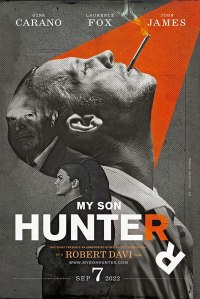 I’ll never understand the pathological obsession people have with Hunter Biden and what may or may not be on his laptop. This fixation on President Biden’s son seems so unshakably quixotic, hoping that with each new murky examination somehow, magically, there will be impropriety and criminality if you only look right. This dogged obsession with, at best, a tertiary figure to the true target of conservative ire reminds me of the crackpot theories concerning Vince Foster, a deputy White House counsel who took his own life in 1993. It was ruled a suicide by five investigations, and yet there are still enough people that are unsatisfied with this provable reality and want to see something more nefarious, more suspect, and simply more. Surely Vince Foster must have been assassinated by the Clintons, and especially Hilary, because he knew too much. It’s nonsense but to some it’s the only thing that makes sense. Such is the same with the Hunter Biden laptop, which some have deluded themselves into thinking could have been the difference maker between a President Biden winning by eight million more votes and a second-term for Trump. It’s difficult for the rational mind to fathom how many ordinary voters would truly care about a presidential candidate’s son’s liaisons, especially when that person is a private citizen and not employed in government.
I figured it was only a matter of time before a rapacious conservative media bankrolled a Hunter Biden Laptop Movie, and it seems only natural as Breitbart’s first foray into narrative filmmaking. The movie takes a lot of style and attitude notes from the latter films of Adam McKay, borrowing liberally from the mixture of documentary and cheeky fourth-wall breaking motifs from The Big Short and Vice. I’ll admit it makes for a slightly more entertaining movie, and My Son Hunter wasn’t the complete disaster that I had dreaded. It’s still not a good movie, by far, and its points are leaden and misleading at best and downright false and speculative at worst, but I’d rather watch a conservative movie that attempts to ape better filmmakers. Trying and failing is at least better to watch for 80 minutes than simply preaching to the converted and not even trying.
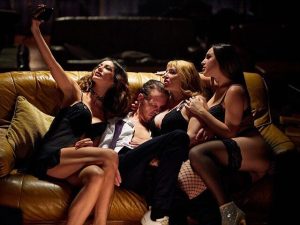 Hunter Biden (Laurence Fox) is drifting through life, parties, and may be the biggest hindrance to a would-be President Joe Biden (John James). Hunter left his laptop at a repair shop but thankfully the media refuses to cover the story, instead downplaying it as a possible Russian disinformation campaign in the last weeks before the 2020 presidential election. Joe can’t have anything go wrong so close to his possible big victory, but Hunter, at least in this not-at-all biased interpretation, seems like a walking catastrophe waiting for his next landmine.
Before even discussing the filmmaking merits, let’s tackle the chief purpose of this movie, which is to defame Hunter Biden and by association Joe Biden. It’s not exactly breaking news that Hunter Biden has lived a troubled life. The man has been upfront about his own struggles with addiction; he wrote about it openly in his own 2021 memoir. Watching Hunter snort anything within reach, party with hookers, and hang out with lowlifes just feels gratuitous because it’s the same characterization over and over. That’s all the movie covers for its first 30 minutes, Hunter partying with strangers and strippers (but still in a demure way where nobody, even before passing out on the floor, removes their clothes). It feels like we’re wallowing in a man’s degradation and it’s unseemly because the intention is not meant to be empathetic. The target audience watching this won’t likely care about Hunter genuinely getting better as a person. That’s not what this expose is for, trying to better understand his humanity and vulnerability. This is merely a roundabout way to taint Joe Biden, a figure too boring by himself, so the critics have to settle for Hunter and his salacious escapades and work on grimy guilt by association.
I can hear some griping that the movie presents Hunter in a more sympathetic light, at least early, with him recognizing his own screw-up nature but feeling powerless to rise above. He also talks about the grief of losing his mother and sister at such a young age, as well as his older brother in 2015. However, any pretense of humanizing goes out the window once big daddy Joe arrives, and Hunter becomes a sniveling sycophant who shrugs his way through life, not just aware of his nepotistic privilege but fully comfortable with his participation in corruption and graft. Any introspection is abandoned and it makes any prior introspection appear phony. It’s hard to square the Hunter in the beginning who talks about the wounds of losing his mother with the Hunter who complains that his dad never supports his art, complete with cutaway to his finger painting. There’s an entire six-minute stretch where Hunter is lectured to, by his stripper named Kitty (Emma Gojkovic) who just happens to be the estranged child of Christian missionaries, about China’s concentration camps for its Uyghur population, and he stares slack-jawed, as if he hasn’t kept up with the news in years (the reprehensible concentration camps for Muslims have been well-documented by the mainstream media). This Hunter is merely a stand-in for vague political corruption, an irredeemable naif that is only meant to make his father appear worse, and that’s also why now that Republicans have won the House, you’ll see a lot more of Hunter Biden’s name in 2023 because, obviously, investigating his previous business handling as a private citizen is the cure for inflation and higher gas prices.
 So what does the movie profess to expose, especially so that had this evil laptop of incriminating evidence been properly adjudicated, then Donald Trump, the most unpopular president in the modern era, would have easily won re-election? It’s a rehashing of what led to Trump’s first impeachment in 2019. Hunter Biden was on the board of a Ukrainian energy company, Burisma, and he most definitely got that position because of his name, and of course this is the only instance in the history of the world where that has happened before to the scions of the rich and famous. When Jared Kushner, who actually worked in Trump’s White House, was offered over two billion dollars by the Saudi royal family upon leaving his taxpayer-paid position, I’m sure it was completely for his unparalleled expertise on Mid-East diplomacy. Anyway, this Burisma position was already investigated internally by the State Department for conflicts of interest, and the Ukrainian prosecutor that Joe Biden pressured to be removed as VP was not threatening to investigate Hunter. This prosecutor was corrupt and refused to investigate Russian-backed assets; he even refused to investigate Burisma. There was no inappropriate arm-twisting to protect Hunter or Joe Biden, as thoroughly debunked during the 2019 impeachment trial. It’s all pretty established, but that doesn’t matter to its target audience, the same group who keeps desperately re-shaking a disparate collection of incorrect election anecdotes to produce a bigger picture like one of those pesky Magic Eye pictures that only “true American patriots” can properly see.
That’s really the majority of the specific accusations against Hunter. It impugns his associates, like Devon Archer who was sentenced for defrauding a Native American tribe in 2022, but too many of the accusations are broad and reaching, much like the Burisma condemnation. Biden did invest in shares of a Chinese technology company, Face++, as part of a larger portfolio, and China has reportedly used this technology to surveil citizens it’s looking to persecute. This is not great, but I wonder how many other venture capitalists have holdings with connections to other similarly sundry applications, especially with technology. I’m not excusing this, I’m just saying this “a ha!” accusation isn’t quite the deathblow the movies seems to assume. If it was, it wouldn’t need a character to literally explain the context of why this is so damning. The larger accusations of bribery and funneling ill-gotten monies back to daddy Joe are weak too, no matter how many times the movie adds titles to tell us, “This really happened” (but it didn’t). So many of these accusations are like Burisma, where it’s a purposely misconstruing of events and a deliberate ignoring of context or corroborating information that would deter their argument.
Hunter Biden isn’t the world’s greatest businessman by any measure. He’s also not the world’s most infamous criminal who fails to be held accountable because of his cushy connections. Hunter Biden hasn’t even been banned from operating a non-profit in New York state because he used a kids-with-cancer charity like a personal piggy bank (sorry, that was Trump’s children). Let it be known by this self-professed progressive, if Hunter Biden is guilty of a crime then prosecute him. Put him in jail. I don’t care. He doesn’t deserve special treatment. But at the same time, if he’s just a guy with problems, he doesn’t deserve this crazy level of unbridled antipathy.
 Following the McKay model, characters will stare directly into the camera for comedic effect, to add additional commentary, like when the movie flatly states, “This is not a true story… except for all the facts.” Of course, the screenwriters have a harder grasp of those stubborn facts. These are the same writers of The Obamagate Movie, which proposes to expose the “Deep State conspiracy to undermine the Trump administration and the fake Russian collusion narrative.” Again, facts are stubborn things, especially when the end of the movie laments when, oh when, will truth matter over lies and the powerful be held responsible for their corrupt actions (were these people just willfully hibernating during the scandal-a-week Donald Trump presidency?). The attempts at humor are often juvenile and stupid, like an opening scene where Hunter has a psychic conversation with a tiny dog while he’s high on drugs, and this is after a cartoon graphic of Hunter’s heart pops onscreen. The jabs against Joe Biden are mostly of the creepy hair-smelling and loony grandpa variety with groan-inducing malapropisms (“Nothing can threaten my erection;” see instead of “election” the dumb man said “erection”). The movie also squeezes in other conservative grievances, like opening with a Black Lives Matter protest and admonishing the media for its portrayal. I think having one of the protesters working as a stripper (to pay off her college loans, she tells us) is meant to be some insult to liberal protestors or even higher education. The same with having a stripper announce her pronouns. Is this the nightmare world the liberals all demand when even the people sleazy men pay to get naked would inform us of their preferred pronouns? I’m surprised they went the entire movie without a trans joke.
I don’t know why Fox (Inspector Lewis, White Lines) would agree to portray Hunter Biden. He doesn’t exactly resemble the man. He looks like a more gaunt version of Ebon Moss-Bachrach (Girls, The Bear). Fox provides the best reason to watch the movie because he’s not acting like he’s in lazy agitprop. Give credit where it’s due, the man gives a dark journey-of-the-soul kind of desperate sheen to this man, that is, until the script just turns him into a shrugging and sulking man-baby. Gina Carano (The Mandalorian) makes a brief appearance as a Secret Service detail to the Bidens, who never missed an opportunity to snidely confide to the camera about how much she loathes these men. John James (Dynasty) doesn’t work as Joe Biden at all, but he seems like he could have been a Sopranos-style goombah goon character reference for Paulie Walnuts. Many of the Eastern European actors who the production utilized from its Serbia filming site seems to have been dubbed over, so I don’t know how much criticism to offer Golkovic as Kitty, the stripper who also happens to be a former lawyer too. She’s a Swiss army knife of uses, including the intended moral uprising the filmmakers would like to believe they can engender.
 I’d like to conclude as a reminder why journalists believed that the Hunter Biden laptop story, which broke in the final weeks of the 2020 election, and was teased by none other than Rudy “Hand down my pants” Giuliani, would be met with skepticism. For an election about competency, a national COVID response, and basic human empathy, it seemed awfully strange that Hunter Biden’s name was coming up again so late, and once more from Giuliani, the man who was caught meddling in American diplomacy so that he could strong-arm Ukraine into pushing a sham investigation to slander Joe Biden. It was all just a bit too convenient, and especially when there wasn’t any corroborating evidence at the time, just one business shop’s word that, no for real, this must be Hunter Biden’s legit laptop. In the end, I doubt any voters could have been persuaded by the laptop, and those that were would have voted for Trump already. Nobody cares about Hunter Biden. And nobody should care about this silly and slimy movie trying to make him into the new conservative obsession. Go after Joe Biden for policy reasons, go after him for his age, but his son? In Joe terms, that’s baloney, man.
Nate’s Grade: D
Share this:

Bowling for Columbine (2002) [Review Re-View]

Originally released October 11, 2002:
Documentary filmmaker, political activist and corporate pot-stirrer Michael Moore prefaces his latest film Bowling for Columbine by admitting his lifetime membership in the National Rifle Association (NRA). He even received a marksmanship award as a teenager in his hometown of Flint, Michigan. Bowling for Columbine is Moore’s sprawling and hilarious search for answers among America’s zealous gun culture and alarmingly high number of homicides. It’s the tangents Moore just can’t help but take along the ride that add some of the more fun moments.
He opens a checking account at a Michigan bank that’s offering a gun for new customer accounts. Moore astutely asks an employee, “Do you think it’s a good idea handing out guns in a bank?” Moore travels to Canada to find out what reasons exist that make our cultures so different when it comes to crime. After hearing from citizens about how they don’t lock their doors, Moore decides to go door-to-door and see for himself. Sure enough, he walks into half-a-dozen homes.
Moore is better at pointing the finger than fathoming real answers. He touches media sensationalism, our nation’s bloody history, corporate greed, past military involvement, and an environment of fear being developed by those who profit from such actions. The sobering truth is that there are no easy answers to be debunked. The film’s climax involves an impromptu sit-down with NRA president Charlton Heston. Moore questions the sensitivity of the NRA after it held support rallies days after the school shootings in Littleton and Flint. Heston becomes weary and walks out of the interview after five minutes.
The film demands to be seen. It’s complex, challenging, and thought-provoking. Not only is Bowling for Columbine the most important film of 2002, it’s also one of the best.
Nate’s Grade: A
——————————————————
WRITER REFLECTIONS 20 YEARS LATER
I was a junior in high school when the horrific massacre at Columbine happened in April of 1999. I remember the shock that washed over the country. I remember the daze and sorrow. I remember students not coming back to school for days, some because they feared that our Ohio school could be the next site of the next tragedy because of how upending the Columbine school shooting had been for the general sense of security. “How could this happen?’ we solemnly asked. I remember exasperated politicians wringing their hands, grasping for solutions and scapegoats alike, and I most remember just the overall gravity of the whole situation, the sense of loss, and the sense that this meant something significant. Flash forward twenty years, and the Columbine school shootings, which snuffed out 15 lives that fateful morning, is now ranked fifth on the list of deadliest school shootings in the United States, having been gut-wrenchingly eclipsed by the 18 at Parkland in 2018, the 22 in Uvalde in 2022, the 28 in Sandy Hook in 2012, and the 33 in Virginia Tech in 2007. Since then, mass shootings and spree killers have become so common that the satirical news website The Onion keeps recycling the same condemning headline with the latest mass shooting: “‘No Way To Prevent This,’ Says Only Nation Where This Regularly Happens” (this damning headline has been repeated 22 times in eight years time, and it’s only a matter of months at most before it gets repeated yet again if history is anything).
After each new tragedy, we’ve been inured to the reality of anything of merit being done in the way of reform; we move from “thoughts and prayers” to, “let’s not politicize this now,” to, “you’ll never solve every problem,” and then finally to a litany of social issues that conveniently are the real culprits, and never the guns mind you, of course. It’s easy to be cynical that, in our current day and age, no gun tragedy will ever move politicians to make real changes. After Sandy Hook, the most watered down of reforms, increasing background checks, was met with stonewalling from Republicans and those funded by the formidable National Rifle Association (NRA) lobby. After 60 people were slaughtered during a music festival in Las Vegas in 2017, the next hopeful reform was eliminating bump stocks. That didn’t happen. The patterns emerge and become their own tragic parody of performative action masquerading as meaningful action.

When people argue, “Well criminals will just ignore the new laws we pass anyway,” I’m dumbfounded by this logic, as if that is reason enough to cancel all attempts at law and governance. The oft-quoted axiom of a “good guy with a gun” being the only real solution to a “bad guy with a gun” is equally nonsensical to me. If that’s the case, then the rising presence of guns would better police these matters, mitigating their deadliness, and that is definitely not the case. The good guys with the guns aren’t working. The challenge is determining who is a good guy with a gun or a bad guy with a gun. This reflexive thinking never applies to other tragedies: “The only way to battle a bad drunk driver is with a good drunk driver.” It’s maddening for any citizen genuinely seeking common sense gun reform that’s supported by a far majority of voters.
America’s fixation with our gun culture was already a potent issue in 2002 when political muckraker Michael Moore elevated himself to new commercial and critical heights, and it’s only become even more essential to unpacking twenty years later. Moore had restyled documentary filmmaking with his searing and tragic-comic 1989 Roger and Me, his documentation of the fall of the American auto industry in his hometown of Flint, Michigan, where my mother grew up, and his search for answers with General Motors’ CEO, Roger B. Smith. Moore put himself front and center in his films, the schlubby everyman trying to hold truth to power, though he himself would have a slippery hold on it as well. Moore directed two more features in the 1990s, The Big One and Canadian Bacon, his only non-documentary film. But Moore catapulted into a new stratosphere of media attention and derision in the George W. Bush era, first with 2002’s Bowling for Columbine, which won him his first Oscar and set doc box-office records, and then in 2004 for Fahrenheit 9/11, which obliterated the box-office records Moore had just set and would have likely won him another Oscar but he refused to submit in Documentary and only wanted to submit for Best Picture (Born into Brothels won that year instead, so thanks I guess).
Bowling for Columbine is an aggravating movie by design and through Moore’s tactics. The issue of guns and violence in America has only become more central to American lives. Moore’s thesis is messy because it’s hard to find a single cause for the root of America’s gun violence, ignoring, of course, the sheer number of guns, though he even says Canada has a high guns-per-resident ratio from their culture of hunting but lacks our murder rate. The section on the media sensationalism driving gun sales is potent, as a nation constantly in fear will reach for protection that is abundant supply and access. As the murder rate has gone down over the 1990s and 2000s, the network news’ reporting over violent crime has increased, as well as gun ownership. It’s a brew of paranoia that benefits politicians, media, and especially gun manufacturers. Gun sales soared once Barack Obama swept into office, not because he said he would take people’s guns, but a section sure trumpeted those fears for monetary gain. The extended anecdote on the mother of the youngest school shooter, a six-year-old, is a powerful indictment on welfare-to-work and a system that forces people into unlivable choices. I wish Moore had touched more upon the mental health aspect of the gun violence equation, as the far majority of gun violence are suicides and not homicides. Many were quick to deduce that the Columbine killers, Eric Harris and Dylan Klebold, were victims of bullying, but millions are victims of bullying and do not shoot up their schools. In a 2017 TED Talk, Dylan Klebold’s mother, Sue, discussed her personal process of coming to terms with her son’s actions and realizing how essential his desire to die was to his infamous actions. When people make irrational, impassioned, split-second decisions, and guns are readily available, then bad things can be made even worse. Moore doesn’t explore this angle, unfortunately. Some of his larger connections can seem very reaching, like when he tries to say that kids knowing their parents work for Lockheed Martin, a military weapons manufacturer, would be less likely to value human life.

But it’s the needless sleight-of-hand tactics with the truth that confound me with Moore, and these inevitably blunt the power of his message and ability to convert thinkers. This habit infuriates and flabbergasts me. Moore has so many good points already at his disposal, so many meaningful data points and heart-tugging anecdotes that he doesn’t need to stretch the truth to convey his message. I’ve since used Bowling for Columbine as an example in teaching credibility gaps and the concept of ethos with public speaking. This is epitomized in the handling of NRA president Charlton Heston. Shortly after the events of Columbine are replayed for us, including frantic 911 calls and security camera footage, Moore cuts to Heston defiantly declaring, “With my cold dead hands,” and informs the viewer that within ten days that the NRA held their annual conference in Denver, despite pleas from local leaders for distance and sensitivity. “Don’t come here? We’re already here,” Heston replies to applause. The problem is that Moore has stitched together two separate Heston speeches to seem as one, including the “From my cold dead hands” intro, which was given an entire year after the Columbine shooting. He also excludes pertinent details like the fact that the meeting in Denver was scheduled a year in advance, the NRA was required by law to notify all four million of its members ten days before a location change, and all other NRA events were canceled except for the meeting required by corporate law. When you look at the parts of Heston’s speech Moore picked from, anyone could follow the same approach and edit the speech to say whatever message they desired. The climax of the movie is Moore sitting down with Heston, but when he peppers him with questions about his speech days after Columbine, and Heston has no idea what he’s talking about, it’s because Moore isn’t playing fair. Then also take into account the aged actor likely going through the Althzeimer’s that caused him to step down from acting and the NRA in 2002. Look, I’m no fan of the NRA, and I personally believe their self-serving actions perform a genuine harm to the country, but this is just self-righteously badgering an ailing old man.
Moore is not the only documentary filmmaker to make use of selective editing, anecdotal evidence extrapolated, and narrative cheats for manipulative emotional purposes, but when you’re being provocative, you’re going to get push back, and when you use deceitful storytelling methods with your facts, you are a disservice to your cause and your message. There’s so much on this topic that Moore can effectively criticize, like the handy media scapegoats, the failings of zero tolerance and school resource officers, the obvious hypocrisy of do-nothing elected officials, the fear-mongering news seeking out consistent sensationalism, a deference to the military industrial complex, and the fact that the rest of the world watches the same movies, listens to the same music, plays the same violent video games, and yet, to paraphrase The Onion, we’re the only country where this happens all the time. Sadly, no place is safe in the U.S. from a possible mass shooting, and yet a good portion of this country will shrug and say that’s just the price we have to pay for living our freedoms. There are so many fallible arguments to poke apart, and that’s why I’m so frustrated with Moore’s misuse of his platform, giving his opponents the ammunition to dismiss his points.

Moore’s career has fallen quite a bit from his meteoric height in 2002 and 2004, last releasing Fahrenheit 11/9 in 2018 to warn about the lasting dangers of an inactive voting public and Donald Trump as president (it grossed $6.3 million, approximately five percent of the gargantuan $119 million gross of Fahrenheit 9/11). It feels like Moore’s style, once so revolutionary, prankish, and urgent, has now become stale. As I wrote in 2018: “If our country ever needed Moore, it would be now, but his time might have already passed as an influencer. The last time Moore was breaking through into the cultural conversation was with Sicko in 2007, years before the formation of the ACA. Since then we’ve seen the rise of social media, YouTube, and the instant commentaries of media old and new, all trying to one-up one another in expediency and exclusivity. Is Moore just another member of the old guard he laments has become obsolete?” It’s not uncommon for a filmmaker to lose their edge or passion after 30 years. It’s also not uncommon for the envelope-pushers to become part of an establishment that a younger public starts tuning out for lack of relevance. I don’t know if Moore has a real audience any more.
Re-reading my old 2002 review, I’m sure glad I kept a paper copy of each of my published film reviews for my college newspaper because it was the only surviving copy I could find. I could not find my review for Bowling for Columbine on any of the websites and blogs I’ve used over the years, so in 2022, I literally sat with my twenty-year-old newspaper and retyped my relatively brief review from 2002. Thank you, me, for stubbornly holding onto these yellowing papers. I remember being more taken with the film in 2002, so much so that I would brush aside criticisms from my other friends who made valid points about Moore’s larger thesis (they just “didn’t get it,” I’m sure I incredulously scoffed). My apologies, my put-upon and sensible friends.
In the scheme of Moore’s catalog of films, I still think Roger and Me is his finest work and much of this is because it’s the most personal of his movies, chronicling the decline of his hometown with his special access. It’s the one that feels most essential for him to be the face of the movie. Bowling for Columbine is a messy movie but all Moore’s films are scattershot entertainments in retrospect, each deserving of reflection but also outside verification. As a result, the movies never become more than the sum of their parts and floating ideas and interviews and stunts and his loose thesis statements rarely coalesce into anything definitive, like an Alex Gibney documentary. Moore can be hectoring and disingenuous, especially during his interviews, and most of all aggravatingly short-sighted in his techniques, but he is a documentary industry unto himself and with good reason. Bowling for Columbine is the start of a conversation, with many asides both illuminating and diversionary, and it’s still worth watching twenty years later, as gun violence has only gotten worse. I think it’s likely Moore’s third best film, after 2007’s Sicko, but maybe I’ll change my mind in 2027. Until then, I’m lowering the film grade from an A to a B.
Re-Review Grade: B


 nathanzoebl
You must be logged in to post a comment.