Blog Archives
Totally Under Control (2020)
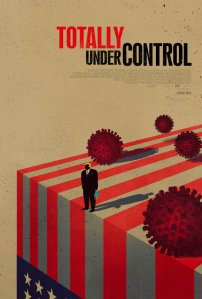 Over 220,000 Americans have died from COVID-19 as of this writing. We here in the U.S. are four percent of the world’s population and yet account for twenty-percent of the world’s deaths. I lament that this number will only go higher over the next many months of the pandemic that has defined 2020. Oscar-winning filmmaker Alex Gibney (Taxi to the Dark Side, Going Clear, Enron: The Smartest Guys in the Room) and his co-directors Ophelia Harutyunyan and Suzanne Hillinger conducted interviews around the world with special cameras and protective measures to complete the first major documentary on the coronavirus outbreak. Totally Under Control (title taken directly from Trump’s early February response to COVID-19) is their collaborative effort, and it’s both a timely work of criticism and destined to be inevitably out-of-date in short order.
Given the constant deluge of news about the by-the-minute Trump administration mistakes and questionable calls, the question for a documentary like Totally Under Control is whether or not it provides more insights than simply keeping up with the shocking and dispiriting headlines. I would argue that Gibney’s first pass at recounting our still-living history of calamity offers the benefit of hindsight but also an immediacy or urgency, considering we are still months away from a presumable vaccine. The movie feels like what the first part of the COVID-19 mini-series would cover, focusing on those first few critical months of bungled government response from January to April. The abbreviated focus allows Gibney and his crew to zero in on what the early mistakes were and how we have been paying for them ever since. The collapsed time also allows for more get-able interview subjects, people who might not currently be serving in the administration who feel comfortable or compelled to go on the record with their accounts. There are some great interview subjects here that were plugged in from the beginning, sounding the alarm, and who can give the public a clear understanding of just how woefully equipped a deeply un-serious administration was to handle the most serious public health crisis in a century.
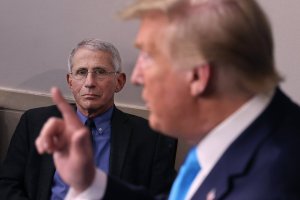 One of the more aggravating tragedies is that many of the thousands of COVID deaths could have been prevented if better steps had been taken early to contain its spread. Naturally, there’s always going to be clearer reflection when looking back on mistakes of the past, not knowing at the time that they were mistakes, but the Trump administration made a political calculus that would only exacerbate the spread of the coronavirus. Early on, the Trump administration’s guiding principle seemed to amount to stripping away anything and everything that the Obama administration had accomplished. It didn’t matter what it was, if Obama had built it, then Trump was motivated to tear it down. This included the pandemic response task force in 2018. This included ignoring the 70-page pandemic response playbook left behind. So when the early warnings appeared in December and January, the United States was already playing from behind. We could have been preparing with amping up production for necessary medical supplies and installing the infrastructure for a robust testing and tracing program; however, this all came into conflict with the other major political calculus that governed all of Trump’s decision-making. His mantra heading into 2020 and re-election was, simply, “Do no harm… to the economy.” Rather than take preventative measures or treat the virus as a danger, the Trump political apparatus was afraid acknowledging the threat so it would not spook the financial markets, a source of bragging for Trump to tout why the American people should re-elect him. When the CDC briefed government officials and media with updated predictions of normal life being uprooted, the markets responded negatively, and Trump fumed. From there, decisions were less about stopping the coronavirus and more about making everything appear like it was no big deal.
Totally Under Control keeps a running calendar of events to compare the U.S. response to South Korea, two countries that had their first official COVID infection on the same day. The Korean government had already taken preventative measures after the 2015 MERS scare to be ready if another frightening new contagion emerged. The politicians left the science to the scientists and followed their recommendations. The Korean people wore masks and were diligent about simple safety measures to stay safe. They had a system of contact tracing already installed. These moves are in sharp contrast to the American response, and while there would be some cultural roadblocks for Americans who consider themselves rugged individuals to submit themselves to a big data-harvesting consortium that contact tracing requires, we could have done so much better. In 1918, people wore masks because it made a real difference and saved lives. They took the Spanish flu epidemic seriously and they had fewer networks of knowledge at their disposal. Today, sadly, wearing a mask has become a political symbol and for many not wearing a mask has become a proud yet misguided act of defiance. Masks show consideration. Masks have been said to be even more effective at thwarting coronavirus spread than a vaccine. Masks work. The rest of the world, and South Korea, have showed what happens when you trust scientific recommendations. South Korea has less than 500 total COVID-19 deaths with a population of 52 million. Even if you multiply that figure by a generous seven to match the current U.S. population, that’s still only an estimated 3,500 total COVID-19 deaths during the same period.
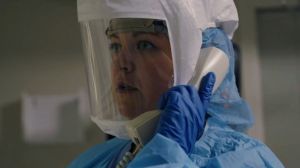 The level of ineptitude is highlighted by two key interview subjects. Rick Bright was the director of the Biomedical Advanced Research and Development Authority (BARDA) from 2016 to 2020. He filed a whistle-blower complaint about the Trump administration applying undue pressure to approve hydroxychloroquine, an experimental treatment that showed no signs of helping COVID patients. There was no medical reason to eliminate safeguards and protocols but the administration wanted a ready-to-market cure, and Bright was horrified that they wanted to make it widely available and over the counter, which would surely lead a panicked populace to request it and endanger their health. Recounting his experiences even brings Bright to tears as he recounts the disregard for safety and dereliction of duty of these political appointees dictating science. He’s a sobering and thoughtful voice to have in the documentary and also one of the biggest names of someone who worked inside the Trump response team. Another intriguing subject is Max Kennedy, who served on Jared Kushner’s White House supply chain task force. Kennedy thought he was going to be running errands or support tasks for the task force. He didn’t realize he and the other volunteers would be the entire task force. They were left to their personal laptops and emails to cold-call companies and perform Google searches to find personal protection equipment (PPE). They had no experience, no coordination with other government bodies, and they were competing against the federal government for the exact same dwindling supplies. Kennedy is breaking the NDA he was forced to sign to reveal the full extent of the chaos and inadequacy that Kushner’s “expertise” brought installing a solution to a very real problem. Kennedy and Bright’s first-hand insider accounts are both harrowing and maddening.
When it appeared that the Trump administration wasn’t going to be able to contain COVID-19, that’s when they pivoted to shifting blame and responsibility onto the states. The Trump administration could have authorized the Defense Production Act to force companies to begin manufacturing very needed PPE, but they didn’t. They thought, as conservative dogma has preached for decades, that government is the problem and the private market will solve it all. The problem with this line of thinking is that there are certain powers the states do not have in comparison to the federal government. State governments cannot run past their budgets. State governments do not have the power to set up a national system of testing. State governments were forced into a 50-way fight for supplies and were vulnerable to capitalistic gouging. The states were then also competing with the federal government, which was driving up the bids for these supplies and then overpaying for the same supplies by many times over their cost. The states were left on their own to duke it out and any slip-ups or shortages were disparaged from afar by a Trump administration that wanted to look in charge but didn’t want the responsibility.
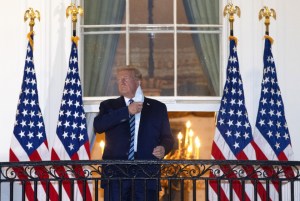 Totally Under Control is an essential documentary for our times but it also can’t help but feel like the beginning of an even bigger and more excoriating story. It’s frustratingly incomplete. It’s the opening chapter of the examination on the U.S. response to the coronavirus, and this story will likely only get more depressing and infuriating as the death toll rises and the regret of “what could have been” grows even more pressing with every week. Gibney and his fellow directors keep their movie pretty straightforward and efficient, and there is something powerful about putting all the relevant facts together into an easy to understand timeline and seeing all the dots connected. Gibney has always been blessed at his ability to artfully articulate a big picture with his films. Totally Under Control is a useful artifact for history and a denunciation of the early days when so much could have been so different if the United States had leaders that trusted science, didn’t dismantle key government bodies, took responsibility when the moment called upon rather than ducking leadership, and cared about more than their personal finances and standing. It’s only going to get worse from here, especially once we fully analyze all the important steps not taken.
Nate’s Grade: B+
Share this:

The First Purge (2018)
 This is the first Purge movie to exist in the era of President Donald J. Trump, and that has made the films more political and even more oddly relevant. The movies have been pretty upfront about the political machinations of the Purge events from the start, the rich elites (read: white males) using the annual occasion to sweep the world of undesirables (read: poor, minorities). The fourth film, The First Purge, goes back to the origins and it’s even more bluntly political with its commentary. However, when we see children being held in cages in our daily headlines, it’s an affirmation that we may live in blunt times and perhaps we need blunt instruments of dark social satire to get the message across.
The residents of Staten Island have been selected for a social experiment from the governing party of the New Founding Fathers (NFF). For twelve hours, all crime will be legal. Dmitri (Y’lan Noel) is a local gang leader with his eye on his community, making sure his people will be taken care of and protected. His ex-girlfriend Nya (Lex Scott Davis) rejects his outreach, and little brother Isaiah (Jovian Wade) is looking for vengeance against a psychopathic loner in the neighborhood. The creator of the Purge, social scientist Dr. Updale (Marisa Tomei), only wants to see where the data leads. The NFF, on the other hand, have their own motives and will make sure the experiment succeeds at all costs.
 Never has the Purge universe felt closer to our own than with this new movie, and that’s a testament to the film franchise finding new ways to spin its stories, but it’s also an indictment on our own modern times. When we have a president who on a whim, as recently reported, asked why we can’t just invade Venezuela or why we can’t just use nuclear weapons, it doesn’t seem too far away that he might, without a moment’s notice or hesitation, champion a real Purge program. The new movie reflects this reality with even more explicit relevance. The figures of oppression and white supremacy are preying upon vulnerable black and brown Americans. We have militiamen dressed in Klansmen garb, shiny Nazi outfits, police uniforms, and even masks that evoke blackface. These same creatures of hatred have been given a new platform of legitimacy from a president who has trouble saying anything bad about his fans, thus ennobling and enabling the fringe elements into renewed visibility. This is a movie where the citizens of a poor neighborhood have to fight back against the racist elements set to kill them and empowered by the government. If that doesn’t sound eerily relevant today, you haven’t been keeping up with the omnipresent news cycle of outrageous offenses.
Another interesting turn of events is that this might be the first Purge movie that is hopeful about the human race. For three movies, the Purge has celebrated our darker natures, positing that mankind when stripped of responsibility for its actions would inevitably trend toward brutish violence because they could. The core belief of the Purge is that people need a release of the evil inside them, as if there was a finite level. We’ve watched crazy people do wantonly destructive and murderous acts for three movies. The First Purge offers a completely different perspective. Once the event happens, the majority of the “participants” will elect not to engage in casual mayhem and murder. There will be the occasional few acts of vandalism and theft, and an outlying psycho or so (more of that dude later), but the majority of State Island residents just stay indoors, find refuge in their church, or simply attend a block party. They actively disengage. It’s then that the NFF fret that the social experiment they’ve bet so much political capital on will not turn out with the preferred results they need. They need Americans to be afraid, and it also helps eliminate the minority voting bases for their rival political parties. This reality is not to their liking, so they will simply repackage the news to their liking. That’s when the NFF push the reactionary elements (paramilitary white supremacists) to infiltrate and instigate mass death to ensure the Purge experiment is successful. The numbers are skewed, and paying people based upon their level of violent participation may start the process skewed to begin with. In an unexpected bout of optimism,The First Purge argues for the morality of humanity.
 Because of this very purposeful perspective, it also means that the movie is a bit slow and dull for the first hour. The First Purge has the same flaws as the other films, notably an over reliance on jump scares and less-than-interesting peripheral characters. One female supporting player (Mugga) is meant to be comic relief but I found her to be exceptionally grating, like she had been ported in from the sitcom version of the Purge (There is a TV show headed for USA and a commercial for it in the end credits, the first I’ve ever seen that happen). The glowing iris contact lenses of the participants created an eerie mood in place of larger set pieces. Some of the run-ins are actually rather lame, like an armed holdup where the gun is revealed to be… a water pistol. Who is running around pranking people with a toy when actual murder, with actual murder-capable guns, is sanctioned? That’s just beyond stupid. Likewise there’s a crew of people waiting in the sewers to… sexually assault women by grabbing their crotches. It’s a bit odd considering all of the uncomfortable waiting they must endure. I did find the lead character Dmitri to be quietly compelling as he tries to protect his neighborhood. When the final act comes, and Dmitri becomes a one-man wrecking crew taking down murderers in Nazi regalia, that’s when the movie transitions into the action spectacle we’ve been craving. The final fight is righteous and satisfying, and it even brings back a wildcard character you may have forgotten. By its conclusion, The First Purge has packed its best, most exciting stuff, but until then it’s a somewhat somber, somewhat restrained experience that may rankle the blood-lusting audience that had grown familiar with the series’ depravity.
And now we have to talk about the best character in the whole movie, and maybe second best after Frank Grillo’s grizzled badass hero. Skeletor (Rotimi Paul) is a local criminal who seems pretty unstable, prone to violent outbursts and self-aggrandizing talk. Whenever he talks it feels like you need a spittle guard as protection. He either has facial implants of scars running along his exterior, though I’d bet they were self-induced scars. He is, as my friend Ben Bailey attributed, the human equivalent of Roberto from Futurama, a psychopathic stabby robot that would mumble to himself and, very often, stab repeatedly. That is Skeletor, who is so brazenly crazy that he circles around from threat to figure of entertainment, like some 80s slasher villain elevated by personality and execution (not literally). When he reappeared I would chuckle to myself and say, “Oh, what’s that Skeletor going to get up to next?”
 The First Purge is the latest in an unsubtle sci-fi thriller franchise, though this is the first Purge movie to separate itself from its grisly ilk in interesting and thematically relevant ways. It rejects the core pessimistic belief system that human beings, when given the freedom to be violent, will exercise that opportunity. This is the first questionably (naively?) optimistic Purge movie, even though we know what comes after. It’s a bit slow and still beholden to the overall staid formula of the franchise, but this is a Purge film with enough sharp contrasts and a streamlined thematic perspective that it stands out. I won’t say it hits the peak of 2014’s Purge: Anarchy, but I would easily call this the second best entry in the franchise. In Trump America, it’s scary how relevant these movies have become and it’s refreshing they haven’t shrunk from that unexpected relevance.
Nate’s Grade: B


 nathanzoebl
You must be logged in to post a comment.