Blog Archives
Pirates of the Caribbean: Dead Men Tell No Tales (2017)
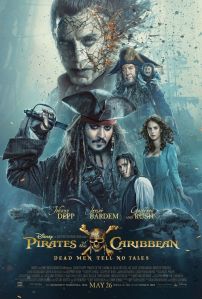 Rest assured fans, Pirates of the Caribbean: Dead Men Tell No Tales is a definite improvement over its waterlogged 2011 predecessor, but I can’t help feeling like the magic of this franchise, and even the high spirits of the immediate sequels, has been squelched. It’s a multi billion-dollar franchise born from a theme park ride and now I think I’m ready for that ride to come to an end.
Captain Jack Sparrow (Johnny Depp) is once again in the middle of some high seas hijinks. Everyone is on a collision course with the world’s most infamous, swishy, and soused pirate. The ghostly Captain Salazar (Javier Bardem) and his undead crew are looking for a release from their curse and of course vengeance against Sparrow, and Barbossa (Geoffrey Rush) is their key to reaching their target. Henry Turner (Brenton Thwaites), the son of Elizabeth Swan and Will Turner, is looking to retrieve the mystical Trident to erase all nautical curses, thus freeing his father’s indentured servitude aboard the Flying Dutchman. Carina Smyth (Kaya Scodelario) is looking to discover the whereabouts of her father via clues tied into astronomy. All the parties are fighting to be the first to discover the location of the Trident and get what they feel is deserved.
Pirates of the Caribbean: Dead Men Tell No Tales has some advantages that are worth discussing before attention turns to what’s wrong with the franchise as a whole. Unlike Rob Marshall, directors Joachim Ronning and Espen Sandberg (Kon-Tiki) understand how to expressly direct action sequences. They have a strong sense of visuals and know how to hit some majestic big screen imagery, whether it’s a see-through silhouette of a zombie shark, or Salazar’s ship splaying like a retracting ribcage, or a runaway bank heist with a literal runaway building. There’s a terrific scene of visual comedy and action when Sparrow is trapped in a spinning guillotine, with the blade coming perilously close only to fall away from gravity and then repeat the process. That was a moment that made me think of the original 2003 film’s comic inventiveness. Instead of just having cool ideas and concepts (carnivorous mermaids, a psychically controlled ship), Pirates 5 at least puts them to better effect. It feels like greater care has been put into meaningfully incorporating the elements of the story, though there are still noticeable shortcomings. I loved the look of Bardem’s villain and the CGI texture that made him seem like he was underwater. It added an unsettling dreamlike quality. Jack Sparrow is thankfully once again a supporting character. There are also several other characters that are worthy of our attention, plus the welcomed return of Barbossa. The movie comes together quite well for an extravagant final set-piece that reasonably serves as an emotional climax.
 For the last couple days since my screening, I’ve been turning over in my head reasons why the Pirates sequels, especially of late, have felt so removed from the original film and even the lesser sequels from 2006 and 2007. I think I have deduced the three essential missing ingredients: clarity, urgency, and characters.
The first three Pirates films were gloriously complicated and convoluted, a series of spinning plotlines that weaved in and out, intertwined with conspiracy, collusion, and reversals. They’re overly plotted affairs, and eventually the third films succumbs to the pitfalls of convolution. However, something readily apparent in those movies was a sense of clarity in the individual scenes. Perhaps the overall picture was murky but in the moment you knew what needed to happen, which characters had opposing goals, and what those conflicts were. It’s those opposing goals that provide much of the enjoyable confrontations and complications in the film. Take for instance the first meeting with Jack Sparrow and Will Turner in the blacksmith’s shop. Jack is looking to free himself of his shackles and escape. Will is looking to capture Jack, for his believed assault on Elizabeth, and he’s also looking to prove himself as a swordsman. One of them wants to leave and one of them wants to delay that leave. It’s clear. The scene plays out as the characters clash but we, the audience, know the needs of the scene, and it allows each to reveal their character through action. The majority of the first three films follow this edict. The allegiances are all in conflict: Barbossa wants to alleviate his curse, Jack wants vengeance and to regain his ship, Will wants to rescue Elizabeth, and none of them trust the other. While the dynamics are complicated they are built upon classic storytelling devices of conflict/opposing goals and there’s a genuine clarity in the micro. You know what the characters need scene-to-scene and why they are in conflict and what those goals are. In Pirates 5, the goals are too vague or overly generalized, and from scene-to-scene there’s little internal logic established for the actions to have significance.
 The next missing element is urgency, which is a natural byproduct of clarity. If you don’t know what your characters are doing or what their goals are then it’s hard to maintain a sense of urgency. The stakes of this franchise have felt a bit wishy washy after the culmination of 2007’s At World’s End. Before, the characters felt like they had something to lose, something that might not be accomplished. Look at the first Pirates film and you see that those goals are being accomplished poorly. There are complications and unexpected detours, but the stakes felt real because there were ongoing challenges. I think the absolving of stakes in the franchise has gone directly hand-in-hand with the series becoming more jokey. Once characters become cartoons the sense of danger dissipates and then anything can become lazily excusable. There is no recognition of an over-the-top anymore, which then makes the characters feel limitless. That’s not good when they’re supposed to be going against supernatural villains who present their own special powers. In Pirates 5, the characters bumble through every sort of scenario, and while they may not be in control at the moment, you never really fear for them. It’s a safe series of chases and escapes like a Saturday morning cartoon you know will merely reset its characters back to their starting positions by the next adventure. It feels weightless, which is shocking considering the Macguffin everyone is after eliminates all known curses.
Finally, with the series becoming jokier, it’s become more of the Jack Sparrow Show to its overall detriment. Maybe it’s too much of a good thing, or maybe it’s a latent realization that Sparrow was never the main character of the original trilogy, but Depp’s iconic figure has simply lost some of his luster. It feels like Depp is on sashay autopilot. He’s still a charming rogue but it’s become drastically obvious that he needs supporting characters that can stand on their own to serve as foils. He’s a character that leaps off the screen; however, if he’s our only focus, then his act starts to curdle into schtick. There are sequences that only serve to deliver misapplied comedy, like a beachside wedding where Jack is strong-armed into marrying an ugly woman. Jack should not be the lead character but he also still needs to be a character with a sufficient storyline and arc, which has not happened since At World’s End. He’s become the Halloween costume of Captain Jack Sparrow, content to coast on audience good will repeating the same act and delivering the same punchlines. Likewise, the characters supporting Jack Sparrow need their own individually compelling stories and motivations to alleviate some of the pressure.
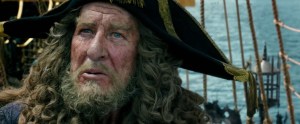 Fortunately, one of the more noticeable improvements with Pirates 5 is that there are some interesting supporting characters, chiefly Scodelario (The Maze Runner). She could have been a discount version of Keria Knightley, much in the same way that Thwaits (The Giver) is so bland he comes across as a discount Orlando Bloom. While she follows the same feisty, independent-woman-ahead-of-her-time model, she manages to separate with her own identity, a woman who loves science, pushes against authority, and is desperate to discover the whereabouts of her father. Her discovery of her lineage provides the film with an unanticipated degree of emotion. She’s a fun character who can provide a rich, exasperated sense of irony as a learned woman constantly being mistaken for a witch, and then when called upon, she provides the heart of the story with her family drama. Likewise, Barbossa has always been one of the series highlights and in particular the MVP of On Stranger Tides. As he’s waffled between friend and foe, Rush has always found a way to make him worthy of our attention. He gets what I’ll call the Yondo treatment in Guardians of the Galaxy vol. 2 (supporting character elevated into force that can legitimately elicit audience emotion). He comes into the film late but he dominates the second half. Pirates 5 also has a superior villain to On Stranger Tides. Javier Bardem (Skyfall) eats up every second as his ghostly captain and his enjoyment is infectious. He’s weird and creepy and just the right kind of crazy to make him even more dangerous.
Also worth noting is a flashback scene that explores the personal connections between Sparrow and Salazar, though Salazar’s back-story is still rather weak even with the mysterious Caribbean volcanic lava pits. The sequence is noticeable for the fact that it employs the de-aging CGI technology on Depp, making him look like a plasticized version of himself circa… Edward Scissorhands? It’s a neat trick and it seems like nobody does the de-aging effect better than Disney at this point (Michael Douglas in Ant-Man, Robert Downey Jr. in Civil War). But then the movie keeps featuring the effect, showcasing it in ill-advised close-ups, and the magic starts to fade and we’re reminded of its fakeness. It’s a moment that inadvertently sums up the later Pirates sequels: a neat trick undone by sloppy repetition and a lack of self-control.
 If you’re a fan of the Pirates of the Caribbean franchise, by all means you’ll find enough to satisfy your appetite with the fifth installment. At this point audience expectations have become entrenched, which is one of the reasons why Jack Sparrow has morphed into a Looney Tunes cartoon rather than a fleshed-out comic character with depths of danger. I don’t regret seeing the latest Pirates film but I would also shed few tears if this were the last time we visit this universe. The recent sequels leave the inescapable impression of listless fan fiction. They’re trying to recapture the magic formula of the original but missing the crucial elements that made a movie about drunken pirates and zombies a zeitgeist-harnessing, culture-defining classic. The sequels have lacked consistently effective clarity, urgency, and characterization to register as anything but generally incomprehensible, vacant, disposable mass entertainment. It’s become product, and maybe that was inevitable for what once felt like something so different and subversive, especially coming from the Mouse House. Age softens all franchises and a safe sense of routine creeps in. They start becoming imitations of themselves and then imitations of the imitations. Pirates of the Caribbean: Dead Men Tell No Tales is a fitfully entertaining venture that saves its best stuff for last, has some solid supporting turns, and decent fantasy-horror visuals. It’s also a reminder of what has been lost and, unless the franchise changes course, will continue to be lost.
Nate’s Grade: B-
Share this:

Pirates of the Caribbean: On Stranger Tides (2011)
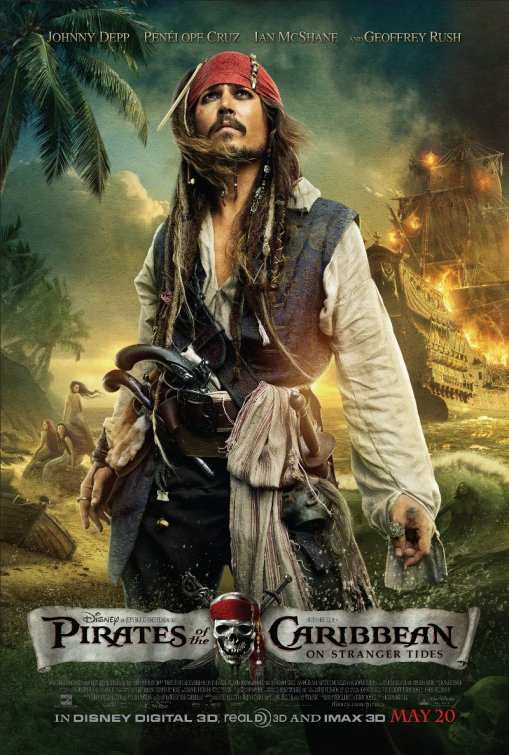 The public reaction to the two previous Pirates of the Caribbean sequels, 2006’s Dead Man’s Chest and 2007’s At World’s End, were decidedly mixed, though that didn’t stop them each from earning a bazillion dollars. Fans didn’t care for the darker tone, the confusing interlocking of the story, and especially the bloated running times. It feels like Disney’s uber-producer Jerry Bruckheimer must have taken notes from the sequel backlash and they amounted to: “Less of everything.” Welcome to less plot, less character, less involvement, and far less entertainment. Welcome to Pirates of the Caribbean: On Stranger Tides.
It’s been a few years since the non-world-ending events of At World’s End, and Jack Sparrow (Johnny Depp) has been in London putting a new crew together. Except, it’s a Sparrow imposter. Turns out it’s Angelica (Penelope Cruz), a former lover of Jack’s who woud still like to settle some scores. She and her father, the feared pirate captain Blackbeard (Ian McShane), force Sparrow to lead them to the Fountain of Youth. Apparently, Jack at one point had the map. King George II (a delightfully hammy Richard Griffiths in one of the film’s best scenes) is in a race against the Spanish crown. The English monarch hires Barbossa (Geoffrey Rush), Sparrow’s occasional enemy and ally, to find the fountain as well. It’s a race to see who can benefit from eternal youth first because, apparently, no one can share a source of water. Second grade teachers nationwide are very disappointed, Disney.
The entire enterprise just lies there on the screen, devoid of all energy or danger. The entire picture is just so shockingly inert, lazy, phoned in from every angle, missing any resonance of magic. Rob Marshall was the wrong man to be tapped as the new director of this series. Marshall has a fine eye for visuals, but the man couldn’t stage an action sequence to save his life. The Oscar-nominated director of musicals like Chicago and Nine stages his action sequences like dance sequences, which on paper don’t sound too far off. That’s until you realize action needs to incorporate story, location, build in tension, create organic obstacles, and be easy to follow. The action sequences in On Stranger Tides aren’t outlandish enough. It’s all so dull, a sword fight here a sword fight there. Short of a mermaid attack sequence, there’s no excitement to be found onscreen. That is disastrous for a franchise that has built a reputation for its anarchic, wild action and storylines. Marshall’s action angles and editing don’t communicate urgency. There’s no mood to these set pieces. The editing feels like it’s always catching up, always too late, needing a myriad of trims. Action cinema has been lambasted when it’s hyper edited and the audience cannot see what is happening; On Stranger Tides is not edited enough. One of the reasons these half-baked action sequences can never get going is because they always seem to be starting and stopping with the lackadaisical editing, always a step behind. The shots linger when they shouldn’t. The ingredients are there for a tasty meal but the chef (Marshall, screenwriters) doesn’t know what to do. The musical score by Hans Zimmer tries very hard to compensate and rattle the audience, compelling them to think what is transpiring on screen is exhilarating. It is not, and the music is just loud and annoying.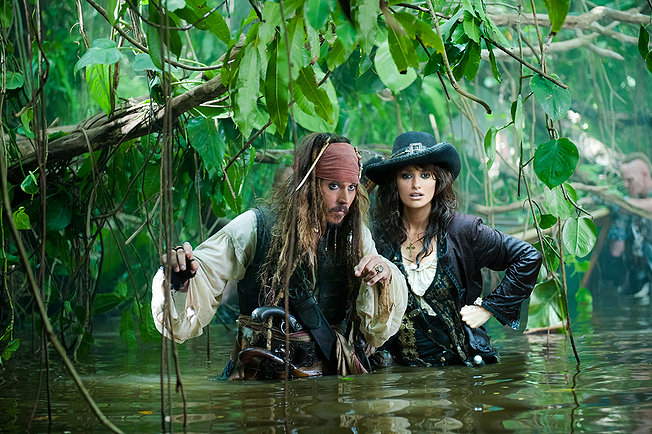
One of the chief criticisms of the two Pirates sequels were that they were overstuffed with storylines, characters, setups, and were just far too convoluted and confusing for their own good. So with On Stranger Tides we get a simplified, pared down one-off movie. Much of the film is just characters walking in circles and, likewise, talking in circles. Motivations are flimsy. The dialogue is stilted; Sparrow’s malapropisms and one-liners feeling sloppy (“I agree with the missionary’s position,” he quips. Groan). The entire premise is to get to the Fountain of Youth, and then they get there and, well, very little happens. The characters will talk about little, walk a few feet, talk about little more, and this process repeats. Barbossa should be an interesting foil, going from fop to pirate by film’s end, and yet his every appearance in the movie feels like when the next-door neighbor appears on a TV sitcom. It’s an intrusion meant to remind you that you, the audience, like this character, even if they don’t serve any point in the story. The plot lacks any twists and turns, ultimately having every competing force converge on the Fountain of Youth at exactly the same time for a slapdash climax that involves more lackluster sword fighting, just like all the other sequences. On Stranger Tides is a full half-hour shorter than the third movie, and yet it still feels like an eternity at two hours and seventeen minutes because it spends so much time doing so little.
At least the other three Pirates movies found clever ways to mingle their sci-fi mythology into an old-fashioned Errol Flynn swashbuckling adventure. With On Stranger Tides, the sci-fi fantasy elements are just as underdeveloped as the characters. The Fountain of Youth is another of those magic do-hickeys that involve gathering magic tokens and blah blah blah, mermaid tears, silver chalices. Hey, if you wanted to drink up some mermaid tears, have them watch 2009’s Oscar-winning best documentary, The Cove. That ought to do it (a scene driving the mermaids into nets oddly reminded me of The Cove). Blackbeard and Angelica have a Jack Sparrow voodoo doll, which is highly effective, and yet this plot device is nearly forgotten for the entire film. There is no clever application of this unique device. Blackbeard has a magic sword that makes ships come alive. Why? How? It’s just another magical Macguffin, like Jack’s compass. Man-eating mermaid temptresses is an interesting idea, and a great way to squeeze in a lot of obfuscated nudity in a Disney film for teen boys who have not discovered the Internet. Too bad the mermaids are confined to one scene, albeit the highpoint of an otherwise bad film. Their feeding frenzy is the only moment in the film that channels that high-flying sense of verve that made the original so memorable. Don’t even get me started on the fishy romance presented between the captive mermaid (played with all the acting capability of a French perfume model) and a missionary (Sam Claflin). The whole experience feels like a shambled, draggy, inarticulate rip-off of Last Crusade, complete with a climactic drink from a magic chalice. I appreciate Marshall’s emphasis on practical special effects but if these are the results then bring back the previous sequels’ CGI vomitorium. This franchise feels like every ounce of energy and danger has been squeezed out of it.
So does that means that this Pirates venture is more character-based now that it has jettisoned side characters and complex plots? Fat chance. The problem is that Jack Sparrow is not a good lead protagonist. He’s not meant to be a classic good guy. He’s a libertine, somebody who makes selfish choices but will revert to do something proper when his conscience nags him enough. Sparrow is more of the dashing rogue at best. Does anyone remember how he was going to trick doomed men into signing their souls to Davy Jones? He also needs a foil, a striaghtman to bounce off of. I almost miss the wooden performance of Orlando Bloom. Without a do-gooding striaghtman, Jack Sparrow plays like a man adrift, searching for his groove. Unfortunately, Sparrow never finds it in this vehicle, which just asks him to go through motions and mannerisms. Blackbeard makes for one very bland villain. McShane (TV’s Deadwood) can glower and chew scenery with the best of them, but his baddie never seems too menacing. He burns one guy alive and threatens to kill his own daughter in order to keep Jack in line. I’m sorry, but that doesn’t even compare after the previous films included a monstrous ship captain who would readily slice prisoners’ throats and a British bureaucrat who hanged an eight-year-old before the freaking opening credits. Blackbeard, in contrast, just comes off like a crusty old man in need of a shave.
 The film’s biggest addition was bringing in Jack’s former flame Angelica, a woman he robbed of her virtue and personally betrayed. But is there any tension? No, because Jack and Angelica don’t have any old feelings for one another they rehash (oh how I was even pleading for a trope like that), and the characters don’t really feel any antagonism either. Sure they will parry and threaten one another, but it’s so devoid of danger or tension or interest. This is no screwball romance. They feel like a couple that can’t be bothered working up any notable feelings toward one another. Therefore, all their shared scenes, and there are many, sink the film’s flow. Their bickering should bring some sparks. She should be exciting; she’s the daughter of a notorious pirate, she was going to be a nun until Jack Sparrow came sailing into her life. She should be sore. She should be angry. She should be a lot of things that ultimately the character is not. Cruz (Nine, Vicky Cristina Barcelona) doesn’t come across as an equal or love interest, she just feels like an annoying sidekick, harping on “Yack.” At one point, Jack tells her, “If you had a sister and a dog, I would take the dog.” When she’s got a personality like this, I’d agree.
Depp (Alice in Wonderland, Sweeney Todd) is obviously a comic gift and his Sparrow character will go down in the ages as one of the most universally beloved figures in cinema history. Everyone adores this character, a loveable scoundrel. But that doesn’t mean the screenwriters can just strand him in a crummy story with nothing to do. Depp will always be enjoyable when he puts on his Captain Jack eye liner and does that funky, swishy walk of his, but even he feels like he’s phoning this one in. He realizes that his character is trapped in a sodden adventure that offers little to do as a character and an actor.
I never thought I would say this, but On Stranger Tides makes me positively reevaluate the other Pirates sequels (I admit to being one of the few critics who liked Dead Man’s Chest a good deal). If this is what a simplified Pirates of the Caribbean film gets you, bring me back the messy, maddening plots of the previous films. Bring me back the scope, the danger, the clever mingling of genre elements, the adventure, the sizzle, the anarchy, and bring me back director Gore Verbinsky. Marshall has no feel for this material or how best to serve story. I never expected a movie with this kind of budget to be so lifeless. It all just sits there on screen, expecting the pieces to come together through ardent wishful thinking. On Stranger Tides suffers not because it strips away some of the excess and convolution that plagued the other films, it suffers because it gives no reason for its existence. It does not enrich the characters, the Pirates universe, or provide a rip-roaring story. Obviously, the film exists to line the coffers of Disney. It may earn plenty of booty this summer, but this is no way to rejuvenate a sinking franchise.
Nate’s Grade: C
Share this:

Pirates of the Caribbean: At World’s End (2007)
 Shiver me timbers Jerry Bruckheimer. The Pirates of the Caribbean movies are taking no prisoners when it comes to money and fans. Ten months after 2006’s Dead Man’s Chest comes the concluding chapter to the Pirates saga. At World’s End is longer, bigger, and more expensive, but it is also the first Pirates movie that felt like a ride I wanted to get off.
The British navy, at the command of Lord Beckett (Tom Hollander), is eliminating all piracy once and for all. He now controls the heart of Davey Jones (Bill Nighy) and so controls Jones and the crew of the Flying Dutchman, the most fearsome ship run by cursed barnacle-encrusted crewmen. As the very busy hangmen will attest, it’s not a friendly time to be a pirate. The Black Pearl has set out to Singapore to find support from Soa Feng (Chow Yun-Fat), one of the nine pirate lords. The Pearl is now commanded by Barbosa (Geoffrey Rush) who was brought back from the dead thanks to the witchy Tia Dalma (Naomie Harris). They travel to the ends of the earth to Davy Jones’ locker to rescue Jack Sparrow (Johnny Depp), who was last seen in the belly of a beast. Elisabeth (Keira Knightley) and Will (Orlando Bloom) are both aboard and still bickering about their stalled romance. Once Sparrow returns to the land of the living, the group meets with the other pirate lords from all across the globe in an effort to pull together and stand against Beckett.
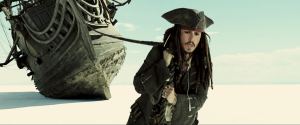 As it turns out, the fear that Pirates of the Caribbean: Dead Man’s Chest was a 150-minute trailer for this movie was unfounded. That’s because the third movie in the Pirates of the Caribbean series completely ignores or messes up the many intriguing setups from the second film. Character motivations from Dead Man’s Chest are mostly unresolved and revert to stock generalizations. Jack Sparrow feels like he’s been grafted onto an unrelated storyline. Most disappointingly is what happens to Davy Jones, the greatest addition to the Pirates landscape. This awesomely-realized villain was scary and fascinating and looked fantastic thanks to Oscar-winning special effects. At World’s End takes such an intriguing villain and turns him into an impotent tool to Beckett. He’s been transformed into a houseboy who might as well fill people’s teacups. Yes Davy Jones thankfully figures into the climax but why in the world’s end must an audience wait that long? Davy Jones reminds me a lot of the ghostly twins from 2003’s The Matrix Reloaded who were completely dropped from the second Matrix film to the third.
But not only does At World’s End fumble the hand-off from the previous sequel, the movie itself establishes many setups with poor or unsatisfying payoffs. So much is made about the pirate lords from all over the world, and we see a colorful collection of international pirating groups that is fitfully amusing, but the whole section has no point at all. Chow Yun-Fat’s character is a non-starter; in fact none of the new characters introduced in At World’s End play any importance on the overall plot. The film is building to a final all-out battle between the united pirate lords and the British navy. We witness the awesome sight of the sea filled with vast armadas of ships, and as an audience we are getting hungry for some epic nautical action. Then At World’s End pretends that none of the other ships matter and sets its entire battle as one ship versus one ship inside a whirlpool. While this is admittedly exciting it isn’t anywhere near as exciting as an entire war amongst hundreds of ships. The filmmakers have all the money in the world and they couldn’t give us a little something bigger in scope? The pirate lords could have just as easily been cut from the movie if they were just going to stand on the sidelines and wave a flag.
The pirate lords make a big deal about their apprehension with releasing the sea goddess Calysto from her earthly prison. The pirates trapped her into the body of a human in order for them to gain control of the seas. They reckon she’ll be one very bitter sea goddess and take out some apocalyptic wrath out on the pirates. So the pirates release her, cowering in fear at her powerful reprisals and,,, nothing. Calysto vanishes, causes some mildly inclement weather, and is never seen again. Talk about a lot of pointless hot air.
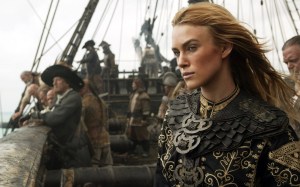 I think perhaps the clearest example of how the movie screws up is with the monstrous Kraken. This slimy beast got a ton of attention in Dead Man’s Chest and was a ferocious terror on the high seas. Now, I would expect that such a creature that played an integral role in Dead Man’s Chest would be back for the next sequel. Ignoring its prominence in the plot, the thing just looked amazing onscreen. But with At World’s End the giant monster is killed off screen and in between the movies. I felt insulted when I saw the mighty carcass washed ashore like a pathetic beached whale. What is satisfying about that? Why would Beckett make Davy Jones kill such a powerful weapon he could use for his own unseemly gain? It makes no sense. The Kraken isn’t the only character done a disservice by a plot stuffed to the gills. Some are killed in terribly pointless incidents and it just becomes irritating.
At World’s End is missing the high-flying fun of the first two Pirates movies, and this venture just feels draggy, tiresome, and far too dreary. You know you’re headed for some morose subject matter when a movie hangs an eight-year-old before the opening credits. This latest film is crushed to death by the weight of excess plot and confusion. There’s a damn near 20-minute section of the movie that’s nothing but characters double-crossing, triple-crossing, quadruple-crossing each other; it literally requires a character to spell out what has just taken place and set the record straight. I don’t think At World’s End ever recovers from this absurdly confusing miscue.
The film seems more interested in talking over an audience than delivering something genuinely thrilling and stirring. There’s a curious lack of action and nothing new matches the imaginative action set pieces of the previous films, like the duel atop the roving water wheel. Excluding a large melee between the Black Pearl and the Flying Dutchman as the climax, the action pops in and out in shortly timed bursts. For a movie within a hair or running three hours, there needed to be more action. Instead of derring-do, At World’s End spends interminable periods of people talking, usually in personal quarters, and explaining the increasingly laborious plot to each other. All of the Pirates movies are filled with false endings and heaping helpings of extra plot, but this is the first time I really felt the real drag of its running time. Director Gore Verbinski still knows how to keep things looking good but he can’t save the film from its anchor of a maddening and convoluted plot.
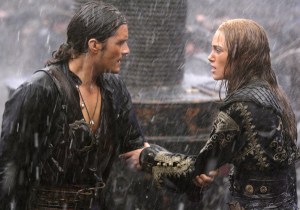 The movie is not without its due pleasures. Depp is always going to enchant with his now iconic character, but the true star of the film is Rush, who makes welcomed return. The special effects are still tops. The sequence rescuing Jack from the world of the dead provides many trippy moments that possess their own strange beauty, like when we watch the Black Pearl sail against the black, star-spotted sky. It’s fun seeing Keith Richards appear in cameo as Jack’s father and the stated inspiration for Depp’s performance. A small man and a large gun makes for one very funny sight gag. A Mexican standoff that actually involves an armed monkey is a comic high point. It’s just that all the fun or memorable moments seem to be the ones that matter the least. At World’s End still manages to do enough right to work, especially its Singapore opening. As far as a movie that upholds the quality of its franchise name, that’s a whole other matter.
Pirates of the Caribbean: At World’s End is a somewhat entertaining but heavily flawed final film to a trilogy. It’s the darkest and trippiest of the three movies, but it also makes the least amount of sense and has the least amount of action. That doesn’t seem like a good exchange in my book. There are not enough important events to justify the bloat. At World’s End has a hardcore case of butterfingers when it comes to handling plot and character setups from earlier films, and as a result almost nothing and no one ends in a satisfying fashion. The effects are still eye-popping and Depp will always be a comic treasure, but this lackluster movie feels like tripping at the end of a marathon. I had so much hope for At World’s End after how gratifying I found the other two movies but I cannot quell my disappointment. This is not a fitting conclusion. This feels more Matrix Revolutions than Return of the King. Of course it’ll make tremendous amounts of booty at the box-office, but will demand for a fourth be as rabid after this muddled and murky capper?
Nate’s Grade: B-
Share this:

Pirates of the Caribbean: The Curse of the Black Pearl (2003)
 Johnny Depp is THE MAN. But then, we already knew this. Can’t wait to see more.
Nate’s Grade: A


 nathanzoebl
You must be logged in to post a comment.